
Steganography Biswapati Jana Vidyasagar University Introduction Fig 1
Steganography Biswapati Jana Vidyasagar University
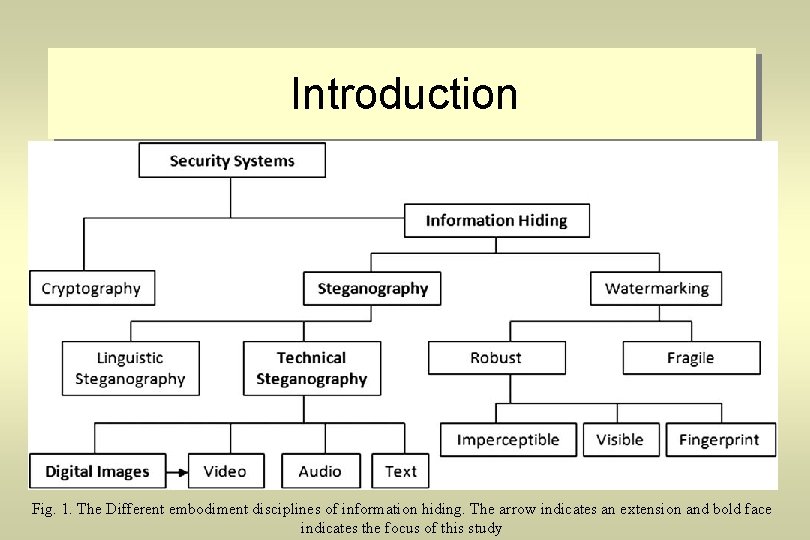
Introduction Fig. 1. The Different embodiment disciplines of information hiding. The arrow indicates an extension and bold face indicates the focus of this study

Why not Encryption? Confidentiality Steganography Encryption (hide existence of the secret message, (encrypt the message, but do not hide the message) but do not use encryption) • Ideally nobody can see both parties are secretly communicating. • Anybody can see both parties are communicating in secret. • Innocent. • Suspicious.
Steganography Three techniques are interlinked, steganography, watermarking and cryptography. The first two are quite difficult to tease apart especially for those coming from different disciplines. Fig. 1 may eradicate such confusion.
Steganography can be split into two main categories: 1. Statistics-aware steganography 2. Model-based steganography Each of these categories aims to preserve the qualities of the original cover Work, with the logic that it will be hard to detect steganography in suspect Work that is identical to an innocent Work.
Statistics/Model-based steganography Statistics-aware steganography considers the statistical techniques that steganalysts are known to use to detect steganography. With these techniques in mind, the steganographic system is developed in such a way that none of these attacks will prove successful. In other words, the stegogramme that is produced after embedding a secret message will be statistically sound. Model-based steganography considers the preservation of a chosen model of the cover Works, rather than its statistics. This framework measures the components of a cover Work that do not change after embedding, against the components that change as a result of embedding. The resulting task is to develop a steganographic system that ensures the values that change are as minimal as possible.

Basic Principle in Steganography Secret Image Cover Image Secret Image Stego Object Encoder Key Decoder Communications Channel Original Cover
Types of Steganography • Fragile – Hidden information destroyed as soon as object is modified. – Protocols tend to be easy to implement. – Useful in proving objects have not been manipulated and changed e. g. evidence in a court of law. • Robust – It should be infeasible to remove the hidden data without degrading the perceived quality of the data. – Protocols are more complex. – One single protocol may not withstand all object manipulations. – Useful in copyright watermarking.
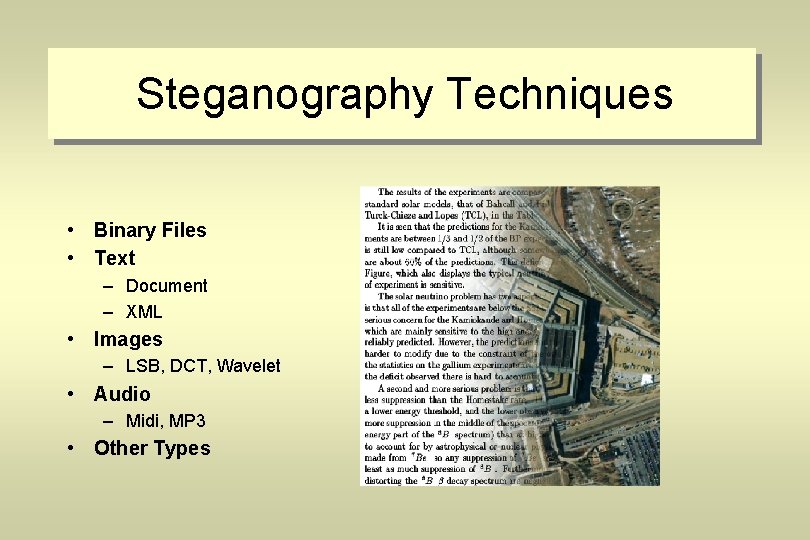
Steganography Techniques • Binary Files • Text – Document – XML • Images – LSB, DCT, Wavelet • Audio – Midi, MP 3 • Other Types
What is Steganalysis? Steganalysis is the art of identifying stegogrammes that contain a secret message. Steganalysis does not however consider the successful extraction of the message, this is usually a requirement for cryptanalysis.
How is Steganalysis Used? Steganalysis is an extremely difficult science, as it relies on insecure steganography. If steganography is to be successful, it should leave no indication that a secret message exists. Jessica Fridrich suggests that "the ability to detect secret messages in images is related to the message length". This statement is based on the logic that a small message embedded within a large carrier will result in a small percentage of manipulations, and therefore it will be much harder to spot any artefacts within the stegogramme.
The success of steganalysis also depends on what information the steganalyst has to work from. There are two main classifications of steganography - targeted, and blind. Targeted steganalysis works when a method designed for identifying a specific steganographic algorithm has been developed. For example, embedding within pixel values leaves patterns that can be searched for with suspicious files. If the steganalyst is sure that covert communications are taking place, and also knows of a possible method for how a secret message can be embedded, then it should be a fairly trivial task to summarise if the file contains this type of steganography or not.
Blind steganalysis on the other hand is a much harder task, and means that the steganalyst has no reason to believe that covert communications is taking place. In this case, a set of algorithms are typically developed in order to check for signs of tampering. If some signs of tampering are flagged by the algorithms, then it is likely that the suspect file contains steganography
A good steganographic image Perceptability--The stegogramme that is produced after embedding a secret message, should not be altered such that it is visually obvious that information has been embedded. In fact, the resulting image should be so similar to the original that if you compare both side by side, you should not be able to see any difference at all between the two Capacity--The amount of information that is embedded should be as small as possible. Logic suggests that the longer the message, the more the image has to be altered to compensate for this. Obviously, the more a Work is modified, the easier it is for the steganalyst to discover artifacts within an image. Therefore, the usual practice for embedding is to make the message as short as possible so that the image is altered as little as possible
A good steganographic image Robustness-- This refers to the degree of difficulty required by a steganalyst to determine whether or not the image contains a hidden message or not. A good implementation of steganography would be one where the image can be subjected to many attacks that each prove inconclusive Christy A. Stanley suggests that another important property of steganography is speed, where information should be embedded as quickly as possible. However, it is generally considered that this is not as important as those properties that have been outlined. Speed is really more of a constraint than a key principle of steganography.
A good steganographic Algorithm If a steganographic algorithm can fulfil these three principles, then the resulting image will highly likely reach its recipient undetected, meaning a successful implementation of steganography has been developed.
Steganalysis Nomenclature In fact, the role of the steganalyst can be defined in three categories passive, active, and malicious. Passive steganalysts intercept a Work as it is passed through the communications channel, and then tests it to identify whether it contains a secret message or not. If no secret message is detected, the Work will be allowed to continue through the communications channel. However, if a secret message is detected, the steganalyst will block the transmission and Bob will not receive the secret message. However, the fact that Bob does not receive the message he was waiting for may lead him to suspect that a steganalyst has successfully broken the communication, and therefore they will often change the algorithm and resend the message again
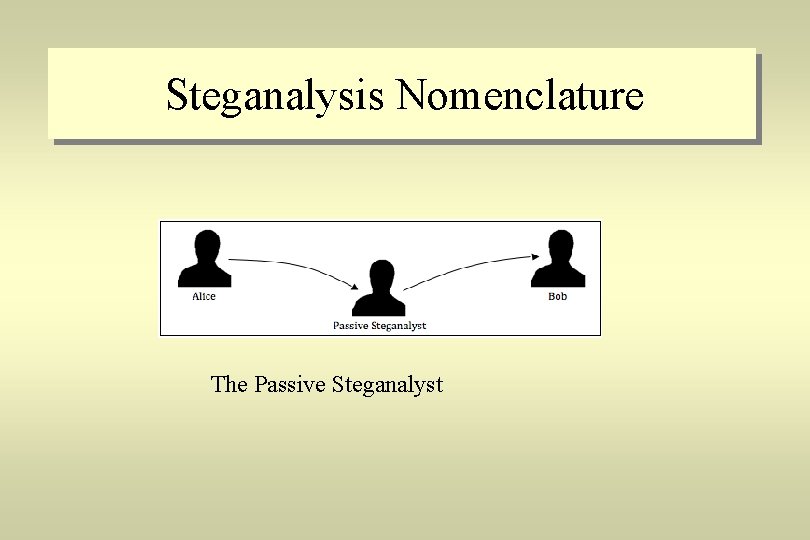
Steganalysis Nomenclature The Passive Steganalyst
Steganalysis Nomenclature An active steganalyst differs from a passive steganalyst because if the existence of a secret message is found, the active warden would modify the Work such that the integrity of the message is broken. This modification may be achieved by compressing the image in the hope that some important pixel values alter the secret message data. Most steganographic techniques assume a passive steganalyst, and therefore the stegogramme is not designed to survive modifications such as these. With this method, Bob will still receive the Work, but when he extracts the message he will find it does not make sense.
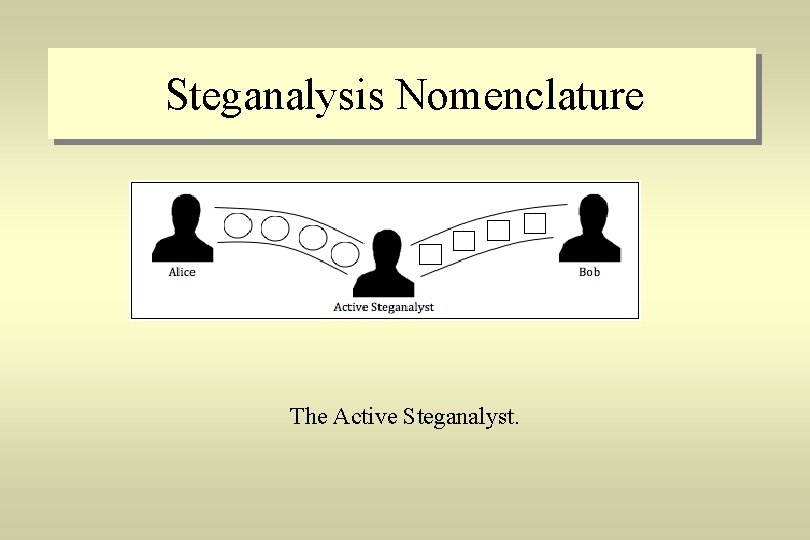
Steganalysis Nomenclature The Active Steganalyst.
Steganalysis Nomenclature A mailicious steganalyst will analyse the Work sent between Alice and Bob to determine if it contains a hidden message. If it does, they will then try and work out how the message was embedded such that they can then impersonate Alice and send their own messages to Bob. However, this method is about much more than just detecting whether or not a secret message is embedded within a Work. For this reason, it is very rare for a steganalyst to carry these traits.
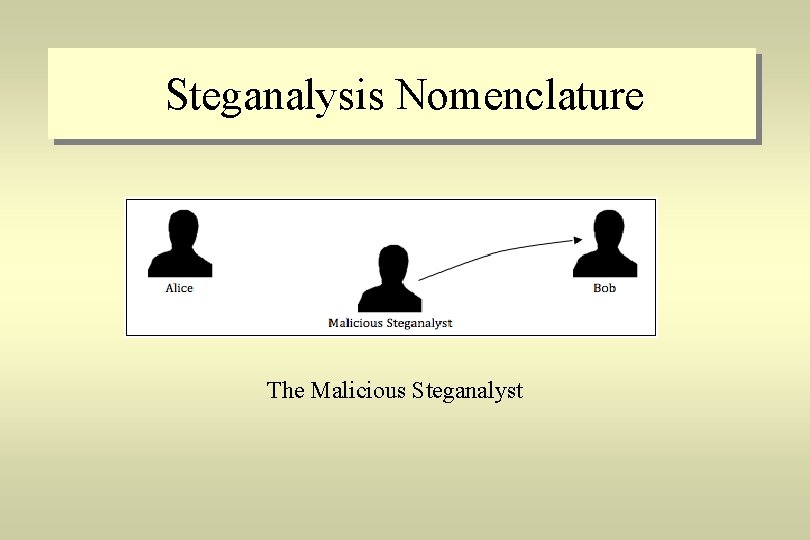
Steganalysis Nomenclature The Malicious Steganalyst

Evaluative Metrics When evaluating the success or failure of steganalysis algorithms, they are often classified based on how many stegogrammes are successfully identified, and how many pass through undetected. The terms falsenegatives and false-positives are used to express this. False-negatives refer to the amount of stegogrammes that are not detected when applying the steganalysis algorithm. In other words, it expresses an indication of how reliable the algorithm is. If there are many false-positives, then the algorithm should not be depended on for filtering steganographic content. The term false-positive means the exact opposite, where the algorithm deems innocent Works to be stegogrammes.
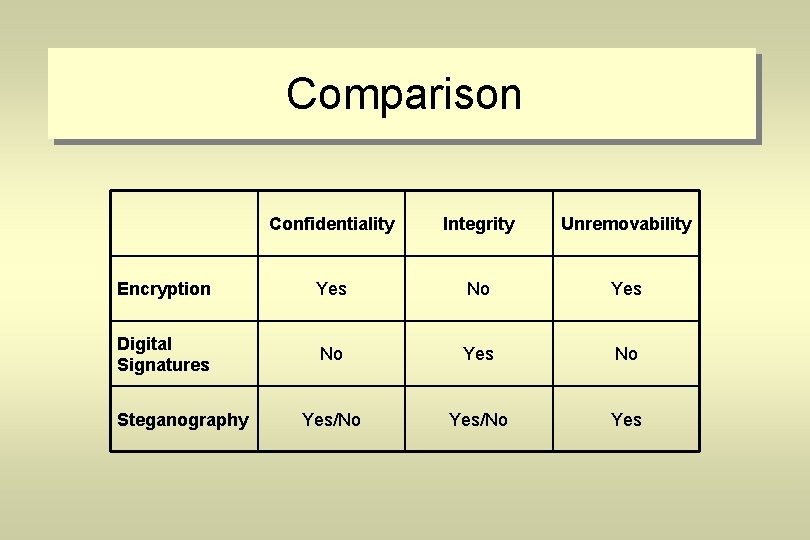
Comparison Confidentiality Integrity Unremovability Encryption Yes No Yes Digital Signatures No Yes/No Yes Steganography
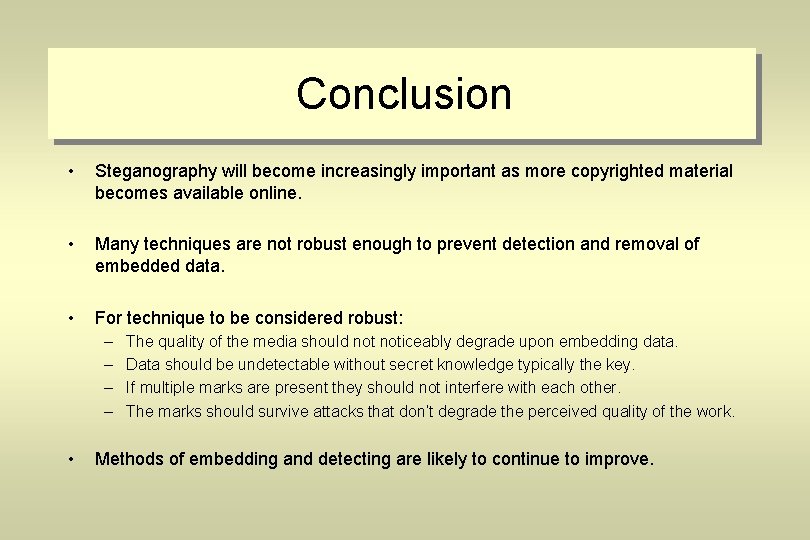
Conclusion • Steganography will become increasingly important as more copyrighted material becomes available online. • Many techniques are not robust enough to prevent detection and removal of embedded data. • For technique to be considered robust: – – • The quality of the media should noticeably degrade upon embedding data. Data should be undetectable without secret knowledge typically the key. If multiple marks are present they should not interfere with each other. The marks should survive attacks that don’t degrade the perceived quality of the work. Methods of embedding and detecting are likely to continue to improve.

Questions
- Slides: 26