
Stefano Profumo Santa Cruz Institute for Particle Physics









- Slides: 64
Stefano Profumo Santa Cruz Institute for Particle Physics University of California, Santa Cruz Opportunities for dark matter searches with extremely large telescopes Shedding Light On The Dark Universe With ELTs ICTP, Trieste, Italy, Wednesday, July 4, 2018
Dark Matter most convincing evidence for a a new elementary particle
what is an elementary particle?
what is an elementary particle? an irreducible, unitary representation of the Poincaré Group
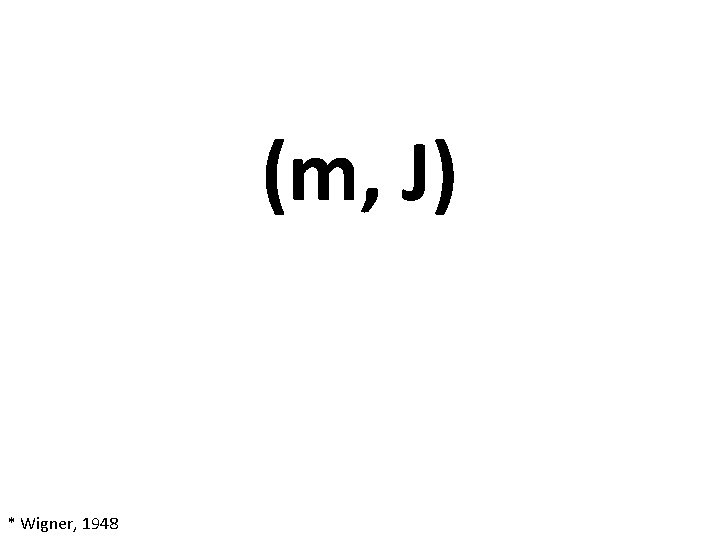
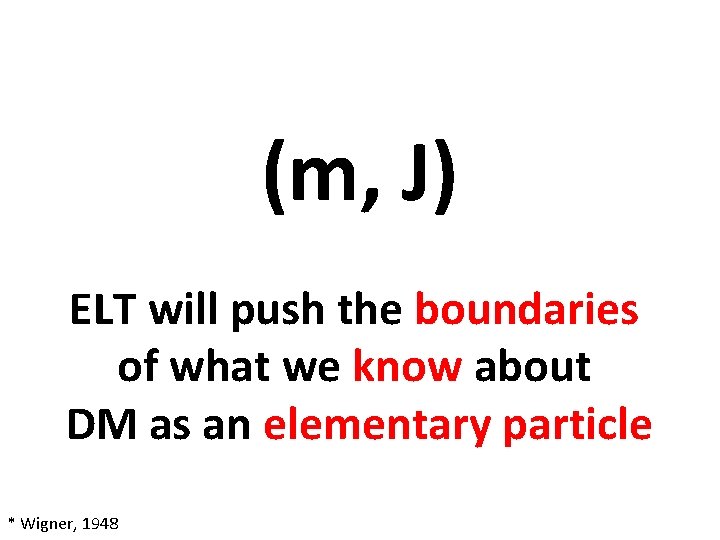
(m, J) * Wigner, 1948
(m, J) ELT will push the boundaries of what we know about DM as an elementary particle * Wigner, 1948
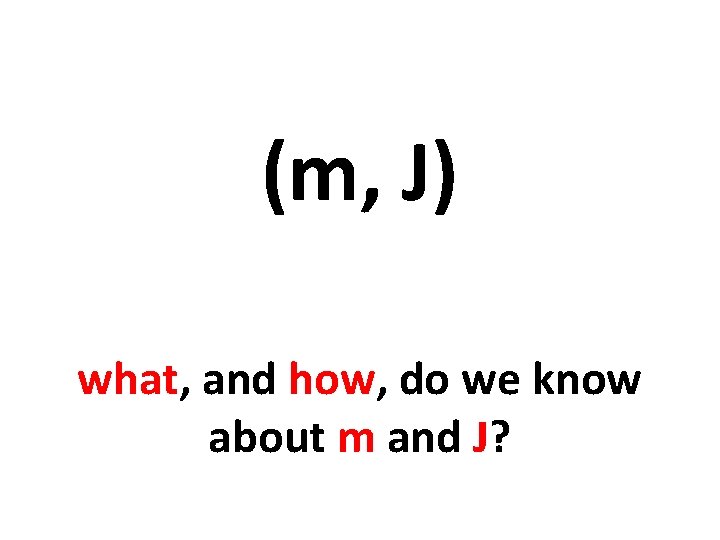
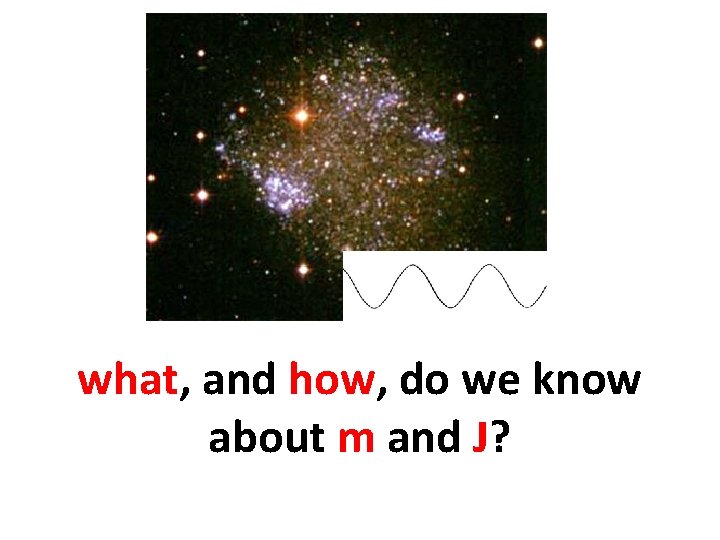
(m, J) what, and how, do we know about m and J?
what, and how, do we know about m and J?
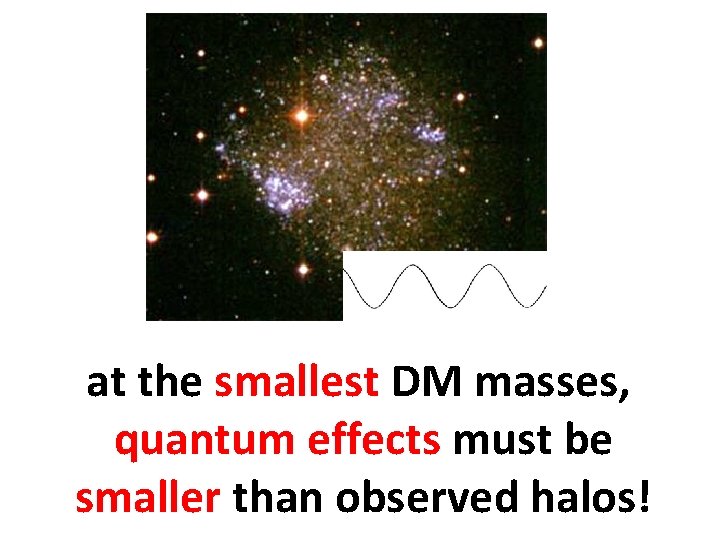
at the smallest DM masses, quantum effects must be smaller than observed halos!
(more positive spin): DM quantum effects could be detectable from precision halo measurements
l. DB = h/(m. DMv) ~ 1 kpc l. DB = 0. 3 cm (1 e. V/m. DM) < 3 x 1021 cm
m. DM>10 -22 e. V (Viel, Blum, …) l. DB = 0. 3 cm (1 e. V/m. DM) < 3 x 1021 cm
-22 ~10 m. DM e. V …DM particles of that mass will imprint signatures on small halos
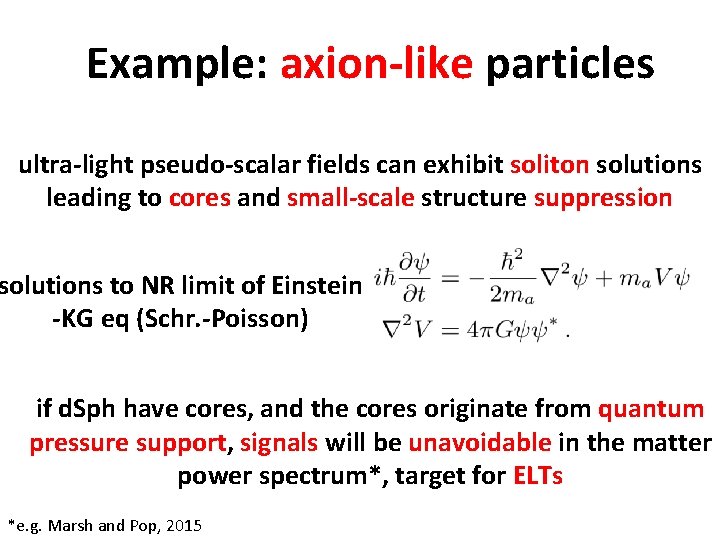
Example: axion-like particles ultra-light pseudo-scalar fields can exhibit soliton solutions leading to cores and small-scale structure suppression solutions to NR limit of Einstein -KG eq (Schr. -Poisson) if d. Sph have cores, and the cores originate from quantum pressure support, signals will be unavoidable in the matter power spectrum*, target for ELTs *e. g. Marsh and Pop, 2015
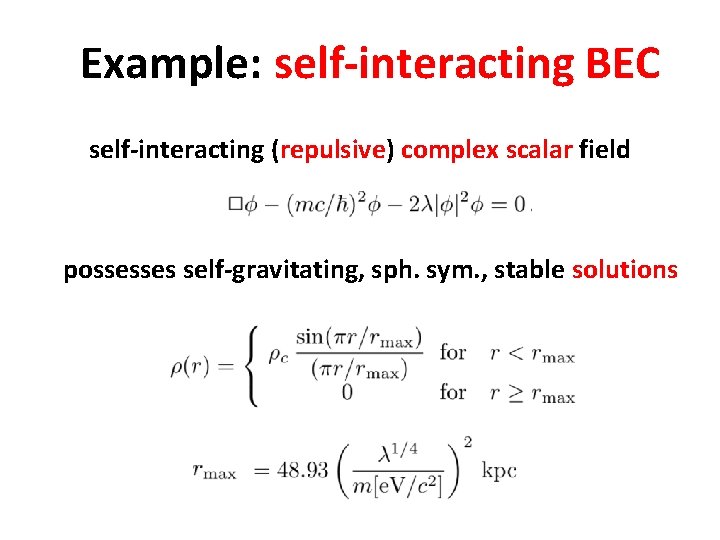
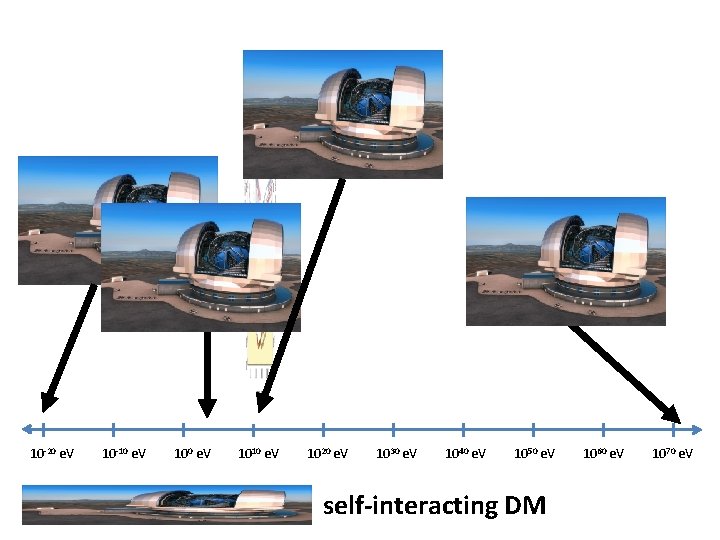
Example: self-interacting BEC self-interacting (repulsive) complex scalar field possesses self-gravitating, sph. sym. , stable solutions
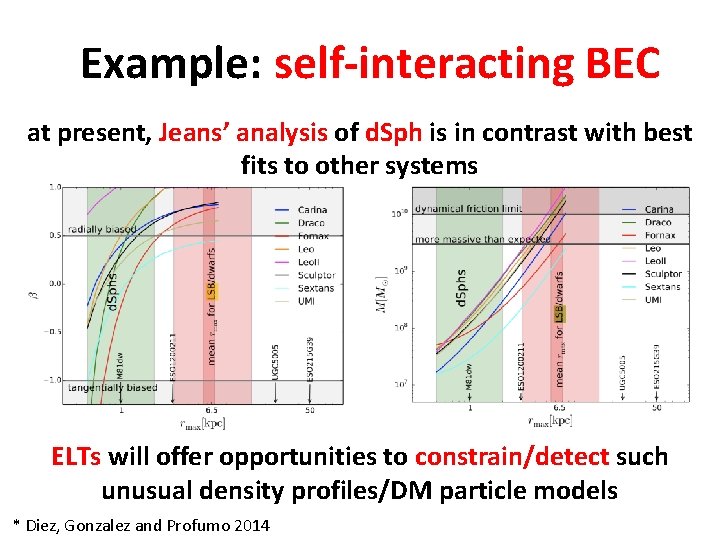
Example: self-interacting BEC at present, Jeans’ analysis of d. Sph is in contrast with best fits to other systems ELTs will offer opportunities to constrain/detect such unusual density profiles/DM particle models * Diez, Gonzalez and Profumo 2014
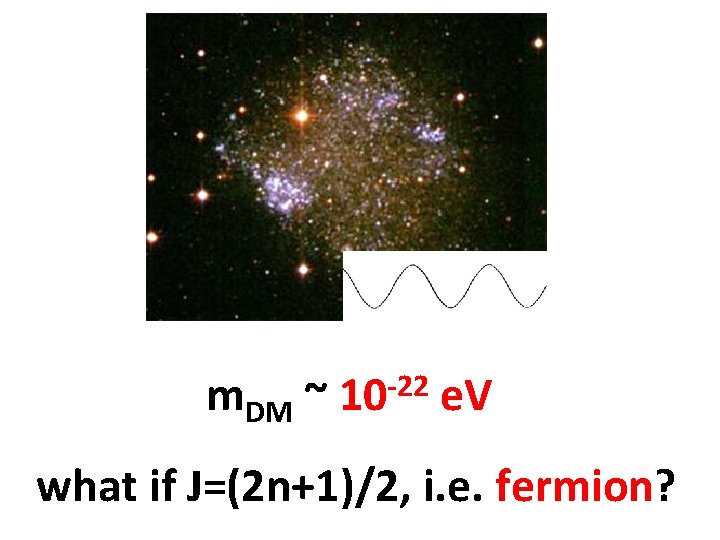
m. DM ~ -22 10 e. V what if J=(2 n+1)/2, i. e. fermion?
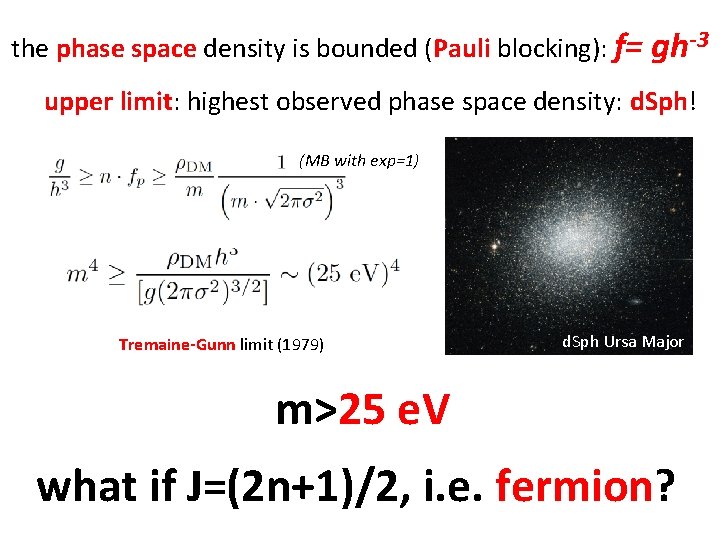
the phase space density is bounded (Pauli blocking): f= gh-3 upper limit: highest observed phase space density: d. Sph! (MB with exp=1) Tremaine-Gunn limit (1979) d. Sph Ursa Major m>25 e. V what if J=(2 n+1)/2, i. e. fermion?
…depending on the details of the production mechanism, light fermions affect structure up to masses of a few ke. V (e. g. Viel+) interestingly, these particles can be directly detected if they are meta-stable, with X-ray telescopes, offering future complementary X-ray-ELT synergies in DM searches a recent story shows how close we might be to discovering the particle nature of dark matter after all!
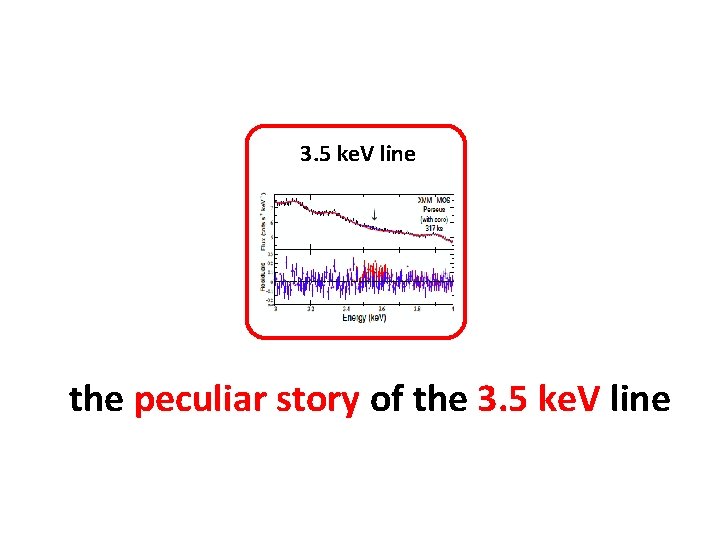
3. 5 ke. V line the peculiar story of the 3. 5 ke. V line
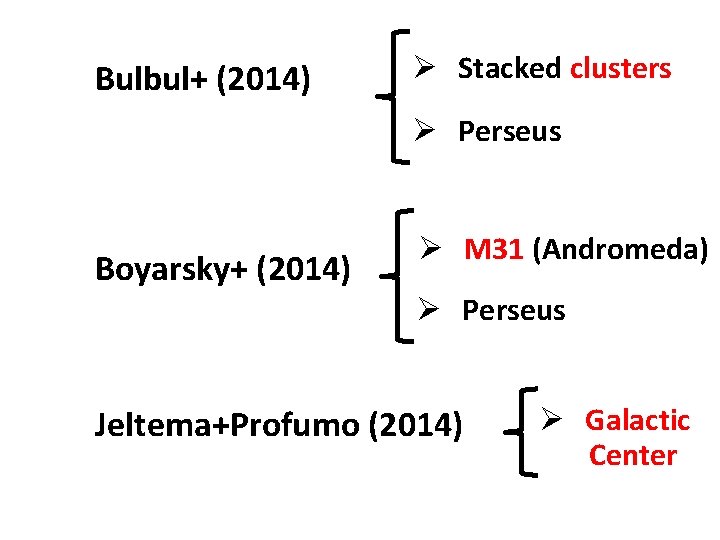
Bulbul+ (2014) Ø Stacked clusters Ø Perseus Boyarsky+ (2014) Ø M 31 (Andromeda) Ø Perseus Jeltema+Profumo (2014) Ø Galactic Center
X-ray lines predicted from sterile neutrinos • SU(2)L gauge singlet, but (small) mixing angle qa with active neutrinos • Viable DM candidates (Dodelson-Woodrow production; “warm” DM) • Possibly connected with baryogenesis (n. MSM) • Would decay via mixing with active neutrinos 3. 5 ke. V lines (roughly) compatible with this!
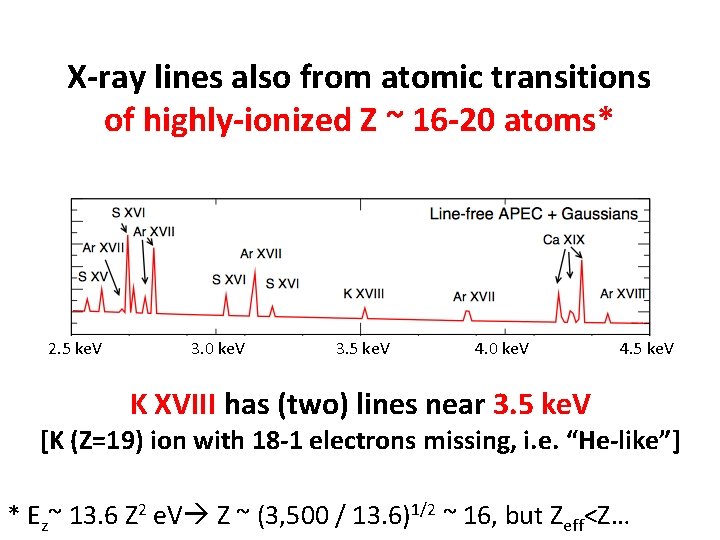
X-ray lines also from atomic transitions of highly-ionized Z ~ 16 -20 atoms* 2. 5 ke. V 3. 0 ke. V 3. 5 ke. V 4. 0 ke. V 4. 5 ke. V K XVIII has (two) lines near 3. 5 ke. V [K (Z=19) ion with 18 -1 electrons missing, i. e. “He-like”] * Ez~ 13. 6 Z 2 e. V Z ~ (3, 500 / 13. 6)1/2 ~ 16, but Zeff<Z…
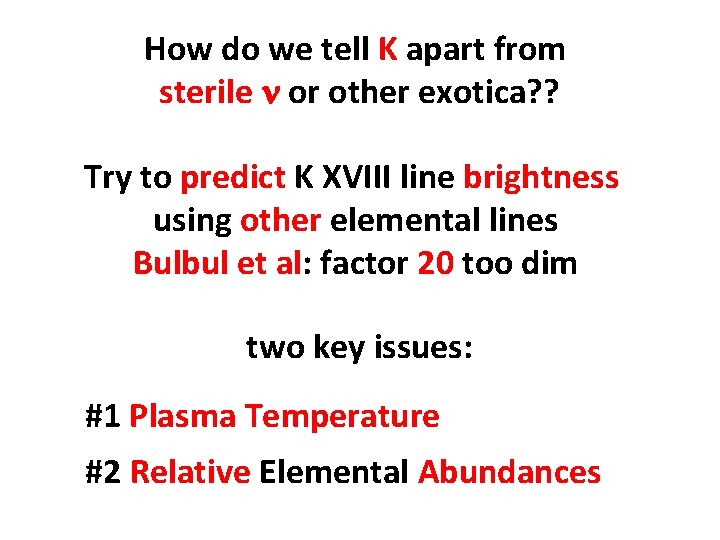
How do we tell K apart from sterile n or other exotica? ? Try to predict K XVIII line brightness using other elemental lines Bulbul et al: factor 20 too dim two key issues: #1 Plasma Temperature #2 Relative Elemental Abundances
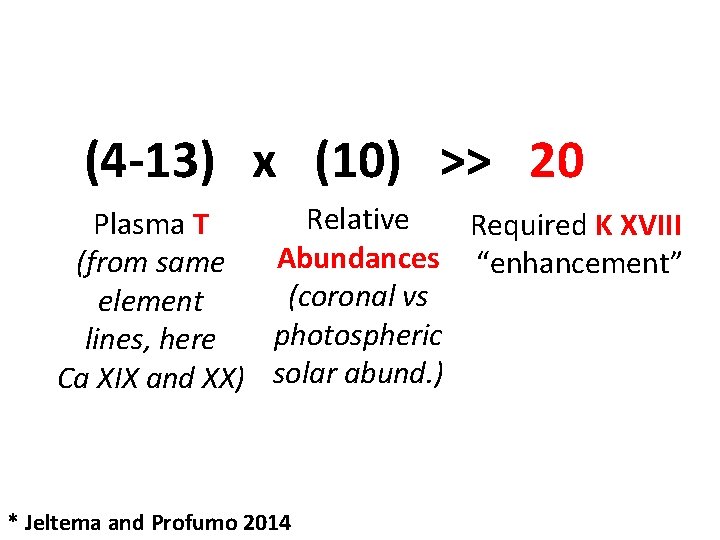
(4 -13) x (10) >> 20 Relative Plasma T Required K XVIII Abundances “enhancement” (from same (coronal vs element photospheric lines, here Ca XIX and XX) solar abund. ) * Jeltema and Profumo 2014
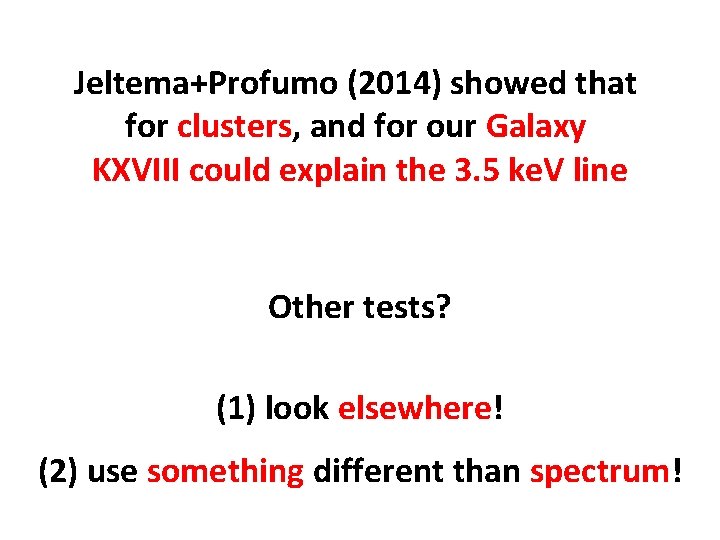
Jeltema+Profumo (2014) showed that for clusters, and for our Galaxy KXVIII could explain the 3. 5 ke. V line Other tests? (1) look elsewhere! (2) use something different than spectrum!
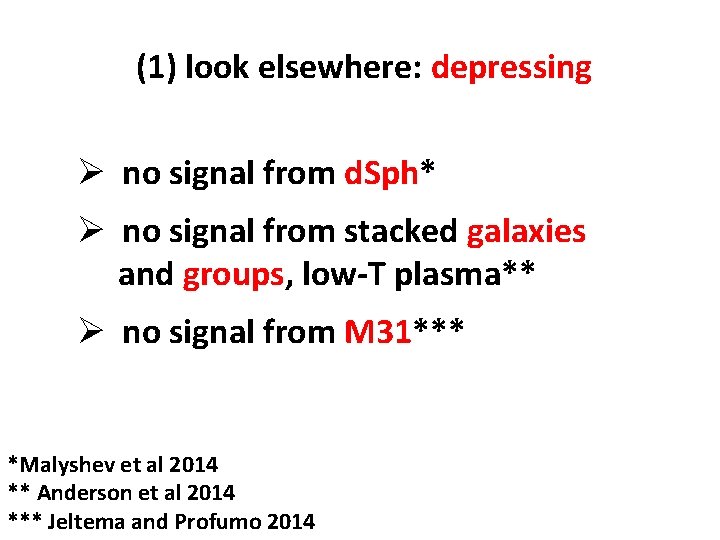
(1) look elsewhere: depressing Ø no signal from d. Sph* Ø no signal from stacked galaxies and groups, low-T plasma** Ø no signal from M 31*** *Malyshev et al 2014 ** Anderson et al 2014 *** Jeltema and Profumo 2014
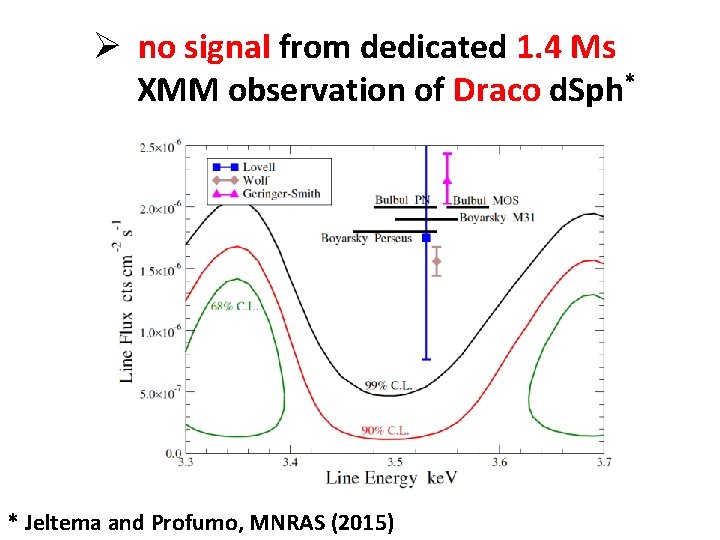
Ø no signal from dedicated 1. 4 Ms XMM observation of Draco d. Sph* * Jeltema and Profumo, MNRAS (2015)
Ø no signal from dedicated 1. 4 Ms XMM observation of Draco d. Sph* An example of a zealous Referee: “Finally, I would like to let you know that, after I was asked to referee this paper, I decided to download the data and examine the spectrum myself. I largely agree with your conclusions regarding the absence of a notable feature at ~3. 5 ke. V, as well as your limits on the line flux in this region. ” * Jeltema and Profumo, MNRAS (2015)
#2 use something different than spectrum! Morphology! Look at where the 3. 5 ke. V photons come from! conclusively similar to other plasma lines, via scanning window template analysis (Carlson, Jeltema & Profumo 2015)
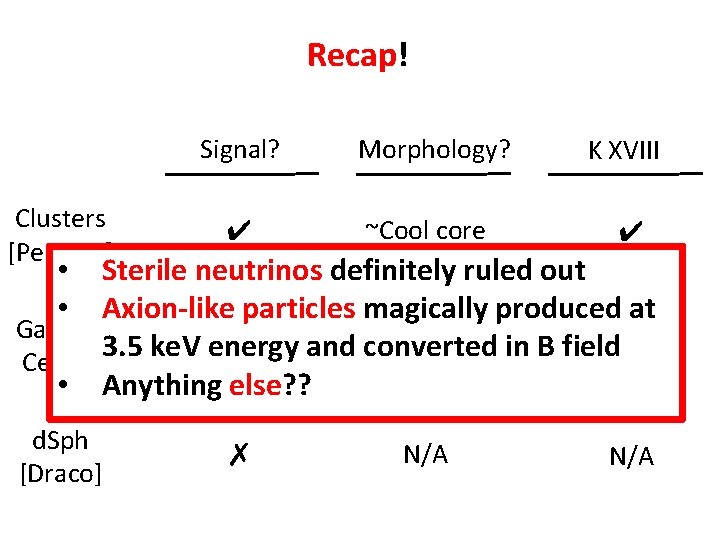
Recap! Signal? Clusters [Perseus] ✔ d. Sph [Draco] ✗ Morphology? ~Cool core K XVIII ✔ Sterile neutrinos definitely ruled out Axion-like particles magically produced at Galactic ~Bulge in B field✔ ✔ 3. 5 ke. V energy and converted Center • Anything else? ? • • N/A
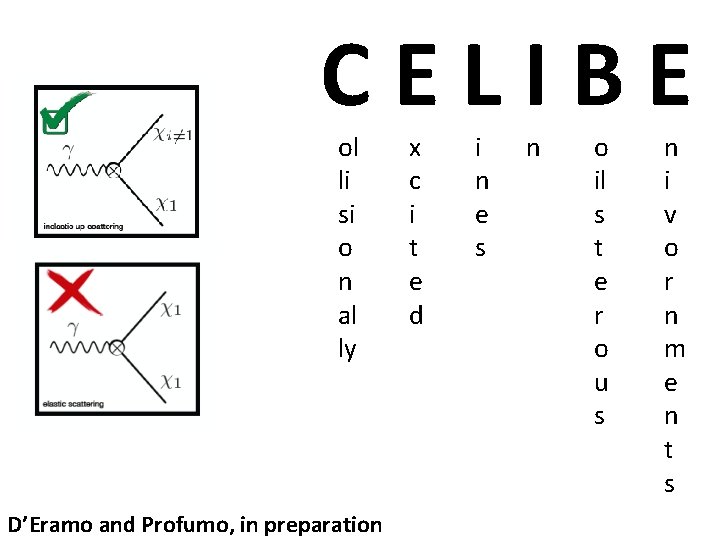
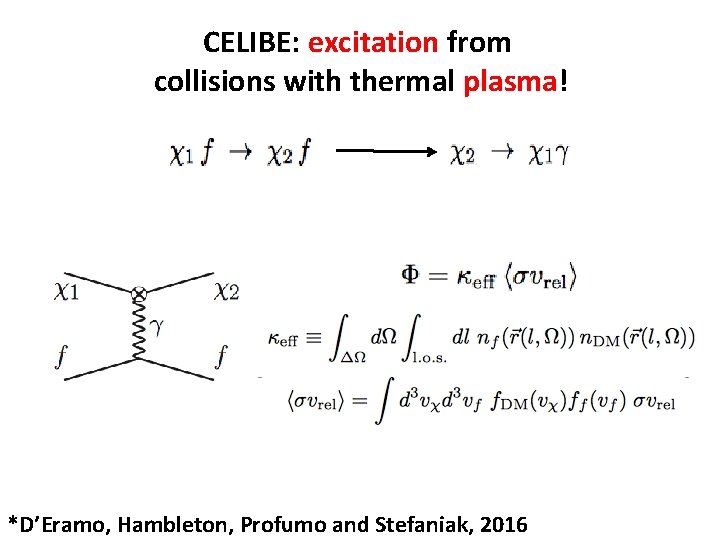
CELIBE ol li si o n al ly D’Eramo and Profumo, in preparation x c i t e d i n e s n o il s t e r o u s n i v o r n m e n t s
CELIBE: excitation from collisions with thermal plasma! *D’Eramo, Hambleton, Profumo and Stefaniak, 2016
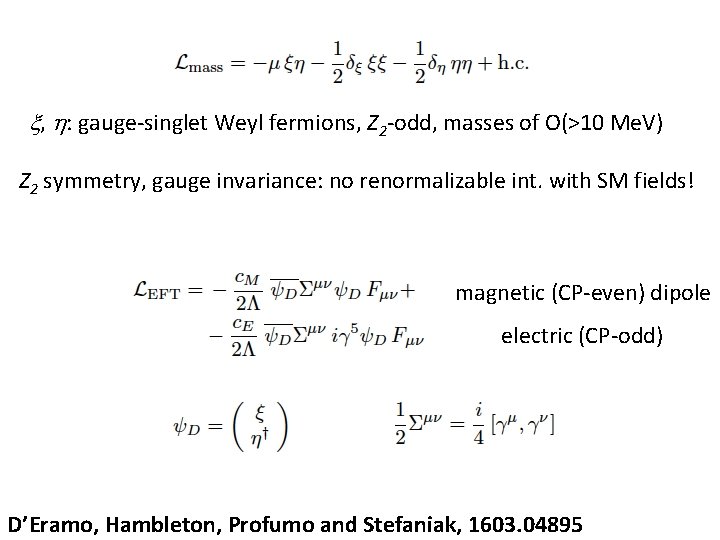
x, h: gauge-singlet Weyl fermions, Z 2 -odd, masses of O(>10 Me. V) Z 2 symmetry, gauge invariance: no renormalizable int. with SM fields! magnetic (CP-even) dipole electric (CP-odd) D’Eramo, Hambleton, Profumo and Stefaniak, 1603. 04895
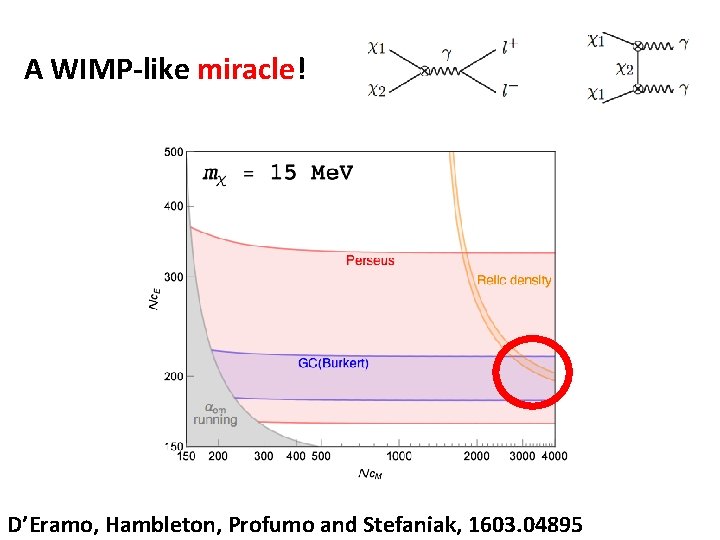
A WIMP-like miracle! D’Eramo, Hambleton, Profumo and Stefaniak, 1603. 04895
A highly falsifiable scenario • Line Shape – geometric average of thermal, DM velocities (could have been resolved by Hitomi/Astro-H)
A highly falsifiable scenario • Line Shape – geometric average of thermal, DM velocities (could have been resolved by Hitomi/Astro-H) • Unique morphology • Unique target-dependence • Lines could appear anywhere from e. V (visible) to UV, to X-ray
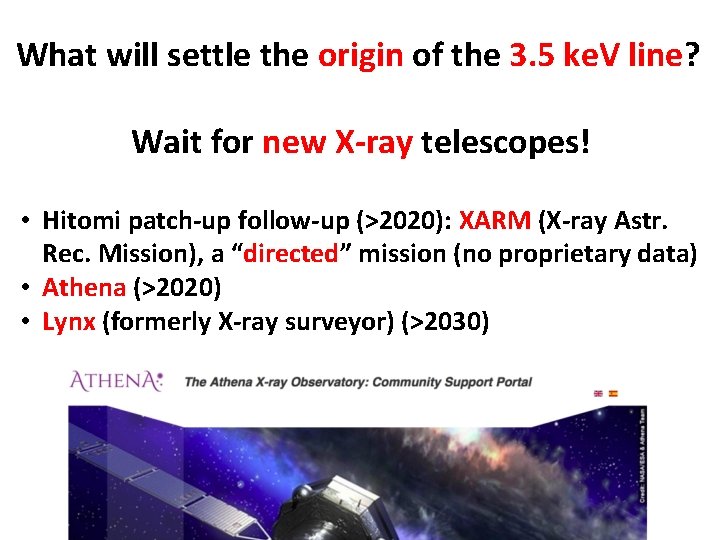
What will settle the origin of the 3. 5 ke. V line? Wait for new X-ray telescopes! • Hitomi patch-up follow-up (>2020): XARM (X-ray Astr. Rec. Mission), a “directed” mission (no proprietary data) • Athena (>2020) • Lynx (formerly X-ray surveyor) (>2030)
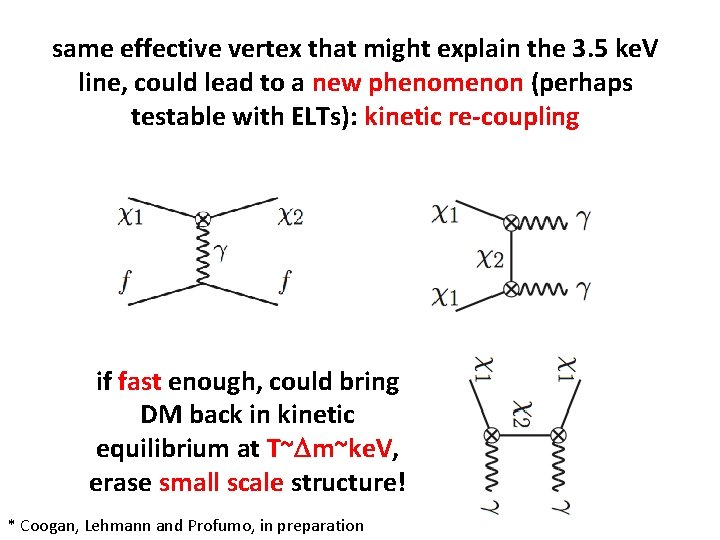
same effective vertex that might explain the 3. 5 ke. V line, could lead to a new phenomenon (perhaps testable with ELTs): kinetic re-coupling if fast enough, could bring DM back in kinetic equilibrium at T~Dm~ke. V, erase small scale structure! * Coogan, Lehmann and Profumo, in preparation
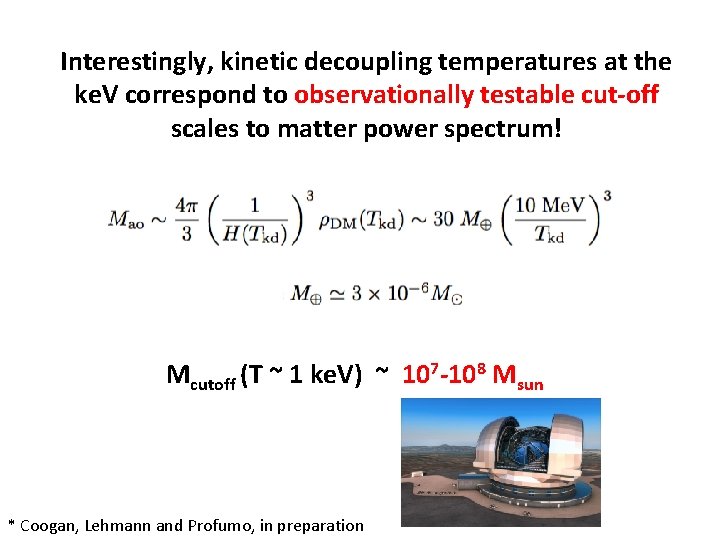
Interestingly, kinetic decoupling temperatures at the ke. V correspond to observationally testable cut-off scales to matter power spectrum! Mcutoff (T ~ 1 ke. V) ~ 107 -108 Msun * Coogan, Lehmann and Profumo, in preparation
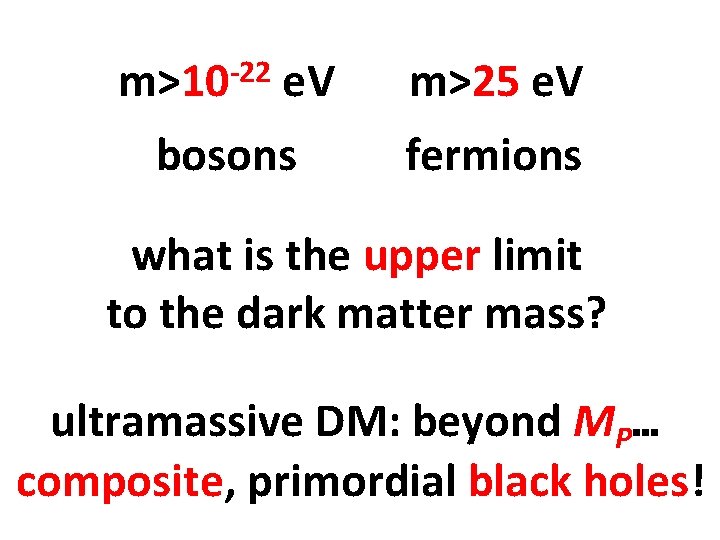
-22 m>10 e. V bosons m>25 e. V fermions what is the upper limit to the dark matter mass? ultramassive DM: beyond MP… composite, primordial black holes!
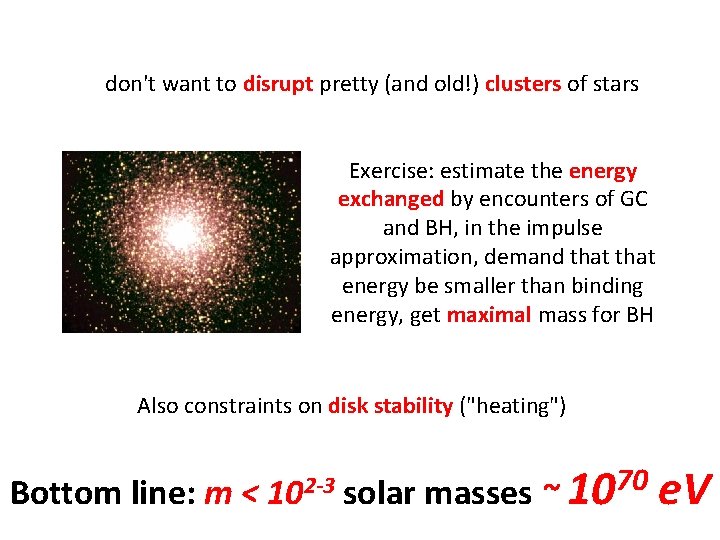
don't want to disrupt pretty (and old!) clusters of stars Exercise: estimate the energy exchanged by encounters of GC and BH, in the impulse approximation, demand that energy be smaller than binding energy, get maximal mass for BH Also constraints on disk stability ("heating") Bottom line: m < 102 -3 70 solar masses ~ 10 e. V
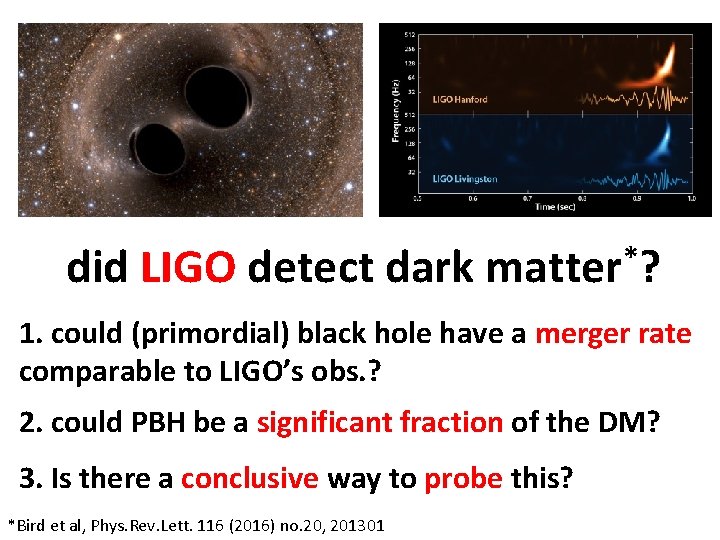
did LIGO detect dark * matter ? 1. could (primordial) black hole have a merger rate comparable to LIGO’s obs. ? 2. could PBH be a significant fraction of the DM? 3. Is there a conclusive way to probe this? *Bird et al, Phys. Rev. Lett. 116 (2016) no. 20, 201301
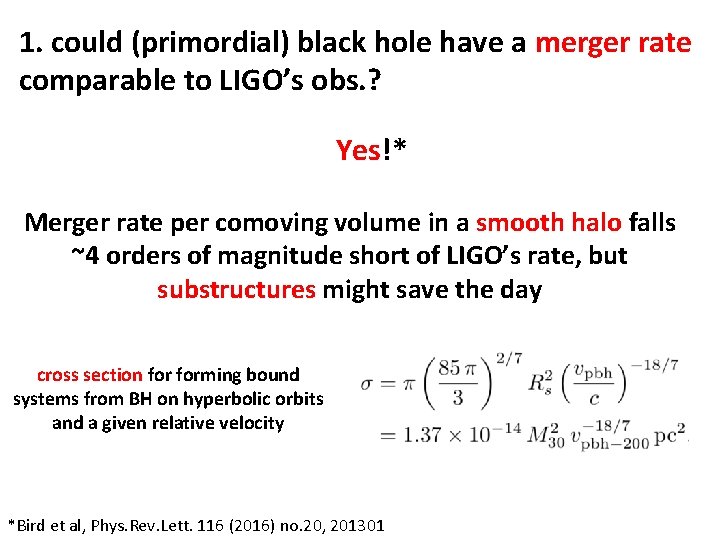
1. could (primordial) black hole have a merger rate comparable to LIGO’s obs. ? Yes!* Merger rate per comoving volume in a smooth halo falls ~4 orders of magnitude short of LIGO’s rate, but substructures might save the day cross section forming bound systems from BH on hyperbolic orbits and a given relative velocity *Bird et al, Phys. Rev. Lett. 116 (2016) no. 20, 201301
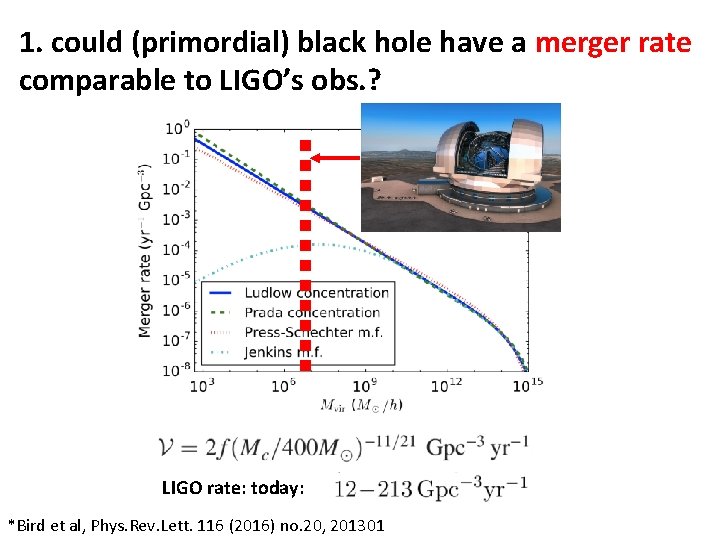
1. could (primordial) black hole have a merger rate comparable to LIGO’s obs. ? LIGO rate: today: *Bird et al, Phys. Rev. Lett. 116 (2016) no. 20, 201301
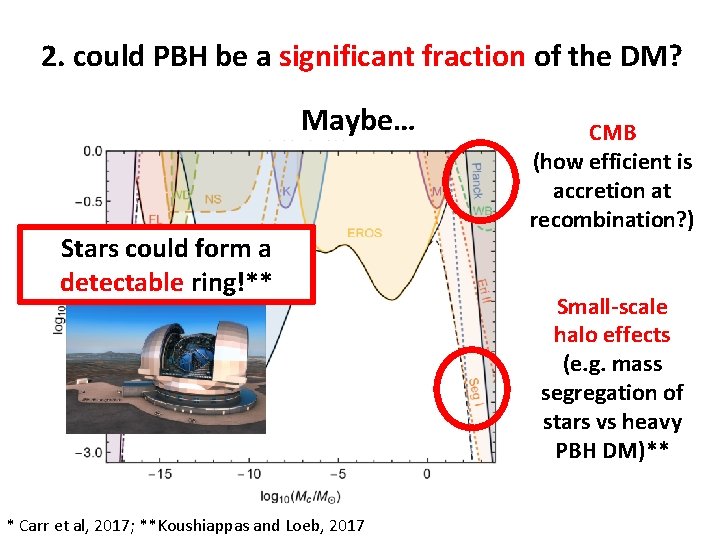
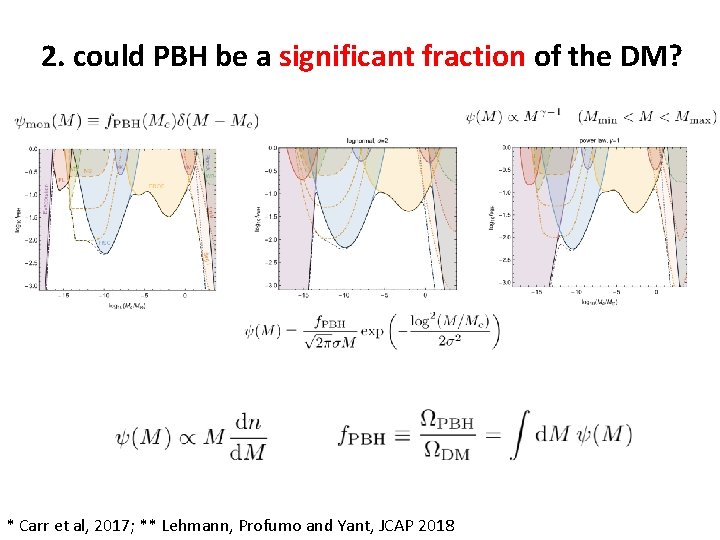
2. could PBH be a significant fraction of the DM? Maybe… Stars could form a detectable ring!** * Carr et al, 2017; **Koushiappas and Loeb, 2017 CMB (how efficient is accretion at recombination? ) Small-scale halo effects (e. g. mass segregation of stars vs heavy PBH DM)**
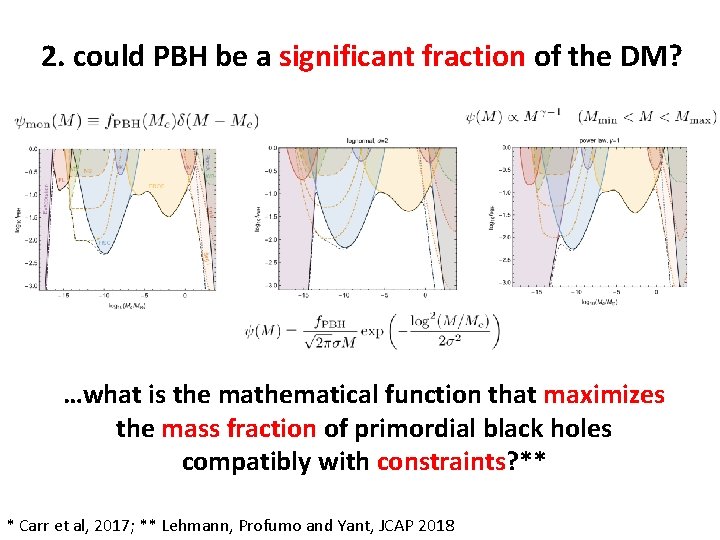
2. could PBH be a significant fraction of the DM? * Carr et al, 2017; ** Lehmann, Profumo and Yant, JCAP 2018
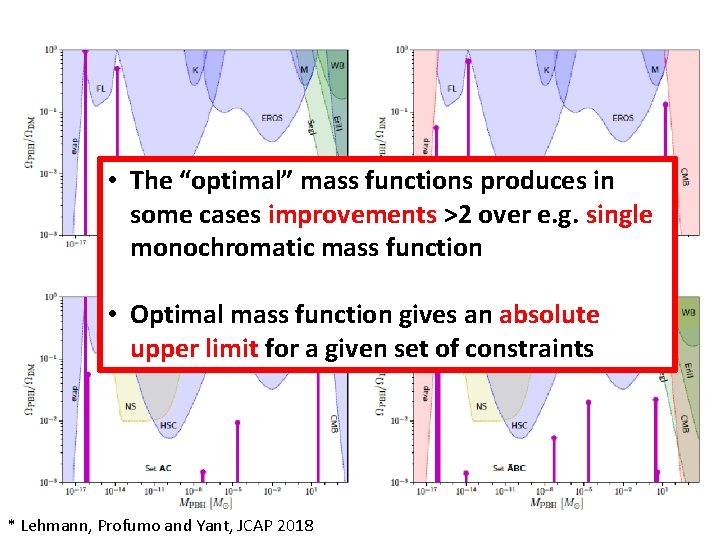
2. could PBH be a significant fraction of the DM? …what is the mathematical function that maximizes the mass fraction of primordial black holes compatibly with constraints? ** * Carr et al, 2017; ** Lehmann, Profumo and Yant, JCAP 2018
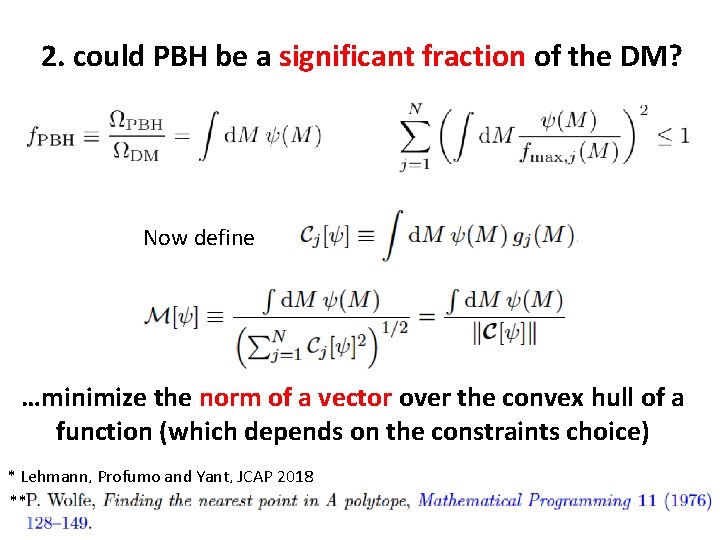
2. could PBH be a significant fraction of the DM? Now define …minimize the norm of a vector over the convex hull of a function (which depends on the constraints choice) * Lehmann, Profumo and Yant, JCAP 2018 **
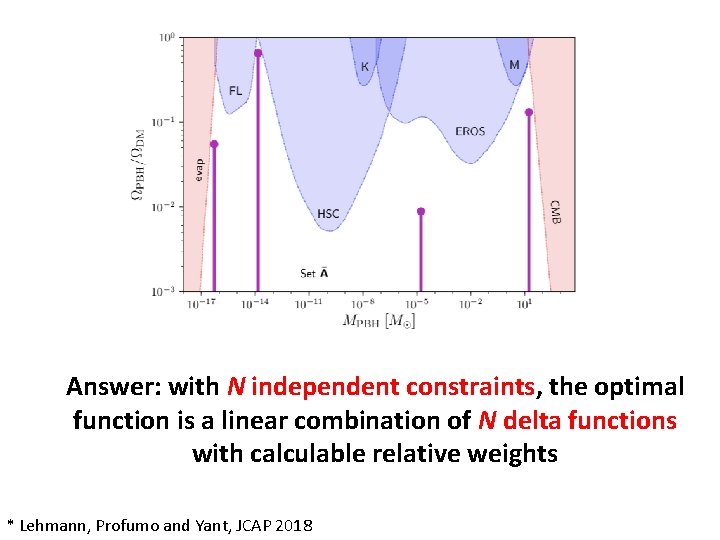
Answer: with N independent constraints, the optimal function is a linear combination of N delta functions with calculable relative weights * Lehmann, Profumo and Yant, JCAP 2018
• The “optimal” mass functions produces in some cases improvements >2 over e. g. single monochromatic mass function • Optimal mass function gives an absolute upper limit for a given set of constraints * Lehmann, Profumo and Yant, JCAP 2018
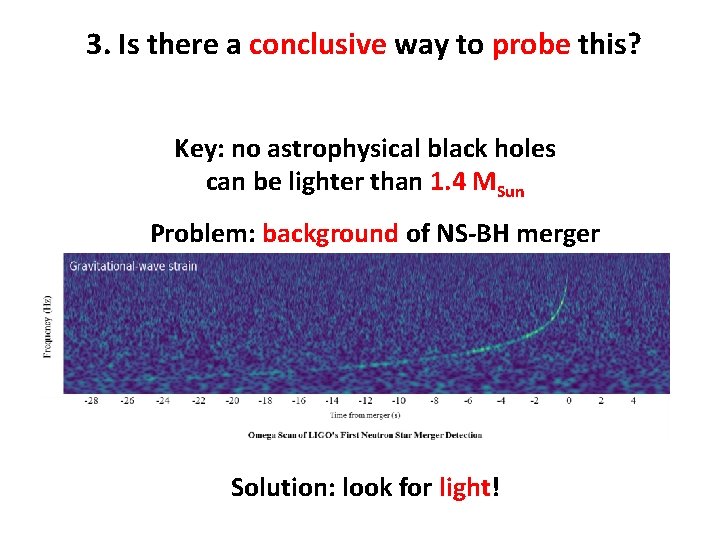
3. Is there a conclusive way to probe this? Key: no astrophysical black holes can be lighter than 1. 4 MSun Problem: background of NS-BH merger Solution: look for light!
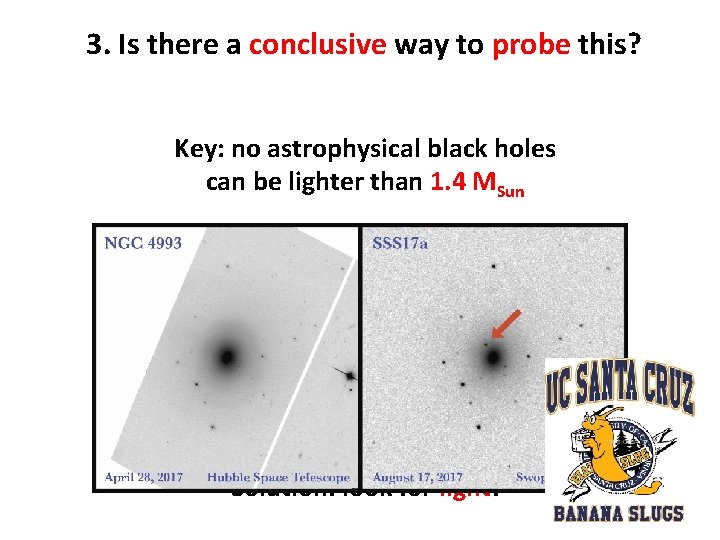
3. Is there a conclusive way to probe this? Key: no astrophysical black holes can be lighter than 1. 4 MSun Problem: background of NS-BH merger Solution: look for light!
3. Is there a conclusive way to probe this? for a given mass function, rate of sub-solar mass BH-BH mergers is calculable Again, an “optimal” mass function will given an absolute upper limit to the sub-Msun BH-BH merger rate * Lehmann, Profumo and Yant, in preparation
ELT’s Mass imaging capabilities will allow synergies with other ways to detect DM as a particle: cosmic-ray electron-positrons (e+e-) Example: a long-standing DM “discovery” claim: the anomalous positron fraction, and a more recent claim: the DAMPE excess
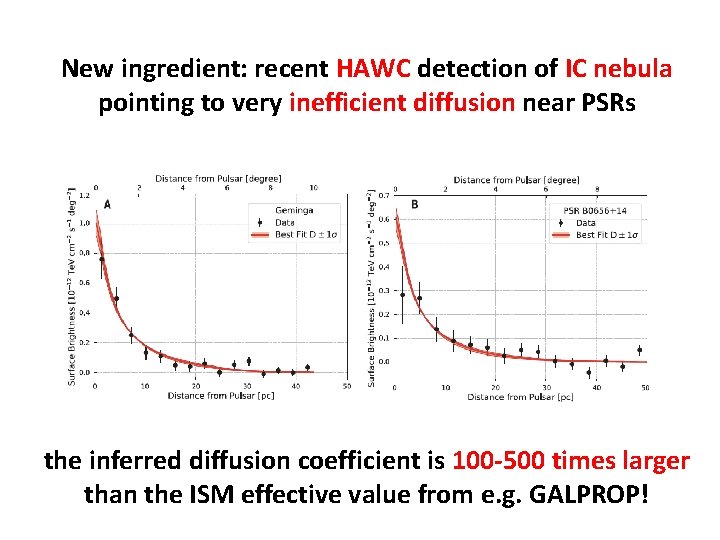
New ingredient: recent HAWC detection of IC nebula pointing to very inefficient diffusion near PSRs the inferred diffusion coefficient is 100 -500 times larger than the ISM effective value from e. g. GALPROP!
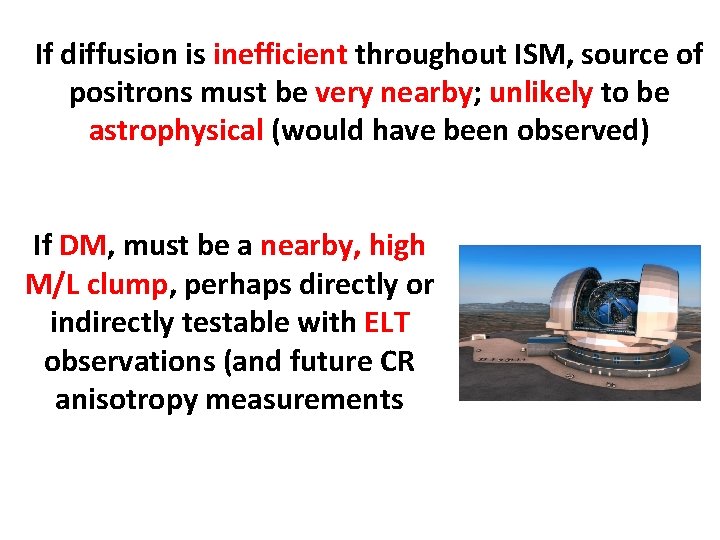
If diffusion is inefficient throughout ISM, source of positrons must be very nearby; unlikely to be astrophysical (would have been observed) If DM, must be a nearby, high M/L clump, perhaps directly or indirectly testable with ELT observations (and future CR anisotropy measurements
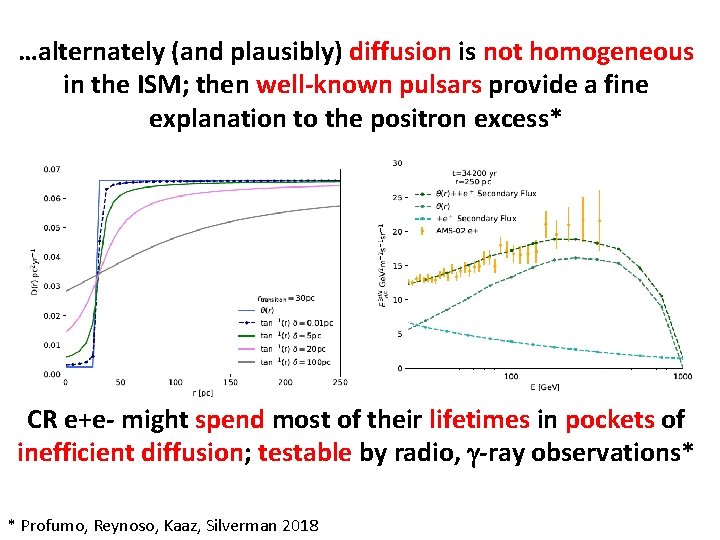
…alternately (and plausibly) diffusion is not homogeneous in the ISM; then well-known pulsars provide a fine explanation to the positron excess* CR e+e- might spend most of their lifetimes in pockets of inefficient diffusion; testable by radio, g-ray observations* * Profumo, Reynoso, Kaaz, Silverman 2018
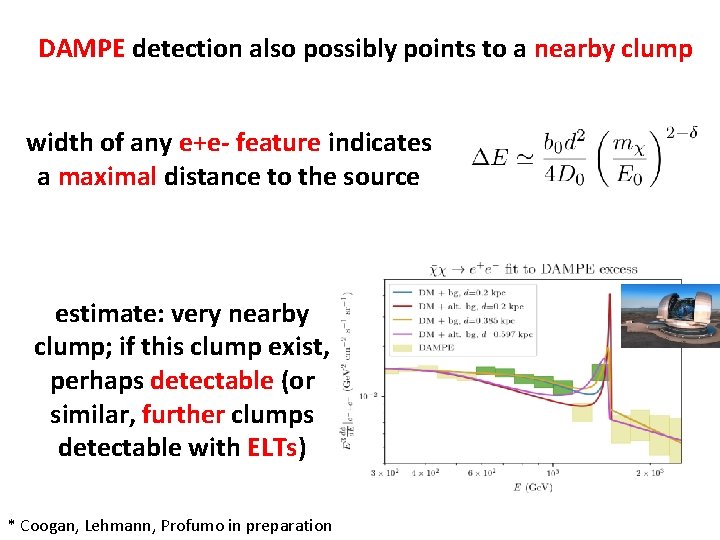
DAMPE detection also possibly points to a nearby clump width of any e+e- feature indicates a maximal distance to the source estimate: very nearby clump; if this clump exist, perhaps detectable (or similar, further clumps detectable with ELTs) * Coogan, Lehmann, Profumo in preparation
10 -20 e. V 10 -10 e. V 1010 e. V 1020 e. V 1030 e. V 1040 e. V 1050 e. V 1060 e. V 1070 e. V
10 -20 e. V 10 -10 e. V 1010 e. V 1020 e. V 1030 e. V 1040 e. V 1050 e. V 1060 e. V 1070 e. V
10 -20 e. V 10 -10 e. V 1010 e. V 1020 e. V 1030 e. V 1040 e. V 1050 e. V 1060 e. V 1070 e. V
10 -20 e. V 10 -10 e. V 1010 e. V 1020 e. V 1030 e. V 1040 e. V 1050 e. V self-interacting DM 1060 e. V 1070 e. V