
Stefano Corradetti INFN Laboratori di Legnaro Status of
Stefano Corradetti INFN – Laboratori di Legnaro
Status of the Project Experimental activities Stefano Corradetti LNL January 2018
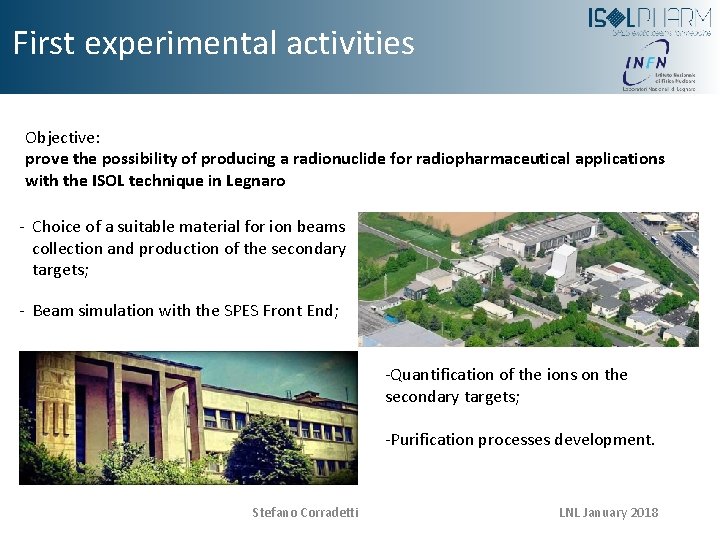
First experimental activities Objective: prove the possibility of producing a radionuclide for radiopharmaceutical applications with the ISOL technique in Legnaro - Choice of a suitable material for ion beams collection and production of the secondary targets; - Beam simulation with the SPES Front End; -Quantification of the ions on the secondary targets; -Purification processes development. Stefano Corradetti LNL January 2018
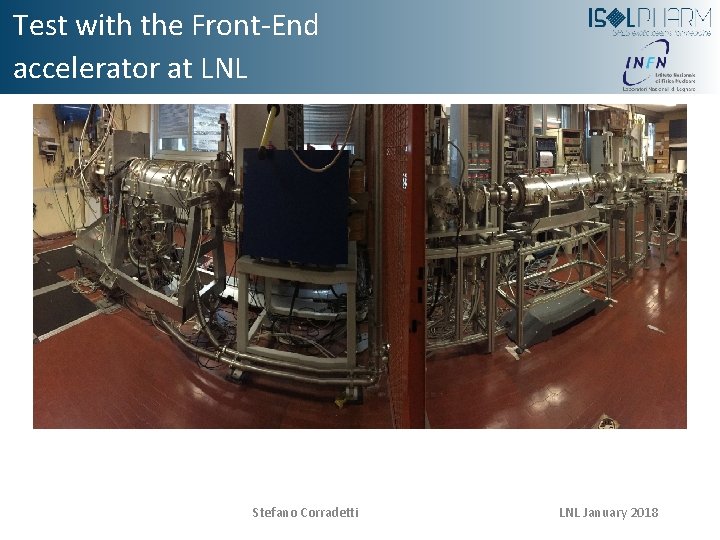
Test with the Front-End accelerator at LNL Stefano Corradetti LNL January 2018
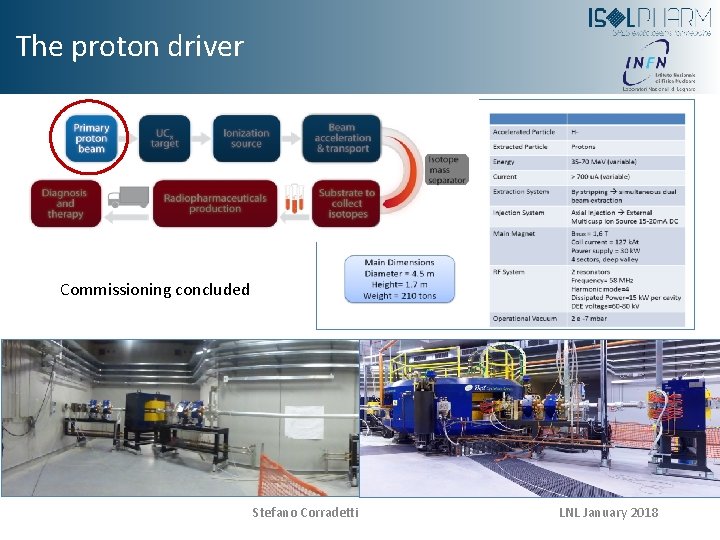
The proton driver Commissioning concluded Stefano Corradetti LNL January 2018
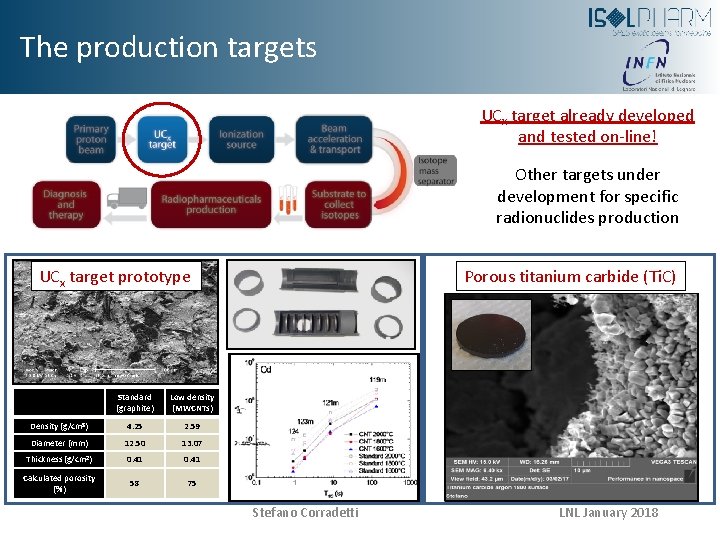
The production targets UCx target already developed and tested on-line! Other targets under development for specific radionuclides production UCx target prototype Standard (graphite) Low density (MWCNTs) Density (g/cm³) 4. 25 2. 59 Diameter (mm) 12. 50 13. 07 Thickness (g/cm²) 0. 41 Calculated porosity (%) 58 75 Porous titanium carbide (Ti. C) Stefano Corradetti LNL January 2018
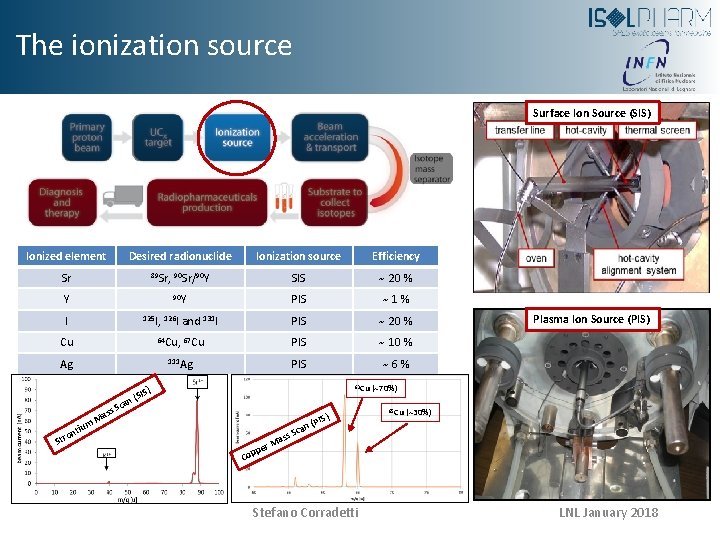
The ionization source Surface Ion Source (SIS) Ionized element Desired radionuclide Ionization source Efficiency Sr 89 Sr, 90 Sr/90 Y SIS ~ 20 % Y 90 Y PIS ~1% PIS ~ 20 % I 125 I, 126 I and 131 I Cu 64 Cu, 67 Cu PIS ~ 10 % Ag 111 Ag PIS ~6% Sc on Str ss Ma m 63 Cu S) a SI n ( S) tiu (~70%) 65 Cu (~30%) S ass r M ppe (PI can Plasma Ion Source (PIS) Co Stefano Corradetti LNL January 2018
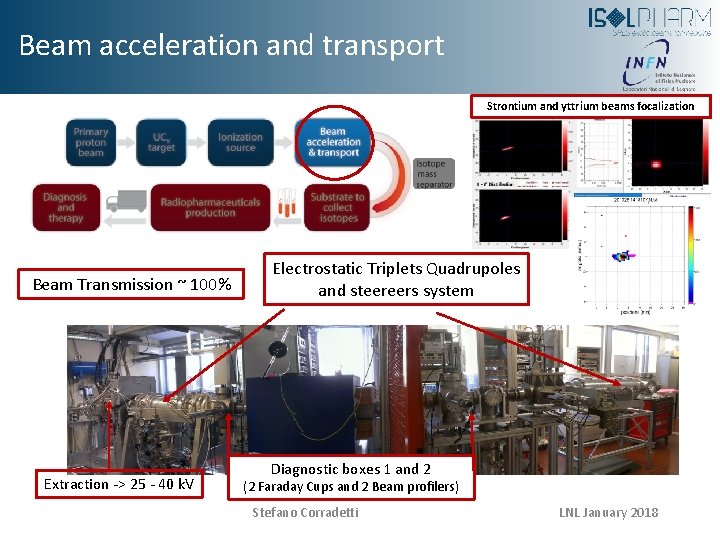
Beam acceleration and transport Strontium and yttrium beams focalization Beam Transmission ~ 100% Extraction -> 25 - 40 k. V Electrostatic Triplets Quadrupoles and steereers system Diagnostic boxes 1 and 2 (2 Faraday Cups and 2 Beam profilers) Stefano Corradetti LNL January 2018
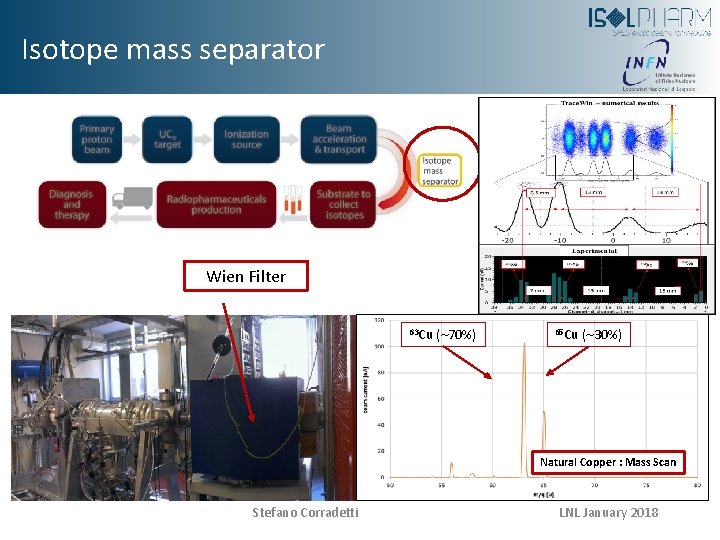
Isotope mass separator Wien Filter 63 Cu (~70%) 65 Cu (~30%) Natural Copper : Mass Scan Stefano Corradetti LNL January 2018
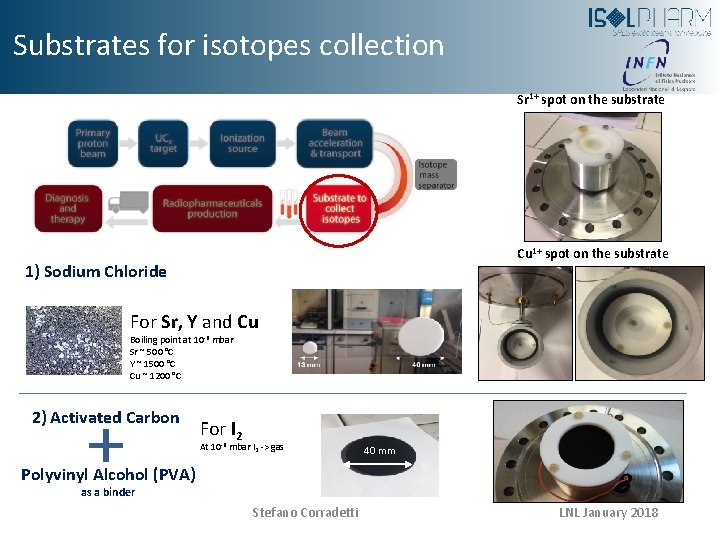
Substrates for isotopes collection Sr 1+ spot on the substrate Cu 1+ spot on the substrate 1) Sodium Chloride For Sr, Y and Cu Boiling point at 10 -6 mbar Sr ~ 500 °C Y ~ 1500 °C Cu ~ 1200 °C 2) Activated Carbon For I 2 At 10 -6 mbar I 2 -> gas 40 mm Polyvinyl Alcohol (PVA) as a binder Stefano Corradetti LNL January 2018
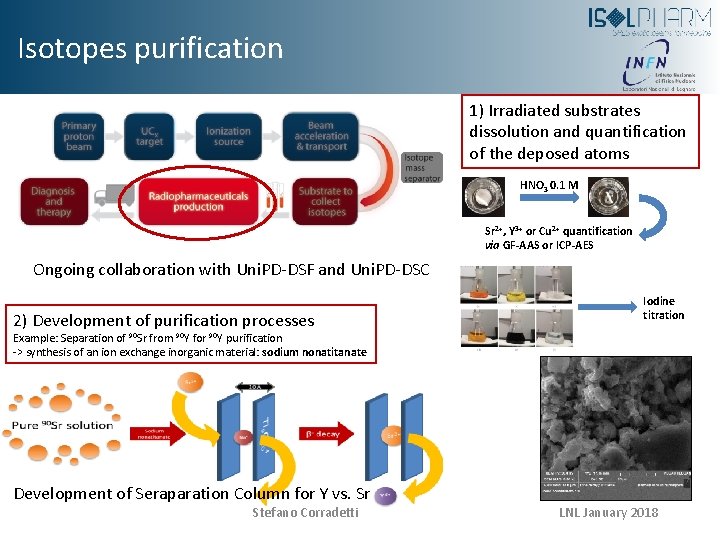
Isotopes purification 1) Irradiated substrates dissolution and quantification of the deposed atoms HNO 3 0. 1 M Sr 2+, Y 3+ or Cu 2+ quantification via GF-AAS or ICP-AES Ongoing collaboration with Uni. PD-DSF and Uni. PD-DSC 2) Development of purification processes Iodine titration Example: Separation of 90 Sr from 90 Y for 90 Y purification -> synthesis of an ion exchange inorganic material: sodium nonatitanate Development of Seraparation Column for Y vs. Sr Stefano Corradetti LNL January 2018
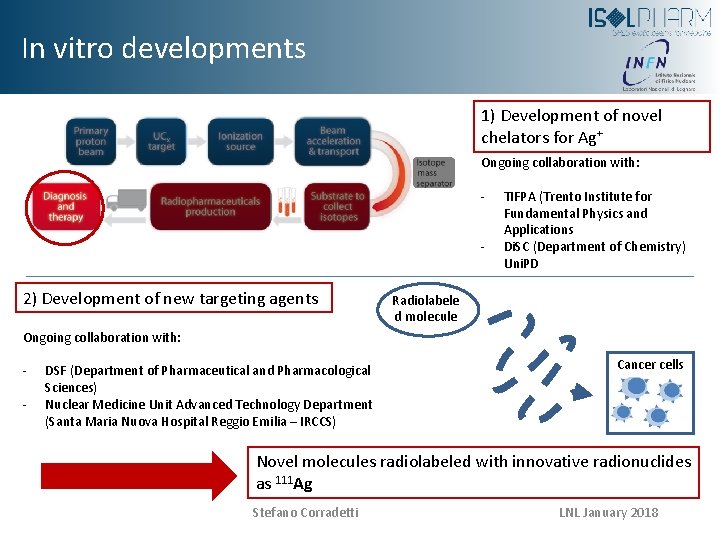
In vitro developments 1) Development of novel chelators for Ag+ Ongoing collaboration with: - 2) Development of new targeting agents TIFPA (Trento Institute for Fundamental Physics and Applications Di. SC (Department of Chemistry) Uni. PD Radiolabele d molecule Ongoing collaboration with: - DSF (Department of Pharmaceutical and Pharmacological Sciences) Nuclear Medicine Unit Advanced Technology Department (Santa Maria Nuova Hospital Reggio Emilia – IRCCS) Cancer cells Novel molecules radiolabeled with innovative radionuclides as 111 Ag Stefano Corradetti LNL January 2018
First new project derived from ISOLPHARM in collaboration with PSI Stefano Corradetti ISOLPHARM_AG LNL January 2018
ISOLPHARM_AG
ISOLPHARM_Ag Goals & organization 111 Ag Promising radionuclide for therapy: • b- emitter (average energy 360 ke. V) • Low percentage of associated g-emission Good decay properties! Development of Ag-based radiopharmaceuticals Task 1: physics and computing Task 2: production of Ag+, purification and chelators development Task 3: cellular targets studies and radiopharmaceutical development Stefano Corradetti LNL January 2018
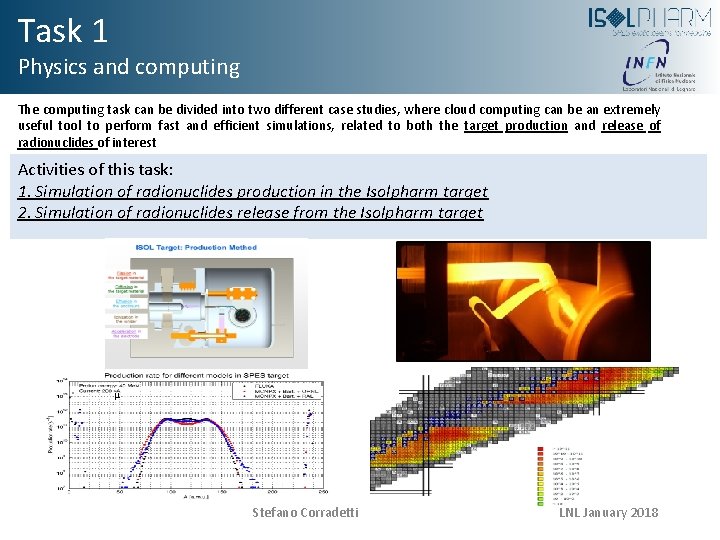
Task 1 Physics and computing The computing task can be divided into two different case studies, where cloud computing can be an extremely useful tool to perform fast and efficient simulations, related to both the target production and release of radionuclides of interest Activities of this task: 1. Simulation of radionuclides production in the Isolpharm target 2. Simulation of radionuclides release from the Isolpharm target μ Stefano Corradetti LNL January 2018
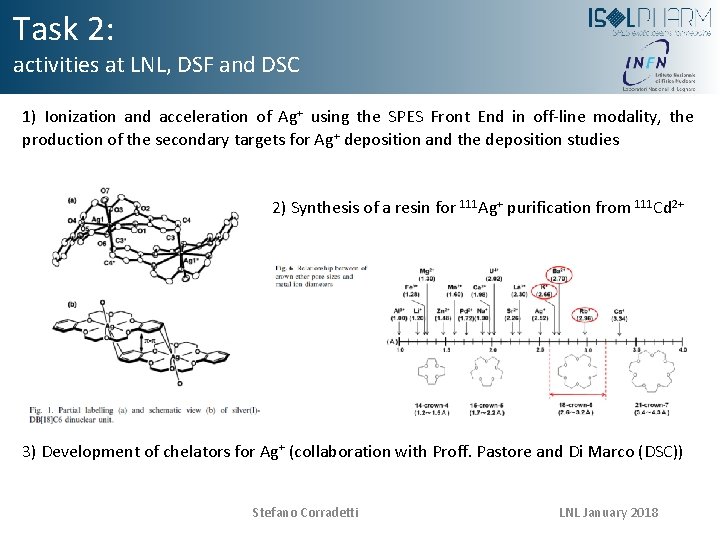
Task 2: activities at LNL, DSF and DSC 1) Ionization and acceleration of Ag+ using the SPES Front End in off-line modality, the production of the secondary targets for Ag+ deposition and the deposition studies 2) Synthesis of a resin for 111 Ag+ purification from 111 Cd 2+ 3) Development of chelators for Ag+ (collaboration with Proff. Pastore and Di Marco (DSC)) Stefano Corradetti LNL January 2018
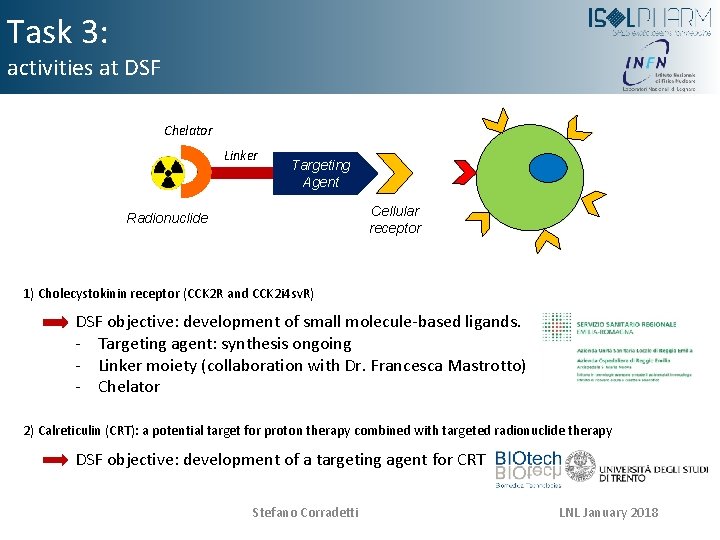
Task 3: activities at DSF Chelator Linker Targeting Agent Cellular receptor Radionuclide 1) Cholecystokinin receptor (CCK 2 R and CCK 2 i 4 sv. R) DSF objective: development of small molecule-based ligands. - Targeting agent: synthesis ongoing - Linker moiety (collaboration with Dr. Francesca Mastrotto) - Chelator 2) Calreticulin (CRT): a potential target for proton therapy combined with targeted radionuclide therapy DSF objective: development of a targeting agent for CRT Stefano Corradetti LNL January 2018
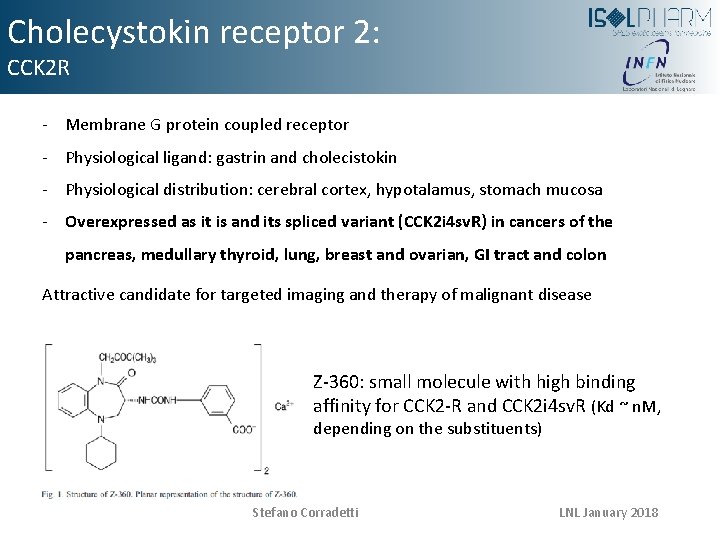
Cholecystokin receptor 2: CCK 2 R - Membrane G protein coupled receptor - Physiological ligand: gastrin and cholecistokin - Physiological distribution: cerebral cortex, hypotalamus, stomach mucosa - Overexpressed as it is and its spliced variant (CCK 2 i 4 sv. R) in cancers of the pancreas, medullary thyroid, lung, breast and ovarian, GI tract and colon Attractive candidate for targeted imaging and therapy of malignant disease Z-360: small molecule with high binding affinity for CCK 2 -R and CCK 2 i 4 sv. R (Kd ~ n. M, depending on the substituents) Stefano Corradetti LNL January 2018
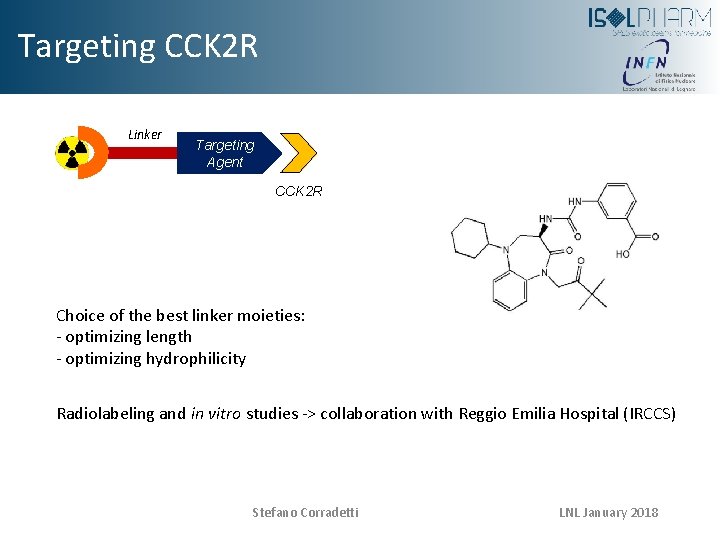
Targeting CCK 2 R Linker Targeting Agent CCK 2 R Choice of the best linker moieties: - optimizing length - optimizing hydrophilicity Radiolabeling and in vitro studies -> collaboration with Reggio Emilia Hospital (IRCCS) Stefano Corradetti LNL January 2018
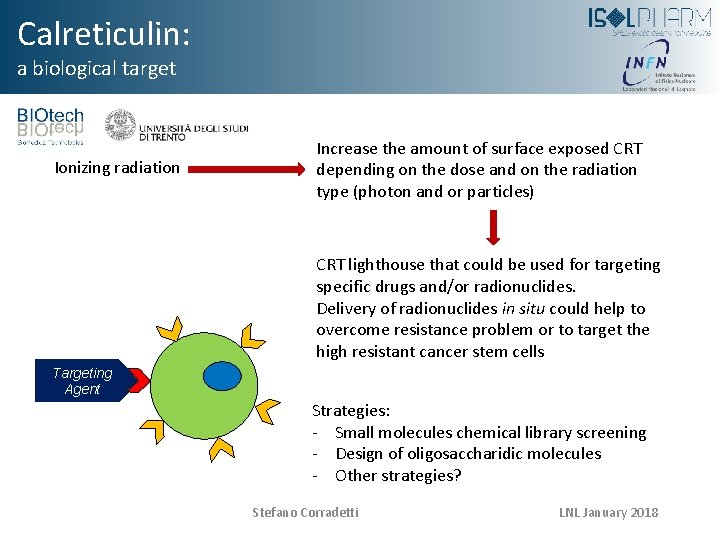
Calreticulin: a biological target Ionizing radiation Increase the amount of surface exposed CRT depending on the dose and on the radiation type (photon and or particles) CRT lighthouse that could be used for targeting specific drugs and/or radionuclides. Delivery of radionuclides in situ could help to overcome resistance problem or to target the high resistant cancer stem cells Targeting Agent Strategies: - Small molecules chemical library screening - Design of oligosaccharidic molecules - Other strategies? Stefano Corradetti LNL January 2018
Collaboration with POLATOM and NCSR-DEMOKRITOS Stefano Corradetti LNL January 2018
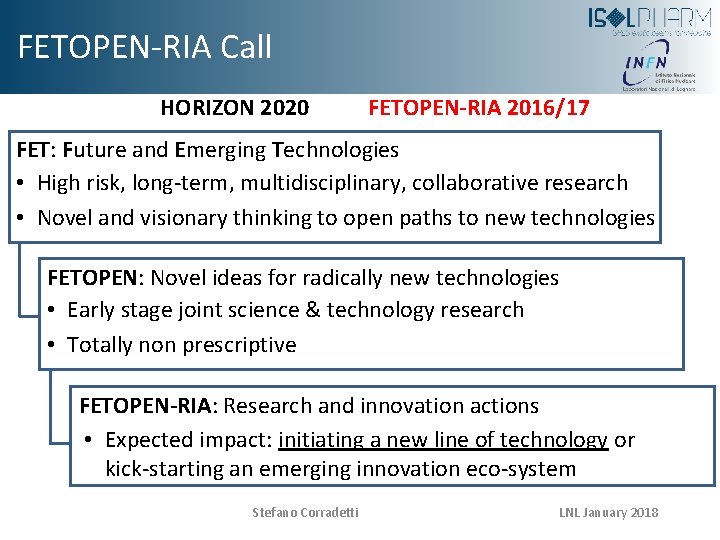
FETOPEN-RIA Call HORIZON 2020 FETOPEN-RIA 2016/17 FET: Future and Emerging Technologies • High risk, long-term, multidisciplinary, collaborative research • Novel and visionary thinking to open paths to new technologies FETOPEN: Novel ideas for radically new technologies • Early stage joint science & technology research • Totally non prescriptive FETOPEN-RIA: Research and innovation actions • Expected impact: initiating a new line of technology or kick-starting an emerging innovation eco-system Stefano Corradetti LNL January 2018
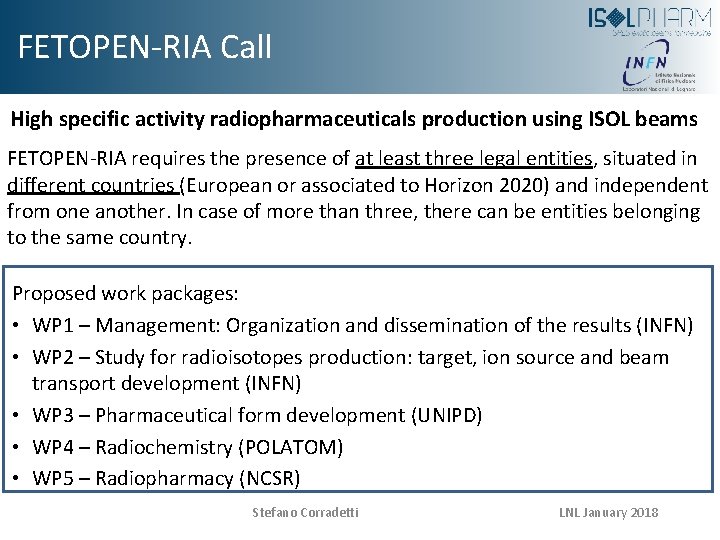
FETOPEN-RIA Call High specific activity radiopharmaceuticals production using ISOL beams FETOPEN-RIA requires the presence of at least three legal entities, situated in different countries (European or associated to Horizon 2020) and independent from one another. In case of more than three, there can be entities belonging to the same country. Proposed work packages: • WP 1 – Management: Organization and dissemination of the results (INFN) • WP 2 – Study for radioisotopes production: target, ion source and beam transport development (INFN) • WP 3 – Pharmaceutical form development (UNIPD) • WP 4 – Radiochemistry (POLATOM) • WP 5 – Radiopharmacy (NCSR) Stefano Corradetti LNL January 2018
- Slides: 24