
Stefan Uttenthaler Tc in Bulge and Field AGB
Stefan Uttenthaler: Tc in Bulge and Field AGB Stars This talk mainly deals with two papers: "Technetium and the third dredge up in AGB stars I. : Field stars" Lebzelter & Hron, 2003, A&A 411, 533 – 542 "Technetium and the third dredge up in AGB stars II. : Bulge stars" Uttenthaler et al. , in preparation for A&A Paper I: Stars in solar neighborhood, good HIPPARCOS parallaxes Spectra from UVES, KPNO, AAT ESO: Hans-Ulrich Käufl Vienna (A): Bernhard Aringer Thomas Lebzelter Josef Hron Michael Lederer Michael Gorfer Besançon (F): Mathias Schultheis Perugia (I): Maurizio Busso Paper II: Bulge stars in PG 3 b -10°, l = 0° Spectra taken with UVES/VLT
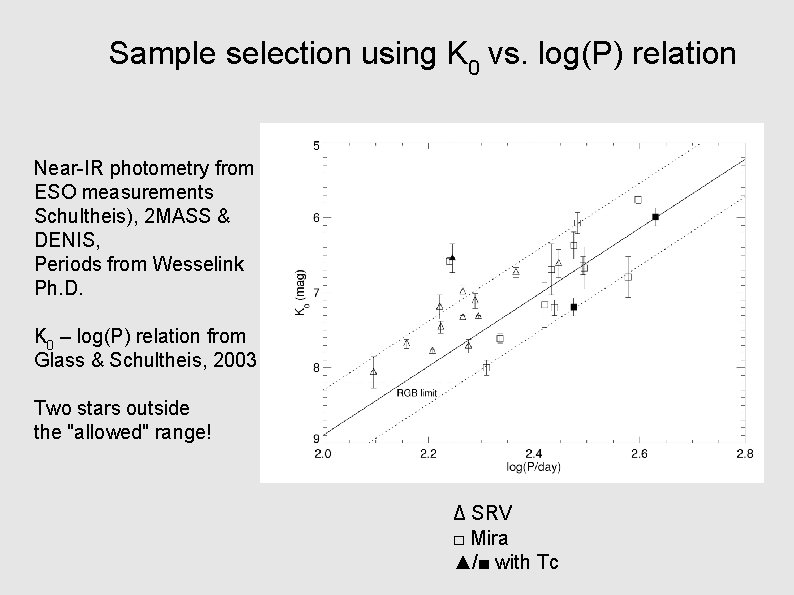
Sample selection using K 0 vs. log(P) relation Near-IR photometry from ESO measurements Schultheis), 2 MASS & DENIS, Periods from Wesselink Ph. D. K 0 – log(P) relation from Glass & Schultheis, 2003 Two stars outside the "allowed" range! Δ SRV □ Mira ▲/■ with Tc
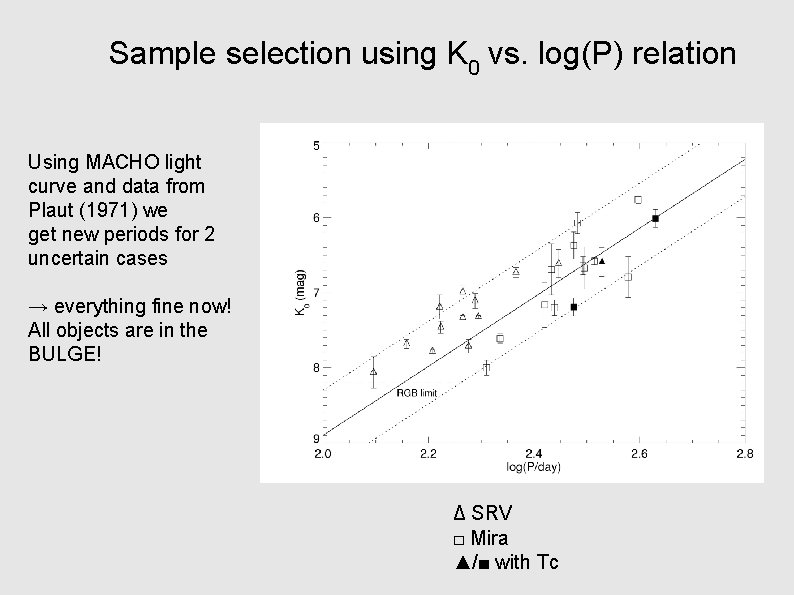
Sample selection using K 0 vs. log(P) relation Using MACHO light curve and data from Plaut (1971) we get new periods for 2 uncertain cases → everything fine now! All objects are in the BULGE! Δ SRV □ Mira ▲/■ with Tc
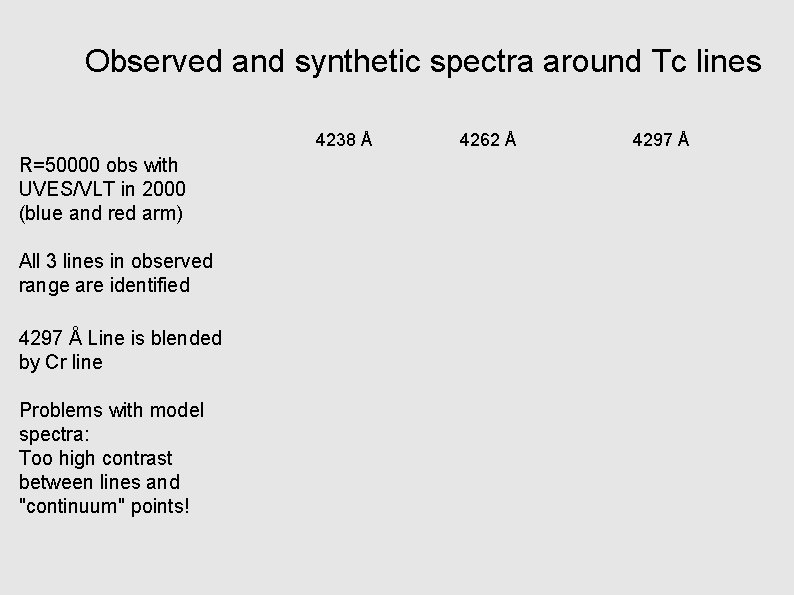
Observed and synthetic spectra around Tc lines 4238 Å R=50000 obs with UVES/VLT in 2000 (blue and red arm) All 3 lines in observed range are identified 4297 Å Line is blended by Cr line Problems with model spectra: Too high contrast between lines and "continuum" points! 4262 Å 4297 Å
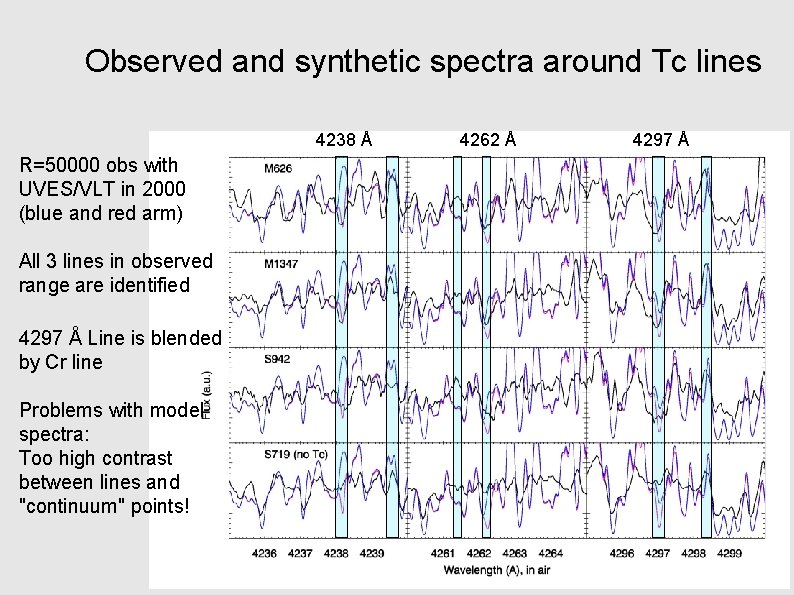
Observed and synthetic spectra around Tc lines 4238 Å R=50000 obs with UVES/VLT in 2000 (blue and red arm) All 3 lines in observed range are identified 4297 Å Line is blended by Cr line Problems with model spectra: Too high contrast between lines and "continuum" points! 4262 Å 4297 Å
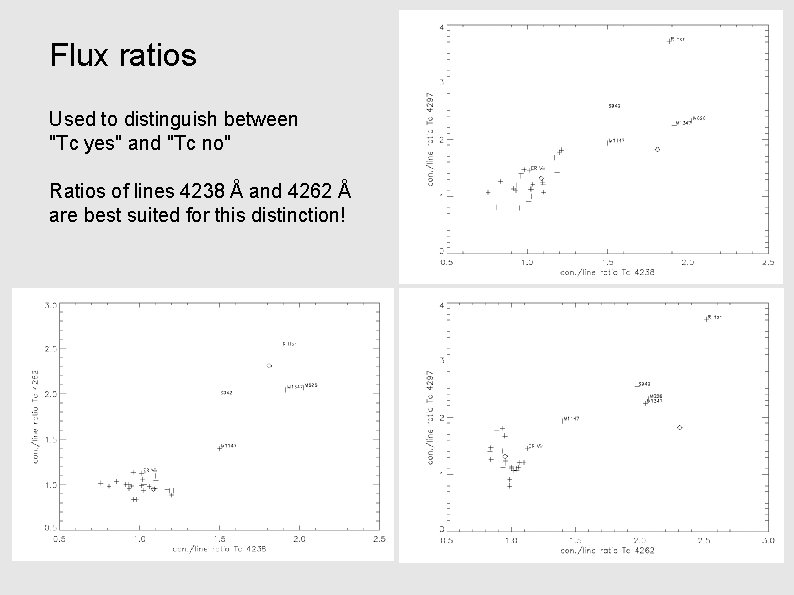
Flux ratios Used to distinguish between "Tc yes" and "Tc no" Ratios of lines 4238 Å and 4262 Å are best suited for this distinction!
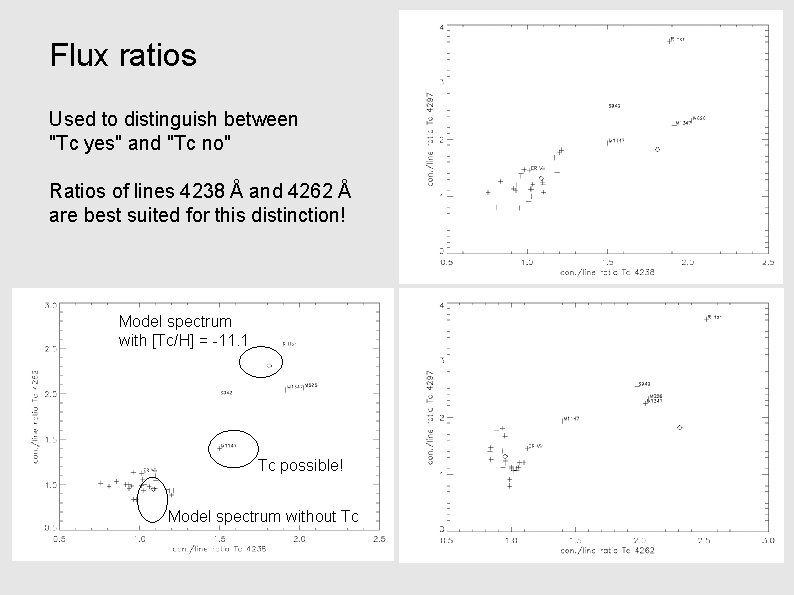
Flux ratios Used to distinguish between "Tc yes" and "Tc no" Ratios of lines 4238 Å and 4262 Å are best suited for this distinction! Model spectrum with [Tc/H] = -11. 1 Tc possible! Model spectrum without Tc
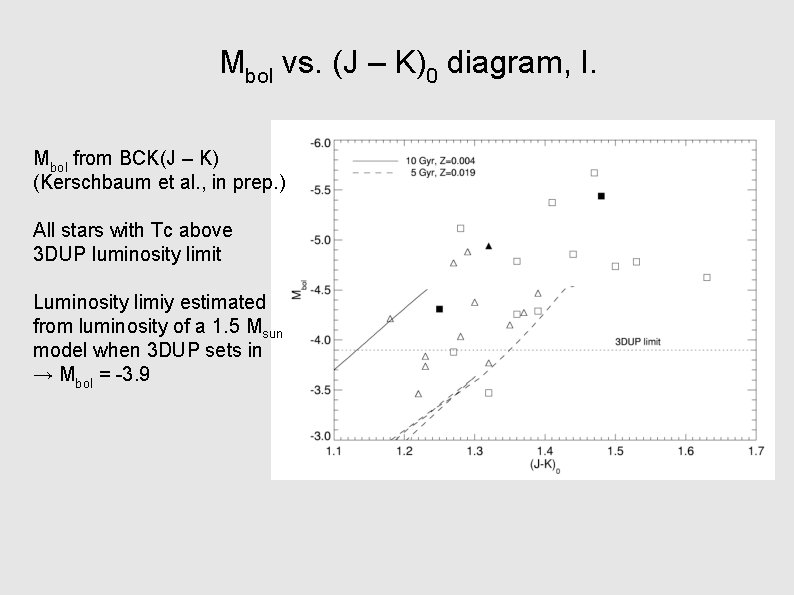
Mbol vs. (J – K)0 diagram, I. Mbol from BCK(J – K) (Kerschbaum et al. , in prep. ) All stars with Tc above 3 DUP luminosity limit Luminosity limiy estimated from luminosity of a 1. 5 Msun model when 3 DUP sets in → Mbol = -3. 9
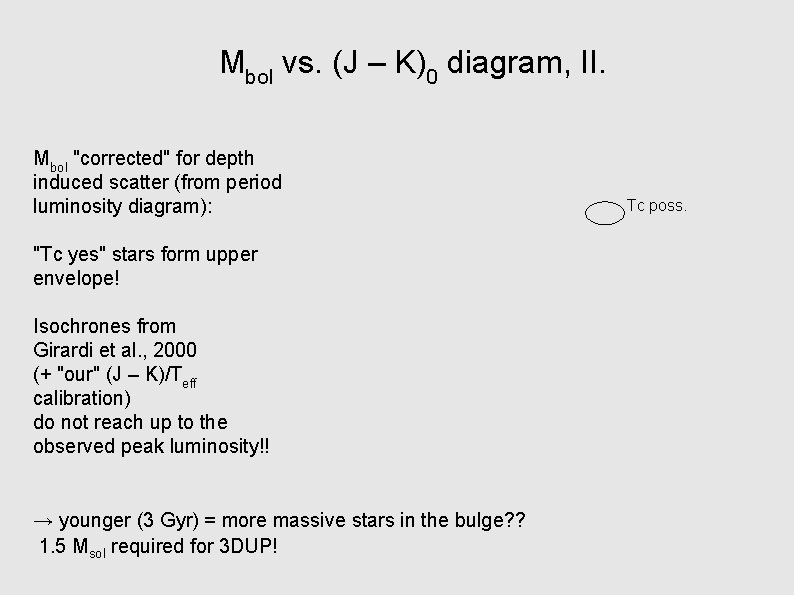
Mbol vs. (J – K)0 diagram, II. Mbol "corrected" for depth induced scatter (from period luminosity diagram): "Tc yes" stars form upper envelope! Isochrones from Girardi et al. , 2000 (+ "our" (J – K)/Teff calibration) do not reach up to the observed peak luminosity!! → younger (3 Gyr) = more massive stars in the bulge? ? 1. 5 Msol required for 3 DUP! Tc poss.
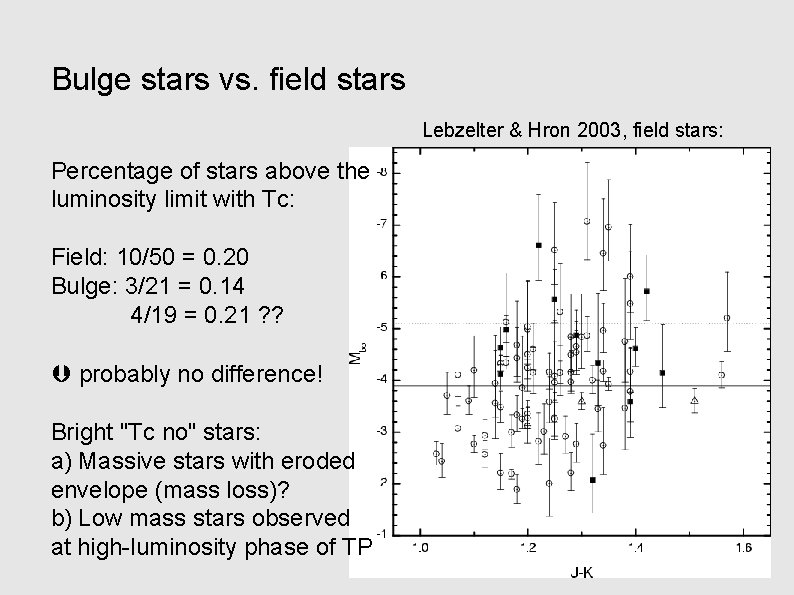
Bulge stars vs. field stars Lebzelter & Hron 2003, field stars: Percentage of stars above the luminosity limit with Tc: Field: 10/50 = 0. 20 Bulge: 3/21 = 0. 14 4/19 = 0. 21 ? ? probably no difference! Bright "Tc no" stars: a) Massive stars with eroded envelope (mass loss)? b) Low mass stars observed at high-luminosity phase of TP
Are there AGB stars which have had 3 DUP some time ago, but all Tc has decayed by now (case a)? To solve this question: ● ● Determine s-element abundances in the atmospheres : -( Model spectra are not yet good enough for this But: qualitative information on Nb content helps! → Will be worked out on Monday, 8 a. m. ! Measure C/O and 12 C/13 C ratios of the stars : -( ISAAC/VLT observing time was not granted : -/ Maybe DDT observations?
Take care with abbreviations! HB = Horizontal Branch ? ? HB = Hof Bräu ? ? Hofbräuhaus, Munich
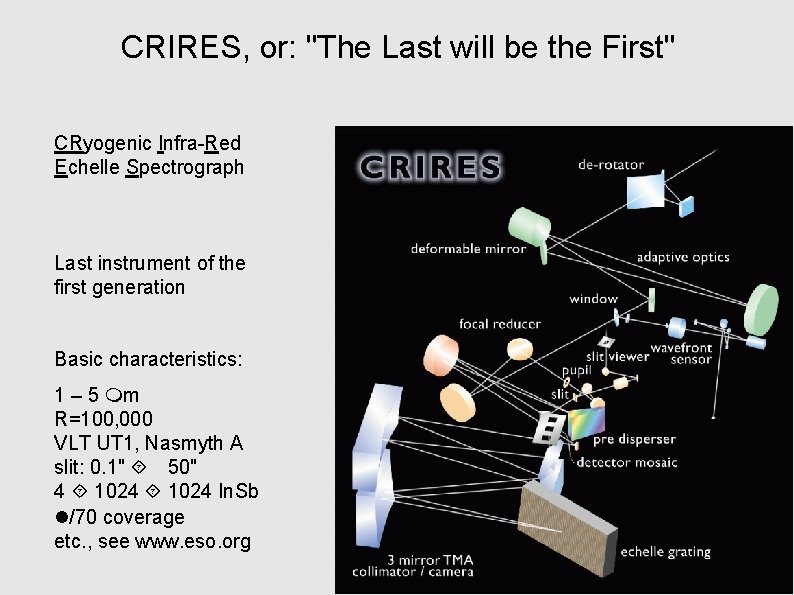
CRIRES, or: "The Last will be the First" CRyogenic Infra-Red Echelle Spectrograph Last instrument of the first generation Basic characteristics: 1 – 5 m R=100, 000 VLT UT 1, Nasmyth A slit: 0. 1" 50" 4 1024 In. Sb /70 coverage etc. , see www. eso. org
CRIRES, or: "The Last will be the First" Current status: All subsystems are tested, final lab tests of the whole system, all specifications are me April 2006: commissioning of warm parts at the telescope June 2006: commissioning of the rest August 2006: science verification, 2 nd commissioning What can CRIRES do for research on AGB stars? All AGBs out to the bulge & the brightest in the MCs observable ● Atmospheric dynamics, especially in C stars ● Temperature structure pinned down ● Improved chemical and isotopic abundances ● Born-again AGB and Post-AGB stars: narrow nebular lines resolved, kinematics from velocity along the slit ● etc. ●
(CO 2) (H 2 O) (CO 2) (CO 2) (N 2) (CO 2) (CO 2) (H 2 O) (CO 2) (CO 2) (H 2 O) (CO 2) (N 2) (CO 2) (H 2 O) (CO 2)
- Slides: 16