
STEERING SYSTEM FOR MINI BAJA CAR Benjamin Genre
STEERING SYSTEM FOR MINI BAJA CAR Benjamin Genre Advisor: Dr. Ho-Hoon Lee Dr. Cris Koutsougeras ET 493 Senior Design Project II Fall 2017
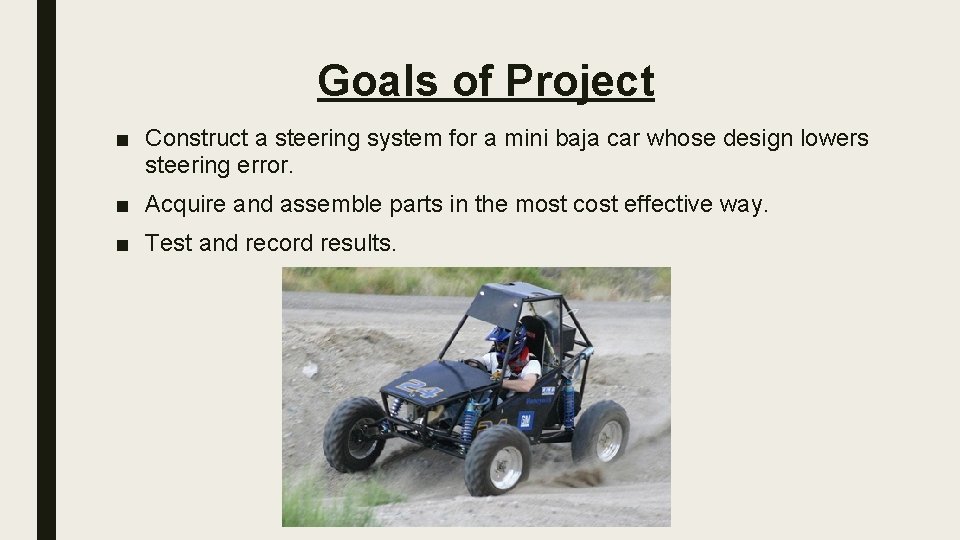
Goals of Project ■ Construct a steering system for a mini baja car whose design lowers steering error. ■ Acquire and assemble parts in the most cost effective way. ■ Test and record results.
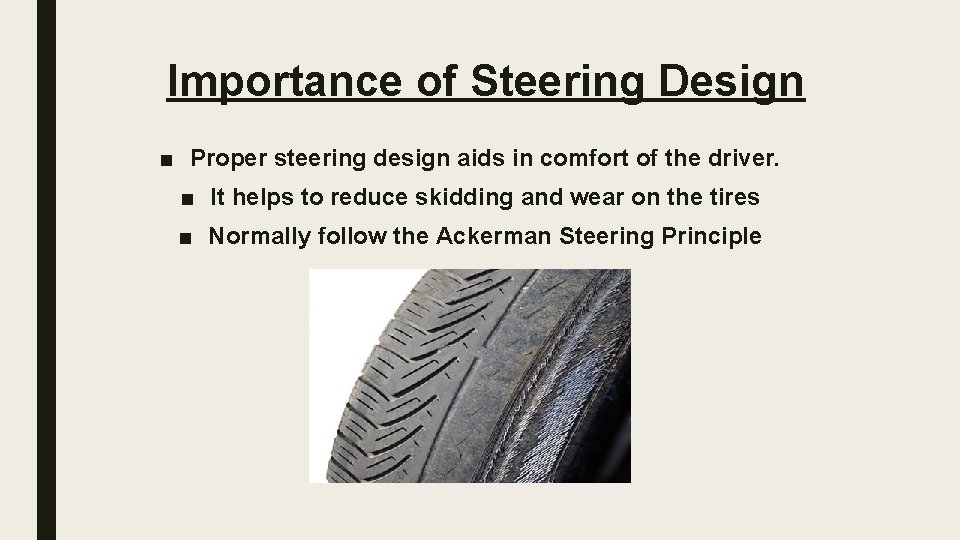
Importance of Steering Design ■ Proper steering design aids in comfort of the driver. ■ It helps to reduce skidding and wear on the tires ■ Normally follow the Ackerman Steering Principle

Ackerman Steering Principle ■ States that the axial lines of all the wheels should meet at the same point.
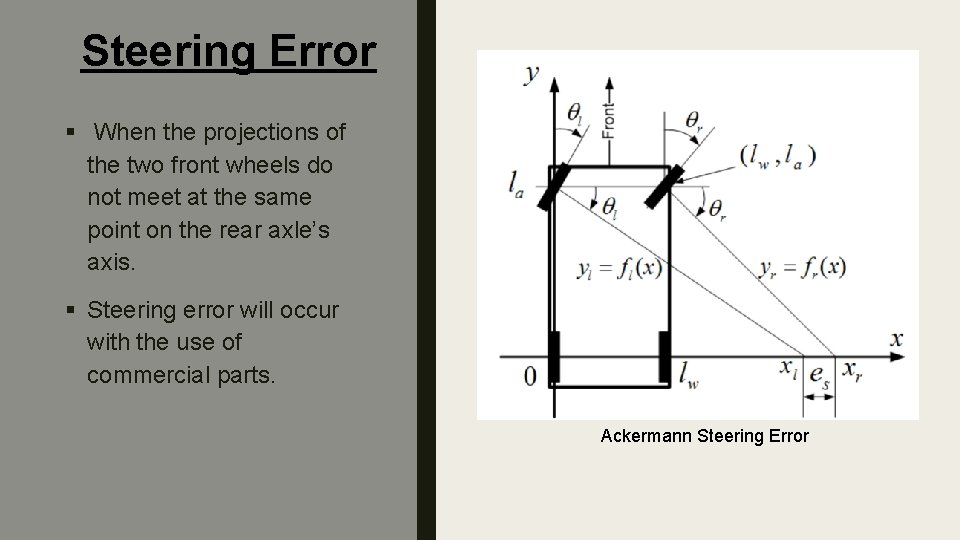
Steering Error § When the projections of the two front wheels do not meet at the same point on the rear axle’s axis. § Steering error will occur with the use of commercial parts. Ackermann Steering Error
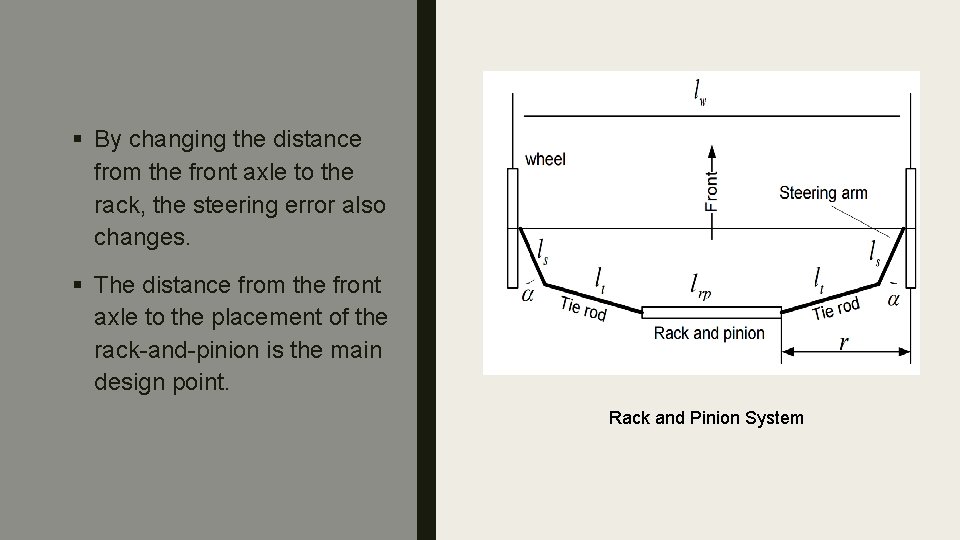
§ By changing the distance from the front axle to the rack, the steering error also changes. § The distance from the front axle to the placement of the rack-and-pinion is the main design point. Rack and Pinion System
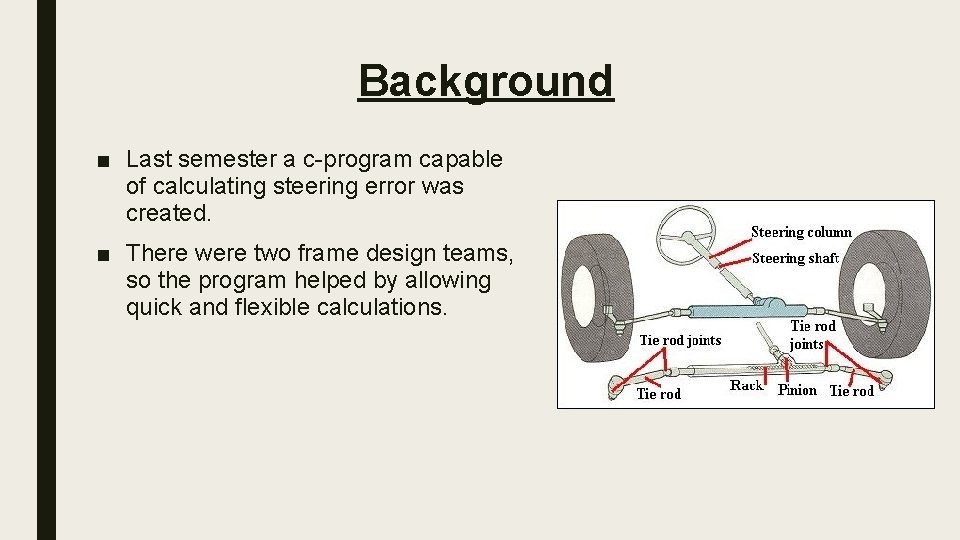
Background ■ Last semester a c-program capable of calculating steering error was created. ■ There were two frame design teams, so the program helped by allowing quick and flexible calculations.
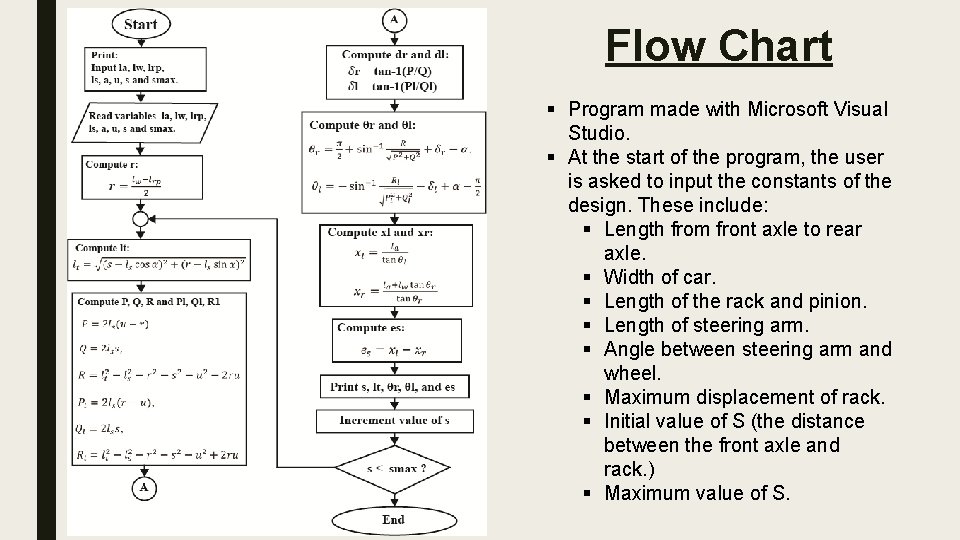
Flow Chart § Program made with Microsoft Visual Studio. § At the start of the program, the user is asked to input the constants of the design. These include: § Length from front axle to rear axle. § Width of car. § Length of the rack and pinion. § Length of steering arm. § Angle between steering arm and wheel. § Maximum displacement of rack. § Initial value of S (the distance between the front axle and rack. ) § Maximum value of S.
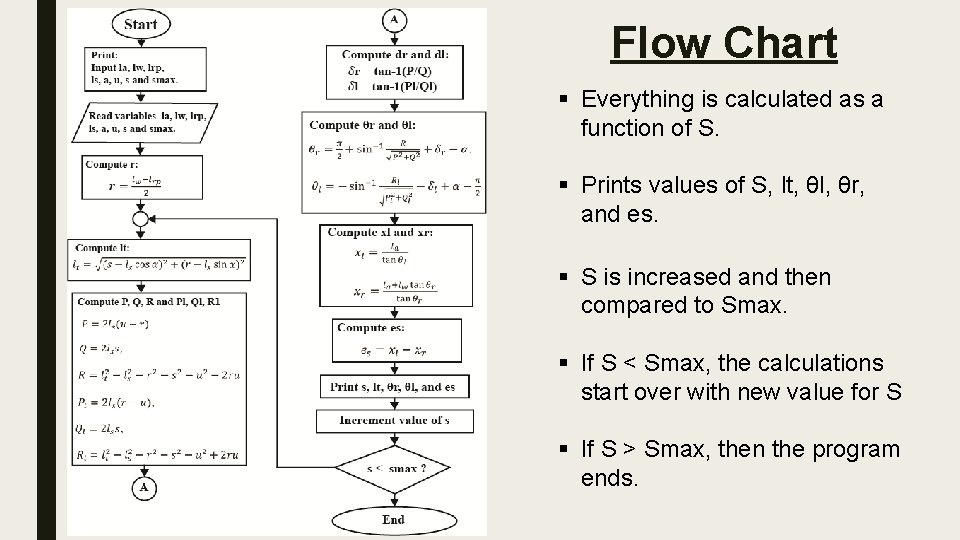
Flow Chart § Everything is calculated as a function of S. § Prints values of S, lt, θl, θr, and es. § S is increased and then compared to Smax. § If S < Smax, the calculations start over with new value for S § If S > Smax, then the program ends.
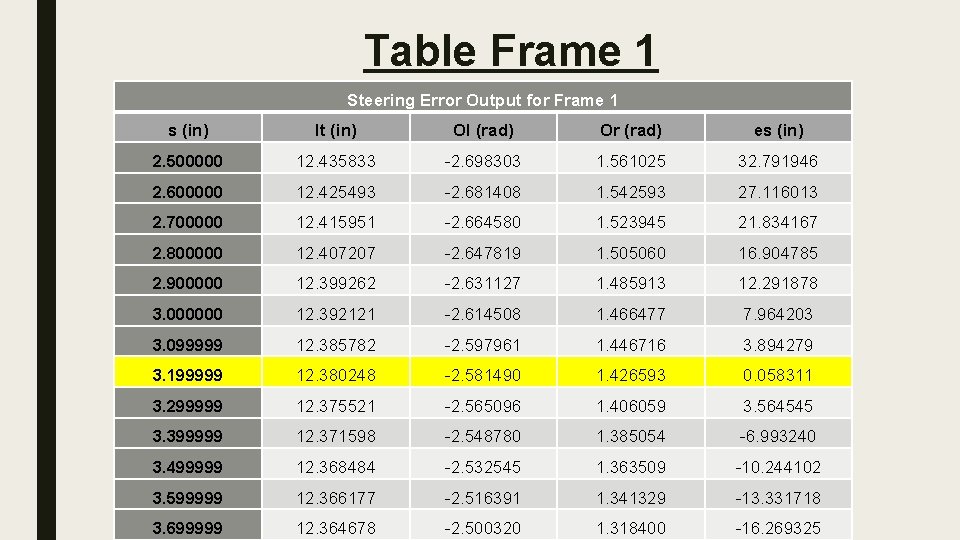
Table Frame 1 Steering Error Output for Frame 1 s (in) lt (in) Ol (rad) Or (rad) es (in) 2. 500000 12. 435833 -2. 698303 1. 561025 32. 791946 2. 600000 12. 425493 -2. 681408 1. 542593 27. 116013 2. 700000 12. 415951 -2. 664580 1. 523945 21. 834167 2. 800000 12. 407207 -2. 647819 1. 505060 16. 904785 2. 900000 12. 399262 -2. 631127 1. 485913 12. 291878 3. 000000 12. 392121 -2. 614508 1. 466477 7. 964203 3. 099999 12. 385782 -2. 597961 1. 446716 3. 894279 3. 199999 12. 380248 -2. 581490 1. 426593 0. 058311 3. 299999 12. 375521 -2. 565096 1. 406059 3. 564545 3. 399999 12. 371598 -2. 548780 1. 385054 -6. 993240 3. 499999 12. 368484 -2. 532545 1. 363509 -10. 244102 3. 599999 12. 366177 -2. 516391 1. 341329 -13. 331718 3. 699999 12. 364678 -2. 500320 1. 318400 -16. 269325
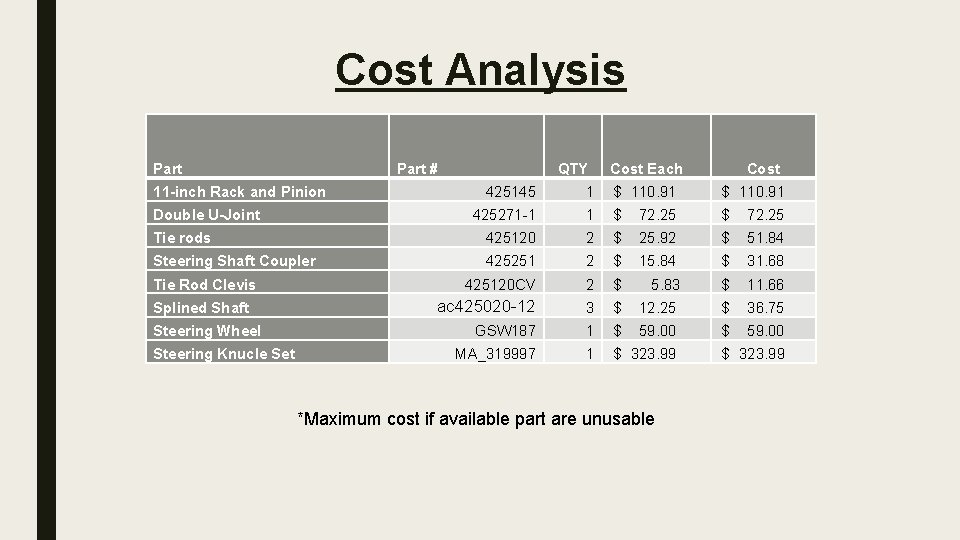
Cost Analysis Part # 11 -inch Rack and Pinion QTY Cost Each Cost 425145 1 $ 110. 91 425271 -1 1 $ 72. 25 Tie rods 425120 2 $ 25. 92 $ 51. 84 Steering Shaft Coupler 425251 2 $ 15. 84 $ 31. 68 425120 CV 2 $ 5. 83 $ 11. 66 ac 425020 -12 3 $ 12. 25 $ 36. 75 GSW 187 1 $ 59. 00 MA_319997 1 $ 323. 99 Double U-Joint Tie Rod Clevis Splined Shaft Steering Wheel Steering Knucle Set *Maximum cost if available part are unusable
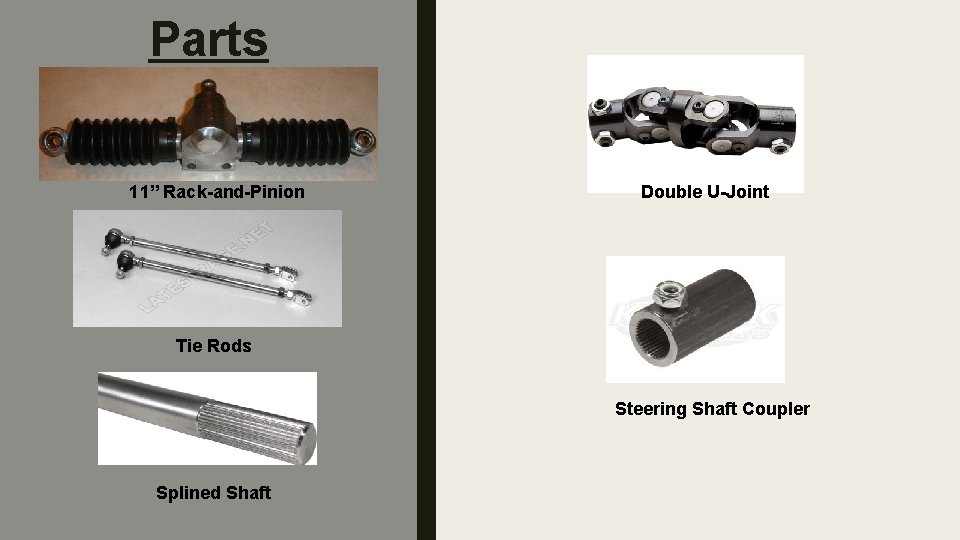
Parts 11” Rack-and-Pinion Double U-Joint Tie Rods Steering Shaft Coupler Splined Shaft
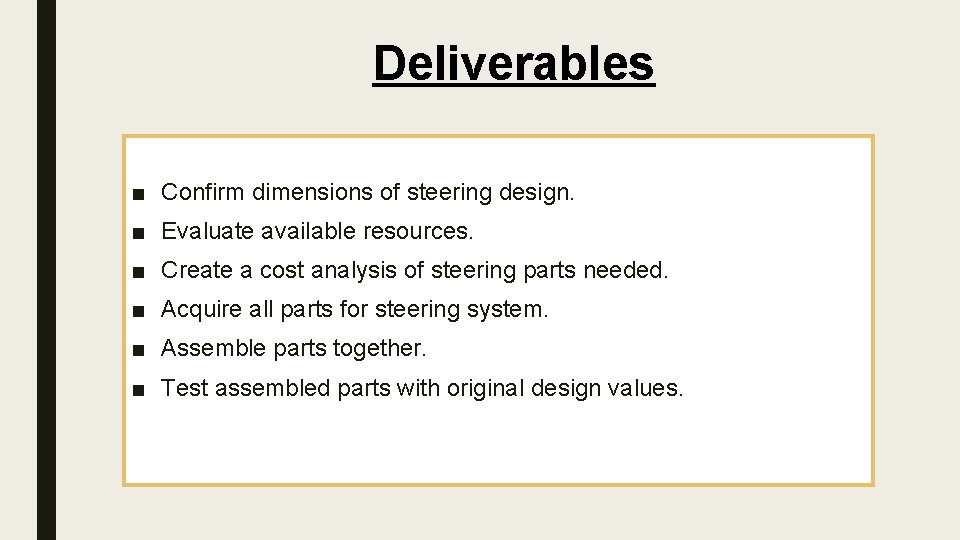
Deliverables ■ Confirm dimensions of steering design. ■ Evaluate available resources. ■ Create a cost analysis of steering parts needed. ■ Acquire all parts for steering system. ■ Assemble parts together. ■ Test assembled parts with original design values.
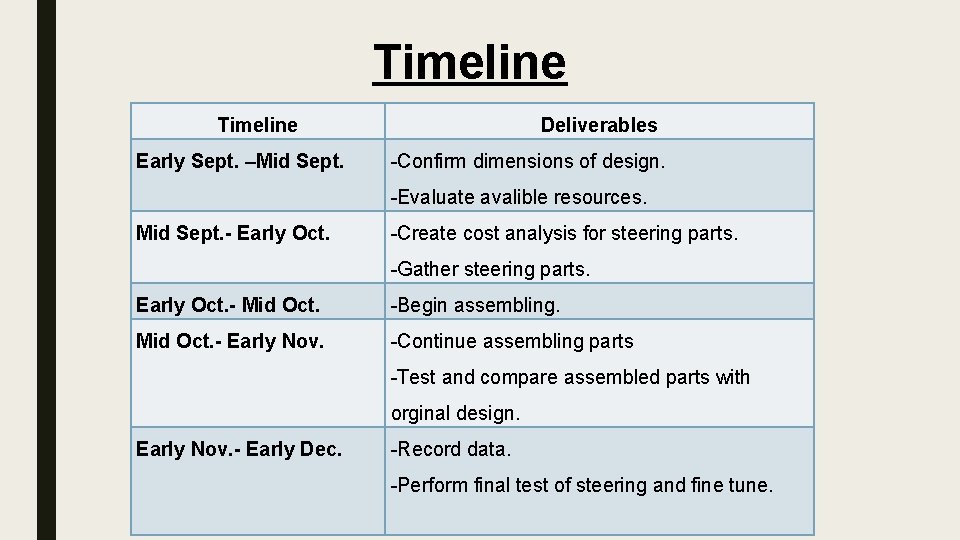
Timeline Early Sept. –Mid Sept. Deliverables -Confirm dimensions of design. -Evaluate avalible resources. Mid Sept. - Early Oct. -Create cost analysis for steering parts. -Gather steering parts. Early Oct. - Mid Oct. -Begin assembling. Mid Oct. - Early Nov. -Continue assembling parts -Test and compare assembled parts with orginal design. Early Nov. - Early Dec. -Record data. -Perform final test of steering and fine tune.
- Slides: 14