
SteerbyWire Implications for Vehicle Handling and Safety What
Steer-by-Wire: Implications for Vehicle Handling and Safety
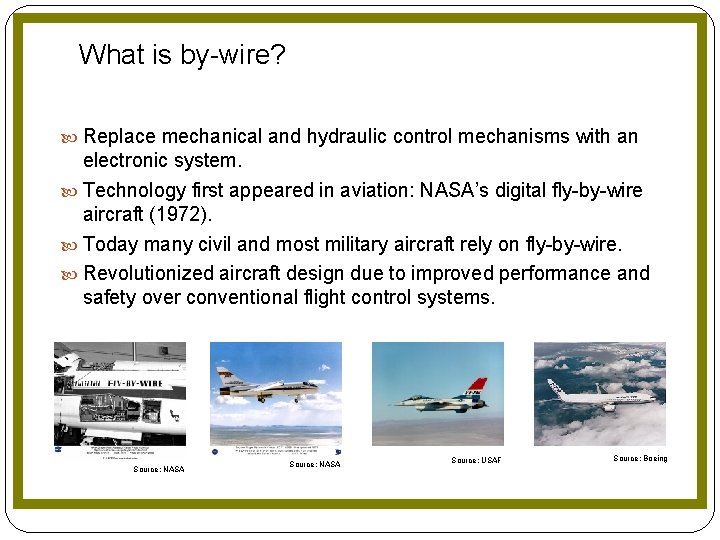
What is by-wire? Replace mechanical and hydraulic control mechanisms with an electronic system. Technology first appeared in aviation: NASA’s digital fly-by-wire aircraft (1972). Today many civil and most military aircraft rely on fly-by-wire. Revolutionized aircraft design due to improved performance and safety over conventional flight control systems. Source: NASA Source: USAF Source: Boeing
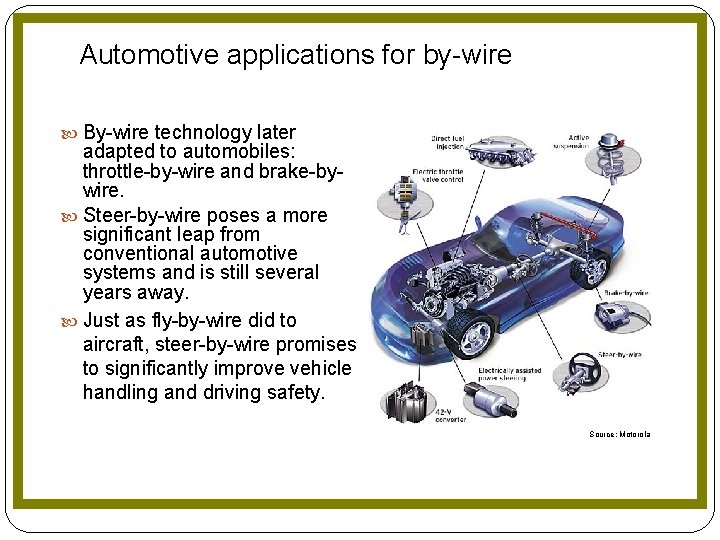
Automotive applications for by-wire By-wire technology later adapted to automobiles: throttle-by-wire and brake-bywire. Steer-by-wire poses a more significant leap from conventional automotive systems and is still several years away. Just as fly-by-wire did to aircraft, steer-by-wire promises to significantly improve vehicle handling and driving safety. Source: Motorola
Outline Introduction Car as a dynamic system Tire properties Basic handling characteristics and stability Vehicle control Estimation Conclusion and future work introduction steering system vehicle control estimation conclusion

Why do accidents occur? 42% of fatal crashes result from loss of control (European Accident Causation Survey, 2001). In most conditions, a vehicle under proper control is very safe. However, every vehicle has thresholds beyond which control becomes extremely difficult. introduction steering system vehicle control estimation conclusion
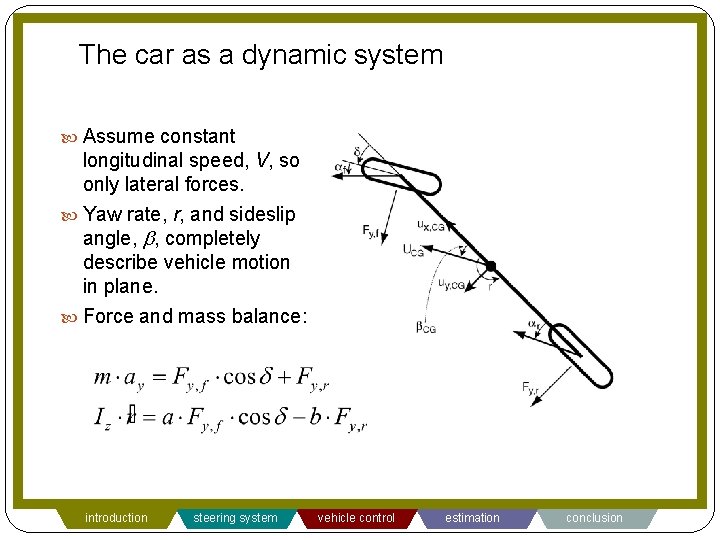
The car as a dynamic system Assume constant longitudinal speed, V, so only lateral forces. Yaw rate, r, and sideslip angle, , completely describe vehicle motion in plane. Force and mass balance: introduction steering system vehicle control estimation conclusion
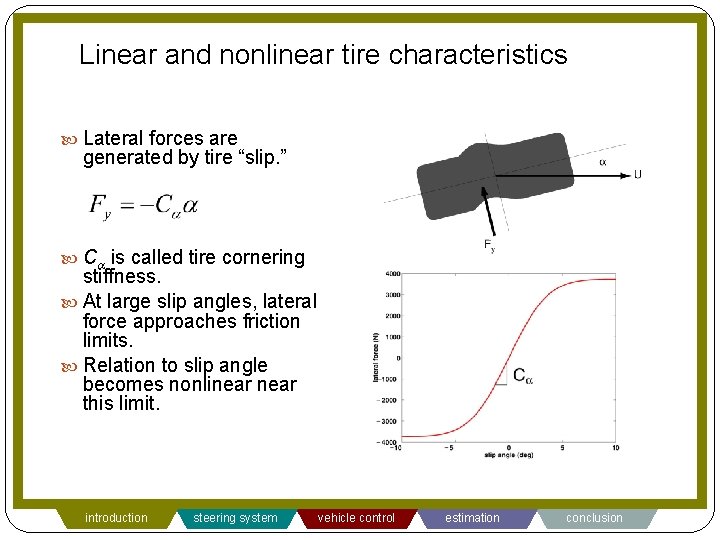
Linear and nonlinear tire characteristics Lateral forces are generated by tire “slip. ” Ca is called tire cornering stiffness. At large slip angles, lateral force approaches friction limits. Relation to slip angle becomes nonlinear this limit. introduction steering system vehicle control estimation conclusion

Linearized vehicle model Equations of motion: Valid even when tires operating in nonlinear region by approximating nonlinear effects of the tire curve. introduction steering system vehicle control estimation conclusion

Handling characteristics determined by physical properties Define understeer gradient: A car can have one of three characteristics: understeering + neutral steering - Kus less responsive introduction oversteering system more responsive vehicle control estimation conclusion
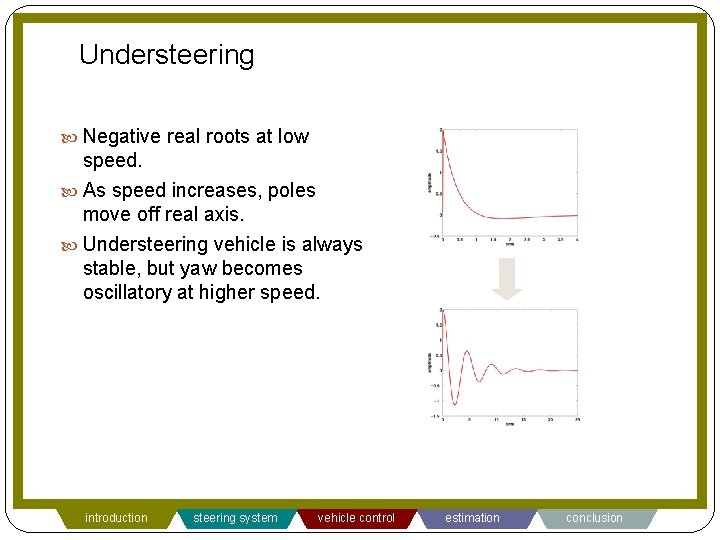
Understeering Negative real roots at low speed. As speed increases, poles move off real axis. Understeering vehicle is always stable, but yaw becomes oscillatory at higher speed. introduction steering system vehicle control estimation conclusion
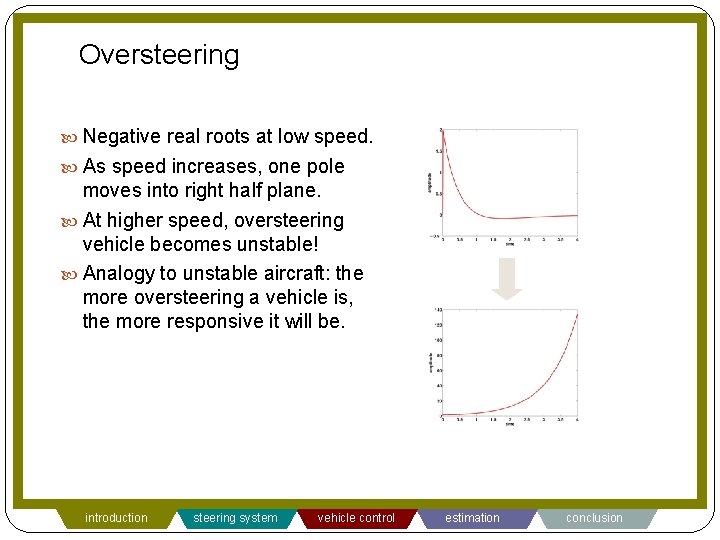
Oversteering Negative real roots at low speed. As speed increases, one pole moves into right half plane. At higher speed, oversteering vehicle becomes unstable! Analogy to unstable aircraft: the more oversteering a vehicle is, the more responsive it will be. introduction steering system vehicle control estimation conclusion
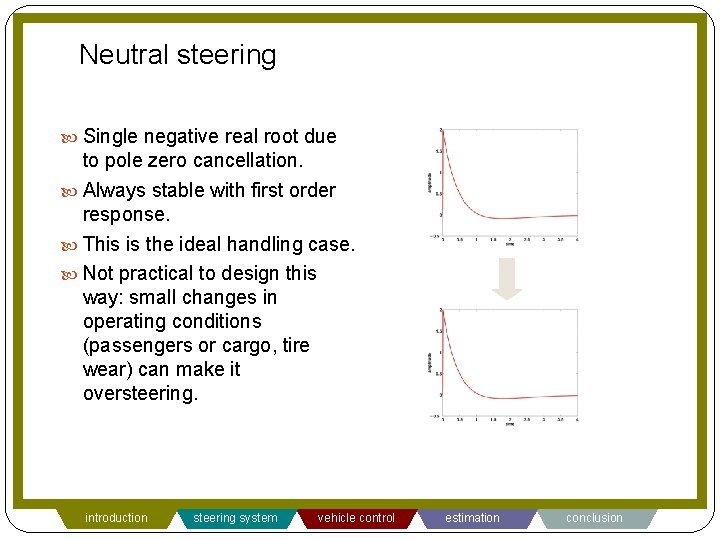
Neutral steering Single negative real root due to pole zero cancellation. Always stable with first order response. This is the ideal handling case. Not practical to design this way: small changes in operating conditions (passengers or cargo, tire wear) can make it oversteering. introduction steering system vehicle control estimation conclusion
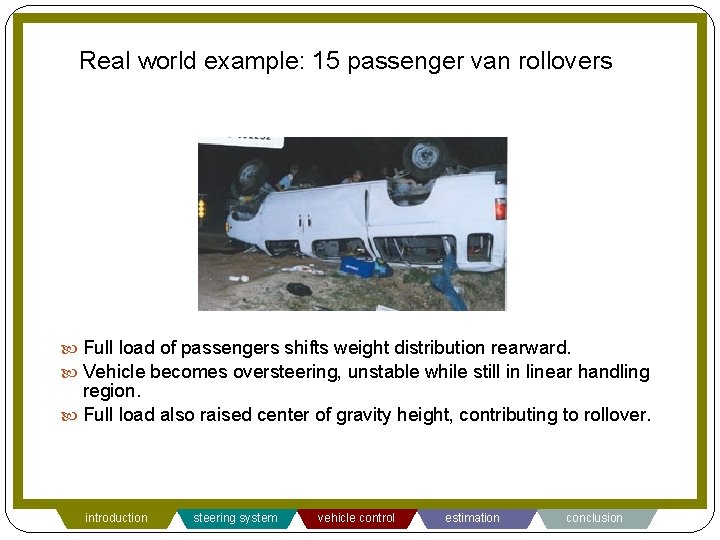
Real world example: 15 passenger van rollovers Full load of passengers shifts weight distribution rearward. Vehicle becomes oversteering, unstable while still in linear handling region. Full load also raised center of gravity height, contributing to rollover. introduction steering system vehicle control estimation conclusion
How are vehicles designed? Most vehicles designed to be understeering (by tire selection, weight distribution, suspension kinematics). Provides safety margin. Compromises responsiveness. What if we could arbitrarily change handling characteristics? Don’t need such a wide safety margin. Can make vehicle responsive without crossing over to instability. Can in fact do this with combination of steer-by-wire and state feedback! introduction steering system vehicle control estimation conclusion
Prior art Active steering has been demonstrated using yaw rate and lateral acceleration feedback (Ackermann et al. 1999, Segawa et al. 2000). Yaw rate alone not always enough (vehicle can have safe yaw rate but be skidding sideways). Many have proposed sideslip feedback for active steering in theory (Higuchi et al. 1992, Nagai et al. 1996, Lee 1997, Ono et al. 1998). Electronic stability control uses sideslip rate feedback to intervene with braking when vehicle near the limits (van Zanten 2002). No published results for smooth, continuous handling control during normal driving. introduction steering system vehicle control estimation conclusion
Research contributions An approach for precise by-wire steering control taking into account steering system dynamics and tire forces. Techniques apply to steer-by-wire design in general. The application of active steering capability and full state feedback to virtually and fundamentally modify a vehicle’s handling characteristics. Never done before due to difficulty in obtaining accurate sideslip measurement, and There just aren’t that many steer-by-wire cars around. The development and implementation of a vehicle sideslip observer based on steering forces. Two-observer structure combines steering system and vehicle dynamics the way they are naturally linked. Solve the problem of sideslip estimation. introduction steering system vehicle control estimation conclusion
Outline Steering system: precise steering control Conversion to steer-by-wire System identification Steering control design Vehicle control Estimation Conclusion and future work introduction steering system vehicle control estimation conclusion
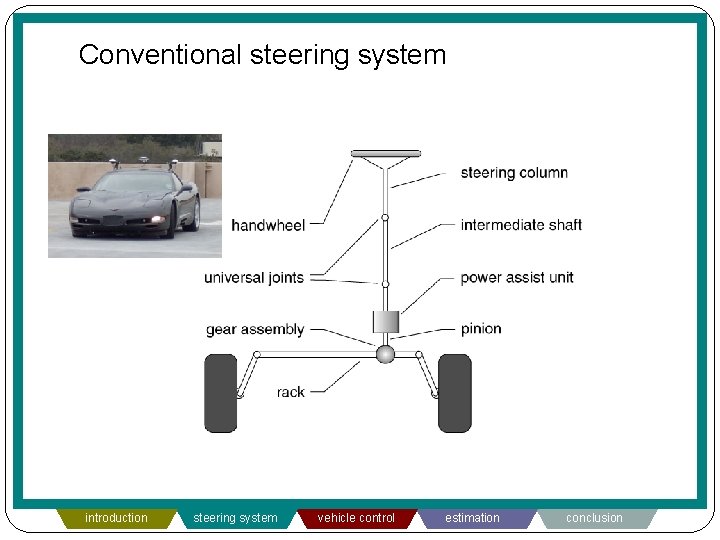
Conventional steering system introduction steering system vehicle control estimation conclusion
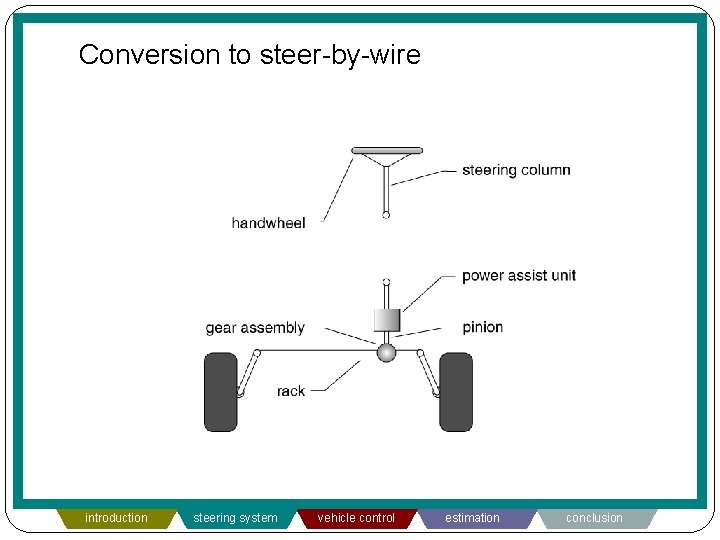
Conversion to steer-by-wire introduction steering system vehicle control estimation conclusion
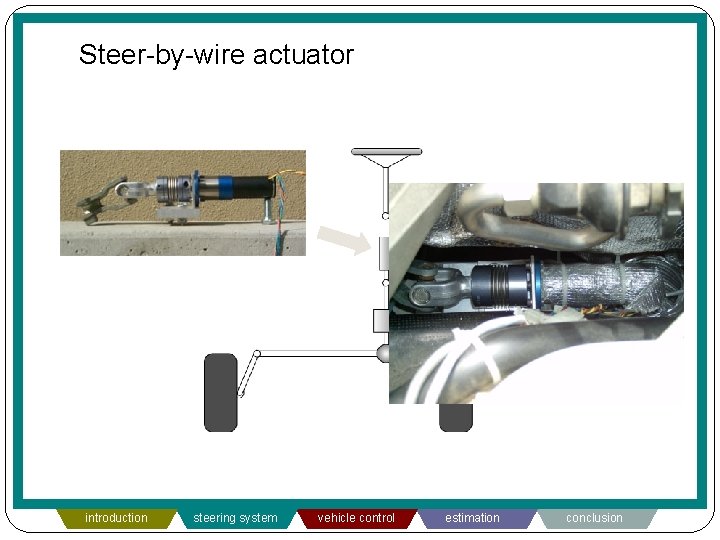
Steer-by-wire actuator introduction steering system vehicle control estimation conclusion
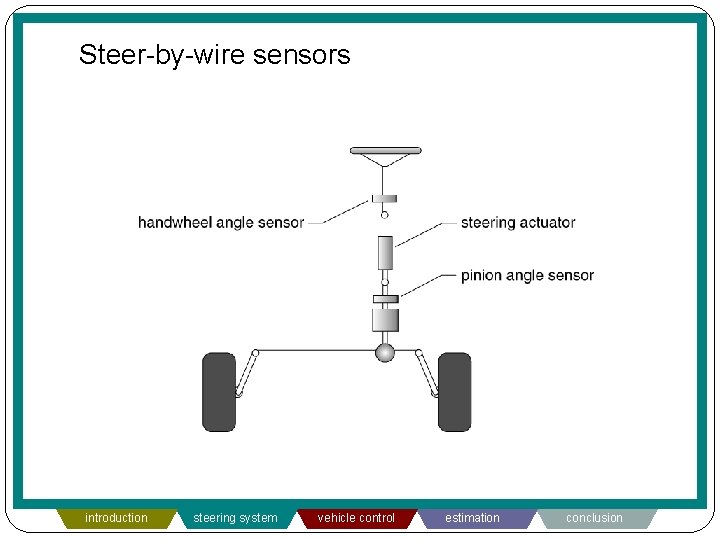
Steer-by-wire sensors introduction steering system vehicle control estimation conclusion
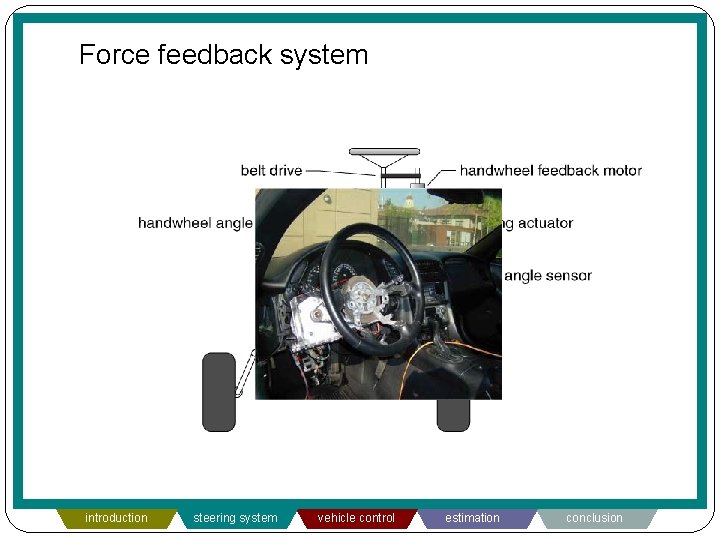
Force feedback system introduction steering system vehicle control estimation conclusion
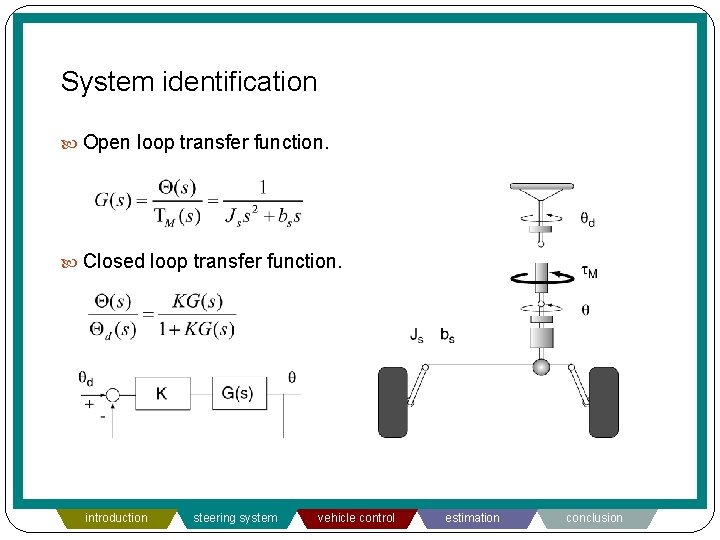
System identification Open loop transfer function. Closed loop transfer function. introduction steering system vehicle control estimation conclusion
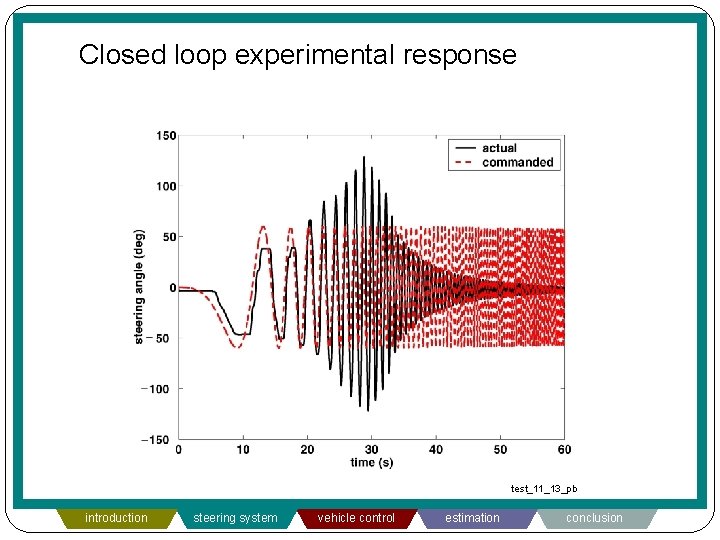
Closed loop experimental response test_11_13_pb introduction steering system vehicle control estimation conclusion
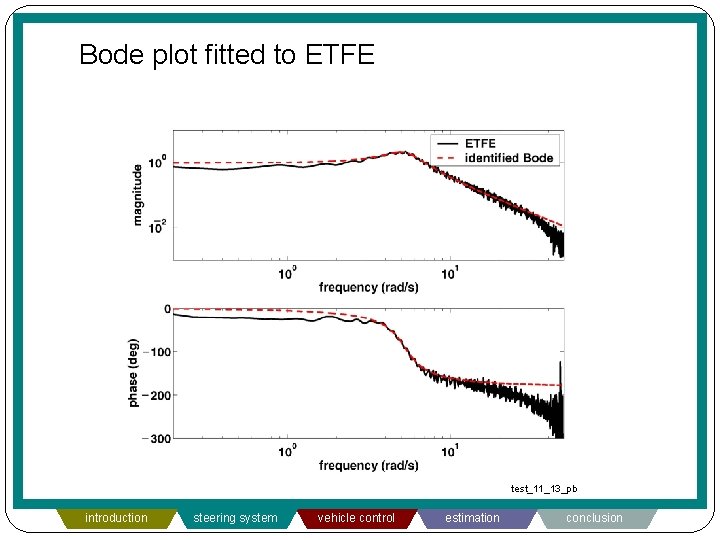
Bode plot fitted to ETFE test_11_13_pb introduction steering system vehicle control estimation conclusion
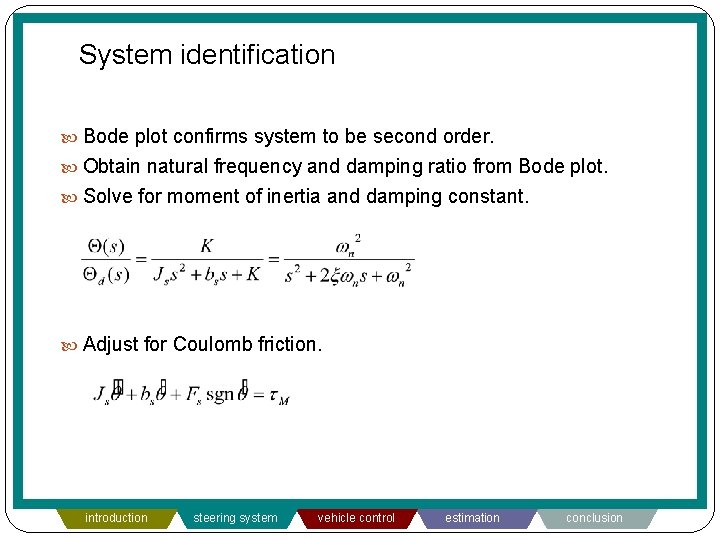
System identification Bode plot confirms system to be second order. Obtain natural frequency and damping ratio from Bode plot. Solve for moment of inertia and damping constant. Adjust for Coulomb friction. introduction steering system vehicle control estimation conclusion
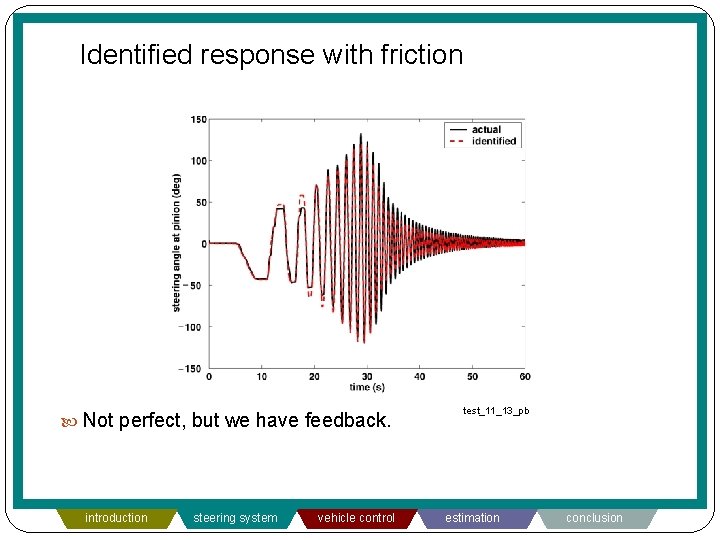
Identified response with friction Not perfect, but we have feedback. introduction steering system vehicle control test_11_13_pb estimation conclusion
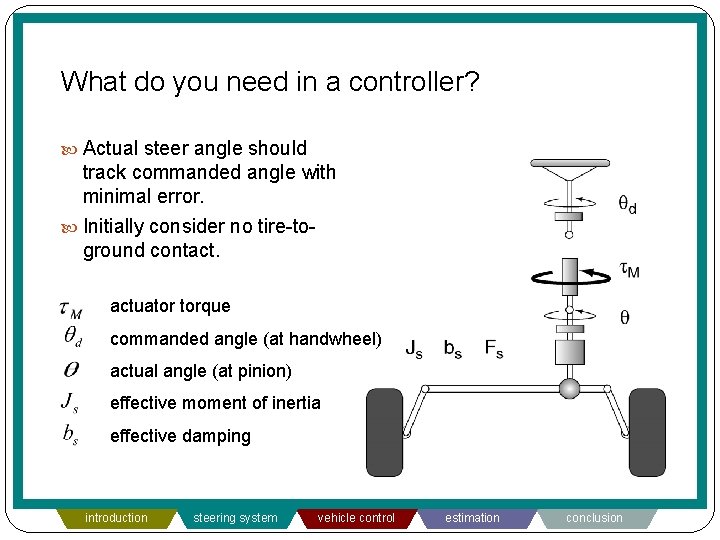
What do you need in a controller? Actual steer angle should track commanded angle with minimal error. Initially consider no tire-toground contact. actuator torque commanded angle (at handwheel) actual angle (at pinion) effective moment of inertia effective damping introduction steering system vehicle control estimation conclusion
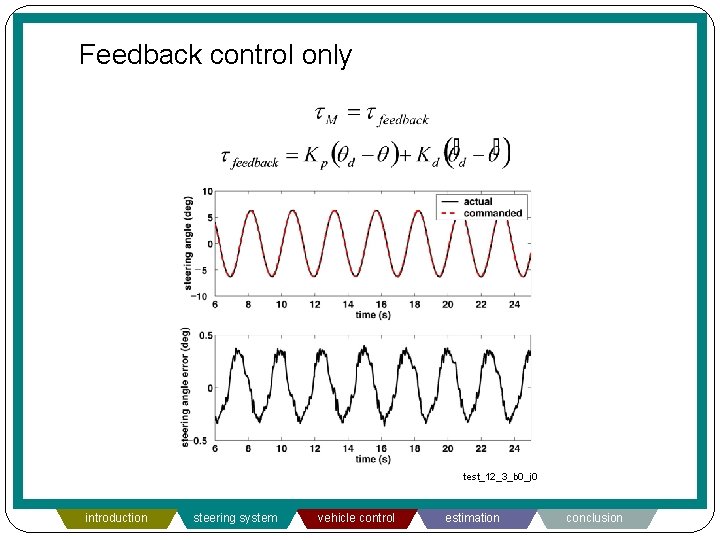
Feedback control only test_12_3_b 0_j 0 introduction steering system vehicle control estimation conclusion
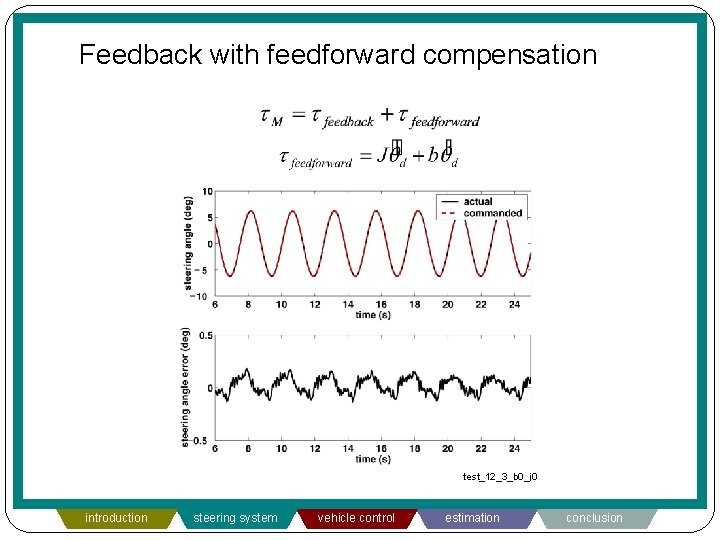
Feedback with feedforward compensation test_12_3_b 0_j 0 introduction steering system vehicle control estimation conclusion
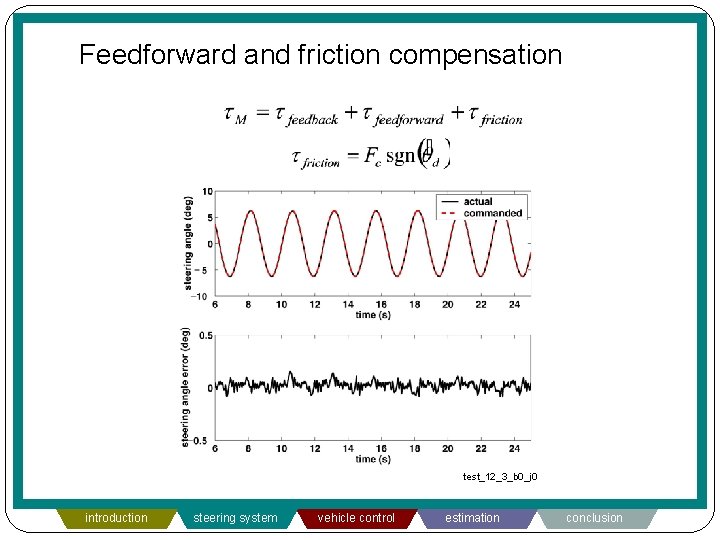
Feedforward and friction compensation test_12_3_b 0_j 0 introduction steering system vehicle control estimation conclusion
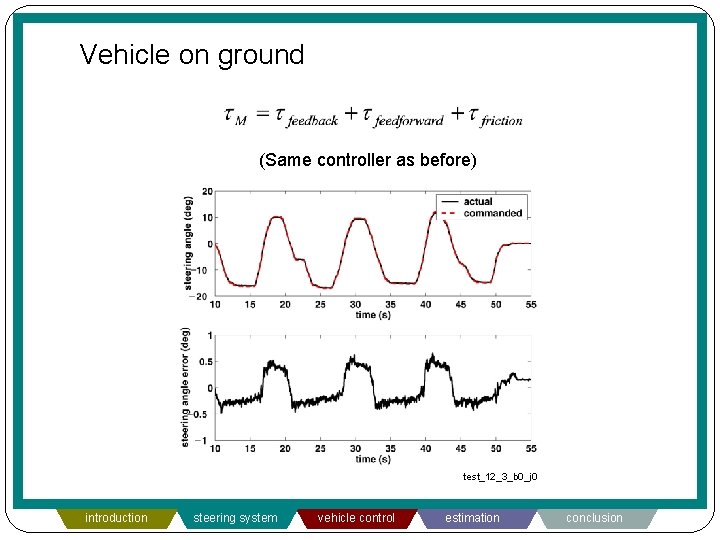
Vehicle on ground (Same controller as before) test_12_3_b 0_j 0 introduction steering system vehicle control estimation conclusion
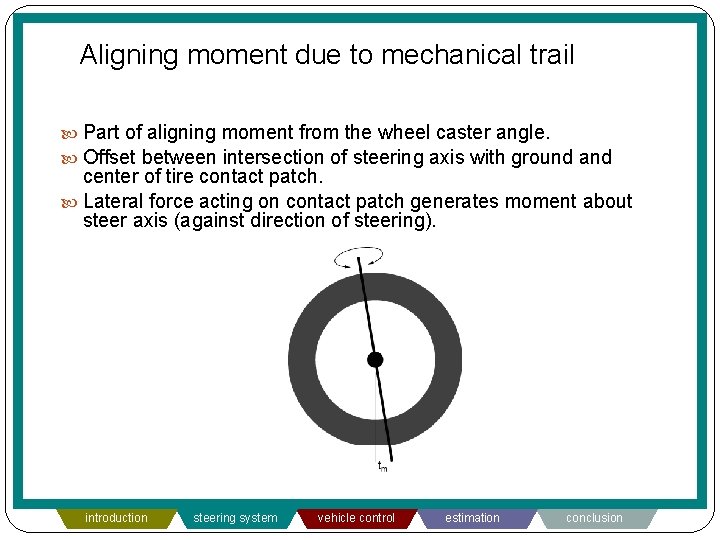
Aligning moment due to mechanical trail Part of aligning moment from the wheel caster angle. Offset between intersection of steering axis with ground and center of tire contact patch. Lateral force acting on contact patch generates moment about steer axis (against direction of steering). introduction steering system vehicle control estimation conclusion
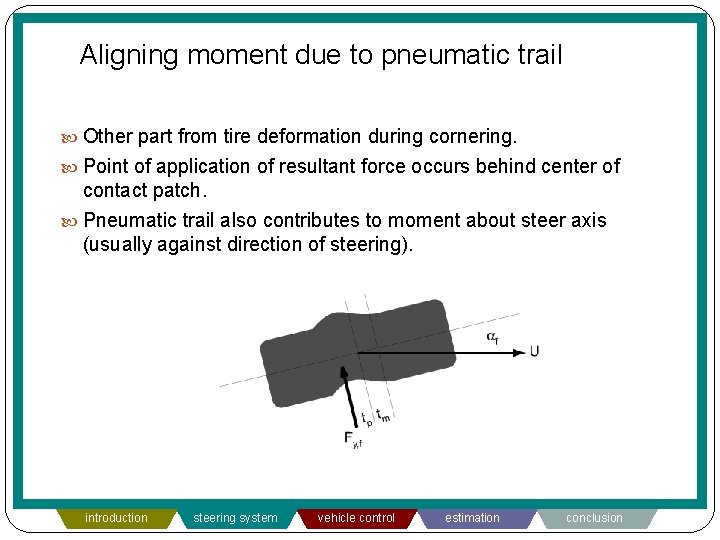
Aligning moment due to pneumatic trail Other part from tire deformation during cornering. Point of application of resultant force occurs behind center of contact patch. Pneumatic trail also contributes to moment about steer axis (usually against direction of steering). introduction steering system vehicle control estimation conclusion
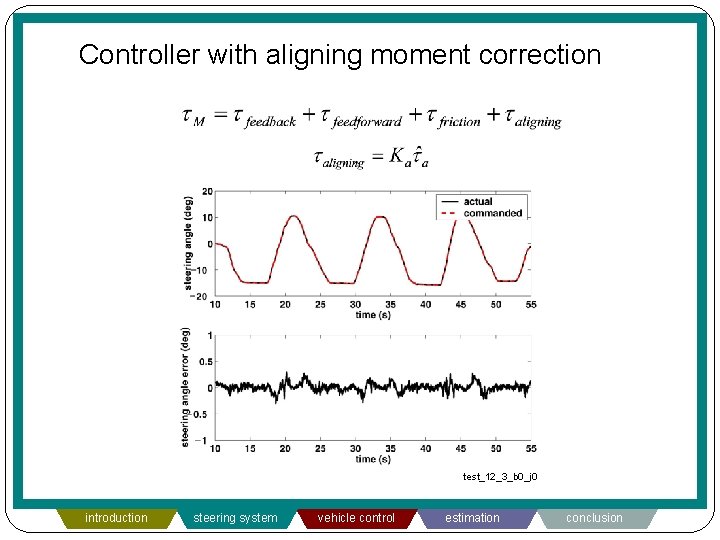
Controller with aligning moment correction test_12_3_b 0_j 0 introduction steering system vehicle control estimation conclusion
From steering to vehicle control Disturbance force acting on steering system causes tracking error. Simply increasing feedback gains may result in instability. Since we have an idea where the disturbance comes from, we cancel it out. We now have precise active steering control via steer-by-wire system…what can we do with it? introduction steering system vehicle control estimation conclusion
Outline Steering system: precise steering control Conversion to steer-by-wire System identification Steering control design Vehicle control: infinitely variable handling characteristics Handling modification Experimental results Estimation Conclusion and future work introduction steering system vehicle control estimation conclusion
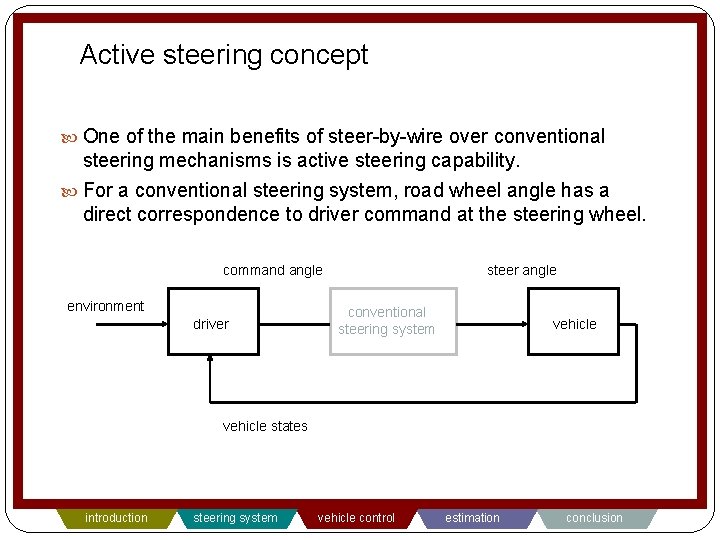
Active steering concept One of the main benefits of steer-by-wire over conventional steering mechanisms is active steering capability. For a conventional steering system, road wheel angle has a direct correspondence to driver command at the steering wheel. command angle environment driver steer angle conventional steering system vehicle states introduction steering system vehicle control estimation conclusion
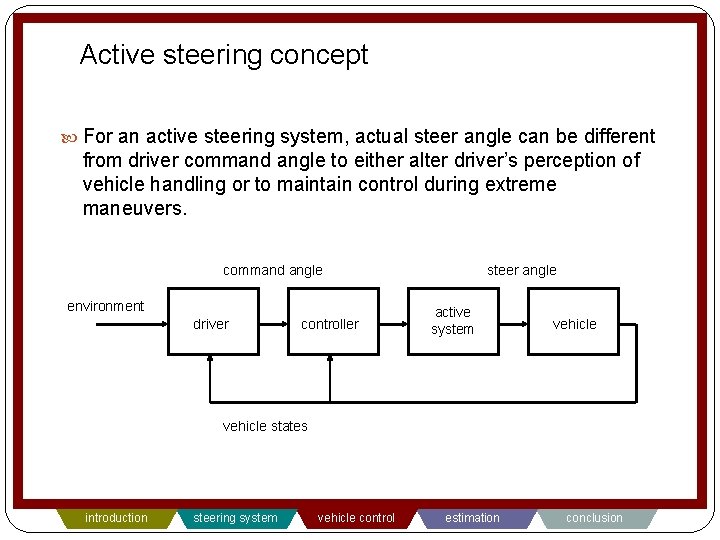
Active steering concept For an active steering system, actual steer angle can be different from driver command angle to either alter driver’s perception of vehicle handling or to maintain control during extreme maneuvers. command angle environment driver controller steer angle active system vehicle states introduction steering system vehicle control estimation conclusion
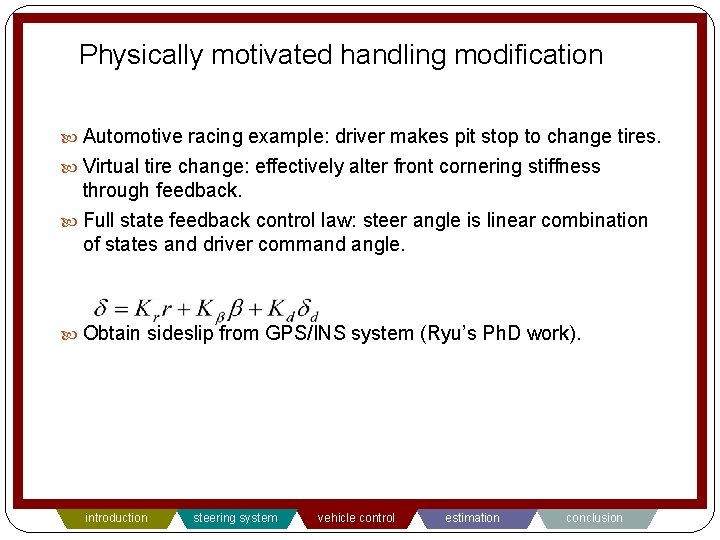
Physically motivated handling modification Automotive racing example: driver makes pit stop to change tires. Virtual tire change: effectively alter front cornering stiffness through feedback. Full state feedback control law: steer angle is linear combination of states and driver command angle. Obtain sideslip from GPS/INS system (Ryu’s Ph. D work). introduction steering system vehicle control estimation conclusion
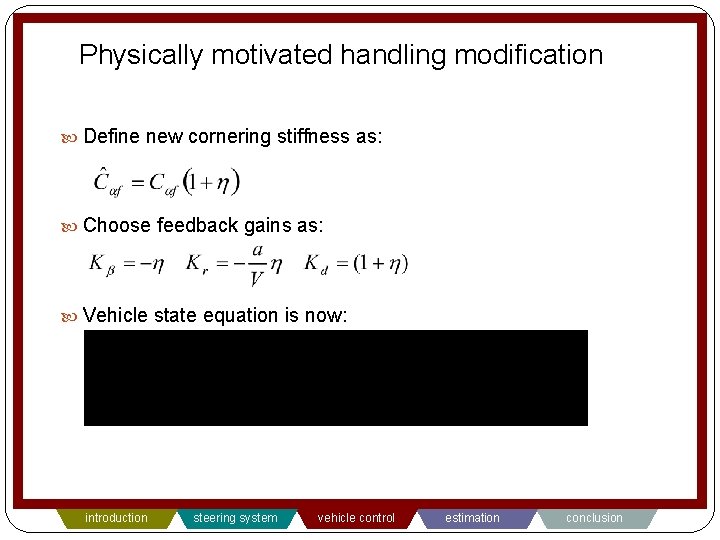
Physically motivated handling modification Define new cornering stiffness as: Choose feedback gains as: Vehicle state equation is now: introduction steering system vehicle control estimation conclusion
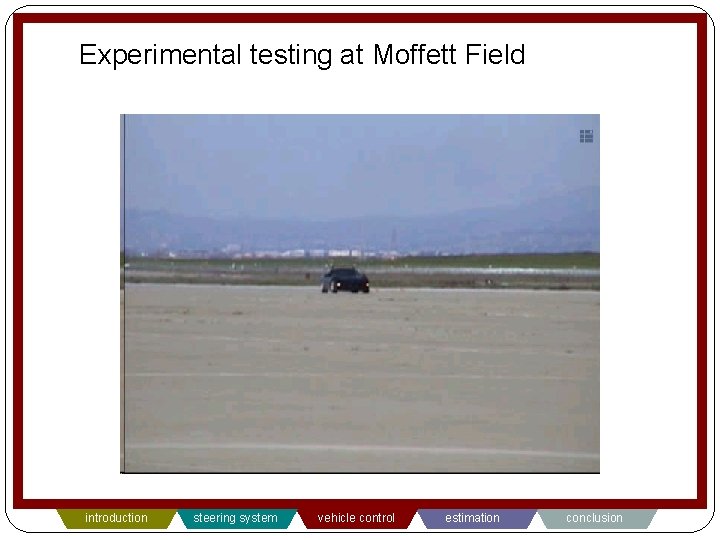
Experimental testing at Moffett Field introduction steering system vehicle control estimation conclusion
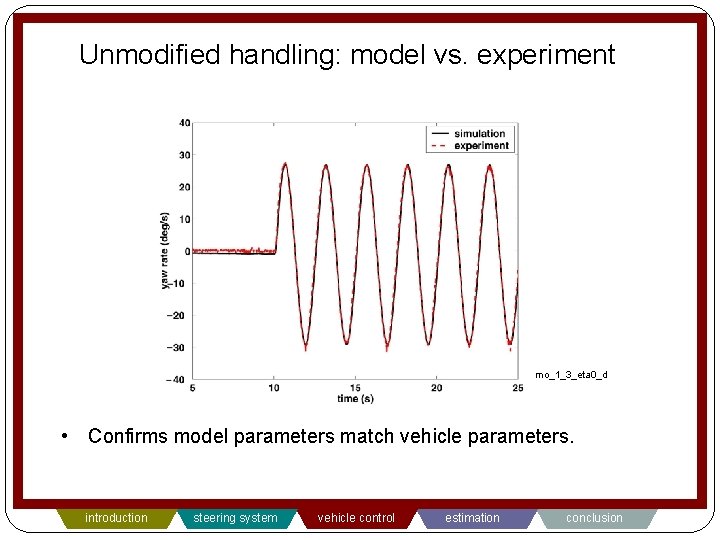
Unmodified handling: model vs. experiment mo_1_3_eta 0_d • Confirms model parameters match vehicle parameters. introduction steering system vehicle control estimation conclusion
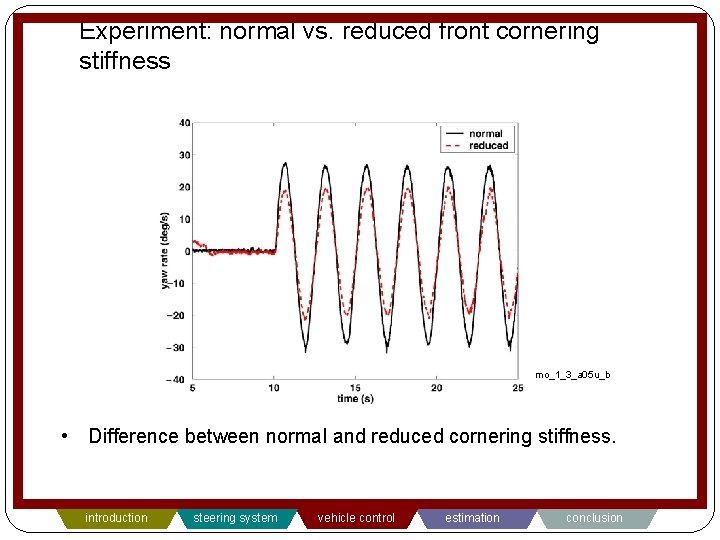
Experiment: normal vs. reduced front cornering stiffness mo_1_3_a 05 u_b • Difference between normal and reduced cornering stiffness. introduction steering system vehicle control estimation conclusion
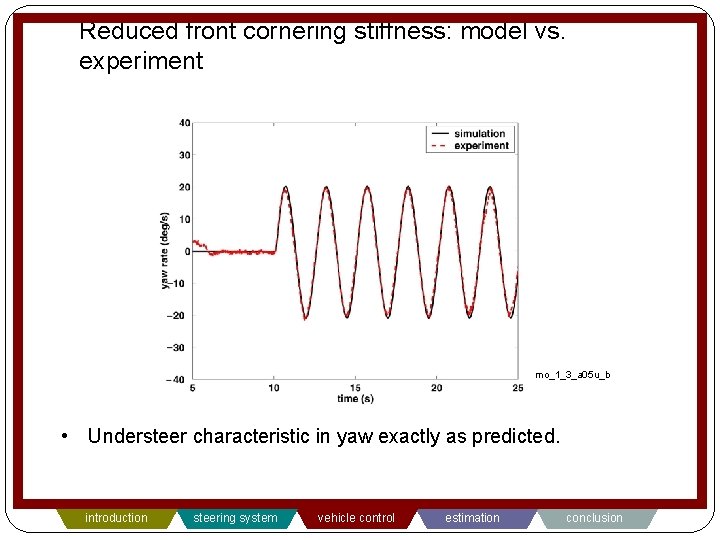
Reduced front cornering stiffness: model vs. experiment mo_1_3_a 05 u_b • Understeer characteristic in yaw exactly as predicted. introduction steering system vehicle control estimation conclusion
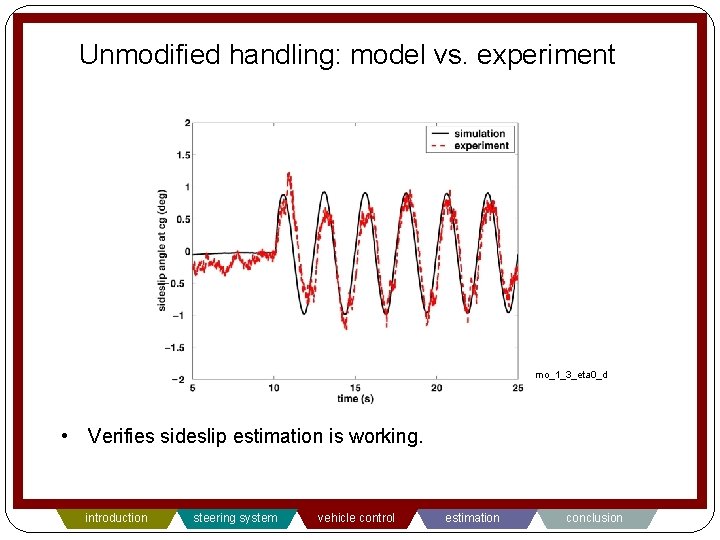
Unmodified handling: model vs. experiment mo_1_3_eta 0_d • Verifies sideslip estimation is working. introduction steering system vehicle control estimation conclusion
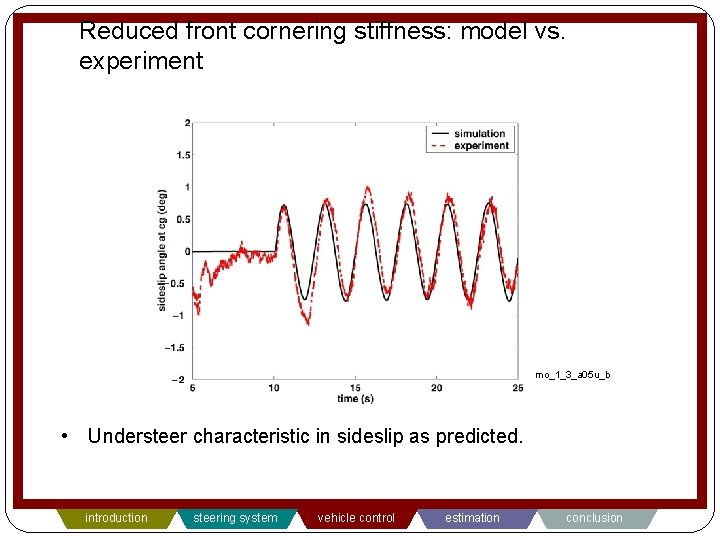
Reduced front cornering stiffness: model vs. experiment mo_1_3_a 05 u_b • Understeer characteristic in sideslip as predicted. introduction steering system vehicle control estimation conclusion
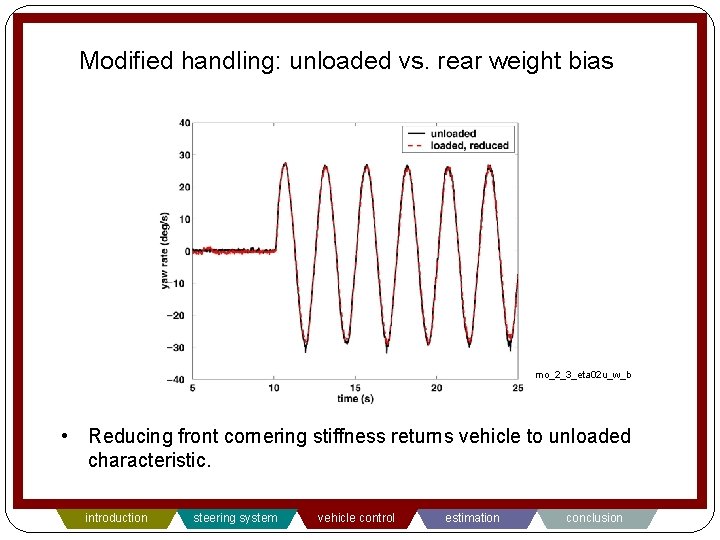
Modified handling: unloaded vs. rear weight bias mo_2_3_eta 02 u_w_b • Reducing front cornering stiffness returns vehicle to unloaded characteristic. introduction steering system vehicle control estimation conclusion
From control to estimation We need accurate, clean feedback of sideslip angle to smoothly modify a vehicle’s handling characteristics. Can we do this without GPS? introduction steering system vehicle control estimation conclusion
Outline Steering system: precise steering control Conversion to steer-by-wire System identification Steering control design Vehicle control: infinitely variable handling characteristics Handling modification Experimental results Estimation: steer-by-wire as an observer Steering disturbance observer Vehicle state observer Conclusion and future work introduction steering system vehicle control estimation conclusion
Sideslip estimation Yaw rate easily measured, but sideslip angle much more difficult to measure directly. Current approaches: GPS: loses signal under adverse conditions optical ground sensor: very expensive Steer-by-wire approach: Aligning moment transmits information about the vehicle’s motion—we canceled it out, remember? Can be determined from current applied to the steer-by-wire actuator. introduction steering system vehicle control estimation conclusion
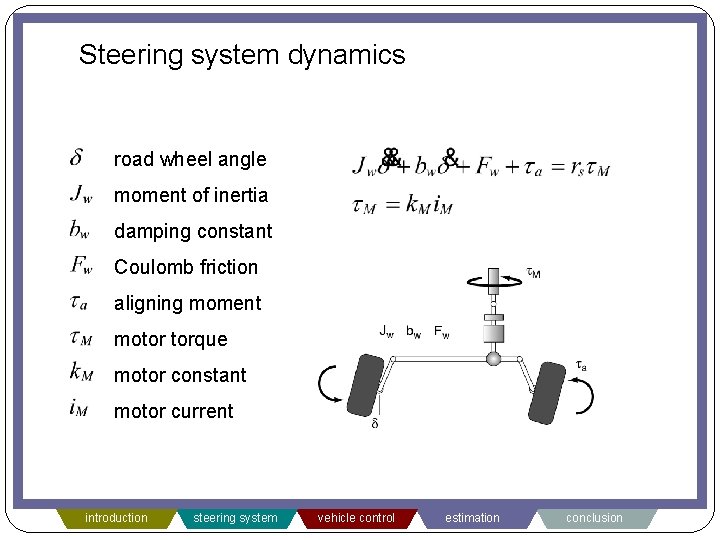
Steering system dynamics road wheel angle moment of inertia damping constant Coulomb friction aligning moment motor torque motor constant motor current introduction steering system vehicle control estimation conclusion
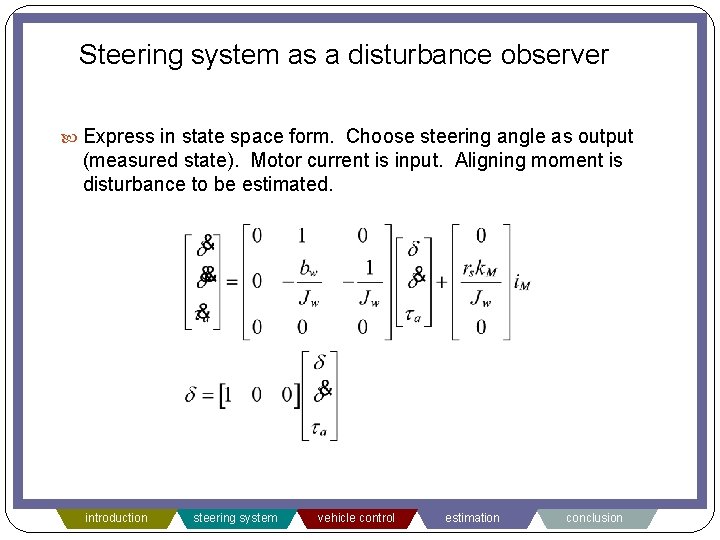
Steering system as a disturbance observer Express in state space form. Choose steering angle as output (measured state). Motor current is input. Aligning moment is disturbance to be estimated. introduction steering system vehicle control estimation conclusion
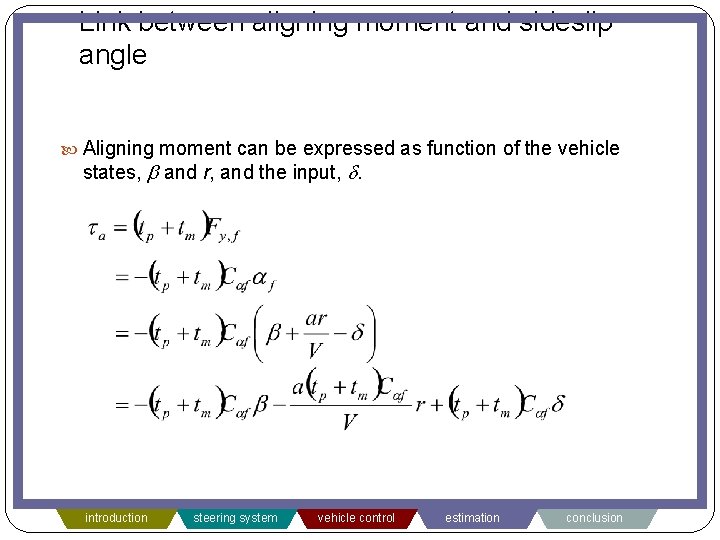
Link between aligning moment and sideslip angle Aligning moment can be expressed as function of the vehicle states, and r, and the input, d. introduction steering system vehicle control estimation conclusion
Vehicle state observer Express in state space form. Steering angle is input. Yaw rate and aligning moment (from the disturbance observer) are outputs (measurements). introduction steering system vehicle control estimation conclusion
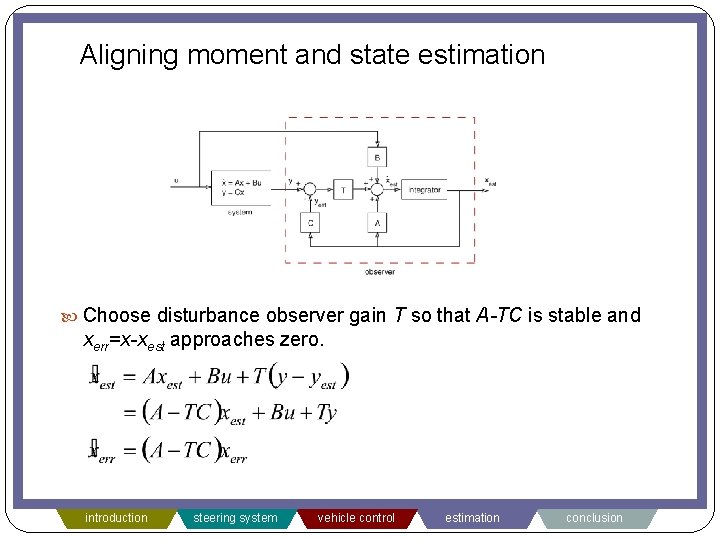
Aligning moment and state estimation Choose disturbance observer gain T so that A-TC is stable and xerr=x-xest approaches zero. introduction steering system vehicle control estimation conclusion
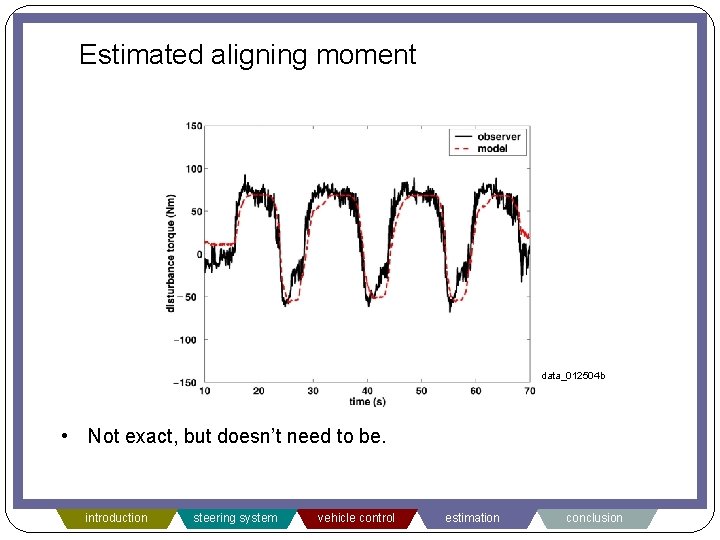
Estimated aligning moment data_012504 b • Not exact, but doesn’t need to be. introduction steering system vehicle control estimation conclusion
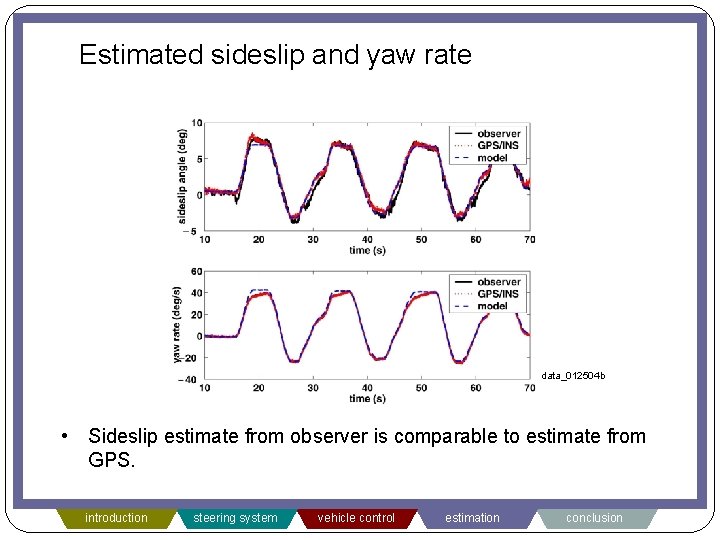
Estimated sideslip and yaw rate data_012504 b • Sideslip estimate from observer is comparable to estimate from GPS. introduction steering system vehicle control estimation conclusion
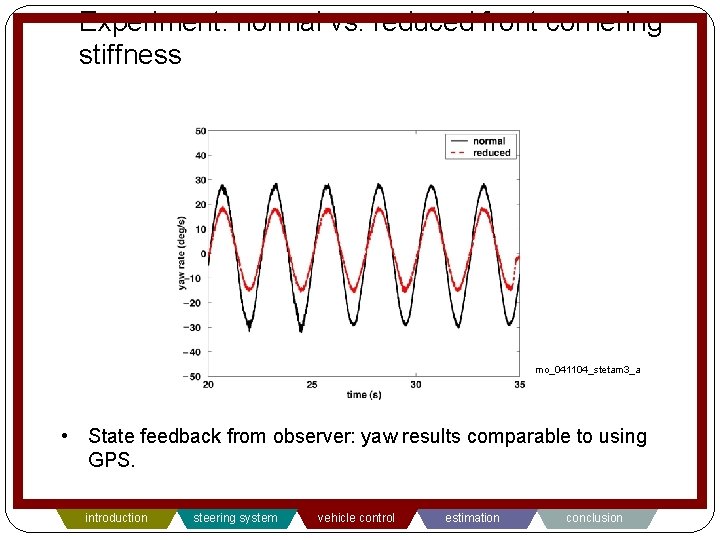
Experiment: normal vs. reduced front cornering stiffness mo_041104_stetam 3_a • State feedback from observer: yaw results comparable to using GPS. introduction steering system vehicle control estimation conclusion
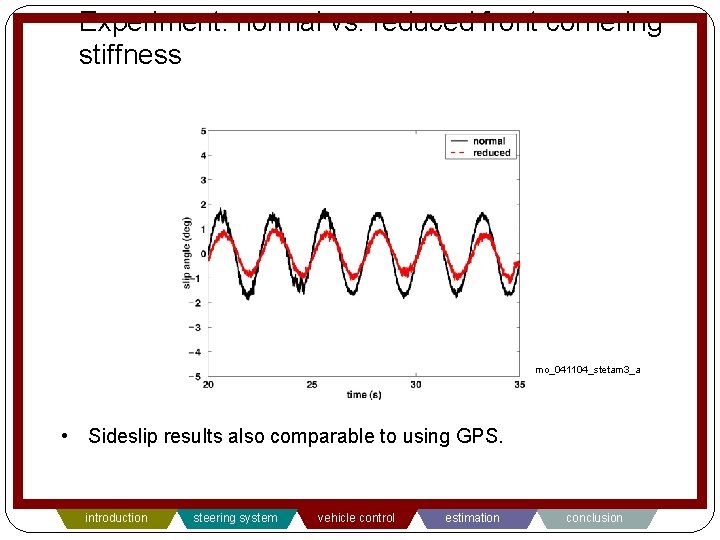
Experiment: normal vs. reduced front cornering stiffness mo_041104_stetam 3_a • Sideslip results also comparable to using GPS. introduction steering system vehicle control estimation conclusion
Conclusion Driving safety depends on a vehicle’s underlying handling characteristics. Can make handling characteristics anything we want provided we have: Precise active steering capability Full knowledge of vehicle states Precise steering control requires understanding of interaction between tire and road. Treated as disturbance to be canceled out. Vehicle state estimation uses interaction between tire and road as source of information. Seen by observer as force that govern vehicle’s motion. introduction steering system vehicle control estimation conclusion
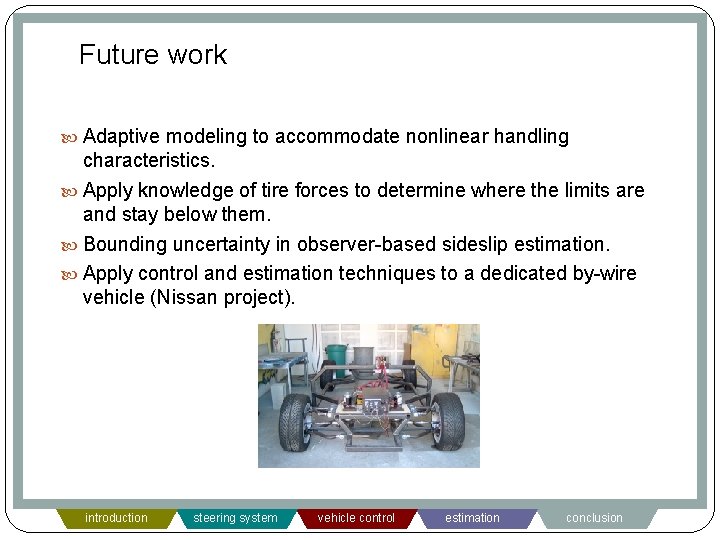
Future work Adaptive modeling to accommodate nonlinear handling characteristics. Apply knowledge of tire forces to determine where the limits are and stay below them. Bounding uncertainty in observer-based sideslip estimation. Apply control and estimation techniques to a dedicated by-wire vehicle (Nissan project). introduction steering system vehicle control estimation conclusion
- Slides: 62