
Steerable Part Models Hamed Pirsiavash and Deva Ramanan
Steerable Part Models Hamed Pirsiavash and Deva Ramanan Department of Computer Science UC Irvine
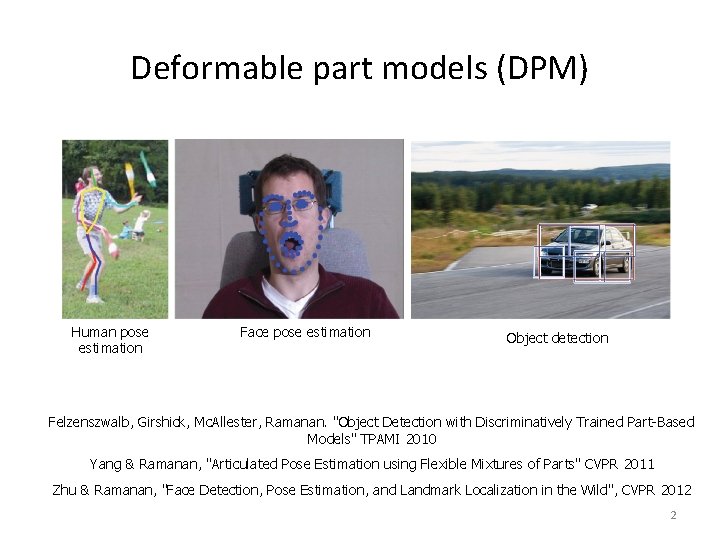
Deformable part models (DPM) Human pose estimation Face pose estimation Object detection Felzenszwalb, Girshick, Mc. Allester, Ramanan. "Object Detection with Discriminatively Trained Part-Based Models" TPAMI 2010 Yang & Ramanan, "Articulated Pose Estimation using Flexible Mixtures of Parts" CVPR 2011 Zhu & Ramanan, "Face Detection, Pose Estimation, and Landmark Localization in the Wild", CVPR 2012 2
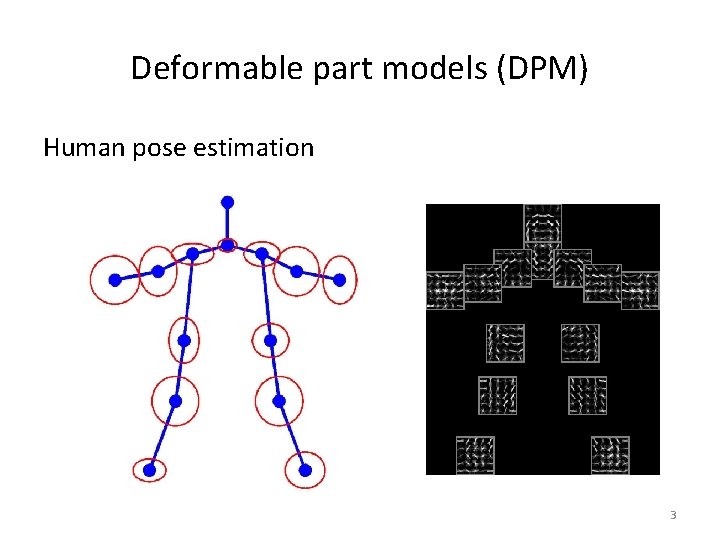
Deformable part models (DPM) Human pose estimation 3

Sample results 4
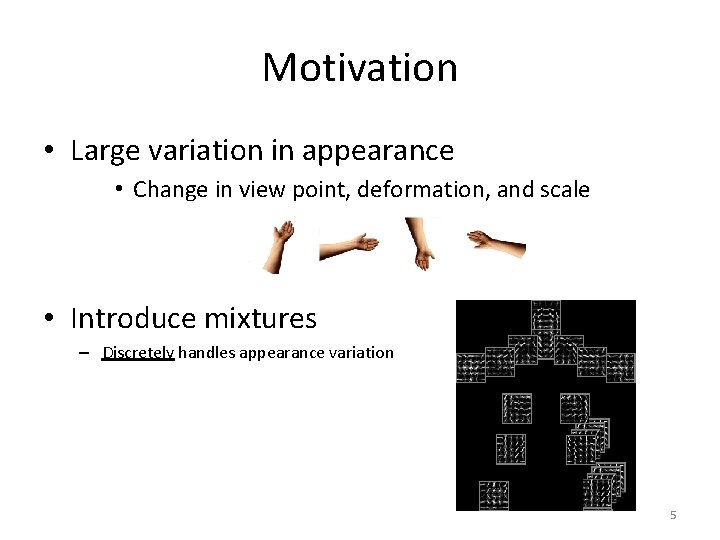
Motivation • Large variation in appearance • Change in view point, deformation, and scale • Introduce mixtures – Discretely handles appearance variation 5
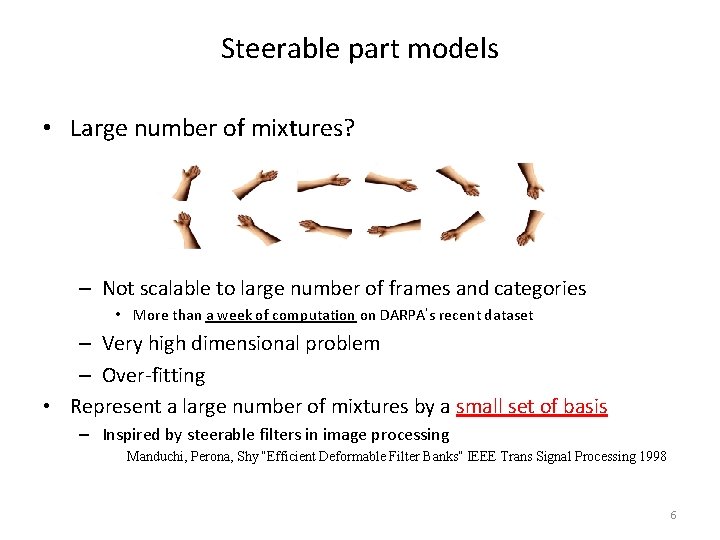
Steerable part models • Large number of mixtures? – Not scalable to large number of frames and categories • More than a week of computation on DARPA’s recent dataset – Very high dimensional problem – Over-fitting • Represent a large number of mixtures by a small set of basis – Inspired by steerable filters in image processing Manduchi, Perona, Shy “Efficient Deformable Filter Banks” IEEE Trans Signal Processing 1998 6
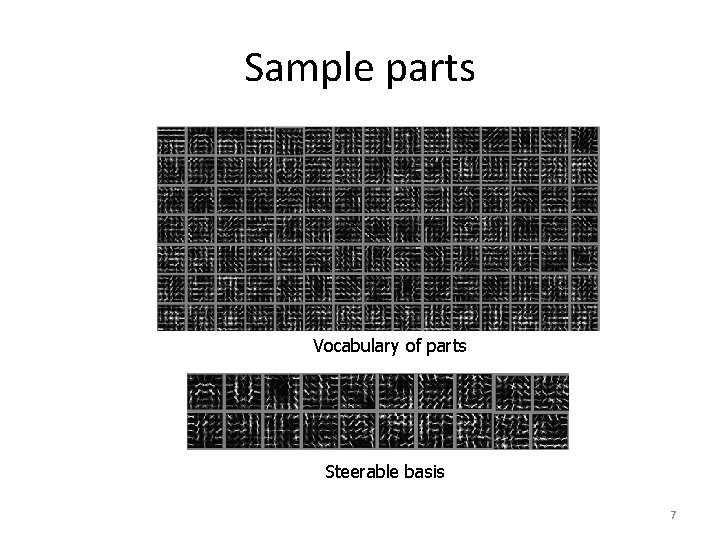
Sample parts Vocabulary of parts Steerable basis 7
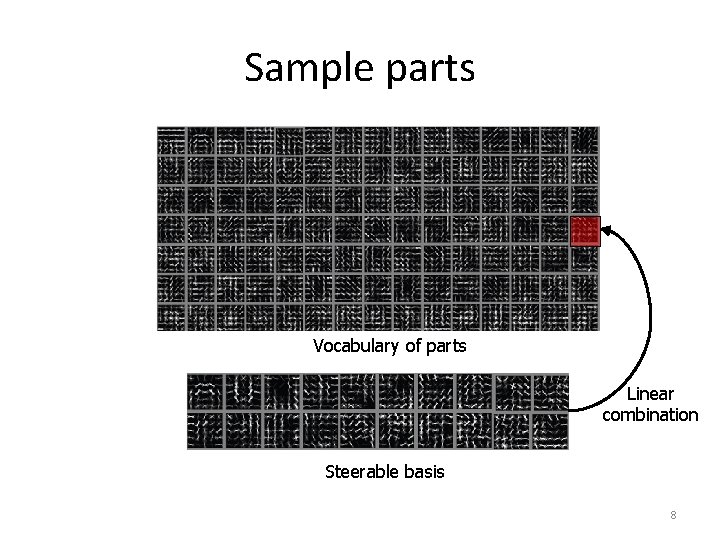
Sample parts Vocabulary of parts Linear combination Steerable basis 8
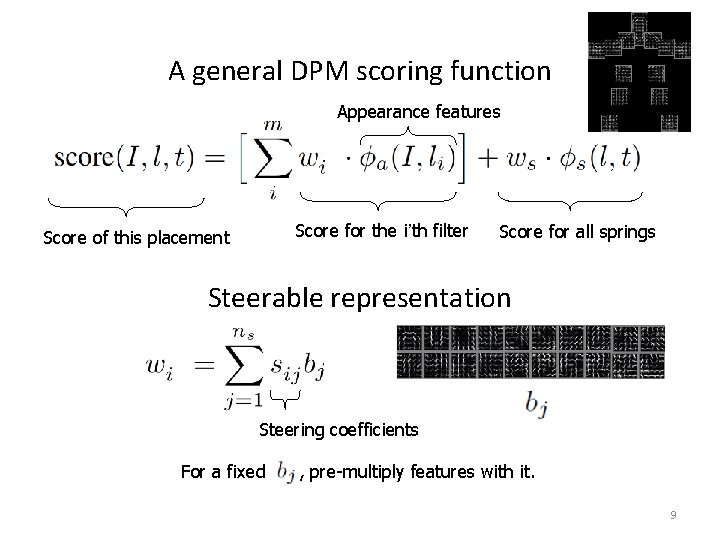
A general DPM scoring function Appearance features Score for the i’th filter Score of this placement Score for all springs Steerable representation Steering coefficients For a fixed , pre-multiply features with it. 9
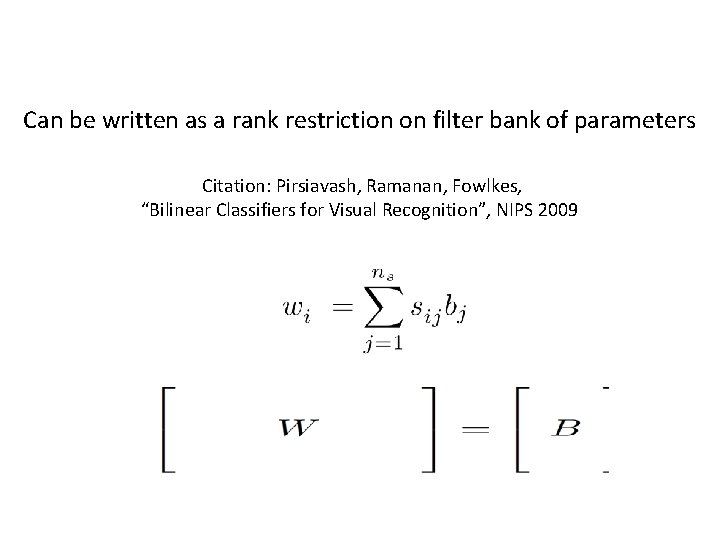
Can be written as a rank restriction on filter bank of parameters Citation: Pirsiavash, Ramanan, Fowlkes, “Bilinear Classifiers for Visual Recognition”, NIPS 2009
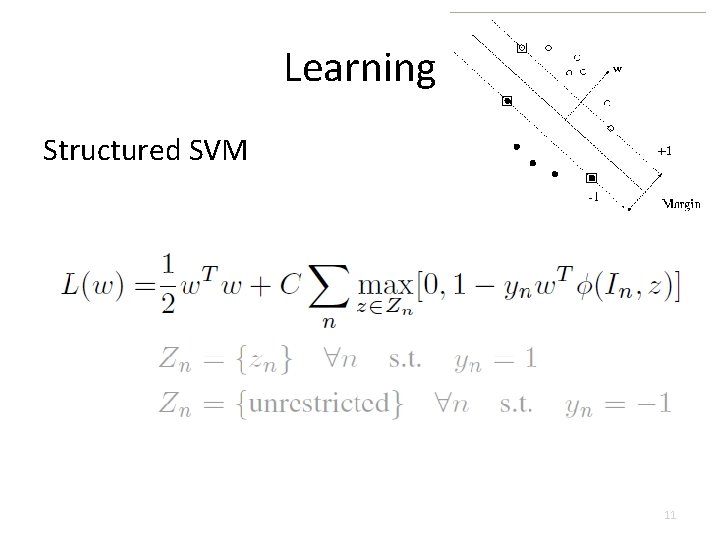
Learning Structured SVM 11
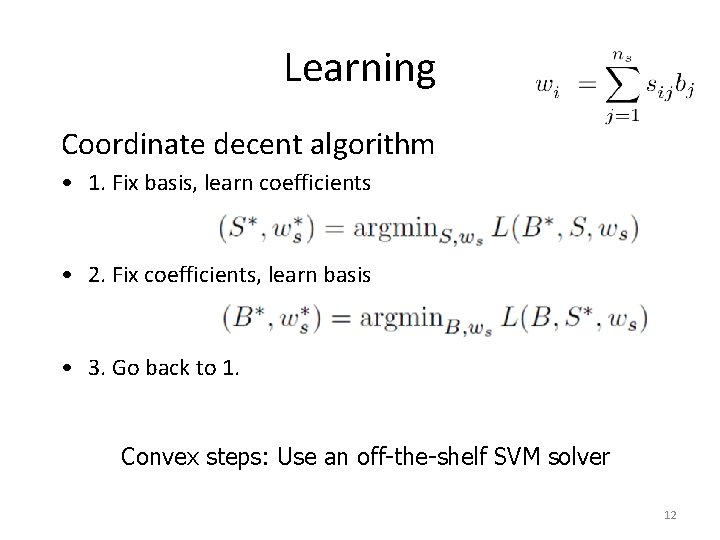
Learning Coordinate decent algorithm • 1. Fix basis, learn coefficients • 2. Fix coefficients, learn basis • 3. Go back to 1. Convex steps: Use an off-the-shelf SVM solver 12
Why is this a good idea? – Sharing • Share basis across different categories – Regularization • Less number of parameters – Computation • Score basis filters • Then, reconstruct filter scores by linear combination 13
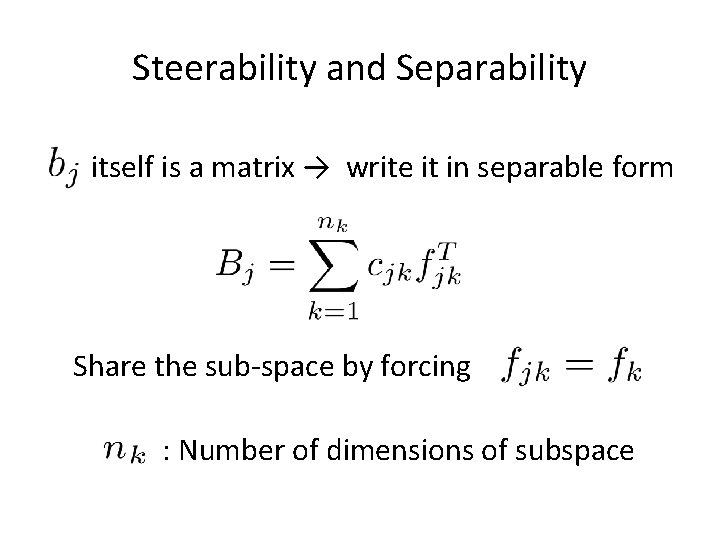
Steerability and Separability itself is a matrix → write it in separable form Share the sub-space by forcing : Number of dimensions of subspace
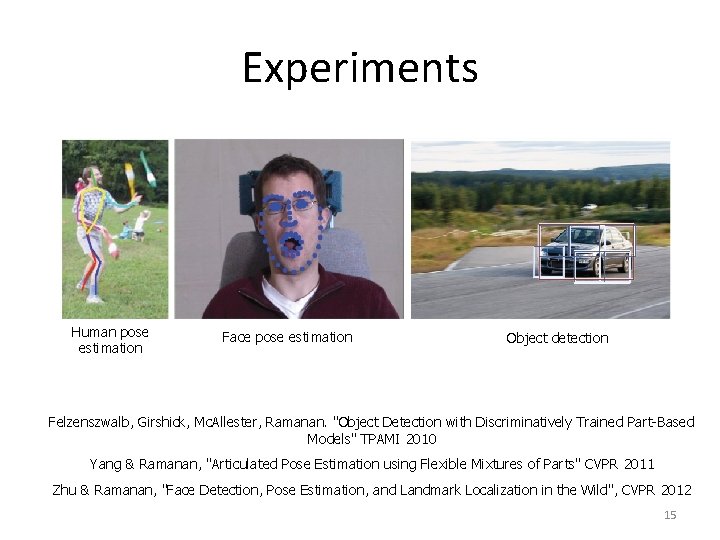
Experiments Human pose estimation Face pose estimation Object detection Felzenszwalb, Girshick, Mc. Allester, Ramanan. "Object Detection with Discriminatively Trained Part-Based Models" TPAMI 2010 Yang & Ramanan, "Articulated Pose Estimation using Flexible Mixtures of Parts" CVPR 2011 Zhu & Ramanan, "Face Detection, Pose Estimation, and Landmark Localization in the Wild", CVPR 2012 15
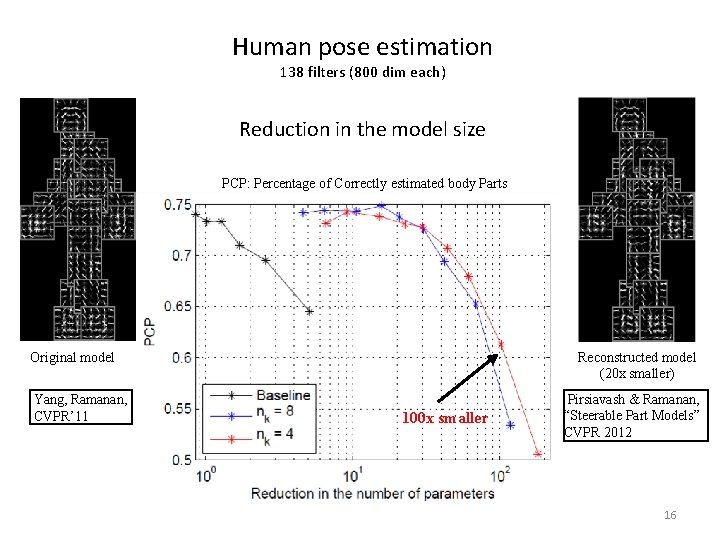
Human pose estimation 138 filters (800 dim each) Reduction in the model size PCP: Percentage of Correctly estimated body Parts Original model Yang, Ramanan, CVPR’ 11 Reconstructed model (20 x smaller) 100 x smaller Pirsiavash & Ramanan, “Steerable Part Models” CVPR 2012 16
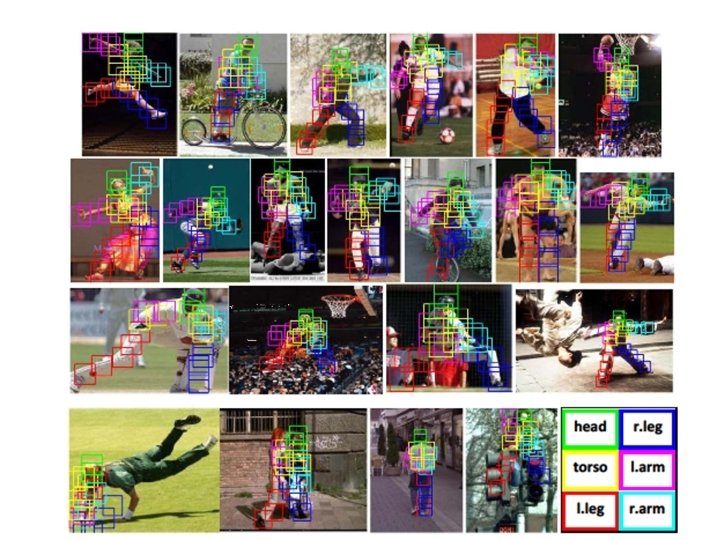
17
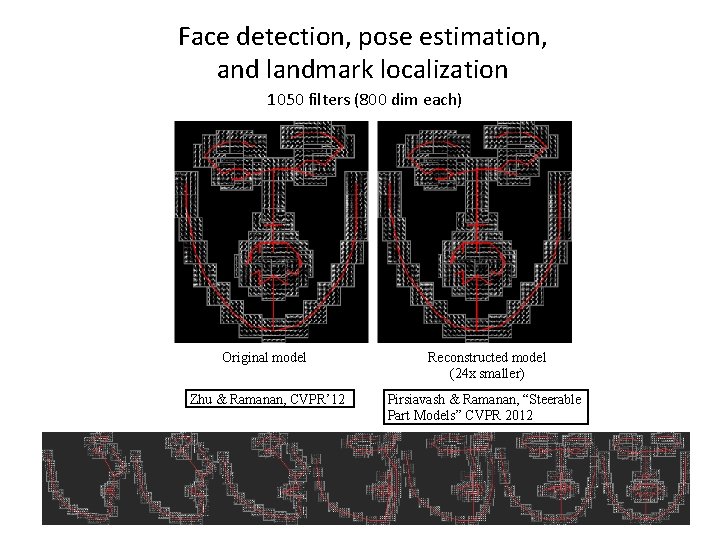
Face detection, pose estimation, and landmark localization 1050 filters (800 dim each) Original model Reconstructed model (24 x smaller) Zhu & Ramanan, CVPR’ 12 Pirsiavash & Ramanan, “Steerable Part Models” CVPR 2012 18
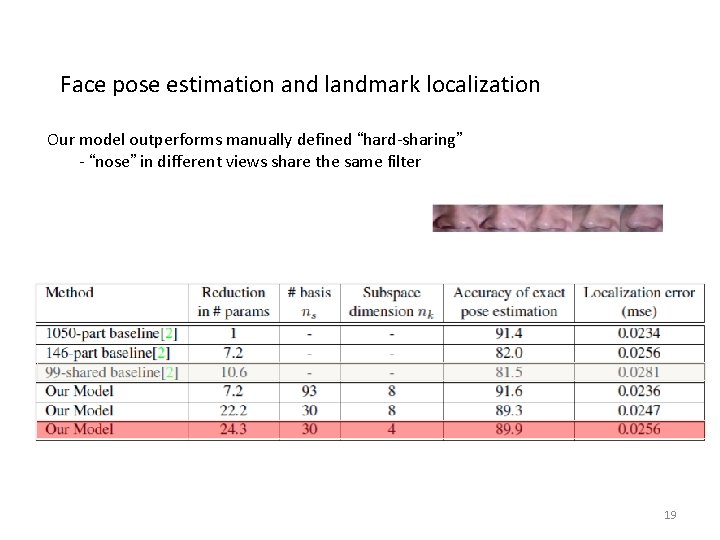
Face pose estimation and landmark localization Our model outperforms manually defined “hard-sharing” - “nose” in different views share the same filter 19
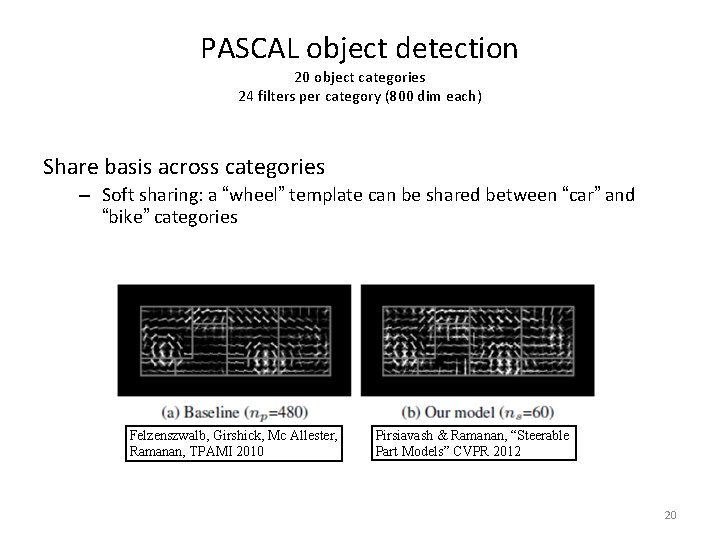
PASCAL object detection 20 object categories 24 filters per category (800 dim each) Share basis across categories – Soft sharing: a “wheel” template can be shared between “car” and “bike” categories Felzenszwalb, Girshick, Mc Allester, Ramanan, TPAMI 2010 Pirsiavash & Ramanan, “Steerable Part Models” CVPR 2012 20
Conclusion • We write part templates as linear filter banks. • We leverage existing SVM-solvers to learn steerable representations using rank-constraints. • We demonstrate impressive results on three diverse problems showing improvements up to 10 x-100 x in size and speed. • We demonstrate that steerable structure can be shared across different object categories.
- Slides: 21