
Steep Turns Private Pilot Curriculum Stephen Saslow August

- Slides: 22
Steep Turns Private Pilot Curriculum Stephen Saslow August 2020
Objective The student should develop knowledge of the elements related to steep turns (load factors, torque, adverse yaw, and the overbanking tendency). The student should have the ability to perform a steep turn as required in the ACS/PTS.
Elements of Steep Turns • 1. Maximum Performance Turn • 2. The Science Behind It • 3. Performing The Steep Turn
What are Steep Turns, Why Do We Learn Them? The steep turn maneuver consists of a constant altitude turn in either direction, using a bank angle between 45 degree to 50 degree (45 degree Private, or 50 degree - Commercial). This will cause an overbanking tendency during which maximum turning performance is attained and relatively high load factors are imposed. Steep turns develop smoothness, coordination, orientation, division of attention, and control techniques necessary for the execution of maximum performance turns. The pilot also understands the effects of the over banking tendency and how to counteract it.
What is a Steep Turn How To Perform A Steep Turn • A steep turn is a maximum performance turn • An airplane’s maximum turning performance is its fastest rate of turn and shortest radius of turn • This changes with both airspeed angle of bank • • The higher the airspeed, the bigger the radius The higher the bank angle, the smaller the radius • In addition to other factors, the maximum bank angle is determined by the limiting load factor which can be maintained without stalling or exceeding the airplane’s structural limitations • In most small airplanes the max bank is approx. 50 to 60 degrees
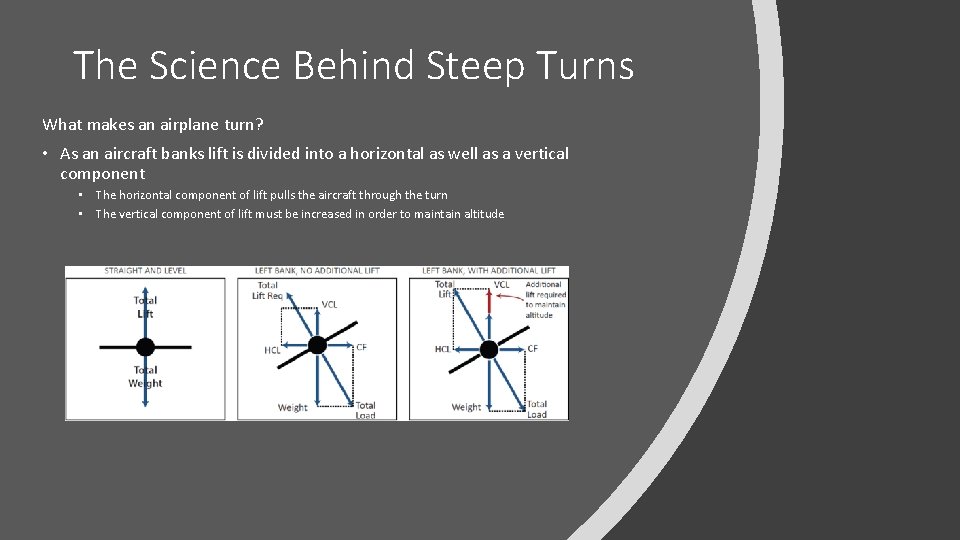
The Science Behind Steep Turns What makes an airplane turn? • As an aircraft banks lift is divided into a horizontal as well as a vertical component • The horizontal component of lift pulls the aircraft through the turn • The vertical component of lift must be increased in order to maintain altitude
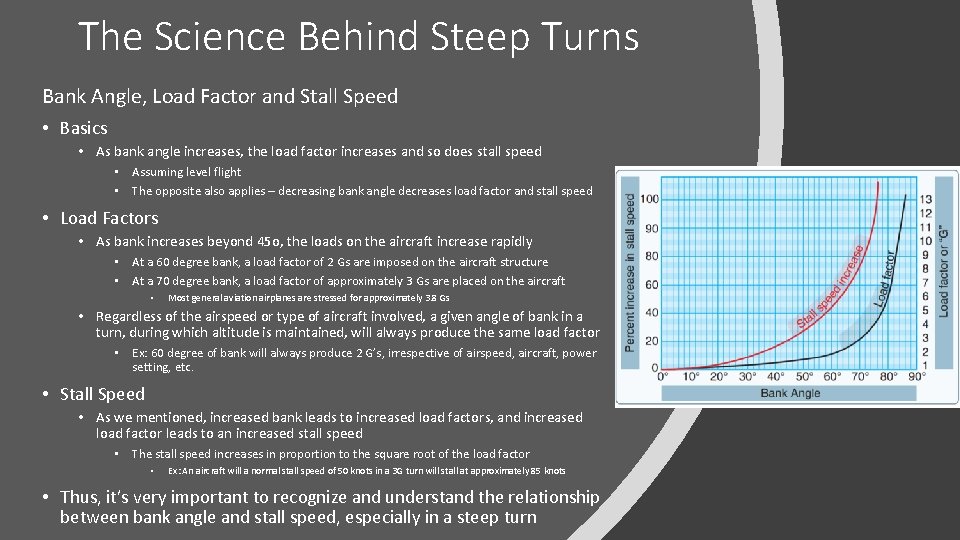
The Science Behind Steep Turns Bank Angle, Load Factor and Stall Speed • Basics • As bank angle increases, the load factor increases and so does stall speed • Assuming level flight • The opposite also applies – decreasing bank angle decreases load factor and stall speed • Load Factors • As bank increases beyond 45 o, the loads on the aircraft increase rapidly • At a 60 degree bank, a load factor of 2 Gs are imposed on the aircraft structure • At a 70 degree bank, a load factor of approximately 3 Gs are placed on the aircraft • Most general aviation airplanes are stressed for approximately 3. 8 Gs • Regardless of the airspeed or type of aircraft involved, a given angle of bank in a turn, during which altitude is maintained, will always produce the same load factor • Ex: 60 degree of bank will always produce 2 G’s, irrespective of airspeed, aircraft, power setting, etc. • Stall Speed • As we mentioned, increased bank leads to increased load factors, and increased load factor leads to an increased stall speed • The stall speed increases in proportion to the square root of the load factor • Ex: An aircraft will a normal stall speed of 50 knots in a 3 G turn will stall at approximately 85 knots • Thus, it’s very important to recognize and understand the relationship between bank angle and stall speed, especially in a steep turn
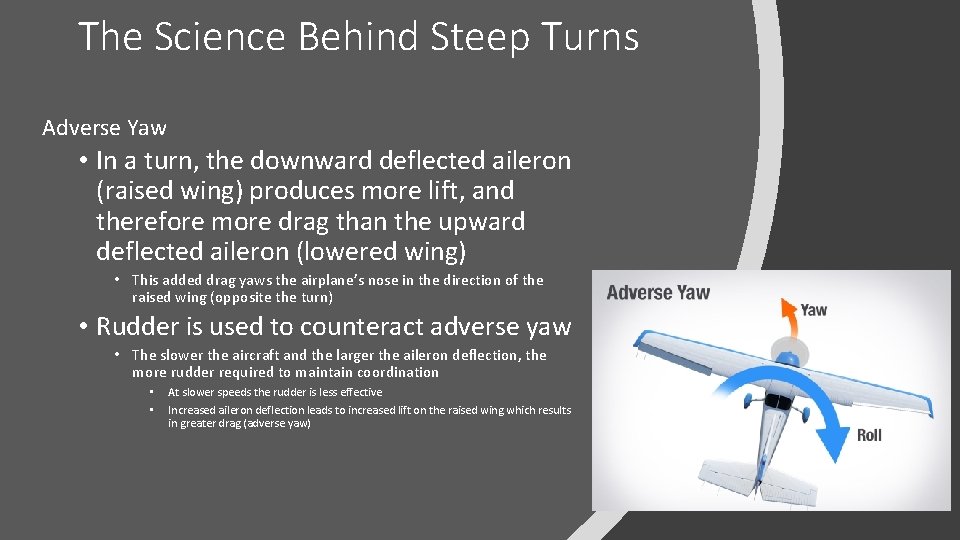
The Science Behind Steep Turns Adverse Yaw • In a turn, the downward deflected aileron (raised wing) produces more lift, and therefore more drag than the upward deflected aileron (lowered wing) • This added drag yaws the airplane’s nose in the direction of the raised wing (opposite the turn) • Rudder is used to counteract adverse yaw • The slower the aircraft and the larger the aileron deflection, the more rudder required to maintain coordination • • At slower speeds the rudder is less effective Increased aileron deflection leads to increased lift on the raised wing which results in greater drag (adverse yaw)
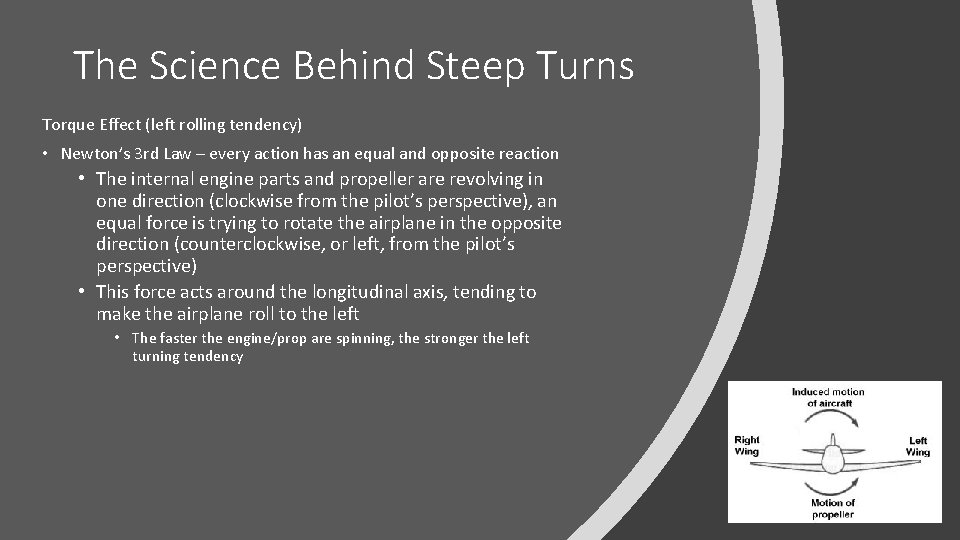
The Science Behind Steep Turns Torque Effect (left rolling tendency) • Newton’s 3 rd Law – every action has an equal and opposite reaction • The internal engine parts and propeller are revolving in one direction (clockwise from the pilot’s perspective), an equal force is trying to rotate the airplane in the opposite direction (counterclockwise, or left, from the pilot’s perspective) • This force acts around the longitudinal axis, tending to make the airplane roll to the left • The faster the engine/prop are spinning, the stronger the left turning tendency
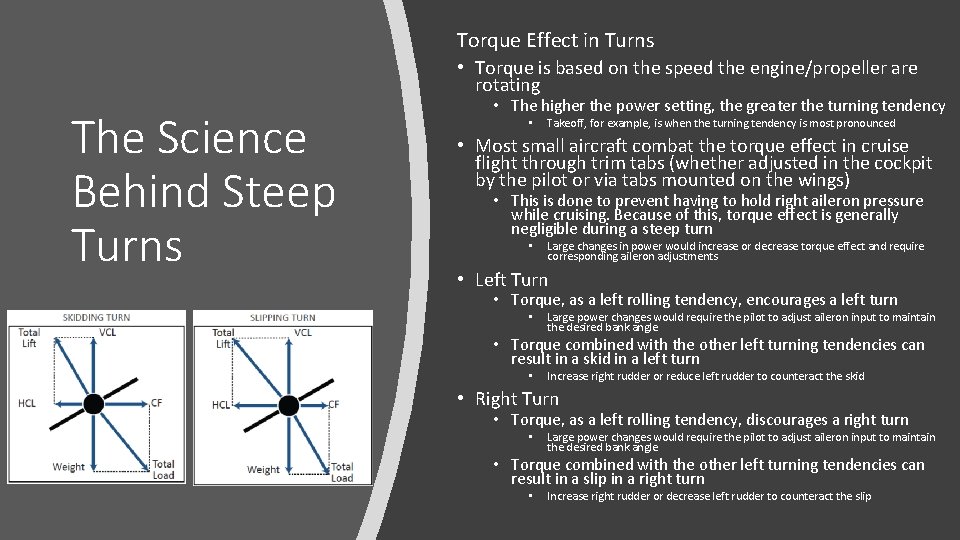
Torque Effect in Turns • Torque is based on the speed the engine/propeller are rotating The Science Behind Steep Turns • The higher the power setting, the greater the turning tendency • Takeoff, for example, is when the turning tendency is most pronounced • Most small aircraft combat the torque effect in cruise flight through trim tabs (whether adjusted in the cockpit by the pilot or via tabs mounted on the wings) • This is done to prevent having to hold right aileron pressure while cruising. Because of this, torque effect is generally negligible during a steep turn • Large changes in power would increase or decrease torque effect and require corresponding aileron adjustments • Left Turn • Torque, as a left rolling tendency, encourages a left turn • Large power changes would require the pilot to adjust aileron input to maintain the desired bank angle • Torque combined with the other left turning tendencies can result in a skid in a left turn • Increase right rudder or reduce left rudder to counteract the skid • Right Turn • Torque, as a left rolling tendency, discourages a right turn • Large power changes would require the pilot to adjust aileron input to maintain the desired bank angle • Torque combined with the other left turning tendencies can result in a slip in a right turn • Increase right rudder or decrease left rudder to counteract the slip
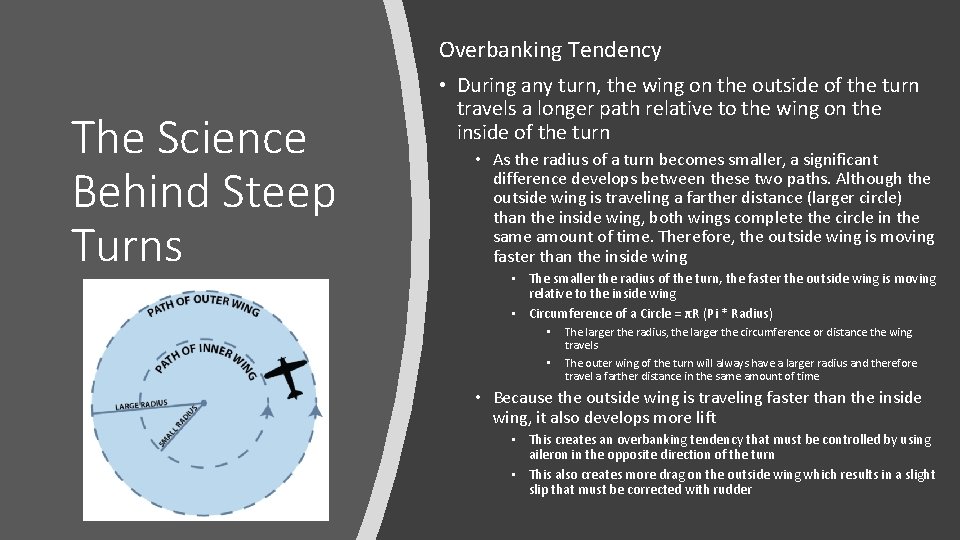
Overbanking Tendency The Science Behind Steep Turns • During any turn, the wing on the outside of the turn travels a longer path relative to the wing on the inside of the turn • As the radius of a turn becomes smaller, a significant difference develops between these two paths. Although the outside wing is traveling a farther distance (larger circle) than the inside wing, both wings complete the circle in the same amount of time. Therefore, the outside wing is moving faster than the inside wing • The smaller the radius of the turn, the faster the outside wing is moving relative to the inside wing • Circumference of a Circle = πR (Pi * Radius) • • The larger the radius, the larger the circumference or distance the wing travels The outer wing of the turn will always have a larger radius and therefore travel a farther distance in the same amount of time • Because the outside wing is traveling faster than the inside wing, it also develops more lift • This creates an overbanking tendency that must be controlled by using aileron in the opposite direction of the turn • This also creates more drag on the outside wing which results in a slight slip that must be corrected with rudder
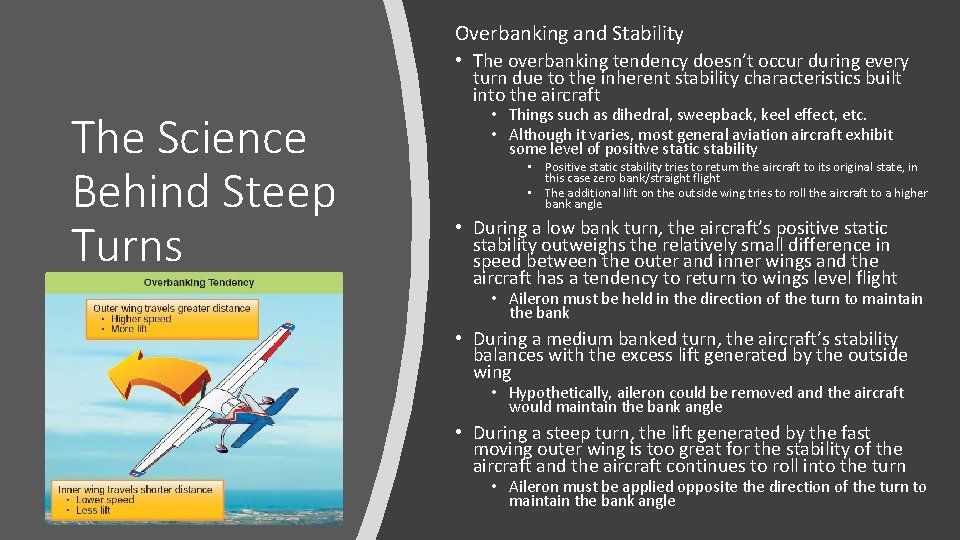
Overbanking and Stability The Science Behind Steep Turns • The overbanking tendency doesn’t occur during every turn due to the inherent stability characteristics built into the aircraft • Things such as dihedral, sweepback, keel effect, etc. • Although it varies, most general aviation aircraft exhibit some level of positive static stability • Positive static stability tries to return the aircraft to its original state, in this case zero bank/straight flight • The additional lift on the outside wing tries to roll the aircraft to a higher bank angle • During a low bank turn, the aircraft’s positive static stability outweighs the relatively small difference in speed between the outer and inner wings and the aircraft has a tendency to return to wings level flight • Aileron must be held in the direction of the turn to maintain the bank • During a medium banked turn, the aircraft’s stability balances with the excess lift generated by the outside wing • Hypothetically, aileron could be removed and the aircraft would maintain the bank angle • During a steep turn, the lift generated by the fast moving outer wing is too great for the stability of the aircraft and the aircraft continues to roll into the turn • Aileron must be applied opposite the direction of the turn to maintain the bank angle
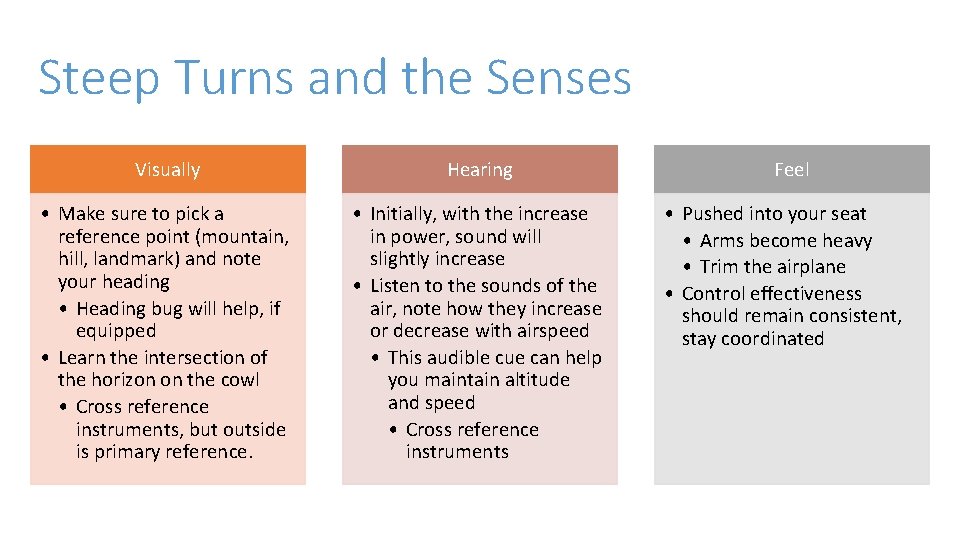
Steep Turns and the Senses Visually Hearing • Make sure to pick a reference point (mountain, hill, landmark) and note your heading • Heading bug will help, if equipped • Learn the intersection of the horizon on the cowl • Cross reference instruments, but outside is primary reference. • Initially, with the increase in power, sound will slightly increase • Listen to the sounds of the air, note how they increase or decrease with airspeed • This audible cue can help you maintain altitude and speed • Cross reference instruments Feel • Pushed into your seat • Arms become heavy • Trim the airplane • Control effectiveness should remain consistent, stay coordinated
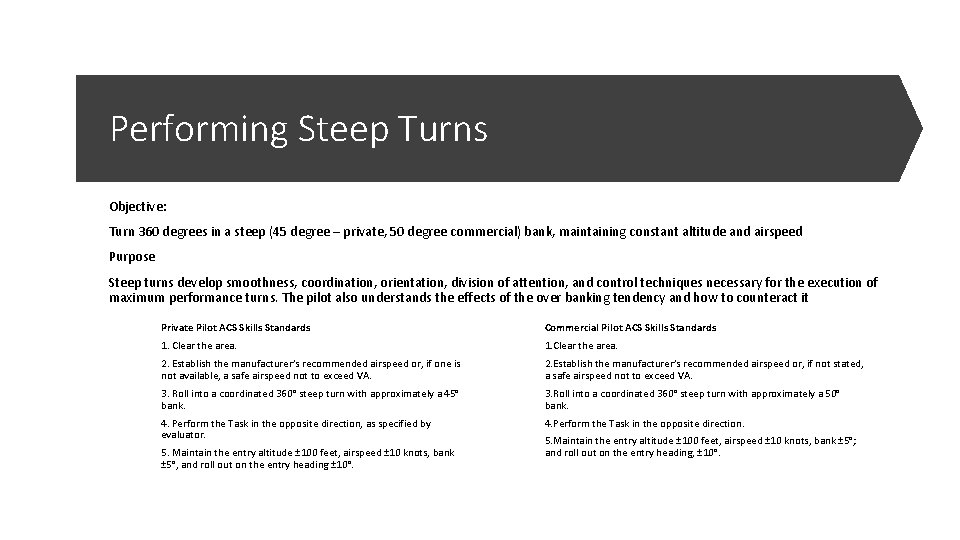
Performing Steep Turns Objective: Turn 360 degrees in a steep (45 degree – private, 50 degree commercial) bank, maintaining constant altitude and airspeed Purpose Steep turns develop smoothness, coordination, orientation, division of attention, and control techniques necessary for the execution of maximum performance turns. The pilot also understands the effects of the over banking tendency and how to counteract it Private Pilot ACS Skills Standards Commercial Pilot ACS Skills Standards 1. Clear the area. 2. Establish the manufacturer’s recommended airspeed or, if one is not available, a safe airspeed not to exceed VA. 2. Establish the manufacturer’s recommended airspeed or, if not stated, a safe airspeed not to exceed VA. 3. Roll into a coordinated 360° steep turn with approximately a 45° bank. 3. Roll into a coordinated 360° steep turn with approximately a 50° bank. 4. Perform the Task in the opposite direction, as specified by evaluator. 4. Perform the Task in the opposite direction. 5. Maintain the entry altitude ± 100 feet, airspeed ± 10 knots, bank ± 5°, and roll out on the entry heading ± 10°. 5. Maintain the entry altitude ± 100 feet, airspeed ± 10 knots, bank ± 5°; and roll out on the entry heading, ± 10°.
Performing Steep Turns Overview • Select outside visual references • Use both instrument indications and visual references • Frequently reference the instruments, but do not fixate on them
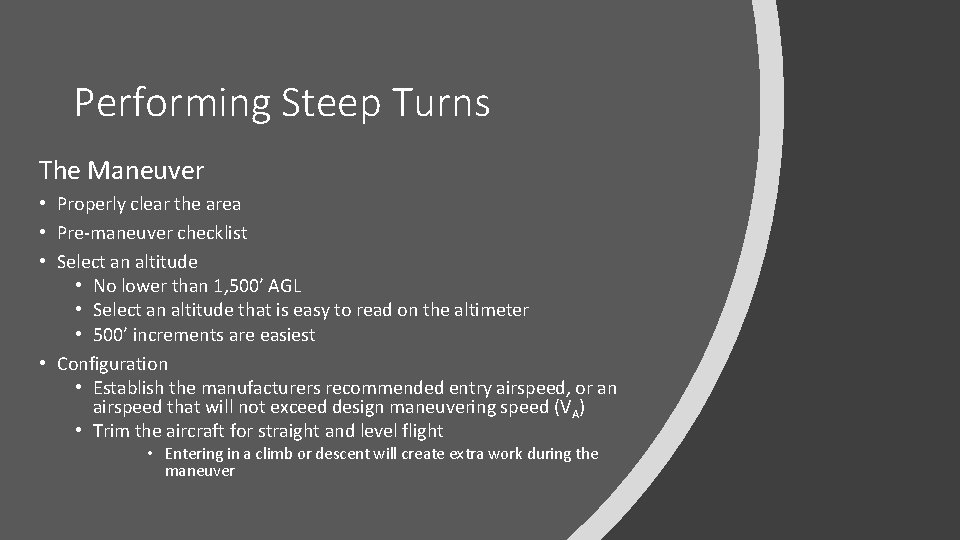
Performing Steep Turns The Maneuver • Properly clear the area • Pre-maneuver checklist • Select an altitude • No lower than 1, 500’ AGL • Select an altitude that is easy to read on the altimeter • 500’ increments are easiest • Configuration • Establish the manufacturers recommended entry airspeed, or an airspeed that will not exceed design maneuvering speed (VA) • Trim the aircraft for straight and level flight • Entering in a climb or descent will create extra work during the maneuver
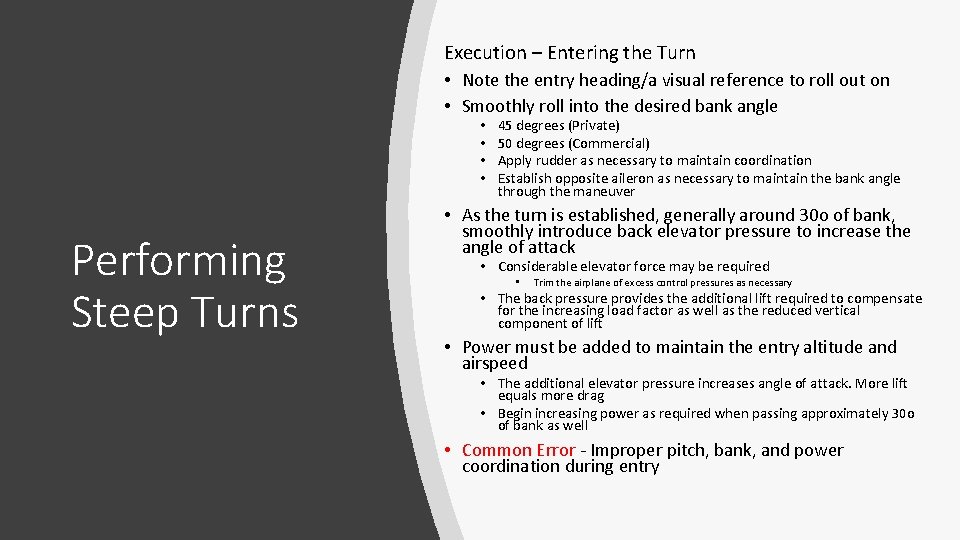
Execution – Entering the Turn • Note the entry heading/a visual reference to roll out on • Smoothly roll into the desired bank angle • • Performing Steep Turns 45 degrees (Private) 50 degrees (Commercial) Apply rudder as necessary to maintain coordination Establish opposite aileron as necessary to maintain the bank angle through the maneuver • As the turn is established, generally around 30 o of bank, smoothly introduce back elevator pressure to increase the angle of attack • Considerable elevator force may be required • Trim the airplane of excess control pressures as necessary • The back pressure provides the additional lift required to compensate for the increasing load factor as well as the reduced vertical component of lift • Power must be added to maintain the entry altitude and airspeed • The additional elevator pressure increases angle of attack. More lift equals more drag • Begin increasing power as required when passing approximately 30 o of bank as well • Common Error - Improper pitch, bank, and power coordination during entry
Performing Steep Turns Execution – During the Turn • Do not focus or stare at any one object • To maintain altitude, as well as orientation, you must have an awareness of the relative position of the horizon to the nose and wings • • Only watching the nose will result in difficulty holding altitude constant With practice, watching the nose and wings relative to the horizon can result in holding altitude within standards, and in time, considerably better • Common Error - Loss of orientation • • Note the entry heading and find a visual reference to use Occasionally glance at the heading indicator/orient yourself with the visual reference to know where you are in the turn
Execution – Adjustments • Increasing/decreasing altitude • Relax or increase elevator pressure as appropriate • • • Make small changes to maintain/correct the altitude Large changes tend to lead to fast movements and a yo-yo effect Power should be adjusted accordingly to maintain the entry airspeed • Changes in bank angle may also be used to control altitude deviations Performing Steep Turns • 1 to 3 degrees of bank angle allows you to stay within bank tolerances and make a controlled correction to the desired altitude • Increasing the bank angle decreases lift • Decreasing the bank angle increases lift • Again, large changes leads to large corrections and the yo-yo effect (chasing the altitude/bank) • If the aircraft is descending and bank angle is excessive, reducing the bank angle may stop the descent • Make further corrections once bank has been reestablished • If ascending and the bank angle is shallow, increasing the bank angle may correct the altitude deviation • Make further corrections once bank has been reestablished • Common Error - Improper procedure in correcting altitude deviations • Use bank and pitch as necessary in order to correct for deviations in altitude • Understand how bank and pitch can work together to maintain altitude • Large corrections often lead to large deviations • Common Error - Uncoordinated use of flight controls • Rudder pressure will be necessary to maintain coordination during the maneuver • Introducing rudder pressure part way through the turn can have adverse effects on altitude
Performing Steep Turns Execution – Roll Out • The rollout should be timed so that the wings reach level flight when the airplane is exactly on the heading from which the maneuver was started • General rule: Begin the rollout when approximately ½ the bank angle from your entry heading • 20 – 25 degrees prior to your entry heading • While the rollout is being made, back-elevator pressure is gradually released and power reduced, as necessary, to maintain altitude and airspeed • If the elevator was trimmed up for the turn ensure the trim is removed on the rollout to prevent a large increase in altitude as wings return level increasing the vertical component of lift • Common Error - Improper pitch, bank, and power coordination during entry and rollout
Common Errors • Improper pitch, bank, and power coordination during entry and rollout • Uncoordinated use of flight controls • Improper procedure in correcting altitude deviations • Loss of orientation
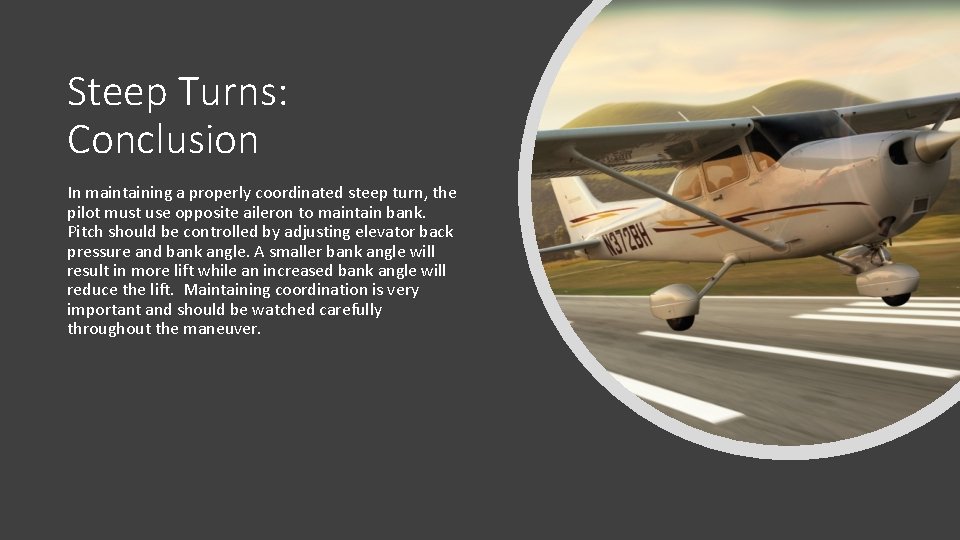
Steep Turns: Conclusion In maintaining a properly coordinated steep turn, the pilot must use opposite aileron to maintain bank. Pitch should be controlled by adjusting elevator back pressure and bank angle. A smaller bank angle will result in more lift while an increased bank angle will reduce the lift. Maintaining coordination is very important and should be watched carefully throughout the maneuver.