
STEAM IN EDUCATION BY THE CA MBRIA H
STEAM IN EDUCATION BY THE CA MBRIA H EI GH TS STEAM ACTION TEAM
STEAM: A 21 ST Century Approach to Educational Learning • There is a growing focus on the need to better prepare students for higher education and arm them with the skills and knowledge they will need to be successful innovators in a 21 st century workforce. STEAM has gained popularity among educators, parents, corporations, institutions, including state and national governments as a way to fulfill this need. • By engaging students around the subjects of Science, Technology, Engineering, Arts and Math, STEAM aims to spark an interest and life long love of the arts and sciences in children from an early age. Science, Technology, Engineering, Art, and Math (STEAM) are similar disciplines in that all involve creative processes and none uses just one method for inquiry and investigation. Teaching relevant, in demand skills that will prepare students to become innovators in an ever evolving world is paramount, not only for the future of these students but for the future of the country.

STEAM: the short definition… STEAM (Science, Technology, Engineering, Arts, and Math) programs have now added art to STEM curriculum by drawing on design principles and encouraging creative solutions. • Science - the systematic study of the world around us • Technology - refers to anything that is man-made and includes anything from a can opener to a super-computer • Engineering - the design, testing and building of new products and technologies • Arts - a diverse range of human activities such as ethics, ideals and expressions creating visual, auditory or performing artifacts or artworks. • Math - the investigation of patterns in shape and quantity and examples can be found in engineering, financial applications and even sports.
STEAM: PDE’s definition… STEAM (Science, Technology, Engineering, Arts, and Math) is an integrated, interdisciplinary, and student-centered approach to learning that encourages curiosity, creativity, artistic expression, collaboration, communication, problem-solving, critical thinking, and design thinking. All students will learn to apply STEAM concepts and practices through 3 -dimensional and authentic project-based learning that connects school (early childhood through postsecondary) with needs, challenges, and/or opportunities in the community, or those presented by business and industry leaders, resulting in a STEAM fluent skilled citizenry for the future of Pennsylvania. (PDE, August 2017)
The Basics of STEAM uses science, technology, engineering, the arts and math as access points for guiding student inquiry, dialogue, and critical thinking • Use of Standards and Assessments • Direct connection to content and arts standards • International Technology and Engineering Educators Association (ITEEA) and Next Generation Science Standards (NGSS), and Engineering by Design (Eb. D) • Purpose for Using the Approach • Integrates any STEAM area with another content through naturally-aligned standards • Foundational Support • Grounded in inquiry, problem-solving and process-based learning. The lesson is created intentionally to address these focus areas. • Intention and Focus • STEAM is process-driven through inquiry, design and creativity. The process leads to the product through a discovery focus. • How it Addresses Various Content Areas • Addresses STEAM areas explicitly. Can utilize the literacy process and addresses the social sciences through the foundational lens of the approach.
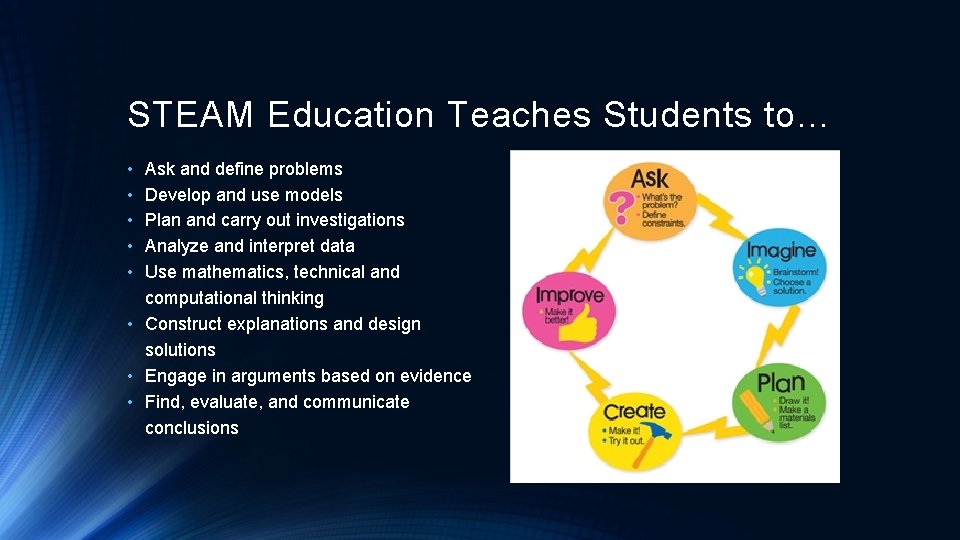
STEAM Education Teaches Students to… • • • Ask and define problems Develop and use models Plan and carry out investigations Analyze and interpret data Use mathematics, technical and computational thinking • Construct explanations and design solutions • Engage in arguments based on evidence • Find, evaluate, and communicate conclusions
Foundations for STEAM Education • Inquiry-based education • “juicy” questions that stimulates curiosity • Provides the opportunity to “do” • Designing one’s own methods for answering questions • Integrated Curriculum • Thematic units and lessons are developed collaboratively by all teachers • Connects subject areas to one another and eliminates “siloing” or isolating from others • Project-based Group Learning • Students study real world problems and investigate solutions • To succeed, they must gain knowledge, understand concepts, and apply skills • Includes a process to give/receive feedback, revise, and inquire further • Career Awareness • Creates relevance and a context for struggles and study • Eliminates the “Why do I need to know this? ” mentality • Illuminates a pathway from the present to future career opportunities
Common STEAM questions Q. Are we doing STEAM in Cambria Heights classrooms now? A. Yes, most of you are and don’t even realize it. Examples are but not limited to; 1. Sciences – Anatomy/Physiology, Biology, Chemistry, Environmental Science, 2. 3. 4. 5. Family Consumer Sciences, Phys. Ed. , Physics, Psychology, Western Civ. , World Cultures Technology – Computers, Internet, Google, Lab Equip, Music, Tech Ed shop equipment Engineering (or English) – CAD, English, Geometry, Spanish, Tech Ed. Arts – Art class of course, Music, Technical Drafting Mathematics – Algebra, Calculus, Geometry, Trigonometry, Physics Q. Is STEAM here to stay or just a passing fad? A. Yep, it’s staying. STEAM job growth has increased three times faster than any other field. If a student has an interest for example in science or in building things, the STEAM classes would be a natural choice due to the hands-on nature of the curricula. Students may succeed in self-paced and those with independent learning projects.
Local STEAM Clubs and Organizations • PA Technology Student Association (TSA) • Northern Cambria MS & HS chapter hosts regional student competitions • Example of Middle School Events; • • • Biotechnology CAD Foundations Career Prep Challenging Tech Issues Chapter Team Coding Construction Challenge Dragster Electrical Applications Flight Aux. Forensic Technology Inventions and Innovations Junior Solar Sprint Leadership Strategies Mass Production Mechanical Engineering Medical Technology Microcontroller Design Off the Grid Prepared Speech Structural Engineering System Control Technology PA-Calculator Robot PA-Delta Dart Aux. PA-Digital Video Challenge PA-Logo Design PA-Materials Processing PA-Robotics PA-Safety Illustration
Local STEAM Clubs and Organizations (cont’d) • PA Technology Student Association (TSA) • Northern Cambria MS & HS chapter hosts regional student competitions • Example of High School Events; • • • Animatronics Architectural Design CAD Architecture Debating Technical Issues Engineering Design Fashion Design and Technology Future Technology Teacher Prepared Presentation STEM Career System Control Technology PA-Logo Design PA-Materials Processes Biotechnology Design Chapter Team CAD Engineering CIM Dragster Design Extemporaneous Presentation Flight Endurance Aux. On Demand Video Promotional Design Structural Design & Engineering Transportation Modeling PA-Robotics PA-Safety Illustration
Comments for our CH STEAM Action Team? Feel free to email us at the following addresses for ideas, concerns, suggestions, etc. ? We thank you in advance for your comments and cooperation. STEAM Champion Eric Nagel STEAM Members Mission statement: enagel@chsd 1. org Mary Angleo -CHES James Blake – CHMS Rachel Manack - CHHS Alec Manifest - CHHS Jeffrey R. Meidinger – CHHS Doug Ropp - CHMS Garett Thomas – CHES mangelo@chsd 1. org jblake@chsd 1. org rmanack@chsd 1. org amanifest@chsd 1. org jmeidinger@chsd 1. org dropp@chsd 1. org gthomas@chsd 1. org To help prepare our students in STEAM education within the Cambria Heights School District to become ready for the 21 st century challenges that lie ahead.
- Slides: 11