
Steam Devices Heros Steam Device Hero of Alexandria
- Slides: 93
Steam Devices
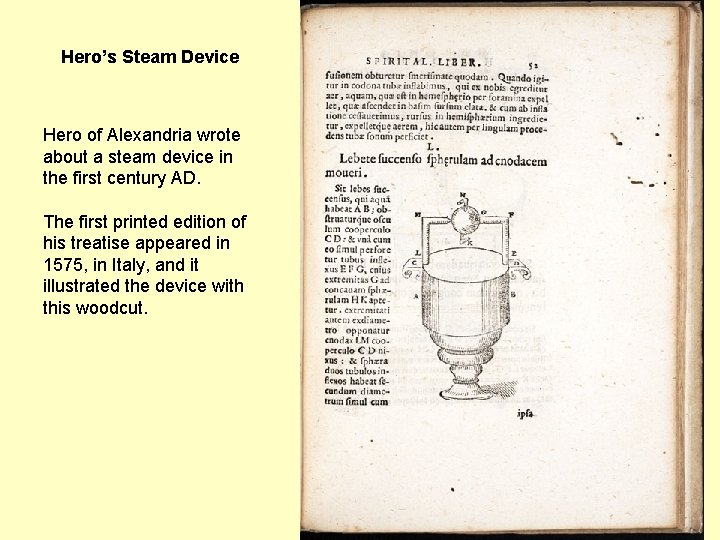
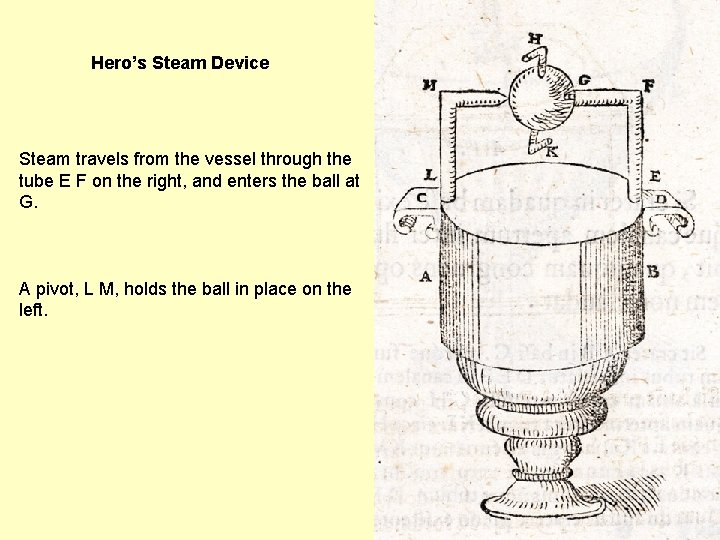
Hero’s Steam Device Hero of Alexandria wrote about a steam device in the first century AD. The first printed edition of his treatise appeared in 1575, in Italy, and it illustrated the device with this woodcut.
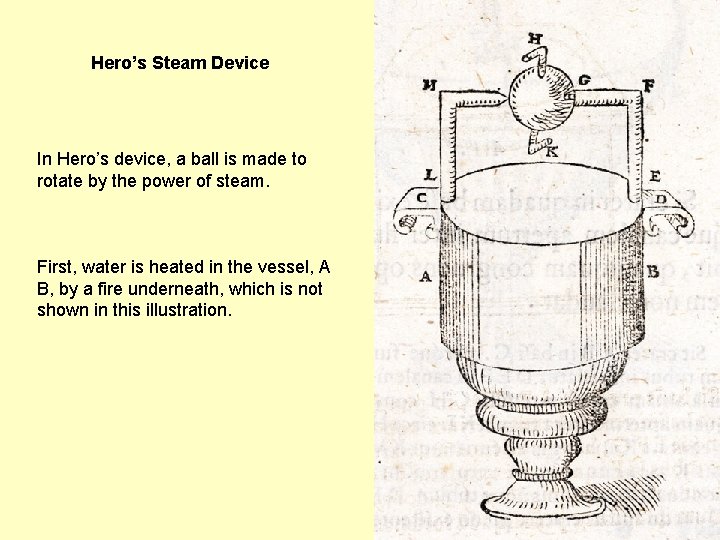
Hero’s Steam Device In Hero’s device, a ball is made to rotate by the power of steam. First, water is heated in the vessel, A B, by a fire underneath, which is not shown in this illustration.
Hero’s Steam Device Steam travels from the vessel through the tube E F on the right, and enters the ball at G. A pivot, L M, holds the ball in place on the left.
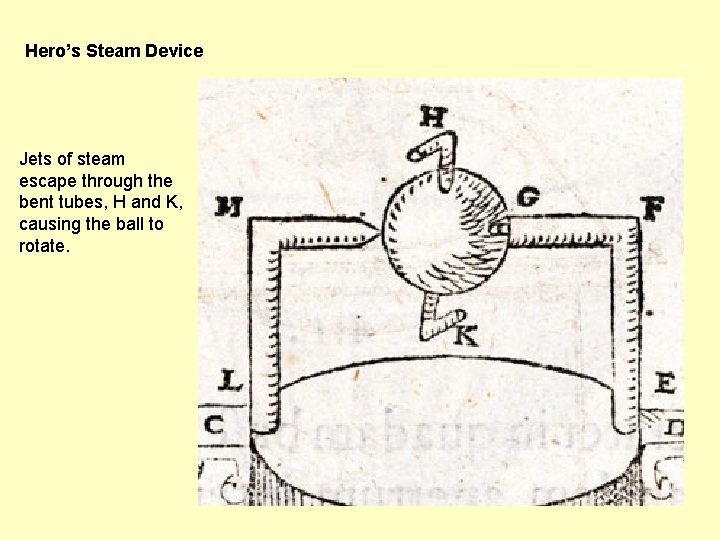
Hero’s Steam Device Jets of steam escape through the bent tubes, H and K, causing the ball to rotate.
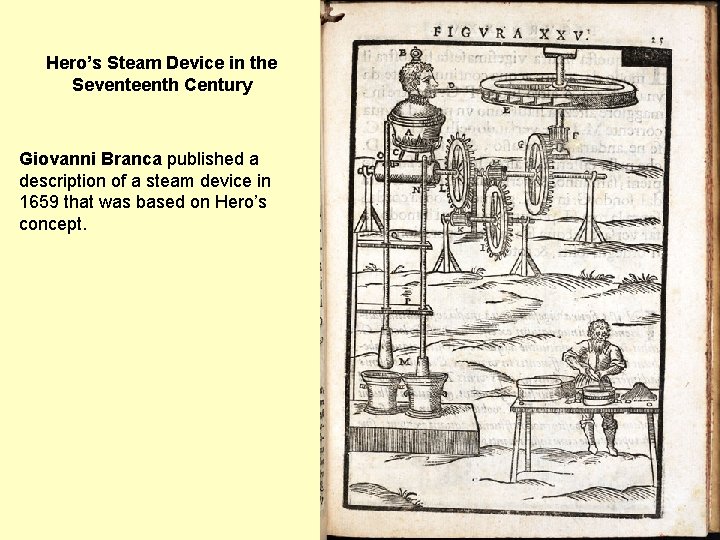
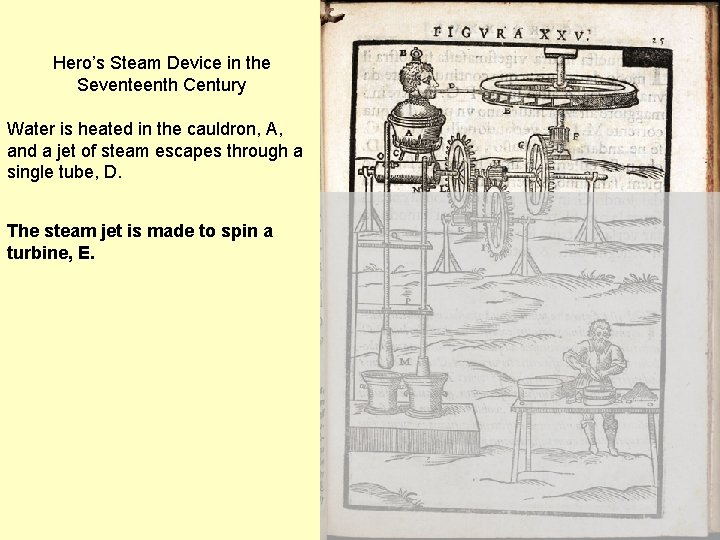
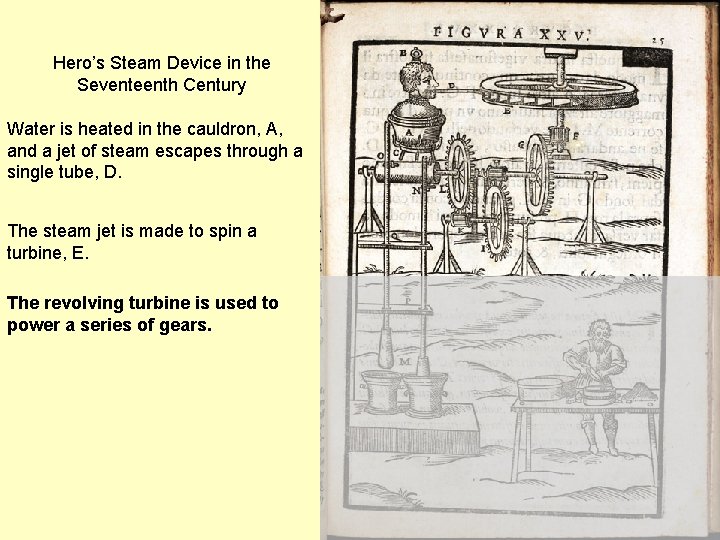
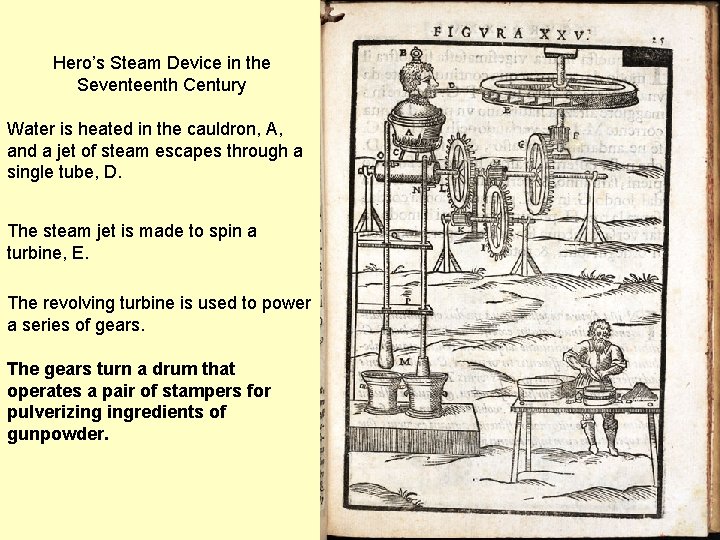
Hero’s Steam Device in the Seventeenth Century Giovanni Branca published a description of a steam device in 1659 that was based on Hero’s concept.
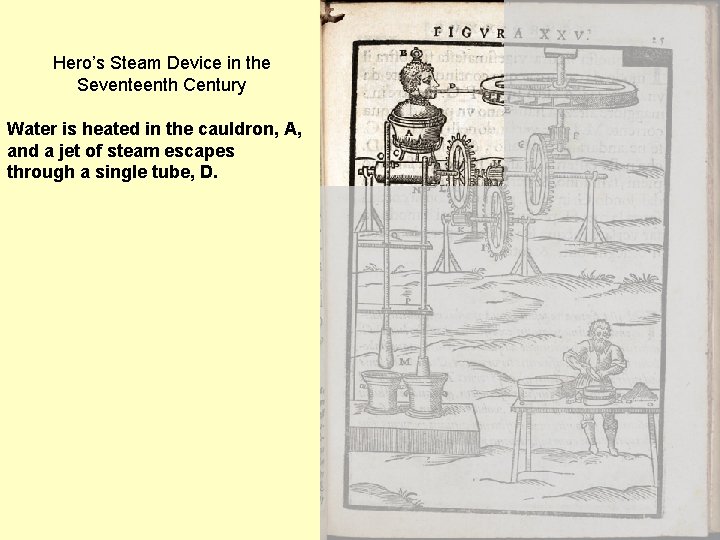
Hero’s Steam Device in the Seventeenth Century Water is heated in the cauldron, A, and a jet of steam escapes through a single tube, D.
Hero’s Steam Device in the Seventeenth Century Water is heated in the cauldron, A, and a jet of steam escapes through a single tube, D. The steam jet is made to spin a turbine, E.
Hero’s Steam Device in the Seventeenth Century Water is heated in the cauldron, A, and a jet of steam escapes through a single tube, D. The steam jet is made to spin a turbine, E. The revolving turbine is used to power a series of gears.
Hero’s Steam Device in the Seventeenth Century Water is heated in the cauldron, A, and a jet of steam escapes through a single tube, D. The steam jet is made to spin a turbine, E. The revolving turbine is used to power a series of gears. The gears turn a drum that operates a pair of stampers for pulverizing ingredients of gunpowder.
Steam Engines
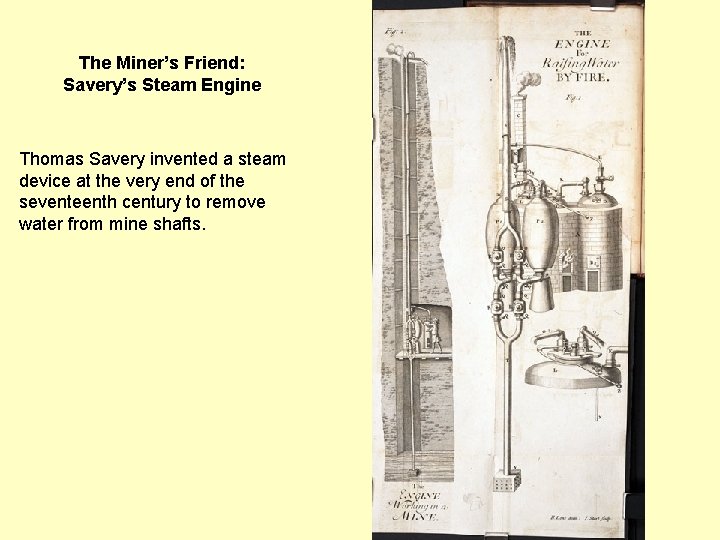
The Miner’s Friend: Savery’s Steam Engine Thomas Savery invented a steam device at the very end of the seventeenth century to remove water from mine shafts.
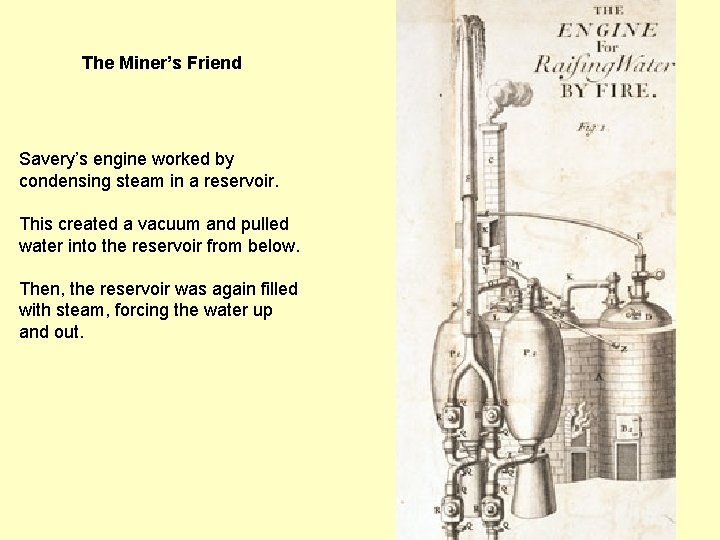
The Miner’s Friend Savery’s engine worked by condensing steam in a reservoir. This created a vacuum and pulled water into the reservoir from below. Then, the reservoir was again filled with steam, forcing the water up and out.
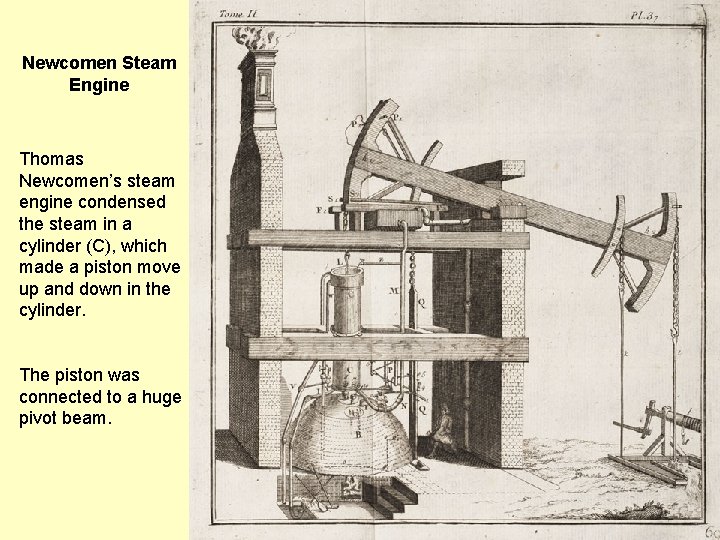
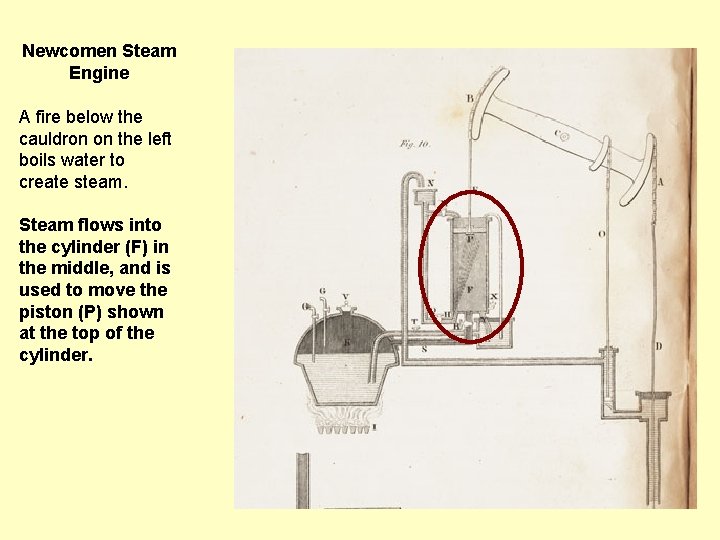
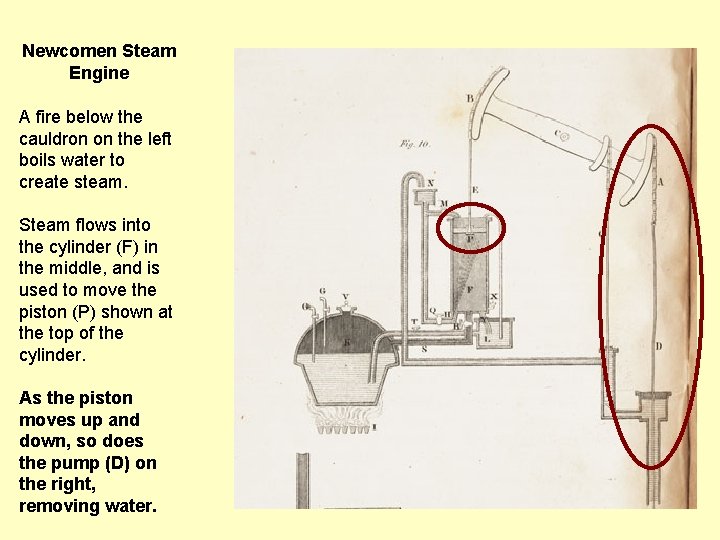
Newcomen Steam Engine Thomas Newcomen’s steam engine condensed the steam in a cylinder (C), which made a piston move up and down in the cylinder. The piston was connected to a huge pivot beam.
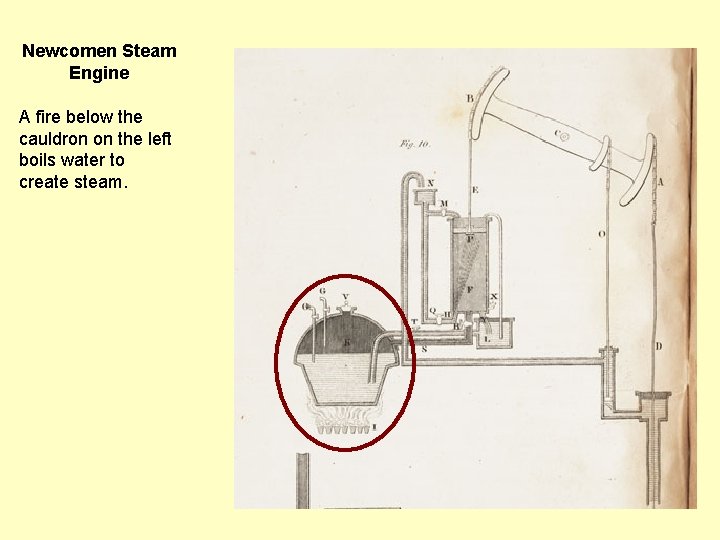
Newcomen Steam Engine A fire below the cauldron on the left boils water to create steam.
Newcomen Steam Engine A fire below the cauldron on the left boils water to create steam. Steam flows into the cylinder (F) in the middle, and is used to move the piston (P) shown at the top of the cylinder.
Newcomen Steam Engine A fire below the cauldron on the left boils water to create steam. Steam flows into the cylinder (F) in the middle, and is used to move the piston (P) shown at the top of the cylinder. As the piston moves up and down, so does the pump (D) on the right, removing water.
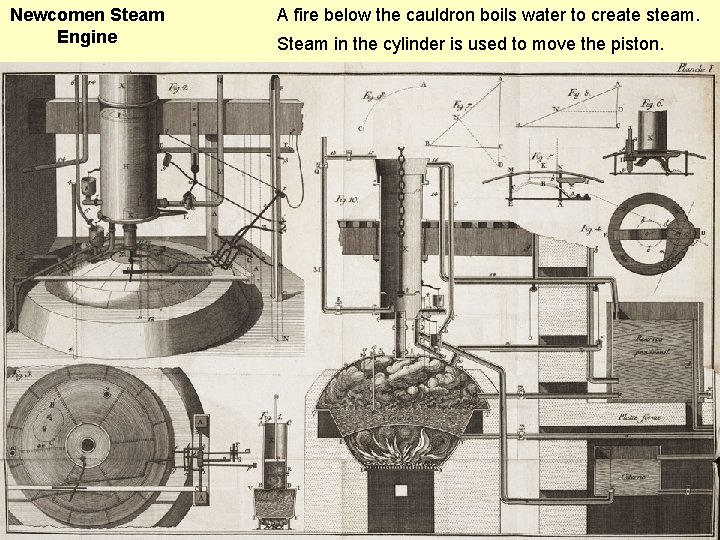
Newcomen Steam Engine A fire below the cauldron boils water to create steam. Steam in the cylinder is used to move the piston.
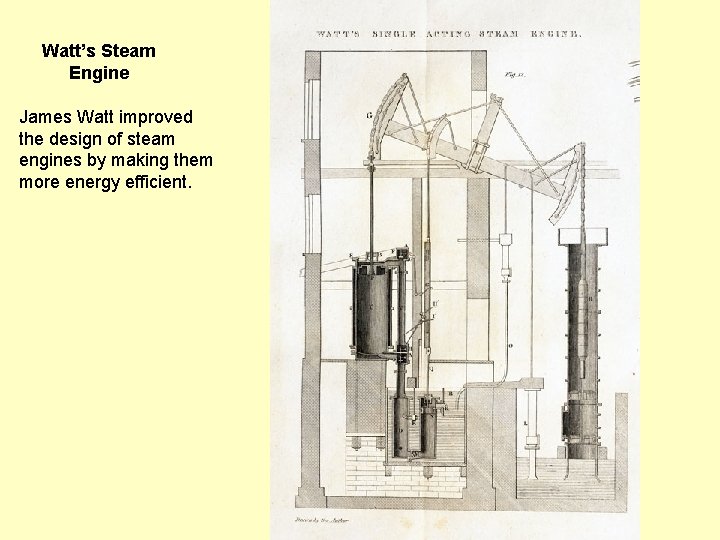
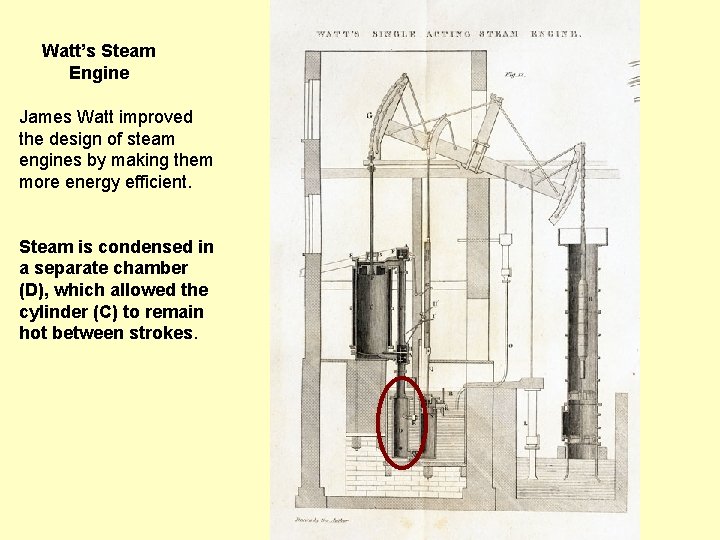
Watt’s Steam Engine James Watt improved the design of steam engines by making them more energy efficient.
Watt’s Steam Engine James Watt improved the design of steam engines by making them more energy efficient. Steam is condensed in a separate chamber (D), which allowed the cylinder (C) to remain hot between strokes.
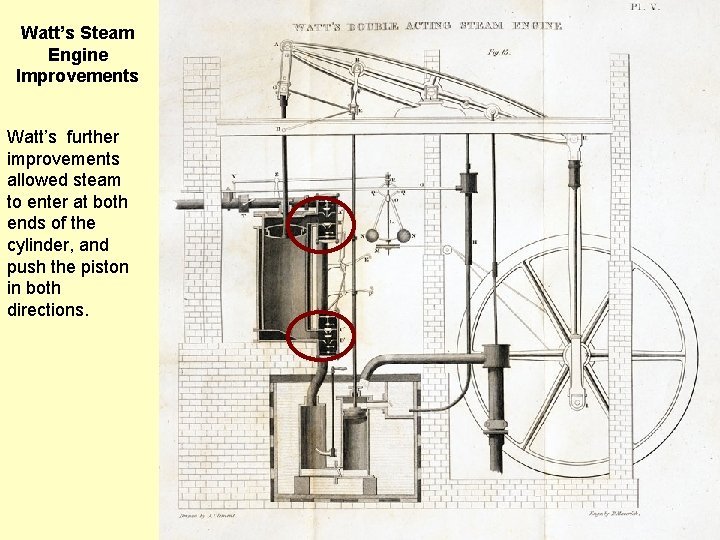
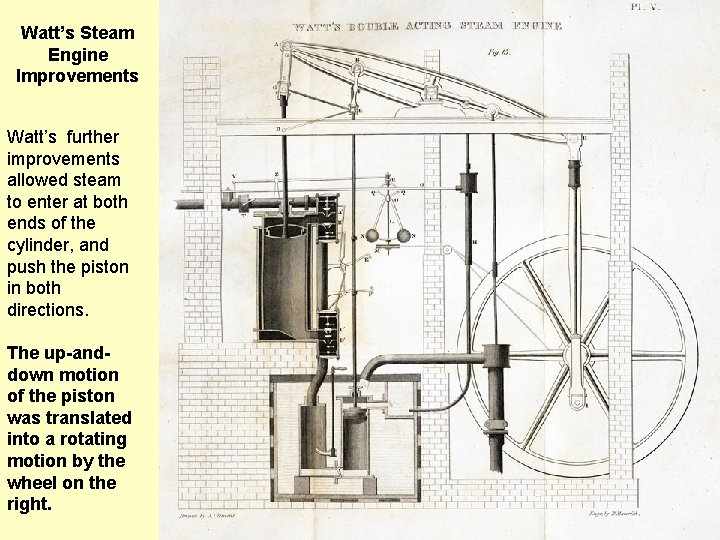
Watt’s Steam Engine Improvements Watt’s further improvements allowed steam to enter at both ends of the cylinder, and push the piston in both directions.
Watt’s Steam Engine Improvements Watt’s further improvements allowed steam to enter at both ends of the cylinder, and push the piston in both directions. The up-anddown motion of the piston was translated into a rotating motion by the wheel on the right.
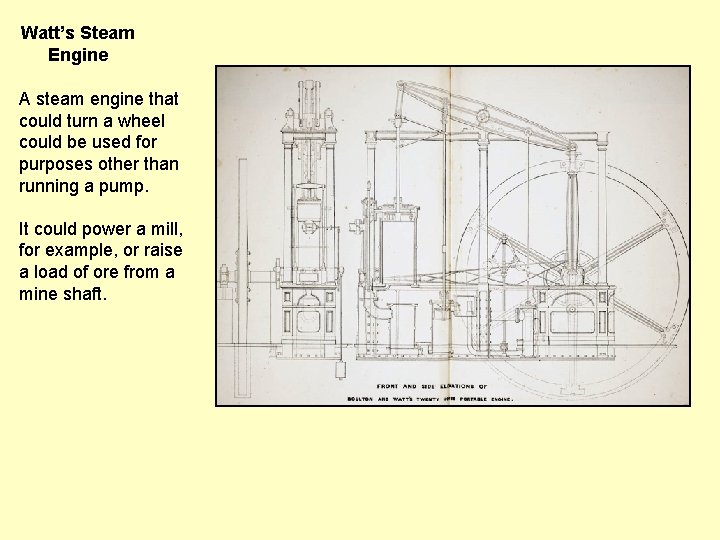
Watt’s Steam Engine A steam engine that could turn a wheel could be used for purposes other than running a pump. It could power a mill, for example, or raise a load of ore from a mine shaft.
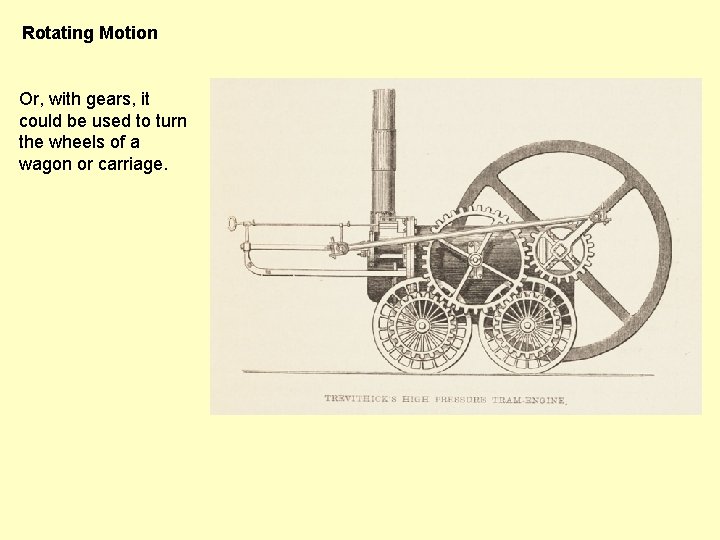
Rotating Motion Or, with gears, it could be used to turn the wheels of a wagon or carriage.
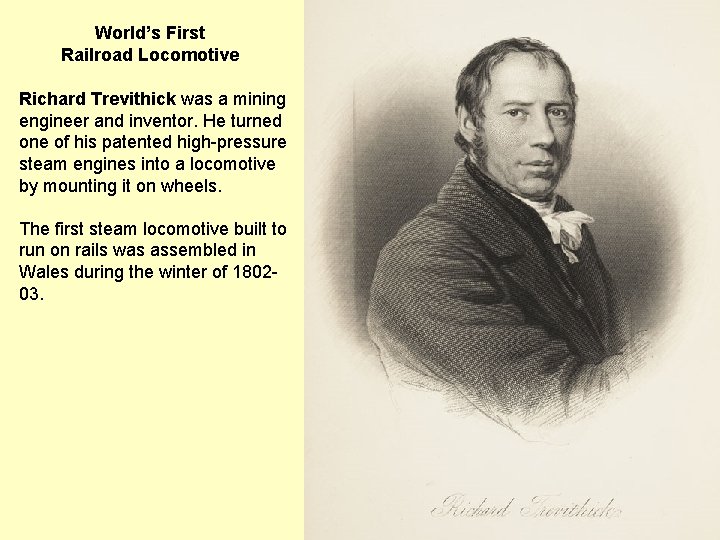
World’s First Railroad Locomotive Richard Trevithick was a mining engineer and inventor. He turned one of his patented high-pressure steam engines into a locomotive by mounting it on wheels. The first steam locomotive built to run on rails was assembled in Wales during the winter of 180203.
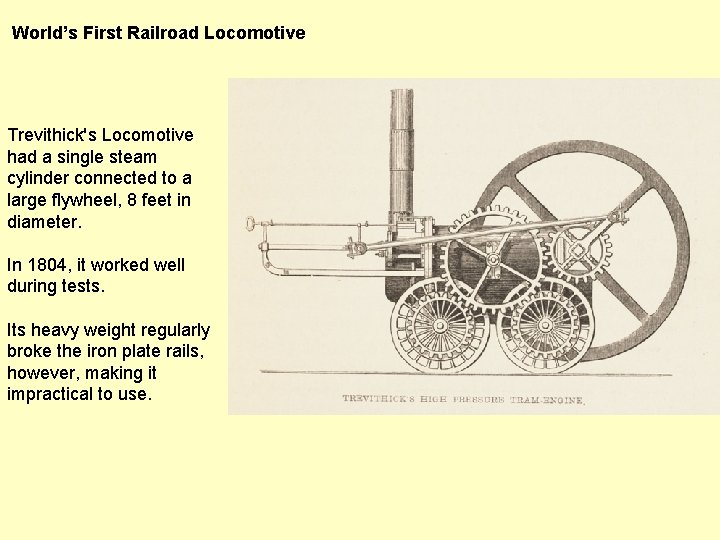
World’s First Railroad Locomotive Trevithick's Locomotive had a single steam cylinder connected to a large flywheel, 8 feet in diameter. In 1804, it worked well during tests. Its heavy weight regularly broke the iron plate rails, however, making it impractical to use.
Railways
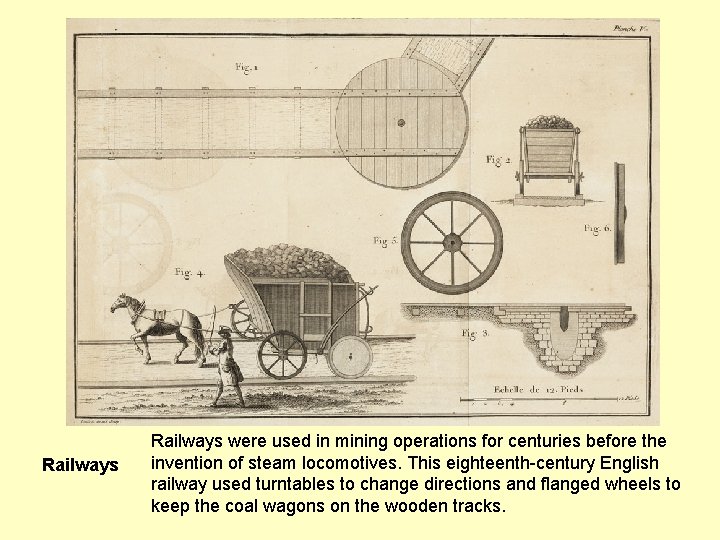
Railways were used in mining operations for centuries before the invention of steam locomotives. This eighteenth-century English railway used turntables to change directions and flanged wheels to keep the coal wagons on the wooden tracks.
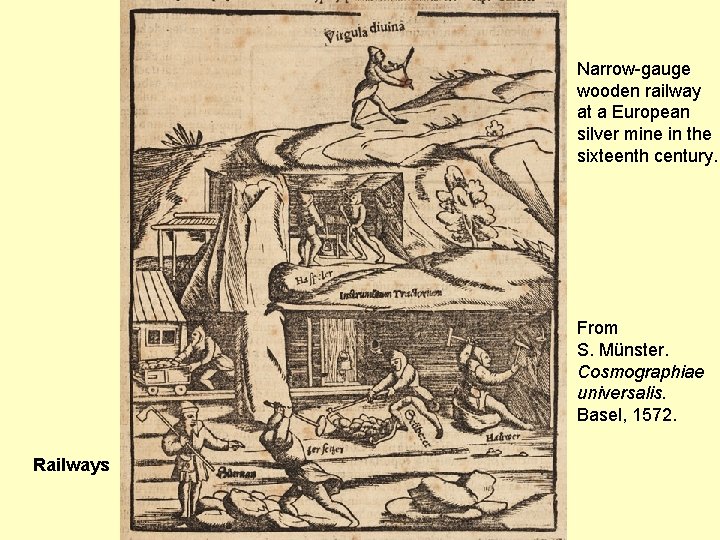
Narrow-gauge wooden railway at a European silver mine in the sixteenth century. From S. Münster. Cosmographiae universalis. Basel, 1572. Railways
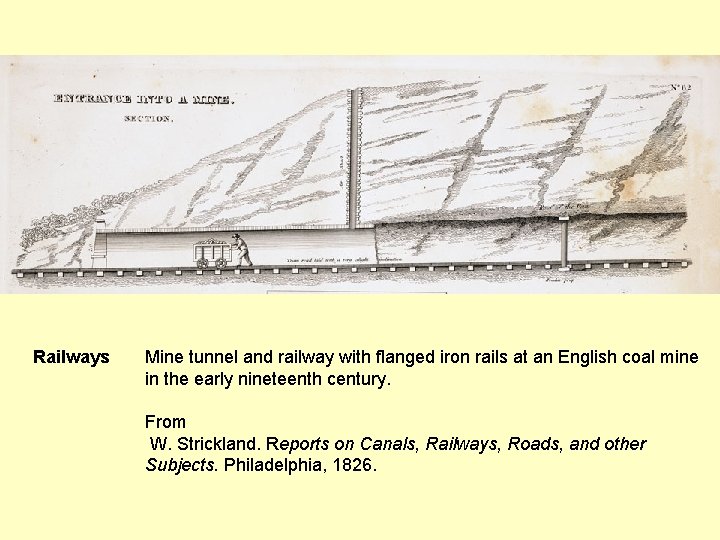
Railways Mine tunnel and railway with flanged iron rails at an English coal mine in the early nineteenth century. From W. Strickland. Reports on Canals, Railways, Roads, and other Subjects. Philadelphia, 1826.
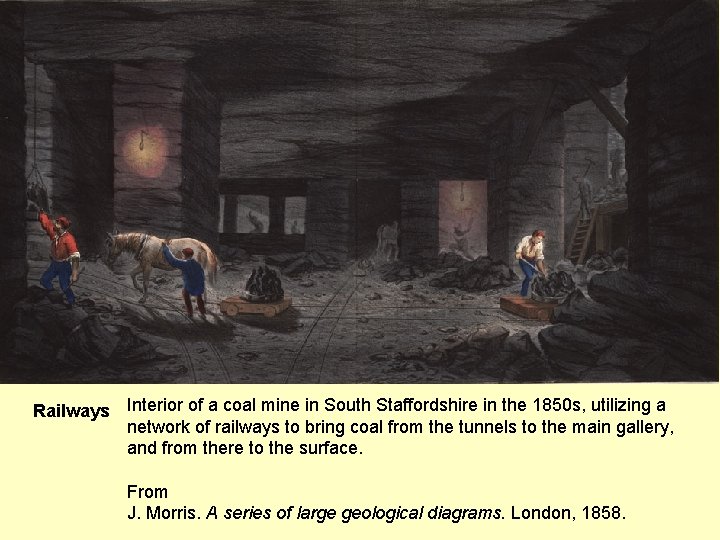
Railways Interior of a coal mine in South Staffordshire in the 1850 s, utilizing a network of railways to bring coal from the tunnels to the main gallery, and from there to the surface. From J. Morris. A series of large geological diagrams. London, 1858.
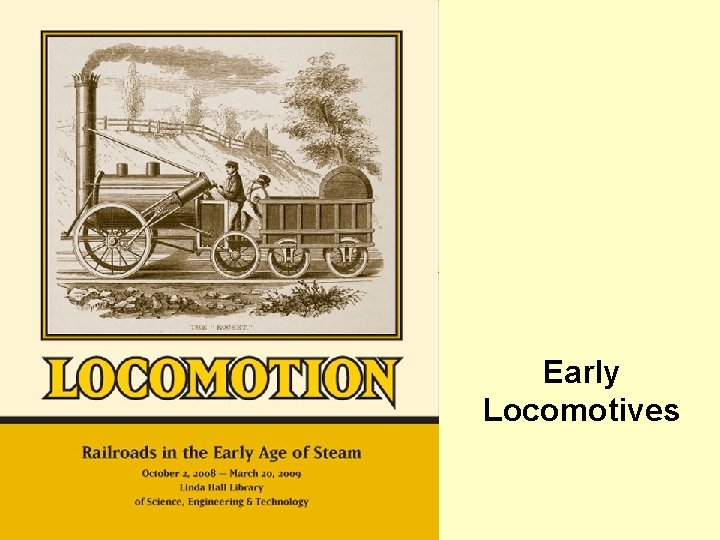
Early Locomotives
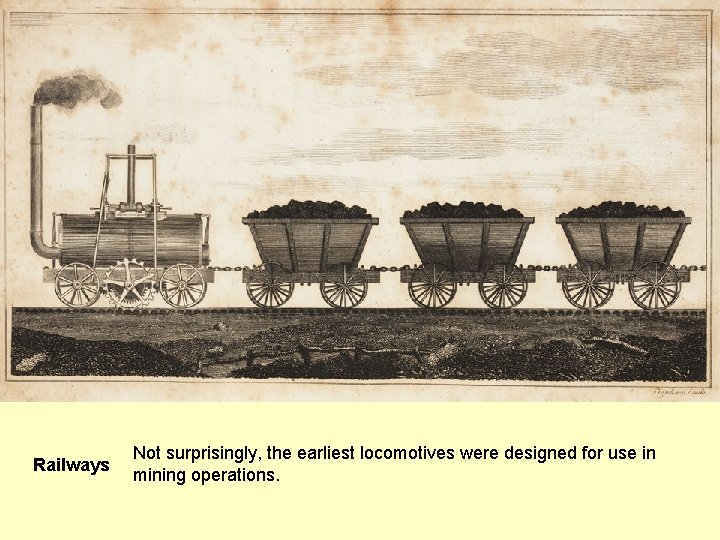
Railways Not surprisingly, the earliest locomotives were designed for use in mining operations.
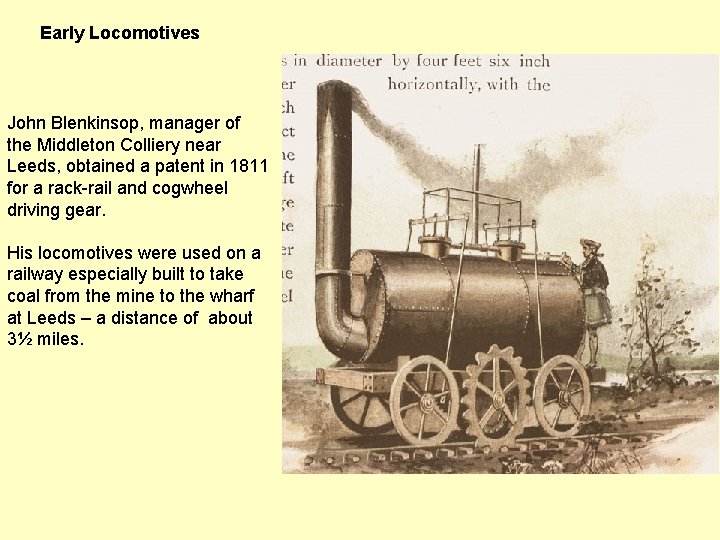
Early Locomotives John Blenkinsop, manager of the Middleton Colliery near Leeds, obtained a patent in 1811 for a rack-rail and cogwheel driving gear. His locomotives were used on a railway especially built to take coal from the mine to the wharf at Leeds – a distance of about 3½ miles.
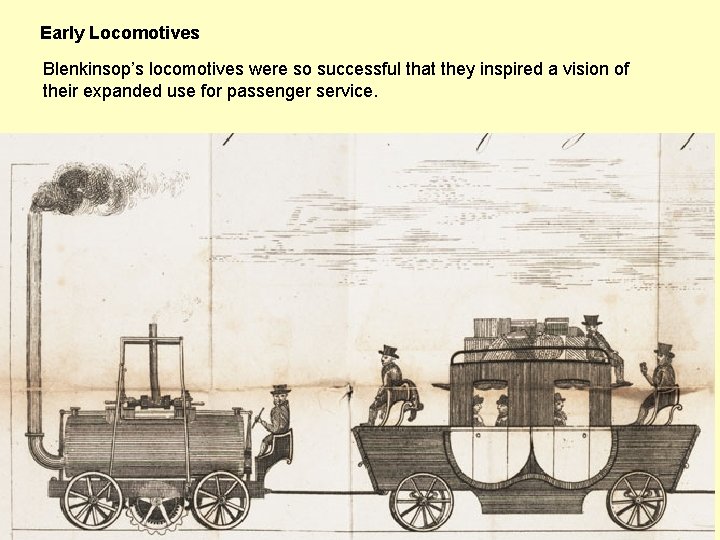
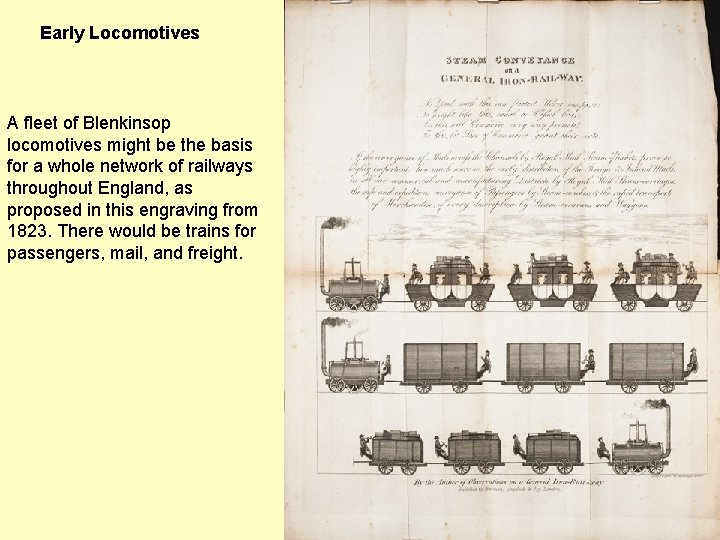
Early Locomotives Blenkinsop’s locomotives were so successful that they inspired a vision of their expanded use for passenger service.
Early Locomotives A fleet of Blenkinsop locomotives might be the basis for a whole network of railways throughout England, as proposed in this engraving from 1823. There would be trains for passengers, mail, and freight.
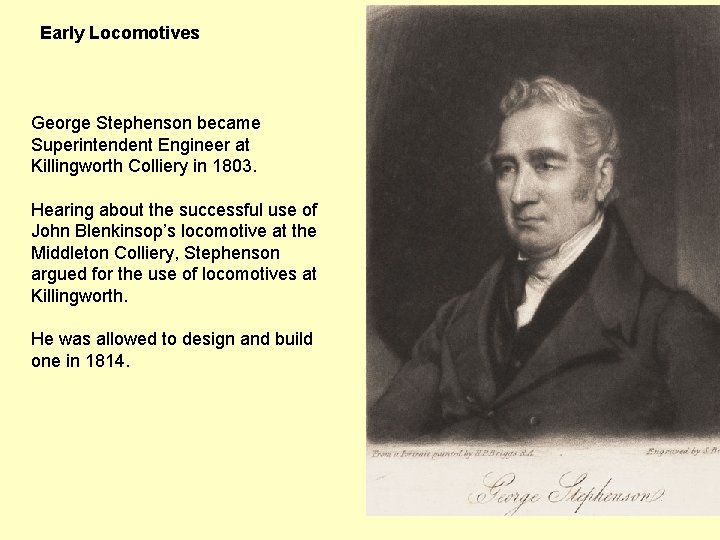
Early Locomotives George Stephenson became Superintendent Engineer at Killingworth Colliery in 1803. Hearing about the successful use of John Blenkinsop’s locomotive at the Middleton Colliery, Stephenson argued for the use of locomotives at Killingworth. He was allowed to design and build one in 1814.
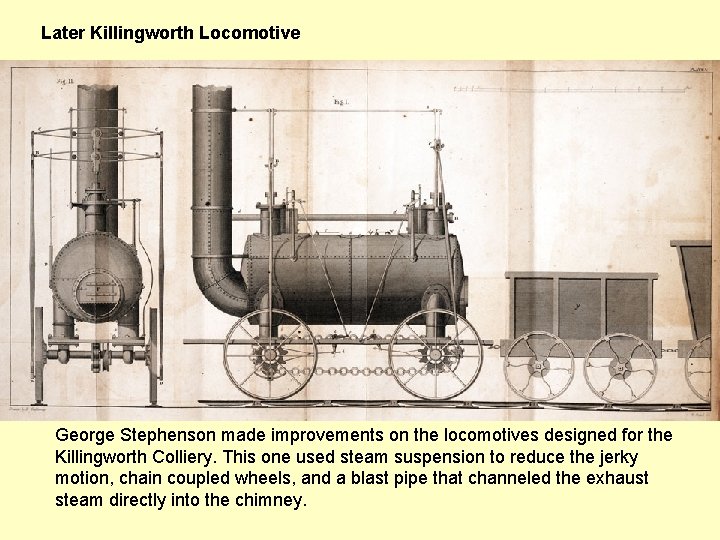
Later Killingworth Locomotive George Stephenson made improvements on the locomotives designed for the Killingworth Colliery. This one used steam suspension to reduce the jerky motion, chain coupled wheels, and a blast pipe that channeled the exhaust steam directly into the chimney.
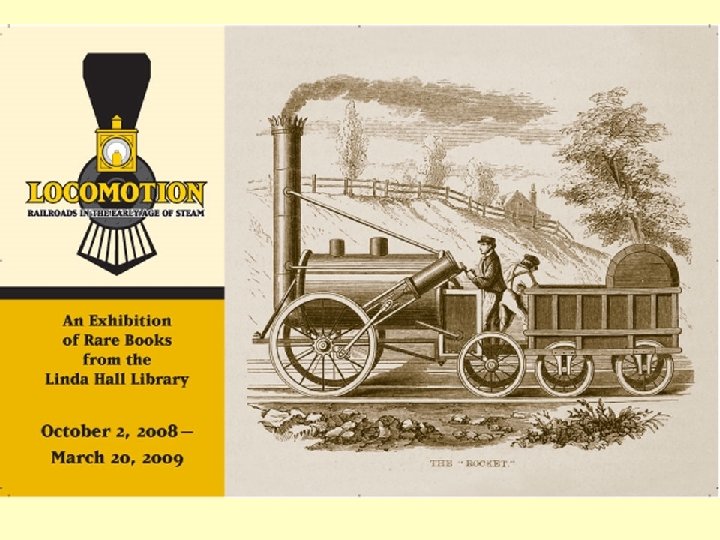
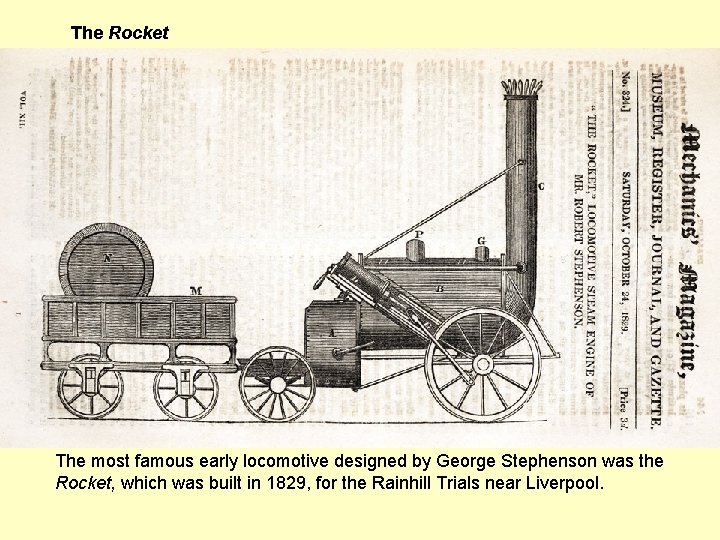
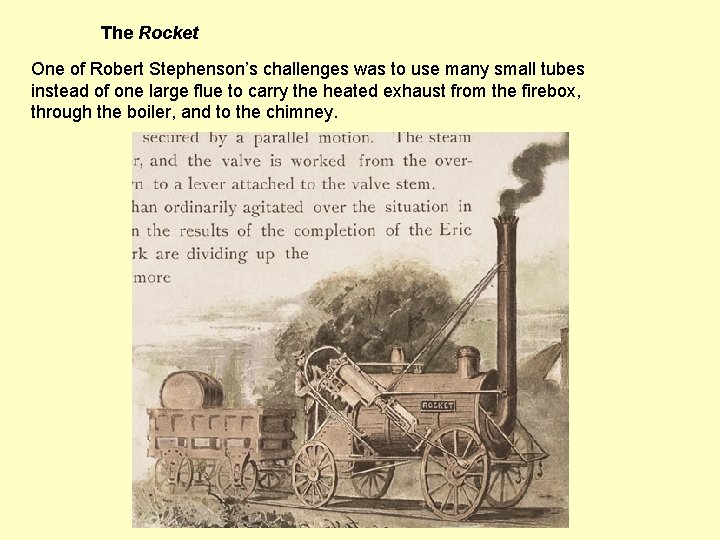
The Rocket The most famous early locomotive designed by George Stephenson was the Rocket, which was built in 1829, for the Rainhill Trials near Liverpool.
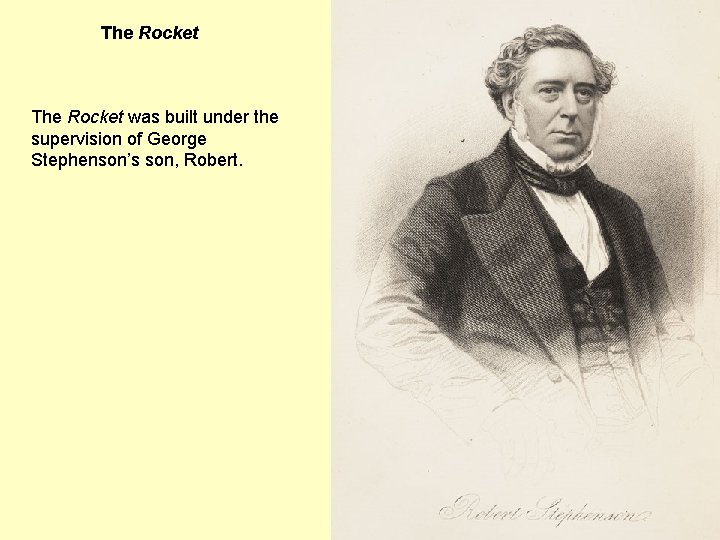
The Rocket was built under the supervision of George Stephenson’s son, Robert.
The Rocket One of Robert Stephenson’s challenges was to use many small tubes instead of one large flue to carry the heated exhaust from the firebox, through the boiler, and to the chimney.
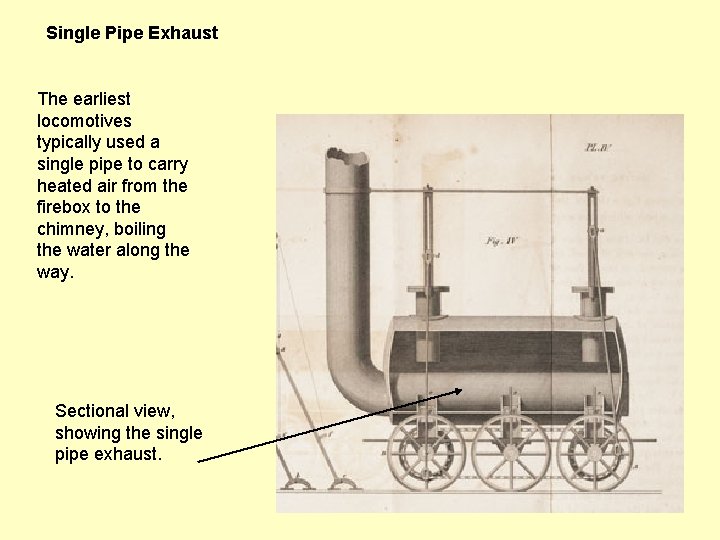
Single Pipe Exhaust The earliest locomotives typically used a single pipe to carry heated air from the firebox to the chimney, boiling the water along the way. Sectional view, showing the single pipe exhaust.
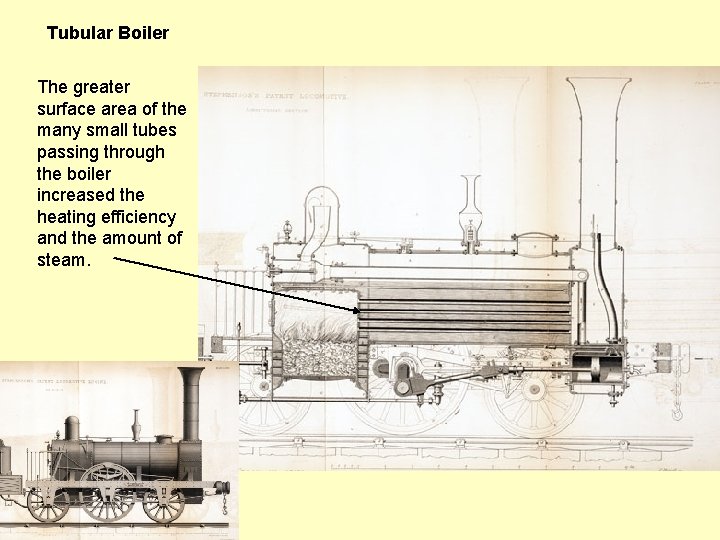
Tubular Boiler The greater surface area of the many small tubes passing through the boiler increased the heating efficiency and the amount of steam.
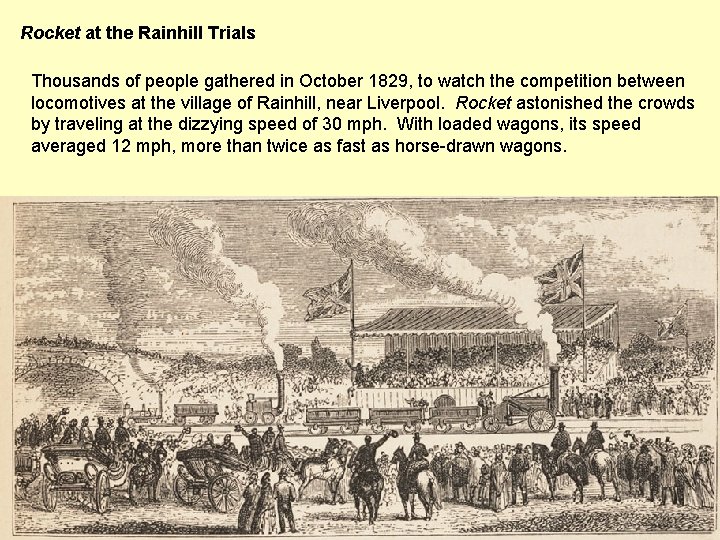
Rocket at the Rainhill Trials Thousands of people gathered in October 1829, to watch the competition between locomotives at the village of Rainhill, near Liverpool. Rocket astonished the crowds by traveling at the dizzying speed of 30 mph. With loaded wagons, its speed averaged 12 mph, more than twice as fast as horse-drawn wagons.
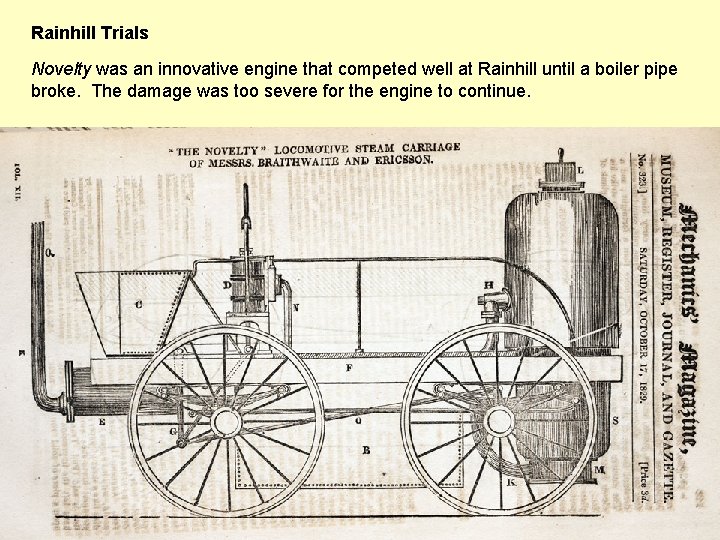
Rainhill Trials Novelty was an innovative engine that competed well at Rainhill until a boiler pipe broke. The damage was too severe for the engine to continue.
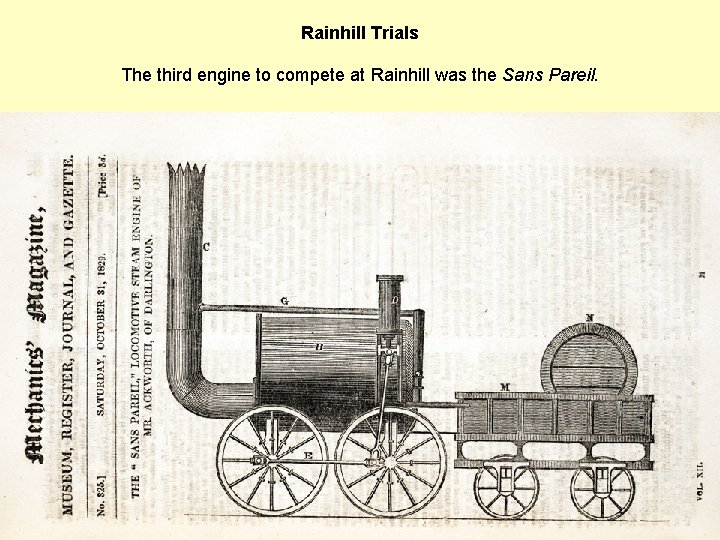
Rainhill Trials The third engine to compete at Rainhill was the Sans Pareil.
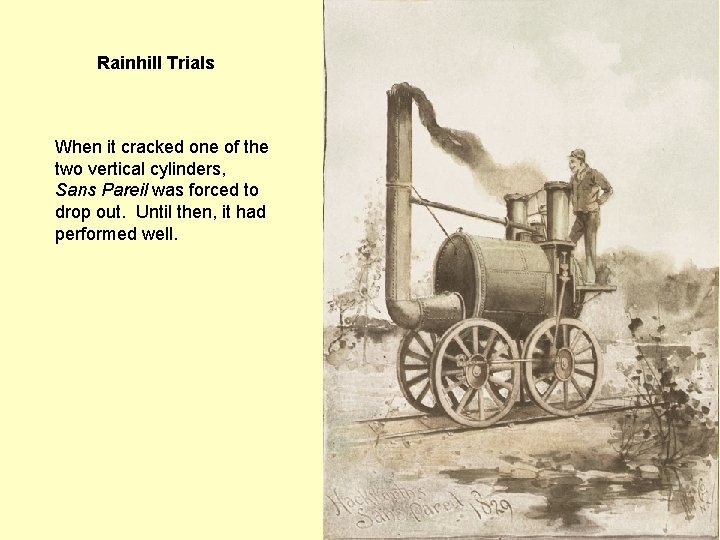
Rainhill Trials When it cracked one of the two vertical cylinders, Sans Pareil was forced to drop out. Until then, it had performed well.
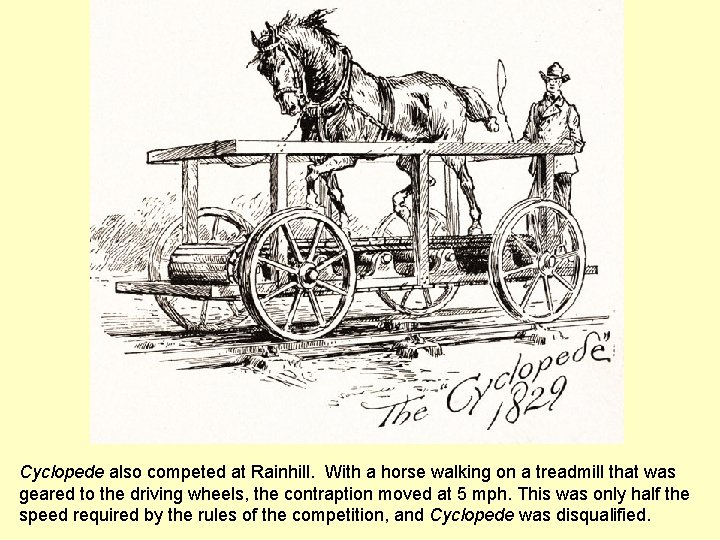
Cyclopede also competed at Rainhill. With a horse walking on a treadmill that was geared to the driving wheels, the contraption moved at 5 mph. This was only half the speed required by the rules of the competition, and Cyclopede was disqualified.
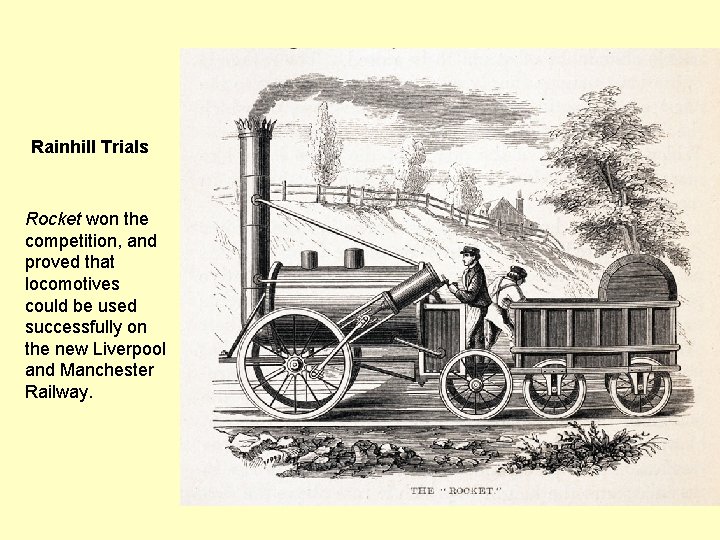
Rainhill Trials Rocket won the competition, and proved that locomotives could be used successfully on the new Liverpool and Manchester Railway.
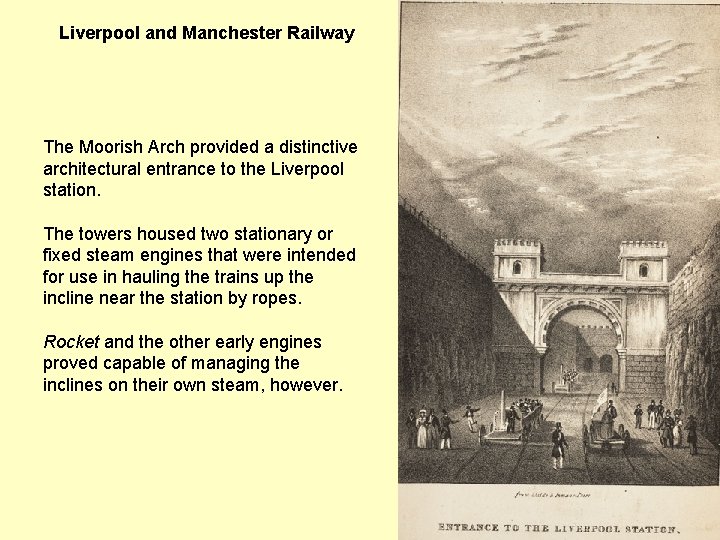
Liverpool and Manchester Railway The Moorish Arch provided a distinctive architectural entrance to the Liverpool station. The towers housed two stationary or fixed steam engines that were intended for use in hauling the trains up the incline near the station by ropes. Rocket and the other early engines proved capable of managing the inclines on their own steam, however.
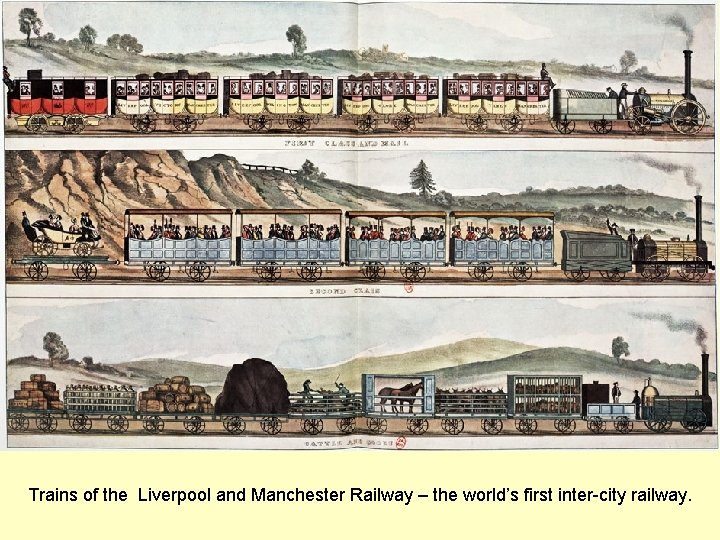
Trains of the Liverpool and Manchester Railway – the world’s first inter-city railway.
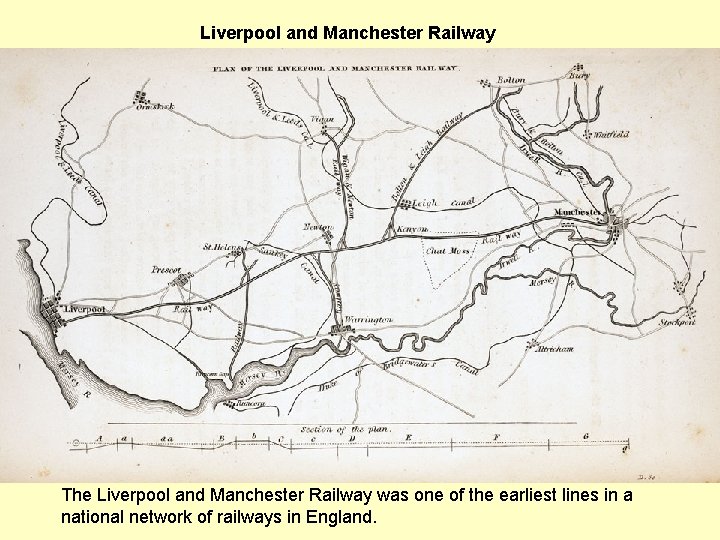
Liverpool and Manchester Railway The Liverpool and Manchester Railway was one of the earliest lines in a national network of railways in England.
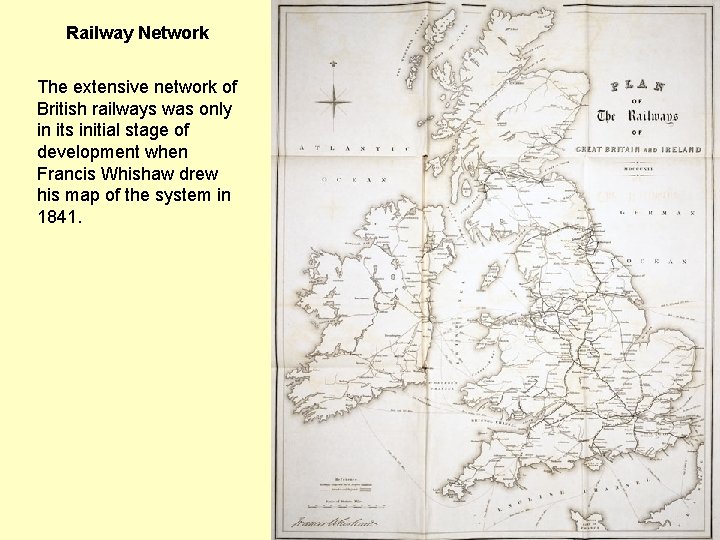
Railway Network The extensive network of British railways was only in its initial stage of development when Francis Whishaw drew his map of the system in 1841.
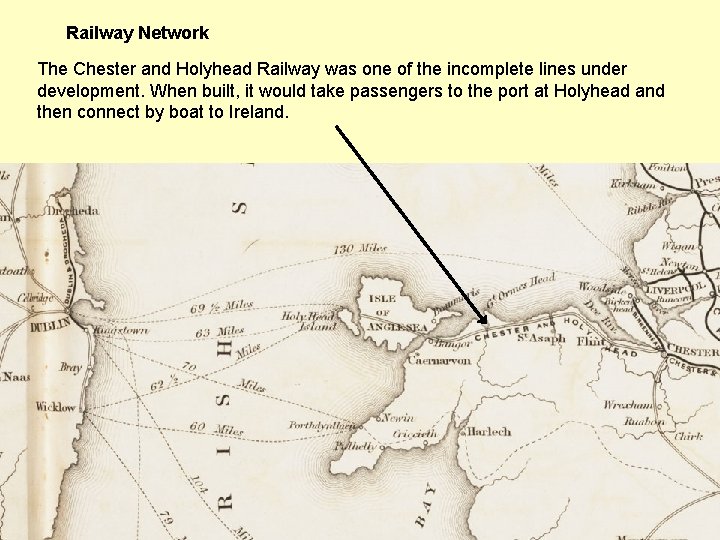
Railway Network The Chester and Holyhead Railway was one of the incomplete lines under development. When built, it would take passengers to the port at Holyhead and then connect by boat to Ireland.
Railroad Bridges
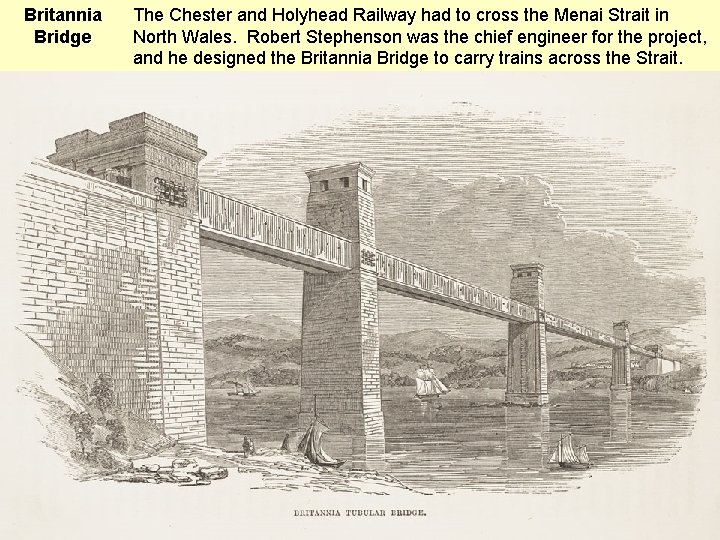
Britannia Bridge The Chester and Holyhead Railway had to cross the Menai Strait in North Wales. Robert Stephenson was the chief engineer for the project, and he designed the Britannia Bridge to carry trains across the Strait.
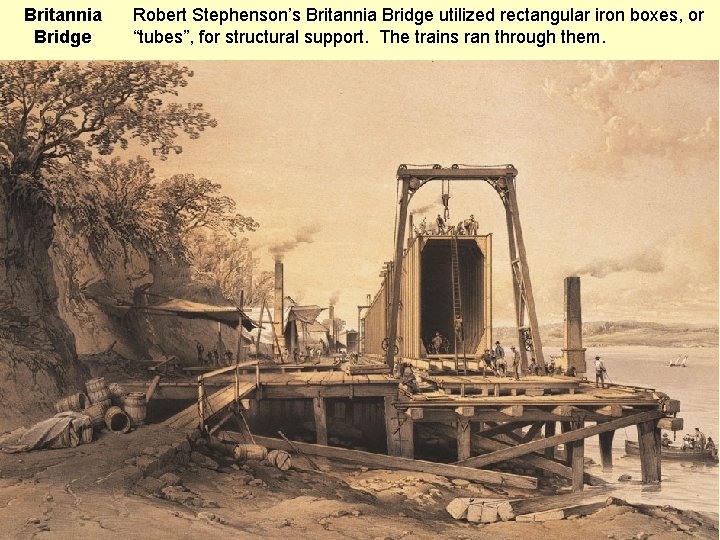
Britannia Bridge Robert Stephenson’s Britannia Bridge utilized rectangular iron boxes, or “tubes”, for structural support. The trains ran through them.
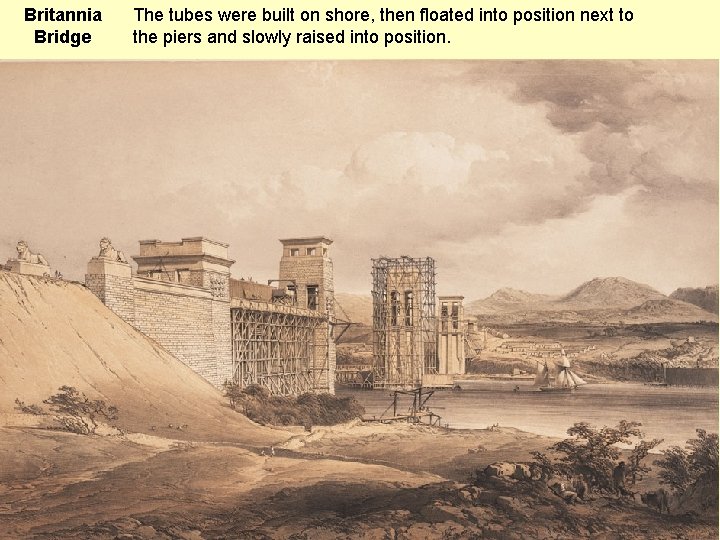
Britannia Bridge The tubes were built on shore, then floated into position next to the piers and slowly raised into position.
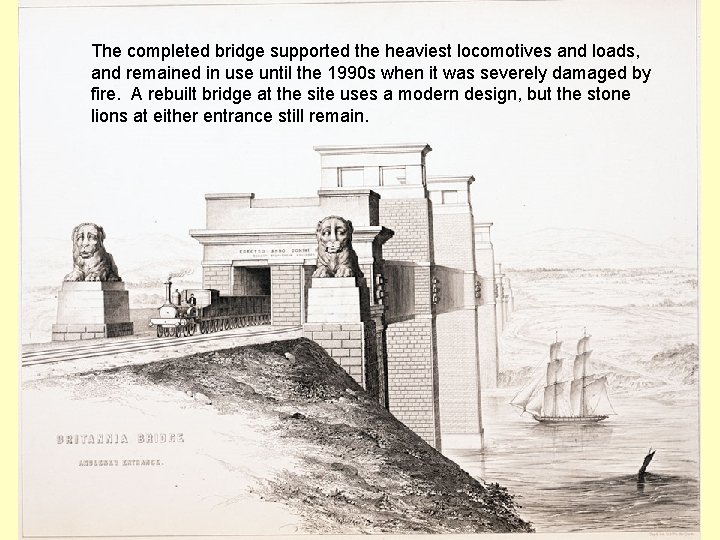
Britannia Bridge The completed bridge supported the heaviest locomotives and loads, and remained in use until the 1990 s when it was severely damaged by fire. A rebuilt bridge at the site uses a modern design, but the stone lions at either entrance still remain.
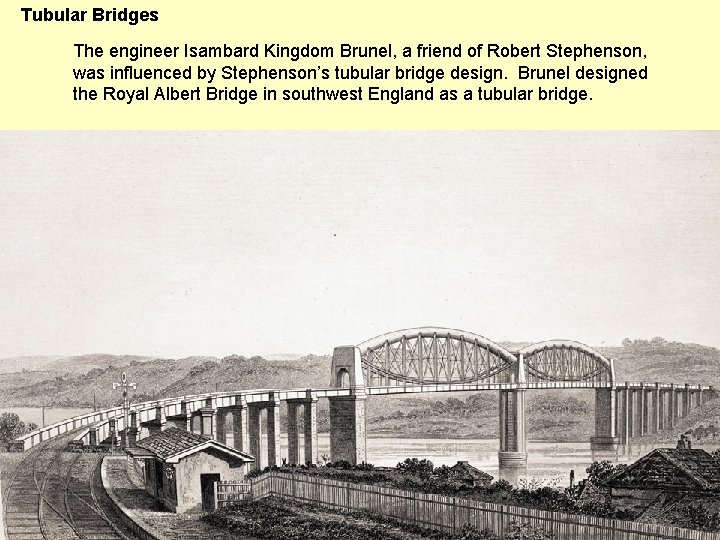
Tubular Bridges The engineer Isambard Kingdom Brunel, a friend of Robert Stephenson, was influenced by Stephenson’s tubular bridge design. Brunel designed the Royal Albert Bridge in southwest England as a tubular bridge.
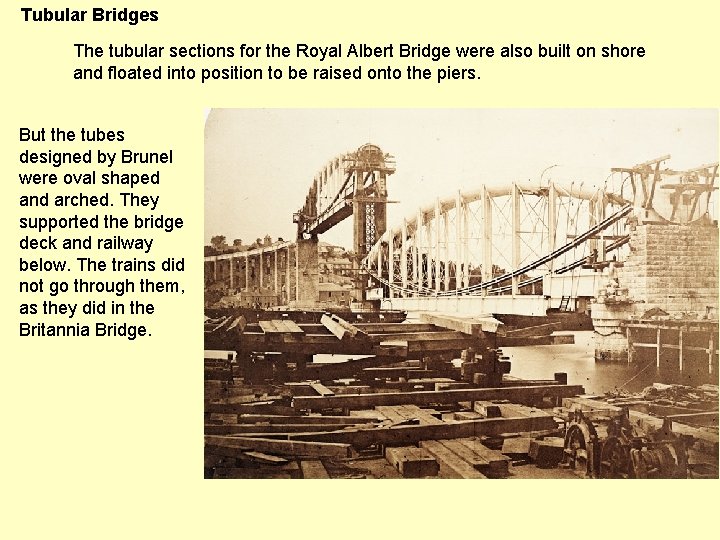
Tubular Bridges The tubular sections for the Royal Albert Bridge were also built on shore and floated into position to be raised onto the piers. But the tubes designed by Brunel were oval shaped and arched. They supported the bridge deck and railway below. The trains did not go through them, as they did in the Britannia Bridge.
Great Western Railway
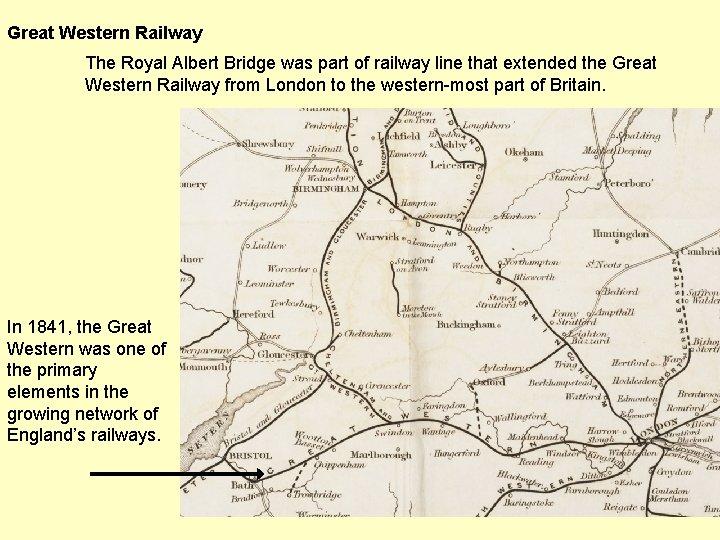
Great Western Railway The Royal Albert Bridge was part of railway line that extended the Great Western Railway from London to the western-most part of Britain. In 1841, the Great Western was one of the primary elements in the growing network of England’s railways.
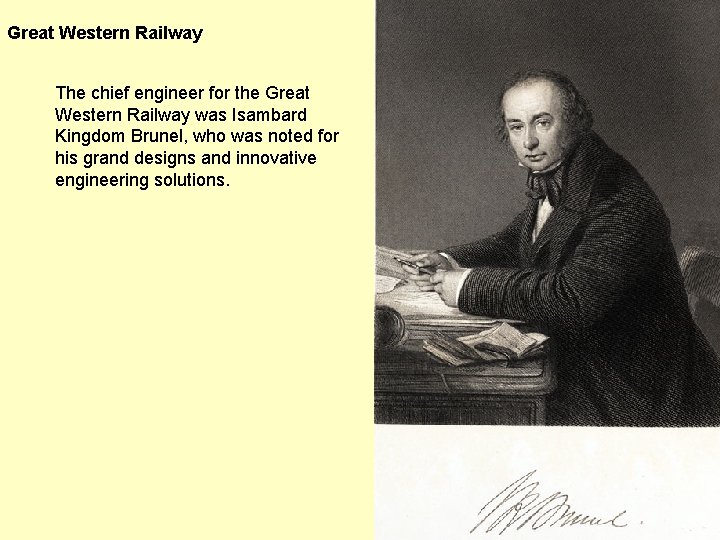
Great Western Railway The chief engineer for the Great Western Railway was Isambard Kingdom Brunel, who was noted for his grand designs and innovative engineering solutions.
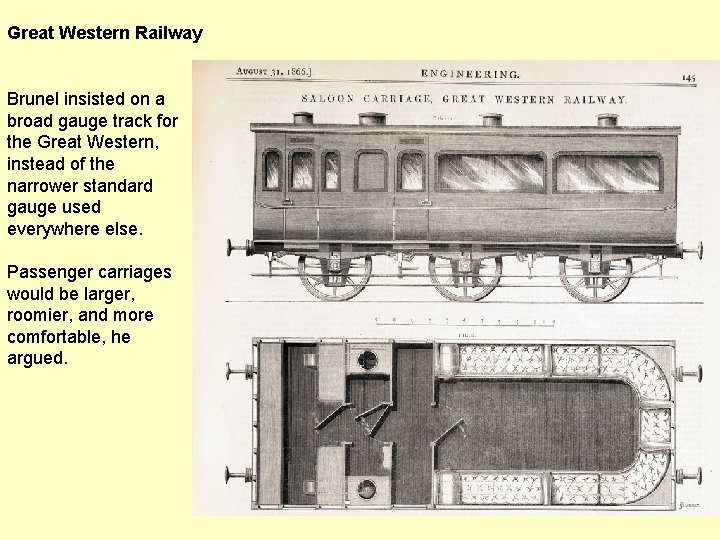
Great Western Railway Brunel insisted on a broad gauge track for the Great Western, instead of the narrower standard gauge used everywhere else. Passenger carriages would be larger, roomier, and more comfortable, he argued.
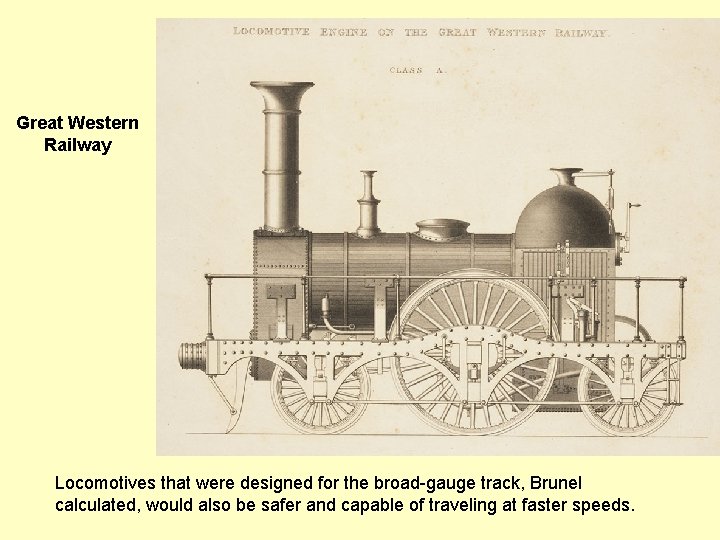
Great Western Railway Locomotives that were designed for the broad-gauge track, Brunel calculated, would also be safer and capable of traveling at faster speeds.
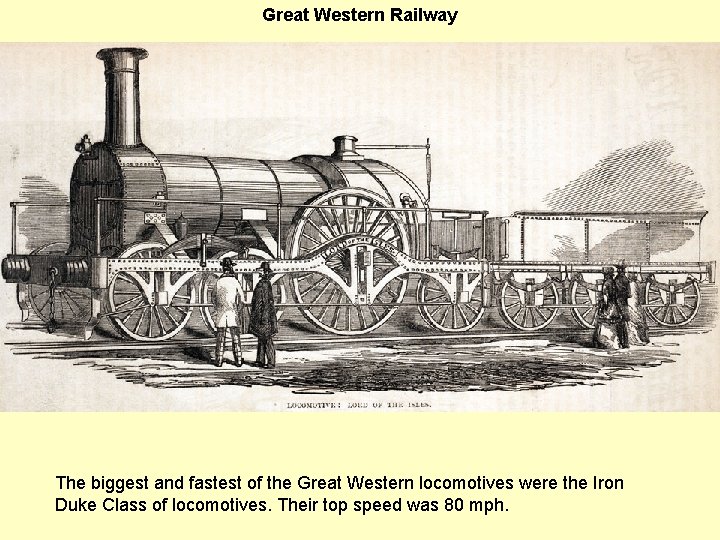
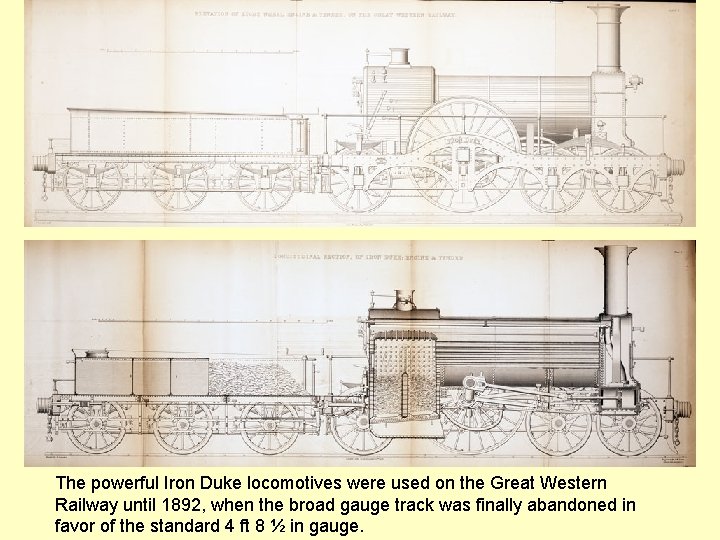
Great Western Railway The biggest and fastest of the Great Western locomotives were the Iron Duke Class of locomotives. Their top speed was 80 mph.
Great Western Railway The powerful Iron Duke locomotives were used on the Great Western Railway until 1892, when the broad gauge track was finally abandoned in favor of the standard 4 ft 8 ½ in gauge.
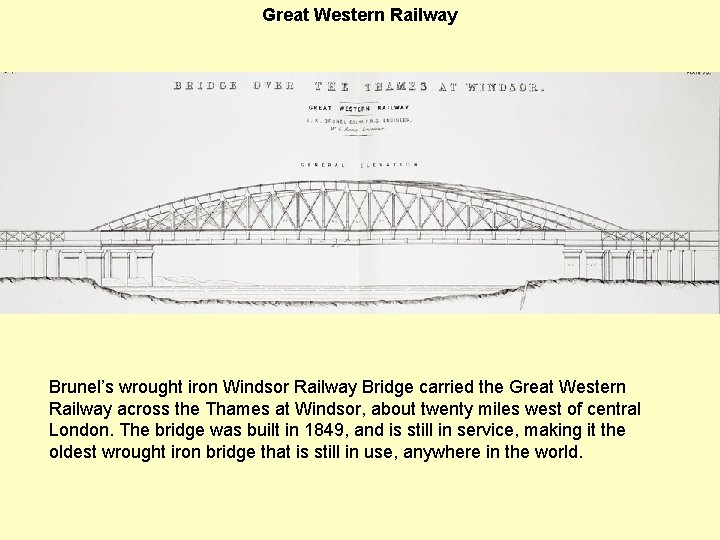
Great Western Railway Brunel’s wrought iron Windsor Railway Bridge carried the Great Western Railway across the Thames at Windsor, about twenty miles west of central London. The bridge was built in 1849, and is still in service, making it the oldest wrought iron bridge that is still in use, anywhere in the world.
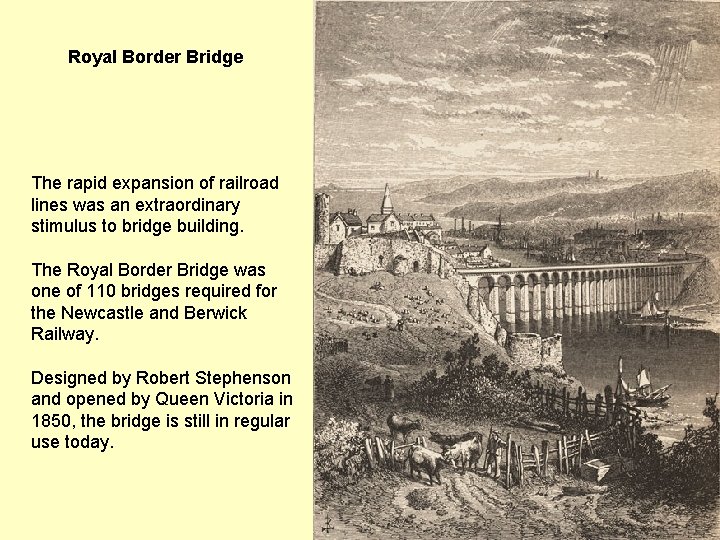
Royal Border Bridge The rapid expansion of railroad lines was an extraordinary stimulus to bridge building. The Royal Border Bridge was one of 110 bridges required for the Newcastle and Berwick Railway. Designed by Robert Stephenson and opened by Queen Victoria in 1850, the bridge is still in regular use today.
American Railroads
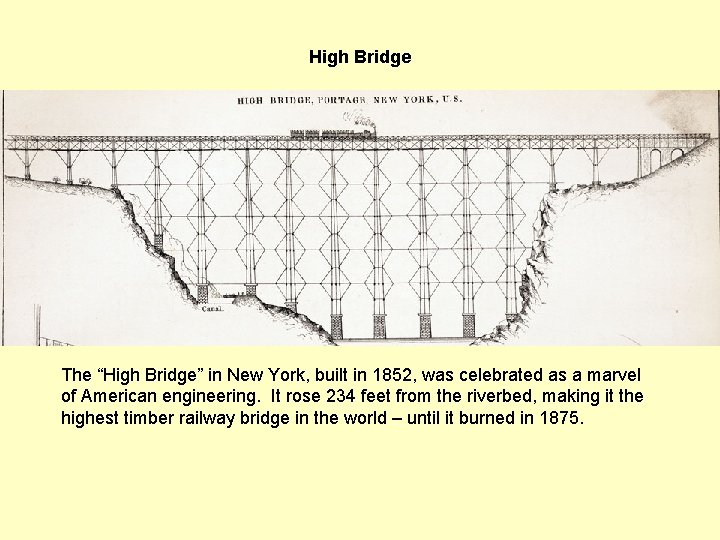
High Bridge The “High Bridge” in New York, built in 1852, was celebrated as a marvel of American engineering. It rose 234 feet from the riverbed, making it the highest timber railway bridge in the world – until it burned in 1875.
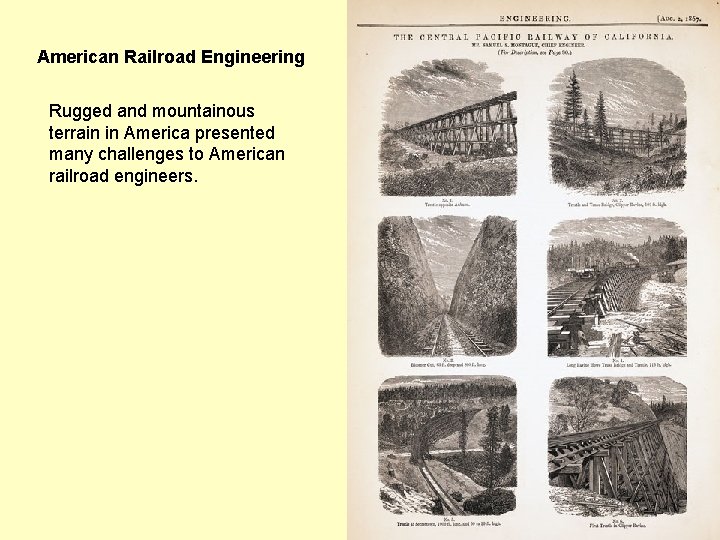
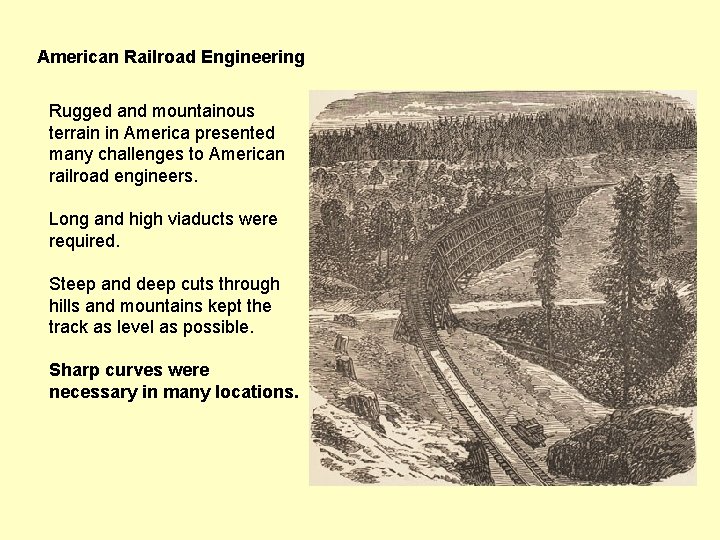
American Railroad Engineering Rugged and mountainous terrain in America presented many challenges to American railroad engineers.
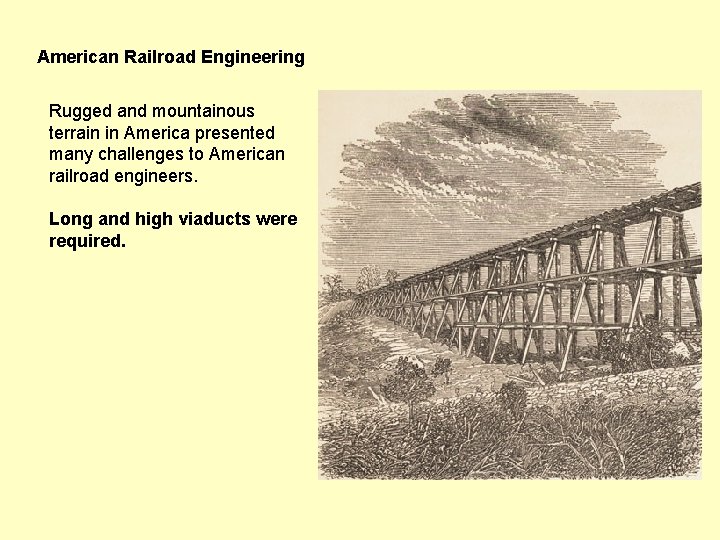
American Railroad Engineering Rugged and mountainous terrain in America presented many challenges to American railroad engineers. Long and high viaducts were required.
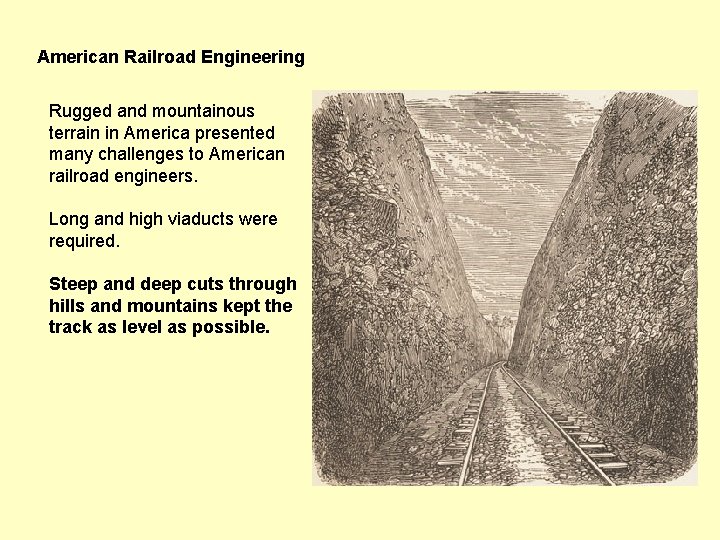
American Railroad Engineering Rugged and mountainous terrain in America presented many challenges to American railroad engineers. Long and high viaducts were required. Steep and deep cuts through hills and mountains kept the track as level as possible.
American Railroad Engineering Rugged and mountainous terrain in America presented many challenges to American railroad engineers. Long and high viaducts were required. Steep and deep cuts through hills and mountains kept the track as level as possible. Sharp curves were necessary in many locations.
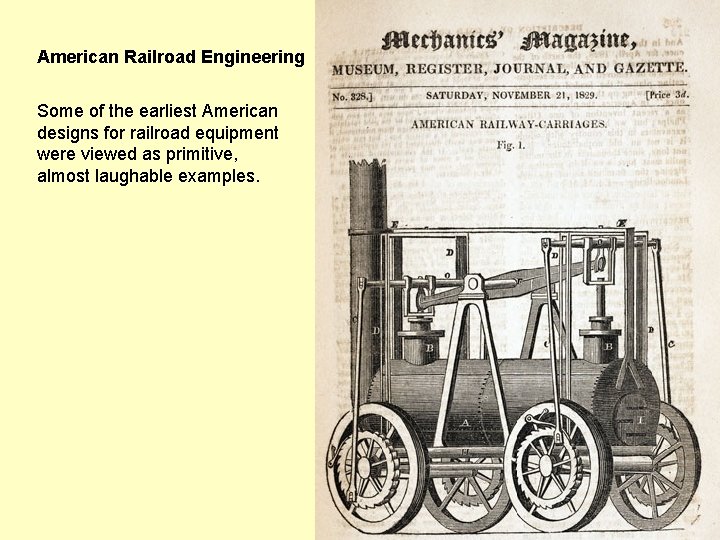
American Railroad Engineering Some of the earliest American designs for railroad equipment were viewed as primitive, almost laughable examples.
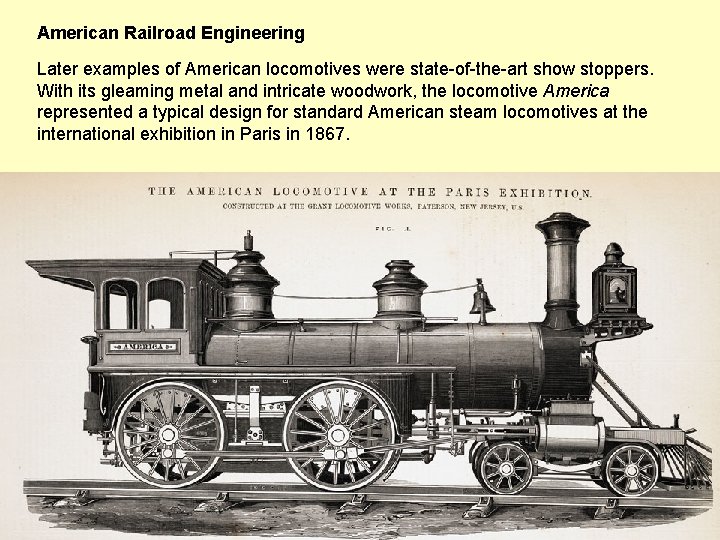
American Railroad Engineering Later examples of American locomotives were state-of-the-art show stoppers. With its gleaming metal and intricate woodwork, the locomotive America represented a typical design for standard American steam locomotives at the international exhibition in Paris in 1867.
American Standard Locomotives
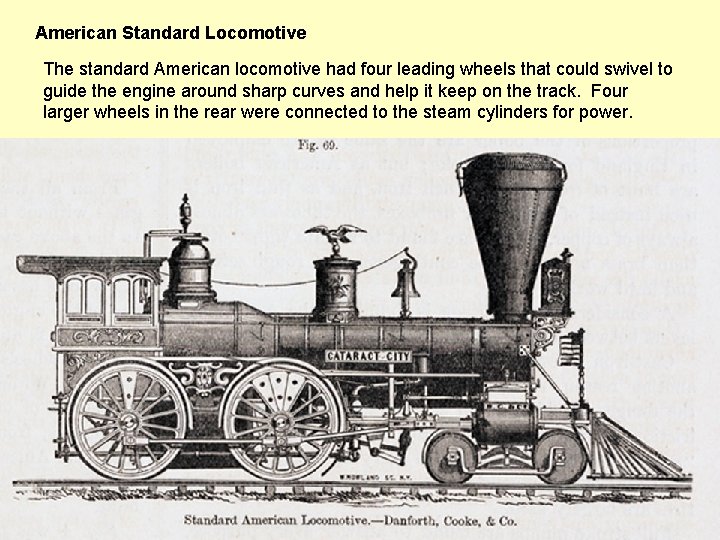
American Standard Locomotive The standard American locomotive had four leading wheels that could swivel to guide the engine around sharp curves and help it keep on the track. Four larger wheels in the rear were connected to the steam cylinders for power.
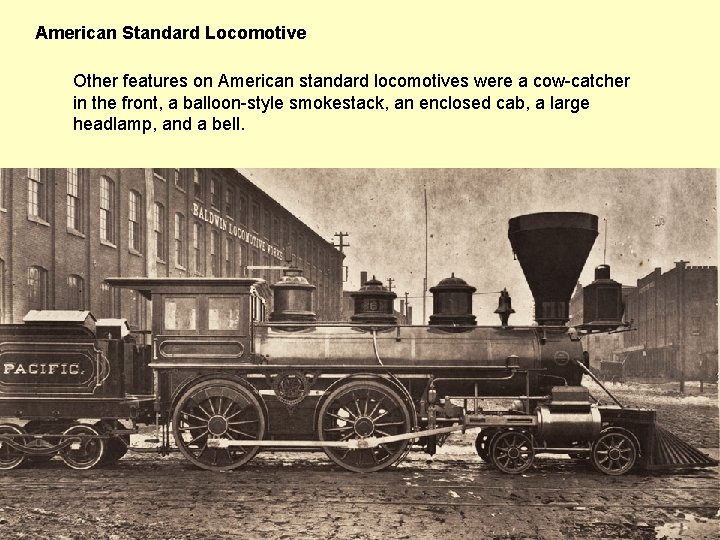
American Standard Locomotive Other features on American standard locomotives were a cow-catcher in the front, a balloon-style smokestack, an enclosed cab, a large headlamp, and a bell.
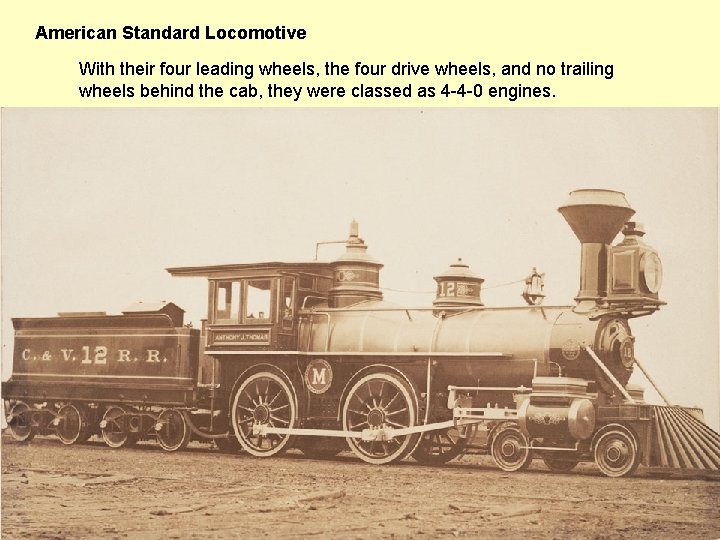
American Standard Locomotive With their four leading wheels, the four drive wheels, and no trailing wheels behind the cab, they were classed as 4 -4 -0 engines.
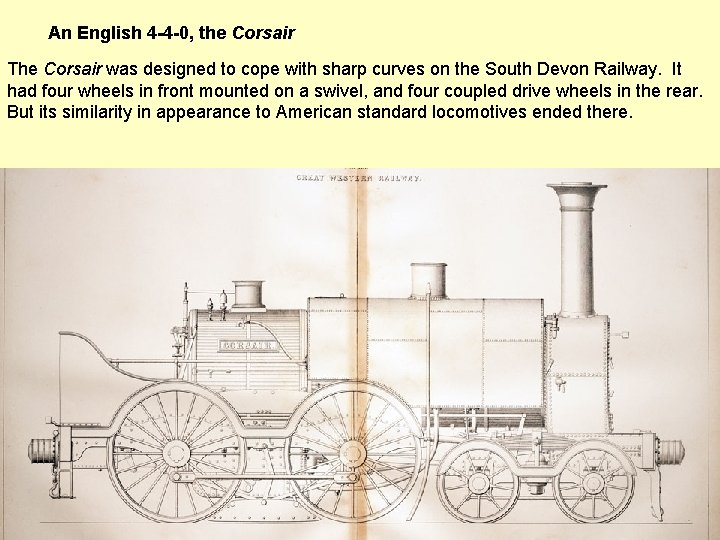
An English 4 -4 -0, the Corsair The Corsair was designed to cope with sharp curves on the South Devon Railway. It had four wheels in front mounted on a swivel, and four coupled drive wheels in the rear. But its similarity in appearance to American standard locomotives ended there.
Crossing the Continent
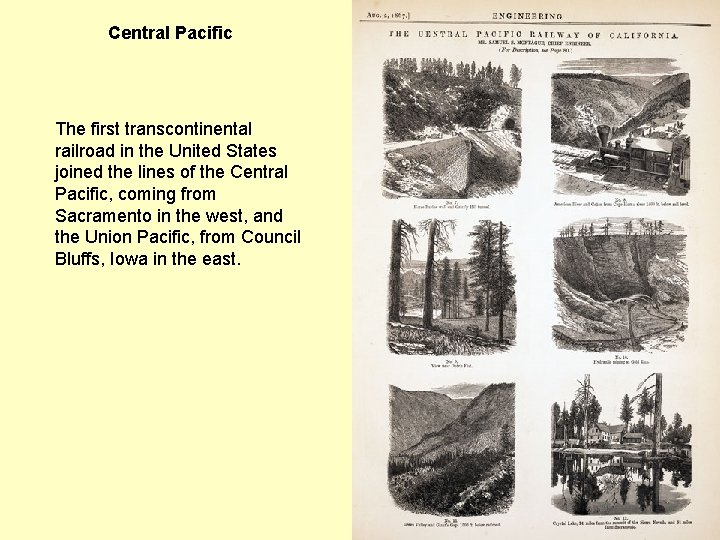
Central Pacific The first transcontinental railroad in the United States joined the lines of the Central Pacific, coming from Sacramento in the west, and the Union Pacific, from Council Bluffs, Iowa in the east.
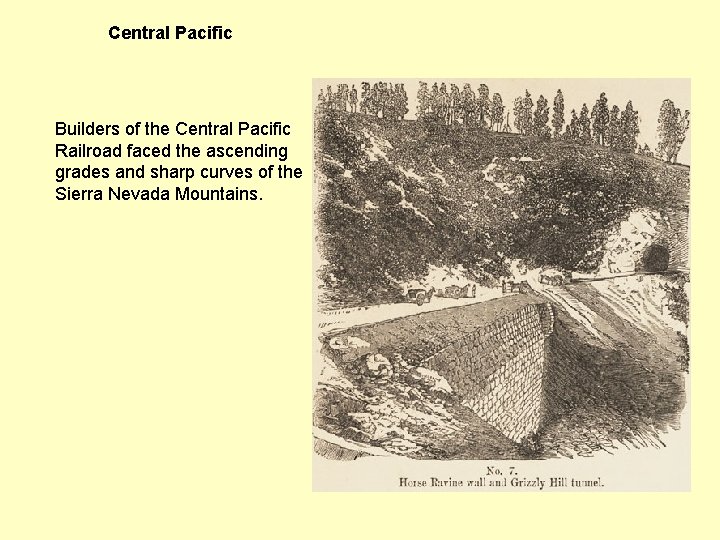
Central Pacific Builders of the Central Pacific Railroad faced the ascending grades and sharp curves of the Sierra Nevada Mountains.
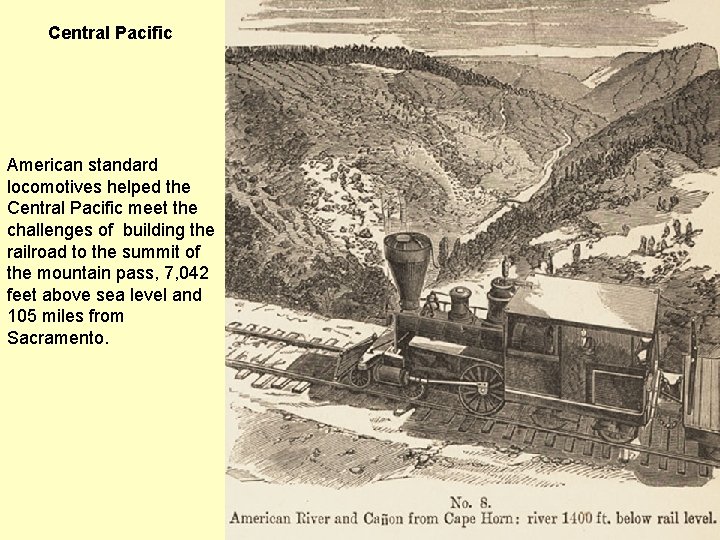
Central Pacific American standard locomotives helped the Central Pacific meet the challenges of building the railroad to the summit of the mountain pass, 7, 042 feet above sea level and 105 miles from Sacramento.
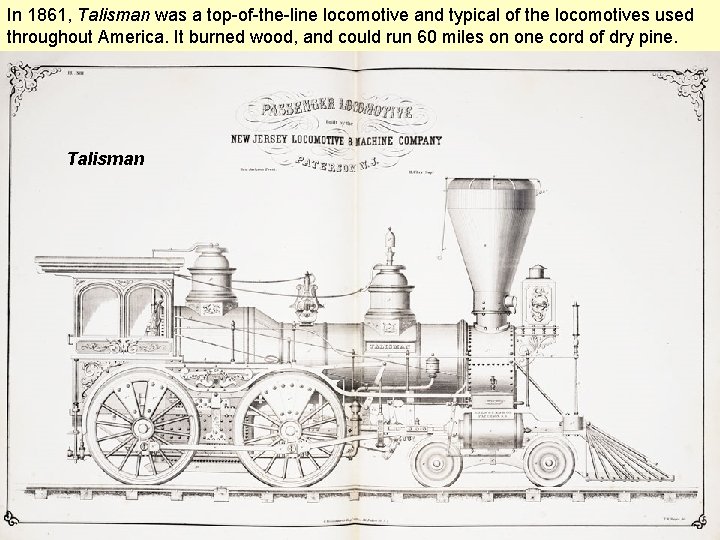
In 1861, Talisman was a top-of-the-line locomotive and typical of the locomotives used throughout America. It burned wood, and could run 60 miles on one cord of dry pine. Talisman
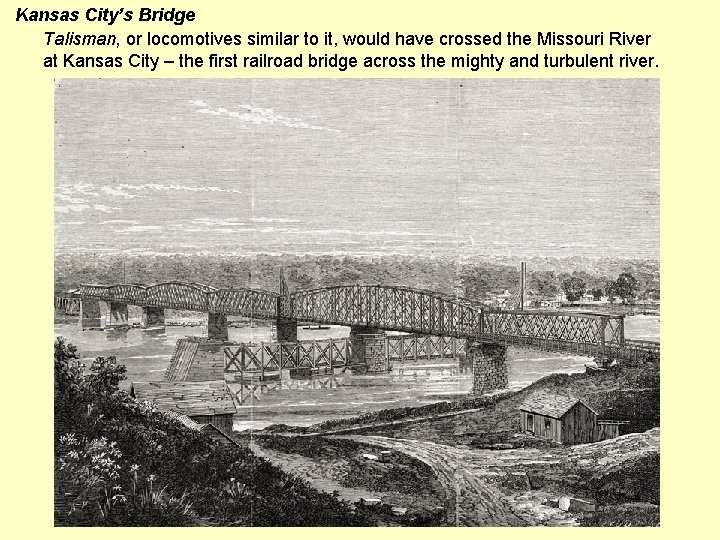
Kansas City’s Bridge Talisman, or locomotives similar to it, would have crossed the Missouri River at Kansas City – the first railroad bridge across the mighty and turbulent river.
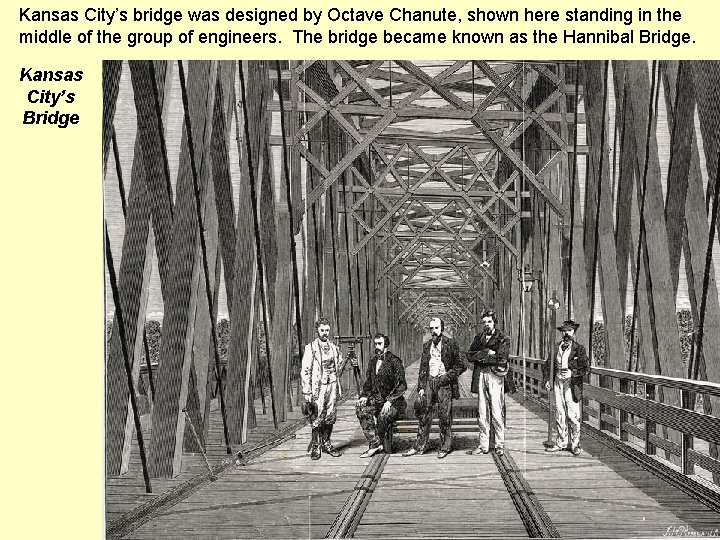
Kansas City’s bridge was designed by Octave Chanute, shown here standing in the middle of the group of engineers. The bridge became known as the Hannibal Bridge. Kansas City’s Bridge
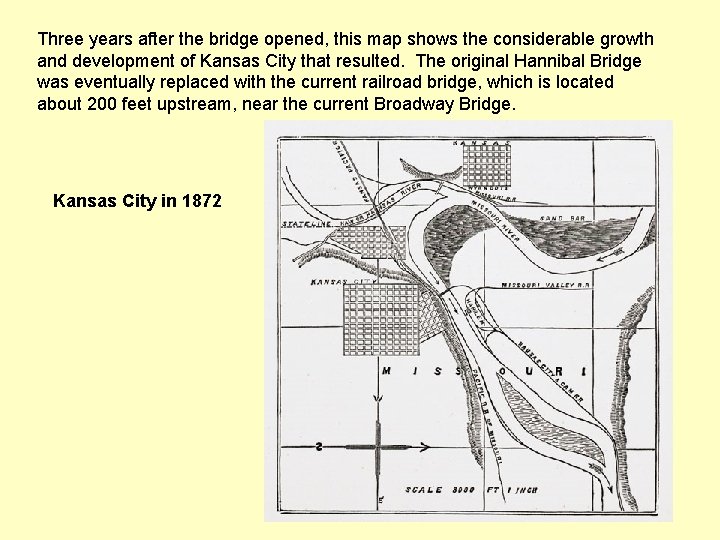
Three years after the bridge opened, this map shows the considerable growth and development of Kansas City that resulted. The original Hannibal Bridge was eventually replaced with the current railroad bridge, which is located about 200 feet upstream, near the current Broadway Bridge. Kansas City in 1872
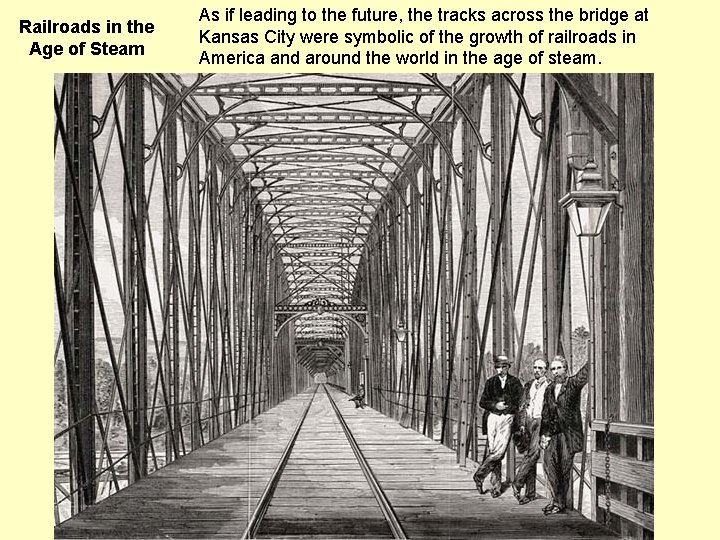
Railroads in the Age of Steam As if leading to the future, the tracks across the bridge at Kansas City were symbolic of the growth of railroads in America and around the world in the age of steam.