
STEAM BOILER EFFICIENCY USING BIOMASS Dr Terry Dixon
STEAM BOILER EFFICIENCY USING BIOMASS Dr Terry Dixon COGENERATION WORKSHOP XXI Congreso De Tecnicos Azucareros De Centroamerica 21 - 25 August 2017

DIXON SOLUTIONS Pty Ltd Dr Terry Dixon
TOPICS TO BE COVERED Boilers and Efficiency in the Cogeneration context Three pillars of Cogen – Factory Steam Demand, Bagasse Moisture, Boiler Efficiency Australian cogeneration context Efficiency components Fixed and Variable factors Design parameters Operational factors Maintenance factors Monitoring and Management
BOILERS, EFFICIENCY and COGENERATION Cogeneration is all about energy management Fixed (and free) fuel supply – bagasse, cane trash Limited auxiliary fuels (coal, other biomass) Electric Power only viable by-product of bagasse Very limited Pulp-Paper usage Cogeneration technology not “advanced” compared to pf coal-fired boilers and turbines Several boiler and turbine design combinations, but relatively “standard” Management mindset needs to change to fully utilise cogeneration potential
THREE COGENERATION PILLARS All about bagasse supply and usage Bagasse Production – Moisture Content Milling tandem settings and optimisation – produce the lowest possible bagasse moisture Factory Steam Demand – “Steam-On-Cane” Complex economic equation to support reduced SOC Boiler Efficiency – some controllable factors Recovery of Cane Trash is 4 th Pillar
AUSTRALIAN COGENERATION CONTEXT Australia has huge coal reserves (8. 6% - USA 26. 6%, Russia 17. 6%, China 12. 8%) Export Power return not economically viable Large Boilers – 150 tph to 320 tph; Low Pressure High Factory steam demand (SOC > 48%) Must incinerate all bagasse “Waste Energy Very Efficiently” Several boiler efficiency reduction techniques - Excess Air - Spray Water on Bagasse - Partial Bypass Economiser / Airheater - Hot Gas Bypass - Dump Steam Condenser
EFFICIENCY – THE ENERGY BOX Consider the Energy Envelope Inputs to Energy Box - Ambient Air - Wet Bagasse from Mill / Storage - Feedwater to Economiser / Drum Outputs from Energy Box - Final Flue Gas (Oxygen, Temperature) - Moisture as steam - Steam to turbines - Carbon Monoxide - Unburnt Carbon - Minor Losses (hot ash, radiation)
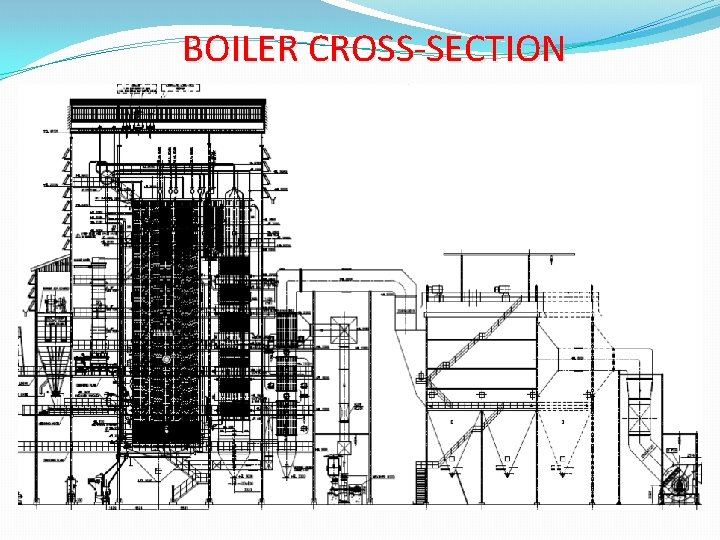
BOILER CROSS-SECTION
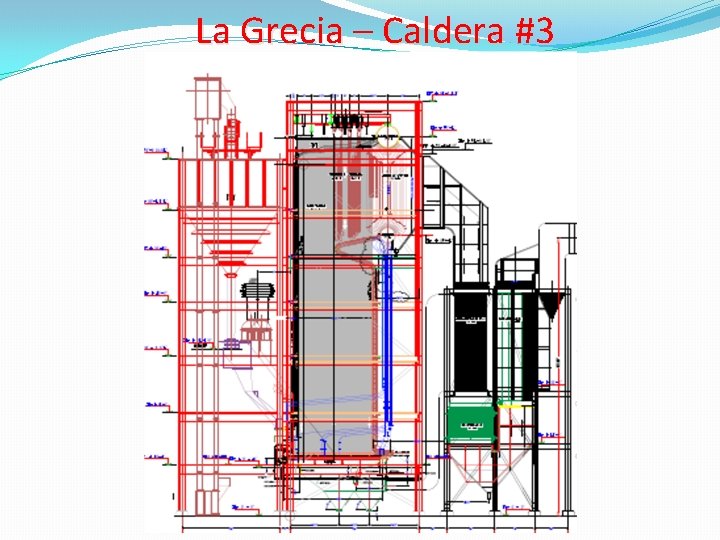
La Grecia – Caldera #3
ENERGY BOX ONLY factors are the Inputs and Outputs Whatever happens inside the Energy Box does not alter the calculation of the Efficiency Various design techniques to recover energy and increase energy efficiency - Air – Airheaters - Water – Economisers - Bagasse – Bagasse Dryers Whatever occurs – final flue gas temperature after last Airheater / Economiser is the key parameter
BOILER EFFICIENCY Direct Method - Measure Steam Flow + Steam Press & Temp and Feedwater Press & Temp - Measure Bagasse Flow - Organised Correct Bagasse Samples - Moisture, Ash, GCV Losses Method - Organised Correct Bagasse Samples - Organised Correct Ash, Fly Ash Samples - Boiler Temperatures (air, flue gas) - Organised Correct Flue Gas Composition - Oxygen, Carbon Monoxide
BOILER EFFICIENCY COMPONENTS Energy Loss components same for ALL Boilers (Bagasse, Coal, Palm Fibre etc. ) Decreasing Order of Importance - Bagasse Moisture - Combustion Moisture (H 2 in bagasse) - Flue Gas (Temperature, Excess Air) - Unburnt Carbon (Carbon in Fly Ash) - Carbon Monoxide - Radiation / Convection from surfaces - Hot Grate Ash and Dust Collector Ash - Moisture in Air
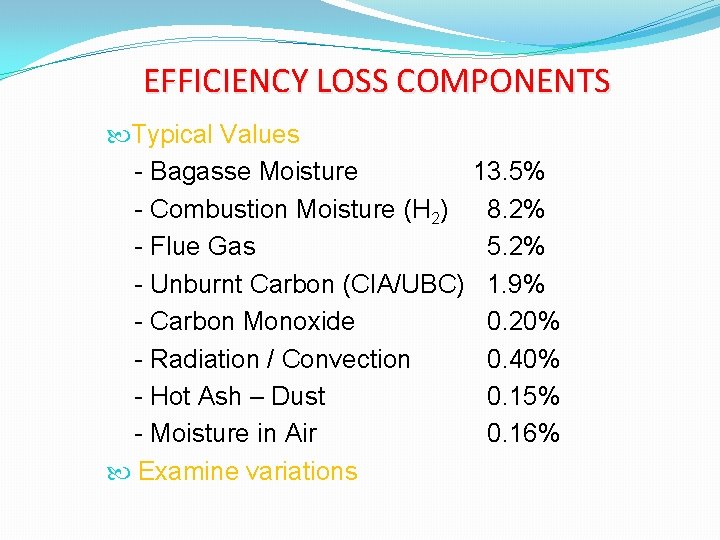
EFFICIENCY LOSS COMPONENTS Typical Values - Bagasse Moisture - Combustion Moisture (H 2) - Flue Gas - Unburnt Carbon (CIA/UBC) - Carbon Monoxide - Radiation / Convection - Hot Ash – Dust - Moisture in Air Examine variations 13. 5% 8. 2% 5. 2% 1. 9% 0. 20% 0. 40% 0. 15% 0. 16%
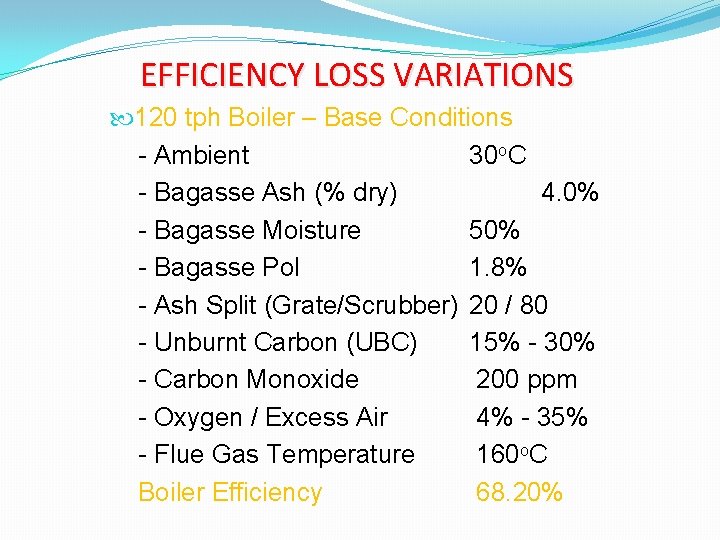
EFFICIENCY LOSS VARIATIONS 120 tph Boiler – Base Conditions - Ambient 30 o. C - Bagasse Ash (% dry) 4. 0% - Bagasse Moisture 50% - Bagasse Pol 1. 8% - Ash Split (Grate/Scrubber) 20 / 80 - Unburnt Carbon (UBC) 15% - 30% - Carbon Monoxide 200 ppm - Oxygen / Excess Air 4% - 35% - Flue Gas Temperature 160 o. C Boiler Efficiency 68. 20%
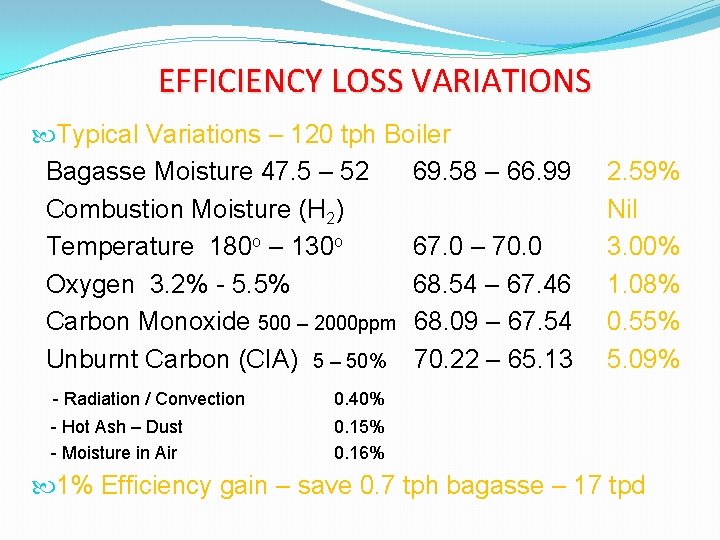
EFFICIENCY LOSS VARIATIONS Typical Variations – 120 tph Boiler Bagasse Moisture 47. 5 – 52 69. 58 – 66. 99 Combustion Moisture (H 2) Temperature 180 o – 130 o 67. 0 – 70. 0 Oxygen 3. 2% - 5. 5% 68. 54 – 67. 46 Carbon Monoxide 500 – 2000 ppm 68. 09 – 67. 54 Unburnt Carbon (CIA) 5 – 50% 70. 22 – 65. 13 - Radiation / Convection 0. 40% - Hot Ash – Dust - Moisture in Air 0. 15% 0. 16% 2. 59% Nil 3. 00% 1. 08% 0. 55% 5. 09% 1% Efficiency gain – save 0. 7 tph bagasse – 17 tpd
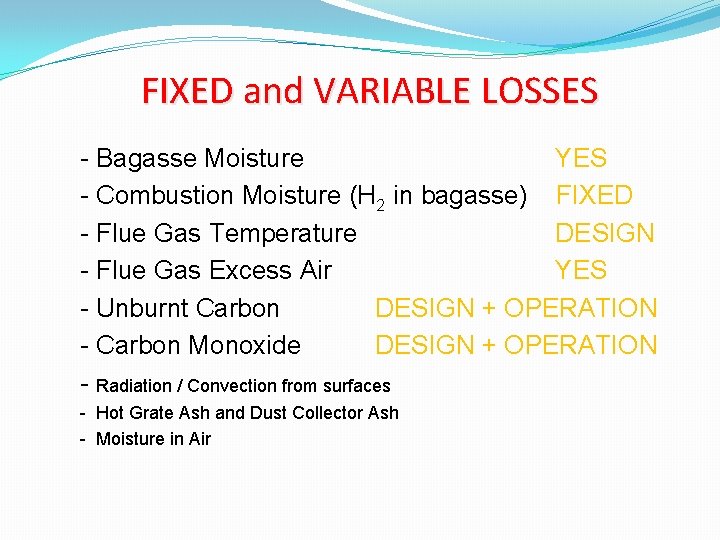
FIXED and VARIABLE LOSSES - Bagasse Moisture YES - Combustion Moisture (H 2 in bagasse) FIXED - Flue Gas Temperature DESIGN - Flue Gas Excess Air YES - Unburnt Carbon DESIGN + OPERATION - Carbon Monoxide DESIGN + OPERATION - Radiation / Convection from surfaces - Hot Grate Ash and Dust Collector Ash - Moisture in Air
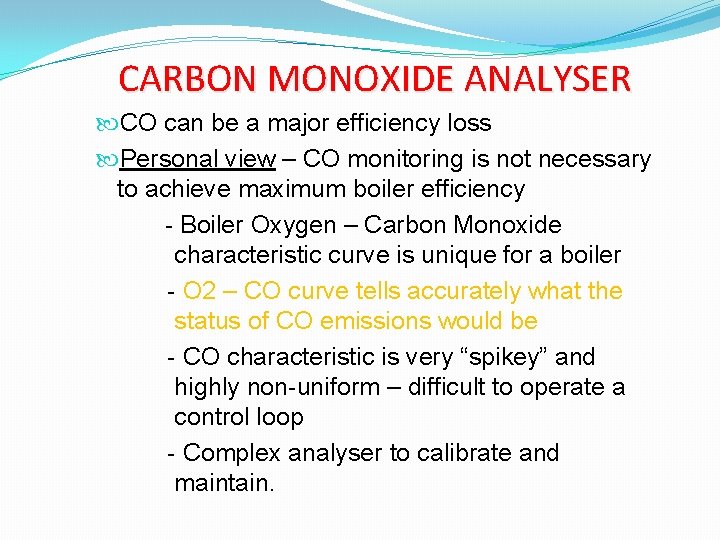
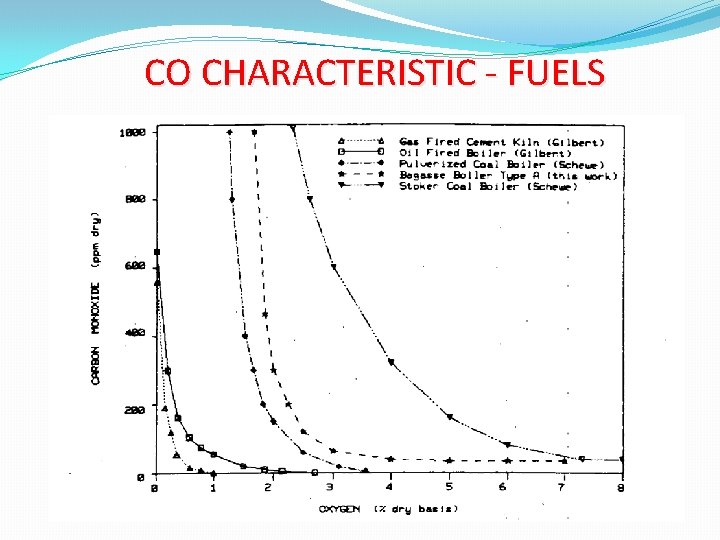
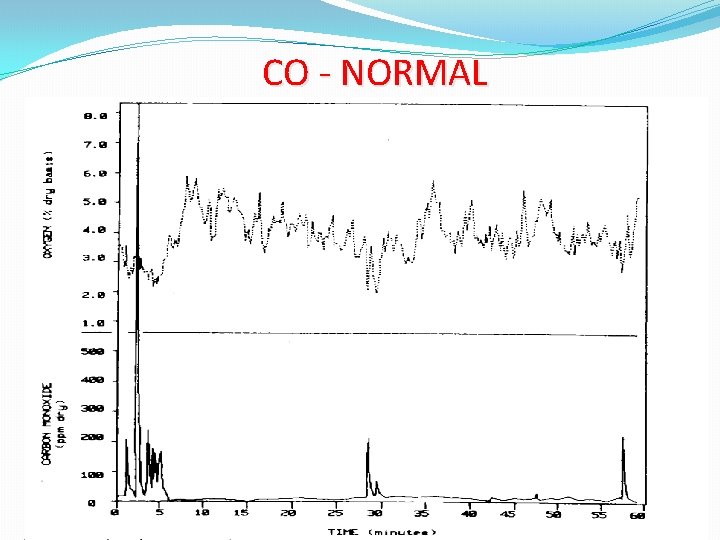
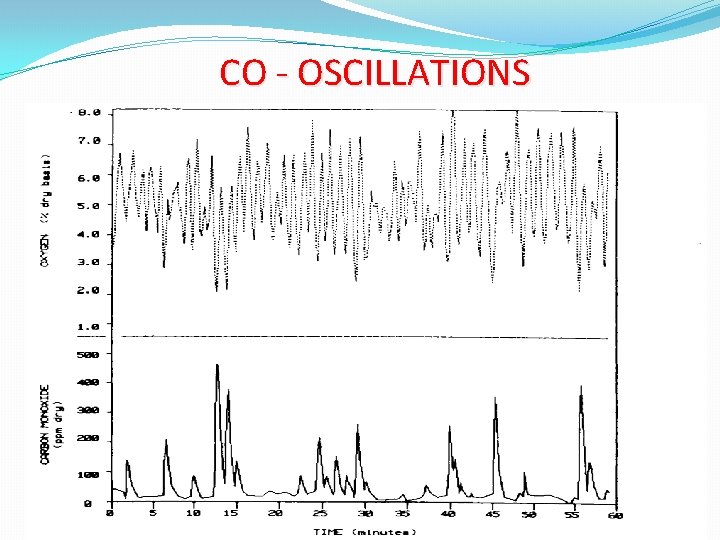
CARBON MONOXIDE ANALYSER CO can be a major efficiency loss Personal view – CO monitoring is not necessary to achieve maximum boiler efficiency - Boiler Oxygen – Carbon Monoxide characteristic curve is unique for a boiler - O 2 – CO curve tells accurately what the status of CO emissions would be - CO characteristic is very “spikey” and highly non-uniform – difficult to operate a control loop - Complex analyser to calibrate and maintain.
CO CHARACTERISTIC - FUELS
CO - NORMAL
CO - OSCILLATIONS
COGEN BOILER A
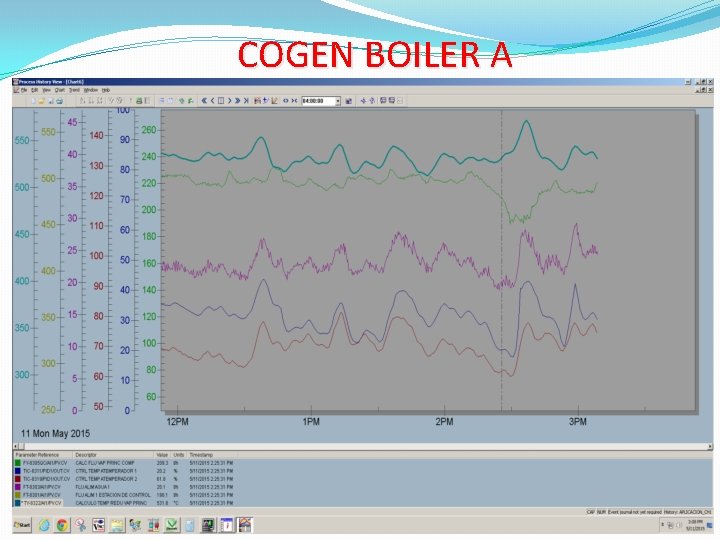
COGEN BOILER A
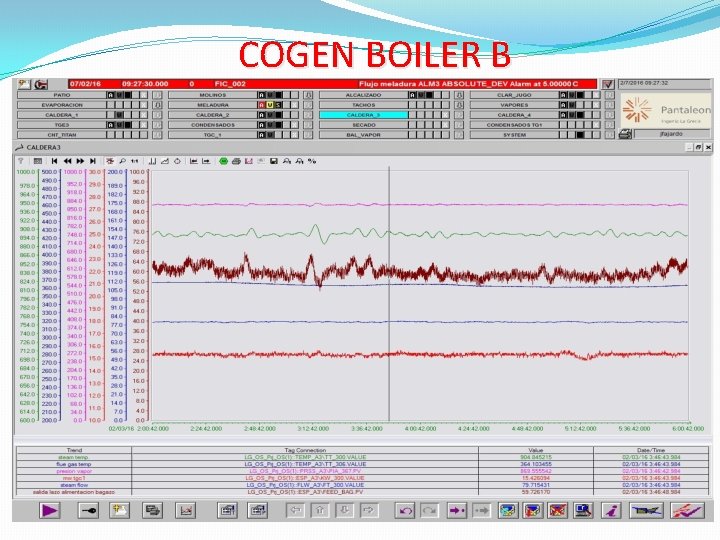
COGEN BOILER B
BOILER DESIGN PARAMETERS Furnace design for multiple factors - Combustion - Char Burnout - Ash fouling - Evaporation / Superheat Convection Bank – evaporation; structural Economiser and Airheater - energy recovery - overall boiler efficiency Bagasse Dryer … ? Air and Gas flows – ID, FD and SA Fans
OPERATIONAL FACTORS Bagasse Moisture Content governs everything Therefore – good Milling Tandem operations are fundamental !!! Very little boiler controls can do to minimise impacts of wet bagasse Bagasse System – bypass wet bagasse around boilers ? ? ? Combustion is key to stable steam generation, low grate deposition and high efficiency Bagasse Spreaders / Distributors set correctly
BAGASSE SPREADERS Like Carburettor on your car engine. … “If the Carburettor is not tuned correctly, the whole car engine does not perform well !” Key to good bagasse combustion is full suspension burning - bagasse dispersed and distributed well in suspension - good mixing with hot furnace gases and Undergrate Air - maximum drying, ignition and burning - only largest particles fall onto grate Constant spreader air pressure
SECONDARY AIR SYSTEM Many designs of Secondary Air systems Many designs are not optimum Performance requirements - control bagasse deposition at rear of grate - additional Oxygen injection to burn-off char and Carbon Monoxide (mixing) - manipulate furnace up-flow to provide optimum gas flow trajectory around nose and through Superheater banks Split of FD air (Undergrate) and Secondary Air - impacts on lower Furnace geometry
OPERATIONAL FACTORS Efficiency focus – not safety (Drum Level) Tuning of major control loops - Master Pressure (Bagasse Feeders) - Steam Temperature (Attemperators) - Oxygen Trim (FD flow) - Furnace Pressure (ID Fans) - Possible Secondary Air modulation (? ) Objective is minimum deviations from Set Point and minimise major excursions during upset conditions Control deviations from set point are small, so efficiency losses are small BUT these accumulate over a long time
OPERATIONAL FACTORS With DCS – no valid reasons why cogeneration boiler operations cannot be fully automated – no Operator “fiddling” for normal operations, including mill stops and starts ! Disturbance conditions can be controlled Exception is physical plant limitations Power Grid trip condition - technically possible and achievable to have factory TA sets “islanding” when disconnected from grid - maintain full factory operations at reduced boiler steam flows
OPERATIONAL FACTORS Options for short term cogen operations dictated by Power Purchase Agreement (PPA) Peaking demand increased sell price ? Economics driver – modify crushing operations to maximise power export Australia – stop crushing during periods of high export power prices …. . Boiler operations are key to maximising bagasse surplus for cogeneration Process operations and Mill Tandem operations are fixed over short term Strong Management directives and focus
OPERATIONAL FACTORS Record and store records of operating data and all plant analyses Historical record of plant performance parameters is valuable tool for problem solving and asset management
MAINTENANCE FACTORS SPREADERS Spreader Plates set at correct angle (~3 o UP above horizontal) Spreader plates flat and smooth – no distortion Spreader air nozzles straight, uniform, correct size Wing Spreaders have deflector guides Air pressures set to specification Optimum duct geometry upstream of spreaders
MAINTENANCE FACTORS INSTRUMENTATION Checks and calibration of main instrumentation – temperatures, pressures through gas passes to ID Fans Gas Temperatures are fundamental Calibration of Oxygen analyser is critical Boiler can be operated well just by understanding and following what the Oxygen analyser tells you
MAINTENANCE FACTORS - OTHER Bagasse Feeders – uniform discharge Airflow distribution in Undergrate Plenum (optimum combustion) Economiser tube erosion (availability) Airheater tube corrosion (increased FD and ID fan power consumption) Convection Bank tube erosion (availability) ESP Performance (statutory limits) Air / Gas flow distributions and ash particle trajectories are key to resolving these issues
MONITORING and MANAGEMENT Problem is magnitude of efficiency improvements 0. 7 tph – 17 tpd Bagasse Saving does not look or sound large Many hours and days of improvement add up to many tonnes of bagasse for cogeneration Challenge for Supervision and Management Fundamental is continuity of attention Operators respond positively when they know management is interested in how they operate the cogen plant
MONITORING SYSTEM Regular representative samples of ash from AH, EC and Scrubber / ESP dust hoppers (2 per week) – sampling accuracy important Reliable Analysis for UBC (procedure) Regular representative sampling for Oxygen and Carbon Monoxide (correct sample location) – check In-Situ Oxygen Analyser Reporting results to all relevant people, including Boiler Operators Supervisors regular review and discussion of results with Operators
MANAGEMENT Conscious examination and understanding of summary reports Frequent superficial contact with supervisors and operators to discuss operating status and progress Management awareness increases the perceived importance of boiler efficiency in cogeneration operations Because the short-term efficiency improvements are small, easy to overlook and forget – bagasse is lost ! Lost opportunities for increased business returns
BOILER EFFICIENCY SUMMARY Cogeneration Totally driven by economics – Power Purchase Agreements (PPA’s) Can be large income stream for business Technical complexity of cogeneration plant and boiler are not high Operating complexity of cogeneration plant and boiler are not high Save bagasse – more power export Because efficiency improvements are small, focus is lost Needs strong Management attention and focus

THANK YOU QUESTIONS ?
BIOGRAPHICAL Terry Dixon has been working in the boiler and combustion fields for over 40 years. He started after graduation in the electric power industry, then spent over 20 years in the sugar industry in Australia with Sugar Research Institute (SRI). His final position was as Engineering Manager. Dr Dixon’s research and development interests included all aspects of boiler technology, combustion dynamics, bagasse drying, bagasse gasification, cogeneration and energy dynamics in the sugar process. He consulted widely to numerous world sugar industries. He subsequently moved to the electric power industry where he specialized in boiler design, coal combustion dynamics, coal milling, slagging dynamics, energy efficiency and maintenance management. Dr Dixon is currently the Director of Dixon Solutions Pty Ltd and consults widely in the sugar and electric power industries worldwide.
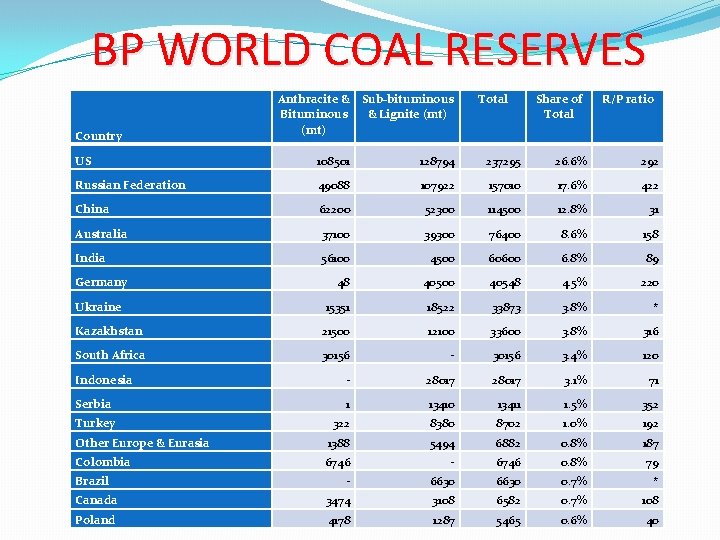
BP WORLD COAL RESERVES Country Anthracite & Sub-bituminous Bituminous & Lignite (mt) Total Share of Total R/P ratio US 108501 128794 237295 26. 6% 292 Russian Federation 49088 107922 157010 17. 6% 422 China 62200 52300 114500 12. 8% 31 Australia 37100 39300 76400 8. 6% 158 India 56100 4500 60600 6. 8% 89 48 40500 40548 4. 5% 220 15351 18522 33873 3. 8% * Kazakhstan 21500 12100 33600 3. 8% 316 South Africa 30156 - 30156 3. 4% 120 Indonesia - 28017 3. 1% 71 Serbia 1 13410 13411 1. 5% 352 322 8380 8702 1. 0% 192 Other Europe & Eurasia 1388 5494 6882 0. 8% 187 Colombia 6746 - 6746 0. 8% 79 - 6630 0. 7% * Canada 3474 3108 6582 0. 7% 108 Poland 4178 1287 5465 0. 6% 40 Germany Ukraine Turkey Brazil
- Slides: 41