
STB 1083 BIOCHEMISTRY Lecture 6 INTRODUCTION TO ENZYMES
STB 1083 BIOCHEMISTRY Lecture 6 INTRODUCTION TO ENZYMES
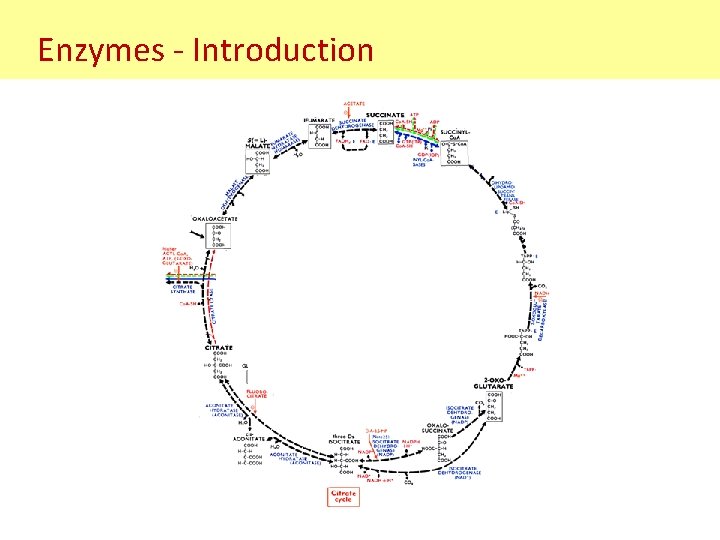
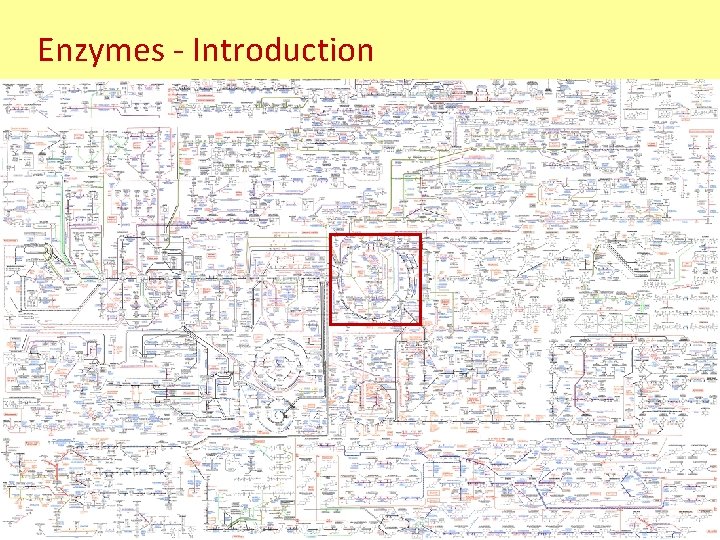
Enzymes - Introduction • Enzymes are large biological molecules that are extraordinarily efficient, selective, biological catalysts. • The word enzyme is derived from Greek meaning “in yeast”. • All cell has hundreds of different enzymes that catalyze reactions essential for life - even the simplest organisms contain hundreds of different enzymes for thousands of metabolic processes. - These processes range from the digestion of food, sensory processing to the synthesis of DNA and other biomolecules.
Enzymes - Introduction
Enzymes - Introduction
Enzymes - Introduction • Most enzymes are proteins, although some catalytic RNA molecules have been identified. - In 1926, James B. Sumner crystallized the first enzyme (urease) and proved that it is a protein. - Five more enzymes were purified later and were also found to be proteins: pepsin, trypsin, chymotrypsin, carboxypeptidase and Old Yellow Enzyme (a flavoprotein NADPH oxidase). - Since then, almost all enzymes have been shown to be proteins or proteins plus cofactors. • Most metabolic enzymes are named by adding the suffix “-ase” to the name of their substrates or to a descriptive term for the reactions they catalyze. - i. e. Urease metabolizes urea, cellulase metabolizes cellulose. - i. e. Alcohol dehydrogenase catalyzes the removal of hydrogen from alcohols.
Enzymes - Introduction • Four main properties of enzymes: 1. Enzymes function as biological catalysts. - Enzymes greatly accelerates metabolic reactions. - Enzymes can accelerate reactions as much as 1016 over uncatalyzed rates! - i. e. Urease Uncatalyzed rate: 3 X 10 -10/sec Catalyzed rate: 3 X 10⁴/sec Ratio is 1 X 10¹⁴ ! - Enzymes remain unchanged in the process.
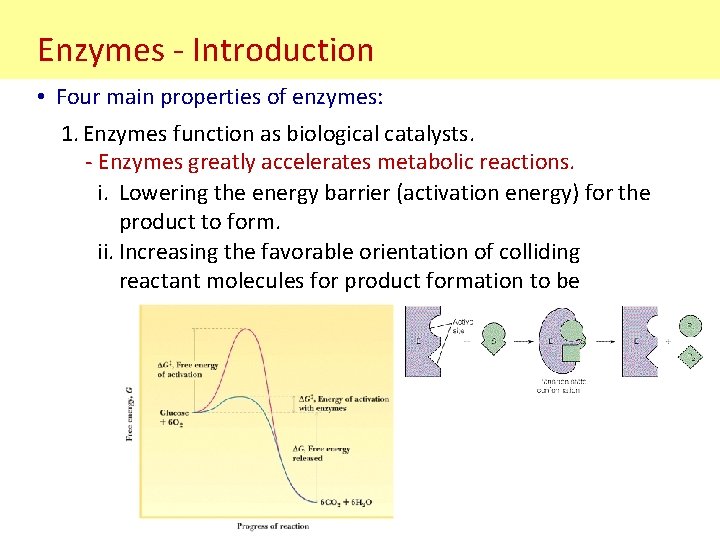
Enzymes - Introduction • Four main properties of enzymes: 1. Enzymes function as biological catalysts. - Enzymes greatly accelerates metabolic reactions. i. Lowering the energy barrier (activation energy) for the product to form. ii. Increasing the favorable orientation of colliding reactant molecules for product formation to be successful.
Enzymes - Introduction • Four main properties of enzymes: 2. Enzymes catalyze highly specific reactions. - Enzymes selectively recognize specific substrates over other molecules. - Specificity is controlled by structure. - The unique fit of substrate with enzyme controls the selectivity for substrate and the product yield. - Some enzymes act on a group of related substrates, and others on only a single compound. - Important aspect of enzyme specificity is reaction specificity that is, the lack of formation of wasteful by-products. - Enzymes produce products in very high yields - often much greater than 95%.
Enzymes - Introduction • Four main properties of enzymes: 3. Enzymes can couple reactions. - Enzymes combine, or couple, two reactions that would normally occur separately, allowing the energy gained from one reaction to be used in a second reaction. - Enzymes can couple different reactions to produce or use similar products or common metabolites. - Couple reactions mediated by enzymes enables reverse in pathways. 4. Enzymes activities can be regulated. - Enzymes activites can be controlled (off/on) when needed. - Regulators can be promoters, inducers or inhibitors. - Enzymes whose activity is regulated generally have a more complex structure than unregulated enzymes.
Classes of enzymes • Enzymes are categorized into six major classes: 1. Oxidoreductases - catalyze oxidation-reduction reactions (NADH). Involves gaining or loss of oxygen and hydrogen. 2. Transferases - catalyze transfer of functional groups from one molecule to another. 3. Hydrolases - catalyze hydrolytic cleavage (addition of water). 4. Lyases - catalyze removal of a group from or addition of a group to a double bond, or other cleavages involving electron rearrangement. Removal of groups of atoms without hydrolysis. 5. Isomerases - catalyze intramolecular rearrangement. 6. Ligases - catalyze reactions in which two molecules are joined.

Classes of enzymes • Enzymes named for the substrates and type of reaction.
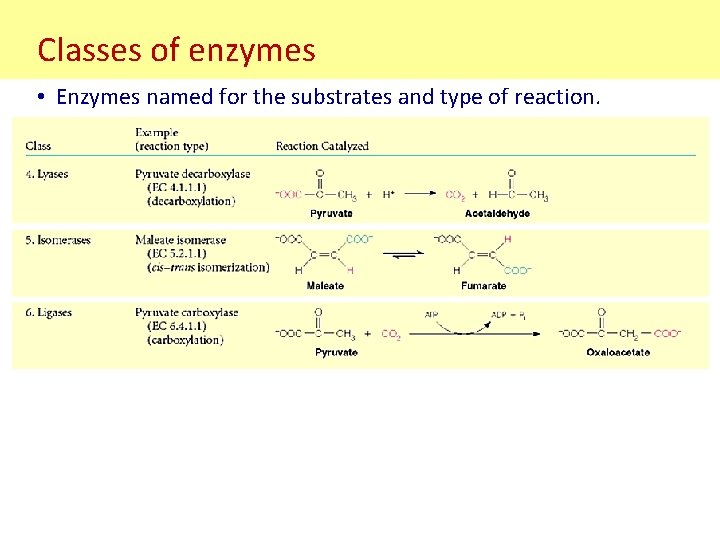
Classes of enzymes • Enzymes named for the substrates and type of reaction.

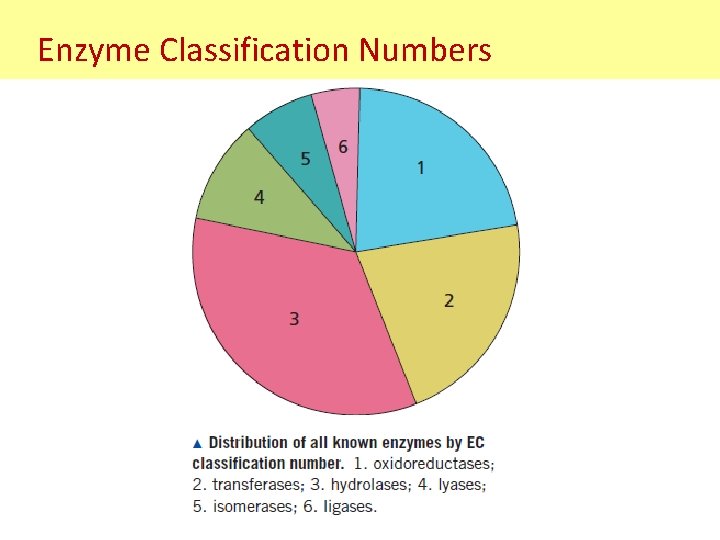
Enzyme Classification Numbers • Enzyme classification numbers are used to recognized specific enzymes. • 1, 4 -α-D-glucanohydrolase (amylase) – EC 3. 2. 1. 1 • Malate dehydrogenase - EC 1. 1. 1. 37 • The first number identifies this enzyme as a member of the first class of enzymes (oxidoreductases). • The second number identifies the substrate group that malate dehydrogenase recognizes. • The third number specifies the electron acceptor for this class of enzymes. Subclass 1. 1. 1 is for enzymes that use NAD+ or NADP+ as an acceptor. • The final number means that malate dehydrogenase is the 37 th enzyme in this category.
Enzyme Classification Numbers
- Slides: 14