
Staying Physically Active Exercise is Important Why Dont



- Slides: 33
Staying Physically Active
Exercise is Important… Why Don’t We Do It I don’t have enough time I get bored!! The gym is too intimidating I Don’t Like It! I am too tired!! I don’t know what to do! I don’t like to sweat
Exercising is good for the Brain! <https: //www. youtube. com/watch? v=m. JW 7 d. YXPZ 2 o Fahey/Insel/Roth, Fit & Well: Core Concepts and Labs in Physical Fitness and Wellness, Chapter 2 © 2007 Mc. Graw-Hill Higher Education. All rights reserved.
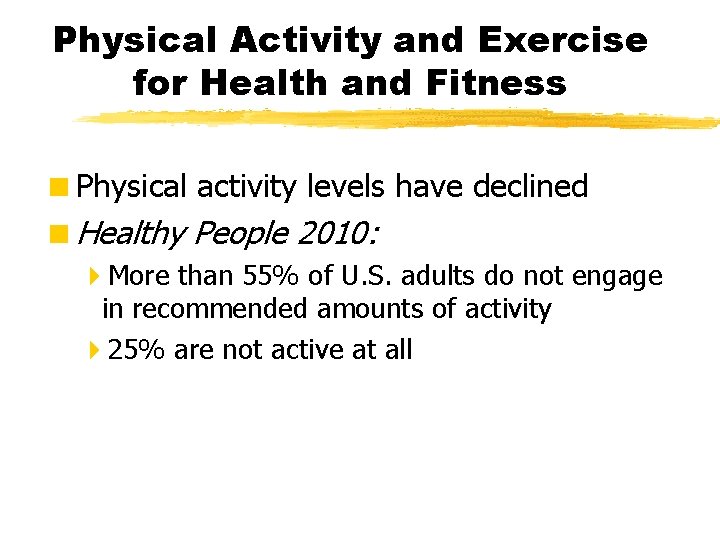
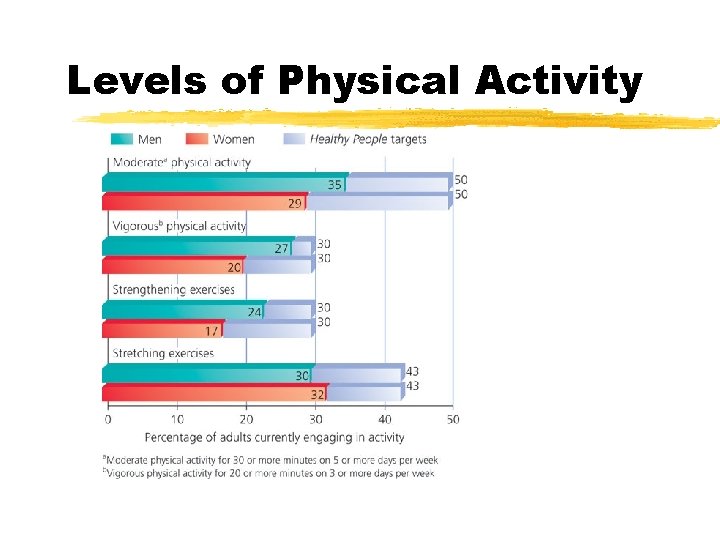
Physical Activity and Exercise for Health and Fitness <Physical activity levels have declined <Healthy People 2010: 4 More than 55% of U. S. adults do not engage in recommended amounts of activity 425% are not active at all
Levels of Physical Activity
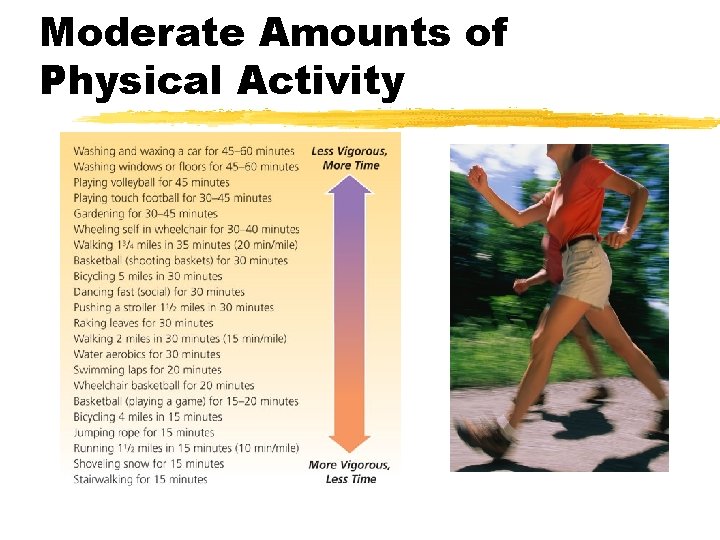
Moderate Amounts of Physical Activity
Fahey/Insel/Roth, Fit & Well: Core Concepts and Labs in Physical Fitness and Wellness, Chapter 2 © 2007 Mc. Graw-Hill Higher Education. All rights reserved.
https: //www. brainpop. com/health/personalhealth/fitness/ Fahey/Insel/Roth, Fit & Well: Core Concepts and Labs in Physical Fitness and Wellness, Chapter 2 © 2007 Mc. Graw-Hill Higher Education. All rights reserved.
Physical Activity on a Continuum <Physical activity: any body movement carried out by the skeletal muscles and requiring energy <Exercise: planned, structured, repetitive movement of the body designed to improve or maintain physical fitness <Physical fitness: a set of physical attributes that allows the body to respond or adapt to the demands and stress of physical effort
Lifestyle Physical Activity <For health promotion: 4 Expend about 150 calories—equivalent to 30 minutes of brisk walking—on most days <For health promotion and weight management: 4 Engage in 60 or more daily minutes of activity to prevent unhealthy weight gain 4 Engage in 60 -90 daily minutes of activity to sustain weight loss
Exercise to Develop Physical Fitness <Lifestyle physical activity improves health but may not improve fitness <A structured, formal exercise program improves physical fitness and provides even greater health improvements
<https: //www. youtube. com/watch? v=Dw. Z we 37 Pb 68&index=1&list=PLGo. Ic. TGz 9 Va. P 7 boy 1 f. MMiwb 97 taw. Slda. F Fahey/Insel/Roth, Fit & Well: Core Concepts and Labs in Physical Fitness and Wellness, Chapter 2 © 2007 Mc. Graw-Hill Higher Education. All rights reserved.
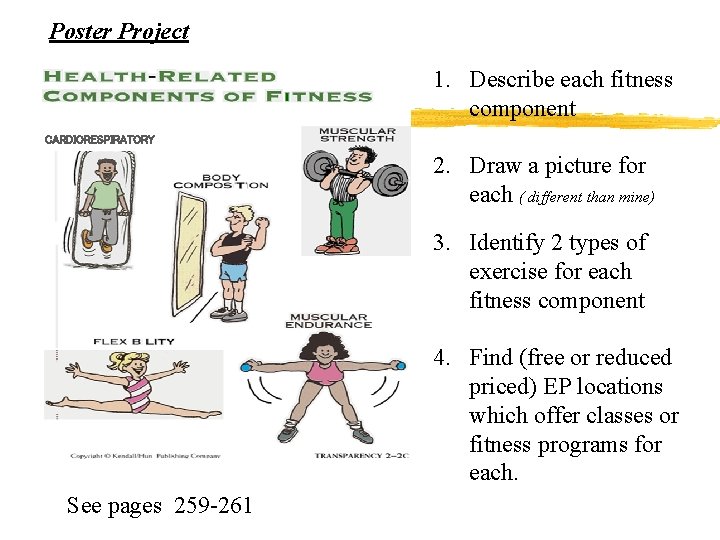
Health-Related Components of Physical Fitness <Health-related fitness = physical capacities that contribute to health <Five components: 1. 2. 3. 4. 5. Cardiorespiratory endurance Muscular Strength Muscular Endurance Flexibility Body Composition
1. Cardiorespiratory fitness = the ability of the body to carry oxygen efficiently through the blood to the body cells.
Health-Related Components of Physical Fitness 2. Muscular strength = the amount of force a muscle can produce with a single maximum effort 3. Muscular endurance = the ability of a muscle or group of muscles to remain contracted or to contract repeatedly 4. Flexibility = the range of motion in a joint or group of joints
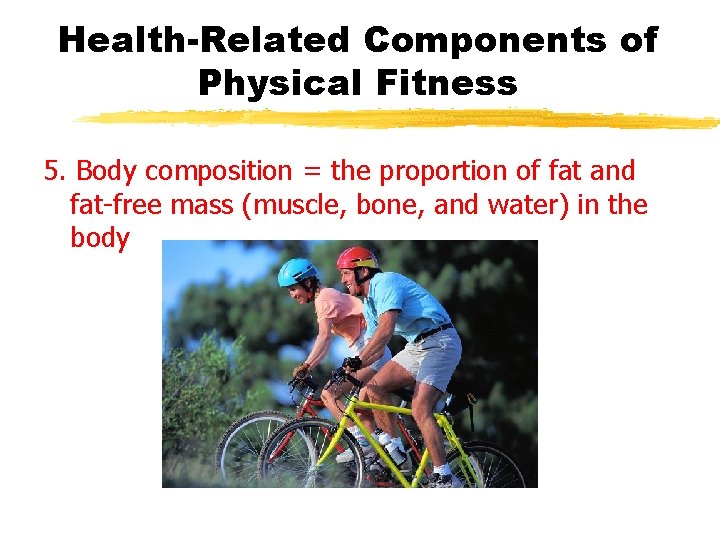
Health-Related Components of Physical Fitness 5. Body composition = the proportion of fat and fat-free mass (muscle, bone, and water) in the body
<https: //www. youtube. com/watch? v=sw. ZZ Dscsqi. Y&list=PLGo. Ic. TGz 9 Va. P 7 boy 1 f. MMiw b 97 taw. Slda. F&index=10 Fahey/Insel/Roth, Fit & Well: Core Concepts and Labs in Physical Fitness and Wellness, Chapter 2 © 2007 Mc. Graw-Hill Higher Education. All rights reserved.
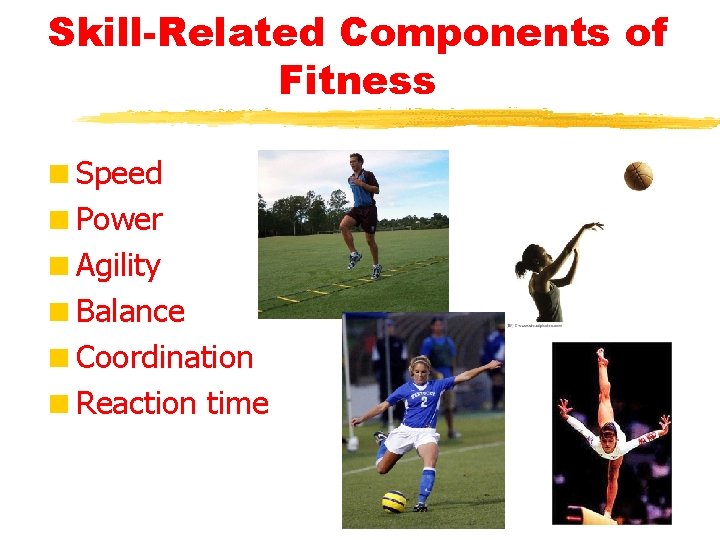
Skill-Related Components of Fitness <Speed <Power <Agility <Balance <Coordination <Reaction time
<https: //www. youtube. com/watch? v=UUFu _1 f_EKg Fahey/Insel/Roth, Fit & Well: Core Concepts and Labs in Physical Fitness and Wellness, Chapter 2 © 2007 Mc. Graw-Hill Higher Education. All rights reserved.
Specificity—Adapting to Type of Training <The body adapts to the particular type and amount of stress placed on it <To develop a particular fitness component, perform exercises specifically designed for that component
Progressive Overload—Adapting to Amount of Training <Placing increasing amounts of stress on the body causes adaptations that improve fitness; progression is critical <FITT principle for overload: 4 Frequency—How often 4 Intensity—How hard 4 Time—How long (duration) 4 Type—Mode of activity
Reversibility—Adapting to a Reduction in Training <Fitness improvements are lost when demands on the body are lowered <If you stop exercising, up to 50% of fitness improvements are lost within 2 months
Individual Differences— Limits on Adaptability <Everyone is NOT created equal from a physical standpoint <There are large individual differences in ability to improve fitness, body composition, and sports skills
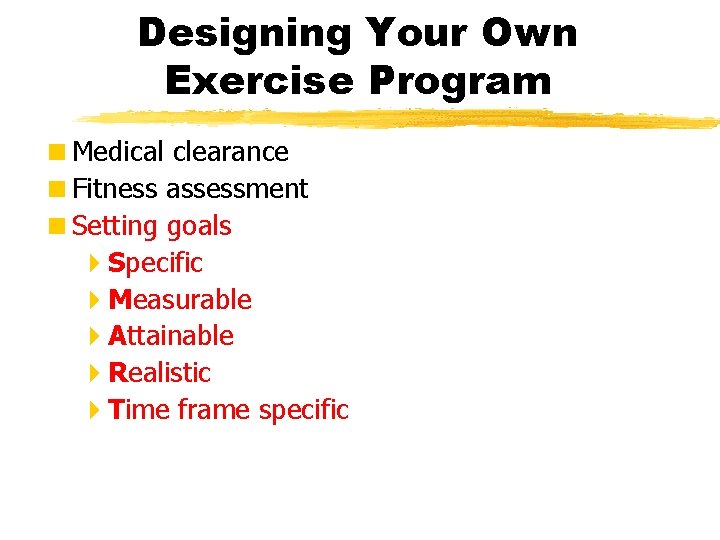
Designing Your Own Exercise Program <Medical clearance <Fitness assessment <Setting goals 4 Specific 4 Measurable 4 Attainable 4 Realistic 4 Time frame specific
Designing Your Own Exercise Program <Choosing activities for a balanced program 4 Include activities to develop health-related components of physical fitness
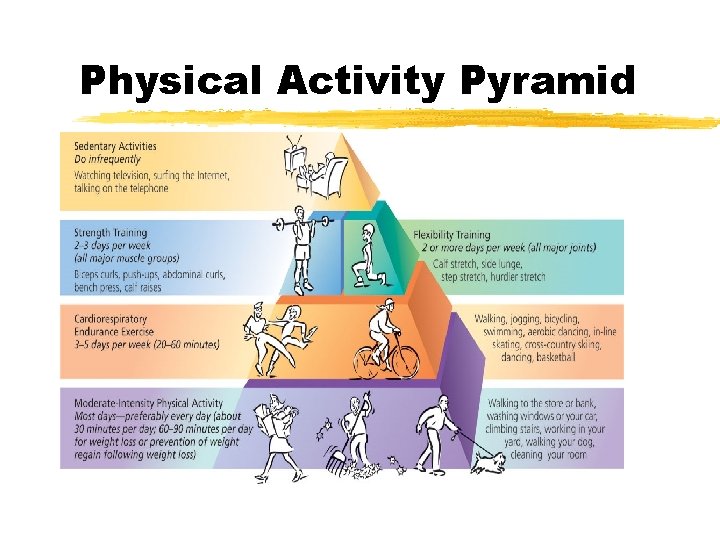
Physical Activity Pyramid
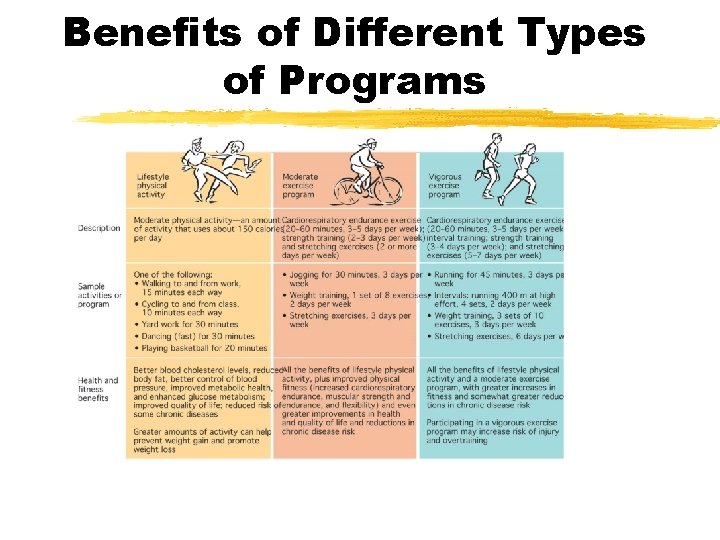
Benefits of Different Types of Programs
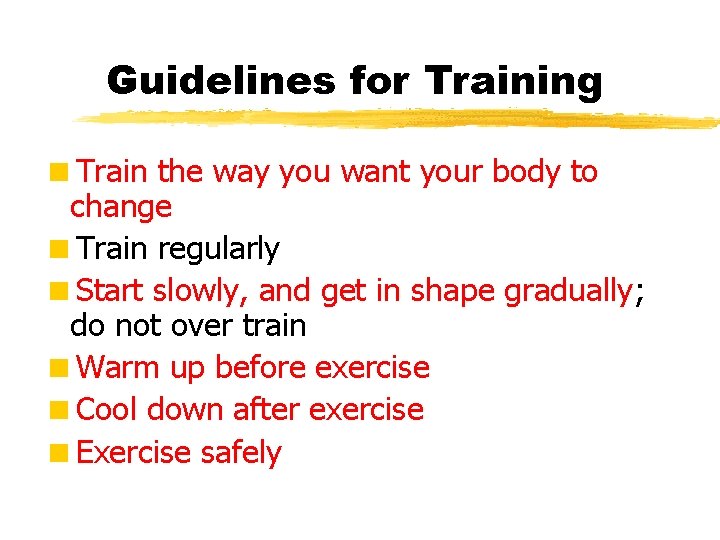
Guidelines for Training <Train the way you want your body to change <Train regularly <Start slowly, and get in shape gradually; do not over train <Warm up before exercise <Cool down after exercise <Exercise safely
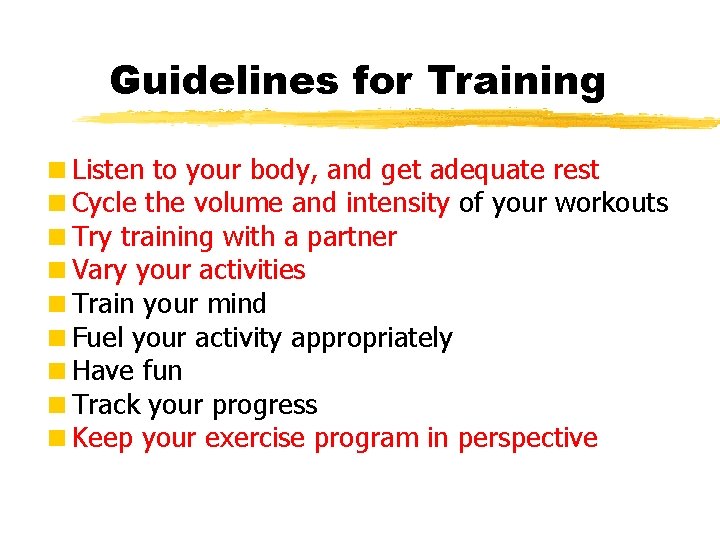
Guidelines for Training <Listen to your body, and get adequate rest <Cycle the volume and intensity of your workouts <Try training with a partner <Vary your activities <Train your mind <Fuel your activity appropriately <Have fun <Track your progress <Keep your exercise program in perspective
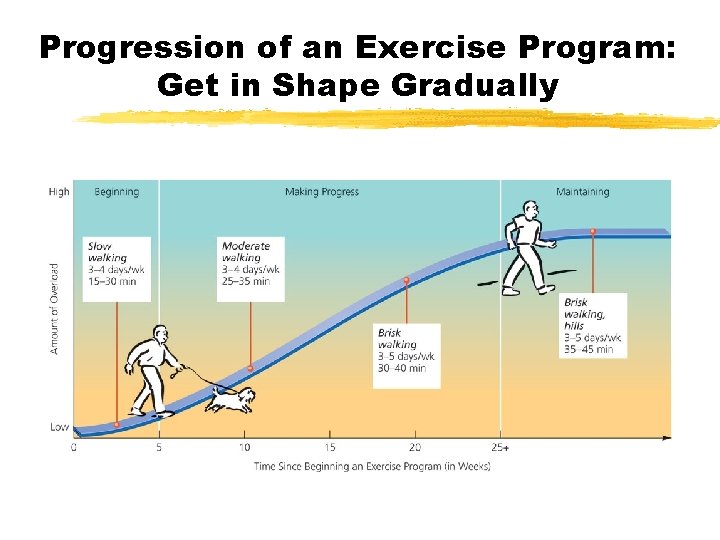
Progression of an Exercise Program: Get in Shape Gradually
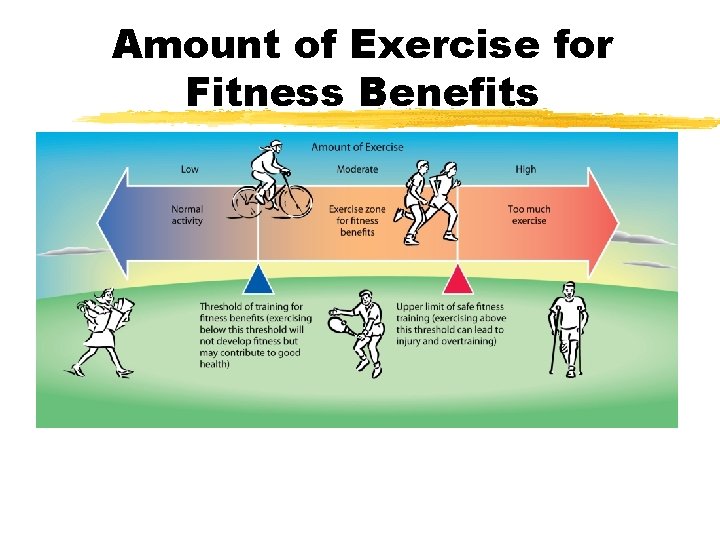
Amount of Exercise for Fitness Benefits
Choosing a Fitness Center <Convenience <Atmosphere <Safety <Trained personnel <Cost <Effectiveness http: //video. pbs. org/video/1785416952
Poster Project 1. Describe each fitness component CARDIORESPIRATORY 2. Draw a picture for each ( different than mine) 3. Identify 2 types of exercise for each fitness component 4. Find (free or reduced priced) EP locations which offer classes or fitness programs for each. See pages 259 -261