
Statutory Audit of Bank Branches VADODARA Advances IRAC
Statutory Audit of Bank Branches VADODARA Advances & IRAC Norms CA Niranjan Joshi 26. 03. 2016 Restriction on Disclosure and Use of Data The data in this document contains trade secrets and confidential or proprietary information of my firm, the disclosure of which would provide a competitive advantage to others. As a result, this document shall not be disclosed, used or duplicated, in whole or in part, for any purpose other than to evaluate my firm. The data subject to this restriction are contained in the entire document.

Disclaimer These are my personal views and can not be construed to be the views of the ICAI or my firm. CA Niranjan Joshi No representations or warranties are made by the WIRC with regard to this presentation. These views do not and shall not be considered as a professional advice. This presentation should not be reproduced in part or in whole, in any manner or form, without our written permission. 2
Agenda ADVANCES Objective - Verification CA Niranjan Joshi Guidelines Cheklist Reporting 3
Objective Background Material – Course, Guidance Note, Circulars, Appointment letters, Manuals, etc. CA Niranjan Joshi Advances – Largest revenue earner – - Major Activity of Bank - Largest item in ASSETS - Major Source of INCOME - Most FOCUSED Audit Area Expectation – Management, SCA, RBI 4

Types of Advances Working Capital Management CA Niranjan Joshi Cash Credit – Clean, Hyp. Overdrafts - Secured/unsecured Term Loans - Fixed period WCDL – Fixed Period/renewable Bills Purchased / Discounted/ Foreign Bills for Collected - Purchase of bills, Discounting of bills, Advance against bills under collection Exports Credit – Pre/Post Shipment Imports Credit – Capital Goods/RM Non Fund – LC/BG/Loc/BC/SBLC/DPG 5
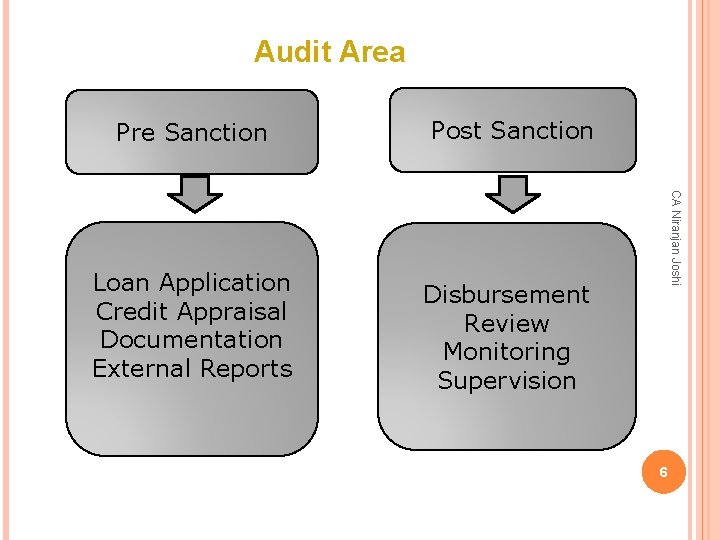
Audit Area Post Sanction Loan Application Credit Appraisal Documentation External Reports Disbursement Review Monitoring Supervision CA Niranjan Joshi Pre Sanction 6
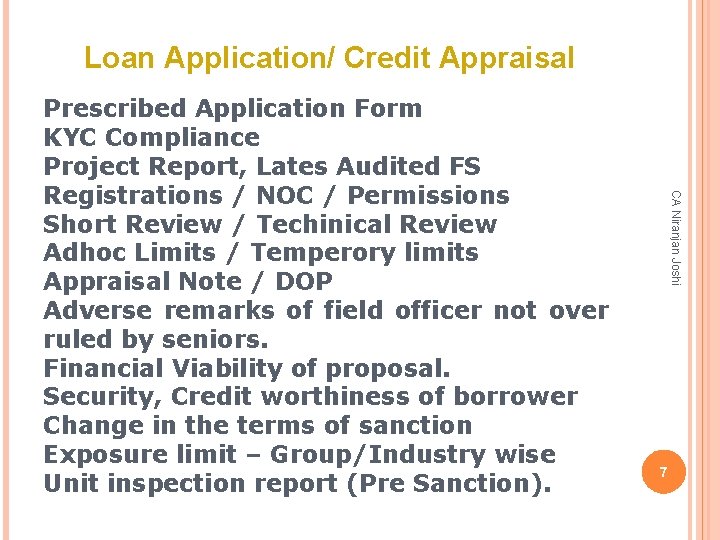
Loan Application/ Credit Appraisal CA Niranjan Joshi Prescribed Application Form KYC Compliance Project Report, Lates Audited FS Registrations / NOC / Permissions Short Review / Techinical Review Adhoc Limits / Temperory limits Appraisal Note / DOP Adverse remarks of field officer not over ruled by seniors. Financial Viability of proposal. Security, Credit worthiness of borrower Change in the terms of sanction Exposure limit – Group/Industry wise Unit inspection report (Pre Sanction). 7
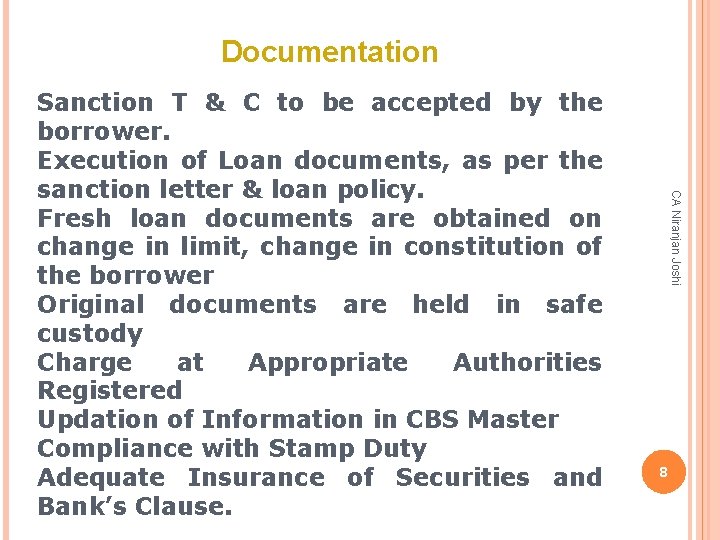
Documentation CA Niranjan Joshi Sanction T & C to be accepted by the borrower. Execution of Loan documents, as per the sanction letter & loan policy. Fresh loan documents are obtained on change in limit, change in constitution of the borrower Original documents are held in safe custody Charge at Appropriate Authorities Registered Updation of Information in CBS Master Compliance with Stamp Duty Adequate Insurance of Securities and Bank’s Clause. 8
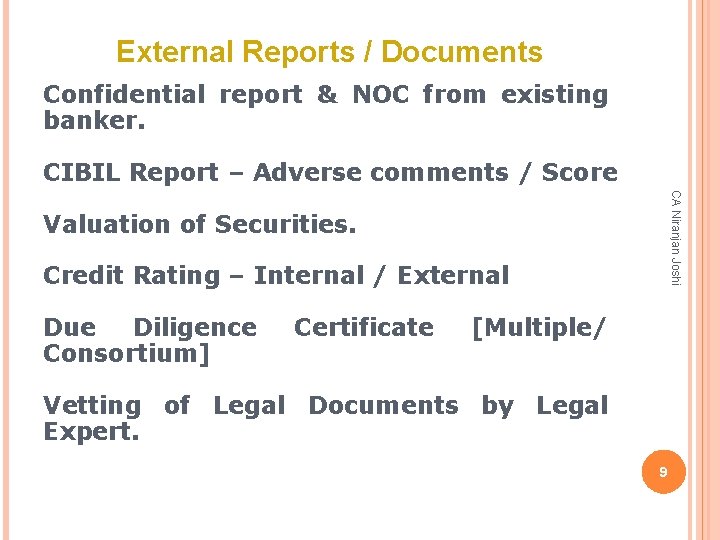
External Reports / Documents Confidential report & NOC from existing banker. CIBIL Report – Adverse comments / Score CA Niranjan Joshi Valuation of Securities. Credit Rating – Internal / External Due Diligence Consortium] Certificate [Multiple/ Vetting of Legal Documents by Legal Expert. 9
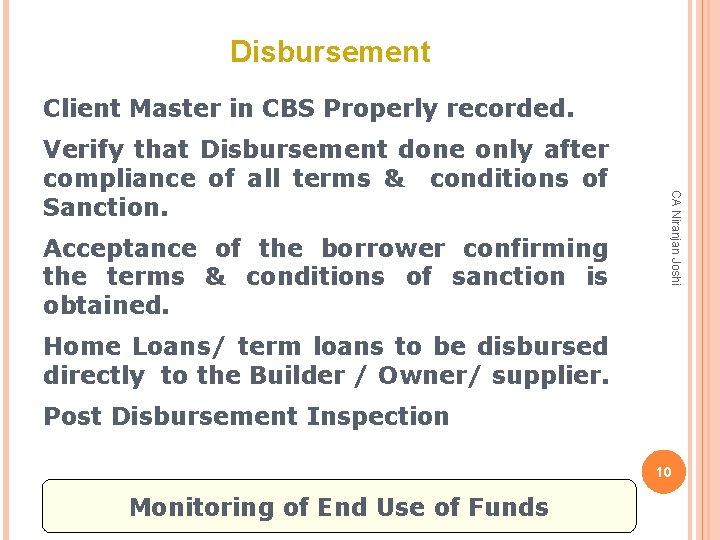
Disbursement Client Master in CBS Properly recorded. Acceptance of the borrower confirming the terms & conditions of sanction is obtained. CA Niranjan Joshi Verify that Disbursement done only after compliance of all terms & conditions of Sanction. Home Loans/ term loans to be disbursed directly to the Builder / Owner/ supplier. Post Disbursement Inspection 10 Monitoring of End Use of Funds
Review / Monitoring / Supervision CA Niranjan Joshi Sanction/Renewal as per Bank’s Policy Stock Inspection / Unit Visit reports. Submission of stocks statements Calculation of Drawing Power. Operational Data & Financial Statements Various Registers (Insurance, Stock) Scrutiny of Exceptional Transactions Interest / Penal Interest Turnover in Account commensurate with Annual Projections. 11
Review / Monitoring / Supervision Consortium Meetings: Minutes & exchange of Information between the Banks CA Niranjan Joshi Management explanation of unusual items / large transactions Over limit - TODs Any comment by inspectors/auditors 12
Term Loans End-use of funds (direct payment/third party verification) directly Disbursement strictly implementation. in as favour per of project Repayment schedule to be as per the sanction and verify record of repayment CA Niranjan Joshi Disbursement beneficiary Stipulated installments / interests are being paid regularly Schematic Loans such as Gold / Vehicle / Housing should be verified as per policy of bank for compliance 13
Bills Tenor as per sanctioned terms Party wise limit to be checked CA Niranjan Joshi Export bills Discounted, if remain o/s. for more than 30 days after due date to be crystallized. RBI – Exchange Control formalities. Branch follow up of overdue bills. Report to RBI about bills beyond 180 days. Premium to ECGC is paid promptly 14
Bank Guarantees / Letter of Credit CA Niranjan Joshi Verify sanction T & C. Compliance - Regulatory Requirements Register of BG/LC Reversal of expired BG/LC Extensions/ Modifications Charges to be recovered. Crystalisation / Devolvement, no fresh BG/LC is to be issued without special sanction from competent authority Discrepancies in documents promptly reported to negotiating banker/ shipper. On non payment liability is crystallized and reported. 15
Letter of Comfort / Buyers Credit Examine Application form carefully. Check whether its for Raw Material or Capital Goods sanction by Check the documentation Treatment in the books of account by Bank CA Niranjan Joshi Check the terms of intermediary foreign bank Treatment in the books of account by borrower Interest Servicing & Repayment of Loan Settlement / Roll over of Lo. C 16
Agenda IRAC Norms Guidelines CA Niranjan Joshi Objective – Prudential Norms of IRAC and Provisioning pertaining to Advances Cheklist Reporting Formats 17
Objective (1. 2) Policy of IR should be objective & based on record of recovery rather than on any subjective considerations. Provisioning made on the basis of the classification of assets based on the period for which the asset has remained non-performing & the availability of security & the realisable value thereof. CA Niranjan Joshi Classification of assets on the basis of objective criteria, which ensure a uniform & consistent application of the norms. 18
Objective (1. 2) Banks should fix realistic repayment schedules at the time of sanction based on cash flows of borrower. CA Niranjan Joshi Master Circular RBI/2015 -16/101/DBR. No. BP. BC. 2/ 21. 048/2015 -16 dated July 1, 2015. 19
Asset Classification PERFORMING ASSET (STANDARD ASSET) NON-PERFORMING ASSET (NPA) (SUB STANDARD, DOUBTFUL, LOSS) Asset ceases to generate income. Higher risk than normal risk attached to business. Non performing as per various criteria for various types of loans. CA Niranjan Joshi Account is performing & does not carry more than normal risk attached to the business. 20
Objective Policy of IR should be objective & based on record of recovery rather than on any subjective considerations. Provisioning made on the basis of the classification of assets based on the period for which the asset has remained non-performing & the availability of security & the realisable value thereof. CA Niranjan Joshi Classification of assets on the basis of objective criteria, which ensure a uniform & consistent application of the norms. 21
Identification of NPA Term Loans (2. 1. 2) Exceptions – Moratorium, Schematic Loans such as Housing / education / Staff Loans etc. CA Niranjan Joshi Interest and/or Installment remains overdue for a period of more than 90 days Bills Purchased / Discounted Bill Purchased / Discounted remains overdue for a period of more than 90 days 22
Identification of NPA Agricultural Advances (4. 2. 13) CA Niranjan Joshi Short Duration Crop - Interest or installments remains overdue for two crop seasons (which are not long duration crops) Long Duration Crop - Interest or installments remains overdue for one crop seasons (season longer than 1 year) How to find about duration of crops? 23
Identification of NPA CA Niranjan Joshi Derivative Transactions Overdue receivables representing positive mark to market value of derivative contract remaining unpaid for a period of 90 days from specified due date Liquidity Facility Remains outstanding for more than 90 days in respect of securitisation transaction. Credit Card Dues (4. 2. 21) If minimum amount due, as mentioned in the statement, is not paid fully within 90 days from the next statement date. 24
Identification of NPA Cash Credit / Overdraft (2. 2) The account is ‘out of order’ if: CA Niranjan Joshi Outstanding Balance remains continuously in excess of sanctioned limit/drawing power for 90 days. or Outstanding Balance less than limit/DP, but there are no credits continuously for 90 days as on the date of Balance Sheet or Credits in the account are not sufficient to cover interest debited during the same period. 25
Identification of NPA CA Niranjan Joshi In case of interest payments, banks should, classify an account as NPA only if the interest due and charged during any quarter is not serviced fully within 90 days from the end of the quarter. (2. 1. 3) Overdue – Any amount due to bank under any credit facility is ‘overdue’ if it is not paid on the due date fixed by the bank. (2. 3) 26
Income Recognition Interest on Advances against Term Deposits, NSC, KVP, IVP and Life Policies may be taken to income account on due date, provided adequate margin is available in the account. (3. 1. 2) CA Niranjan Joshi Policy of income recognition has to be objective and based on record of recovery. Banks should not charge and take to income account interest on any NPA. (3. 1. 1) 27
Income Recognition CA Niranjan Joshi Fees and commissions earned by banks as a result of renegotiation and reschedulement of outstanding debts should be recognised on accrual basis over the period of time covered by extension of credit. (3. 1. 3) If any advance becomes NPA, the entire interest accrued and credited to income in past periods should be reversed if the same is not realised. (3. 2. 1) 28
Income Recognition Interest realised on NPA may be taken to income provided credits are not out of fresh/additional credit facility sanctioned to borrower. (3. 3. 1) CA Niranjan Joshi In respect of NPA, fees, commission or similar income that have accrued, should cease to accrue for past periods, if uncollected. (3. 2. 2) 29
Income Recognition CA Niranjan Joshi In absence of clear agreement between bank and borrower for the purpose of appropriation of recoveries in NPA (interest or principal), banks should adopt an accounting principle and exercise the right of appropriation of recoveries in a uniform and consistent manner. (3. 3. 2) On account turning NPA, Banks should reverse the interest already charged and not collected by debiting P&L Account and stop further application of interest. (3. 4) 30
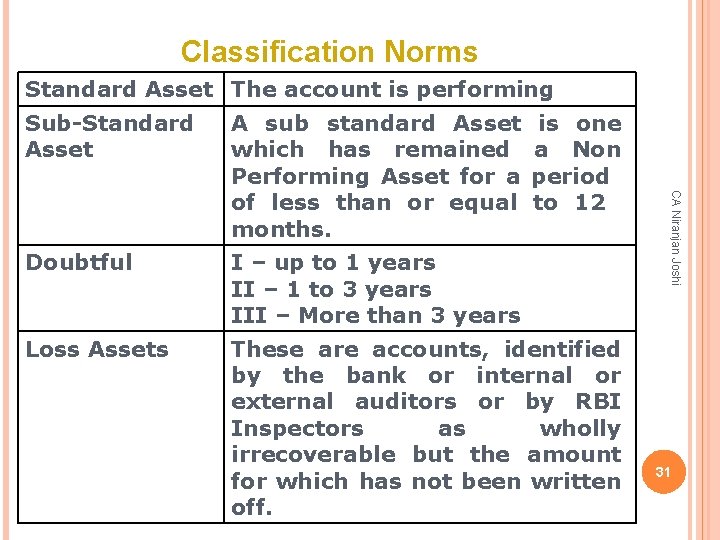
Classification Norms Standard Asset The account is performing A sub standard Asset which has remained Performing Asset for a of less than or equal months. is one a Non period to 12 Doubtful I – up to 1 years II – 1 to 3 years III – More than 3 years Loss Assets These are accounts, identified by the bank or internal or external auditors or by RBI Inspectors as wholly irrecoverable but the amount for which has not been written off. CA Niranjan Joshi Sub-Standard Asset 31
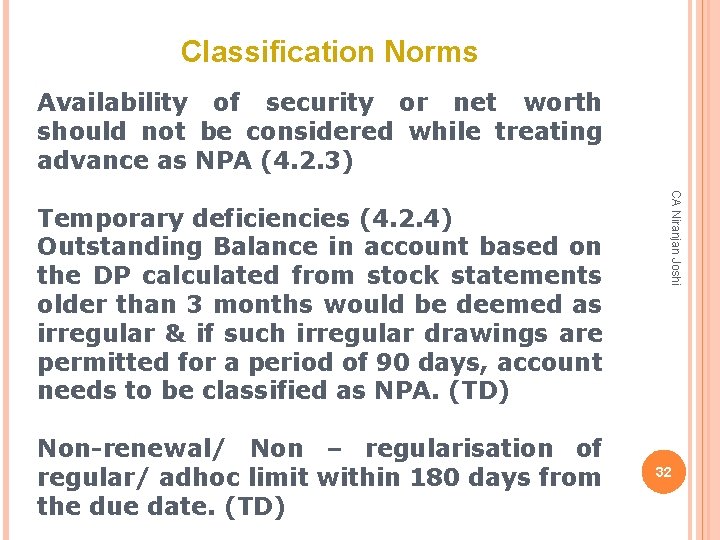
Classification Norms Availability of security or net worth should not be considered while treating advance as NPA (4. 2. 3) Non-renewal/ Non – regularisation of regular/ adhoc limit within 180 days from the due date. (TD) CA Niranjan Joshi Temporary deficiencies (4. 2. 4) Outstanding Balance in account based on the DP calculated from stock statements older than 3 months would be deemed as irregular & if such irregular drawings are permitted for a period of 90 days, account needs to be classified as NPA. (TD) 32
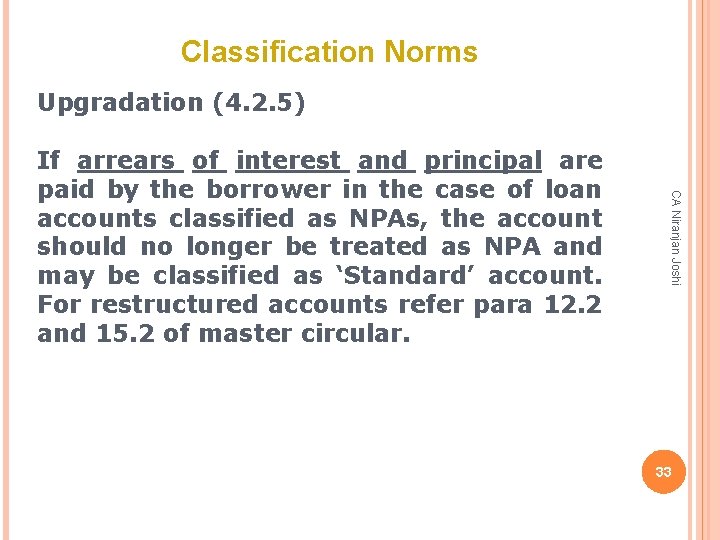
Classification Norms Upgradation (4. 2. 5) CA Niranjan Joshi If arrears of interest and principal are paid by the borrower in the case of loan accounts classified as NPAs, the account should no longer be treated as NPA and may be classified as ‘Standard’ account. For restructured accounts refer para 12. 2 and 15. 2 of master circular. 33
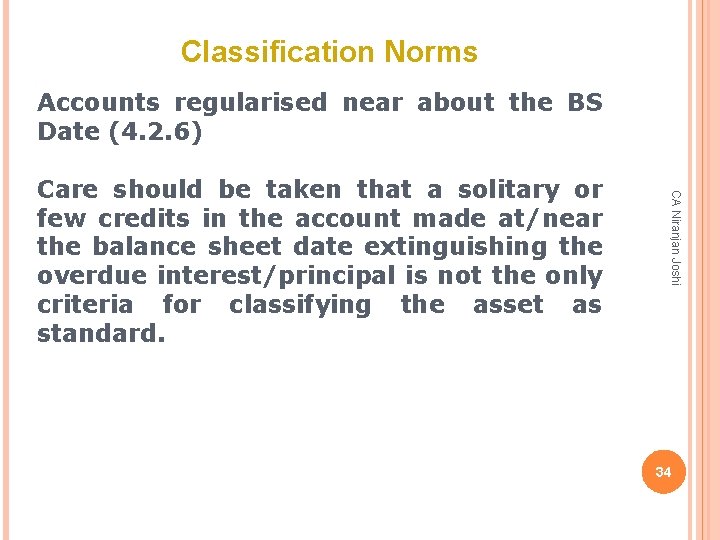
Classification Norms Accounts regularised near about the BS Date (4. 2. 6) CA Niranjan Joshi Care should be taken that a solitary or few credits in the account made at/near the balance sheet date extinguishing the overdue interest/principal is not the only criteria for classifying the asset as standard. 34
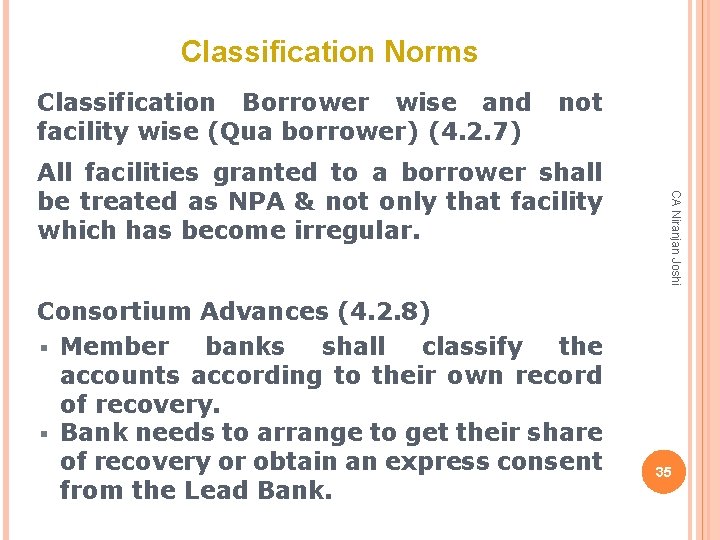
Classification Norms Classification Borrower wise and facility wise (Qua borrower) (4. 2. 7) not Consortium Advances (4. 2. 8) § Member banks shall classify the accounts according to their own record of recovery. § Bank needs to arrange to get their share of recovery or obtain an express consent from the Lead Bank. CA Niranjan Joshi All facilities granted to a borrower shall be treated as NPA & not only that facility which has become irregular. 35
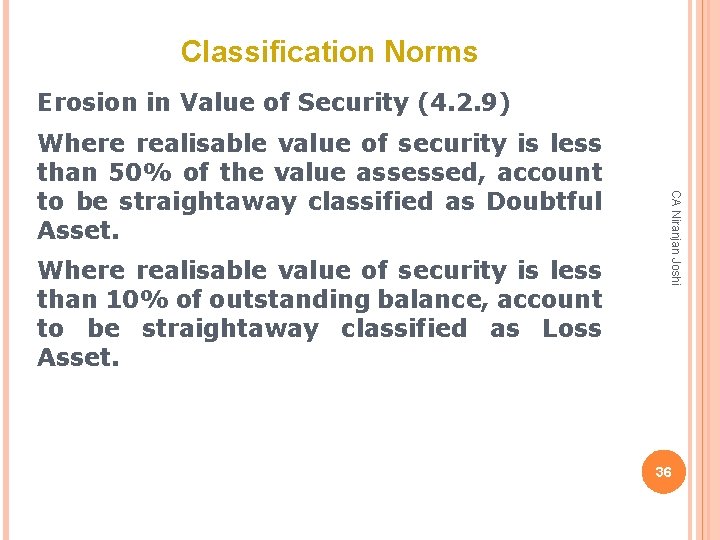
Classification Norms Erosion in Value of Security (4. 2. 9) Where realisable value of security is less than 10% of outstanding balance, account to be straightaway classified as Loss Asset. CA Niranjan Joshi Where realisable value of security is less than 50% of the value assessed, account to be straightaway classified as Doubtful Asset. 36
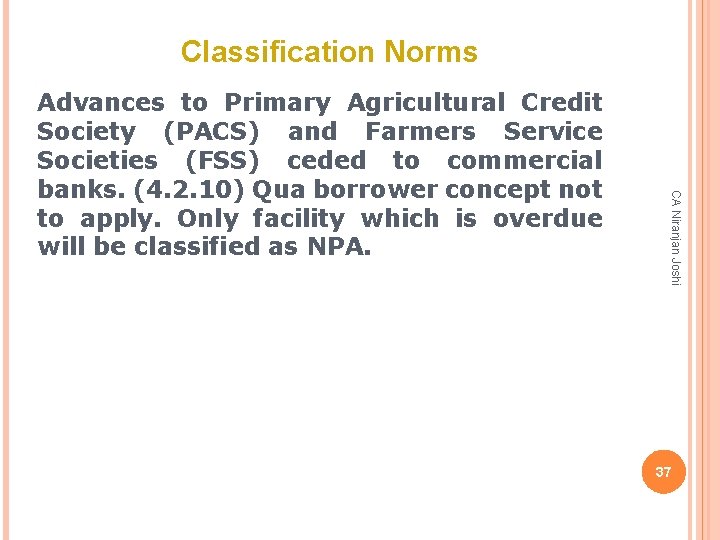
Classification Norms CA Niranjan Joshi Advances to Primary Agricultural Credit Society (PACS) and Farmers Service Societies (FSS) ceded to commercial banks. (4. 2. 10) Qua borrower concept not to apply. Only facility which is overdue will be classified as NPA. 37
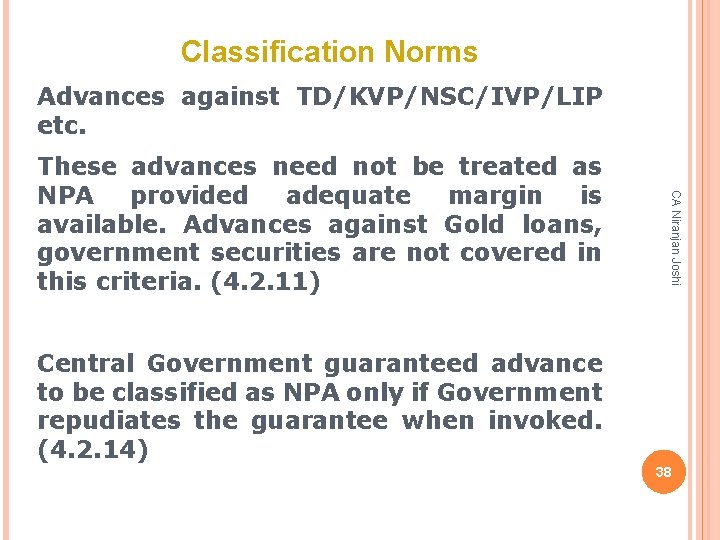
Classification Norms Advances against TD/KVP/NSC/IVP/LIP etc. CA Niranjan Joshi These advances need not be treated as NPA provided adequate margin is available. Advances against Gold loans, government securities are not covered in this criteria. (4. 2. 11) Central Government guaranteed advance to be classified as NPA only if Government repudiates the guarantee when invoked. (4. 2. 14) 38
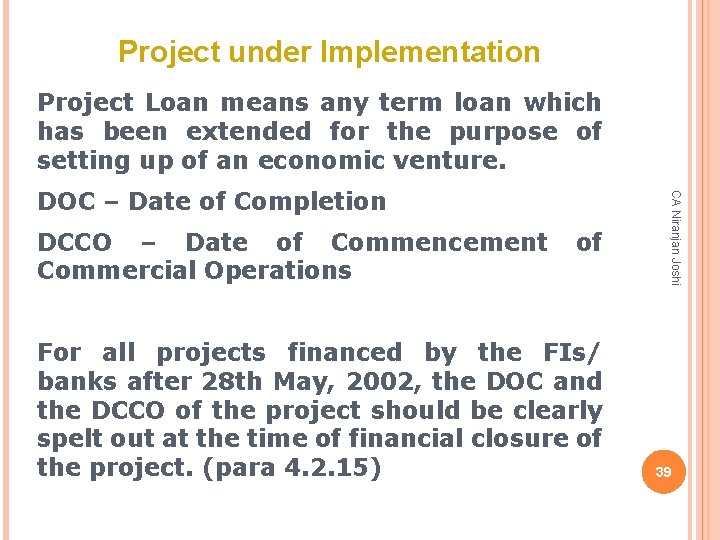
Project under Implementation Project Loan means any term loan which has been extended for the purpose of setting up of an economic venture. DCCO – Date of Commencement Commercial Operations of For all projects financed by the FIs/ banks after 28 th May, 2002, the DOC and the DCCO of the project should be clearly spelt out at the time of financial closure of the project. (para 4. 2. 15) CA Niranjan Joshi DOC – Date of Completion 39
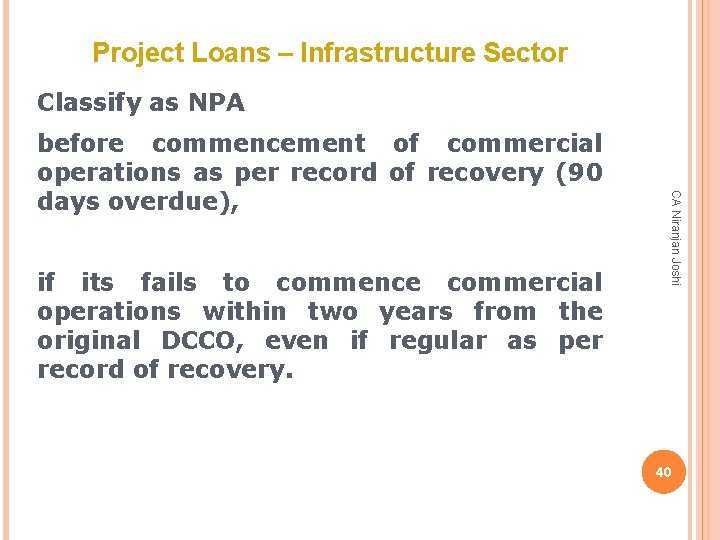
Project Loans – Infrastructure Sector Classify as NPA if its fails to commence commercial operations within two years from the original DCCO, even if regular as per record of recovery. CA Niranjan Joshi before commencement of commercial operations as per record of recovery (90 days overdue), 40
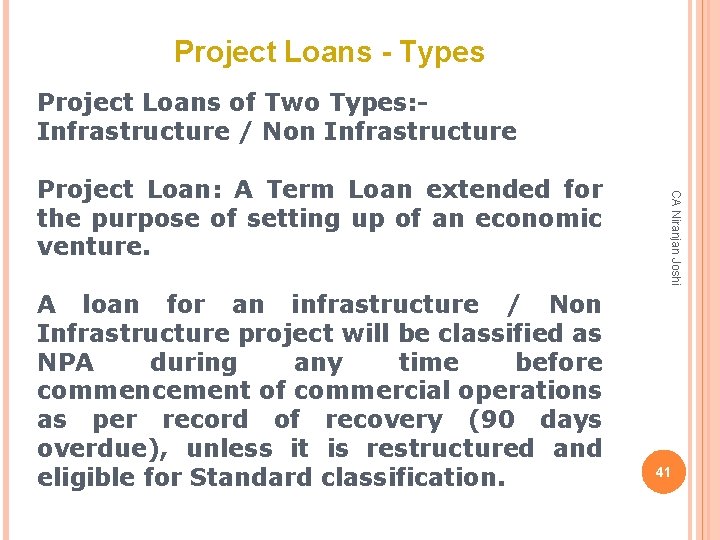
Project Loans - Types Project Loans of Two Types: Infrastructure / Non Infrastructure A loan for an infrastructure / Non Infrastructure project will be classified as NPA during any time before commencement of commercial operations as per record of recovery (90 days overdue), unless it is restructured and eligible for Standard classification. CA Niranjan Joshi Project Loan: A Term Loan extended for the purpose of setting up of an economic venture. 41
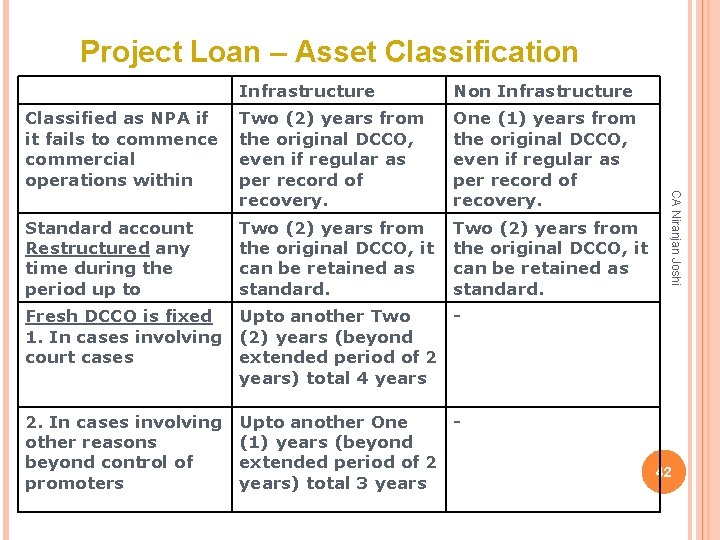
Project Loan – Asset Classification Non Infrastructure Classified as NPA if it fails to commence commercial operations within Two (2) years from the original DCCO, even if regular as per record of recovery. One (1) years from the original DCCO, even if regular as per record of recovery. Standard account Restructured any time during the period up to Two (2) years from the original DCCO, it can be retained as standard. Fresh DCCO is fixed 1. In cases involving court cases Upto another Two (2) years (beyond extended period of 2 years) total 4 years 2. In cases involving other reasons beyond control of promoters Upto another One (1) years (beyond extended period of 2 years) total 3 years CA Niranjan Joshi Infrastructure 42
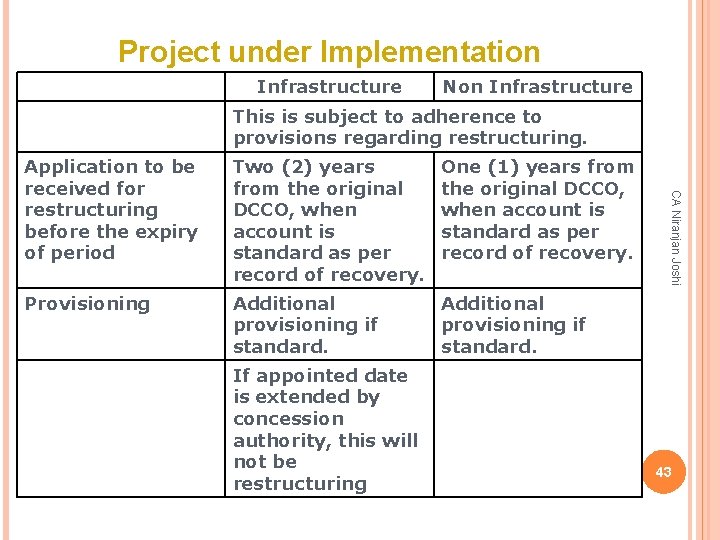
Project under Implementation Infrastructure Non Infrastructure This is subject to adherence to provisions regarding restructuring. Two (2) years from the original DCCO, when account is standard as per record of recovery. One (1) years from the original DCCO, when account is standard as per record of recovery. Provisioning Additional provisioning if standard. If appointed date is extended by concession authority, this will not be restructuring CA Niranjan Joshi Application to be received for restructuring before the expiry of period 43
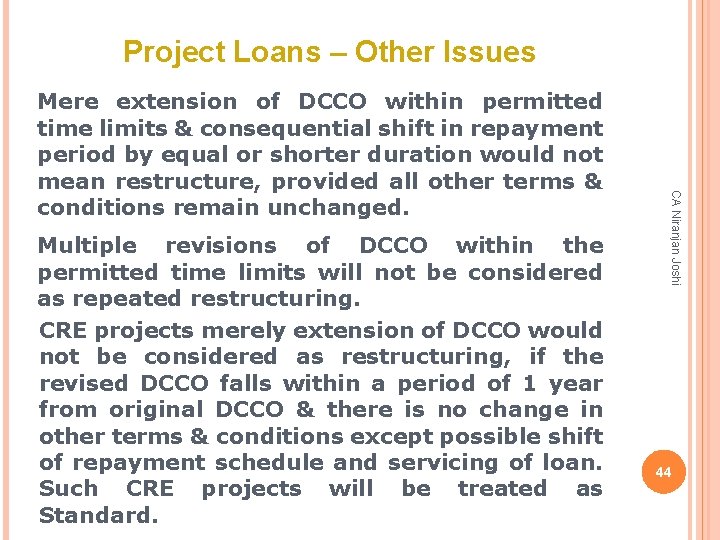
Project Loans – Other Issues Multiple revisions of DCCO within the permitted time limits will not be considered as repeated restructuring. CRE projects merely extension of DCCO would not be considered as restructuring, if the revised DCCO falls within a period of 1 year from original DCCO & there is no change in other terms & conditions except possible shift of repayment schedule and servicing of loan. Such CRE projects will be treated as Standard. CA Niranjan Joshi Mere extension of DCCO within permitted time limits & consequential shift in repayment period by equal or shorter duration would not mean restructure, provided all other terms & conditions remain unchanged. 44
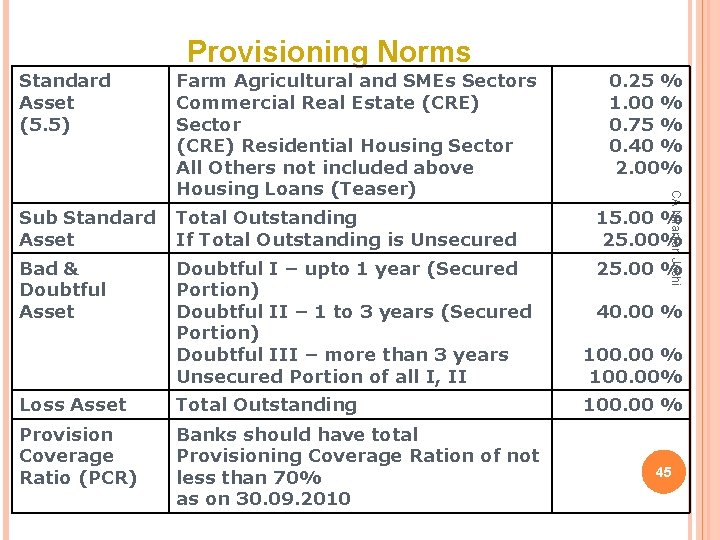
Provisioning Norms Farm Agricultural and SMEs Sectors Commercial Real Estate (CRE) Sector (CRE) Residential Housing Sector All Others not included above Housing Loans (Teaser) 0. 25 % 1. 00 % 0. 75 % 0. 40 % 2. 00% Sub Standard Asset Total Outstanding If Total Outstanding is Unsecured 15. 00 % 25. 00% Bad & Doubtful Asset Doubtful I – upto 1 year (Secured Portion) Doubtful II – 1 to 3 years (Secured Portion) Doubtful III – more than 3 years Unsecured Portion of all I, II 25. 00 % 100. 00% Loss Asset Total Outstanding 100. 00 % Provision Coverage Ratio (PCR) Banks should have total Provisioning Coverage Ration of not less than 70% as on 30. 09. 2010 CA Niranjan Joshi Standard Asset (5. 5) 40. 00 % 45
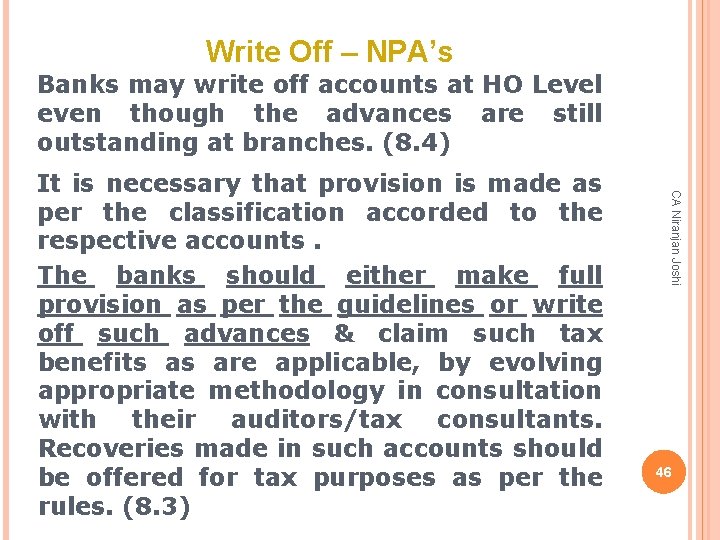
Write Off – NPA’s Banks may write off accounts at HO Level even though the advances are still outstanding at branches. (8. 4) CA Niranjan Joshi It is necessary that provision is made as per the classification accorded to the respective accounts. The banks should either make full provision as per the guidelines or write off such advances & claim such tax benefits as are applicable, by evolving appropriate methodology in consultation with their auditors/tax consultants. Recoveries made in such accounts should be offered for tax purposes as per the rules. (8. 3) 46
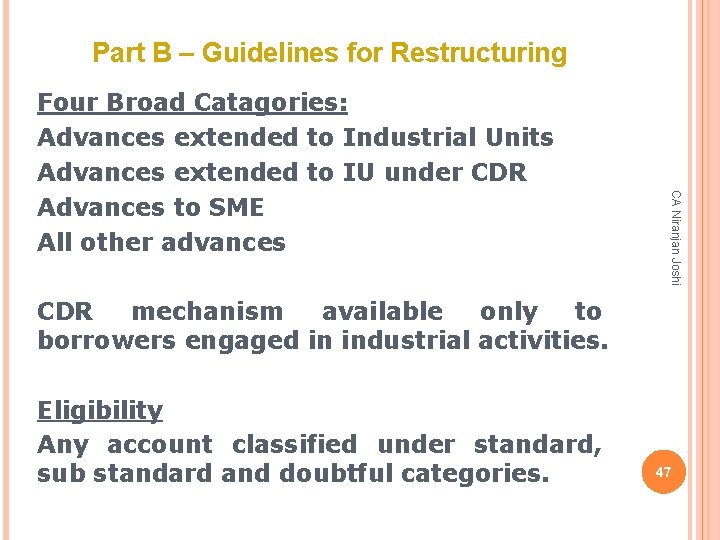
Part B – Guidelines for Restructuring CA Niranjan Joshi Four Broad Catagories: Advances extended to Industrial Units Advances extended to IU under CDR Advances to SME All other advances CDR mechanism available only to borrowers engaged in industrial activities. Eligibility Any account classified under standard, sub standard and doubtful categories. 47
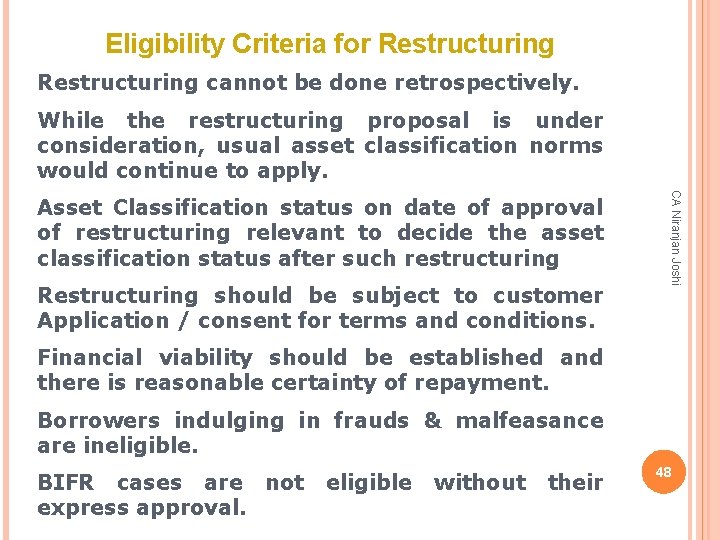
Eligibility Criteria for Restructuring cannot be done retrospectively. While the restructuring proposal is under consideration, usual asset classification norms would continue to apply. Restructuring should be subject to customer Application / consent for terms and conditions. CA Niranjan Joshi Asset Classification status on date of approval of restructuring relevant to decide the asset classification status after such restructuring Financial viability should be established and there is reasonable certainty of repayment. Borrowers indulging in frauds & malfeasance are ineligible. BIFR cases are not express approval. eligible without their 48
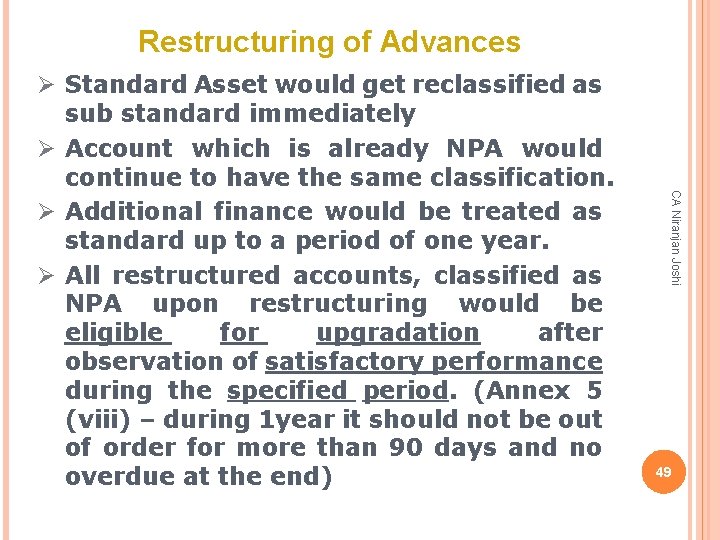
Restructuring of Advances CA Niranjan Joshi Ø Standard Asset would get reclassified as sub standard immediately Ø Account which is already NPA would continue to have the same classification. Ø Additional finance would be treated as standard up to a period of one year. Ø All restructured accounts, classified as NPA upon restructuring would be eligible for upgradation after observation of satisfactory performance during the specified period. (Annex 5 (viii) – during 1 year it should not be out of order for more than 90 days and no overdue at the end) 49
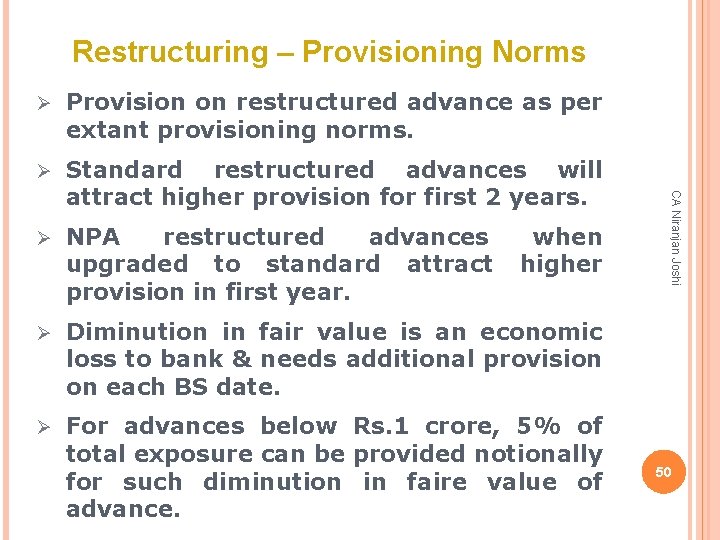
Restructuring – Provisioning Norms Provision on restructured advance as per extant provisioning norms. Ø Standard restructured advances will attract higher provision for first 2 years. Ø NPA restructured advances upgraded to standard attract provision in first year. Ø Diminution in fair value is an economic loss to bank & needs additional provision on each BS date. Ø For advances below Rs. 1 crore, 5% of total exposure can be provided notionally for such diminution in faire value of advance. when higher CA Niranjan Joshi Ø 50
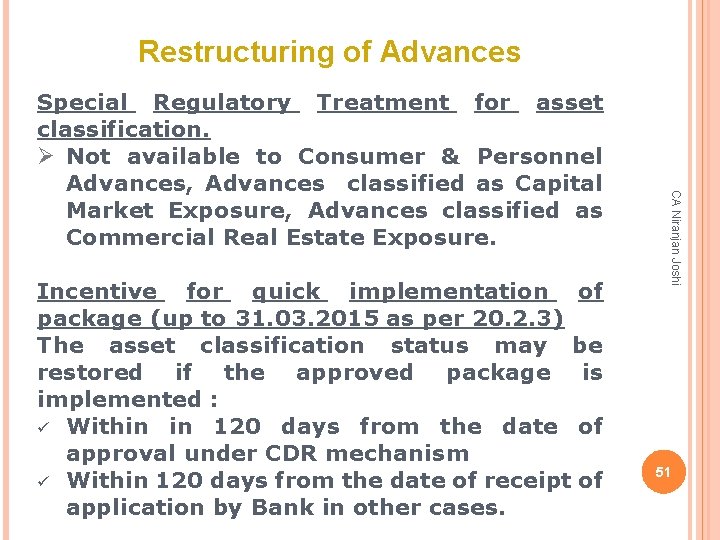
Restructuring of Advances Incentive for quick implementation of package (up to 31. 03. 2015 as per 20. 2. 3) The asset classification status may be restored if the approved package is implemented : ü Within in 120 days from the date of approval under CDR mechanism ü Within 120 days from the date of receipt of application by Bank in other cases. CA Niranjan Joshi Special Regulatory Treatment for asset classification. Ø Not available to Consumer & Personnel Advances, Advances classified as Capital Market Exposure, Advances classified as Commercial Real Estate Exposure. 51
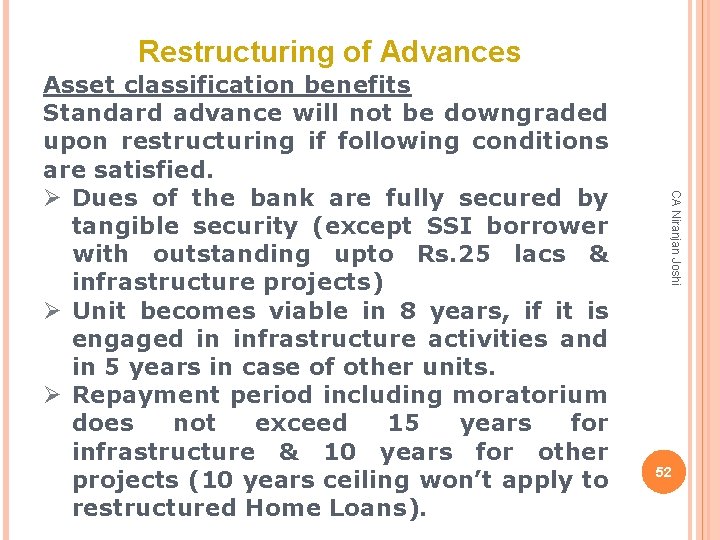
Restructuring of Advances CA Niranjan Joshi Asset classification benefits Standard advance will not be downgraded upon restructuring if following conditions are satisfied. Ø Dues of the bank are fully secured by tangible security (except SSI borrower with outstanding upto Rs. 25 lacs & infrastructure projects) Ø Unit becomes viable in 8 years, if it is engaged in infrastructure activities and in 5 years in case of other units. Ø Repayment period including moratorium does not exceed 15 years for infrastructure & 10 years for other projects (10 years ceiling won’t apply to restructured Home Loans). 52
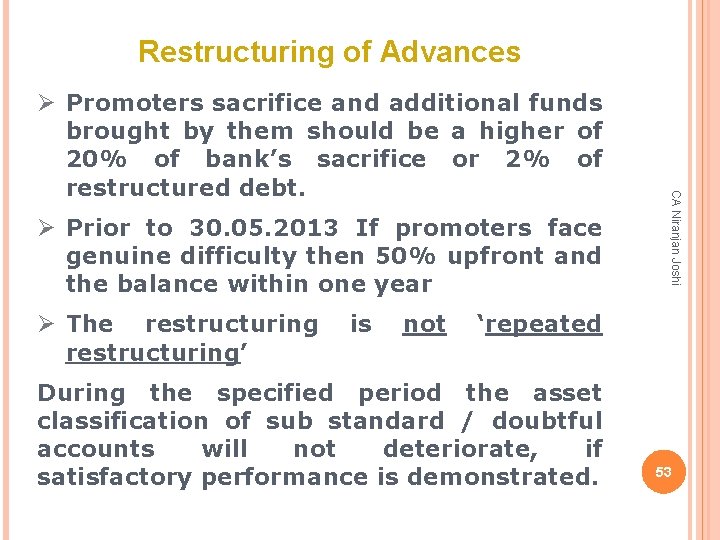
Restructuring of Advances Ø Prior to 30. 05. 2013 If promoters face genuine difficulty then 50% upfront and the balance within one year Ø The restructuring’ is not CA Niranjan Joshi Ø Promoters sacrifice and additional funds brought by them should be a higher of 20% of bank’s sacrifice or 2% of restructured debt. ‘repeated During the specified period the asset classification of sub standard / doubtful accounts will not deteriorate, if satisfactory performance is demonstrated. 53
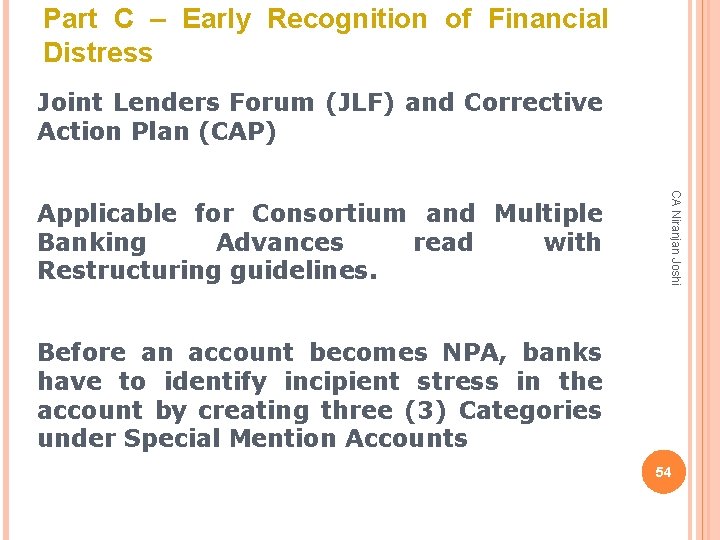
Part C – Early Recognition of Financial Distress Joint Lenders Forum (JLF) and Corrective Action Plan (CAP) CA Niranjan Joshi Applicable for Consortium and Multiple Banking Advances read with Restructuring guidelines. Before an account becomes NPA, banks have to identify incipient stress in the account by creating three (3) Categories under Special Mention Accounts 54
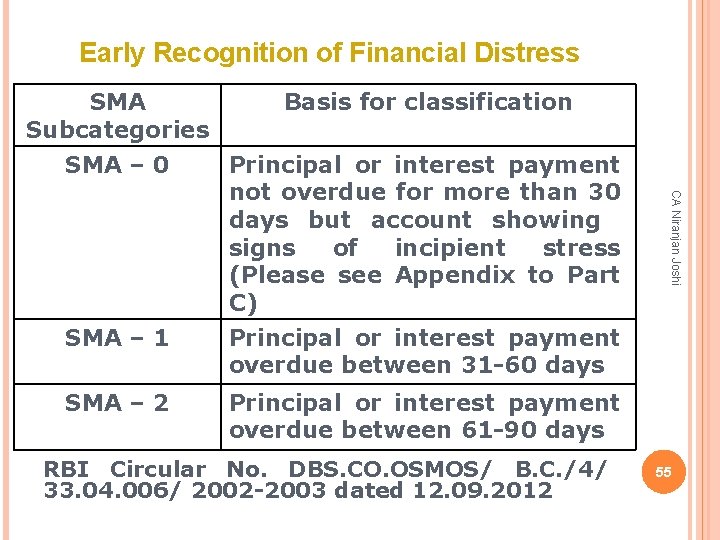
Early Recognition of Financial Distress Basis for classification SMA – 0 Principal or interest payment not overdue for more than 30 days but account showing signs of incipient stress (Please see Appendix to Part C) SMA – 1 Principal or interest payment overdue between 31 -60 days SMA – 2 Principal or interest payment overdue between 61 -90 days RBI Circular No. DBS. CO. OSMOS/ B. C. /4/ 33. 04. 006/ 2002 -2003 dated 12. 09. 2012 CA Niranjan Joshi SMA Subcategories 55
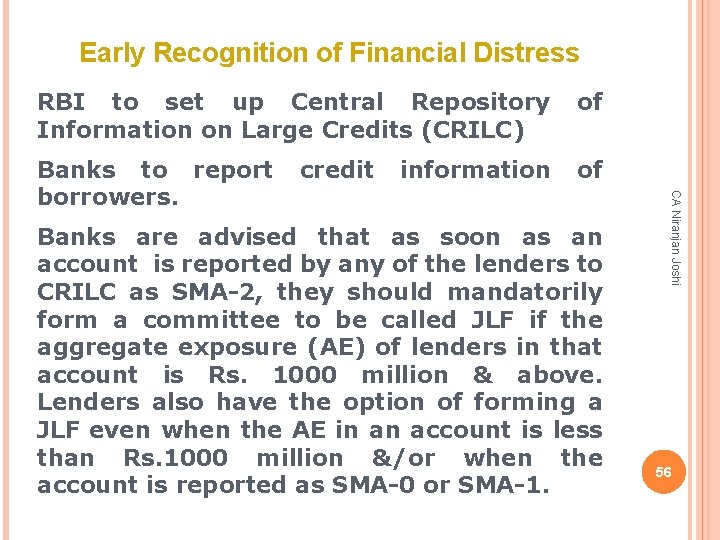
Early Recognition of Financial Distress of Banks to report borrowers. of credit information Banks are advised that as soon as an account is reported by any of the lenders to CRILC as SMA-2, they should mandatorily form a committee to be called JLF if the aggregate exposure (AE) of lenders in that account is Rs. 1000 million & above. Lenders also have the option of forming a JLF even when the AE in an account is less than Rs. 1000 million &/or when the account is reported as SMA-0 or SMA-1. CA Niranjan Joshi RBI to set up Central Repository Information on Large Credits (CRILC) 56
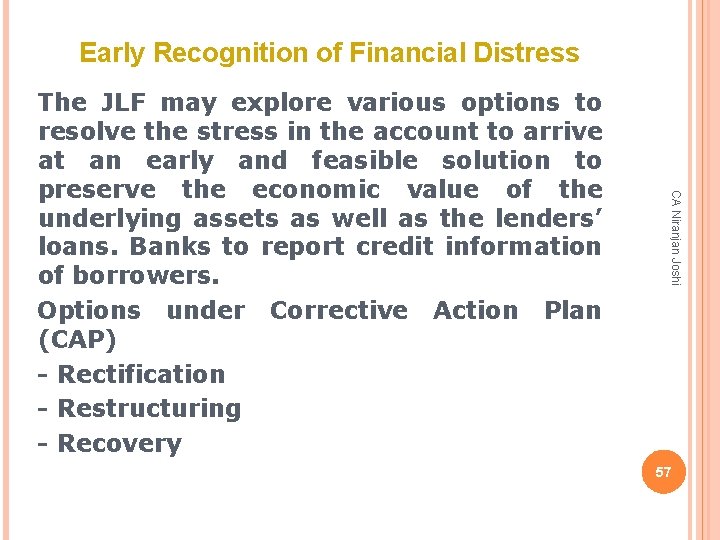
Early Recognition of Financial Distress CA Niranjan Joshi The JLF may explore various options to resolve the stress in the account to arrive at an early and feasible solution to preserve the economic value of the underlying assets as well as the lenders’ loans. Banks to report credit information of borrowers. Options under Corrective Action Plan (CAP) - Rectification - Restructuring - Recovery 57
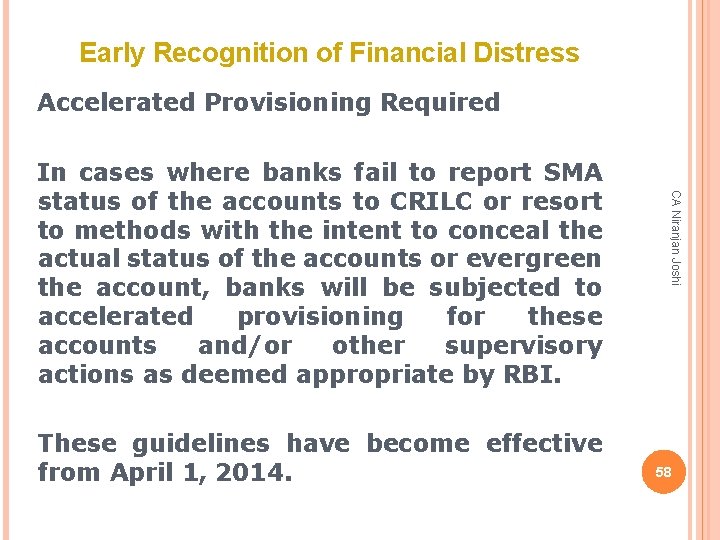
Early Recognition of Financial Distress Accelerated Provisioning Required These guidelines have become effective from April 1, 2014. CA Niranjan Joshi In cases where banks fail to report SMA status of the accounts to CRILC or resort to methods with the intent to conceal the actual status of the accounts or evergreen the account, banks will be subjected to accelerated provisioning for these accounts and/or other supervisory actions as deemed appropriate by RBI. 58
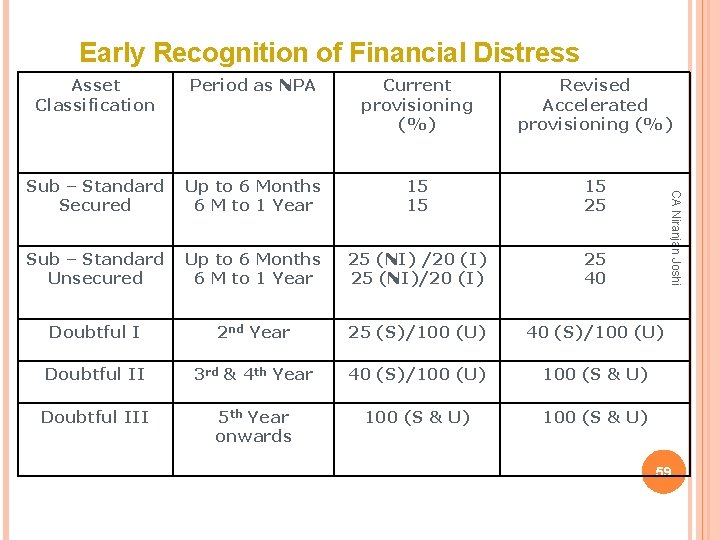
Early Recognition of Financial Distress Period as NPA Current provisioning (%) Revised Accelerated provisioning (%) Sub – Standard Secured Up to 6 Months 6 M to 1 Year 15 15 15 25 Sub – Standard Unsecured Up to 6 Months 6 M to 1 Year 25 (NI) /20 (I) 25 (NI)/20 (I) 25 40 Doubtful I 2 nd Year 25 (S)/100 (U) 40 (S)/100 (U) Doubtful II 3 rd & 4 th Year 40 (S)/100 (U) 100 (S & U) Doubtful III 5 th Year onwards 100 (S & U) CA Niranjan Joshi Asset Classification 59

Questions CA Niranjan Joshi 60

CA Niranjan Joshi, B. Com. , FCA, DISA (ICAI) Email: nvjca 1@gmail. com Cell: 9819078061 61
- Slides: 61