
Status Report March 2017 Programme Supported By Introduction
Status Report March 2017 Programme Supported By
Introduction • SHAREHD is one seven initiatives within the Health Foundation Scaling up Improvement - Objective is to support healthcare improvement interventions and approach's and deliver them at a larger scale. • SHAREHD comprises of 12 dialysis centres across England working together via a Breakthrough Series Collaborative to extend the learning from individual local initiatives and build on the Yorkshire and Humber Shared Haemodialysis Care programme. • SHAREHD will spread the use of shared Haemodialysis care where patients in dialysis units are supported to be involved in their own treatment, undertaking as many tasks as they feel able to. • Output will be a body of evidence that can support a nationwide change towards better patient choice.

High Level Programme Plan
Status Update Breakthrough Series Collaborative • Wave A teams established including patient partners • 2 Learning Events for WAVE A actioned – 2 in planning • Social media used for collaboration including twitter, facebook, whatsapp • WAVE B teams have been contacted – first event 6 th July Research – High level • All 12 sites approval received and baseline data collected • HRA approval for evaluation protocol update provided • All data returned to Sheffield and entered into database
Status Update Communication • Some articles produced including lanyards, pencils • Programme invited to speak at a number of conferences (see next slide) • December Newsletter published • Website updated with articles including Patient stories, governance papers, learning event reports and marketplace • Status Update letter sent to all EXECs who supported the programme Governance • All boards established included pilot of a Commercial Forum • Health Foundation Report in draft
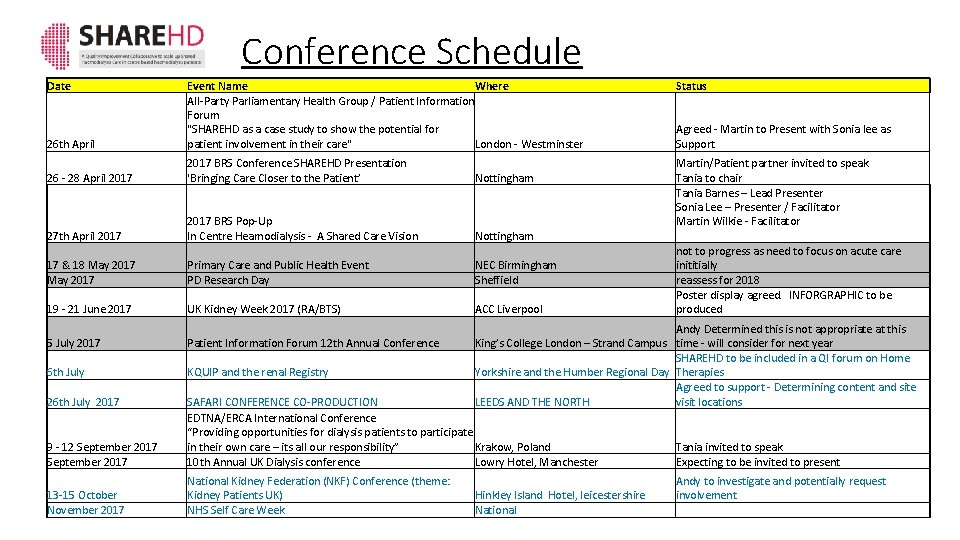
Conference Schedule Date Status 26 th April Event Name Where All-Party Parliamentary Health Group / Patient Information Forum "SHAREHD as a case study to show the potential for patient involvement in their care" London - Westminster 26 - 28 April 2017 BRS Conference SHAREHD Presentation 'Bringing Care Closer to the Patient’ Nottingham 27 th April 2017 BRS Pop-Up In Centre Heamodialysis - A Shared Care Vision Nottingham Martin/Patient partner invited to speak Tania to chair Tania Barnes – Lead Presenter Sonia Lee – Presenter / Facilitator Martin Wilkie - Facilitator 17 & 18 May 2017 Primary Care and Public Health Event PD Research Day NEC Birmingham Sheffield 19 - 21 June 2017 UK Kidney Week 2017 (RA/BTS) ACC Liverpool 5 July 2017 Patient Information Forum 12 th Annual Conference 6 th July KQUIP and the renal Registry 26 th July 2017 9 - 12 September 2017 SAFARI CONFERENCE CO-PRODUCTION EDTNA/ERCA International Conference “Providing opportunities for dialysis patients to participate Krakow, Poland in their own care – its all our responsibility” 10 th Annual UK Dialysis conference Lowry Hotel, Manchester 13 -15 October November 2017 National Kidney Federation (NKF) Conference (theme: Kidney Patients UK) NHS Self Care Week Agreed - Martin to Present with Sonia lee as Support not to progress as need to focus on acute care inititially reassess for 2018 Poster display agreed. INFORGRAPHIC to be produced Andy Determined this is not appropriate at this King’s College London – Strand Campus time - will consider for next year SHAREHD to be included in a QI forum on Home Yorkshire and the Humber Regional Day Therapies Agreed to support - Determining content and site LEEDS AND THE NORTH visit locations Hinkley Island Hotel, leicestershire National Tania invited to speak Expecting to be invited to present Andy to investigate and potentially request involvement
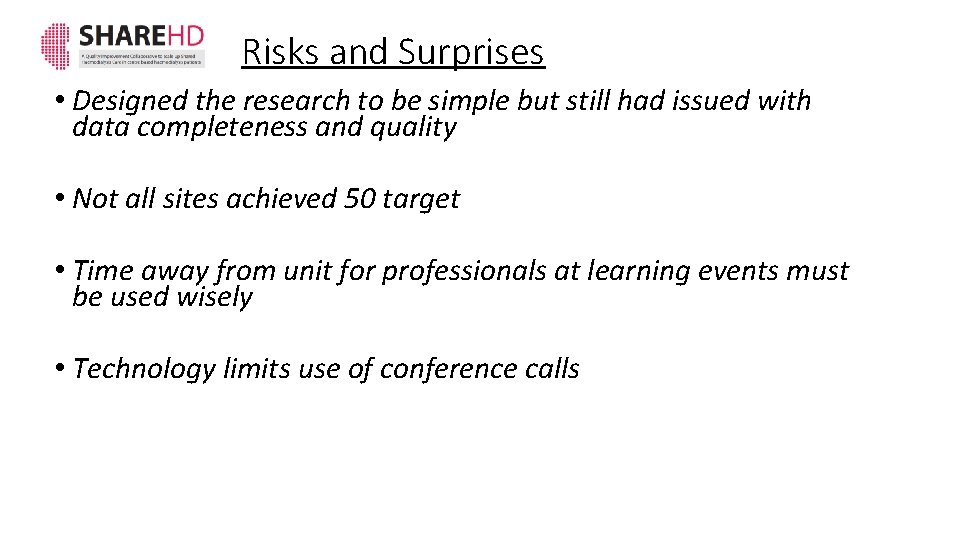
Risks and Surprises • Designed the research to be simple but still had issued with data completeness and quality • Not all sites achieved 50 target • Time away from unit for professionals at learning events must be used wisely • Technology limits use of conference calls
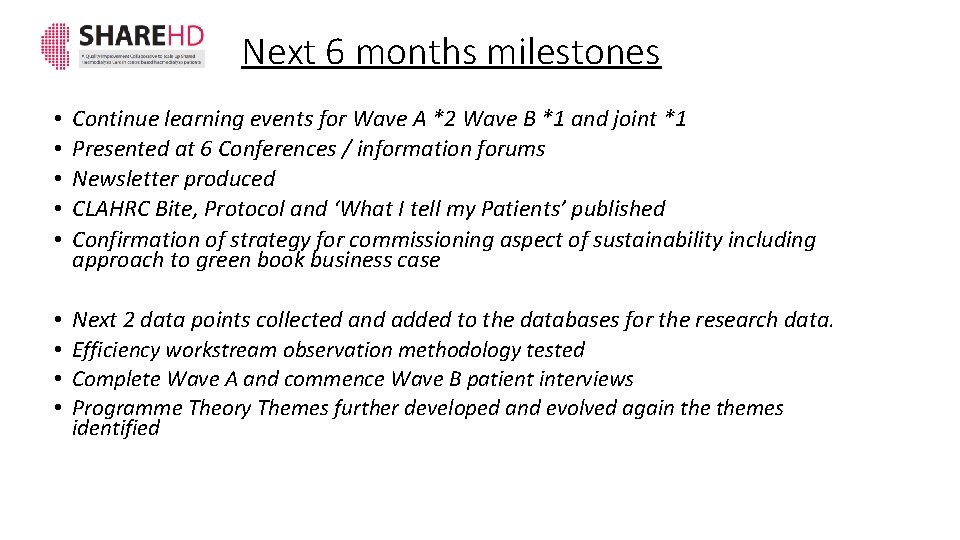
Next 6 months milestones • • • Continue learning events for Wave A *2 Wave B *1 and joint *1 Presented at 6 Conferences / information forums Newsletter produced CLAHRC Bite, Protocol and ‘What I tell my Patients’ published Confirmation of strategy for commissioning aspect of sustainability including approach to green book business case • • Next 2 data points collected and added to the databases for the research data. Efficiency workstream observation methodology tested Complete Wave A and commence Wave B patient interviews Programme Theory Themes further developed and evolved again themes identified
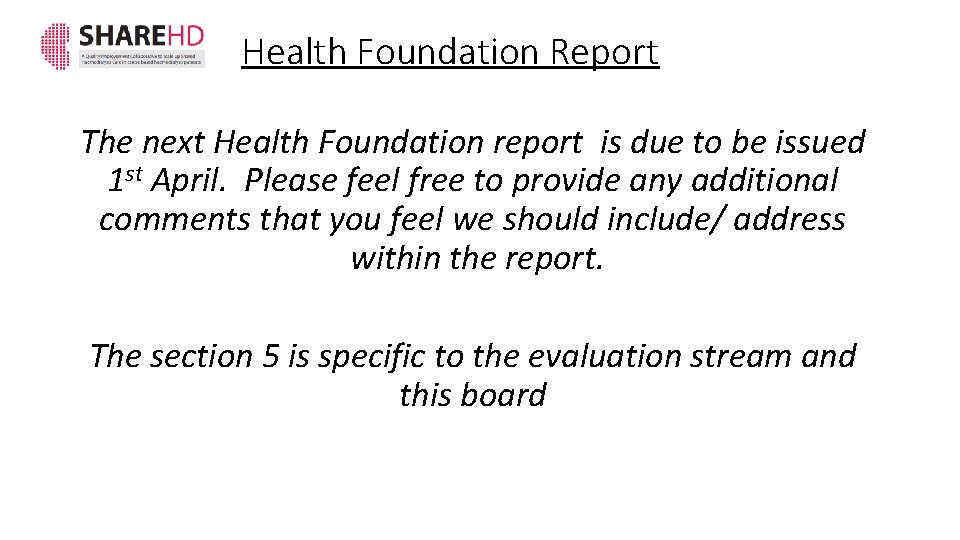
Health Foundation Report The next Health Foundation report is due to be issued 1 st April. Please feel free to provide any additional comments that you feel we should include/ address within the report. The section 5 is specific to the evaluation stream and this board
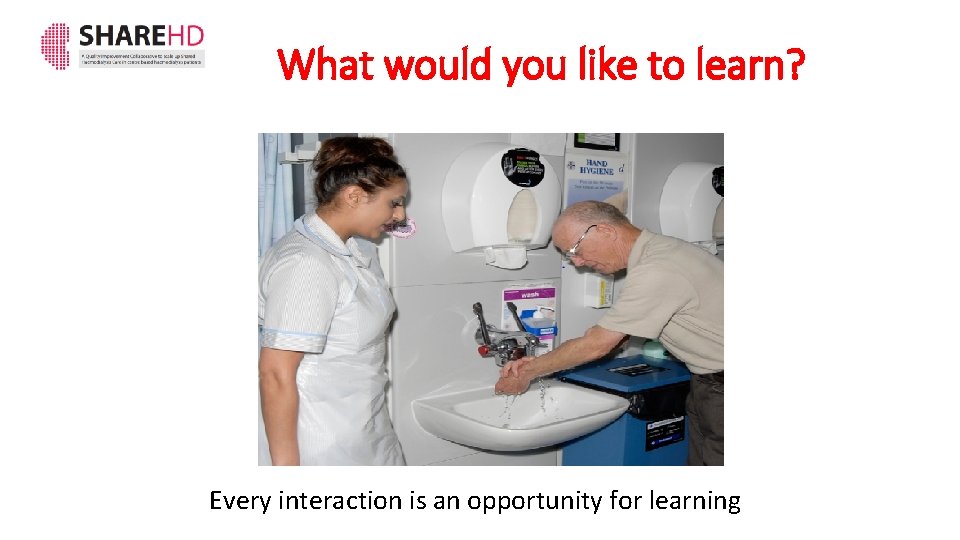
What would you like to learn? Every interaction is an opportunity for learning
SHAREHD: Evaluation Update
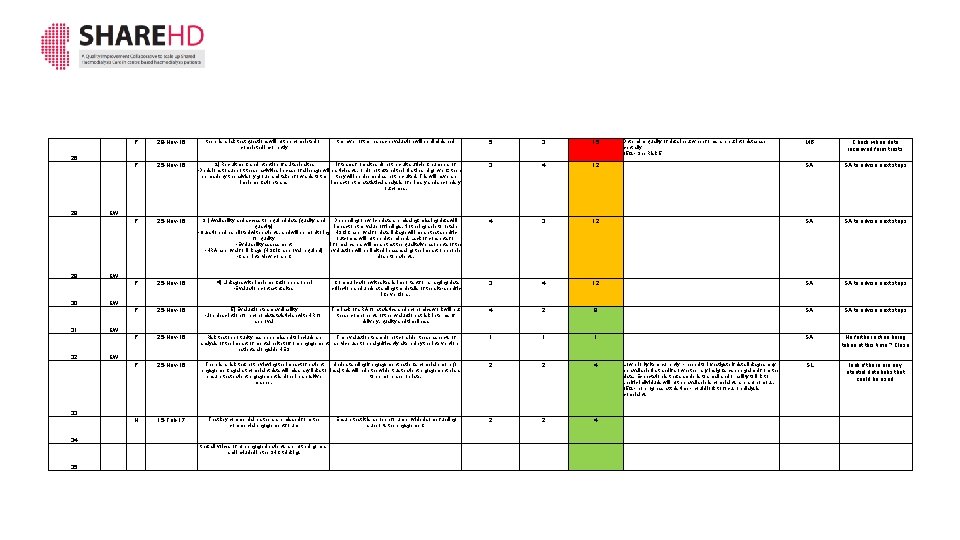
Engage commercial partners • That key commercial partners are missed from the commercial engagement forum: Ensure that it is an open forum provided some funding supports the engagement • That all voices of non-engaged patients are not being heard and included in the SHC thinking.
Quantitative Update: • Data set received and considered implication of data gaps • Data Analyst/statistician/health economist recruited (start April) Economic • Health Economist/statistician recruited (start April) • Could consider things not initially considered such as reduced training time for Home HD if a patients has already done SHC
Qualitative Update: • Visits to Sheffield, Stoke and Nottingham for baseline patient interviews completed and interviews transcribed • Two patients being interviewed in Stevenage w/c 27 th March; Sunderland currently being contacted to arrange patient interviews • The final of the first-phase sites for patient interviews to be arranged is Wolverhampton. Currently we have received no consent forms; this has been chased up • Site pro-forma collaboratively designed to determine variance of site characteristics. Sent to sites to identify correct person to complete and will be followed up with phone call. Sunderland have returned theirs • All letters of access have been obtained for each site (except W’hampton) • University ethics approval for staff interviews has been obtained
SHARE HD Baseline Data James Fotheringham
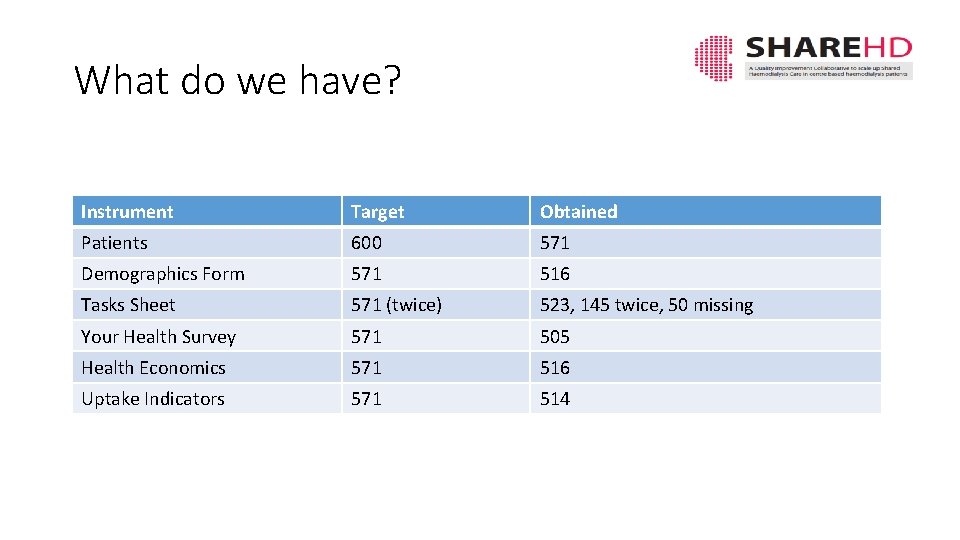
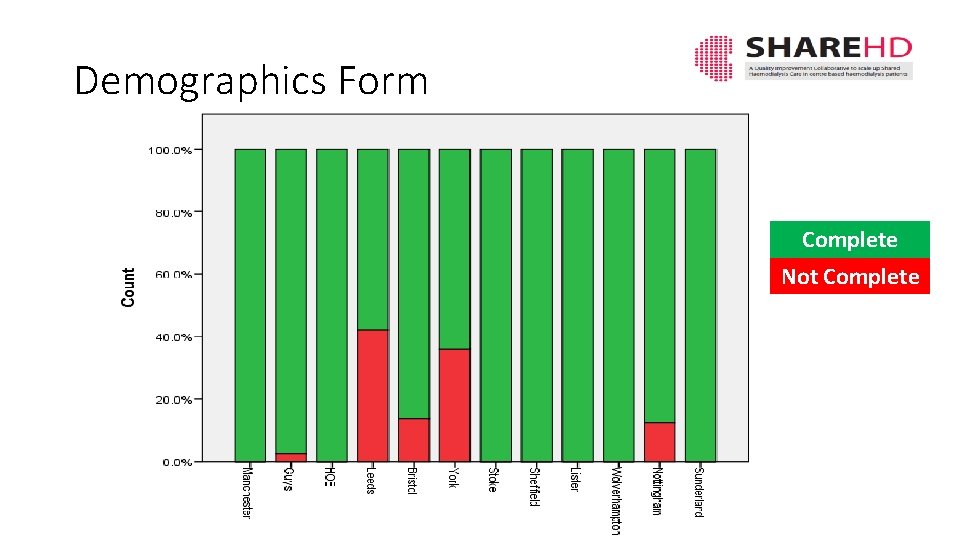
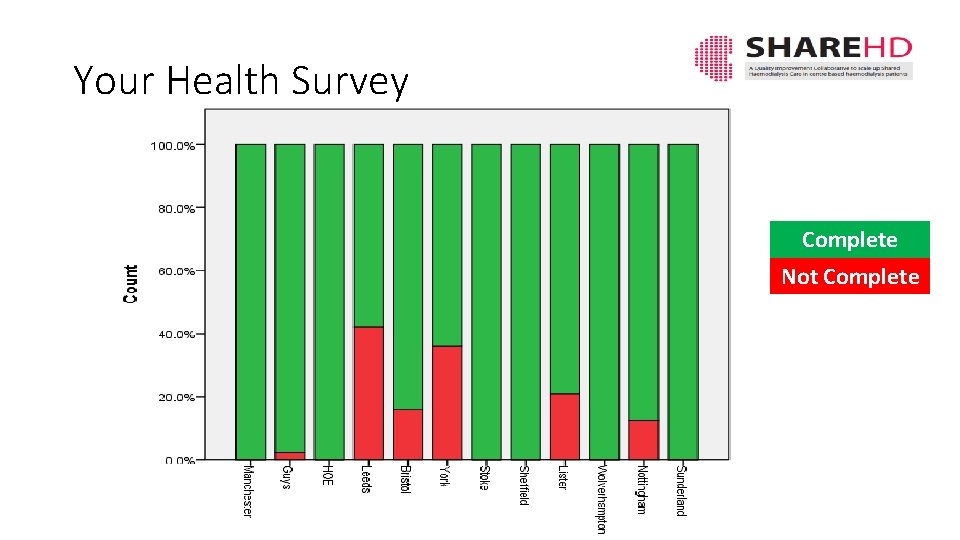
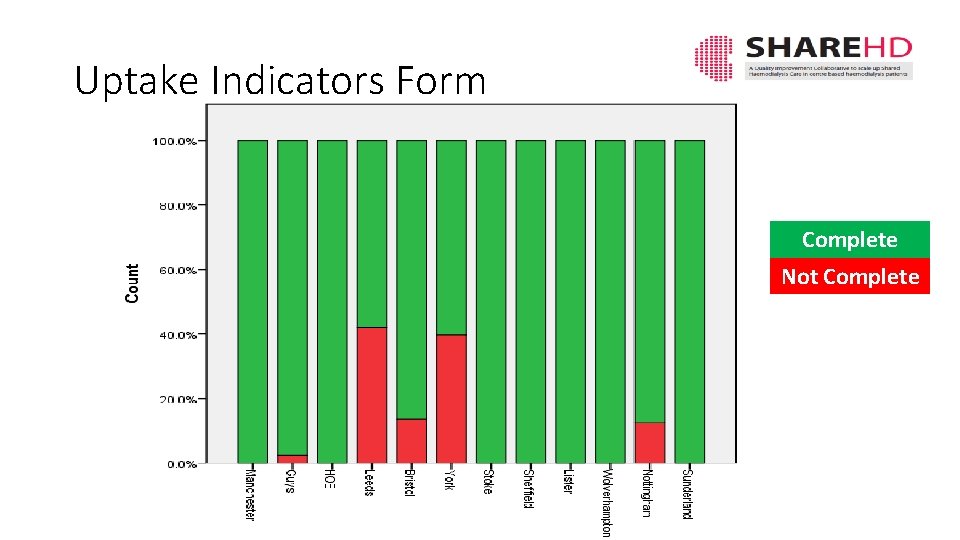
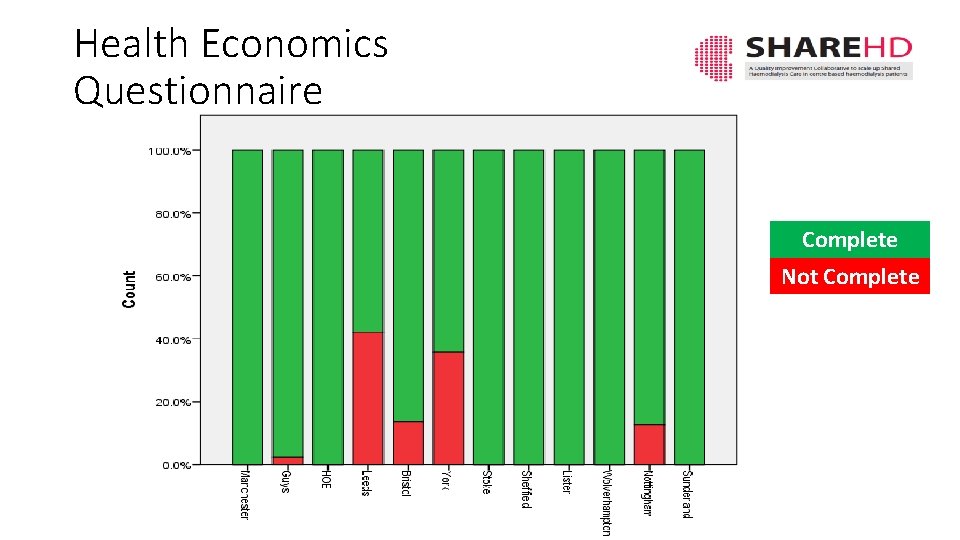
What do we have? Instrument Target Obtained Patients 600 571 Demographics Form 571 516 Tasks Sheet 571 (twice) 523, 145 twice, 50 missing Your Health Survey 571 505 Health Economics 571 516 Uptake Indicators 571 514
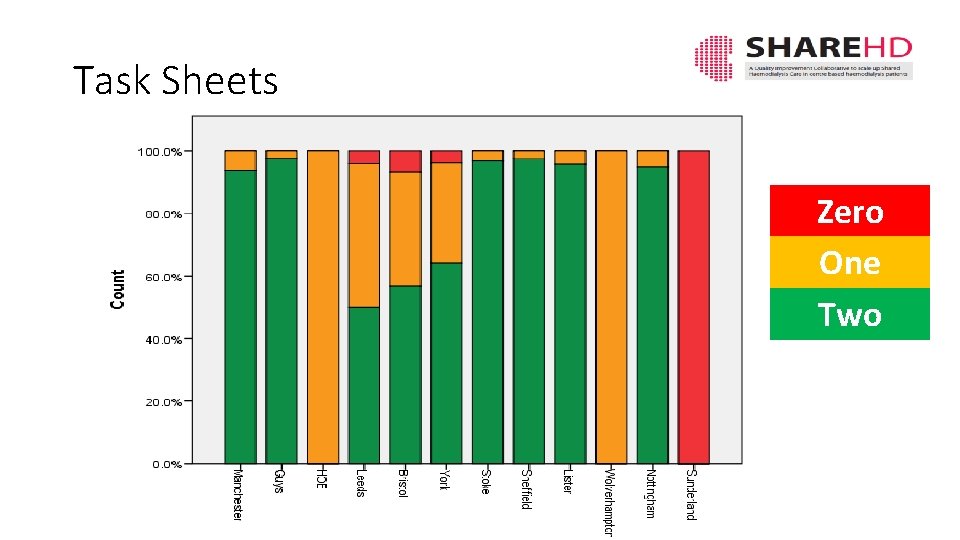
Task Sheets Zero One Two
Demographics Form Complete Not Complete
Your Health Survey Complete Not Complete
Uptake Indicators Form Complete Not Complete
Health Economics Questionnaire Complete Not Complete
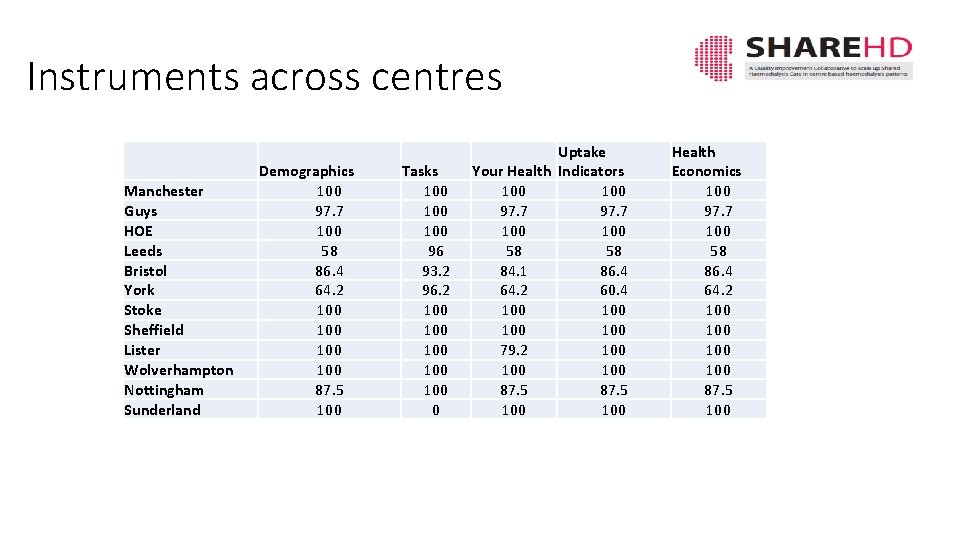
Instruments across centres Manchester Guys HOE Leeds Bristol York Stoke Sheffield Lister Wolverhampton Nottingham Sunderland Demographics 100 97. 7 100 58 86. 4 64. 2 100 100 87. 5 100 Tasks 100 100 96 93. 2 96. 2 100 100 100 0 Uptake Your Health Indicators 100 97. 7 100 58 58 84. 1 86. 4 64. 2 60. 4 100 100 79. 2 100 100 87. 5 100 Health Economics 100 97. 7 100 58 86. 4 64. 2 100 100 87. 5 100
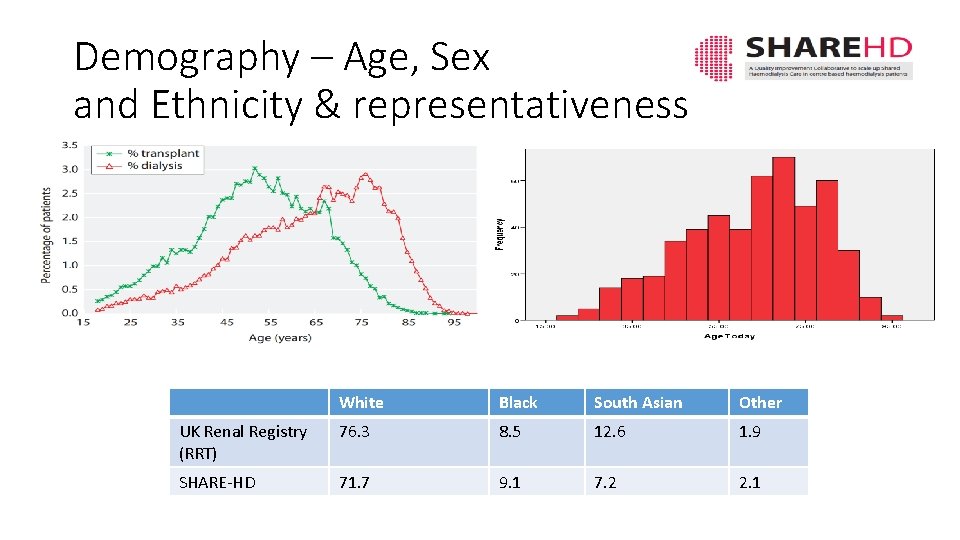
Demography – Age, Sex and Ethnicity & representativeness White Black South Asian Other UK Renal Registry (RRT) 76. 3 8. 5 12. 6 1. 9 SHARE-HD 71. 7 9. 1 7. 2 2. 1
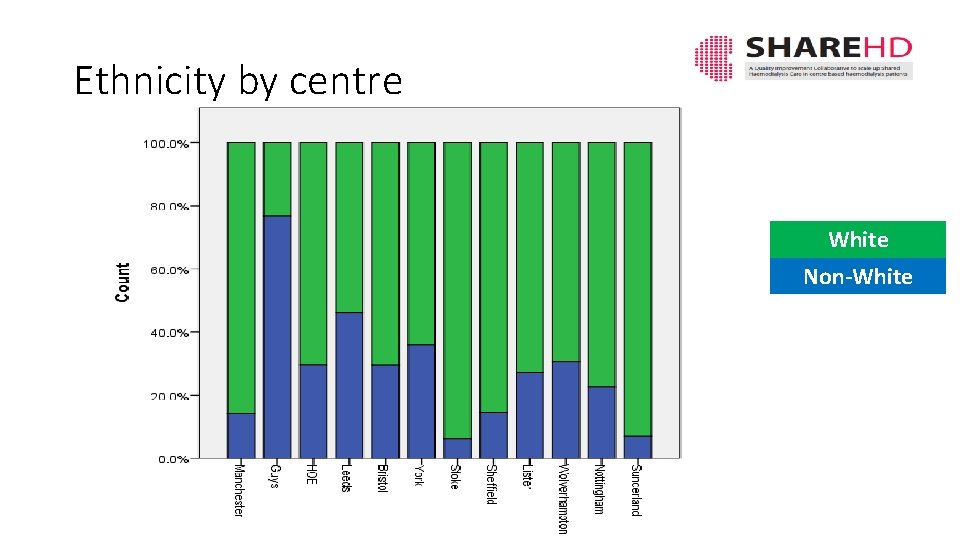
Ethnicity by centre White Non-White
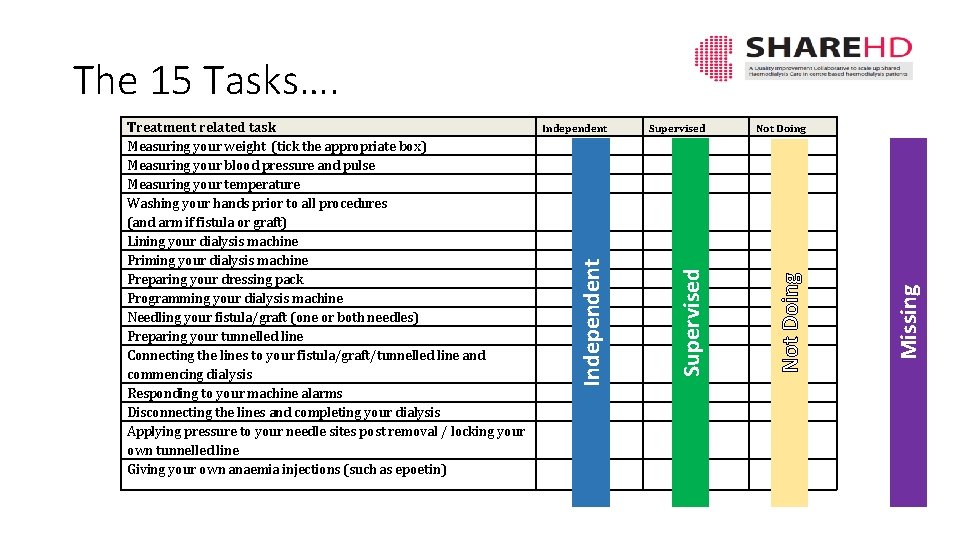
Supervised Not Doing Missing Independent Supervised Treatment related task Measuring your weight (tick the appropriate box) Measuring your blood pressure and pulse Measuring your temperature Washing your hands prior to all procedures (and arm if fistula or graft) Lining your dialysis machine Priming your dialysis machine Preparing your dressing pack Programming your dialysis machine Needling your fistula/graft (one or both needles) Preparing your tunnelled line Connecting the lines to your fistula/graft/tunnelled line and commencing dialysis Responding to your machine alarms Disconnecting the lines and completing your dialysis Applying pressure to your needle sites post removal / locking your own tunnelled line Giving your own anaemia injections (such as epoetin) Independent The 15 Tasks….
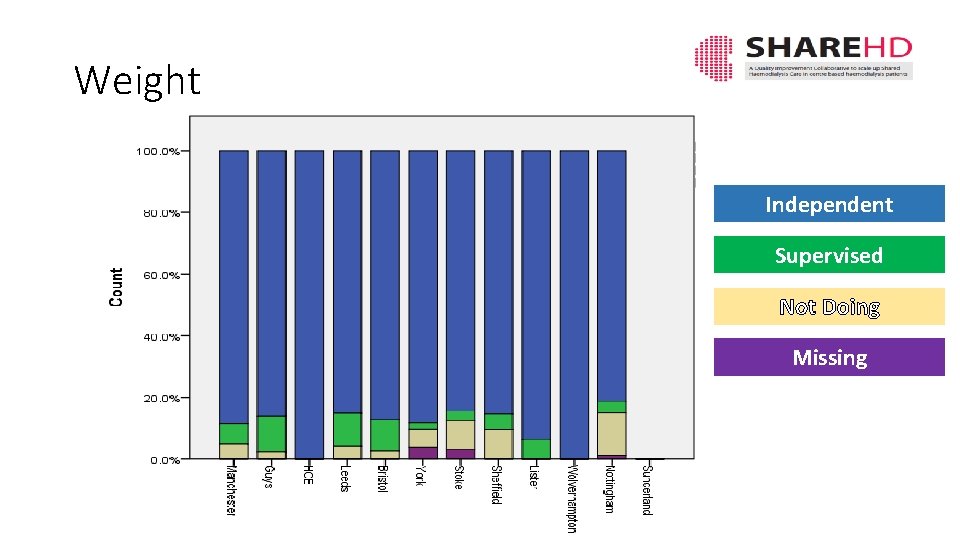
Weight Independent Supervised Not Doing Missing
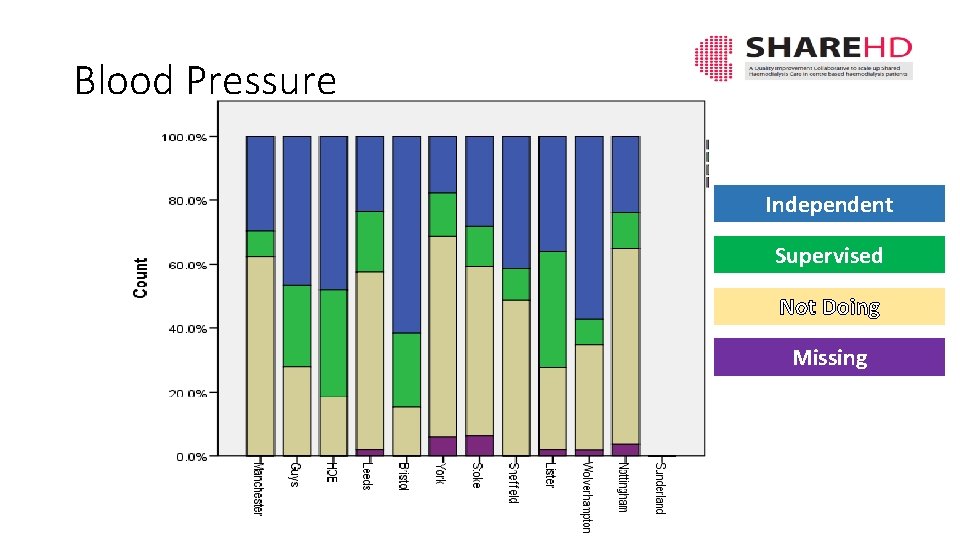
Blood Pressure Independent Supervised Not Doing Missing
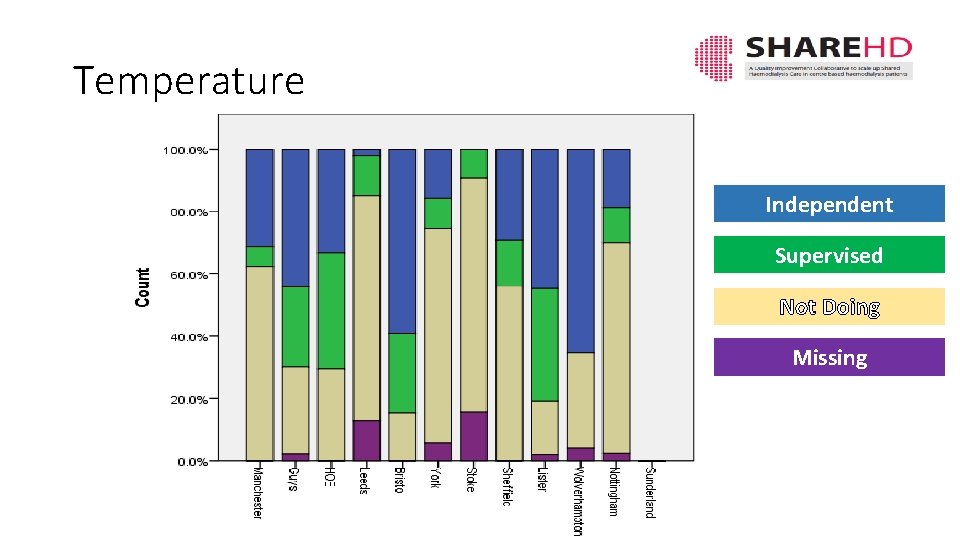
Temperature Independent Supervised Not Doing Missing
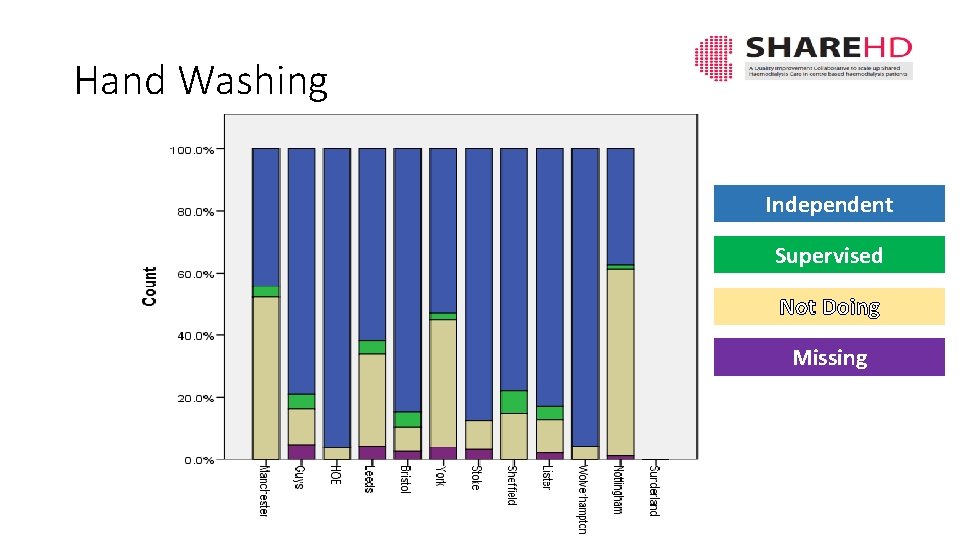
Hand Washing Independent Supervised Not Doing Missing
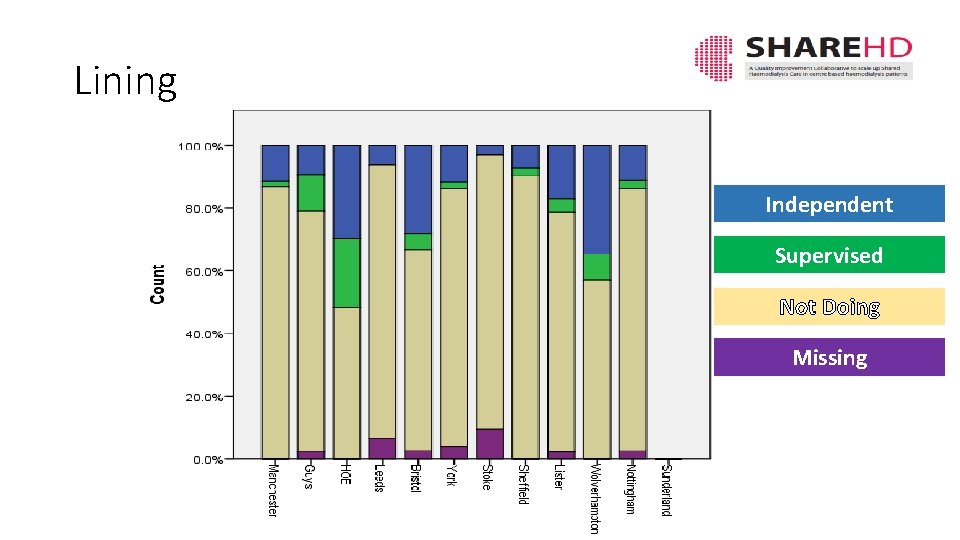
Lining Independent Supervised Not Doing Missing
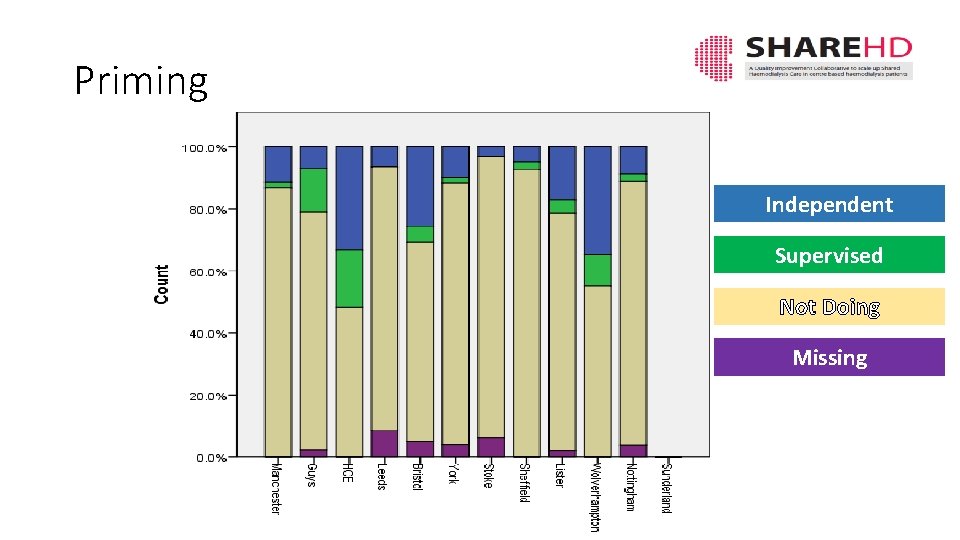
Priming Independent Supervised Not Doing Missing
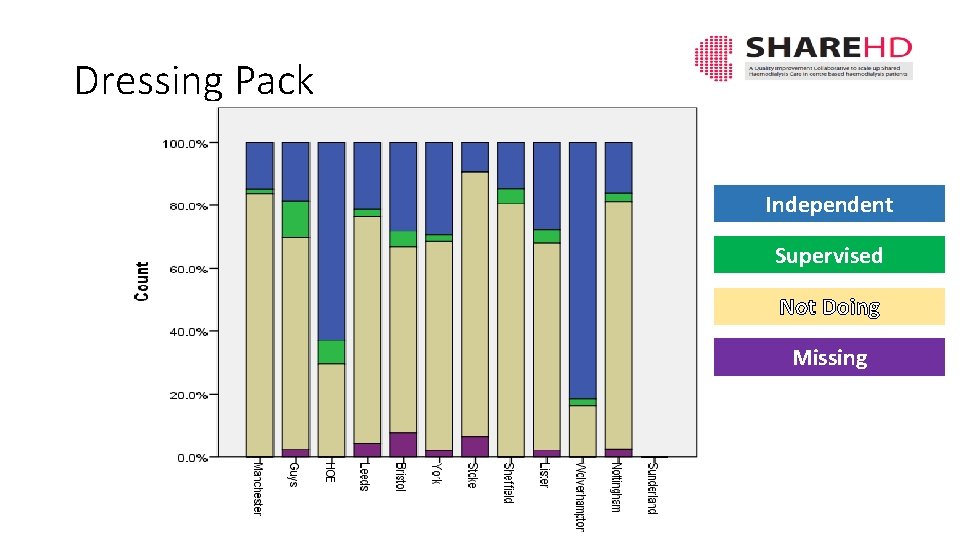
Dressing Pack Independent Supervised Not Doing Missing
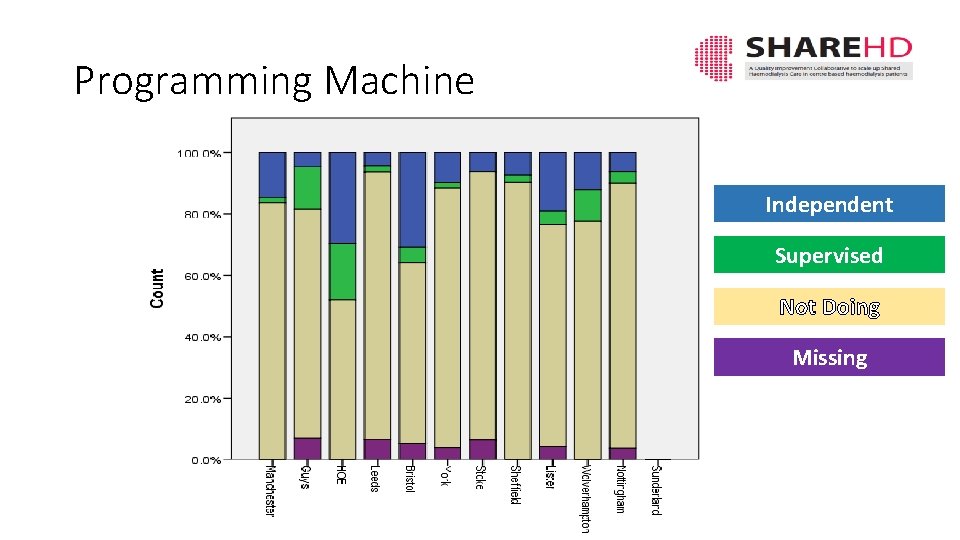
Programming Machine Independent Supervised Not Doing Missing
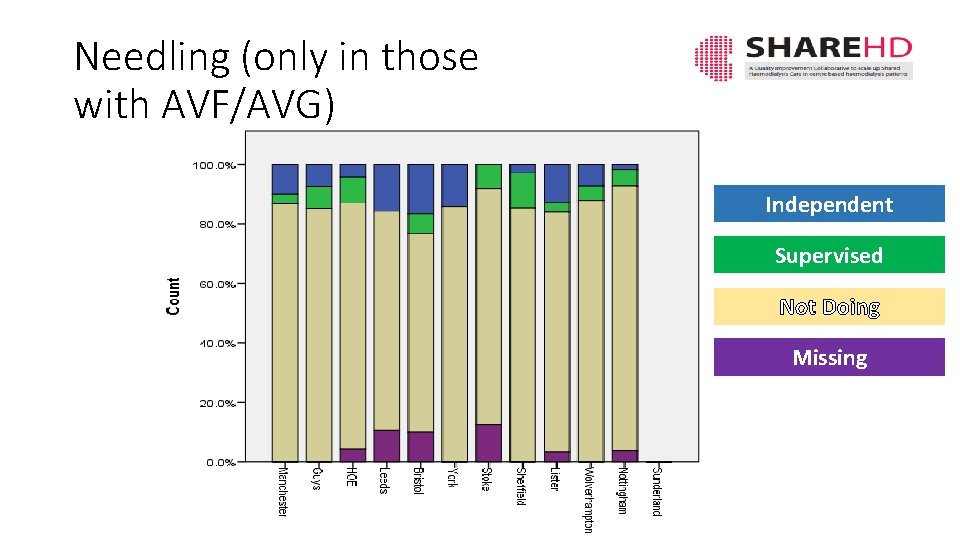
Needling (only in those with AVF/AVG) Independent Supervised Not Doing Missing
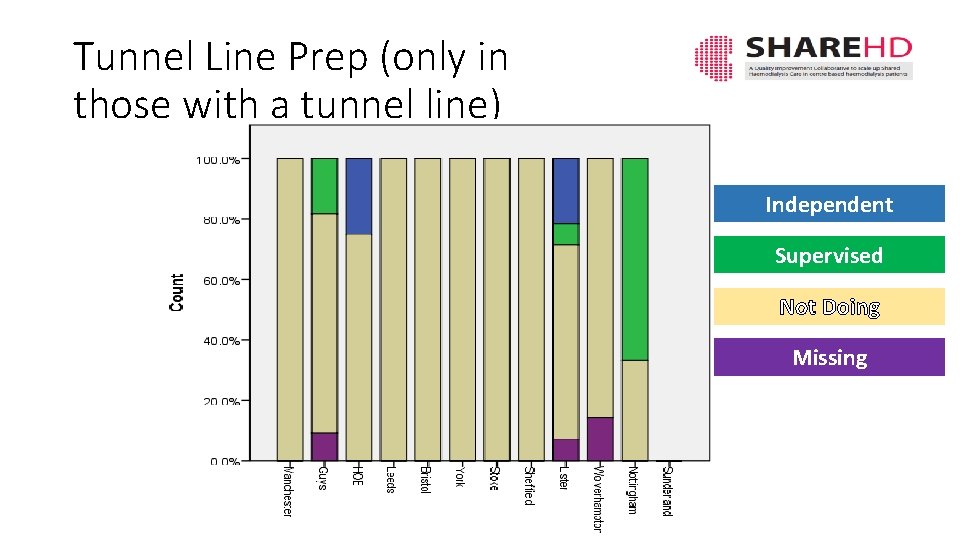
Tunnel Line Prep (only in those with a tunnel line) Independent Supervised Not Doing Missing
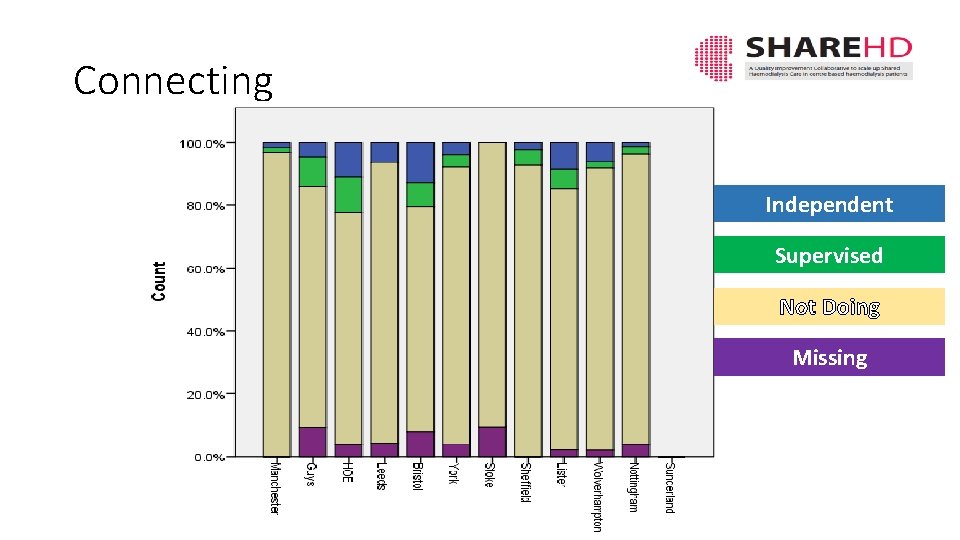
Connecting Independent Supervised Not Doing Missing
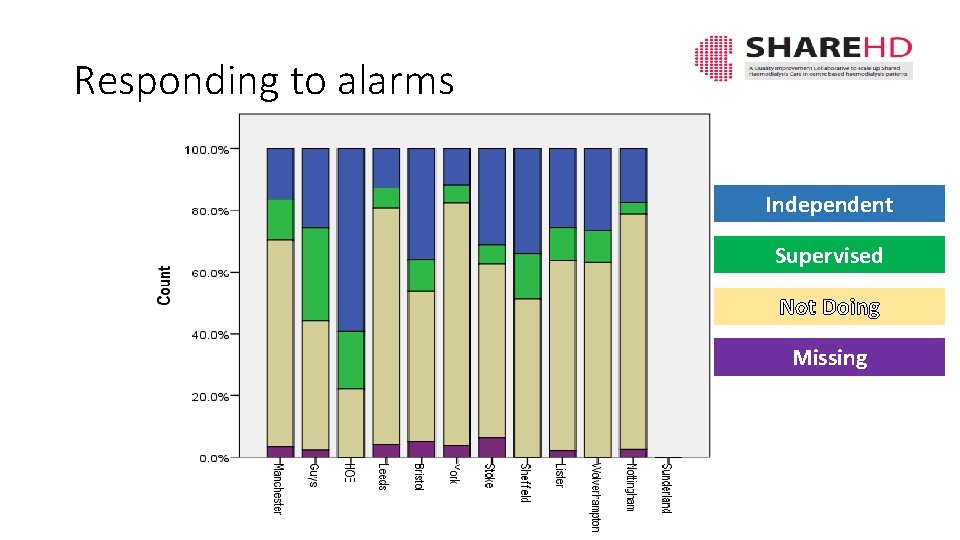
Responding to alarms Independent Supervised Not Doing Missing
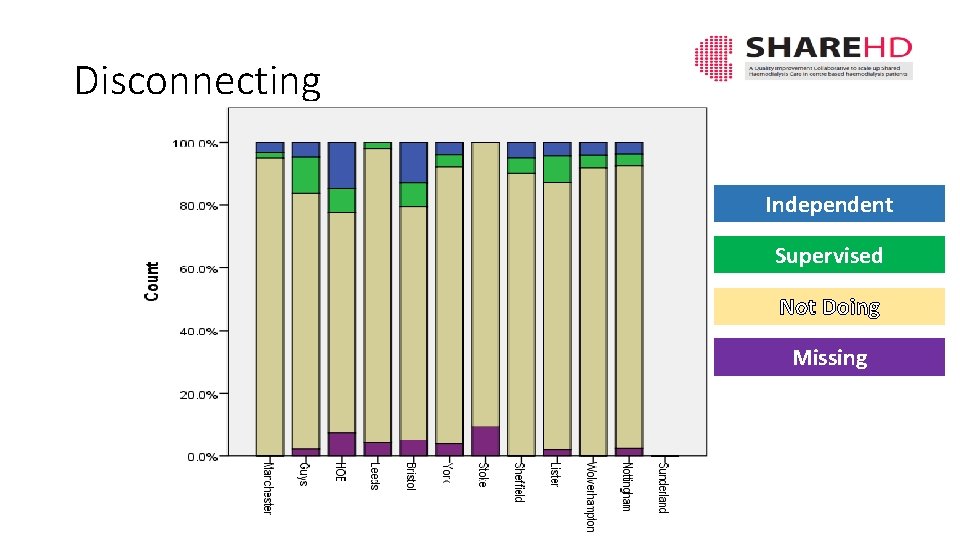
Disconnecting Independent Supervised Not Doing Missing
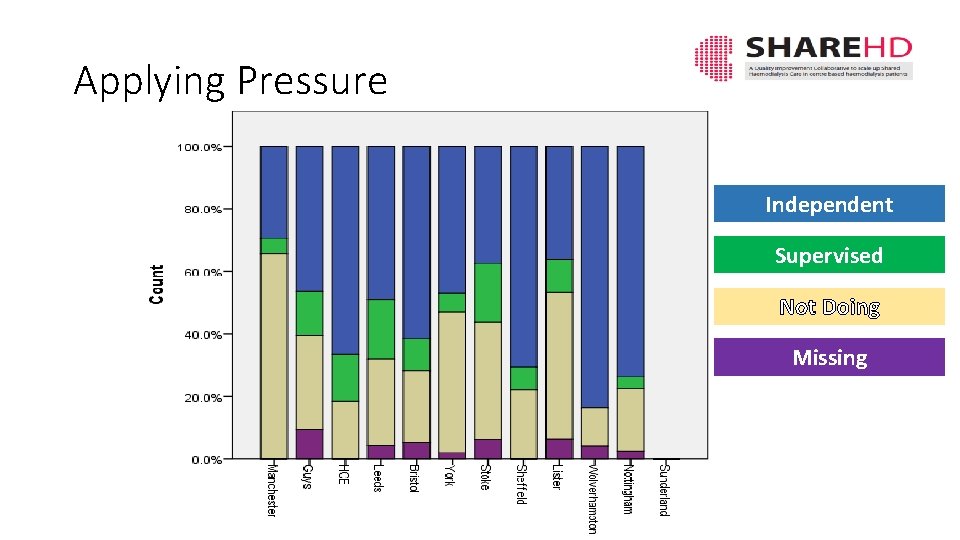
Applying Pressure Independent Supervised Not Doing Missing
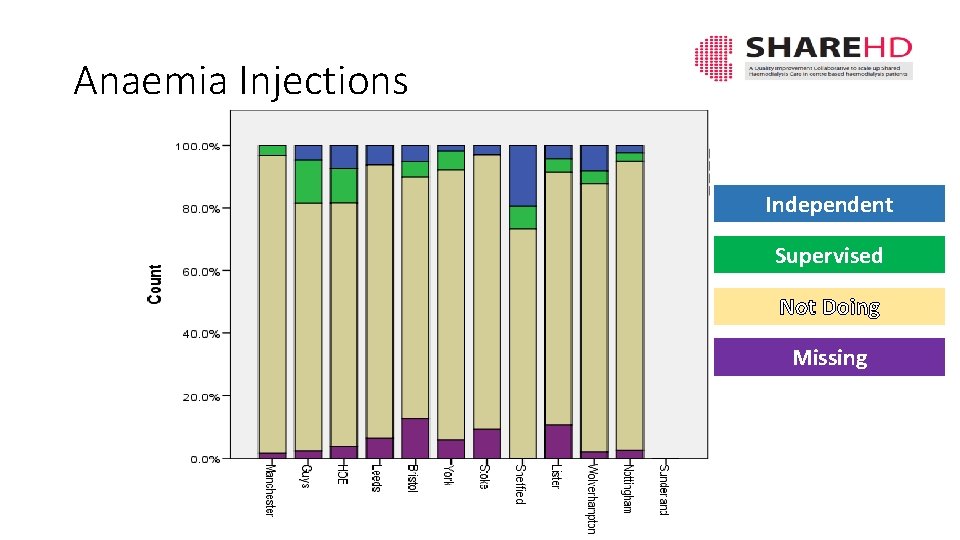
Anaemia Injections Independent Supervised Not Doing Missing
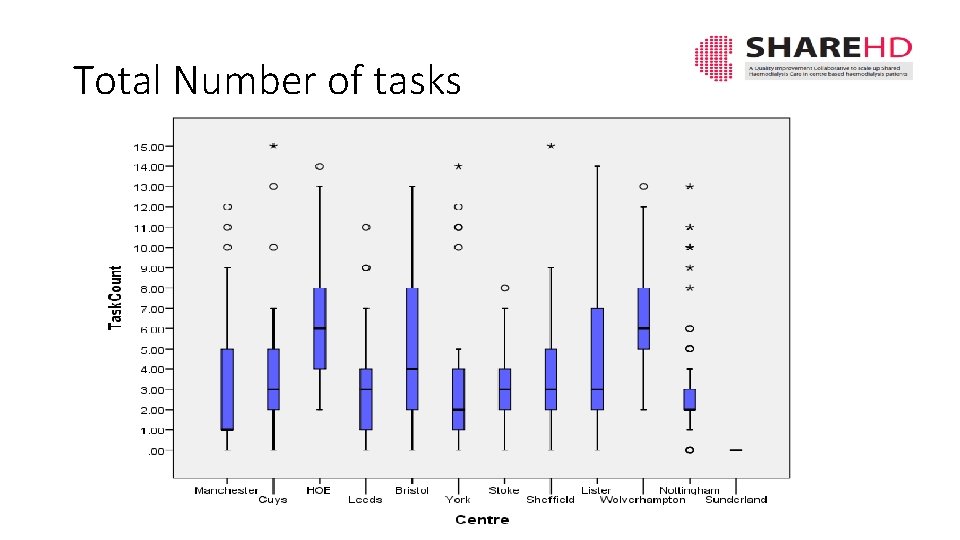
Total Number of tasks
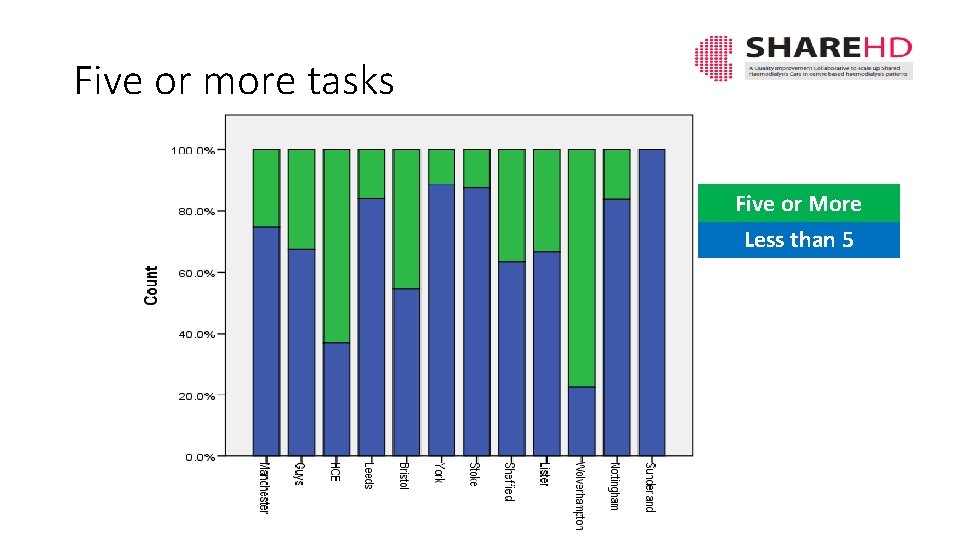
Five or more tasks Five or More Less than 5
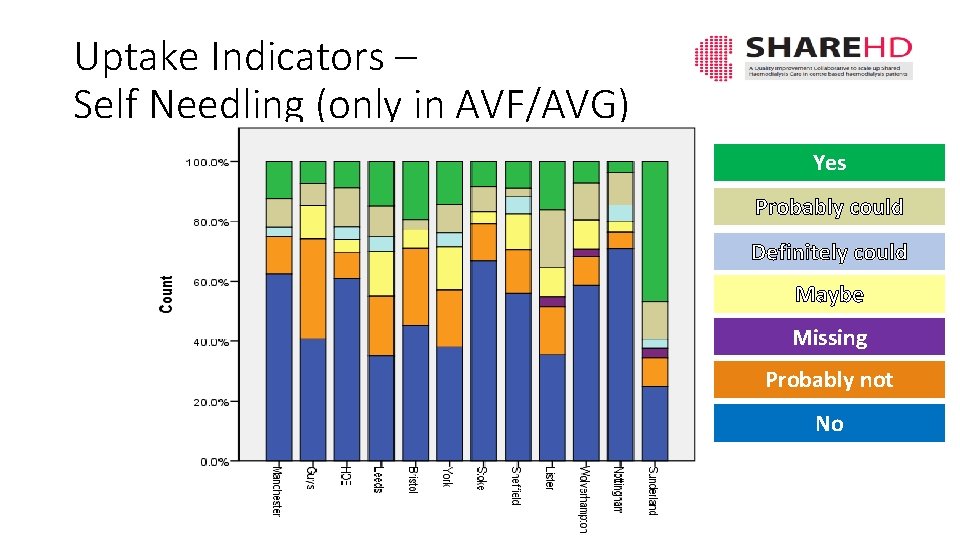
Uptake Indicators – Self Needling (only in AVF/AVG) Yes Probably could Definitely could Maybe Missing Probably not No
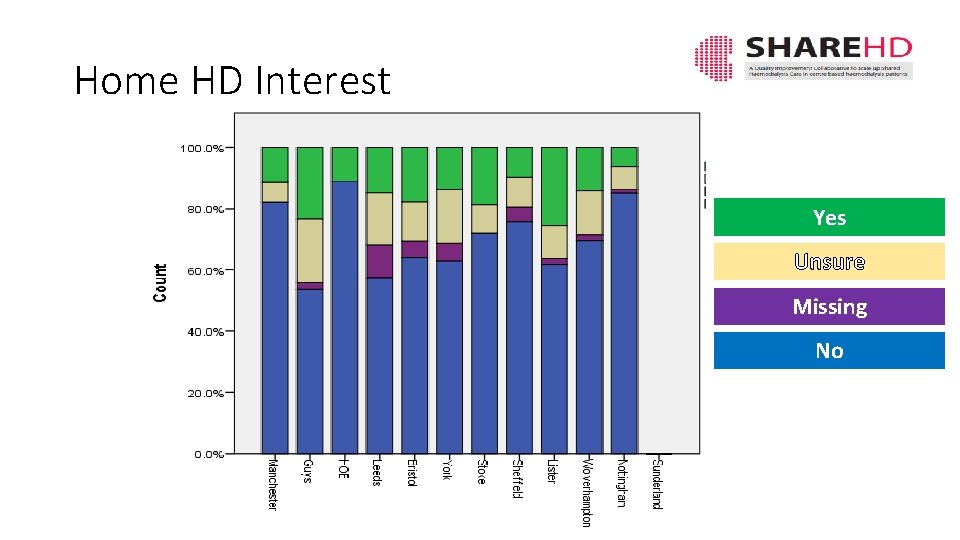
Home HD Interest Yes Unsure Missing No
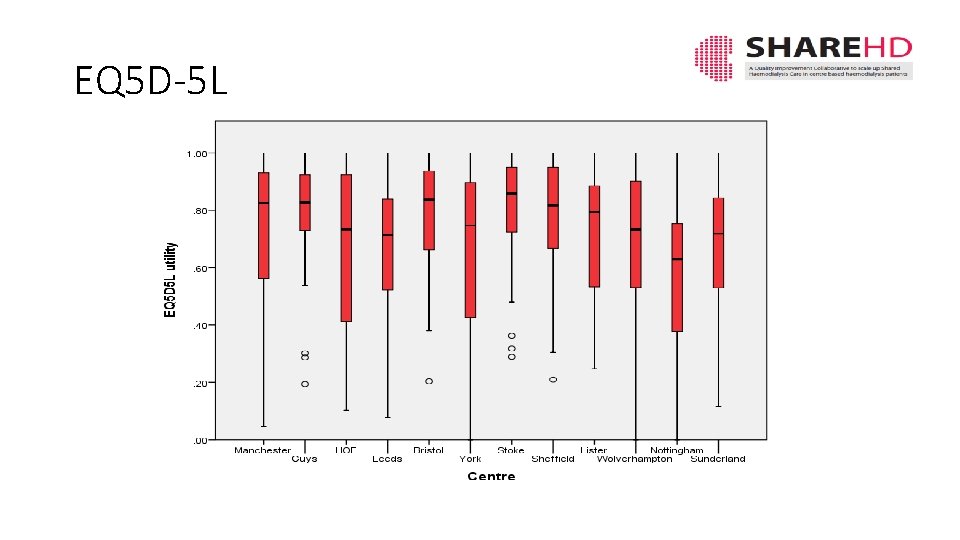
EQ 5 D-5 L
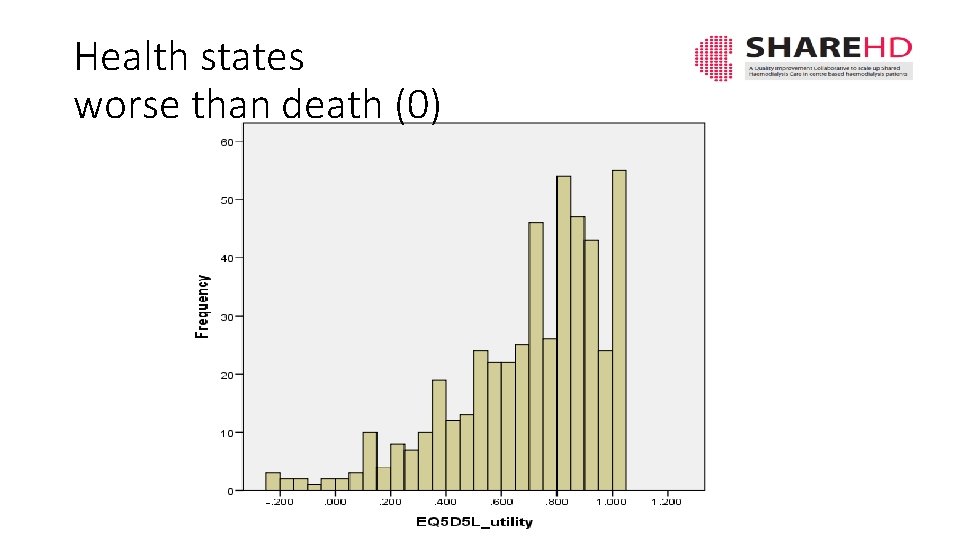
Health states worse than death (0)
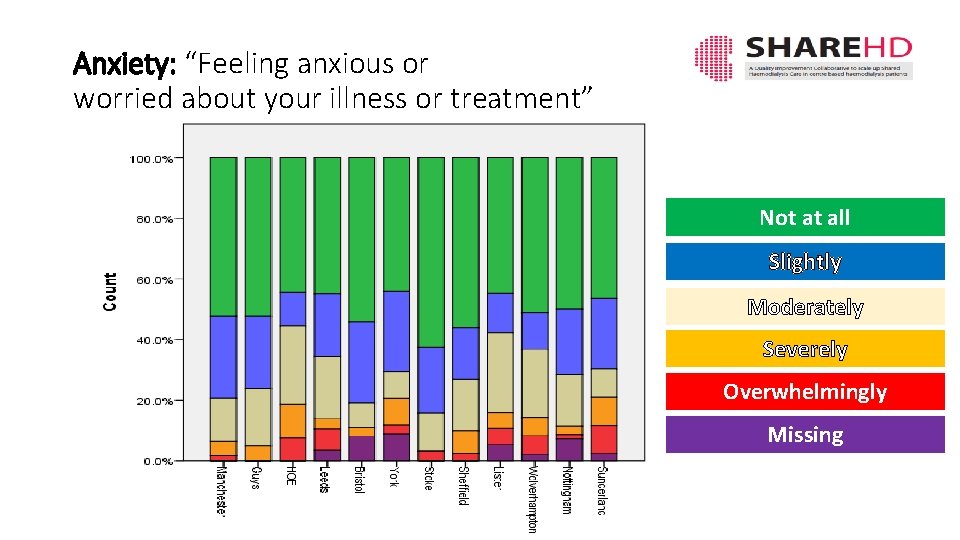
Anxiety: “Feeling anxious or worried about your illness or treatment” Not at all Slightly Moderately Severely Overwhelmingly Missing
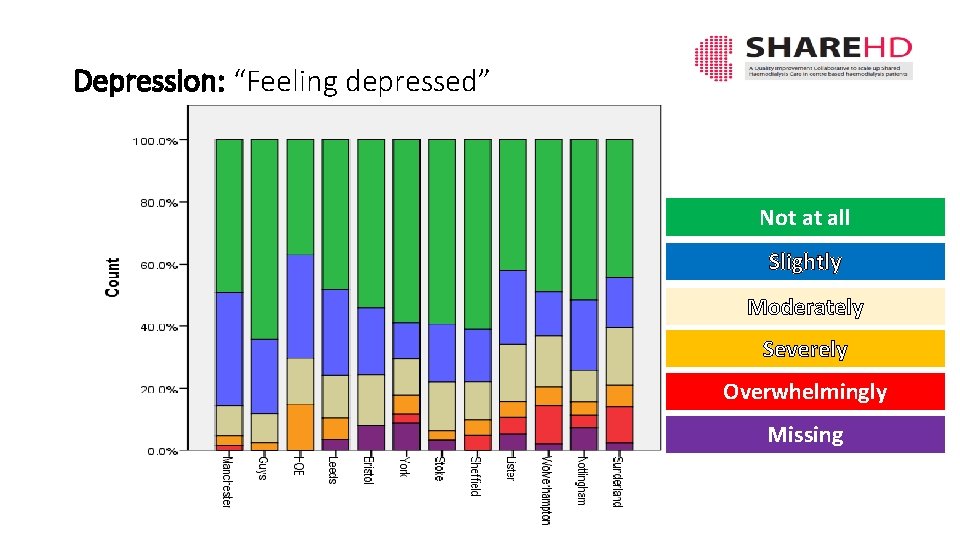
Depression: “Feeling depressed” Not at all Slightly Moderately Severely Overwhelmingly Missing
Summary • Recruited very close to target and “plenty” according to power calculation • Some of the data threats are being addressed • Centres with no task summary • Elements of YHS and Demographics can still be completed • Some centres already have high levels of some tasks • Uptake indicators frosty…?
SHAREHD: Risk Review
there is a risk that questions will not be completed or completed incorrectly P 29 -Nov-16 P 25 -Nov-16 4) Linkages with implementation personnel -Evaluation contact at sites P 25 -Nov-16 P the pwer of the reseach evaluation will be diminished 5 3 15 2) Recruitment and retention of suitable sites If teams from sites do not recruit sufficient numbers of -Decisions to support these activities in case of slippage will participants, or do not attend their first learning event; then be made by the advisory group and taken forwards to they will be deemed as not recruited. This will have an implementation team. impact on the statistical analysis of primary and secondary outcomes. 3 4 MB Check when data receieved form trusts. 12 SA SA to advise next steps 3 ) Availability and access to required data (quality and Depending on which data are missing; missing data will quantity) impact on the value of findings. Not being able to obtain -Questionnaires piloted with patients, and will be monitoring HSCIC approval for data linkage will mean that specific for quality outcomes will not be determined. Lack of consents for -Evaluability assessment informal carers will mean that the qualitative asopects of the -HRA approval for linkage (HSCIC approval required) evaluation will be limited in assessing the impact on people -Carer interview consent close to patients. 4 3 12 SA SA to advise next steps Communication with sites is important for arranging data collection and understanding the details of the site-specific interventions. 3 4 12 SA SA to advise next steps 5) Evaluation team availability -Job description for economist/statistician with HR for approval The lack of a RA for statistics and economics work will put these components of the evaluation at risk in terms of delivery, quality and timeliness 4 2 8 SA SA to advise next steps 25 -Nov-16 Risk that opportunity has been missed to include an analysis of the impact of mental helth to/from engagement patients alongside HES The evaluation team do not consider these aspects of service use to be significantly altered by the intervention 1 1 1 SA No further action being taken at this time ? Close P 25 -Nov-16 There is a risk that not reviewing the impact of patient Understanding if engagement patients complain more (or engagement against complaint data will miss any links to less) this will help the wider trust patient engagement plans ensure that patient engagement is done in a positive to be more appropriate. manner. 2 2 4 SL look if there any otential data links that could be used. N 15 -Feb-17 2 2 4 26 28 29 30 31 32 EW EW EW 33 That key commercial partners are missed form the commercial engagement forum 34 that all voices of non engaged patients are not being hear and included in the SHC thinking. 35 Determine quality of data input when forms are put into database centrally 15/2 - See Risk 5 Ensure that it is an open forum provided some funding supports the engagement Low priority item currently - neeed to investigate if data linkages may be available first and if so whether any insights can be gained from the data. Expectation is that sample is to small and. or ability to link to speific individuals will not be available is complaints are anonomous. 15/2 - no progress at this time - could look to focus on dialysis complaints
Site retention & Data completeness • Recruitment and retention of suitable sites: If teams from sites do not recruit sufficient numbers of participants, or do not attend their first learning event; then they will be deemed as not recruited. This will have an impact on the statistical analysis of primary and secondary outcomes. Decisions to support these activities in case of slippage will be made by the advisory group and taken forwards to the implementation team. • There is a risk that questions will not be completed or completed incorrectly: the ability to assess changes in the primary outcome measure will be diminished
Missing Data • Availability and access to required data (quality and quantity) -Questionnaires piloted with patients, and will be monitored for quality -HRA approval for linkage (HSCIC approval required) -Carer interview consent • Depending on which data are missing; missing data will impact on the value of findings. Not being able to obtain HSCIC approval for data linkage will mean that specific outcomes will not be determined. • Lack of consents for informal carers will mean that the qualitative aspects of the evaluation will be limited in assessing the impact on people close to patients.
Contact with sites & Evaluation team capacity • Linkages with implementation personnel & Evaluation contact at sites: Communication with sites is important for arranging data collection and understanding the details of the site -specific interventions. • Evaluation team availability. The lack of a RA for statistics and economics work will put these components of the evaluation at risk in terms of delivery, quality and timeliness: Job description for economist/statistician with HR for approval
Mental health service use • Risk that opportunity has been missed to include an analysis of the impact of mental health service use: The evaluation team have consulted with service providers and do not consider these aspects of service use to be significantly altered by the intervention. Anxiety and depression are being recorded through PROMS
Patient Complaints • There is a risk that not reviewing the impact of patient engagement against complaint data will miss any links to ensure that patient engagement is done in a positive manner: Understanding if engaged patients complain more (or less) this will help the wider trust patientengagement plans to be more appropriate. • Expectation is that sample is to small and/or ability to link to specific individuals will not be available as complaints are anonymous. • Could be explored through qualitative work?
Programme Theory • We initially had difficulties in convening a group of key stakeholders for long enough periods of time to work on developing the logic model. Using a Watsapp group for asking questions to the group has made this process very efficient. • V 7 of the logic model: Whilst this is a useful repository, we will shortly begin to lift elements out of the model for focused development of hypotheses to be refined and tested. This activity will work in synergy with the interviews and quantitative data analysis.
- Slides: 57