
Status Report For Threshold Scans ShaperSampler Drop Trims
- Slides: 26
Status Report For Threshold Scans
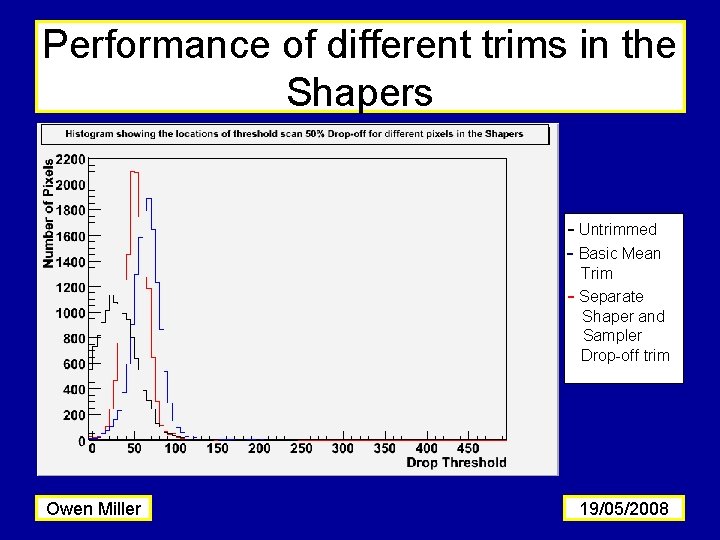
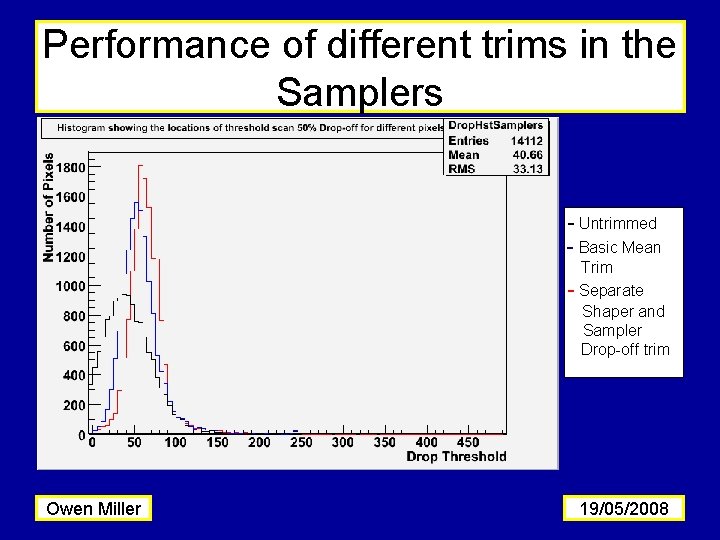
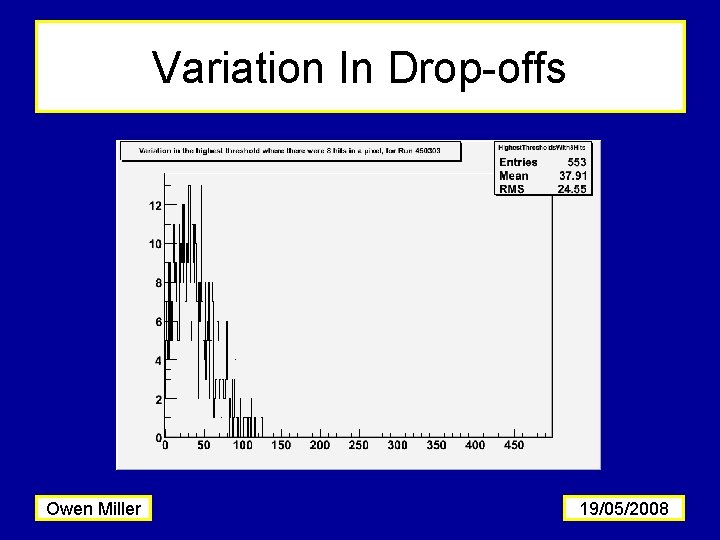
Shaper/Sampler Drop Trims • As promised new and improved trimming techniques have been developed. • As suggested, we will focus on trims calculated according to drop-off point, calculated separately for shapers and samplers. • Here, drop-off is defined as the highest threshold where the bin content is greater than half the maximum bin content recorded. Owen Miller 19/05/2008
Performance of different trims in the Shapers - Untrimmed - Basic Mean Trim - Separate Shaper and Sampler Drop-off trim Owen Miller 19/05/2008
Performance of different trims in the Samplers - Untrimmed - Basic Mean Trim - Separate Shaper and Sampler Drop-off trim Owen Miller 19/05/2008
Correlation Between Pixel Stats • This is essentially an attempt to find out whether or not individual pixel statistics from their threshold scans are consistently related. • Specifically the statistics studied are: Mean threshold, peak threshold and 50% drop-off. Owen Miller 19/05/2008
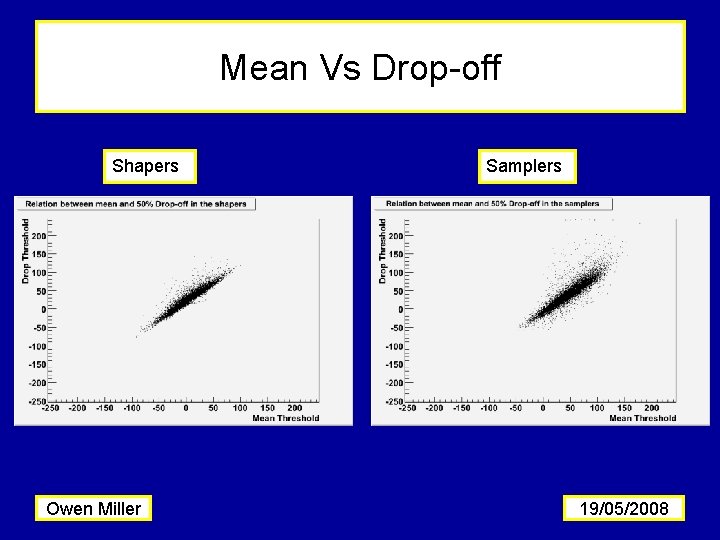
Mean Vs Drop-off Shapers Owen Miller Samplers 19/05/2008
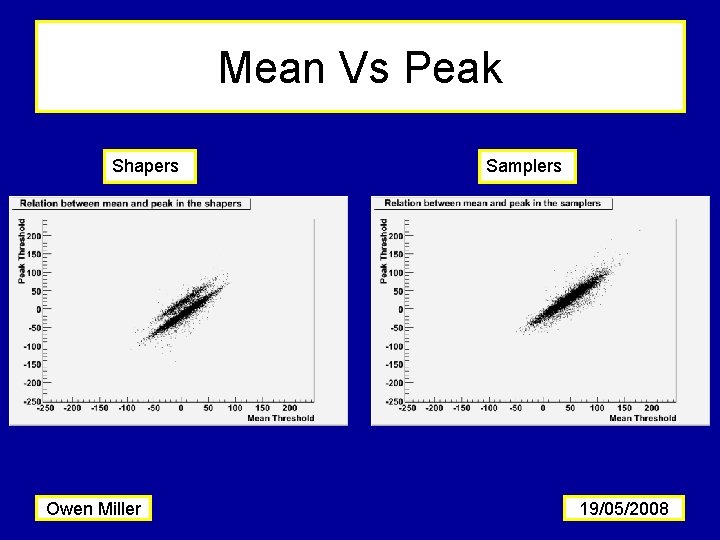
Mean Vs Peak Shapers Owen Miller Samplers 19/05/2008
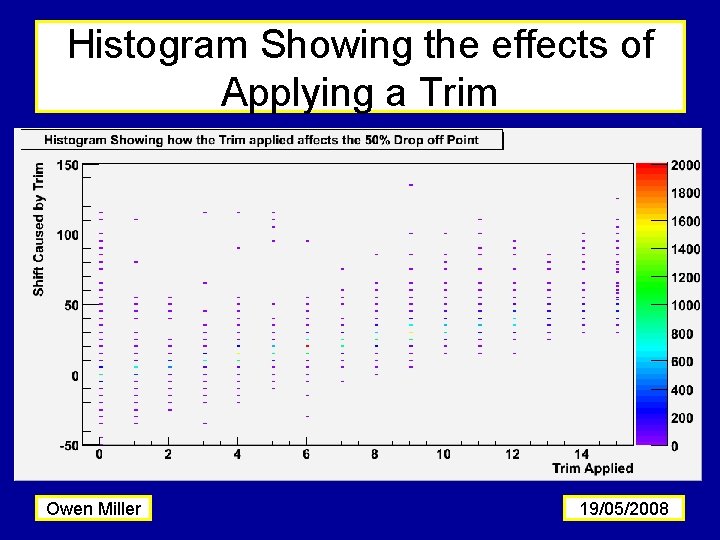
Trim Vs Shift • This study is (hopefully) primarily a sanity check, ensuring that the alterations in pixel behaviour caused by applying a trim are both consistent and predictable. • The following graphs are based on a comparison between trimmed and untrimmed runs, showing how much the position of the drop-off changes with the trim applied to the pixel. Owen Miller 19/05/2008
Histogram Showing the effects of Applying a Trim Owen Miller 19/05/2008
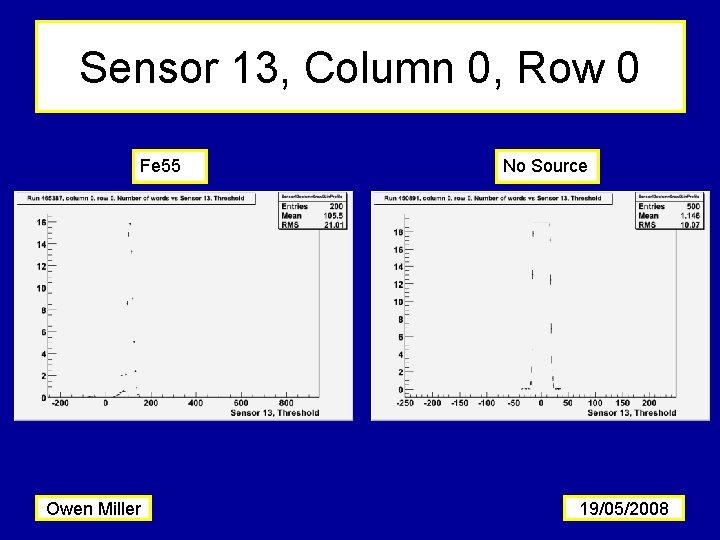
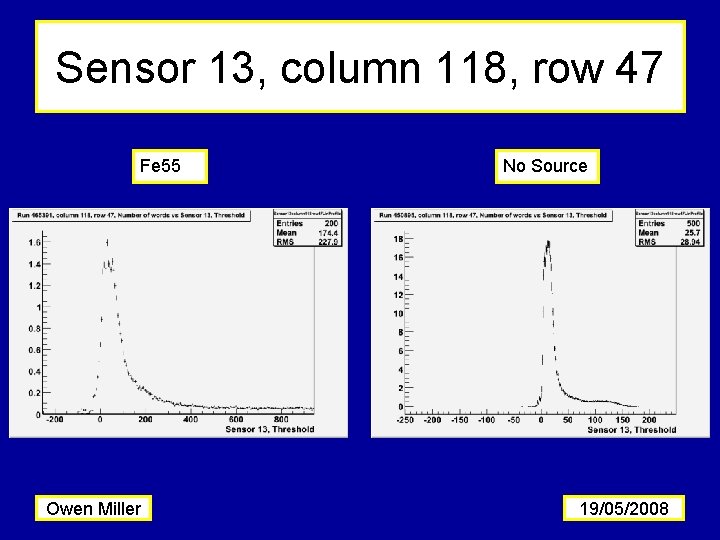
Fe 55 runs • Several sets of per-pixel threshold scan runs were performed with an Fe 55 source next to the sensor. • The following slides show the threshold scans of several pixels with and without the Fe 55 source. Owen Miller 19/05/2008
Sensor 13, Column 0, Row 0 Fe 55 Owen Miller No Source 19/05/2008
Sensor 13, column 118, row 47 Fe 55 Owen Miller No Source 19/05/2008
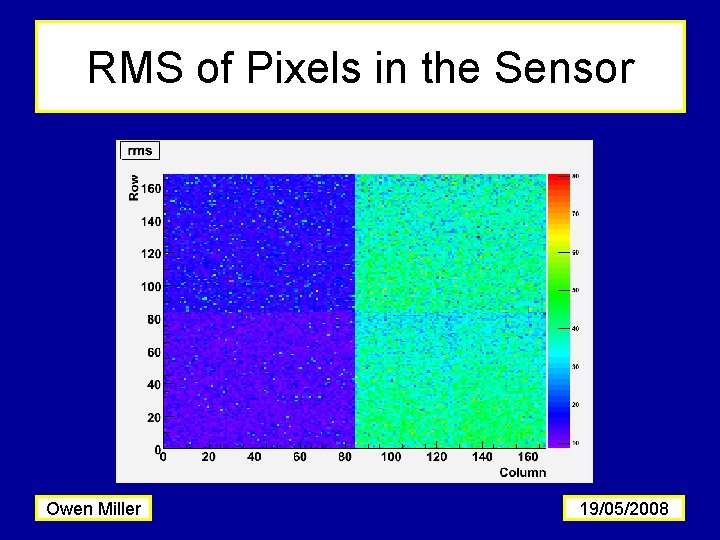
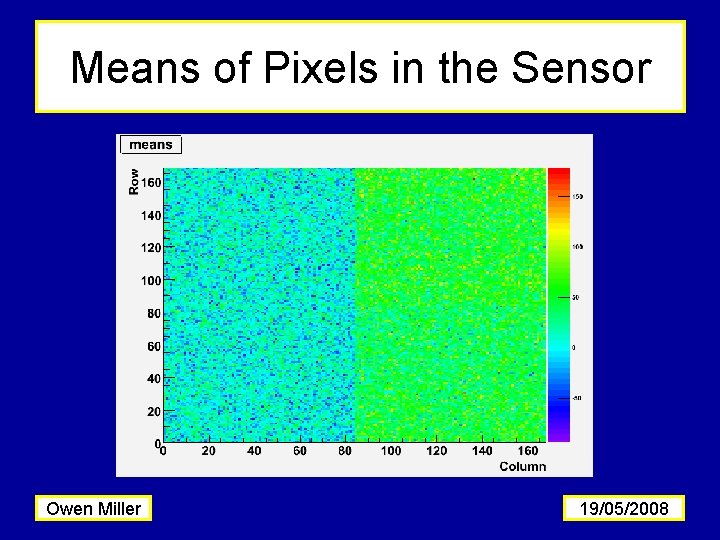
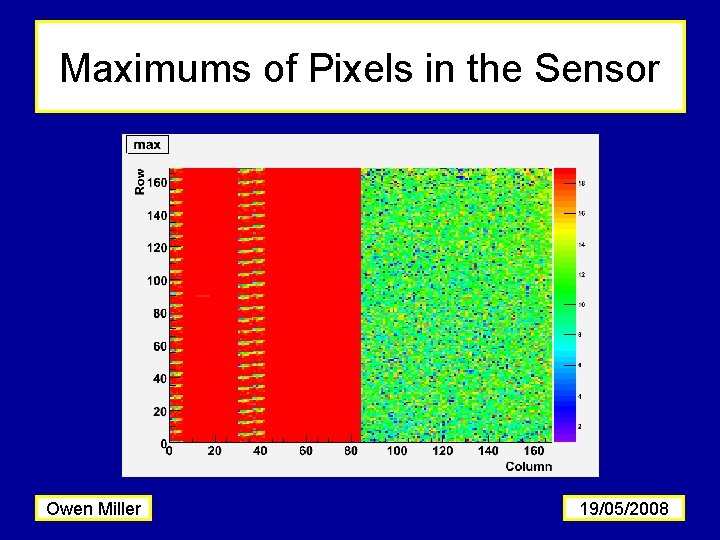
Pedestals & Noise • The pedestal of a pixel is related to its mean threshold (on a threshold scan). • The noise of a pixel is related to the sigma of its threshold scan. Owen Miller 19/05/2008
RMS of Pixels in the Sensor Owen Miller 19/05/2008
Means of Pixels in the Sensor Owen Miller 19/05/2008
Maximums of Pixels in the Sensor Owen Miller 19/05/2008
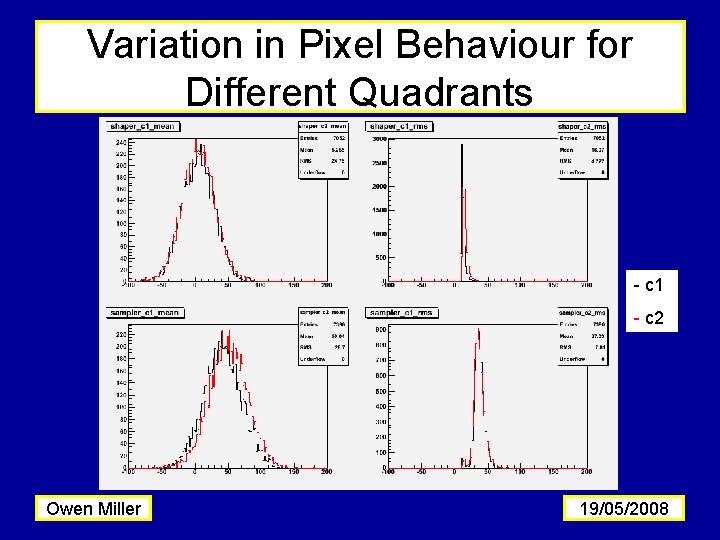
Variation in Pixel Behaviour for Different Quadrants - c 1 - c 2 Owen Miller 19/05/2008
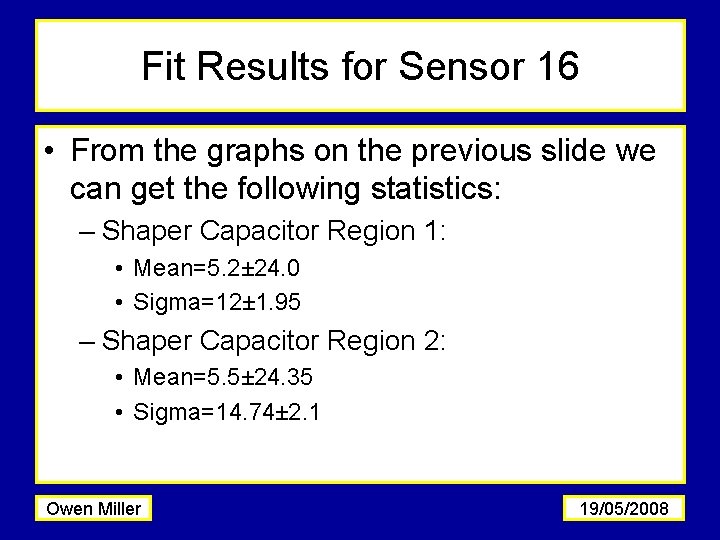
Fit Results for Sensor 16 • From the graphs on the previous slide we can get the following statistics: – Shaper Capacitor Region 1: • Mean=5. 2± 24. 0 • Sigma=12± 1. 95 – Shaper Capacitor Region 2: • Mean=5. 5± 24. 35 • Sigma=14. 74± 2. 1 Owen Miller 19/05/2008
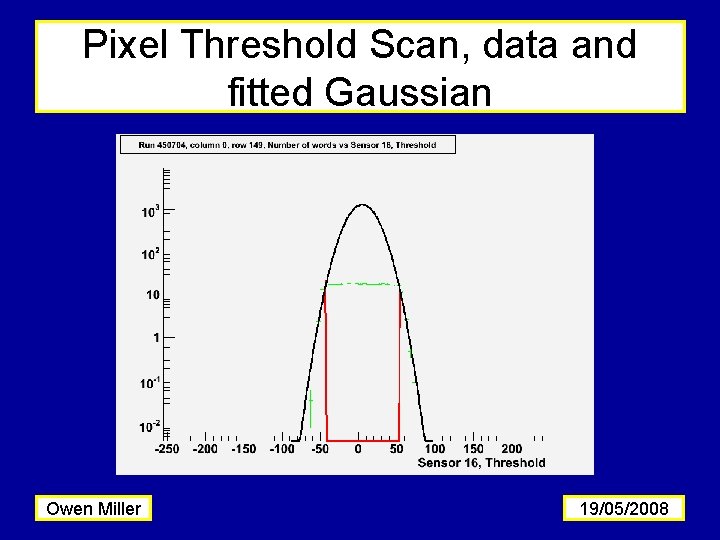
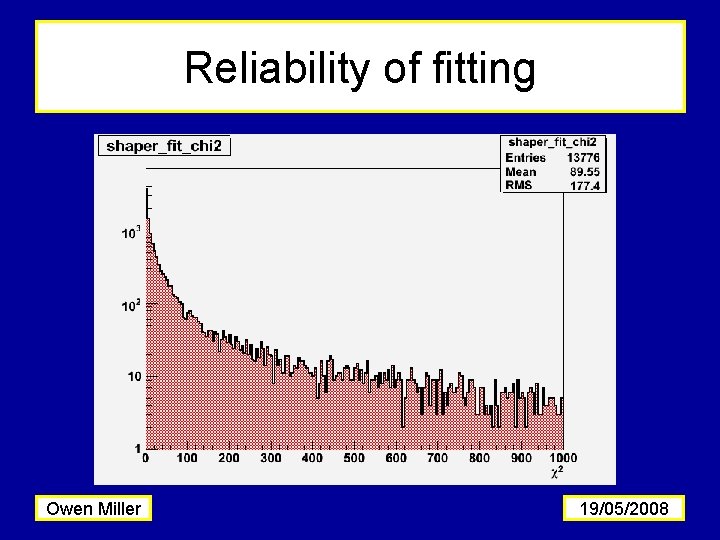
Fitting Program • Marcel has been working on fitting program to deal with the ‘flat-top’ threshold scan distributions seen in the shapers. • The program attempts to fit a Gaussian distribution to an individual pixel threshold scan. • So far the program produces reasonable results in 90% of cases. Owen Miller 19/05/2008
Pixel Threshold Scan, data and fitted Gaussian Owen Miller 19/05/2008
Reliability of fitting Owen Miller 19/05/2008
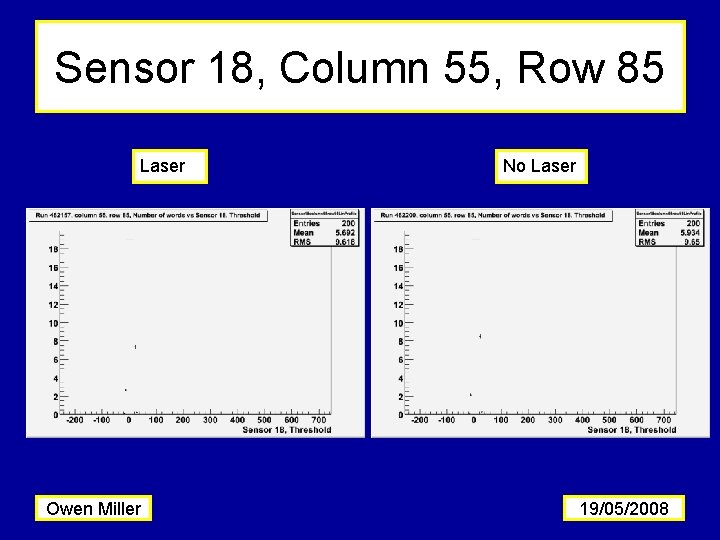
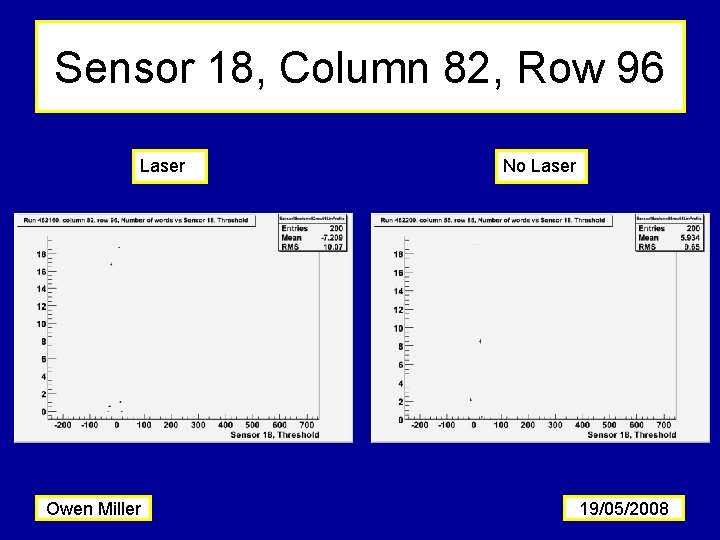
Laser Runs • We are in the process of starting a study of the sensor using the laser. • The laser will cover an area approximately 10 pixels by 10 pixels, this beam size is achieved purely by shutter control (no defocusing). Owen Miller 19/05/2008
Sensor 18, Column 55, Row 85 Laser Owen Miller No Laser 19/05/2008
Sensor 18, Column 82, Row 96 Laser Owen Miller No Laser 19/05/2008
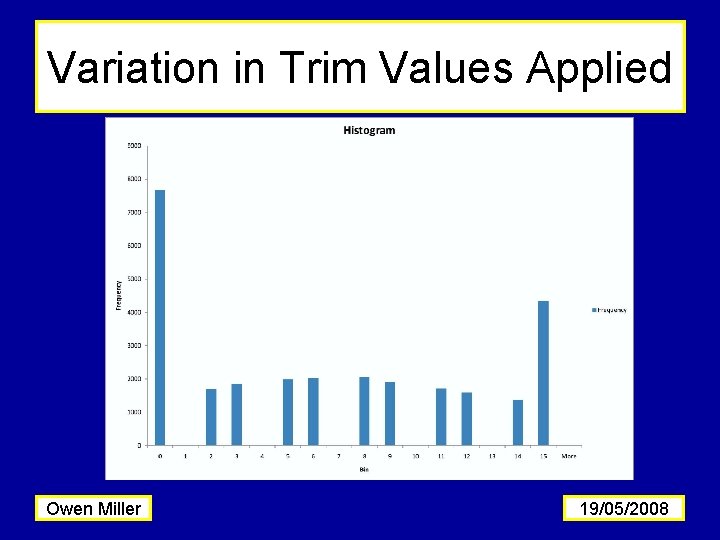
Variation in Trim Values Applied Owen Miller 19/05/2008
Variation In Drop-offs Owen Miller 19/05/2008