
Status Proton Linac Buncher Design Rectangular design longitudinal
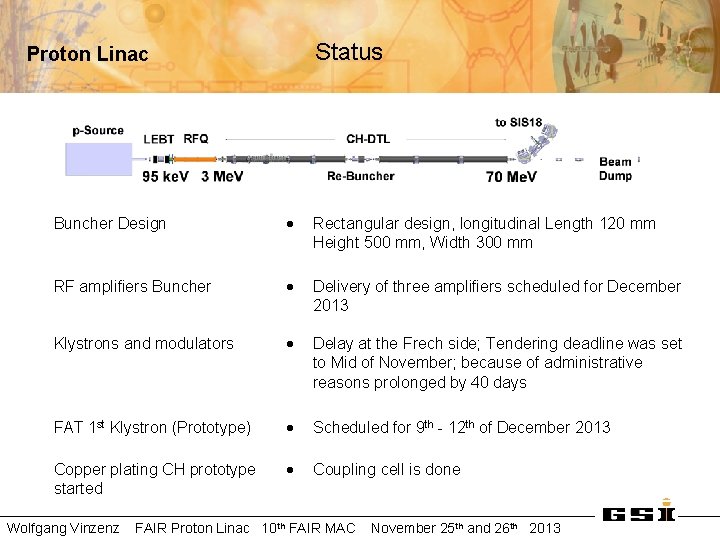
Status Proton Linac Buncher Design Rectangular design, longitudinal Length 120 mm Height 500 mm, Width 300 mm RF amplifiers Buncher Delivery of three amplifiers scheduled for December 2013 Klystrons and modulators Delay at the Frech side; Tendering deadline was set to Mid of November; because of administrative reasons prolonged by 40 days FAT 1 st Klystron (Prototype) Scheduled for 9 th - 12 th of December 2013 Copper plating CH prototype started Coupling cell is done Wolfgang Vinzenz FAIR Proton Linac 10 th FAIR MAC November 25 th and 26 th 2013
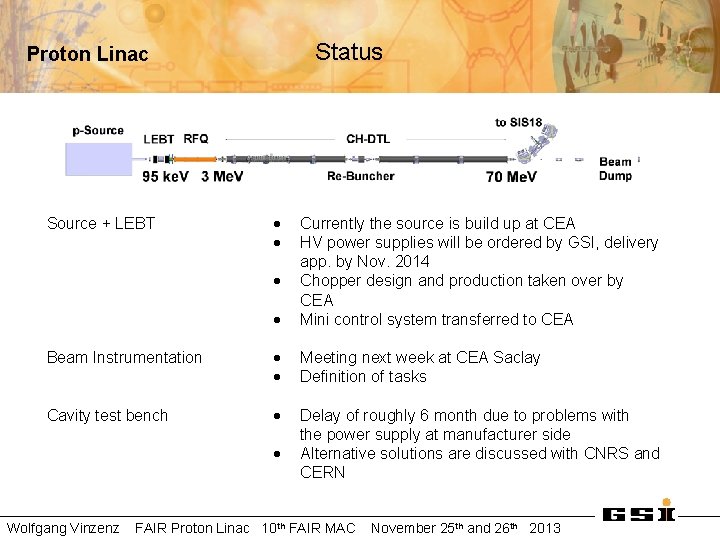
Status Proton Linac Source + LEBT Currently the source is build up at CEA HV power supplies will be ordered by GSI, delivery app. by Nov. 2014 Chopper design and production taken over by CEA Mini control system transferred to CEA Beam Instrumentation Meeting next week at CEA Saclay Definition of tasks Cavity test bench Delay of roughly 6 month due to problems with the power supply at manufacturer side Alternative solutions are discussed with CNRS and CERN Wolfgang Vinzenz FAIR Proton Linac 10 th FAIR MAC November 25 th and 26 th 2013
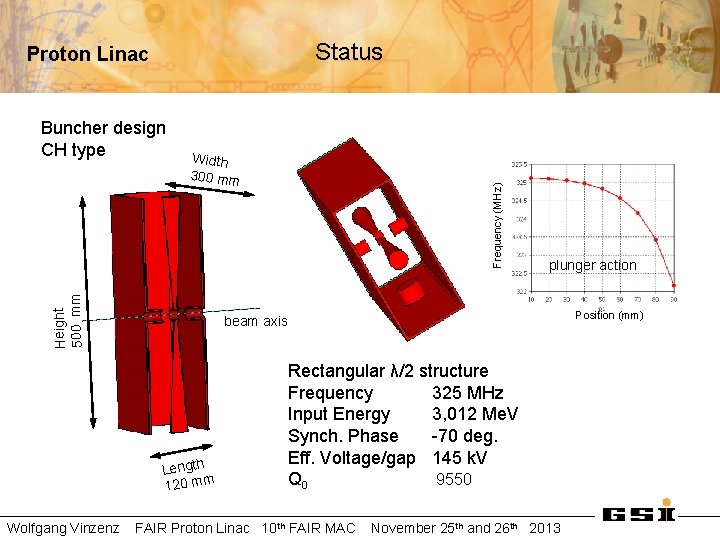
Status Proton Linac plunger action Position (mm) beam axis Length 120 mm Wolfgang Vinzenz Frequency (MHz) Width 300 mm Height 500 mm Buncher design CH type Rectangular λ/2 structure Frequency 325 MHz Input Energy 3, 012 Me. V Synch. Phase -70 deg. Eff. Voltage/gap 145 k. V Q 0 9550 FAIR Proton Linac 10 th FAIR MAC November 25 th and 26 th 2013
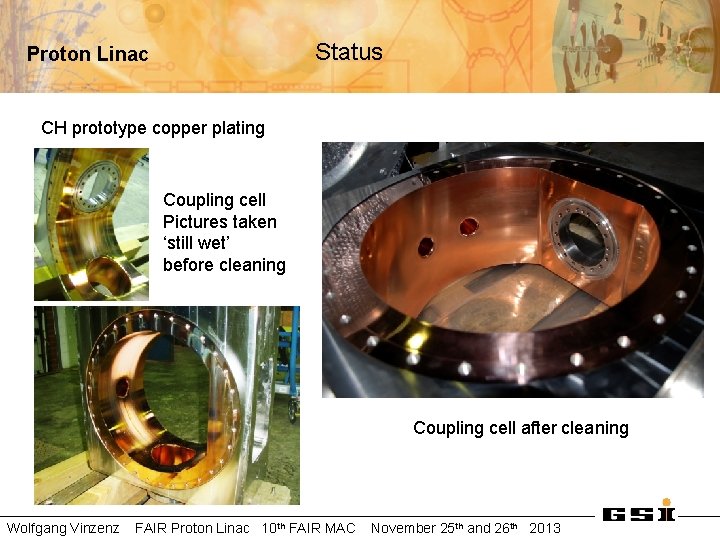
Status Proton Linac CH prototype copper plating Coupling cell Pictures taken ‘still wet’ before cleaning Coupling cell after cleaning Wolfgang Vinzenz FAIR Proton Linac 10 th FAIR MAC November 25 th and 26 th 2013
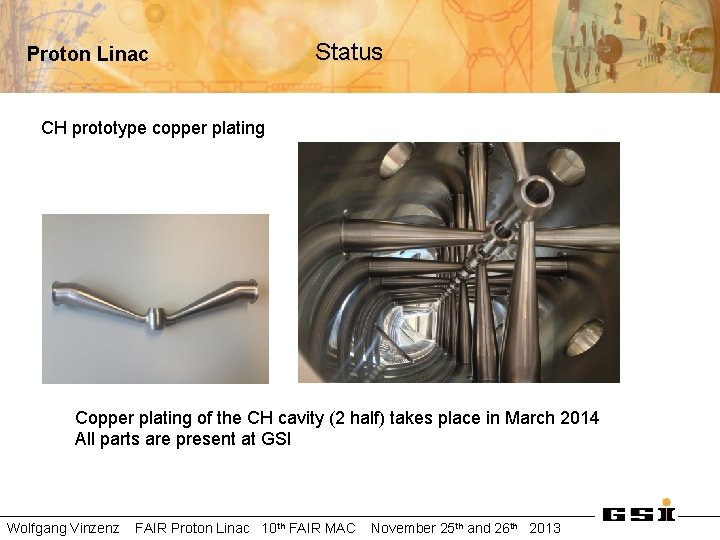
Proton Linac Status CH prototype copper plating Copper plating of the CH cavity (2 half) takes place in March 2014 All parts are present at GSI Wolfgang Vinzenz FAIR Proton Linac 10 th FAIR MAC November 25 th and 26 th 2013
RFQ Proton Linac Comment from MAC May 2013 to the RFQ : . . . Clear steps forward on these issues should be taken within the next 6 months, else they would probably enter the critical path of the FAIR schedule. RFQ Meeting took place 20 th and 21 st of November 2013 Invited participants from Wolfgang Vinzenz CERN IAP Frankfurt AVS Huelva FAIR GSI 3 3 1 1 8 FAIR Proton Linac 10 th FAIR MAC November 25 th and 26 th 2013
Proton Linac RFQ Some remarks to the meeting CERN could clearly show the excellent performance of the LINAC 4 RFQ. This result could be reached due to the challenging selection of materials, the well planned steps in manufacturing and the brilliant collaboration with all those involved. IAP presented new fabrication methods (massive Cu block) to avoid alignment errors and contact problems. The always possible access in case of repair was pointed out. A 4 -rod at 325 MHz with the 4 -vane precision can be performed. 2 nd IAP presentation showed the layout of a Ladder-type 4 -rod. A crankshaft-type fixation of the rods guaranties the alignment precision. Those rings used at the 36 MHz IH-type RFQ at GSI. The RF part of the cavity is made from two massive Cu blocks. Wolfgang Vinzenz FAIR Proton Linac 10 th FAIR MAC November 25 th and 26 th 2013
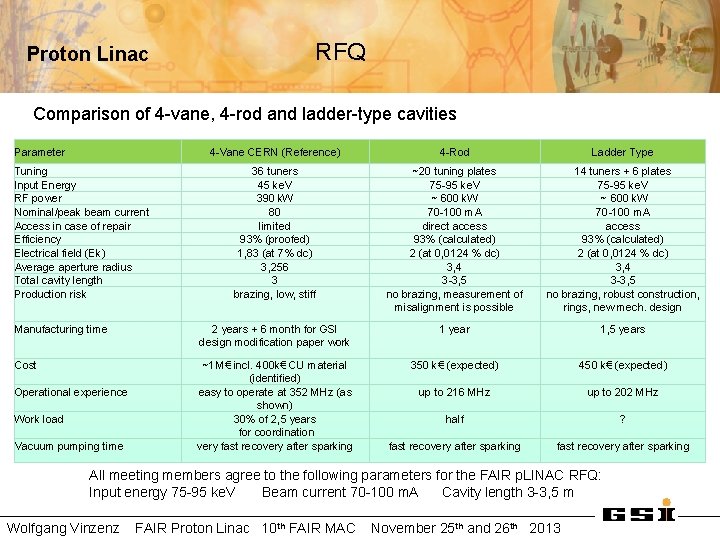
Proton Linac RFQ Comparison of 4 -vane, 4 -rod and ladder-type cavities Parameter 4 -Vane CERN (Reference) 4 -Rod Ladder Type 36 tuners 45 ke. V 390 k. W 80 limited 93% (proofed) 1, 83 (at 7% dc) 3, 256 3 brazing, low, stiff ~20 tuning plates 75 -95 ke. V ~ 600 k. W 70 -100 m. A direct access 93% (calculated) 2 (at 0, 0124 % dc) 3, 4 3 -3, 5 no brazing, measurement of misalignment is possible 14 tuners + 6 plates 75 -95 ke. V ~ 600 k. W 70 -100 m. A access 93% (calculated) 2 (at 0, 0124 % dc) 3, 4 3 -3, 5 no brazing, robust construction, rings, new mech. design Manufacturing time 2 years + 6 month for GSI design modification paper work 1 year 1, 5 years Cost ~1 M€ incl. 400 k€ CU material (identified) easy to operate at 352 MHz (as shown) 30% of 2, 5 years for coordination very fast recovery after sparking 350 k€ (expected) 450 k€ (expected) up to 216 MHz up to 202 MHz half ? fast recovery after sparking Tuning Input Energy RF power Nominal/peak beam current Access in case of repair Efficiency Electrical field (Ek) Average aperture radius Total cavity length Production risk Operational experience Work load Vacuum pumping time All meeting members agree to the following parameters for the FAIR p. LINAC RFQ: Input energy 75 -95 ke. V Beam current 70 -100 m. A Cavity length 3 -3, 5 m Wolfgang Vinzenz FAIR Proton Linac 10 th FAIR MAC November 25 th and 26 th 2013
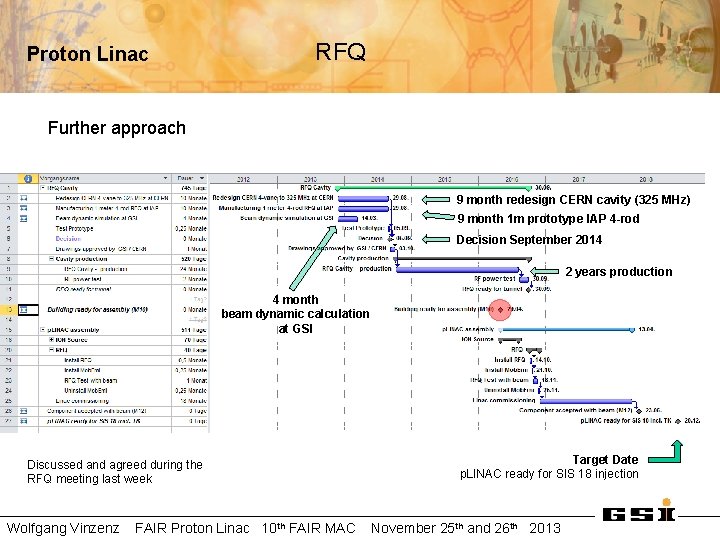
Proton Linac RFQ Further approach 9 month redesign CERN cavity (325 MHz) 9 month 1 m prototype IAP 4 -rod Decision September 2014 2 years production 4 month beam dynamic calculation at GSI Discussed and agreed during the RFQ meeting last week Wolfgang Vinzenz FAIR Proton Linac 10 th FAIR MAC Target Date p. LINAC ready for SIS 18 injection November 25 th and 26 th 2013
Proton Linac RFQ Further steps. . 1 During the next 9 month • ASAP Installation of a (RFQ) team at GSI • Additional man power is needed • Beam dynamic calculations at GSI as input to CERN • • • Fixing input energy and matching Data to the source and LEBT (incl. chopper) from CEA (Chauvin) Fixing cavity length • Redesign of the CERN 4 -vane for 325 MHz operation at CERN • • Collaboration agreement has to be established Persons have to be named • Engineering services have to be found and ensured. • • Search for material suppliers Search for machining shops • Production of a 1 m 4 -rod RFQ section with original dimensions followed by RF power test and inspection of accuracy afterwards. Wolfgang Vinzenz FAIR Proton Linac 10 th FAIR MAC November 25 th and 26 th 2013
Proton Linac RFQ Further steps. . 2 Latest from September 2014 • Decision to the RFQ type • Start cavity production, partly at CERN (brazing and metrology) • • Collaboration contract needed Small corrections can be realized September 2016 • RF power test at the GSI test bench End of October 2016 • Test with beam at the proton linac Wolfgang Vinzenz FAIR Proton Linac 10 th FAIR MAC November 25 th and 26 th 2013
- Slides: 11