
Status of the Wall Current Monitor WCM design
- Slides: 31
Status of the Wall Current Monitor (WCM) design for EUROTe. V Alessandro D’Elia - CERN 12/28/2021 ELC Workshop 1
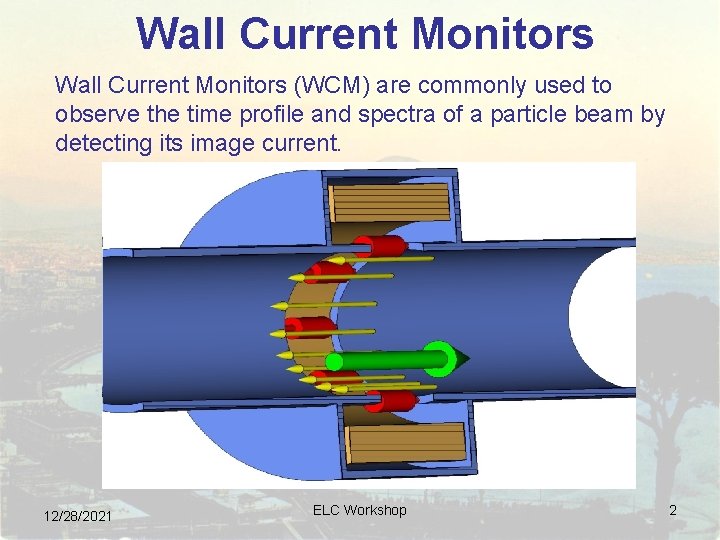
Wall Current Monitors (WCM) are commonly used to observe the time profile and spectra of a particle beam by detecting its image current. 12/28/2021 ELC Workshop 2
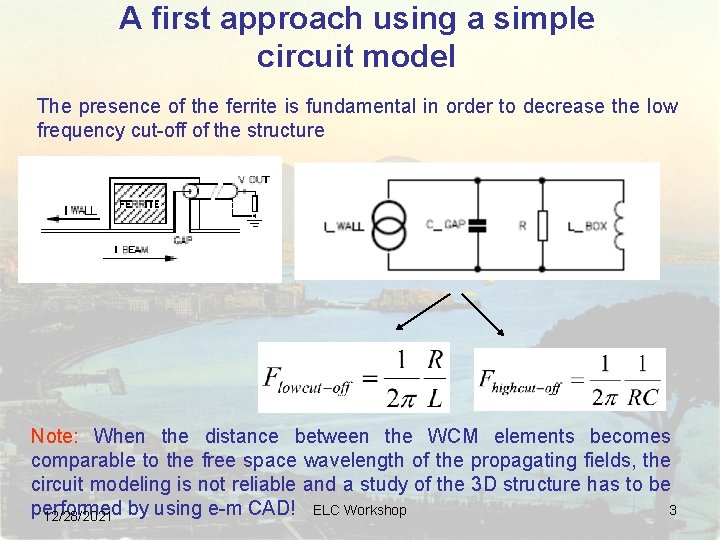
A first approach using a simple circuit model The presence of the ferrite is fundamental in order to decrease the low frequency cut-off of the structure Note: When the distance between the WCM elements becomes comparable to the free space wavelength of the propagating fields, the circuit modeling is not reliable and a study of the 3 D structure has to be performed 3 12/28/2021 by using e-m CAD! ELC Workshop
The aim The 3 rd generation of CLIC Test Facility (CTF 3) foresees a beam formed by bunches separated of b = 67 ps WCM h. f. cut-off = 20 GHz for a total pulse duration of r = 1. 54 µs WCM l. f. cut-off = 100 k. Hz Furthermore Bake out temperature: Operating temperature: Vacuum: 150 C 20 C 10 -9 Torr 100 k. Hz-20 GHz WB signal transmission over 10 -20 m. 12/28/2021 ELC Workshop 4
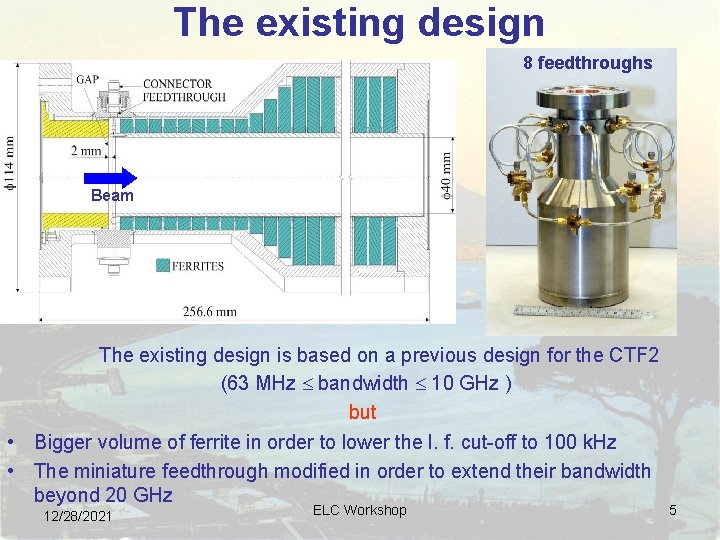
The existing design 8 feedthroughs Beam The existing design is based on a previous design for the CTF 2 (63 MHz bandwidth 10 GHz ) but • Bigger volume of ferrite in order to lower the l. f. cut-off to 100 k. Hz • The miniature feedthrough modified in order to extend their bandwidth beyond 20 GHz 12/28/2021 ELC Workshop 5
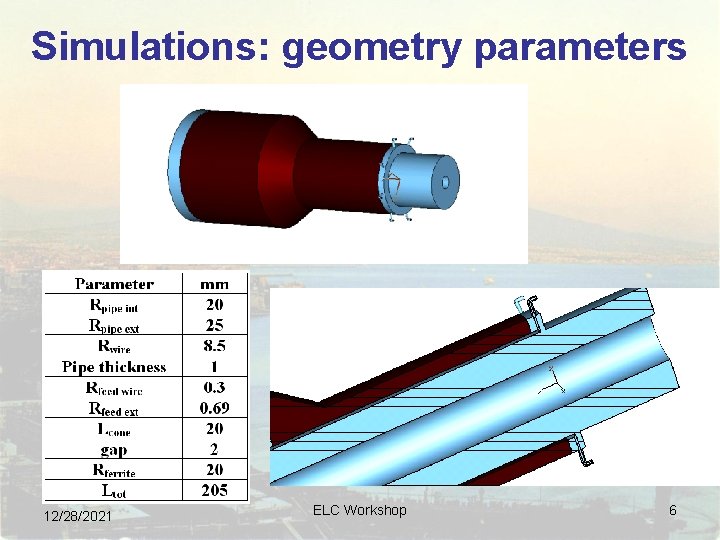
Simulations: geometry parameters 12/28/2021 ELC Workshop 6
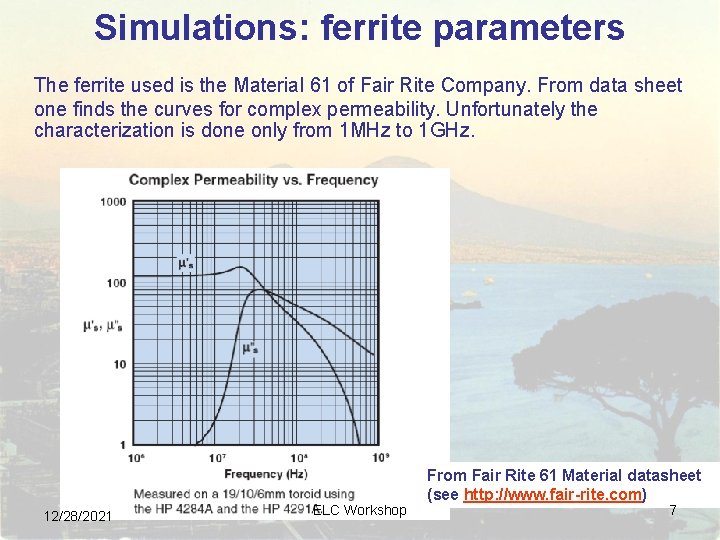
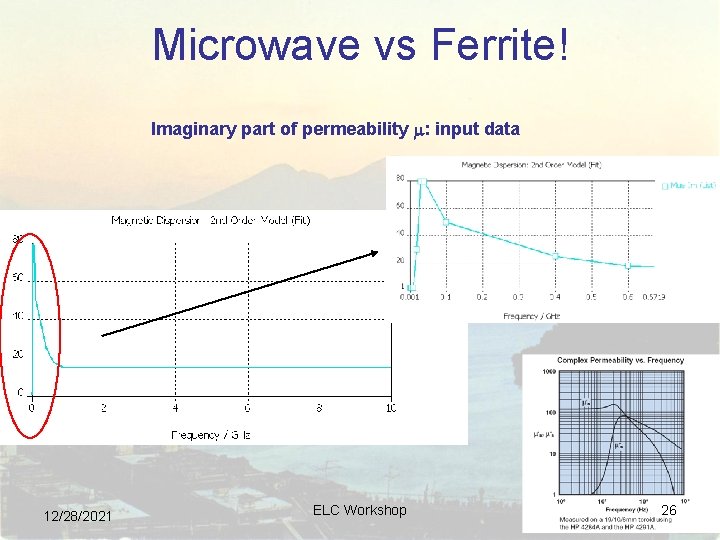
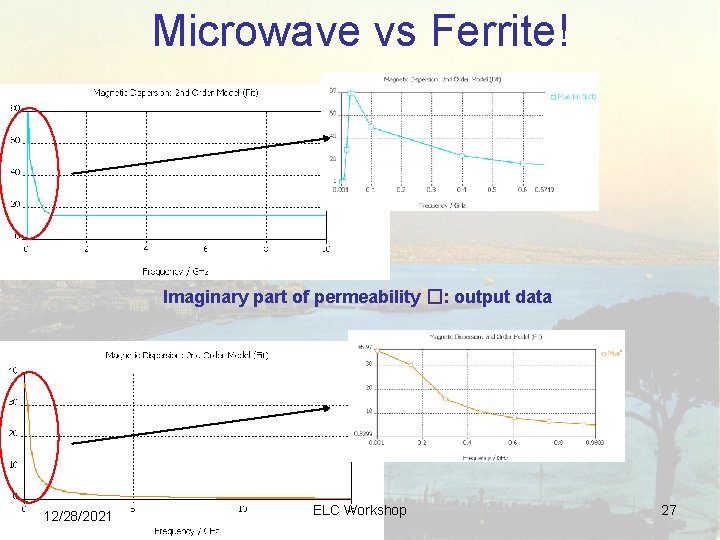
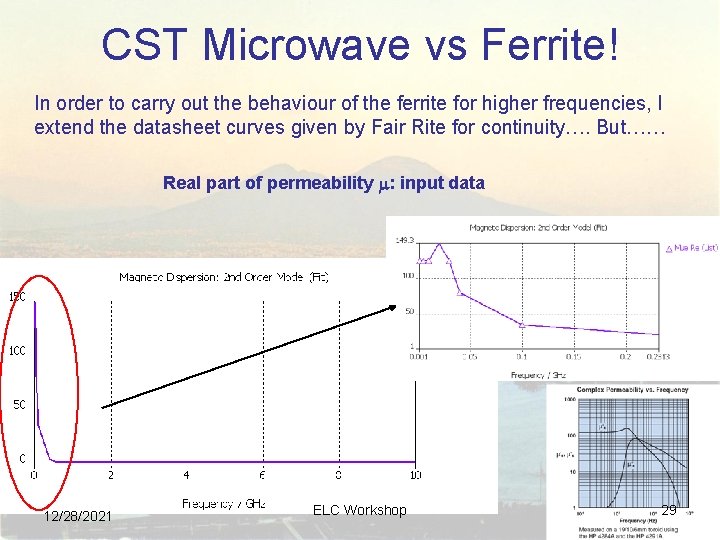
Simulations: ferrite parameters The ferrite used is the Material 61 of Fair Rite Company. From data sheet one finds the curves for complex permeability. Unfortunately the characterization is done only from 1 MHz to 1 GHz. 12/28/2021 ELC Workshop From Fair Rite 61 Material datasheet (see http: //www. fair-rite. com) 7
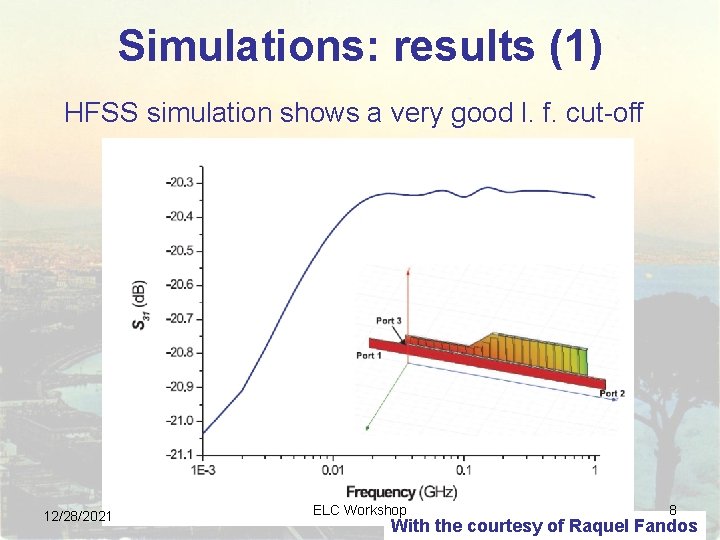
Simulations: results (1) HFSS simulation shows a very good l. f. cut-off 12/28/2021 ELC Workshop 8 With the courtesy of Raquel Fandos
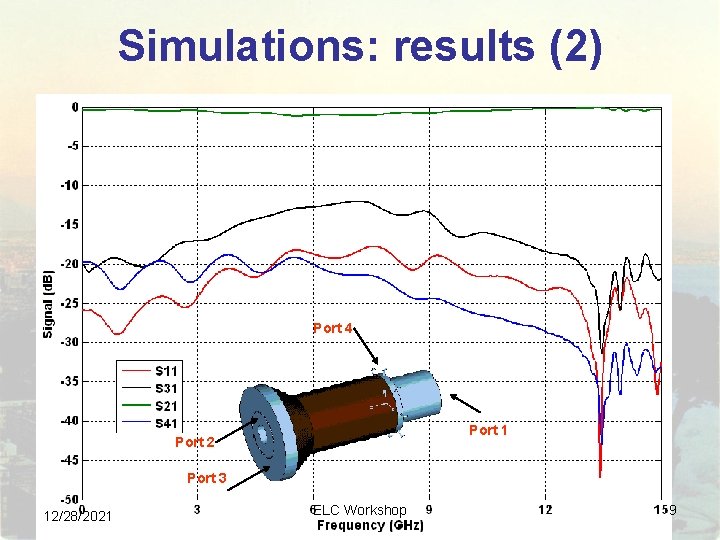
Simulations: results (2) Port 4 Port 1 Port 2 Port 3 12/28/2021 ELC Workshop 9
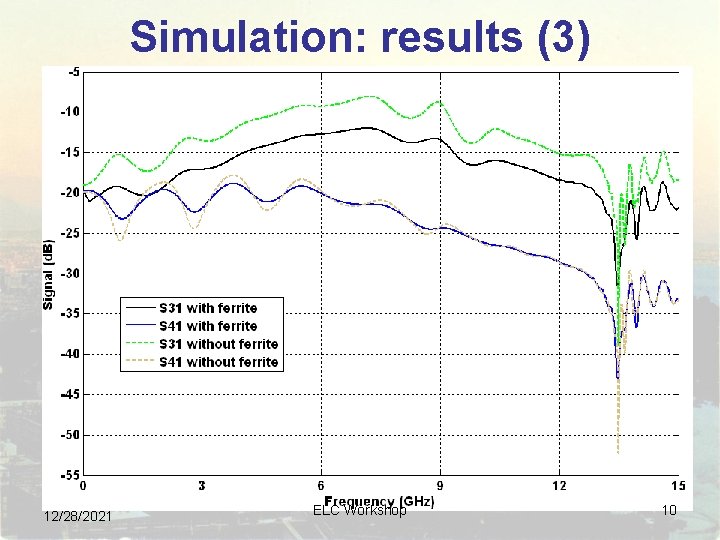
Simulation: results (3) 12/28/2021 ELC Workshop 10
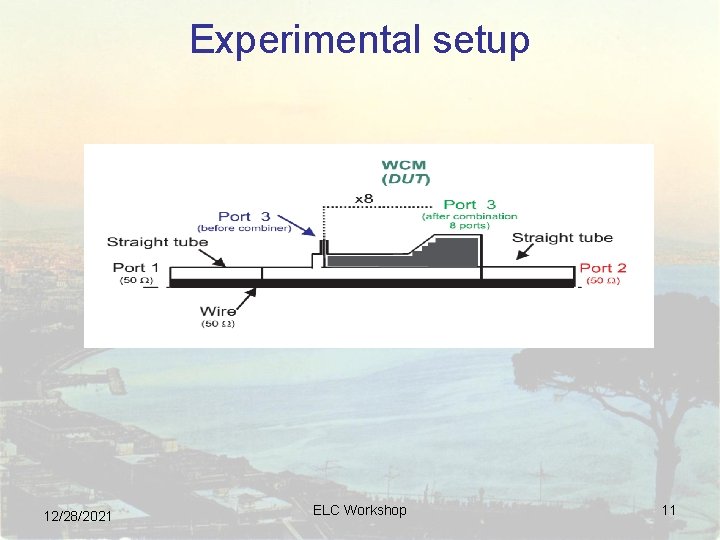
Experimental setup 12/28/2021 ELC Workshop 11
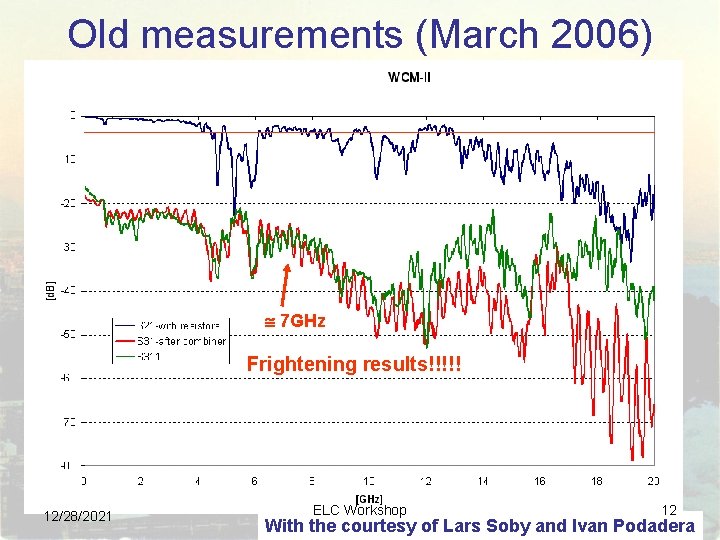
Old measurements (March 2006) 7 GHz Frightening results!!!!! 12/28/2021 ELC Workshop 12 With the courtesy of Lars Soby and Ivan Podadera
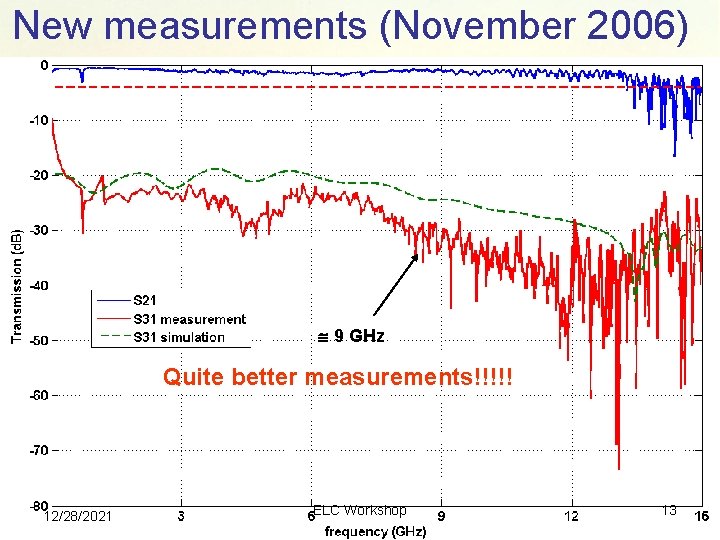
New measurements (November 2006) 9 GHz Quite better measurements!!!!! 12/28/2021 ELC Workshop 13
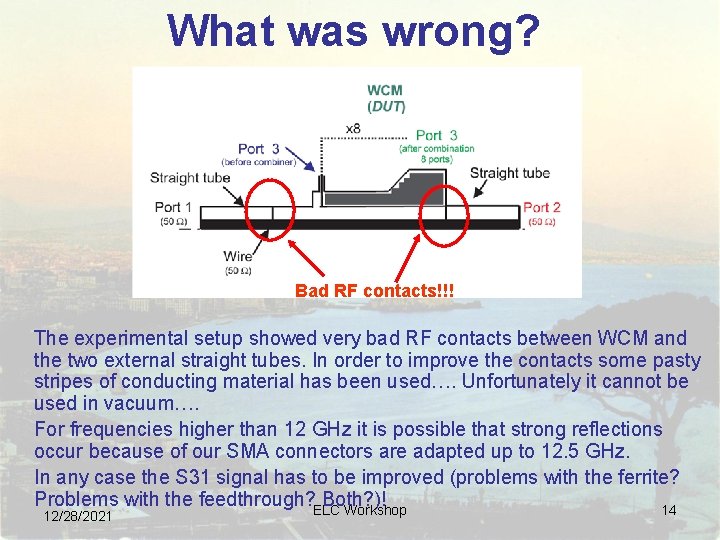
What was wrong? Bad RF contacts!!! The experimental setup showed very bad RF contacts between WCM and the two external straight tubes. In order to improve the contacts some pasty stripes of conducting material has been used…. Unfortunately it cannot be used in vacuum…. For frequencies higher than 12 GHz it is possible that strong reflections occur because of our SMA connectors are adapted up to 12. 5 GHz. In any case the S 31 signal has to be improved (problems with the ferrite? Problems with the feedthrough? ELC Both? )! Workshop 14 12/28/2021
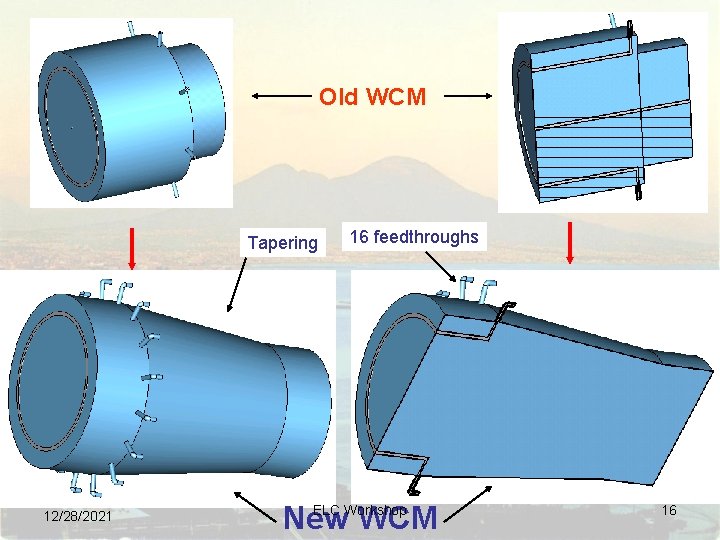
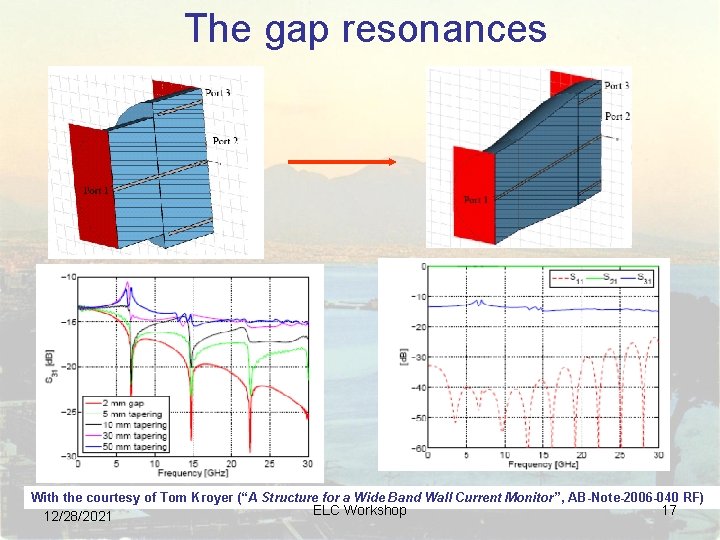
Going beyond 10 GHz Several new structures (biconical structure, several kind of coaxial structures…. ) were deeply studied in order to extend the frequency bandwidth of the WCM, between them, the one giving the best results, is a structure realized at the cost of few changes in the existing WCM structure. 12/28/2021 ELC Workshop 15
Old WCM Tapering 12/28/2021 16 feedthroughs New WCM ELC Workshop 16
The gap resonances With the courtesy of Tom Kroyer (“A Structure for a Wide Band Wall Current Monitor”, AB-Note-2006 -040 RF) 12/28/2021 ELC Workshop 17
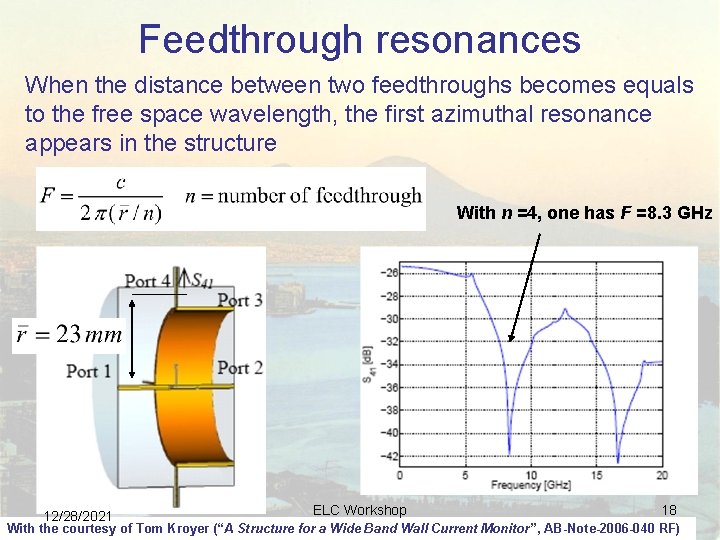
Feedthrough resonances When the distance between two feedthroughs becomes equals to the free space wavelength, the first azimuthal resonance appears in the structure With n =4, one has F =8. 3 GHz 12/28/2021 ELC Workshop 18 With the courtesy of Tom Kroyer (“A Structure for a Wide Band Wall Current Monitor”, AB-Note-2006 -040 RF)
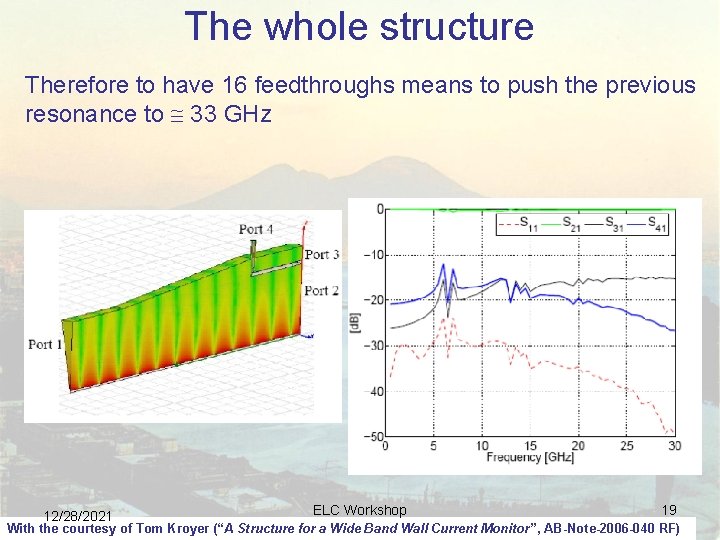
The whole structure Therefore to have 16 feedthroughs means to push the previous resonance to 33 GHz 12/28/2021 ELC Workshop 19 With the courtesy of Tom Kroyer (“A Structure for a Wide Band Wall Current Monitor”, AB-Note-2006 -040 RF)
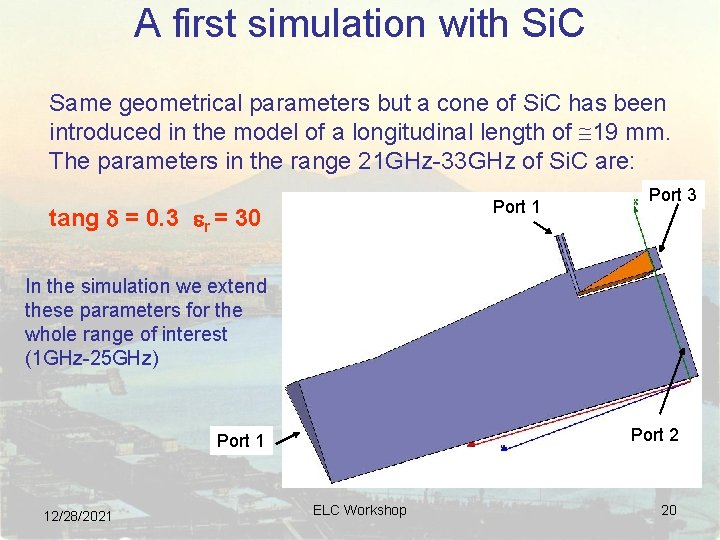
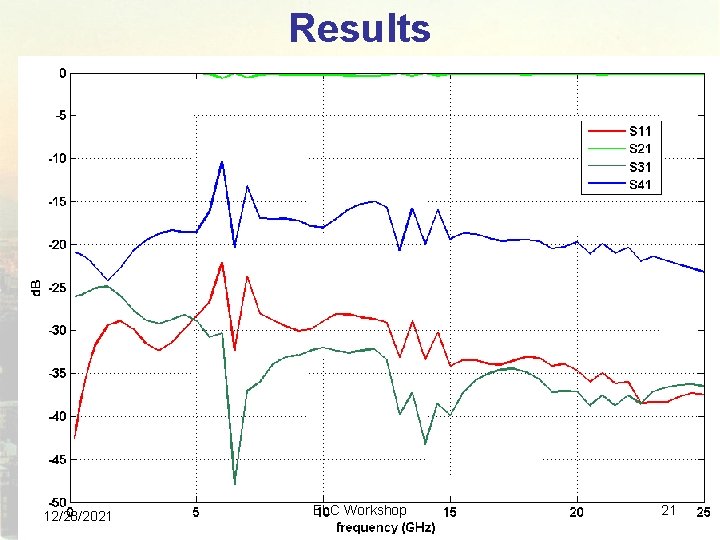
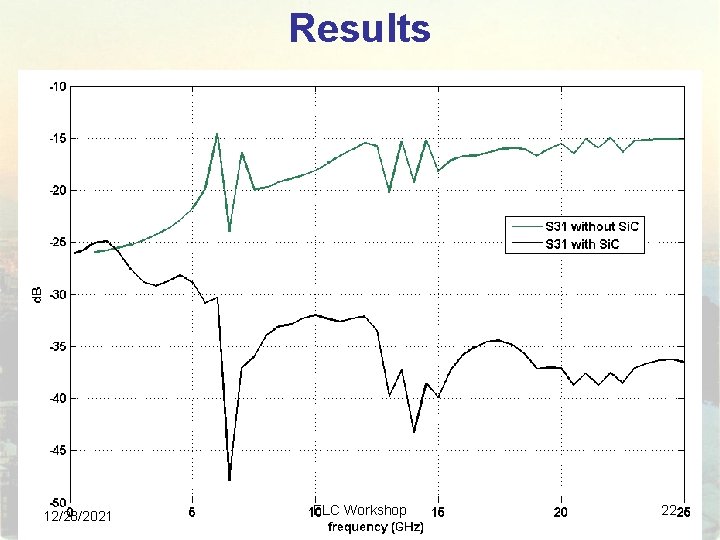
A first simulation with Si. C Same geometrical parameters but a cone of Si. C has been introduced in the model of a longitudinal length of 19 mm. The parameters in the range 21 GHz-33 GHz of Si. C are: Port 1 tang = 0. 3 r = 30 Port 3 In the simulation we extend these parameters for the whole range of interest (1 GHz-25 GHz) Port 2 Port 1 12/28/2021 ELC Workshop 20
Results 12/28/2021 ELC Workshop 21
Results 12/28/2021 ELC Workshop 22
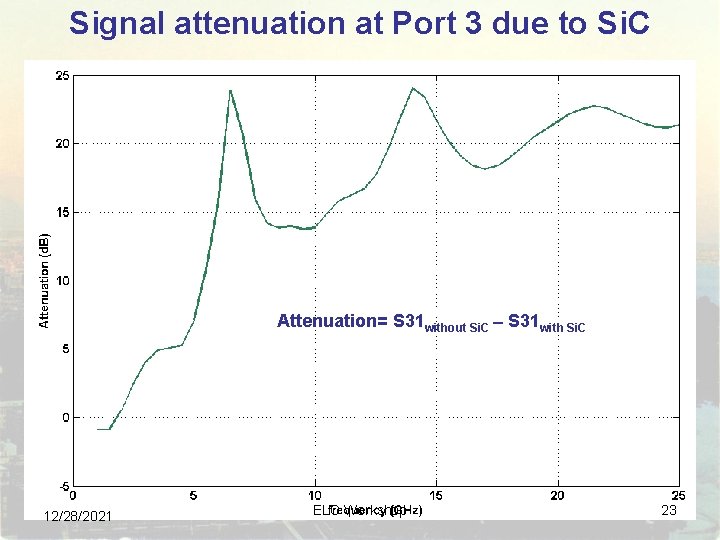
Signal attenuation at Port 3 due to Si. C Attenuation= S 31 without Si. C S 31 with Si. C 12/28/2021 ELC Workshop 23
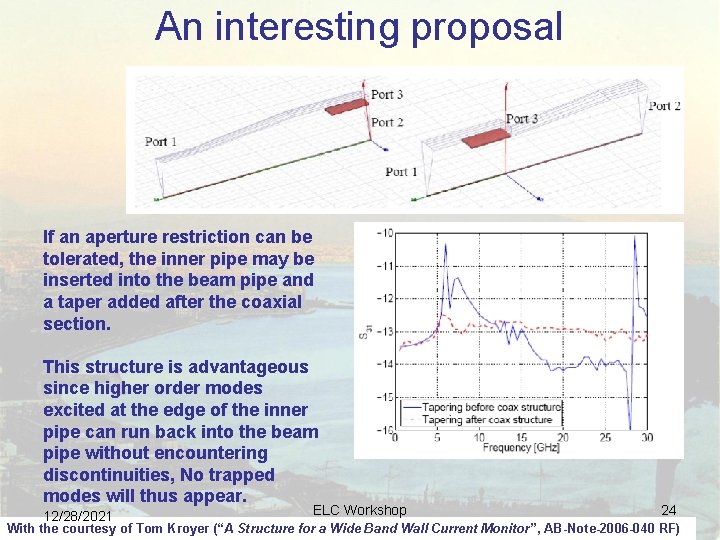
An interesting proposal If an aperture restriction can be tolerated, the inner pipe may be inserted into the beam pipe and a taper added after the coaxial section. This structure is advantageous since higher order modes excited at the edge of the inner pipe can run back into the beam pipe without encountering discontinuities, No trapped modes will thus appear. 12/28/2021 ELC Workshop 24 With the courtesy of Tom Kroyer (“A Structure for a Wide Band Wall Current Monitor”, AB-Note-2006 -040 RF)
Conclusions. . . and a “few” of remaining problems • The test bench has been improved • The new proposed geometry at the cost of few changing in the old one shows a quite good response for our aims: apart of the TM 01 mode at about 5. 5 GHz a quite good flat response it is foreseen up to 25 GHz with the possibility of extending the bandwidth up to 30 GHz for future applications • More accurate studies on the real feedthrough are needed • Development of a new testbench only for feedthrough • Feedthrough vacuum leakage • Reliable ferrite and Si. C models in CST Micro. Wave and/or HFSS • We are confident, on February, of producing a preliminary mechanical design 12/28/2021 ELC Workshop 25
Microwave vs Ferrite! Imaginary part of permeability : input data 12/28/2021 ELC Workshop 26
Microwave vs Ferrite! Imaginary part of permeability �: output data 12/28/2021 ELC Workshop 27
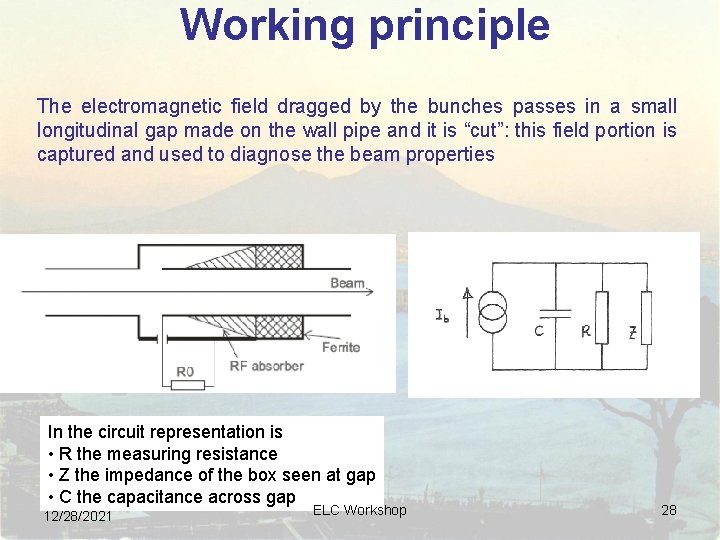
Working principle The electromagnetic field dragged by the bunches passes in a small longitudinal gap made on the wall pipe and it is “cut”: this field portion is captured and used to diagnose the beam properties In the circuit representation is • R the measuring resistance • Z the impedance of the box seen at gap • C the capacitance across gap 12/28/2021 ELC Workshop 28
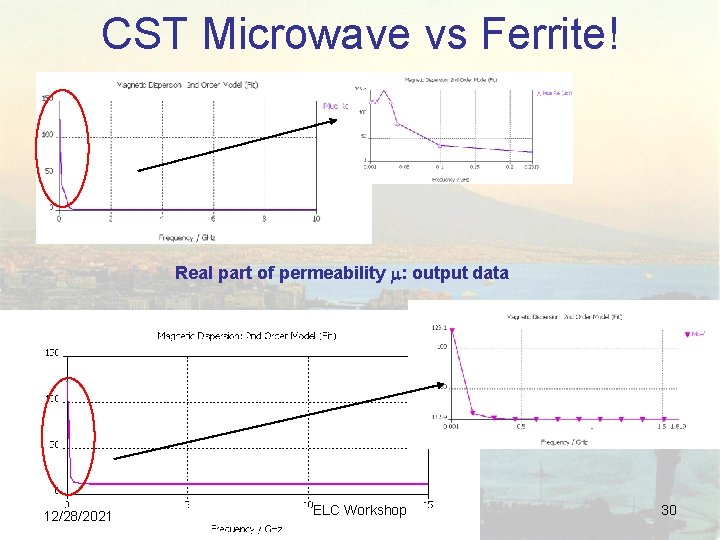
CST Microwave vs Ferrite! In order to carry out the behaviour of the ferrite for higher frequencies, I extend the datasheet curves given by Fair Rite for continuity…. But…… Real part of permeability : input data 12/28/2021 ELC Workshop 29
CST Microwave vs Ferrite! Real part of permeability : output data 12/28/2021 ELC Workshop 30
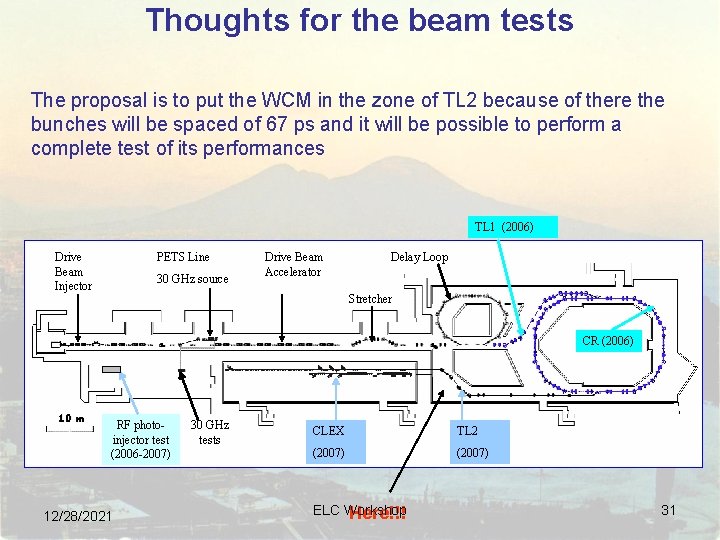
Thoughts for the beam tests The proposal is to put the WCM in the zone of TL 2 because of there the bunches will be spaced of 67 ps and it will be possible to perform a complete test of its performances TL 1 (2006) Drive Beam Injector PETS Line 30 GHz source Drive Beam Accelerator Delay Loop Stretcher CR (2006) RF photoinjector test (2006 -2007) 12/28/2021 30 GHz tests CLEX TL 2 (2007) ELC Workshop Here!!! 31