
Status of the Linac Radio Frequency RF Systems
- Slides: 25
Status of the Linac Radio Frequency (RF) Systems John Moss Lead Engineer, Linac RF February 17, 2016 ORNL is managed by UT-Battelle for the US Department of Energy
Linac RF Systems – Outline • Linac RF Overview • Performance and Availability • Klystrons • High Power Circulators • Low Level Radio Frequency Systems • Equipment Obsolescence • Test Stands • Proton Power Upgrade • Risks and Vulnerabilities • Summary 2 SNS Accelerator Advisory Committee Meeting, February 16 -18, 2016
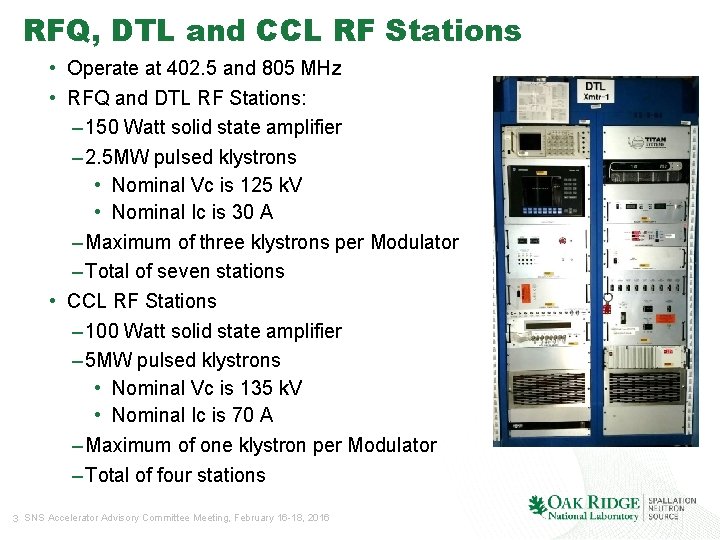
RFQ, DTL and CCL RF Stations • Operate at 402. 5 and 805 MHz • RFQ and DTL RF Stations: – 150 Watt solid state amplifier – 2. 5 MW pulsed klystrons • Nominal Vc is 125 k. V • Nominal Ic is 30 A – Maximum of three klystrons per Modulator – Total of seven stations • CCL RF Stations – 100 Watt solid state amplifier – 5 MW pulsed klystrons • Nominal Vc is 135 k. V • Nominal Ic is 70 A – Maximum of one klystron per Modulator – Total of four stations 3 SNS Accelerator Advisory Committee Meeting, February 16 -18, 2016
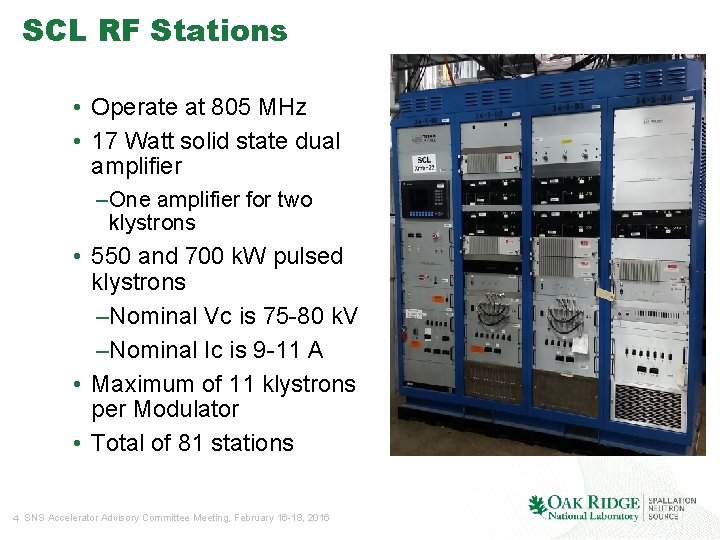
SCL RF Stations • Operate at 805 MHz • 17 Watt solid state dual amplifier – One amplifier for two klystrons • 550 and 700 k. W pulsed klystrons –Nominal Vc is 75 -80 k. V –Nominal Ic is 9 -11 A • Maximum of 11 klystrons per Modulator • Total of 81 stations 4 SNS Accelerator Advisory Committee Meeting, February 16 -18, 2016
Linac RF Performance and Availability • May 2013 through December 2015: – Total Machine operation time – 13, 110 hours out of 16, 161 requested operation hours for neutron production and accelerator physics – Total RF system downtime– 413 hours • Total includes non-beam downtime and cavity vacuum trips – Major contributors of downtime: • DTL High Power RF – 28 hours for two DTL 6 circulator replacements – 114 hours for DTL 5 window replacement and conditioning • CCL High Power RF – 36 hours for CCL 3 klystron replacement – 14 hours for CCL 2 klystron replacement • SCL High Power RF – 20 hours for SCL-1 C klystron replacement – Most trips are in the DTL and CCL and ~ 20 – 30 minutes in duration 5 SNS Accelerator Advisory Committee Meeting, February 16 -18, 2016
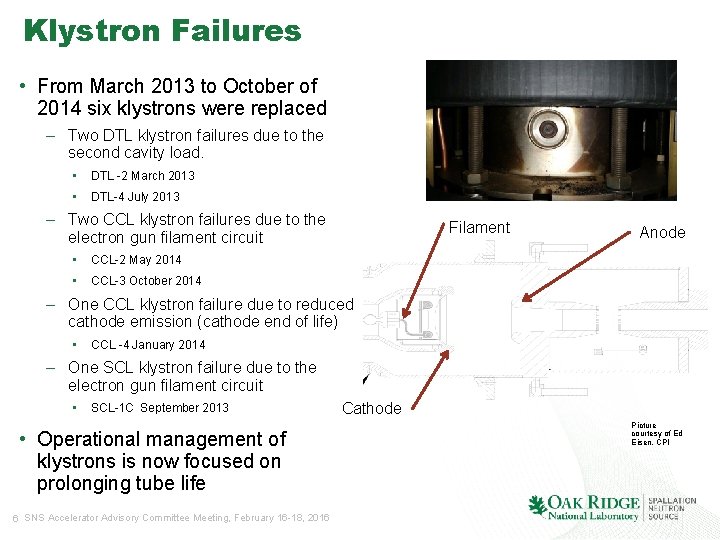
Klystron Failures • From March 2013 to October of 2014 six klystrons were replaced – Two DTL klystron failures due to the second cavity load. • DTL -2 March 2013 • DTL-4 July 2013 – Two CCL klystron failures due to the electron gun filament circuit • CCL-2 May 2014 • CCL-3 October 2014 Filament Anode – One CCL klystron failure due to reduced cathode emission (cathode end of life) • CCL -4 January 2014 – One SCL klystron failure due to the electron gun filament circuit • SCL-1 C September 2013 • Operational management of klystrons is now focused on prolonging tube life 6 SNS Accelerator Advisory Committee Meeting, February 16 -18, 2016 Cathode Picture courtesy of Ed Eisen, CPI
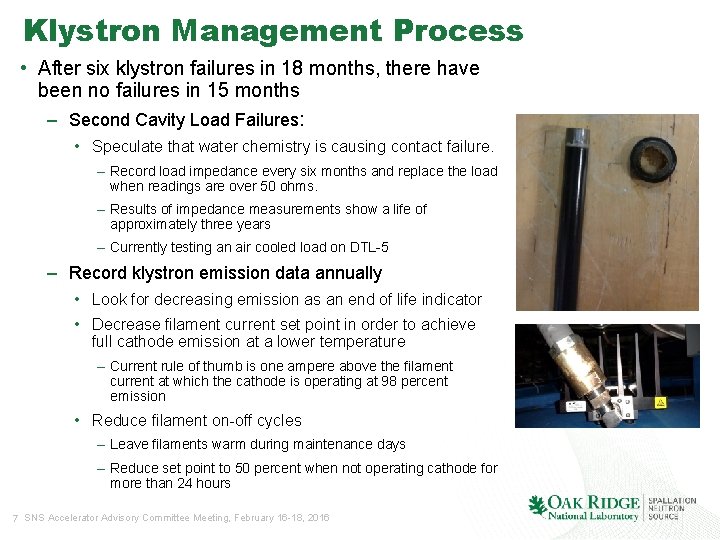
Klystron Management Process • After six klystron failures in 18 months, there have been no failures in 15 months – Second Cavity Load Failures: • Speculate that water chemistry is causing contact failure. – Record load impedance every six months and replace the load when readings are over 50 ohms. – Results of impedance measurements show a life of approximately three years – Currently testing an air cooled load on DTL-5 – Record klystron emission data annually • Look for decreasing emission as an end of life indicator • Decrease filament current set point in order to achieve full cathode emission at a lower temperature – Current rule of thumb is one ampere above the filament current at which the cathode is operating at 98 percent emission • Reduce filament on-off cycles – Leave filaments warm during maintenance days – Reduce set point to 50 percent when not operating cathode for more than 24 hours 7 SNS Accelerator Advisory Committee Meeting, February 16 -18, 2016
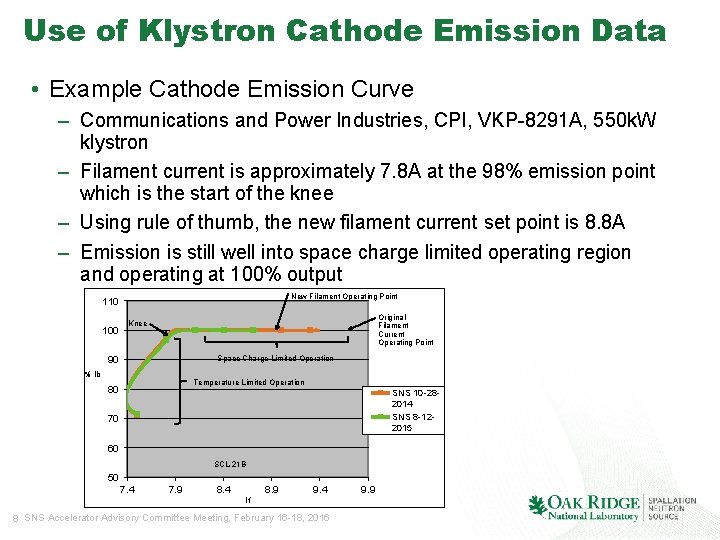
Use of Klystron Cathode Emission Data • Example Cathode Emission Curve – Communications and Power Industries, CPI, VKP-8291 A, 550 k. W klystron – Filament current is approximately 7. 8 A at the 98% emission point which is the start of the knee – Using rule of thumb, the new filament current set point is 8. 8 A – Emission is still well into space charge limited operating region and operating at 100% output New Filament Operating Point 110 100 Original Filament Current Operating Point Knee Space Charge Limited Operation 90 % Ib Temperature Limited Operation 80 SNS 10 -282014 SNS 8 -122015 70 60 SCL-21 B 50 7. 4 7. 9 8. 4 8. 9 9. 4 If 8 SNS Accelerator Advisory Committee Meeting, February 16 -18, 2016 9. 9
SCL-1 C Klystron Rebuild • SCL klystron 1 C failed in September 2013 due to an opened filament – The klystron had 48, 736 operational hours. – The vendor, CPI, was contacted for an evaluation in early 2014 – The klystron was returned to CPI and their analysis indicated that the cathode filament wire had opened as a result of faulty potting material used to insulate the wire from the cathode body. – The klystron was repaired for a cost of $147, 250 or approximately 90 percent of the cost of a new tube – The klystron was successfully factory tested in February 2015 and returned to SNS spares last spring 9 SNS Accelerator Advisory Committee Meeting, February 16 -18, 2016
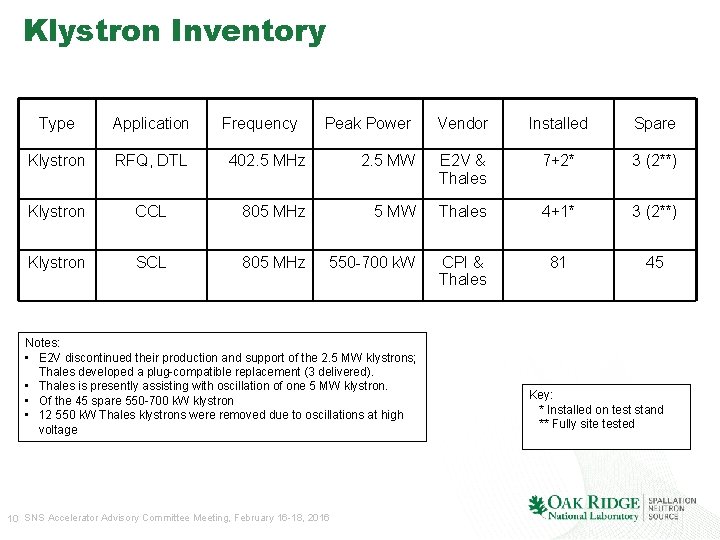
Klystron Inventory Type Application Klystron RFQ, DTL Klystron Frequency Peak Power Vendor Installed Spare 402. 5 MHz 2. 5 MW E 2 V & Thales 7+2* 3 (2**) CCL 805 MHz 5 MW Thales 4+1* 3 (2**) SCL 805 MHz 550 -700 k. W CPI & Thales 81 45 Notes: • E 2 V discontinued their production and support of the 2. 5 MW klystrons; Thales developed a plug-compatible replacement (3 delivered). • Thales is presently assisting with oscillation of one 5 MW klystron. • Of the 45 spare 550 -700 k. W klystron • 12 550 k. W Thales klystrons were removed due to oscillations at high voltage 10 SNS Accelerator Advisory Committee Meeting, February 16 -18, 2016 Key: * Installed on test stand ** Fully site tested
High Power Circulators • Arcing was detected in the DTL-6 circulator on June 16 th, 2014 • A leak was detected on the bottom pancake of the circulator assembly • A spare circulator was removed from the Radio Frequency Test Facility (RFTF) and installed to allow for continued operations – No ready spares were available • The manufacturer, Advanced Ferrite Technology, AFT, was contacted for field support and to inquire about the purchase of new spare 402. 5 MHz circulators • AFT provided costs for a new circulator at $149, 000 per unit. Refurbishment costs are $86, 000 per unit with a minimum of three units. • A purchase order for three new circulators was issued for a total of $463, 575 and a delivery of May 28, 2015 • Inspections of the remaining six 402. 5 MHz circulators revealed similar problems with all installed devices – Evidence of corrosion and possible past water leaks • Inspections of a single CCL circulator and a single SCL circulator revealed no evidence of leaks – Circulator cooling design is different 11 SNS Accelerator Advisory Committee Meeting, February 16 -18, 2016
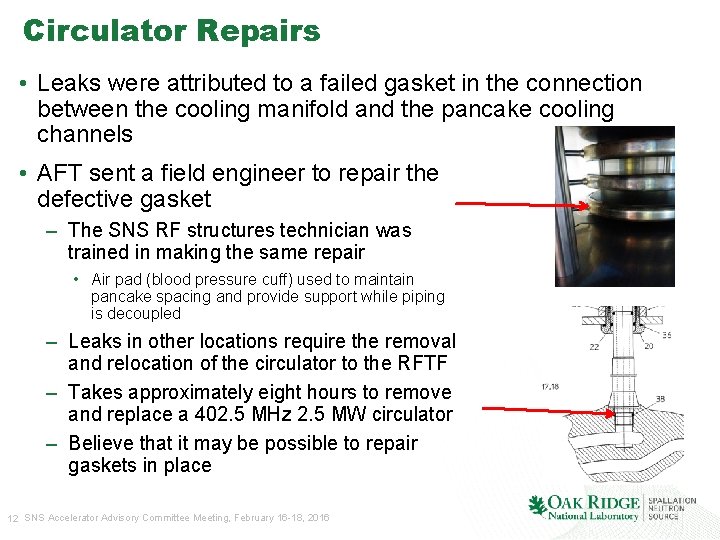
Circulator Repairs • Leaks were attributed to a failed gasket in the connection between the cooling manifold and the pancake cooling channels • AFT sent a field engineer to repair the defective gasket – The SNS RF structures technician was trained in making the same repair • Air pad (blood pressure cuff) used to maintain pancake spacing and provide support while piping is decoupled – Leaks in other locations require the removal and relocation of the circulator to the RFTF – Takes approximately eight hours to remove and replace a 402. 5 MHz 2. 5 MW circulator – Believe that it may be possible to repair gaskets in place 12 SNS Accelerator Advisory Committee Meeting, February 16 -18, 2016
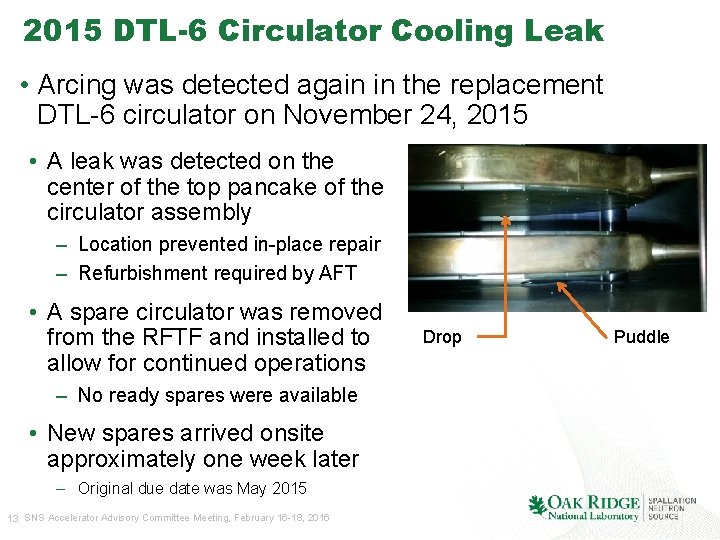
2015 DTL-6 Circulator Cooling Leak • Arcing was detected again in the replacement DTL-6 circulator on November 24, 2015 • A leak was detected on the center of the top pancake of the circulator assembly – Location prevented in-place repair – Refurbishment required by AFT • A spare circulator was removed from the RFTF and installed to allow for continued operations – No ready spares were available • New spares arrived onsite approximately one week later – Original due date was May 2015 13 SNS Accelerator Advisory Committee Meeting, February 16 -18, 2016 Drop Puddle
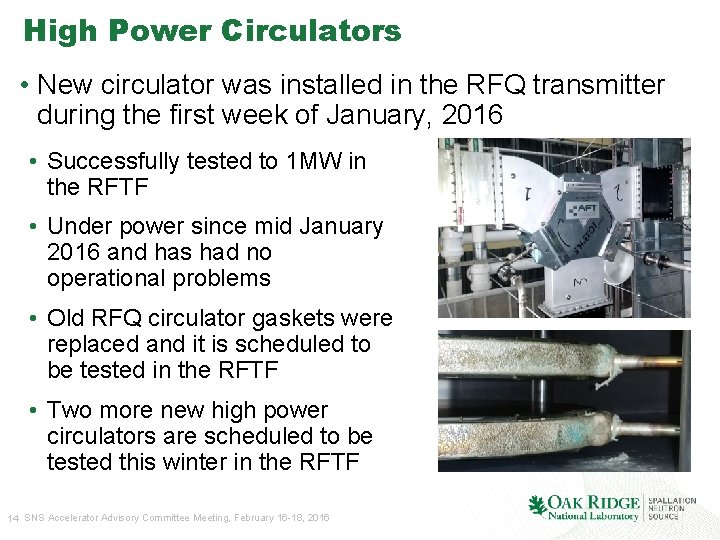
High Power Circulators • New circulator was installed in the RFQ transmitter during the first week of January, 2016 • Successfully tested to 1 MW in the RFTF • Under power since mid January 2016 and has had no operational problems • Old RFQ circulator gaskets were replaced and it is scheduled to be tested in the RFTF • Two more new high power circulators are scheduled to be tested this winter in the RFTF 14 SNS Accelerator Advisory Committee Meeting, February 16 -18, 2016
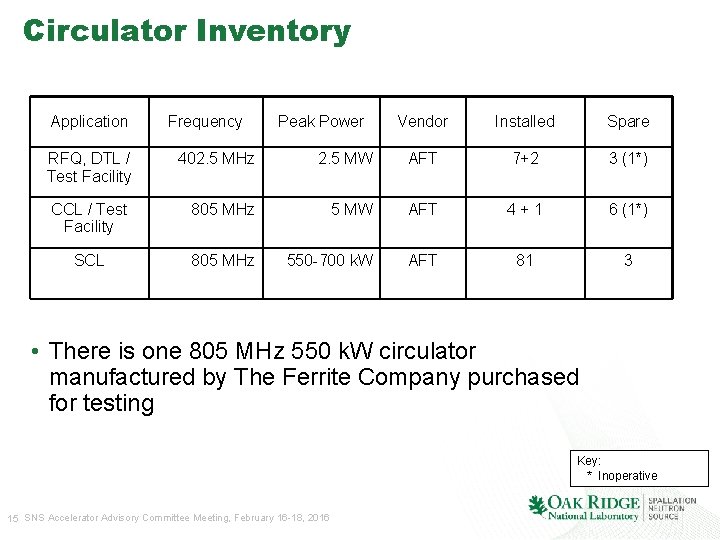
Circulator Inventory Application Frequency Peak Power Vendor Installed Spare RFQ, DTL / Test Facility 402. 5 MHz 2. 5 MW AFT 7+2 3 (1*) CCL / Test Facility 805 MHz 5 MW AFT 4+1 6 (1*) SCL 805 MHz 550 -700 k. W AFT 81 3 • There is one 805 MHz 550 k. W circulator manufactured by The Ferrite Company purchased for testing Key: * Inoperative 15 SNS Accelerator Advisory Committee Meeting, February 16 -18, 2016
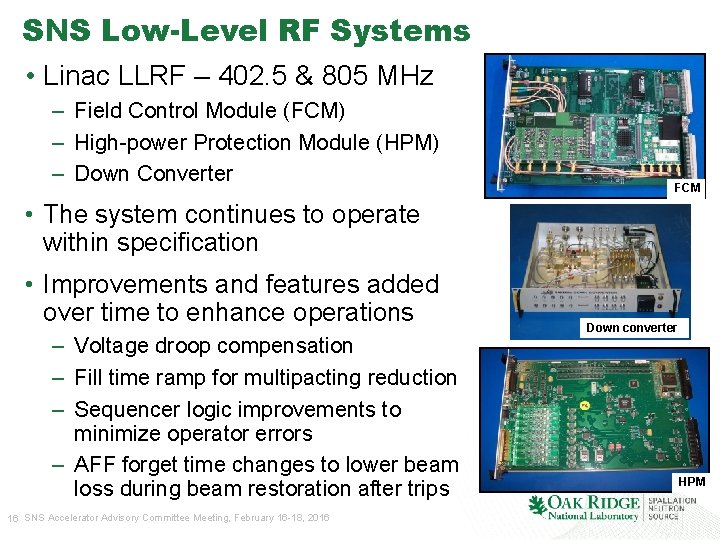
SNS Low-Level RF Systems • Linac LLRF – 402. 5 & 805 MHz – Field Control Module (FCM) – High-power Protection Module (HPM) – Down Converter FCM • The system continues to operate within specification • Improvements and features added over time to enhance operations – Voltage droop compensation – Fill time ramp for multipacting reduction – Sequencer logic improvements to minimize operator errors – AFF forget time changes to lower beam loss during beam restoration after trips 16 SNS Accelerator Advisory Committee Meeting, February 16 -18, 2016 Down converter HPM
LLRF Issues & Obsolescence • 10 years of successful operation but some failures are starting to manifest – Majority of failures have been limited to the RF output module of the field control module • System has several obsolete components including the FPGAs – Adequate spares are available – Redesign of the LLRF system is underway • Will be needed to support the Second Target Station • More and deeper history buffers • Improved time resolution and triggering functions • Additional hardware inputs – Redesign of the high-power protection module is underway and the prototype test board has been utilized to verify the VXI interface and ADC functionality 17 SNS Accelerator Advisory Committee Meeting, February 16 -18, 2016
Transmitter Obsolescence • Transmitter equipment is over ten years old – Several components are no longer manufactured or losing manufacture support in the next two to three years: • • • E 2 V 2. 5 MW klystrons Personnel Safety System PCBs (Titan – L 3) Dual magnet power supplies (SCL system) Temperature Transmitters Operator Interface, Allen Bradley Panel. View 1000 18 SNS Accelerator Advisory Committee Meeting, February 16 -18, 2016
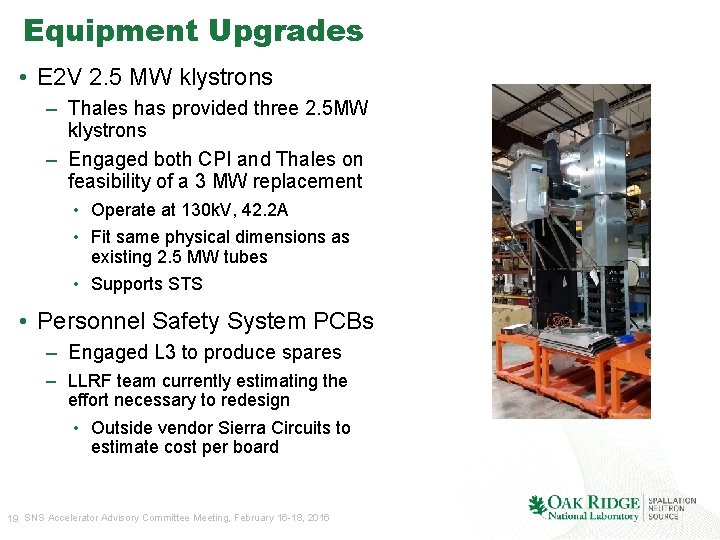
Equipment Upgrades • E 2 V 2. 5 MW klystrons – Thales has provided three 2. 5 MW klystrons – Engaged both CPI and Thales on feasibility of a 3 MW replacement • Operate at 130 k. V, 42. 2 A • Fit same physical dimensions as existing 2. 5 MW tubes • Supports STS • Personnel Safety System PCBs – Engaged L 3 to produce spares – LLRF team currently estimating the effort necessary to redesign • Outside vendor Sierra Circuits to estimate cost per board 19 SNS Accelerator Advisory Committee Meeting, February 16 -18, 2016
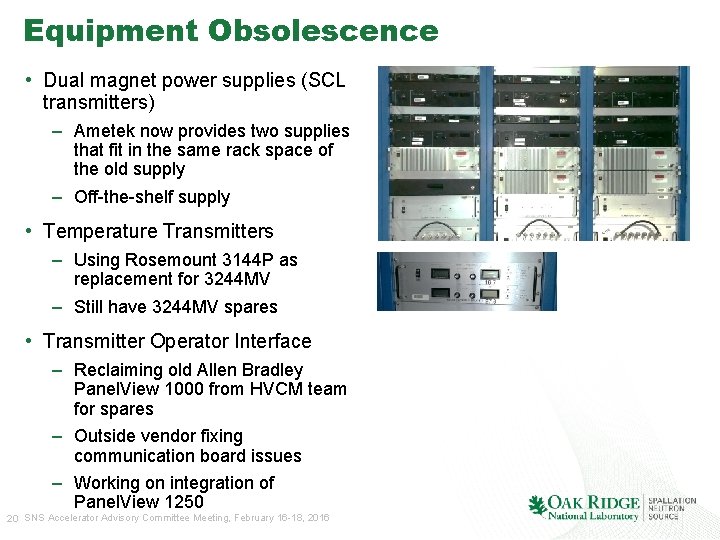
Equipment Obsolescence • Dual magnet power supplies (SCL transmitters) – Ametek now provides two supplies that fit in the same rack space of the old supply – Off-the-shelf supply • Temperature Transmitters – Using Rosemount 3144 P as replacement for 3244 MV – Still have 3244 MV spares • Transmitter Operator Interface – Reclaiming old Allen Bradley Panel. View 1000 from HVCM team for spares – Outside vendor fixing communication board issues – Working on integration of Panel. View 1250 20 SNS Accelerator Advisory Committee Meeting, February 16 -18, 2016
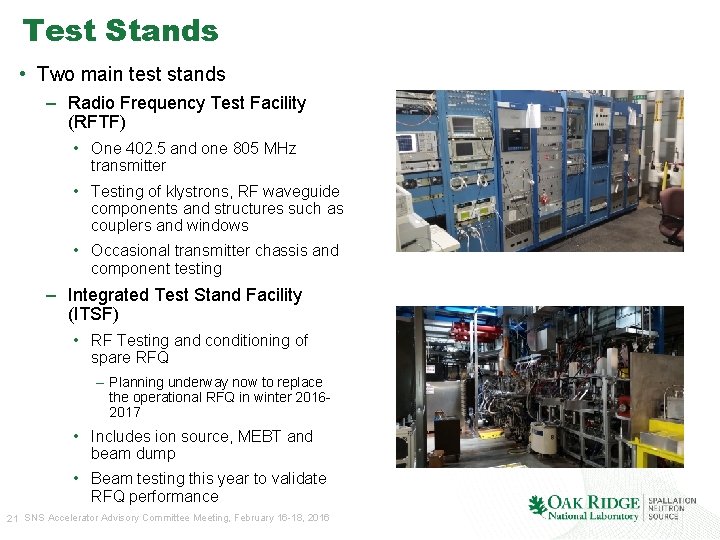
Test Stands • Two main test stands – Radio Frequency Test Facility (RFTF) • One 402. 5 and one 805 MHz transmitter • Testing of klystrons, RF waveguide components and structures such as couplers and windows • Occasional transmitter chassis and component testing – Integrated Test Stand Facility (ITSF) • RF Testing and conditioning of spare RFQ – Planning underway now to replace the operational RFQ in winter 20162017 • Includes ion source, MEBT and beam dump • Beam testing this year to validate RFQ performance 21 SNS Accelerator Advisory Committee Meeting, February 16 -18, 2016
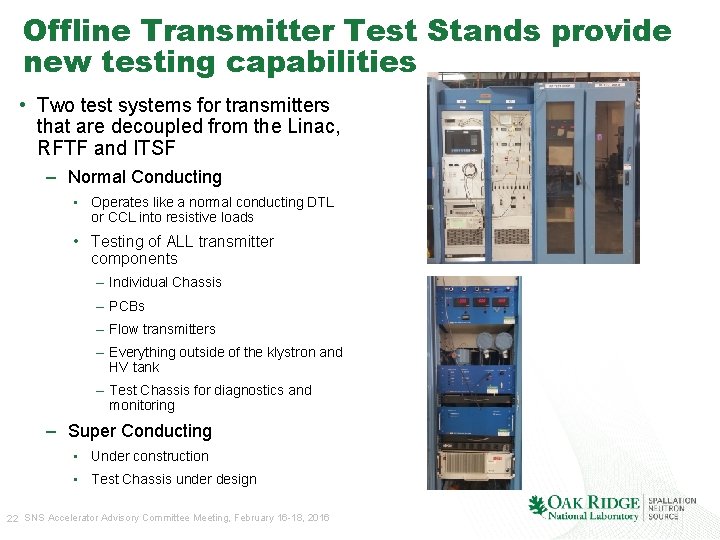
Offline Transmitter Test Stands provide new testing capabilities • Two test systems for transmitters that are decoupled from the Linac, RFTF and ITSF – Normal Conducting • Operates like a normal conducting DTL or CCL into resistive loads • Testing of ALL transmitter components – Individual Chassis – PCBs – Flow transmitters – Everything outside of the klystron and HV tank – Test Chassis for diagnostics and monitoring – Super Conducting • Under construction • Test Chassis under design 22 SNS Accelerator Advisory Committee Meeting, February 16 -18, 2016
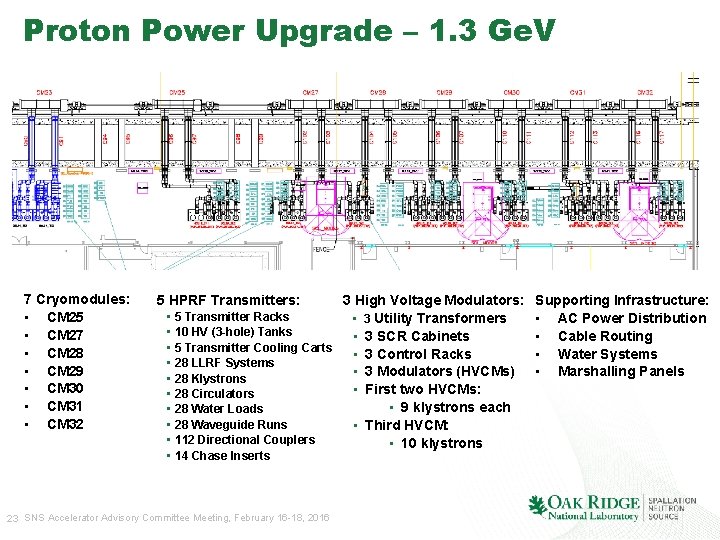
Proton Power Upgrade – 1. 3 Ge. V 7 Cryomodules: • CM 25 • CM 27 • CM 28 • CM 29 • CM 30 • CM 31 • CM 32 5 HPRF Transmitters: 3 High Voltage Modulators: • 5 Transmitter Racks • 3 Utility Transformers • 10 HV (3 -hole) Tanks • 3 SCR Cabinets • 5 Transmitter Cooling Carts • 3 Control Racks • 28 LLRF Systems • 3 Modulators (HVCMs) • 28 Klystrons • First two HVCMs: • 28 Circulators • 9 klystrons each • 28 Water Loads • 28 Waveguide Runs • Third HVCM: • 112 Directional Couplers • 10 klystrons • 14 Chase Inserts 23 SNS Accelerator Advisory Committee Meeting, February 16 -18, 2016 Supporting Infrastructure: • AC Power Distribution • Cable Routing • Water Systems • Marshalling Panels
Risks and Vulnerabilities • Klystrons are aging and most have exceeded specified life of 50, 000 operational hours – Need to continue to engage vendors and purchase replacement klystrons, especially for the 2. 5 MW and 5 MW systems • Not enough spare klystrons for full replacement • Failure of high power circulators – Evidence of leaks on RFQ and all DTL stations – While no leaks were discovered in the CCL and SCL, only two circulators were inspected • Waveguide installation makes inspections difficult – Need to continue to engage with AFT and purchase more spares for all systems • Consider an alternate vendor such as The Ferrite Company or MEGA industries 24 SNS Accelerator Advisory Committee Meeting, February 16 -18, 2016
Summary • Klystron operational management is focused on promoting long tube life – Operational klystrons are aging. Engaging vendors and acquiring additional spares remains a high priority • High power waveguide circulators still pose a significant operational risk – New spares are on location and there is onsite repair gasket available • Equipment obsolescence is being mitigated on a continuous basis – Some solutions are already in place, i. e. SCL magnet power supplies • Development of testing ability has greatly improved troubleshooting and in house repair capabilities • RF systems are exceeding operational requirements for the SNS accelerator 25 SNS Accelerator Advisory Committee Meeting, February 16 -18, 2016