
Status of the LHC Beam Synchrotron Radiation Telescope
Status of the LHC Beam Synchrotron Radiation Telescope G. Trad on the behalf of the BSRT team Emittance meeting 04/11/2015
LAYOUT: q Introduction q Heating of the extraction system q BSRT optical systems § Calibration techniques § Results q BSRT in operation q Miscellaneous q Conclusions and Outlook 2 G. Trad- BSRT status- Emittance Meeting

Extraction System Performance: Fill 4538 (24. 4 h SB) ~ 3 o. C 3 Bunch Length Evolution : 1. 3 ns -> 0. 8 ns 2000+ bunches Total intensity: 2. 3. e 14 =>Maximum Temperature excursion 3 o. C G. Trad- BSRT status- Emittance Meeting
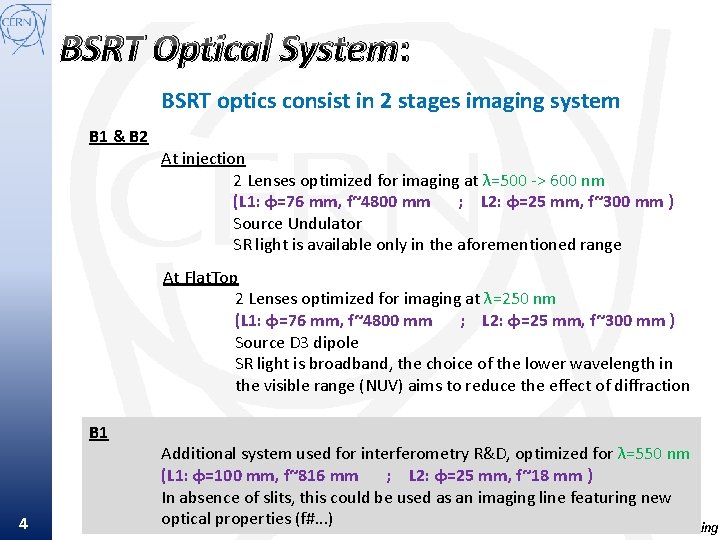
BSRT Optical System: BSRT optics consist in 2 stages imaging system B 1 & B 2 At injection 2 Lenses optimized for imaging at λ=500 -> 600 nm (L 1: φ=76 mm, f~4800 mm ; L 2: φ=25 mm, f~300 mm ) Source Undulator SR light is available only in the aforementioned range At Flat. Top 2 Lenses optimized for imaging at λ=250 nm (L 1: φ=76 mm, f~4800 mm ; L 2: φ=25 mm, f~300 mm ) Source D 3 dipole SR light is broadband, the choice of the lower wavelength in the visible range (NUV) aims to reduce the effect of diffraction B 1 4 Additional system used for interferometry R&D, optimized for λ=550 nm (L 1: φ=100 mm, f~816 mm ; L 2: φ=25 mm, f~18 mm ) In absence of slits, this could be used as an imaging line featuring new optical properties (f#. . . ) G. Trad- BSRT status- Emittance Meeting
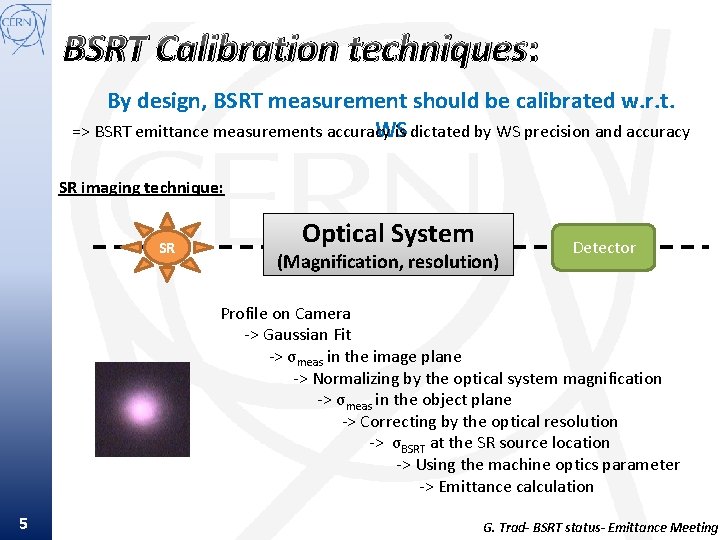
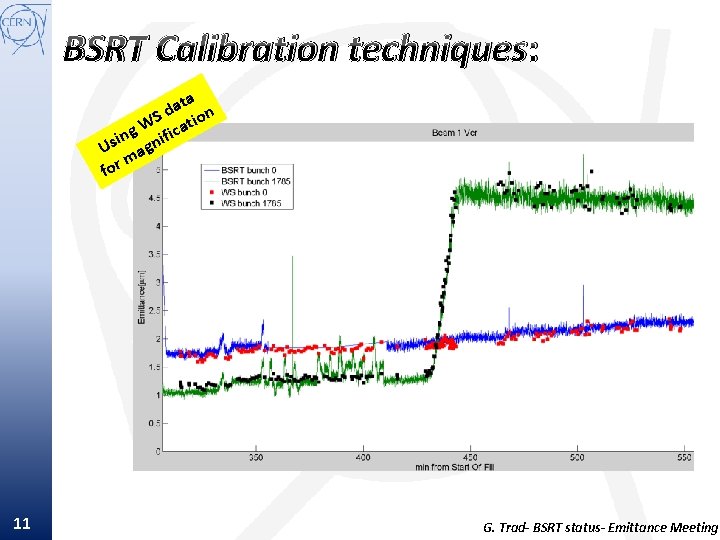
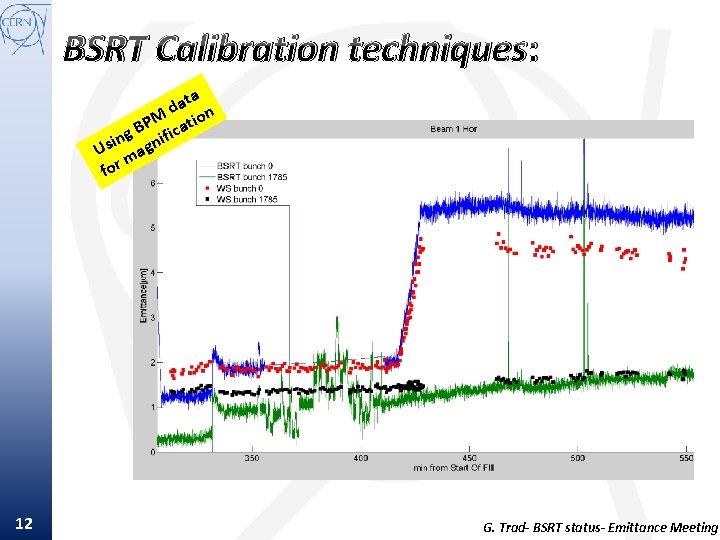
BSRT Calibration techniques: By design, BSRT measurement should be calibrated w. r. t. WS => BSRT emittance measurements accuracy is dictated by WS precision and accuracy SR imaging technique: SR Optical System (Magnification, resolution) Detector Profile on Camera -> Gaussian Fit -> σmeas in the image plane -> Normalizing by the optical system magnification -> σmeas in the object plane -> Correcting by the optical resolution -> σBSRT at the SR source location -> Using the machine optics parameter -> Emittance calculation 5 G. Trad- BSRT status- Emittance Meeting
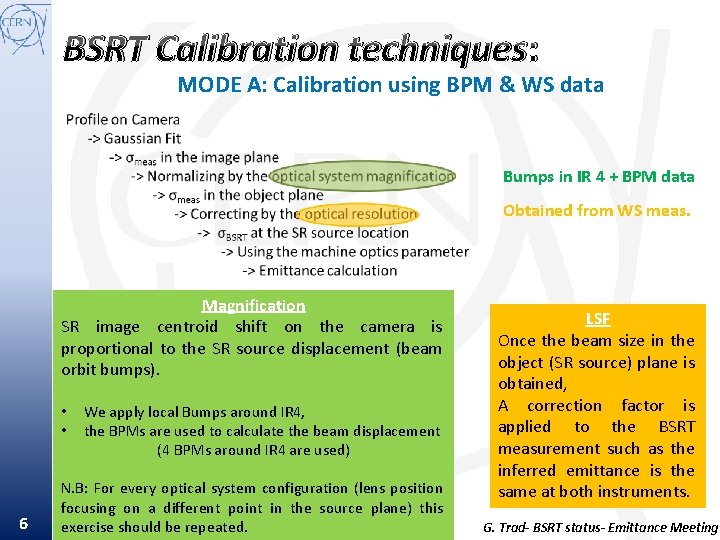
BSRT Calibration techniques: MODE A: Calibration using BPM & WS data Bumps in IR 4 + BPM data Obtained from WS meas. Magnification SR image centroid shift on the camera is proportional to the SR source displacement (beam orbit bumps). • • 6 We apply local Bumps around IR 4, the BPMs are used to calculate the beam displacement (4 BPMs around IR 4 are used) N. B: For every optical system configuration (lens position focusing on a different point in the source plane) this exercise should be repeated. LSF Once the beam size in the object (SR source) plane is obtained, A correction factor is applied to the BSRT measurement such as the inferred emittance is the same at both instruments. G. Trad- BSRT status- Emittance Meeting

BSRT Calibration techniques: MODE A: Calibration using BPM & WS data 7 G. Trad- BSRT status- Emittance Meeting
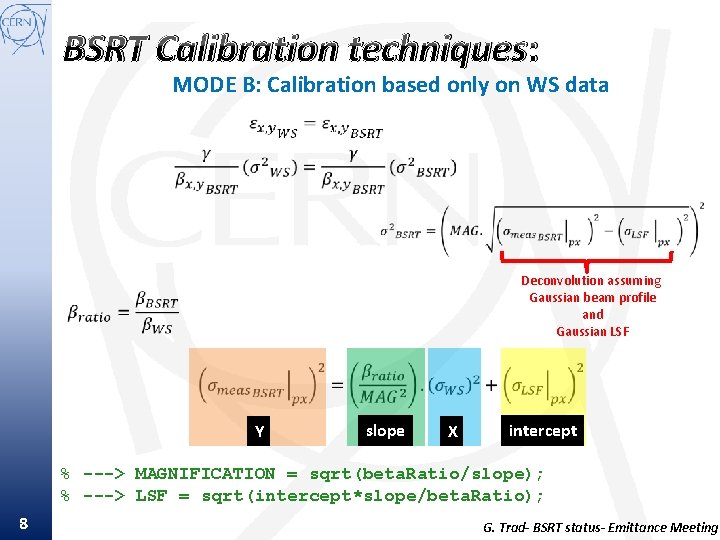
BSRT Calibration techniques: MODE B: Calibration based only on WS data Deconvolution assuming Gaussian beam profile and Gaussian LSF Y slope X intercept % ---> MAGNIFICATION = sqrt(beta. Ratio/slope); % ---> LSF = sqrt(intercept*slope/beta. Ratio); 8 G. Trad- BSRT status- Emittance Meeting
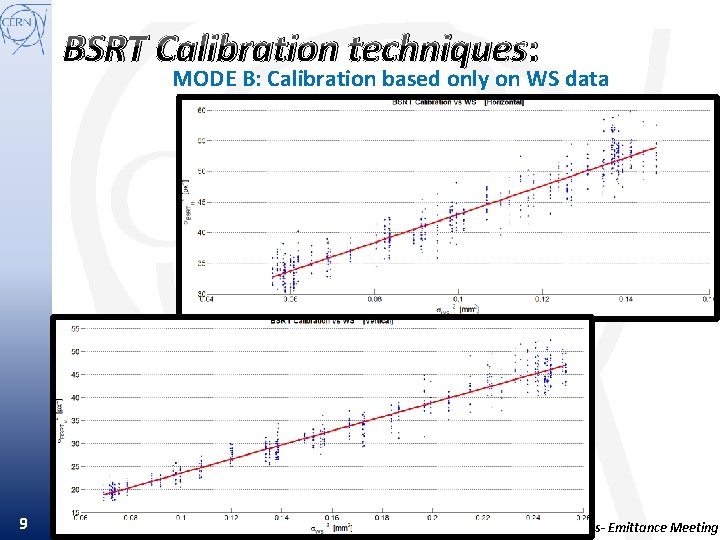
BSRT Calibration techniques: MODE B: Calibration based only on WS data 9 G. Trad- BSRT status- Emittance Meeting
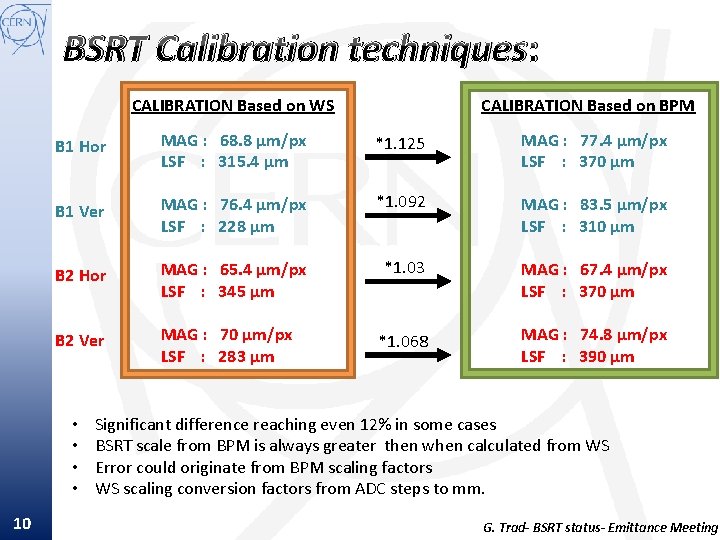
BSRT Calibration techniques: CALIBRATION Based on WS B 1 Hor MAG : 68. 8 µm/px LSF : 315. 4 µm *1. 125 MAG : 77. 4 µm/px LSF : 370 µm B 1 Ver MAG : 76. 4 µm/px LSF : 228 µm *1. 092 MAG : 83. 5 µm/px LSF : 310 µm B 2 Hor MAG : 65. 4 µm/px LSF : 345 µm *1. 03 MAG : 67. 4 µm/px LSF : 370 µm B 2 Ver MAG : 70 µm/px LSF : 283 µm *1. 068 MAG : 74. 8 µm/px LSF : 390 µm • • 10 CALIBRATION Based on BPM Significant difference reaching even 12% in some cases BSRT scale from BPM is always greater then when calculated from WS Error could originate from BPM scaling factors WS scaling conversion factors from ADC steps to mm. G. Trad- BSRT status- Emittance Meeting
BSRT Calibration techniques: ata n d S tio W a ing gnific s U a m for 11 G. Trad- BSRT status- Emittance Meeting
BSRT Calibration techniques: ta da n PM catio B ing gnifi s U ma for 12 G. Trad- BSRT status- Emittance Meeting
BSRT in operation: § BSRT is reliably operational in 2015 Has been crucial for beam-beam, instabilities and EC studies Crosschecked with independent measurement (op scans) § Several challenges in Run II, mainly the increasing number of bunches (limited time at injection and limited acquisition speed) Detector lifetime (clear dependence of the beam size on the spot position) § The Server is continuously being upgraded by Enrico to optimize the system (priority scanning for freshly injected beams, Off-centring the beam spot, Compensating eventual camera loss of sensitivity, investigating effects of non Gaussian resolution) § Logging of beam profile on request is available (LOW dynamic range, interpretation very challenging especially at FT) 13 G. Trad- BSRT status- Emittance Meeting
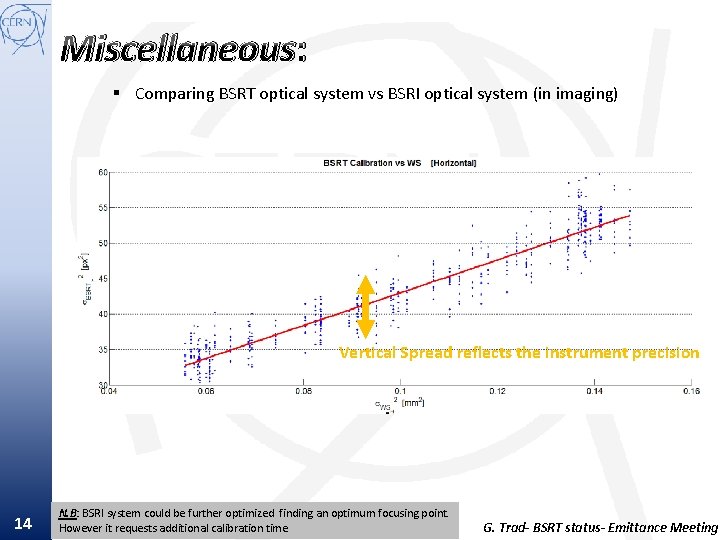
Miscellaneous: § Comparing BSRT optical system vs BSRI optical system (in imaging) Vertical Spread reflects the instrument precision 14 N. B: BSRI system could be further optimized finding an optimum focusing point. However it requests additional calibration time G. Trad- BSRT status- Emittance Meeting
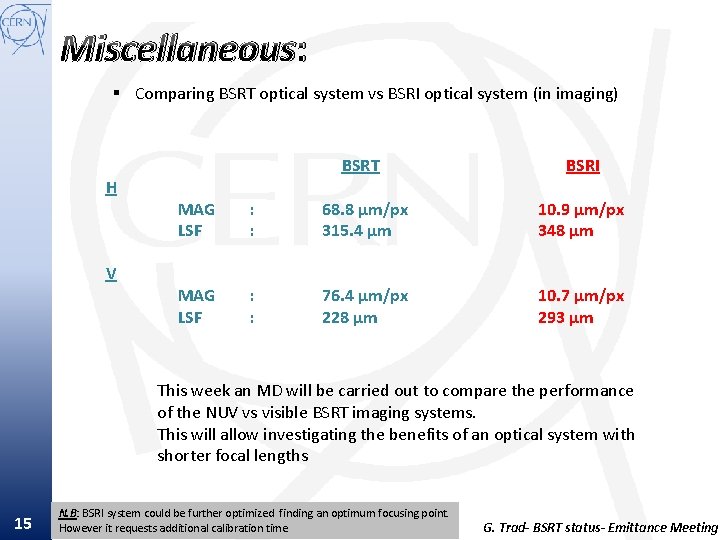
Miscellaneous: § Comparing BSRT optical system vs BSRI optical system (in imaging) H V BSRT BSRI MAG LSF : : 68. 8 µm/px 315. 4 µm 10. 9 µm/px 348 µm MAG LSF : : 76. 4 µm/px 228 µm 10. 7 µm/px 293 µm This week an MD will be carried out to compare the performance of the NUV vs visible BSRT imaging systems. This will allow investigating the benefits of an optical system with shorter focal lengths 15 N. B: BSRI system could be further optimized finding an optimum focusing point. However it requests additional calibration time G. Trad- BSRT status- Emittance Meeting
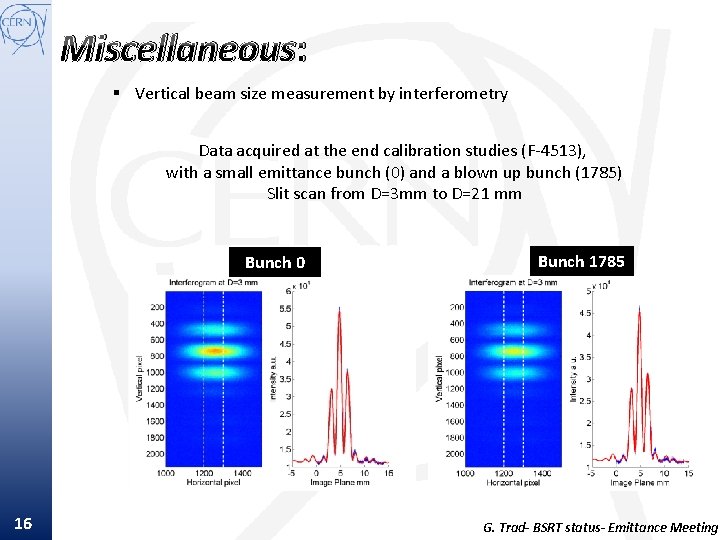
Miscellaneous: § Vertical beam size measurement by interferometry Data acquired at the end calibration studies (F-4513), with a small emittance bunch (0) and a blown up bunch (1785) Slit scan from D=3 mm to D=21 mm Bunch 0 16 Bunch 1785 G. Trad- BSRT status- Emittance Meeting
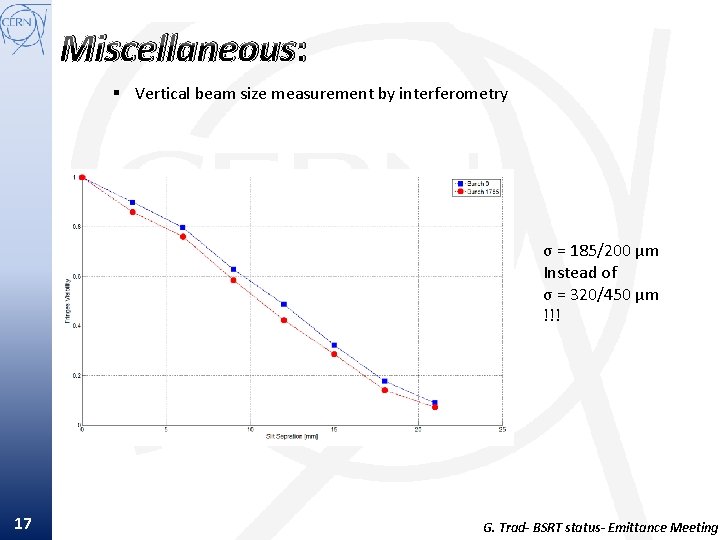
Miscellaneous: § Vertical beam size measurement by interferometry σ = 185/200 µm Instead of σ = 320/450 µm !!! 17 G. Trad- BSRT status- Emittance Meeting
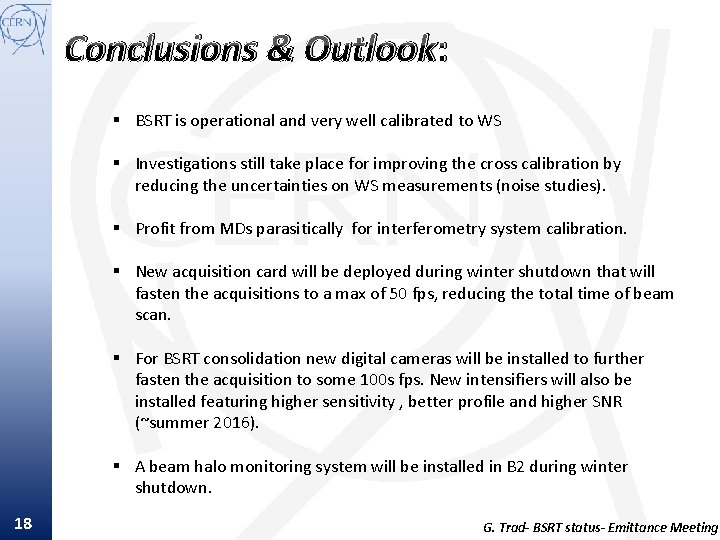
Conclusions & Outlook: § BSRT is operational and very well calibrated to WS § Investigations still take place for improving the cross calibration by reducing the uncertainties on WS measurements (noise studies). § Profit from MDs parasitically for interferometry system calibration. § New acquisition card will be deployed during winter shutdown that will fasten the acquisitions to a max of 50 fps, reducing the total time of beam scan. § For BSRT consolidation new digital cameras will be installed to further fasten the acquisition to some 100 s fps. New intensifiers will also be installed featuring higher sensitivity , better profile and higher SNR (~summer 2016). § A beam halo monitoring system will be installed in B 2 during winter shutdown. 18 G. Trad- BSRT status- Emittance Meeting
- Slides: 18