
Status of the Hollow Electron Lens ebeam Adriana
Status of the Hollow Electron Lens e-beam Adriana Rossi, Sergey Sadovich (CERN BE-BI-EA) With contributions by D. Perini (CERN), G. Stancari (FNAL), A. Barnyakov, A. Levichev, M. Maltseva, D. Nikiforov (BINP) BGC Collaboration Meeting at GSI - 19 March 2018
Outline § Context § Brief description of electron lenses and electron beam dynamics § 2 phases test facility at CERN § Summary and outlook 2
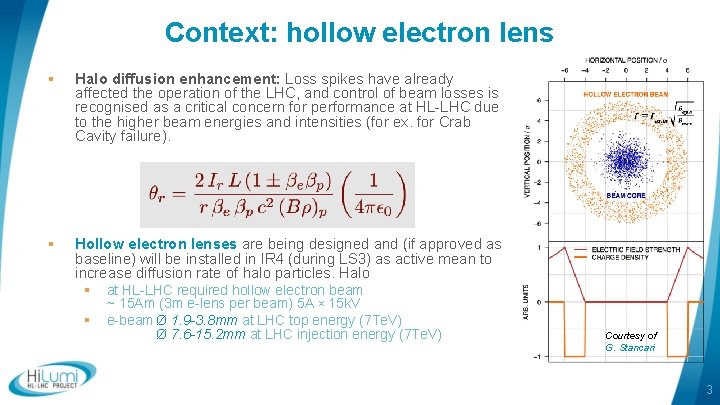
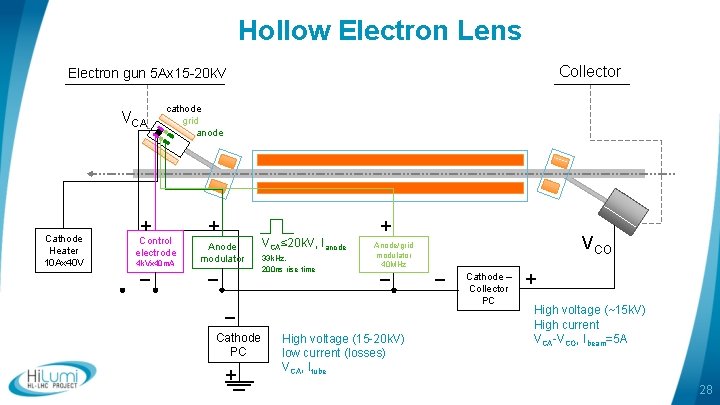
Context: hollow electron lens § Halo diffusion enhancement: Loss spikes have already affected the operation of the LHC, and control of beam losses is recognised as a critical concern for performance at HL-LHC due to the higher beam energies and intensities (for ex. for Crab Cavity failure). § Hollow electron lenses are being designed and (if approved as baseline) will be installed in IR 4 (during LS 3) as active mean to increase diffusion rate of halo particles. Halo § at HL-LHC required hollow electron beam § ~ 15 Am (3 m e-lens per beam) 5 A × 15 k. V e-beam Ø 1. 9 -3. 8 mm at LHC top energy (7 Te. V) Ø 7. 6 -15. 2 mm at LHC injection energy (7 Te. V) Courtesy of G. Stancari 3
Outline § Context § Brief description of electron lenses and electron beam dynamics § 2 phases test facility at CERN § Summary and outlook 4
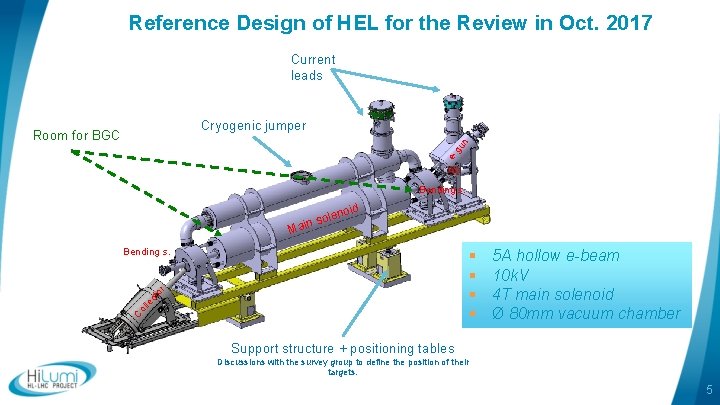
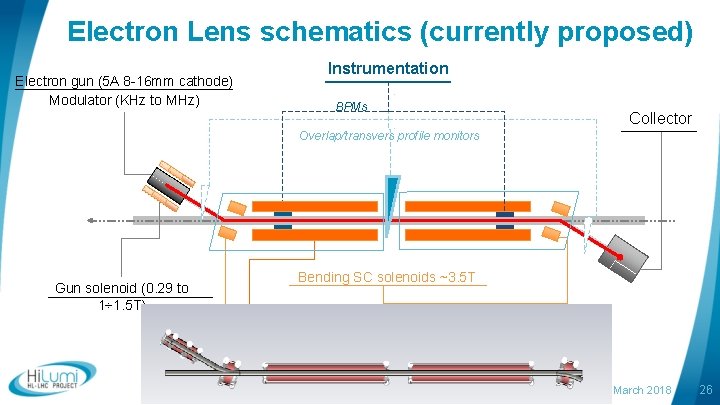
Reference Design of HEL for the Review in Oct. 2017 Current leads Cryogenic jumper e- gu n Room for BGC Bending s. M id leno o s ain Bending s. Co lle ct or § § 5 A hollow e-beam 10 k. V 4 T main solenoid Ø 80 mm vacuum chamber Support structure + positioning tables Discussions with the survey group to define the position of their targets. 5
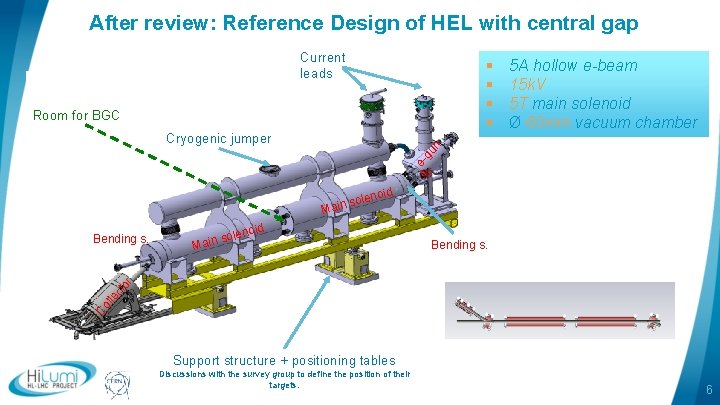
After review: Reference Design of HEL with central gap Current leads § § Room for BGC e- gu n Cryogenic jumper 5 A hollow e-beam 15 k. V 5 T main solenoid Ø 60 mm vacuum chamber d lenoi so Main id oleno s Main Bending s. Co lle ct or Bending s. Support structure + positioning tables Discussions with the survey group to define the position of their targets. 6
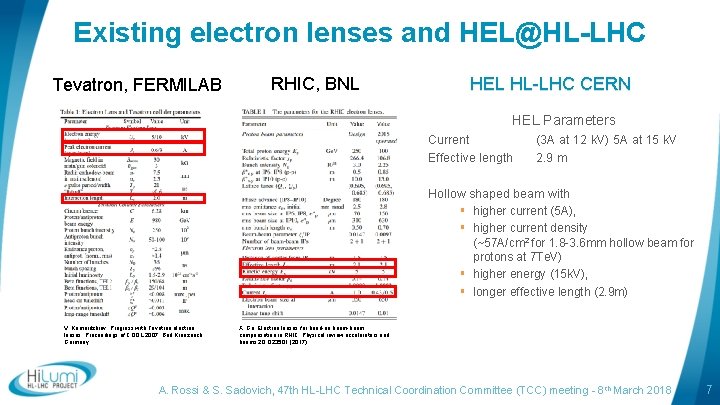
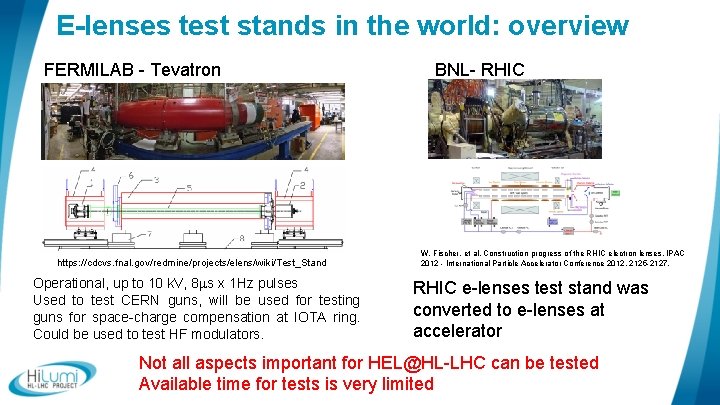
Existing electron lenses and HEL@HL-LHC Tevatron, FERMILAB RHIC, BNL HEL HL-LHC CERN HEL Parameters Current Effective length (3 A at 12 k. V) 5 A at 15 k. V 2. 9 m Hollow shaped beam with § higher current (5 A), § higher current density (~57 A/cm 2 for 1. 8 -3. 6 mm hollow beam for protons at 7 Te. V) § higher energy (15 k. V), § longer effective length (2. 9 m) V. Kamerdzhiev, Progress with Tevatron electron lenses, Proceedings of COOL 2007, Bad Kreuznach, Germany X. Gu, Electron lenses for head-on beam-beam compensation in RHIC, Physical review accelerators and beams 20, 023501 (2017) A. Rossi & S. Sadovich, 47 th HL-LHC Technical Coordination Committee (TCC) meeting - 8 th March 2018 7
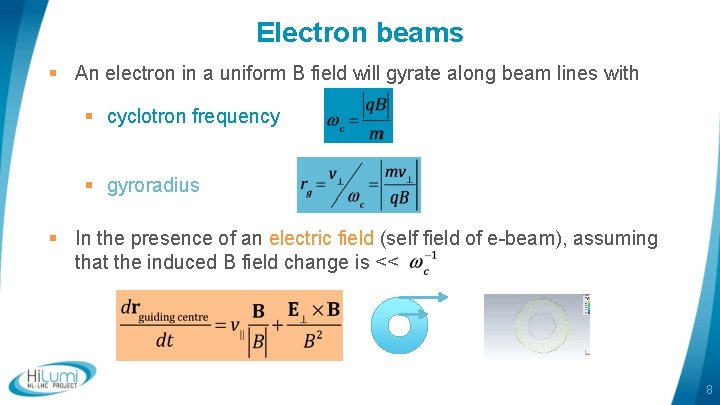
Electron beams § An electron in a uniform B field will gyrate along beam lines with § cyclotron frequency § gyroradius § In the presence of an electric field (self field of e-beam), assuming that the induced B field change is << 8

Electron beam in electron lens Beam is further compressed (few mm) : stronger SC Courtesy of Daniel Noll several A e-beam ~10 mm @ cathode Beam is compressed and bent In case of azimuthally non-uniform beam there could be an angular component of the electric field causing further beam tilt. 9
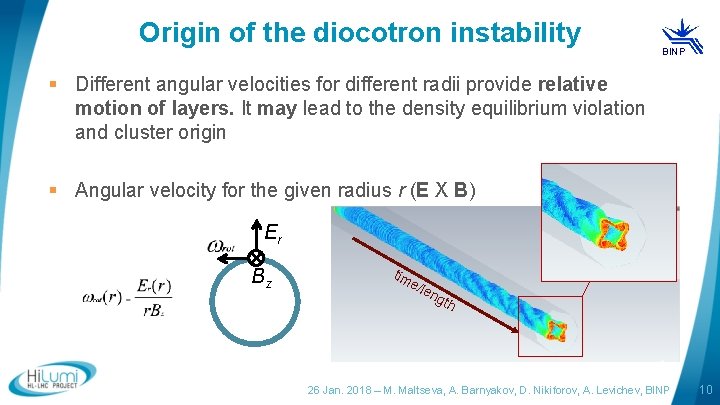
Origin of the diocotron instability BINP § Different angular velocities for different radii provide relative motion of layers. It may lead to the density equilibrium violation and cluster origin § Angular velocity for the given radius r (E X B) Er Bz tim e/l en gth 26 Jan. 2018 – M. Maltseva, A. Barnyakov, D. Nikiforov, A. Levichev, BINP 10
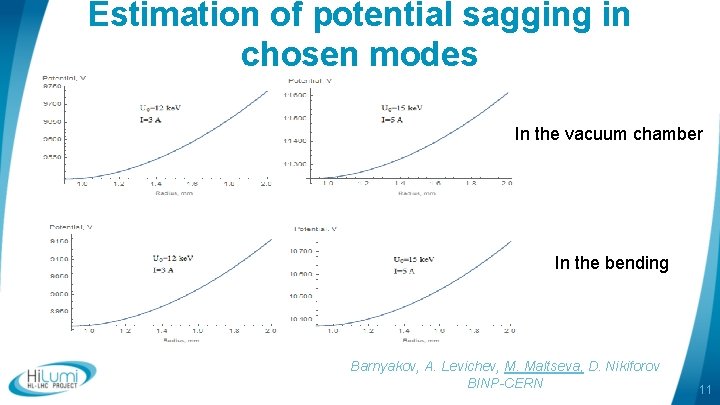
Estimation of potential sagging in chosen modes In the vacuum chamber In the bending Barnyakov, A. Levichev, M. Maltseva, D. Nikiforov BINP-CERN 11
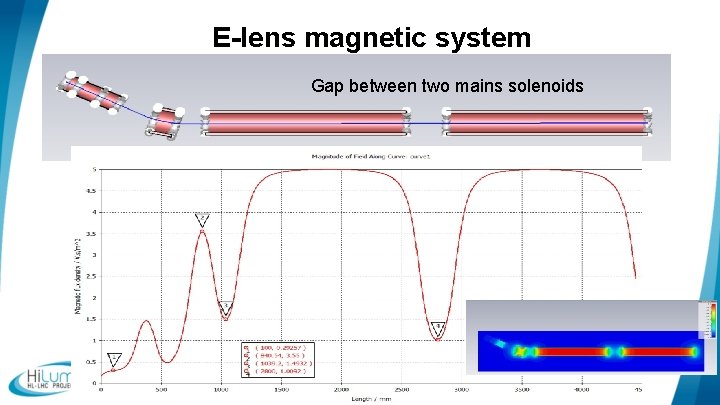
E-lens magnetic system Gap between two mains solenoids
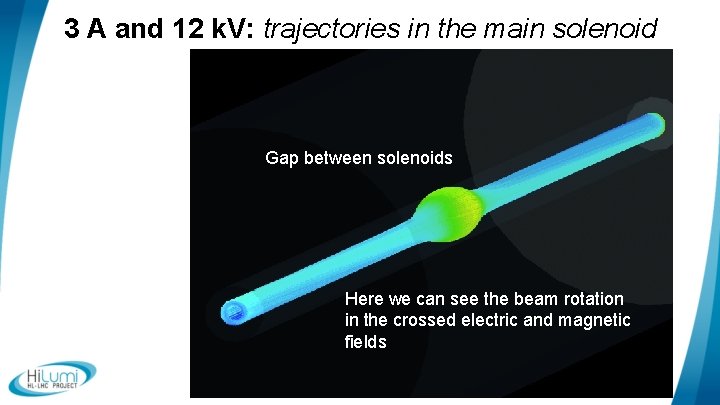
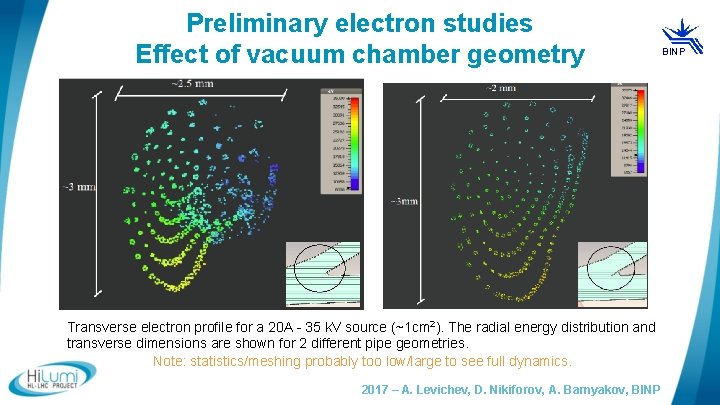
3 A and 12 k. V: trajectories in the main solenoid Gap between solenoids Here we can see the beam rotation in the crossed electric and magnetic fields
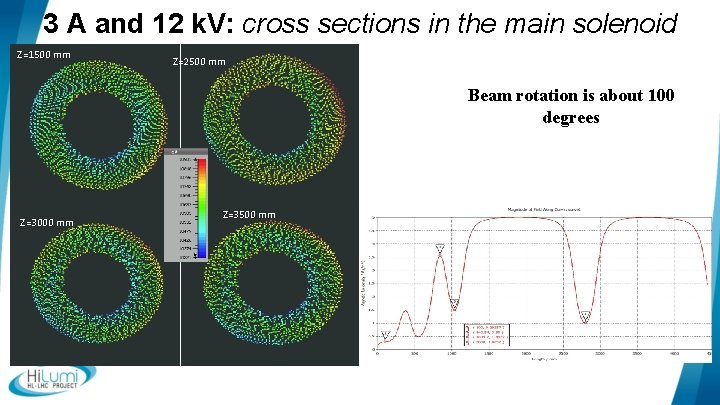
3 A and 12 k. V: cross sections in the main solenoid Z=1500 mm Z=2500 mm Beam rotation is about 100 degrees Z=3000 mm Z=3500 mm
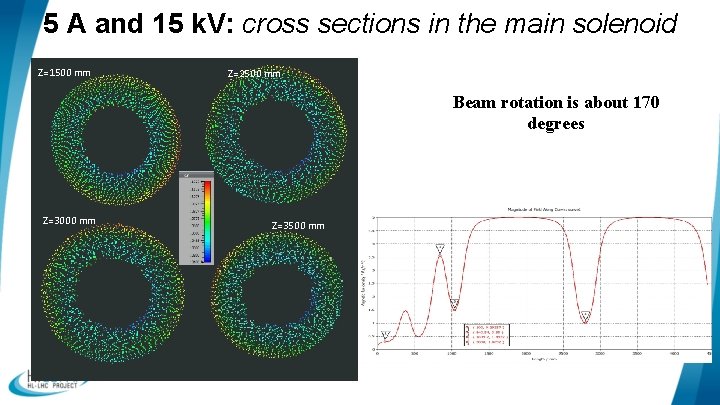
5 A and 15 k. V: cross sections in the main solenoid Z=1500 mm Z=2500 mm Beam rotation is about 170 degrees Z=3000 mm Z=3500 mm
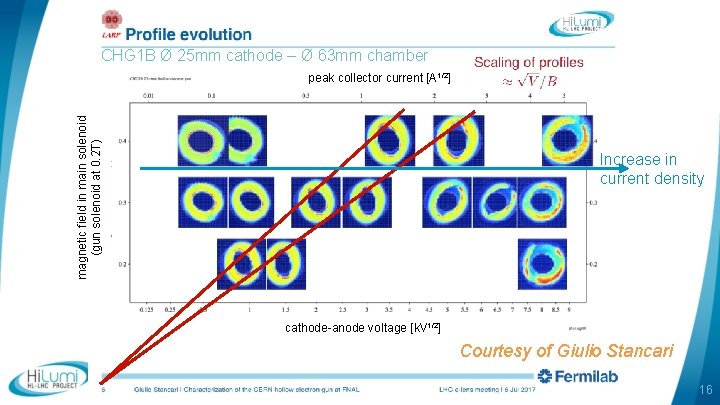
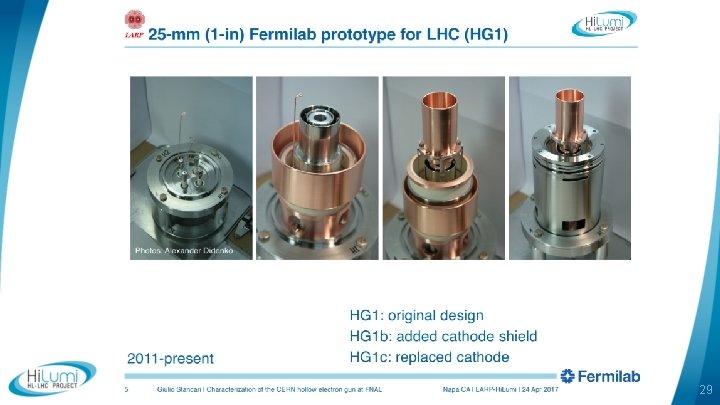
CHG 1 B Ø 25 mm cathode – Ø 63 mm chamber magnetic field in main solenoid (gun solenoid at 0. 2 T) peak collector current [A 1/2] Increase in current density cathode-anode voltage [k. V 1/2] Courtesy of Giulio Stancari 16
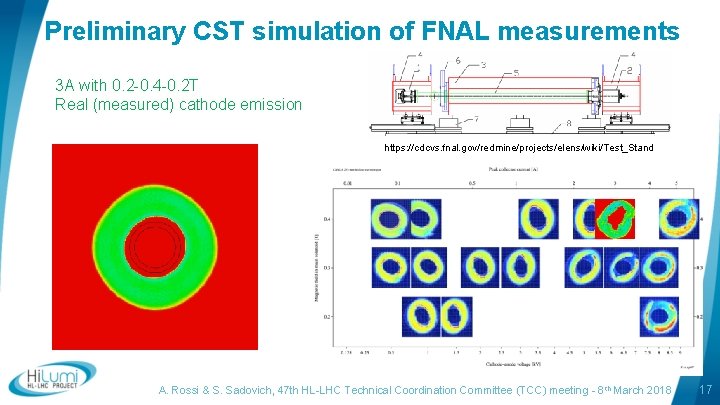
Preliminary CST simulation of FNAL measurements 3 A with 0. 2 -0. 4 -0. 2 T Real (measured) cathode emission https: //cdcvs. fnal. gov/redmine/projects/elens/wiki/Test_Stand A. Rossi & S. Sadovich, 47 th HL-LHC Technical Coordination Committee (TCC) meeting - 8 th March 2018 17
Outline § Context § Brief description of electron lenses and electron beam dynamics § 2 phases test facility at CERN § Summary and outlook 18
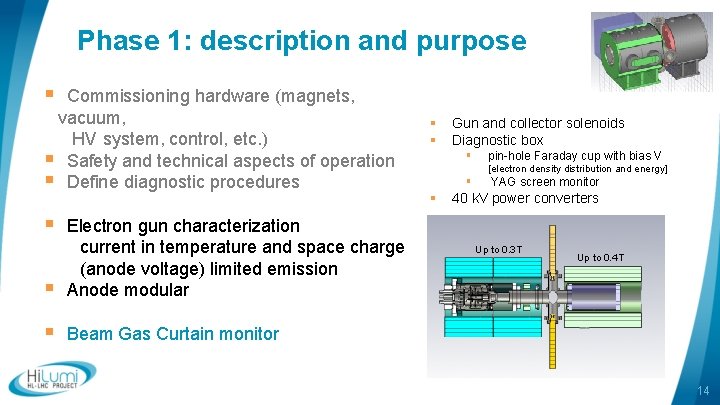
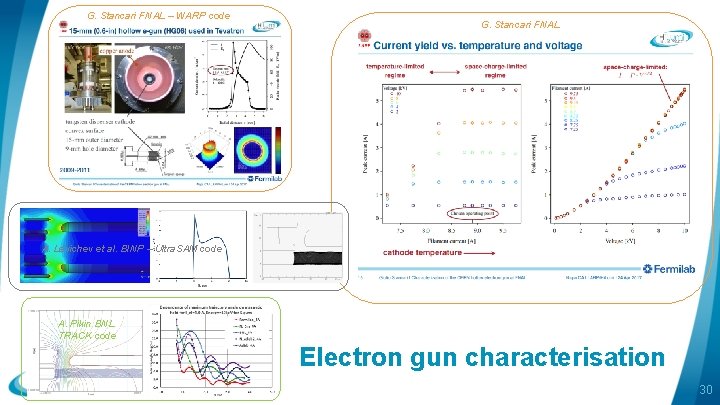
Phase 1: description and purpose § Commissioning hardware (magnets, vacuum, HV system, control, etc. ) § Safety and technical aspects of operation § Define diagnostic procedures § § Electron gun characterization current in temperature and space charge (anode voltage) limited emission Anode modular § Beam Gas Curtain monitor § § Gun and collector solenoids Diagnostic box § pin-hole Faraday cup with bias V [electron density distribution and energy] § § YAG screen monitor 40 k. V power converters Up to 0. 3 T Up to 0. 4 T 14
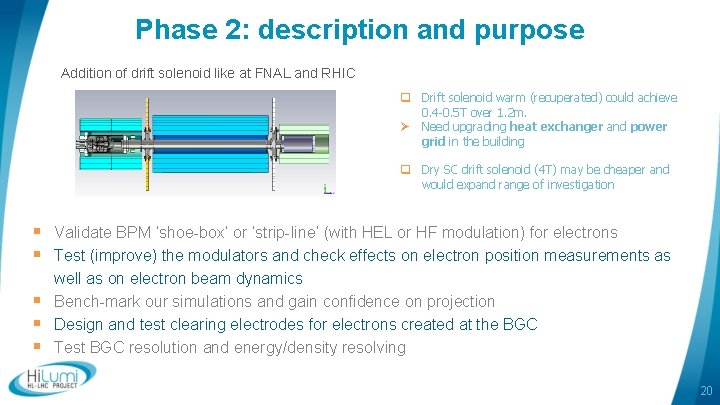
Phase 2: description and purpose Addition of drift solenoid like at FNAL and RHIC q Drift solenoid warm (recuperated) could achieve 0. 4 -0. 5 T over 1. 2 m. Ø Need upgrading heat exchanger and power grid in the building q Dry SC drift solenoid (4 T) may be cheaper and would expand range of investigation § § § Validate BPM ‘shoe-box’ or ‘strip-line’ (with HEL or HF modulation) for electrons Test (improve) the modulators and check effects on electron position measurements as well as on electron beam dynamics Bench-mark our simulations and gain confidence on projection Design and test clearing electrodes for electrons created at the BGC Test BGC resolution and energy/density resolving 20
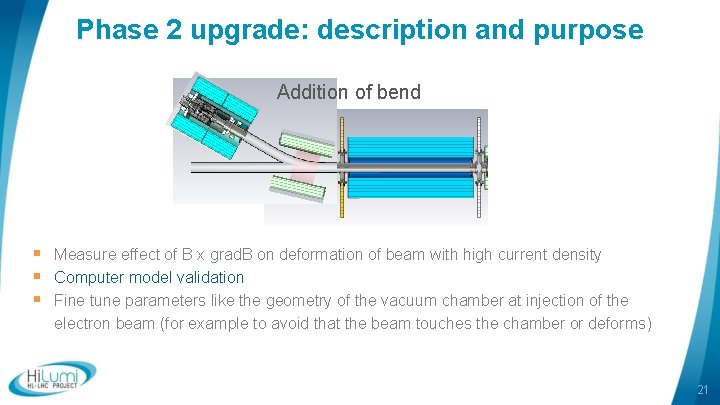
Phase 2 upgrade: description and purpose Addition of bend § § § Measure effect of B x grad. B on deformation of beam with high current density Computer model validation Fine tune parameters like the geometry of the vacuum chamber at injection of the electron beam (for example to avoid that the beam touches the chamber or deforms) 21
Summary and outlook § A test stand at CERN is being constructed in a phased approached. § Phase 1 it will be/ can be used to: § E-gun characterisation (in parallel or after FNAL). § Test and commission BGC [see ref. ] § Phase 2 needed to: § Test RF modulation. § Test BPM for electrons (HF or LF modulation). § Investigate electron beam dynamics and benchmark simulation codes like CST, WARP, Ultra. SAM, … § Test BGC resolution 22
Tests for SIS 18 space charge compensation § Space charge compensation : electric field generated by electron beams (Gabor lenses) used to focus ion/proton beams, whose space charge would otherwise cause emittance blow-up. § Electron beam with transverse and longitudinal distribution plus current intensity ~ matching beam to be focused § 10 A average - 20 A peak current, 50 x 70 mm size, 25 k. V for GSI studies 23
Thank you for your attention References for Beam Gas Curtain (or Jet) monitor: H. Zhang et al, DEVELOPMENT OF A SUPERSONIC GAS JET BEAM PROFILE MONITOR, IBIC 2015 V. Tzoganis et al, EXPERIMENTAL RESULTS OF A GAS JET BASED BEAM PROFILE MONITOR, IPAC 14 V. Tzoganis et al, Design and first operation of a supersonic gas jet based beam profile monitor, Phys. Rev. Accel. Beams 20, 062801, 12 June 2017 logo area
Spare slides logo area A. Rossi, Mini-workshop on Beam-Beam Effects in Circular Colliders, 5 -7 February 2018, LBL Berkeley CA 25
Electron Lens schematics (currently proposed) Electron gun (5 A 8 -16 mm cathode) Modulator (KHz to MHz) Instrumentation BPMs Collector Overlap/transvers profile monitors Gun solenoid (0. 29 to 1÷ 1. 5 T) Bending SC solenoids ~3. 5 T Main SC solenoid 5 T (beam 1. 8 -3. 6 mm = 57 A/cm 2) A. Rossi & S. Sadovich, 47 th HL-LHC Technical Coordination Committee (TCC) meeting - 8 th March 2018 26
E-lenses test stands in the world: overview FERMILAB - Tevatron https: //cdcvs. fnal. gov/redmine/projects/elens/wiki/Test_Stand Operational, up to 10 k. V, 8 ms x 1 Hz pulses Used to test CERN guns, will be used for testing guns for space-charge compensation at IOTA ring. Could be used to test HF modulators. BNL- RHIC W. Fischer, et al. Construction progress of the RHIC electron lenses. IPAC 2012 - International Particle Accelerator Conference 2012. 2125 -2127. RHIC e-lenses test stand was converted to e-lenses at accelerator Not all aspects important for HEL@HL-LHC can be tested Available time for tests is very limited
Hollow Electron Lens Collector Electron gun 5 Ax 15 -20 k. V VCA Cathode Heater 10 Ax 40 V cathode grid anode + Control electrode 4 k. Vx 40 m. A – + + Anode modulator – VCA≤ 20 k. V, Ianode 33 k. Hz, 200 ns rise time – – Cathode PC + VCO Anode/grid modulator 40 MHz High voltage (15 -20 k. V) low current (losses) VCA, Itube – Cathode – Collector PC + High voltage (~15 k. V) High current VCA-VCO, Ibeam=5 A 28
29
G. Stancari FNAL – WARP code G. Stancari FNAL A. Levichev et al. BINP – Ultra. SAM code A. Pikin BNL TRACK code Electron gun characterisation 30
Preliminary electron studies Effect of vacuum chamber geometry Transverse electron profile for a 20 A - 35 k. V source (~1 cm 2). The radial energy distribution and transverse dimensions are shown for 2 different pipe geometries. Note: statistics/meshing probably too low/large to see full dynamics. 2017 – A. Levichev, D. Nikiforov, A. Barnyakov, BINP
- Slides: 31