
Status of the Fermilab Meson Test Beam Facility
Status of the Fermilab Meson Test Beam Facility Erik Ramberg/Fermilab ALCG Workshop – Jan. 9, 2004 Delivering Fermilab’s Main Injector beam to the Meson Laboratory Test area layout Operational characteristics of beam Facility detectors Status and schedule
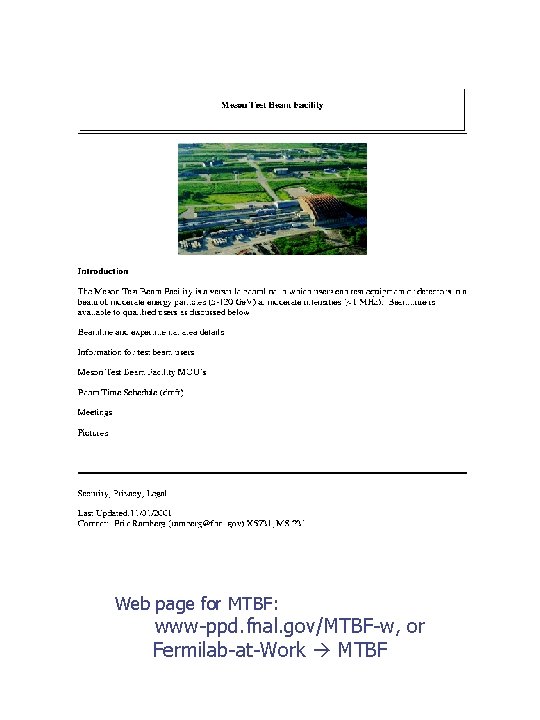
Web page for MTBF: www-ppd. fnal. gov/MTBF-w, or Fermilab-at-Work MTBF
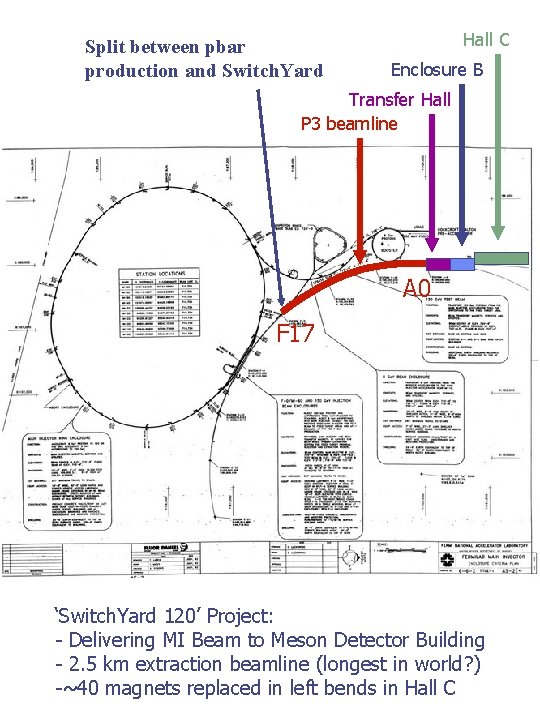
Split between pbar production and Switch. Yard Hall C Enclosure B Transfer Hall P 3 beamline A 0 F 17 ‘Switch. Yard 120’ Project: - Delivering MI Beam to Meson Detector Building - 2. 5 km extraction beamline (longest in world? ) -~40 magnets replaced in left bends in Hall C
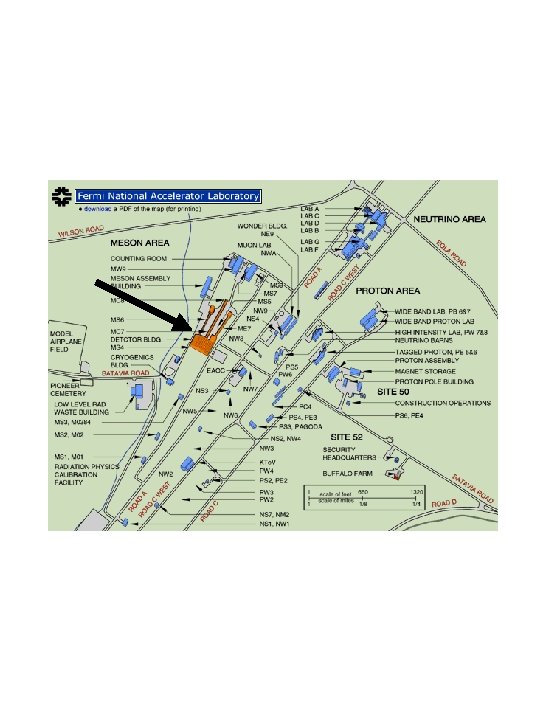
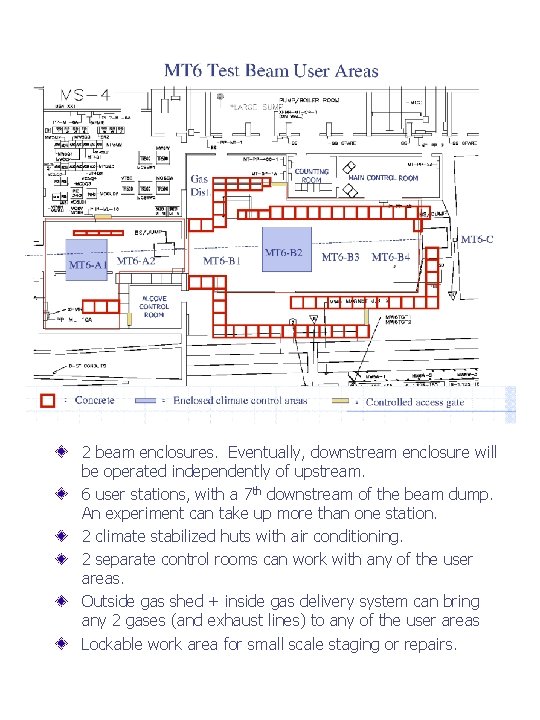
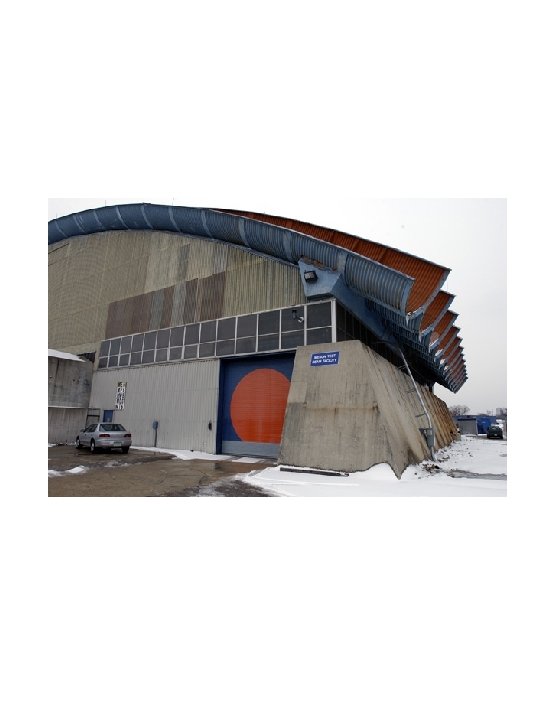
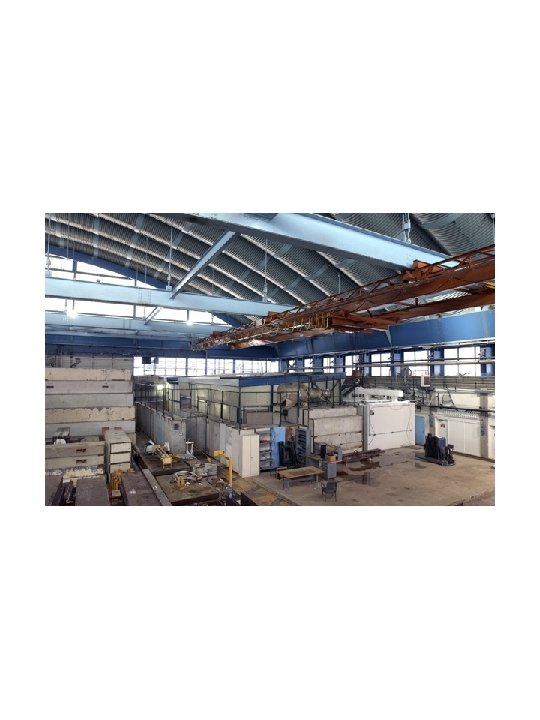
2 beam enclosures. Eventually, downstream enclosure will be operated independently of upstream. 6 user stations, with a 7 th downstream of the beam dump. An experiment can take up more than one station. 2 climate stabilized huts with air conditioning. 2 separate control rooms can work with any of the user areas. Outside gas shed + inside gas delivery system can bring any 2 gases (and exhaust lines) to any of the user areas Lockable work area for small scale staging or repairs.
Operational Characteristics There are several operational modes: n Proton Mode: We tune beamline for 120 Ge. V protons that get transmitted through the target. Rates at the user area are limited to 1 Mhz. n Secondary, or ‘Pion’ Mode: We will vary the tune of the beamline according to the momentum desired. Maximum momentum will be 80 Ge. V, with rates on the order of 50 k. Hz. . Lowest momentum tune is on the order of 3 -5 Ge. V. (See graph of calculated rates) n Muons: By inserting a beam stop upstream, muons of tagged momentum less than 80 Ge. V can be delivered to both areas. By inserting the beam stop between the two user areas, muons of indeterminate momentum can be delivered to the downstream area. n Electrons: At low momentum (< 5 Ge. V), the beamline delivers an enhanced electron fraction, at very low rates. There are intermediate target wheels and sweepers to attempt production of an electron beam at higher momentum. Fast extraction delivers from 30 -80 buckets of 20 nsec duration. Each bucket has ~ 500 -10, 000 particles. Resonant extraction delivers ‘smooth’ beam over. 7 second spill Spot sizes can probably be made as small as 3 -5 mm square and as large as 5 cm square.
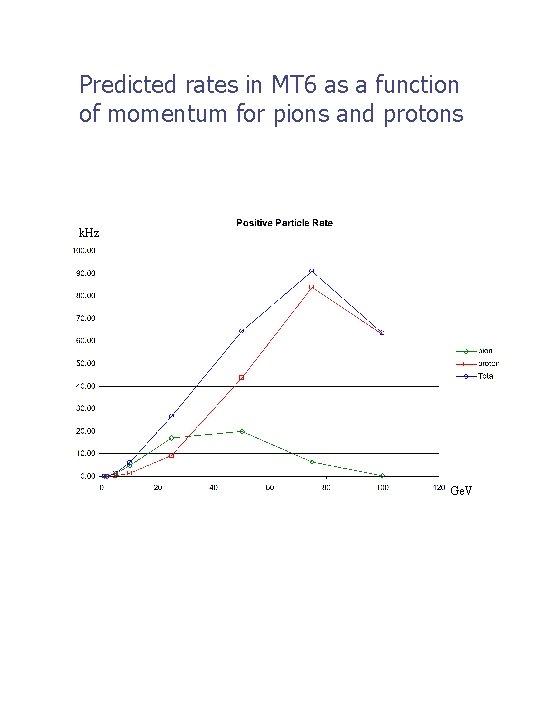
Predicted rates in MT 6 as a function of momentum for pions and protons k. Hz Ge. V
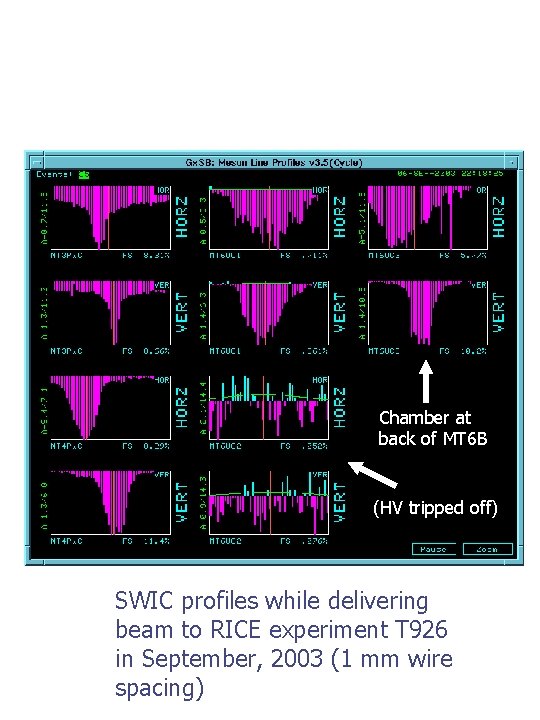
Chamber at back of MT 6 B (HV tripped off) SWIC profiles while delivering beam to RICE experiment T 926 in September, 2003 (1 mm wire spacing)
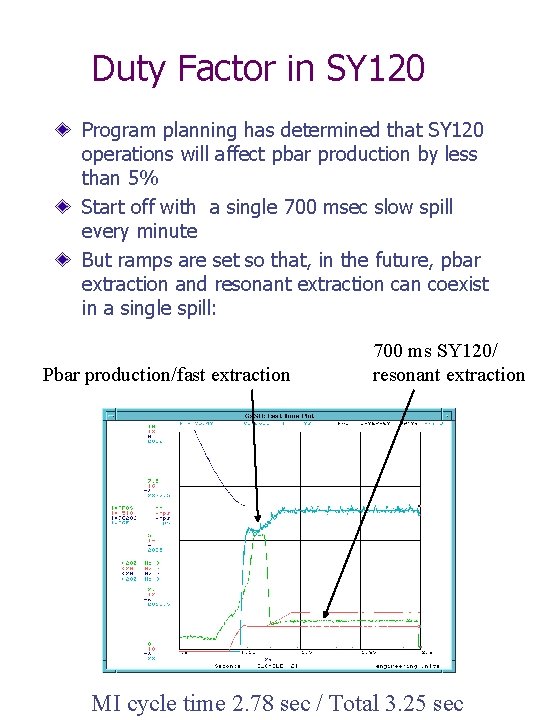
Duty Factor in SY 120 Program planning has determined that SY 120 operations will affect pbar production by less than 5% Start off with a single 700 msec slow spill every minute But ramps are set so that, in the future, pbar extraction and resonant extraction can coexist in a single spill: Pbar production/fast extraction 700 ms SY 120/ resonant extraction MI cycle time 2. 78 sec / Total 3. 25 sec
Facility Detectors Two beamline threshold Cerenkov counters can be operated independently for good particle i. d. (50’ and 80’ long) Two stations of X, Y silicon strip detectors are installed. Three 0. 5 mm pitch MWPC into DAQ Three 1. 0 mm pitch MWPC into the accelerator ACNET control system. DAQ will be minimum bias triggered during the spill. The data from scintillators, Cerenkov counters, silicon and MWPC go into event buffers. Buffers are read out during and after the spill and this data will be accessible to experimenters.
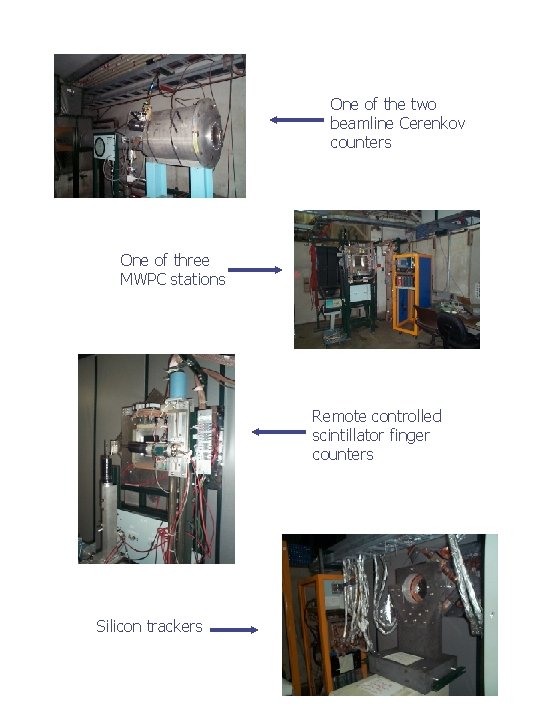
One of the two beamline Cerenkov counters One of three MWPC stations Remote controlled scintillator finger counters Silicon trackers
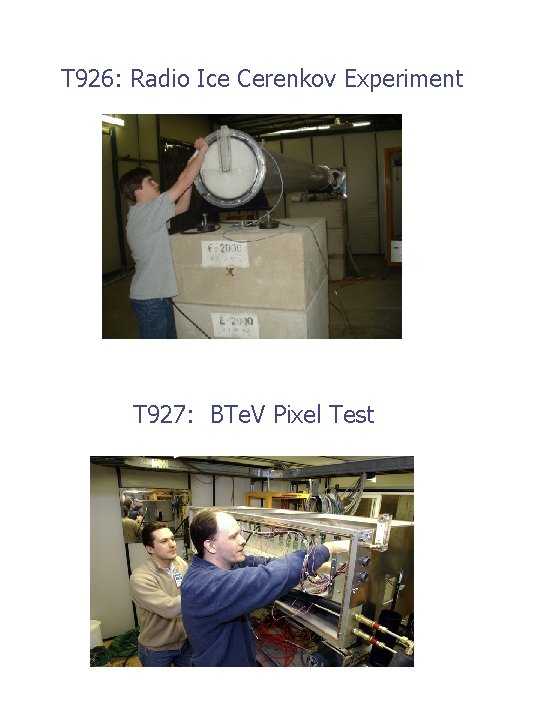
T 926: Radio Ice Cerenkov Experiment T 927: BTe. V Pixel Test
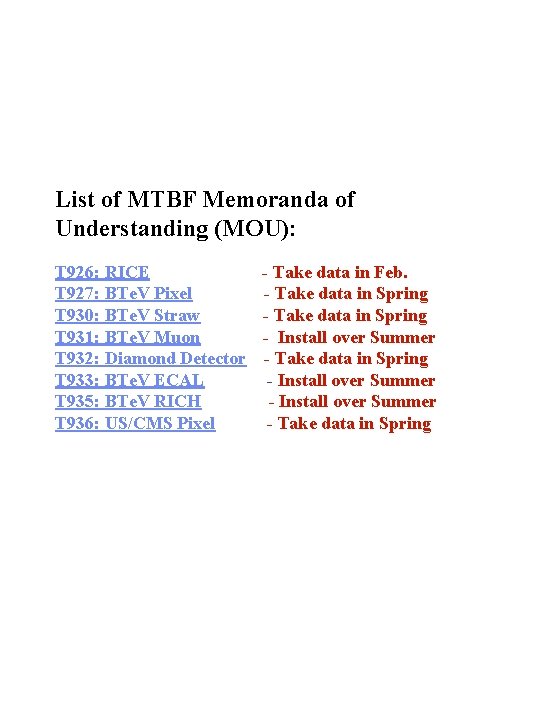
List of MTBF Memoranda of Understanding (MOU): T 926: RICE - Take data in Feb. T 927: BTe. V Pixel - Take data in Spring T 930: BTe. V Straw - Take data in Spring T 931: BTe. V Muon - Install over Summer T 932: Diamond Detector - Take data in Spring T 933: BTe. V ECAL - Install over Summer T 935: BTe. V RICH - Install over Summer T 936: US/CMS Pixel - Take data in Spring
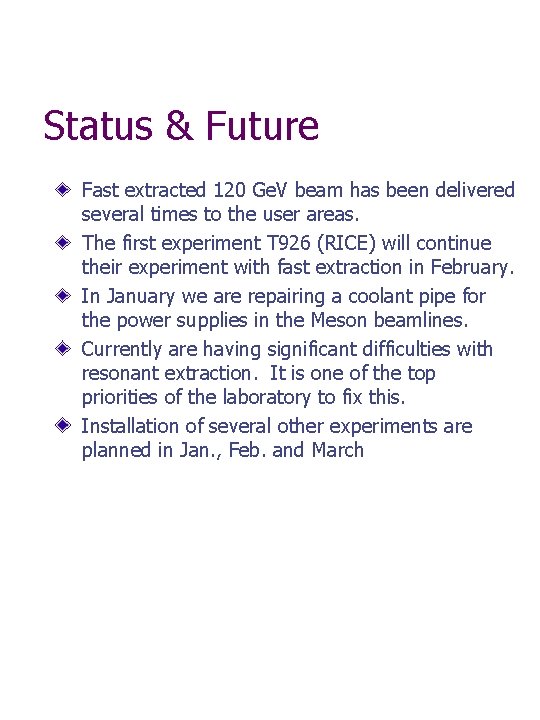
Status & Future Fast extracted 120 Ge. V beam has been delivered several times to the user areas. The first experiment T 926 (RICE) will continue their experiment with fast extraction in February. In January we are repairing a coolant pipe for the power supplies in the Meson beamlines. Currently are having significant difficulties with resonant extraction. It is one of the top priorities of the laboratory to fix this. Installation of several other experiments are planned in Jan. , Feb. and March
- Slides: 16