
Status of the design of triplet BPMs Thibaut
Status of the design of triplet BPMs Thibaut Lefevre on the behalf of the BI group HL-LHC WP 2– 23 rd May 2014
Outline • Status of the current LHC triplet BPMs • Current performance and known limitations • Post LS 1 operation. . • Design for HL-LHC • Specifications and constraints • Pick-up design • Future plans, milestones & conclusions 2
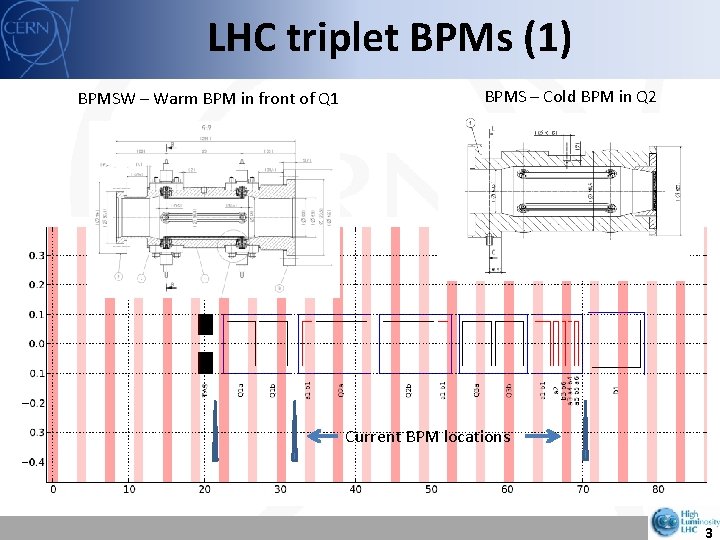
LHC triplet BPMs (1) BPMSW – Warm BPM in front of Q 1 BPMS – Cold BPM in Q 2 Current BPM locations 3
LHC triplet BPMs (3) • Performance and Known Limitation – Limited number of BPMs : no redundancy. . – Limited Accuracy: BPMSW @Q 1 very difficult to align properly: large uncertainty of the alignment procedure : not better than 1 mm – Stability issue due to Tp dependence in the acquisition system – Limited directivity of the present strip-line design: worse than 20 d. B full bandwidth – Cross-talk between the two beams – Error depends of the bunch intensity and position – Resolution of the order of 100 um in B/B and better than 10 um in Orbit mode – Linked to the current electronic design 4
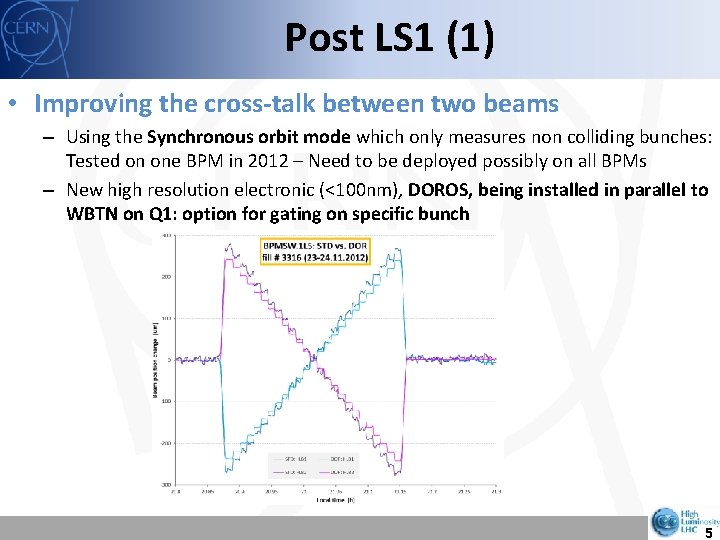
Post LS 1 (1) • Improving the cross-talk between two beams – Using the Synchronous orbit mode which only measures non colliding bunches: Tested on one BPM in 2012 – Need to be deployed possibly on all BPMs – New high resolution electronic (<100 nm), DOROS, being installed in parallel to WBTN on Q 1: option for gating on specific bunch 5
HL-LHC constrains • Inermet shielding for absorbing collision debris – Need to rotate BPM by 45 degrees & insert shielding on mid-planes – Add weight, design complexity (transition from beam screen to BPM) and probably quite costly – Add. heat deposition that need to be estimated • Cryo BPM : Cold to warm implies using sliding contact for strip-line • Larger aperture – less signal & lower final resolution • Heat deposition from pick-up (<100 m. W) – The static heat load for the BPM cables was estimated in 2003 to be 58 m. W per cable for a 1. 25 m cable going from the cold BPM at 25 K to the cryostat flange. (for a 0. 141” Outer jacket°) – The dynamic heat load added by BPM signal was estimated to 32 m. W/cable for Ultimate bunch intensities 6
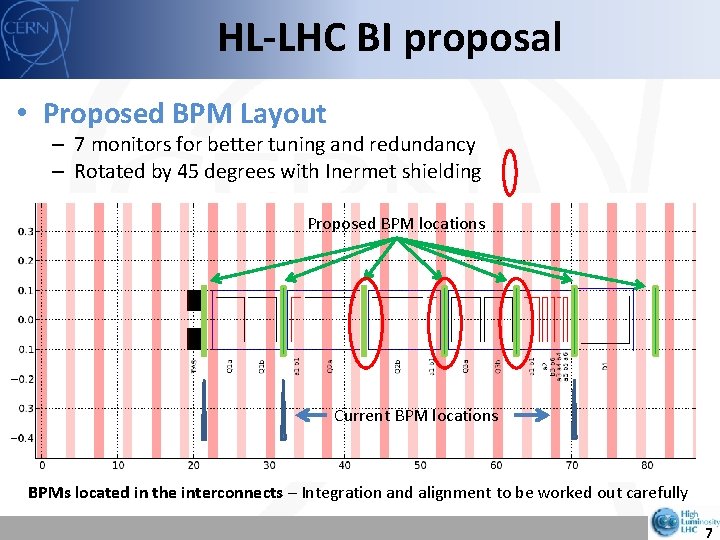
HL-LHC BI proposal • Proposed BPM Layout – 7 monitors for better tuning and redundancy – Rotated by 45 degrees with Inermet shielding Proposed BPM locations Current BPM locations BPMs located in the interconnects – Integration and alignment to be worked out carefully 7
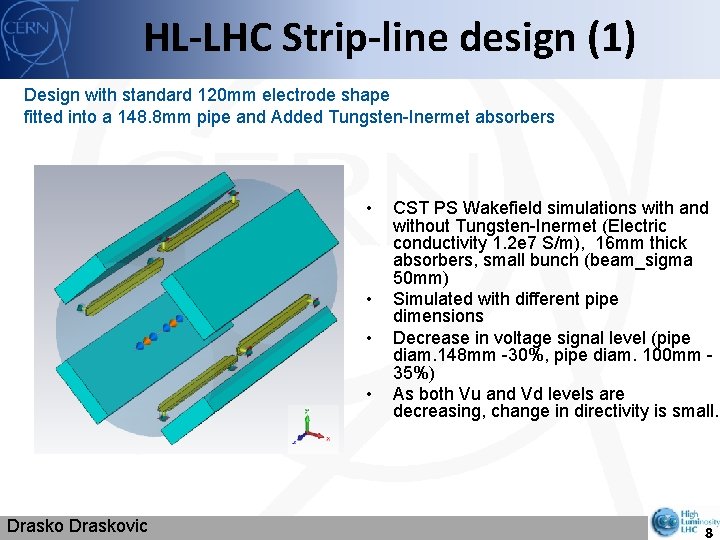
HL-LHC Strip-line design (1) Design with standard 120 mm electrode shape fitted into a 148. 8 mm pipe and Added Tungsten-Inermet absorbers • • Draskovic CST PS Wakefield simulations with and without Tungsten-Inermet (Electric conductivity 1. 2 e 7 S/m), 16 mm thick absorbers, small bunch (beam_sigma 50 mm) Simulated with different pipe dimensions Decrease in voltage signal level (pipe diam. 148 mm -30%, pipe diam. 100 mm 35%) As both Vu and Vd levels are decreasing, change in directivity is small. 8
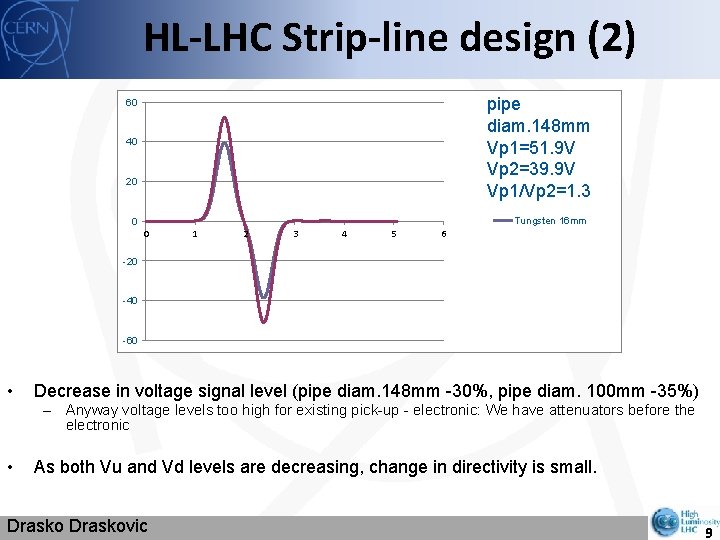
HL-LHC Strip-line design (2) pipe diam. 148 mm Vp 1=51. 9 V Vp 2=39. 9 V Vp 1/Vp 2=1. 3 60 40 20 Tungsten 16 mm 0 0 1 2 3 4 5 6 -20 -40 -60 • Decrease in voltage signal level (pipe diam. 148 mm -30%, pipe diam. 100 mm -35%) – Anyway voltage levels too high for existing pick-up - electronic: We have attenuators before the electronic • As both Vu and Vd levels are decreasing, change in directivity is small. Draskovic 9
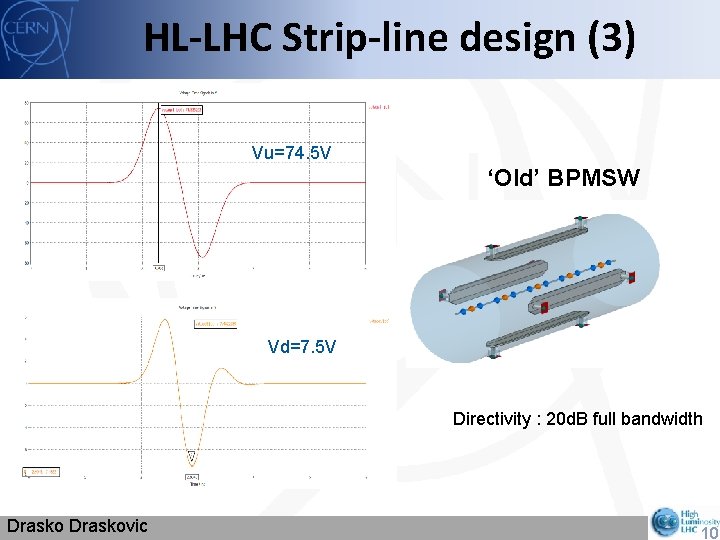
HL-LHC Strip-line design (3) Vu=74. 5 V ‘Old’ BPMSW Vd=7. 5 V Directivity : 20 d. B full bandwidth Draskovic 10
HL-LHC Strip-line design (4) • Maintaining the high degree of directivity requires that: – The velocity of the beam and the signal be matched fairly well. For highly relativistic beams this requires a minimum amount of dielectric material in the vicinity of the stripline – A matching of the stripline impedance to the transmission line or termination impedance at both ends. i. e. impedance mismatch of 10% will reflect 25% of the power to the wrong port. This would limit the directivity (theoretically) to 26 d. B – Minimization of the coupling between the striplines. If the interelectrode capacitance per unit length is too high, then one stripline can induce signals in the other Draskovic 11
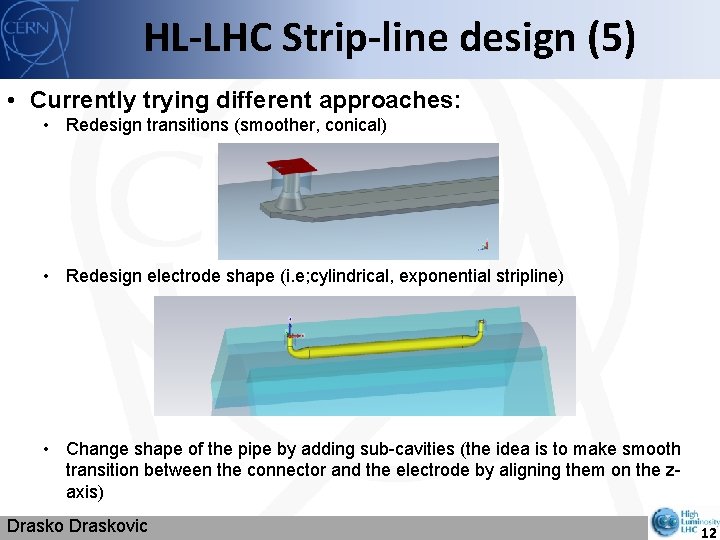
HL-LHC Strip-line design (5) • Currently trying different approaches: • Redesign transitions (smoother, conical) • Redesign electrode shape (i. e; cylindrical, exponential stripline) • Change shape of the pipe by adding sub-cavities (the idea is to make smooth transition between the connector and the electrode by aligning them on the zaxis) Draskovic 12
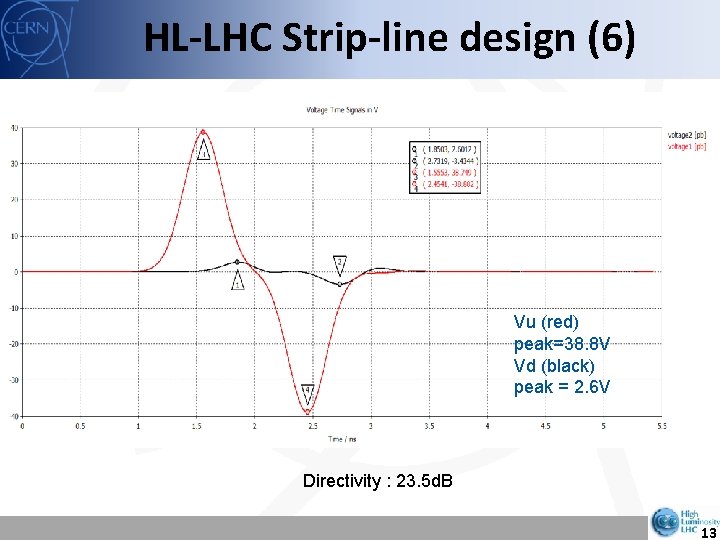
HL-LHC Strip-line design (6) Vu (red) peak=38. 8 V Vd (black) peak = 2. 6 V Directivity : 23. 5 d. B 13
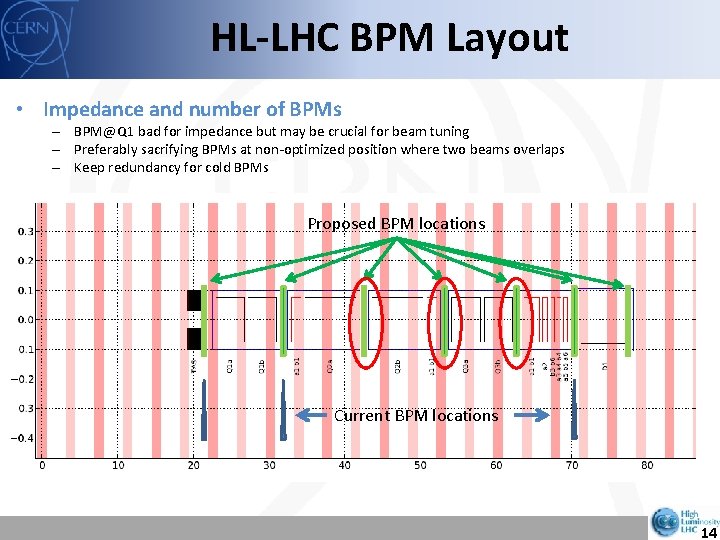
HL-LHC BPM Layout • Impedance and number of BPMs – BPM@Q 1 bad for impedance but may be crucial for beam tuning – Preferably sacrifying BPMs at non-optimized position where two beams overlaps – Keep redundancy for cold BPMs Proposed BPM locations Current BPM locations 14
Plans and Milestones • Pick-up design: RF optimization completed by mid 2015 • Pick electronic: Comparison between DOROS and WBTN: End of 2015 • Pick-up Mechanical design by end 2015 – prototype design • Electronic development: possibly other system using fast sampling – mid 2016 • Mechanical integartion in the Cryostat – end 2016 • Prototype production (Beam test) by End 2016 (2017) • Launch production in 2018 15
Conclusions • Improved Pick-up design started – Aiming for higher directivity • Electronic performance in terms of resolution to be assessed on LHC after LS 1 • Converge on Engineering specifications by 2016 -17 (both pick-up and electronic) • Impedance/number of BPMs to be agreed 16

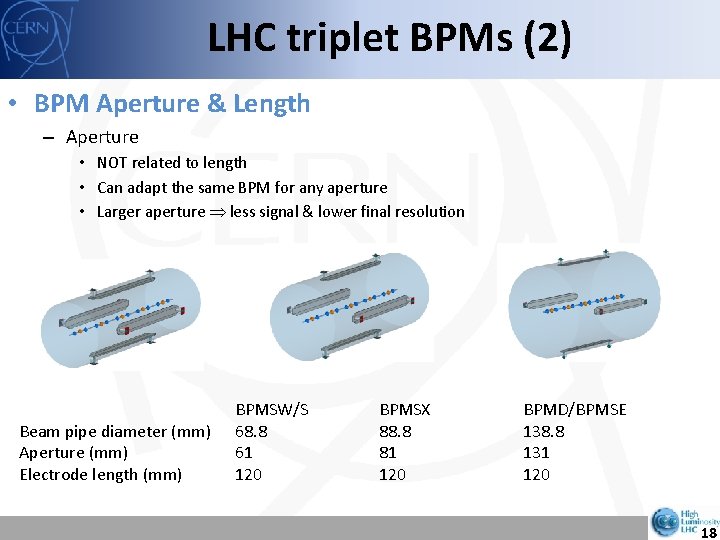
LHC triplet BPMs (2) • BPM Aperture & Length – Aperture • NOT related to length • Can adapt the same BPM for any aperture • Larger aperture less signal & lower final resolution Beam pipe diameter (mm) Aperture (mm) Electrode length (mm) BPMSW/S 68. 8 61 120 BPMSX 88. 8 81 120 BPMD/BPMSE 138. 8 131 120 18
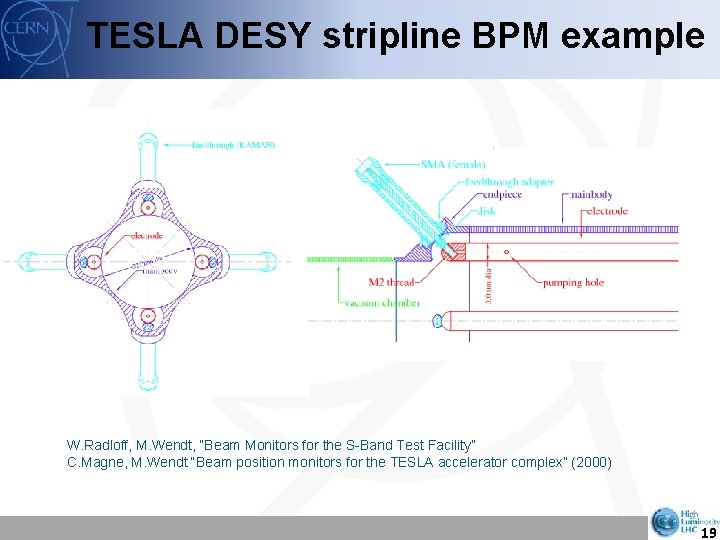
TESLA DESY stripline BPM example W. Radloff, M. Wendt, “Beam Monitors for the S-Band Test Facility” C. Magne, M. Wendt “Beam position monitors for the TESLA accelerator complex” (2000) 19
- Slides: 19