
Status of the Cavity BPM Developments at KNU
Status of the Cavity BPM Developments at KNU and Fermilab Seunghwan Shin KNU / Fermilab 17, March, 2009
Agenda • Introduction. • Cavity BPM R&D for ILC BDS at KNU. • Cavity BPM R&D for ILC ML at Fermilab. • Remote machine study for future work. • Summary. 2
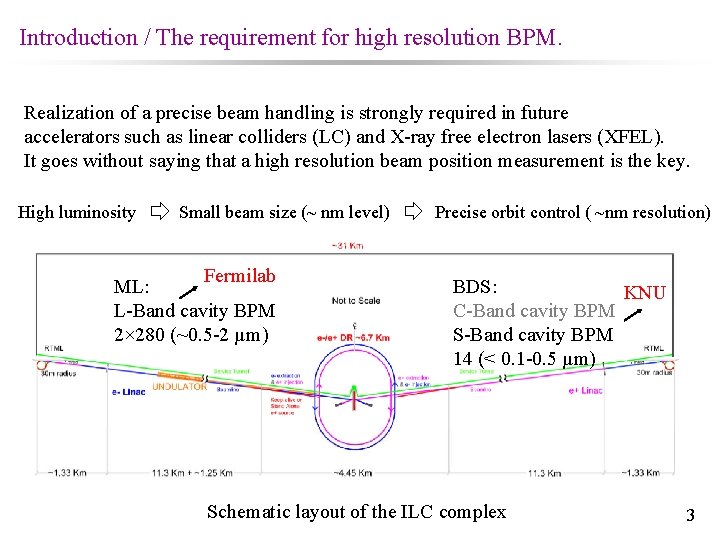
Introduction / The requirement for high resolution BPM. Realization of a precise beam handling is strongly required in future accelerators such as linear colliders (LC) and X-ray free electron lasers (XFEL). It goes without saying that a high resolution beam position measurement is the key. High luminosity Small beam size (~ nm level) Fermilab ML: L-Band cavity BPM 2× 280 (~0. 5 -2 µm) Precise orbit control ( ~nm resolution) BDS: KNU C-Band cavity BPM S-Band cavity BPM 14 (< 0. 1 -0. 5 µm) Schematic layout of the ILC complex 3
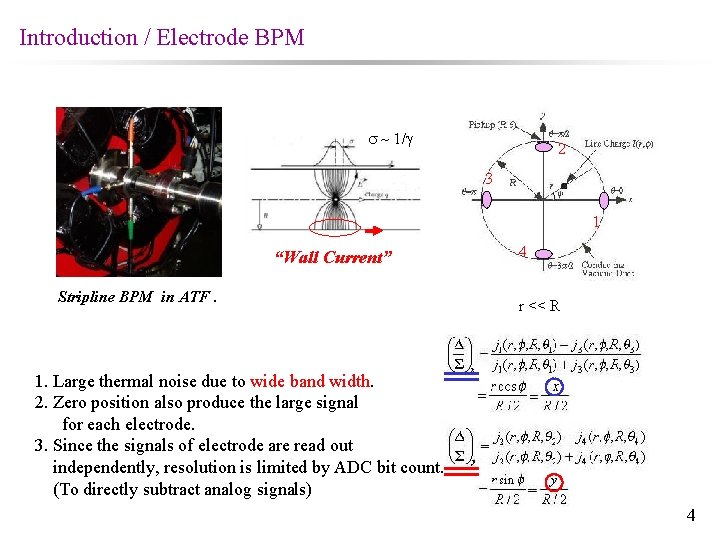
Introduction / Electrode BPM s ~ 1/g 2 3 1 “Wall Current” Stripline BPM in ATF. 4 r << R 1. Large thermal noise due to wide band width. 2. Zero position also produce the large signal for each electrode. 3. Since the signals of electrode are read out independently, resolution is limited by ADC bit count. (To directly subtract analog signals) 4
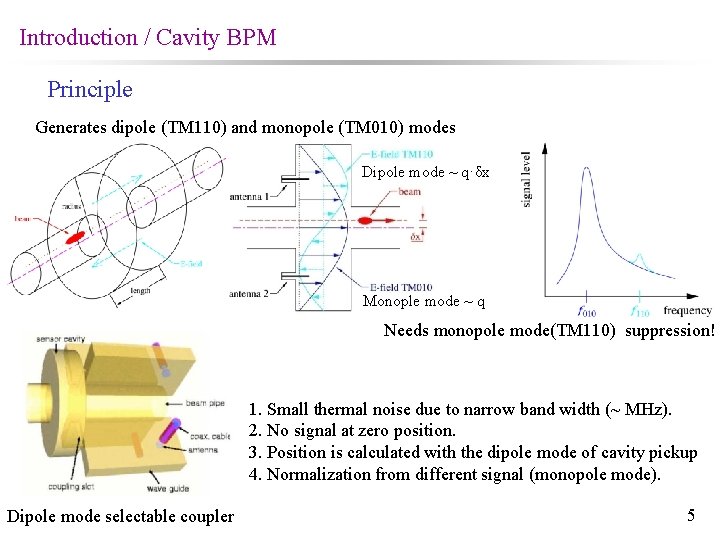
Introduction / Cavity BPM Principle Generates dipole (TM 110) and monopole (TM 010) modes Dipole mode ~ q·δx Monople mode ~ q Needs monopole mode(TM 110) suppression! 1. Small thermal noise due to narrow band width (~ MHz). 2. No signal at zero position. 3. Position is calculated with the dipole mode of cavity pickup 4. Normalization from different signal (monopole mode). Dipole mode selectable coupler 5
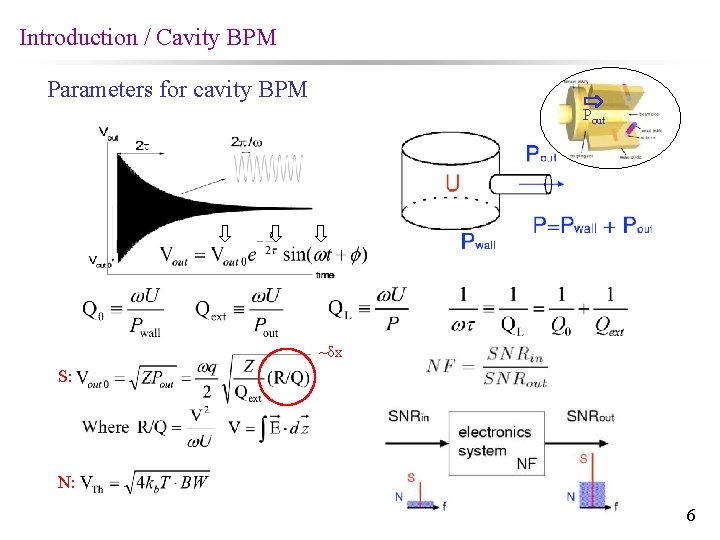
Introduction / Cavity BPM Parameters for cavity BPM Pout ~δx S: N: 6
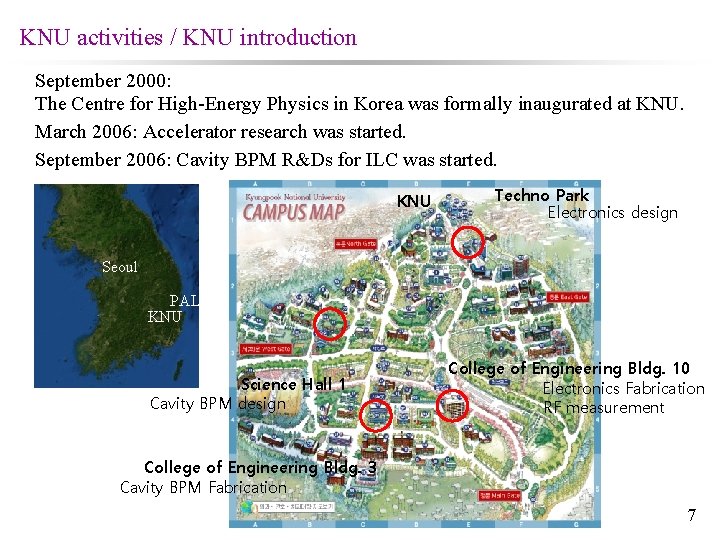
KNU activities / KNU introduction September 2000: The Centre for High-Energy Physics in Korea was formally inaugurated at KNU. March 2006: Accelerator research was started. September 2006: Cavity BPM R&Ds for ILC was started. KNU Techno Park Electronics design Seoul PAL KNU Science Hall 1 Cavity BPM design College of Engineering Bldg. 10 Electronics Fabrication RF measurement College of Engineering Bldg. 3 Cavity BPM Fabrication 7
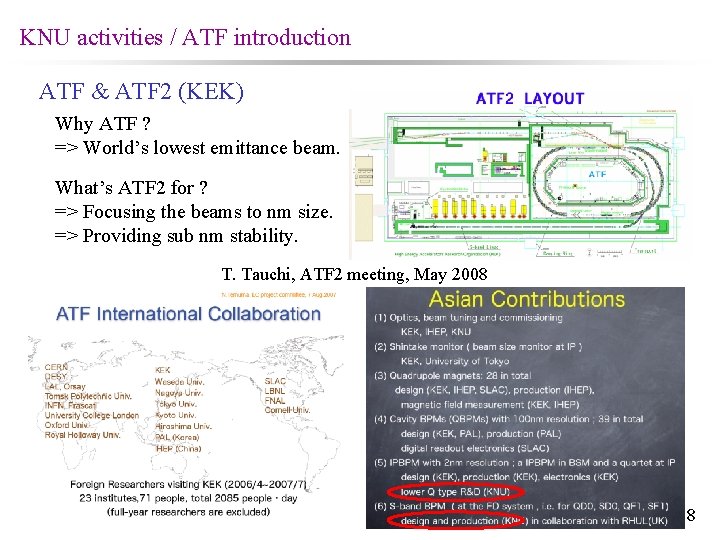
KNU activities / ATF introduction ATF & ATF 2 (KEK) Why ATF ? => World’s lowest emittance beam. What’s ATF 2 for ? => Focusing the beams to nm size. => Providing sub nm stability. T. Tauchi, ATF 2 meeting, May 2008 8
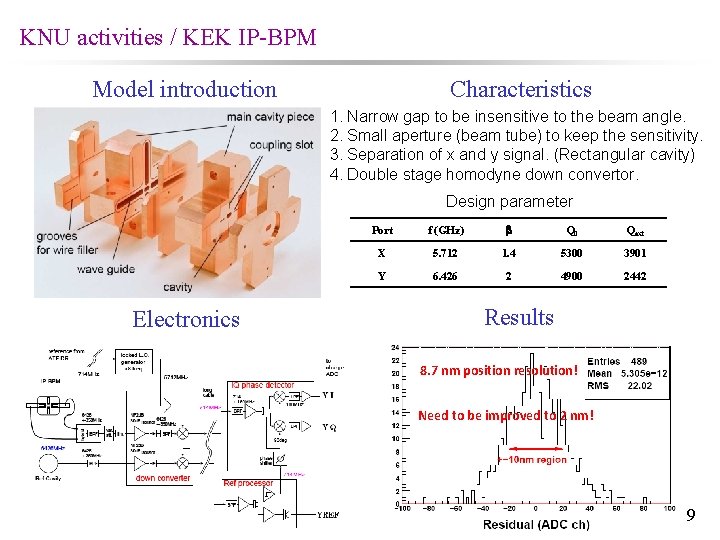
KNU activities / KEK IP-BPM Model introduction Characteristics 1. Narrow gap to be insensitive to the beam angle. 2. Small aperture (beam tube) to keep the sensitivity. 3. Separation of x and y signal. (Rectangular cavity) 4. Double stage homodyne down convertor. Design parameter Electronics Port f (GHz) b Q 0 Qext X 5. 712 1. 4 5300 3901 Y 6. 426 2 4900 2442 Results 8. 7 nm position resolution! Need to be improved to 2 nm! 9
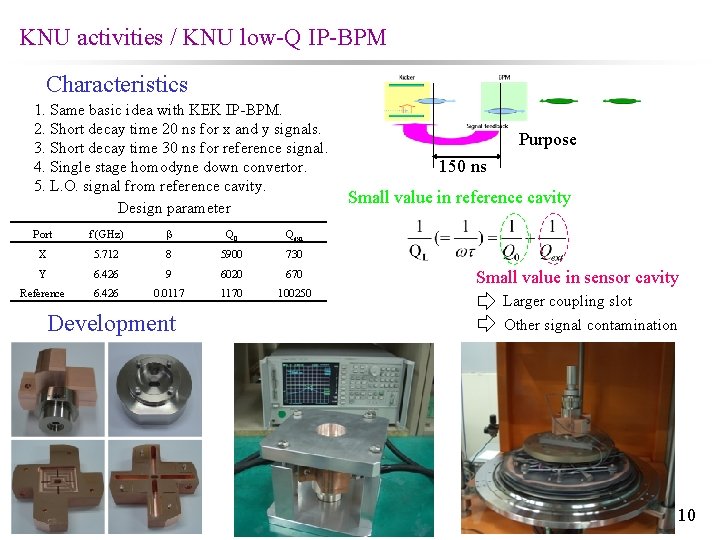
KNU activities / KNU low-Q IP-BPM Characteristics 1. Same basic idea with KEK IP-BPM. 2. Short decay time 20 ns for x and y signals. 3. Short decay time 30 ns for reference signal. 4. Single stage homodyne down convertor. 5. L. O. signal from reference cavity. Design parameter Port f (GHz) b Q 0 Qext X 5. 712 8 5900 730 Y 6. 426 9 6020 670 Reference 6. 426 0. 0117 1170 100250 Development Purpose 150 ns Small value in reference cavity Small value in sensor cavity Larger coupling slot Other signal contamination 10
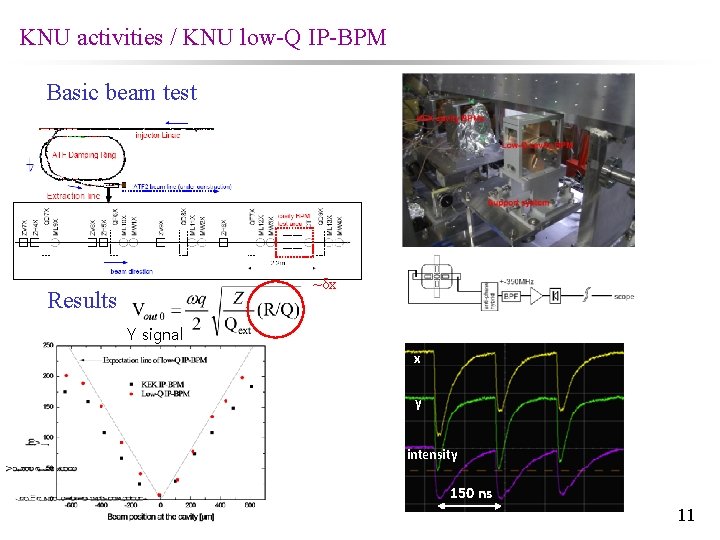
KNU activities / KNU low-Q IP-BPM Basic beam test ~δx Results Y signal x x y y intensity 150 ns 11
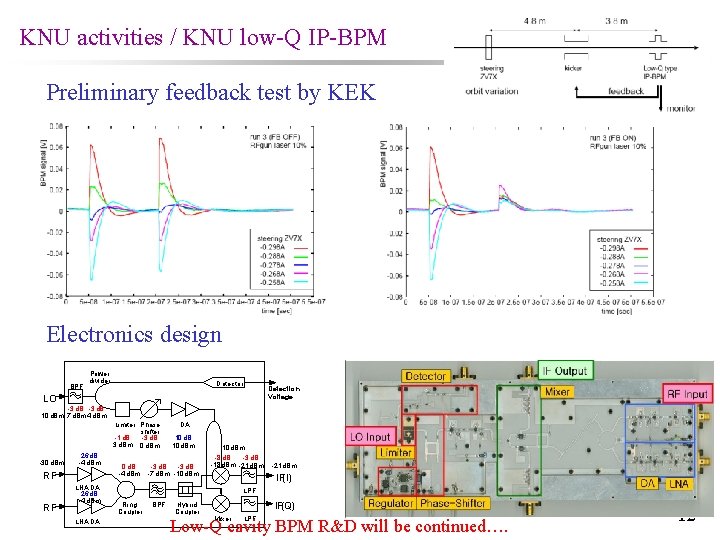
KNU activities / KNU low-Q IP-BPM Preliminary feedback test by KEK Electronics design BPF Power divider Detector Detection Voltage LO -3 d. B 10 d. Bm 7 d. Bm 4 d. Bm Limiter Phase shifter -1 d. B -3 d. Bm 0 d. Bm -30 d. Bm 26 d. B -4 d. Bm RF RF LNA DA 26 d. B -4 d. Bm LNA DA 0 d. B -4 d. Bm DA 10 d. Bm -3 d. B -7 d. Bm -10 d. Bm -8 d. B -3 d. B -18 d. Bm -21 d. Bm IF(I) LPF Ring Coupler BPF Hybrid Coupler IF(Q) Mixer LPF Low-Q cavity BPM R&D will be continued…. 12
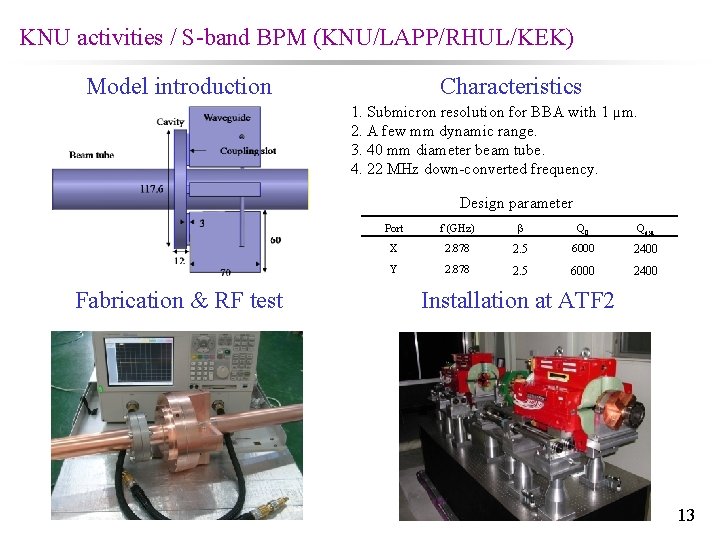
KNU activities / S-band BPM (KNU/LAPP/RHUL/KEK) Model introduction Characteristics 1. Submicron resolution for BBA with 1 µm. 2. A few mm dynamic range. 3. 40 mm diameter beam tube. 4. 22 MHz down-converted frequency. Design parameter Fabrication & RF test Port f (GHz) b Q 0 Qext X 2. 878 2. 5 6000 2400 Y 2. 878 2. 5 6000 2400 Installation at ATF 2 13
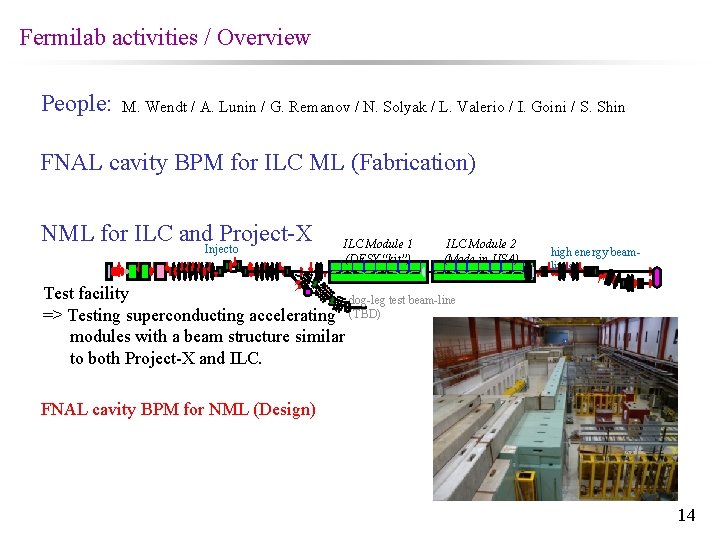
Fermilab activities / Overview People: M. Wendt / A. Lunin / G. Remanov / N. Solyak / L. Valerio / I. Goini / S. Shin FNAL cavity BPM for ILC ML (Fabrication) NML for ILC and Project-X Injecto r ILC Module 1 (DESY “kit”) ILC Module 2 (Made in USA) high energy beamlines Test facility dog-leg test beam-line => Testing superconducting accelerating (TBD) modules with a beam structure similar to both Project-X and ILC. FNAL cavity BPM for NML (Design) 14
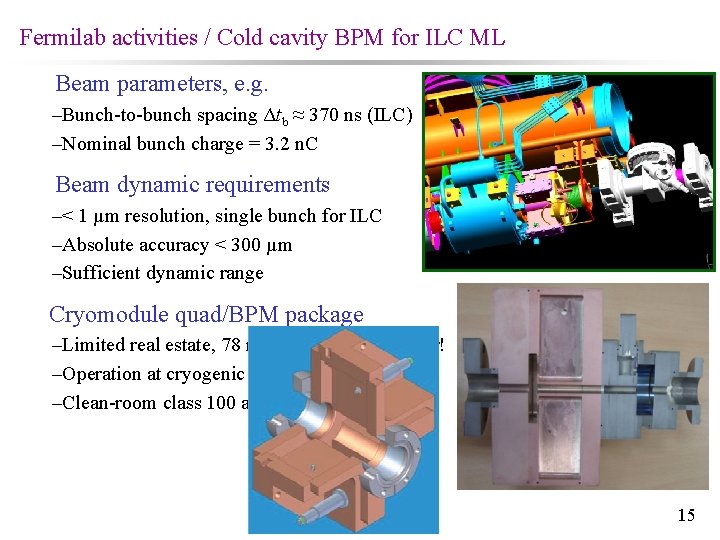
Fermilab activities / Cold cavity BPM for ILC ML Beam parameters, e. g. –Bunch-to-bunch spacing Δtb ≈ 370 ns (ILC) –Nominal bunch charge = 3. 2 n. C Beam dynamic requirements –< 1 µm resolution, single bunch for ILC –Absolute accuracy < 300 µm –Sufficient dynamic range Cryomodule quad/BPM package –Limited real estate, 78 mm beam pipe diameter! –Operation at cryogenic temperatures (2 -10 K) –Clean-room class 100 and UHV certification 15
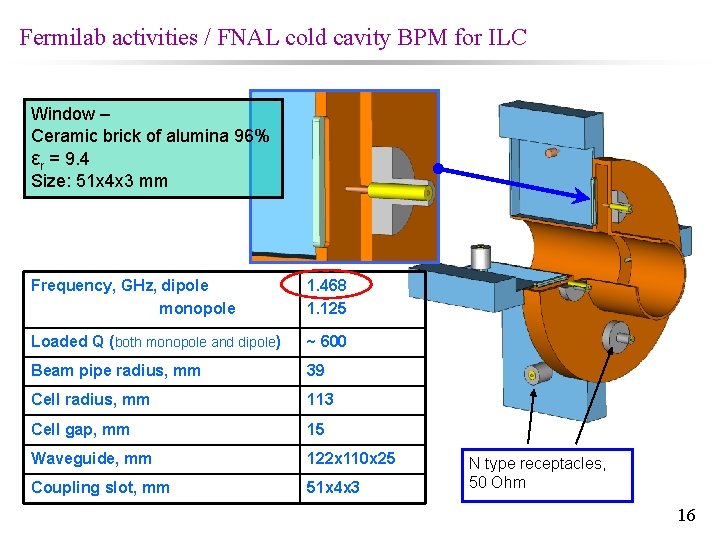
Fermilab activities / FNAL cold cavity BPM for ILC Window – Ceramic brick of alumina 96% εr = 9. 4 Size: 51 x 4 x 3 mm Frequency, GHz, dipole monopole 1. 468 1. 125 Loaded Q (both monopole and dipole) ~ 600 Beam pipe radius, mm 39 Cell radius, mm 113 Cell gap, mm 15 Waveguide, mm 122 x 110 x 25 Coupling slot, mm 51 x 4 x 3 N type receptacles, 50 Ohm 16
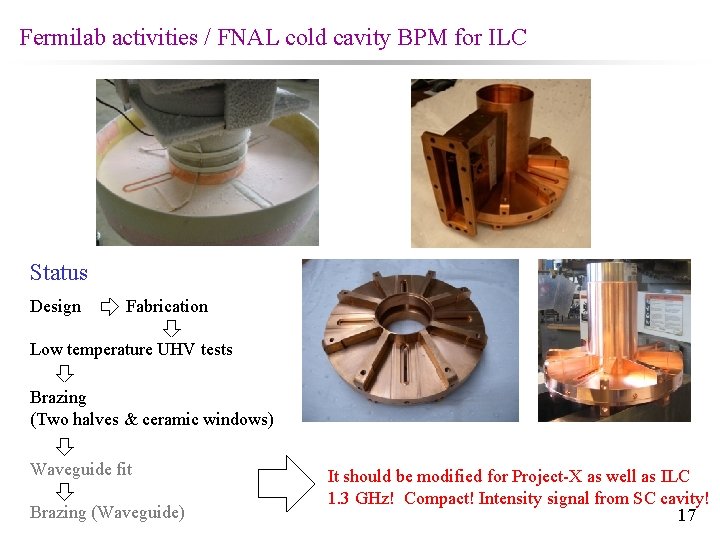
Fermilab activities / FNAL cold cavity BPM for ILC Status Design Fabrication Low temperature UHV tests Brazing (Two halves & ceramic windows) Waveguide fit Brazing (Waveguide) It should be modified for Project-X as well as ILC 1. 3 GHz! Compact! Intensity signal from SC cavity! 17
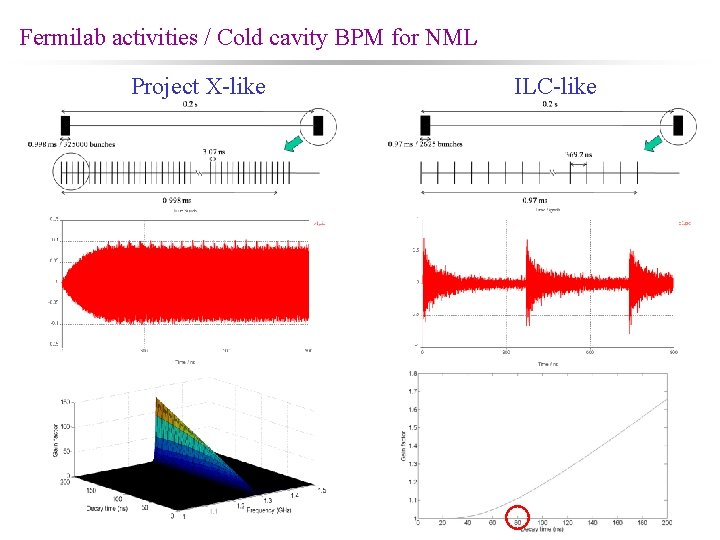
Fermilab activities / Cold cavity BPM for NML Project X-like ILC-like 18
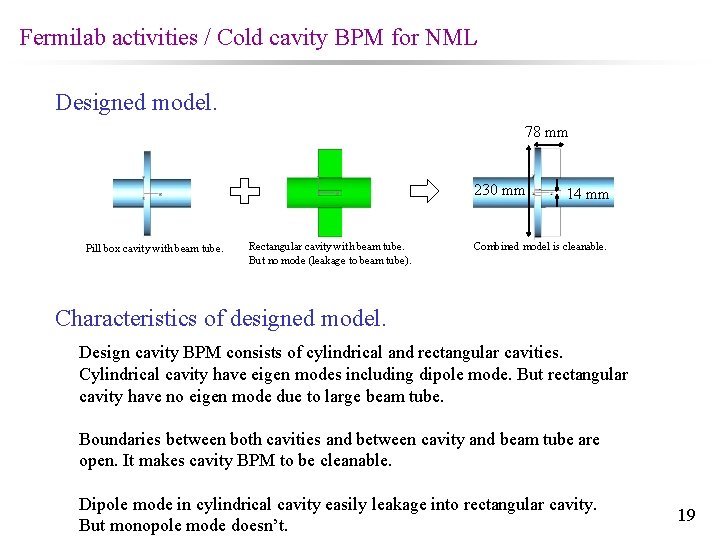
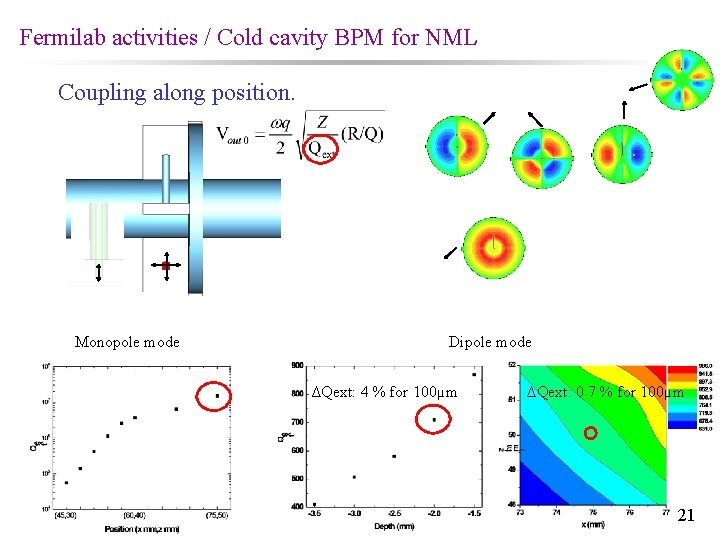
Fermilab activities / Cold cavity BPM for NML Designed model. 78 mm 230 mm Pill box cavity with beam tube. Rectangular cavity with beam tube. But no mode (leakage to beam tube). 14 mm Combined model is cleanable. Characteristics of designed model. Design cavity BPM consists of cylindrical and rectangular cavities. Cylindrical cavity have eigen modes including dipole mode. But rectangular cavity have no eigen mode due to large beam tube. Boundaries between both cavities and between cavity and beam tube are open. It makes cavity BPM to be cleanable. Dipole mode in cylindrical cavity easily leakage into rectangular cavity. But monopole mode doesn’t. 19
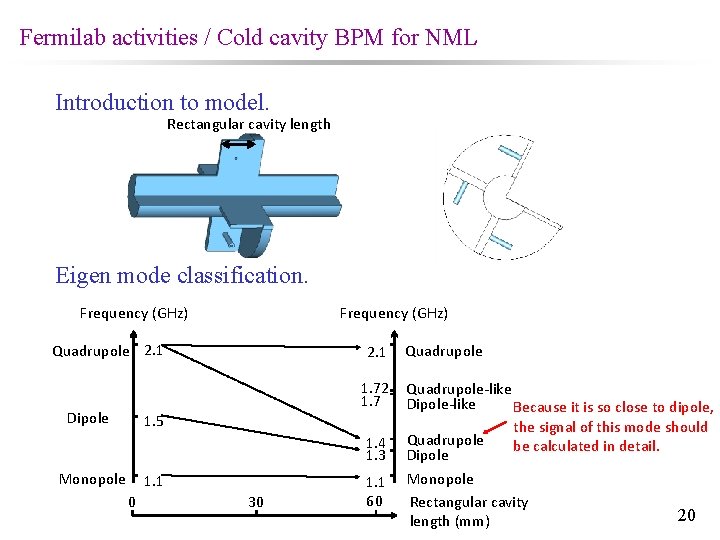
Fermilab activities / Cold cavity BPM for NML Introduction to model. Rectangular cavity length Eigen mode classification. Frequency (GHz) Quadrupole 2. 1 1. 72 1. 7 Dipole 1. 5 1. 4 1. 3 Monopole 1. 1 0 30 1. 1 60 Quadrupole-like Dipole-like Because it is so close to dipole, the signal of this mode should Quadrupole be calculated in detail. Dipole Monopole Rectangular cavity 20 length (mm)
Fermilab activities / Cold cavity BPM for NML Coupling along position. Monopole mode Dipole mode ΔQext: 4 % for 100µm ΔQext: 0. 7 % for 100µm 21
Fermilab activities / Cold cavity BPM for NML Normalized shunt impedance. ~δx route 1 route 2 (1 mm offset) Dipole mode Quad. mode 0. 44 µm / µrad Beam Cavity Rectangular structure 22
Fermilab activities / Cold cavity BPM for NML PIC simulation I. Beam parameters - offset (3 mm, 3 mm) - 3. 2 n. C - 24 mm rms length 1 2 23
Fermilab activities / Cold cavity BPM for NML PIC simulation II. Equivalent position signal of trajectory angle is ~ 0. 43 µm / µrad (0. 44 µm / µrad ) 24
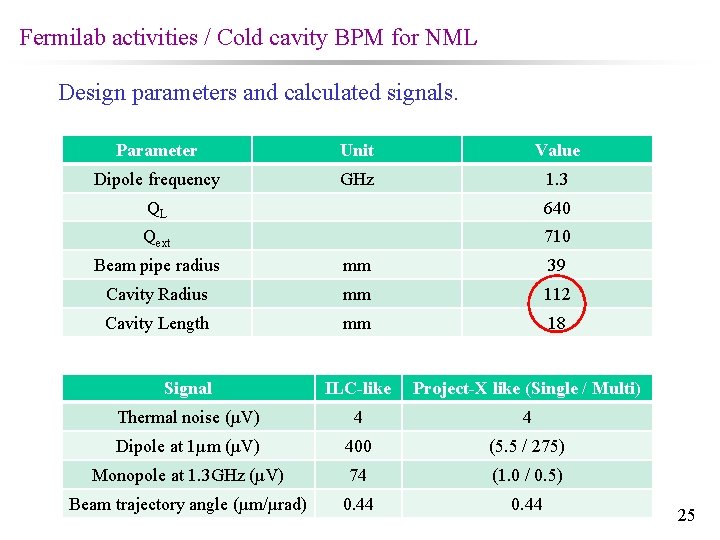
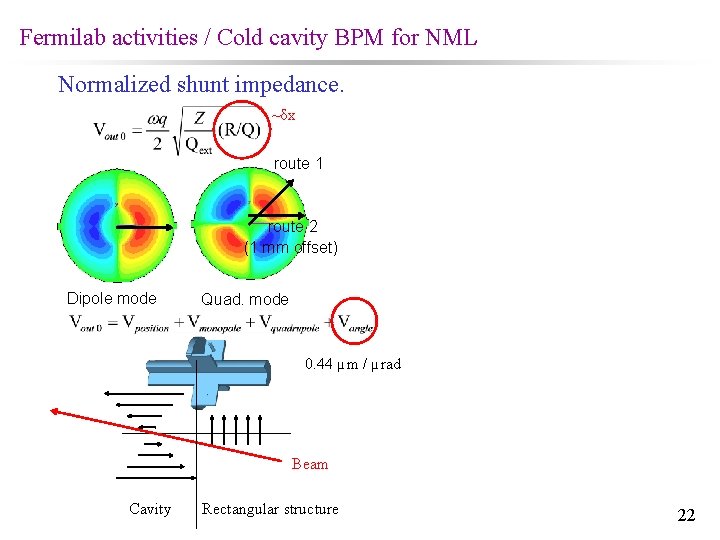
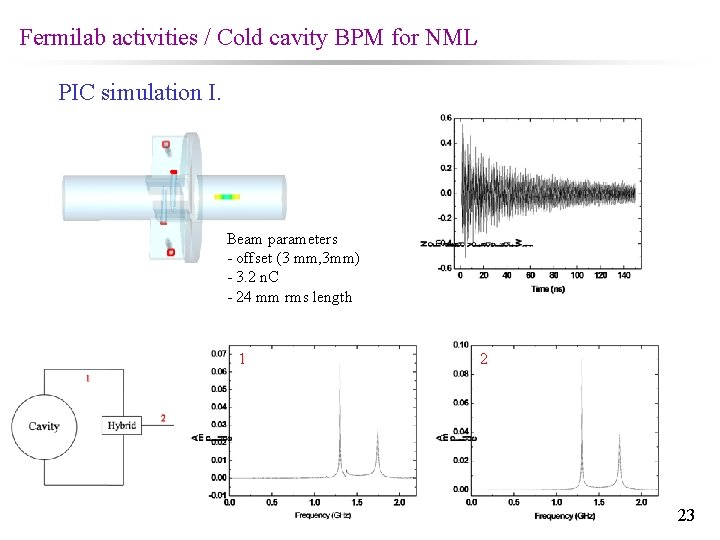
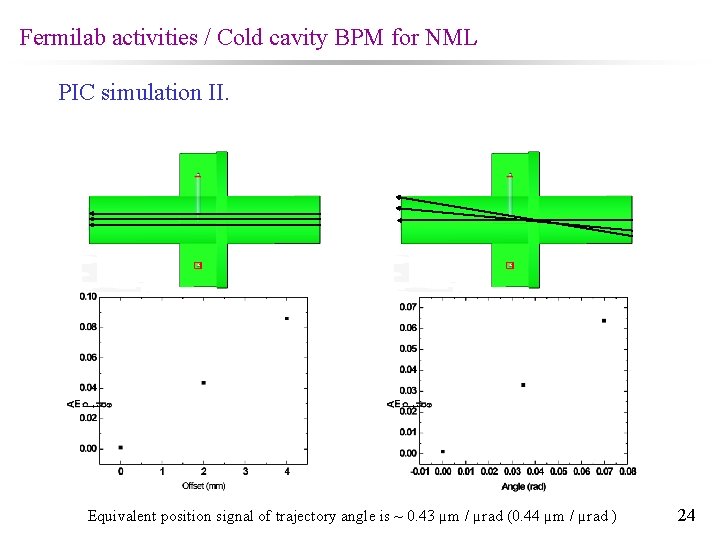
Fermilab activities / Cold cavity BPM for NML Design parameters and calculated signals. Parameter Unit Value Dipole frequency GHz 1. 3 QL 640 Qext 710 Beam pipe radius mm 39 Cavity Radius mm 112 Cavity Length mm 18 Signal ILC-like Project-X like (Single / Multi) Thermal noise (µV) 4 4 Dipole at 1µm (µV) 400 (5. 5 / 275) Monopole at 1. 3 GHz (µV) 74 (1. 0 / 0. 5) Beam trajectory angle (µm/µrad) 0. 44 25
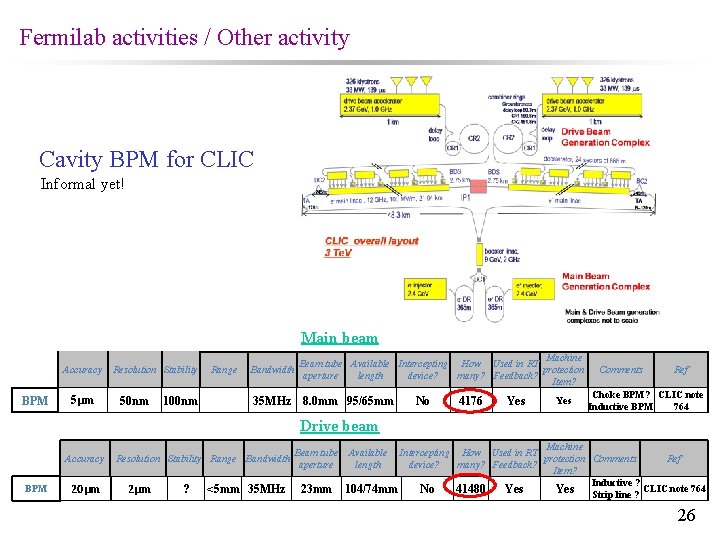
Fermilab activities / Other activity Cavity BPM for CLIC Informal yet! Main beam Accuracy BPM 5µm Resolution Stability 50 nm 100 nm Range Bandwidth 35 MHz Machine Beam tube Available Intercepting How Used in RT protection aperture length device? many? Feedback? Item? 8. 0 mm 95/65 mm No 4176 Yes Comments Ref Choke BPM? CLIC note Inductive BPM 764 Drive beam Accuracy BPM 20µm Resolution Stability Range Bandwidth 2µm ? <5 mm 35 MHz Beam tube aperture 23 mm Machine Intercepting How Used in RT Ref protection Comments device? many? Feedback? Item? Inductive ? 104/74 mm No 41480 Yes Strip line ? CLIC note 764 Available length 26
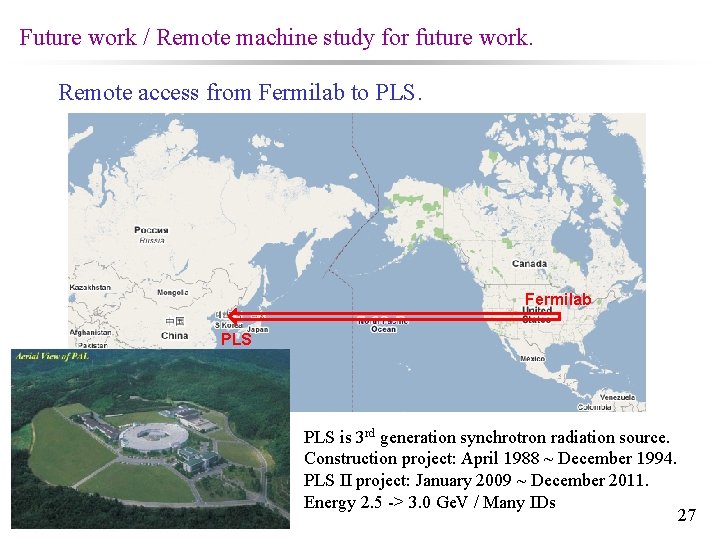
Future work / Remote machine study for future work. Remote access from Fermilab to PLS. Fermilab PLS is 3 rd generation synchrotron radiation source. Construction project: April 1988 ~ December 1994. PLS II project: January 2009 ~ December 2011. Energy 2. 5 -> 3. 0 Ge. V / Many IDs 27
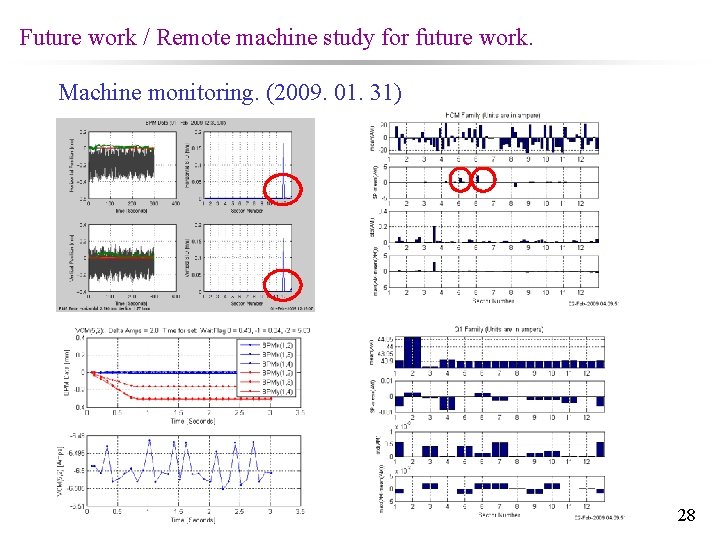
Future work / Remote machine study for future work. Machine monitoring. (2009. 01. 31) 28
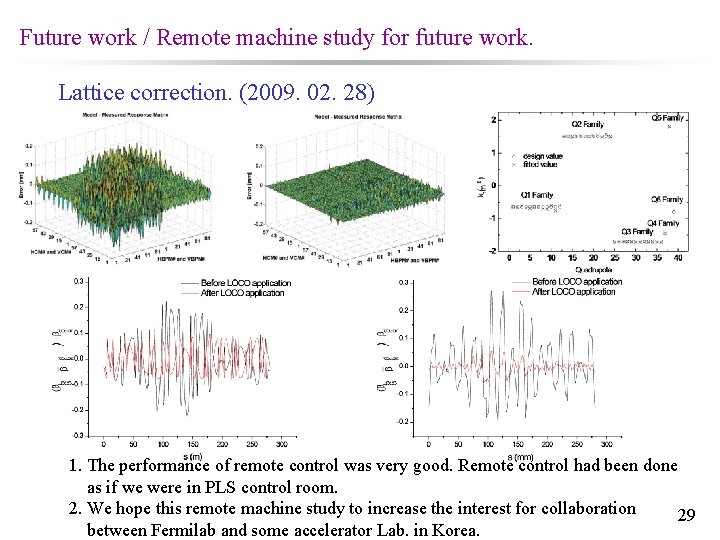
Future work / Remote machine study for future work. Lattice correction. (2009. 02. 28) 1. The performance of remote control was very good. Remote control had been done as if we were in PLS control room. 2. We hope this remote machine study to increase the interest for collaboration 29 between Fermilab and some accelerator Lab. in Korea.
Summary KNU activities • KNU have performed cavity BPM R&Ds for ILC. • System for cavity BPM development is established in KNU. • Low-Q cavity BPM and S-band cavity BPM with international collaboration is being performed in KNU. Fermilab activities • The development of cold cavity BPM for ILC is almost done. • Design studies for cold cavity BPM for NML are finished. • Cavity BPM work for CLIC was informally started. Future work • The result of remote machine study was shown to increase the interest for collaboration. 30
- Slides: 30