
Status of particlehp Pedro Arce Emilio Mendoza Daniel
- Slides: 16
Status of particle_hp Pedro Arce Emilio Mendoza Daniel Cano-Ott (CIEMAT, Madrid)
What is particle_hp? neutron_hp package uses evaluated nuclear data bases for neutron interactions: Total cross sections Inelastic channel cross sections Double differential spectra of outgoing particles Gamma emission because of nuclear level transitions particle_hp: do the same for (inelastic) interactions of other particles (p, d, t, He 3, , ) Inelastic interactions of p/d/t/He 3/ particles E < 200 Me. V G 4 WS, September 2012 Status of particle_hp 2
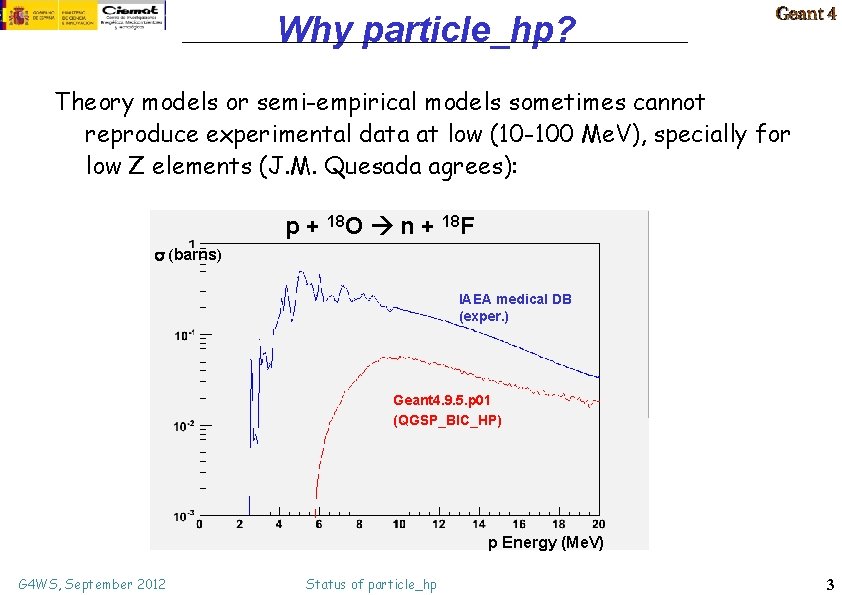
Why particle_hp? Theory models or semi-empirical models sometimes cannot reproduce experimental data at low (10 -100 Me. V), specially for low Z elements (J. M. Quesada agrees): p + 18 O n + 18 F (barns) IAEA medical DB (exper. ) Geant 4. 9. 5. p 01 (QGSP_BIC_HP) p Energy (Me. V) G 4 WS, September 2012 Status of particle_hp 3
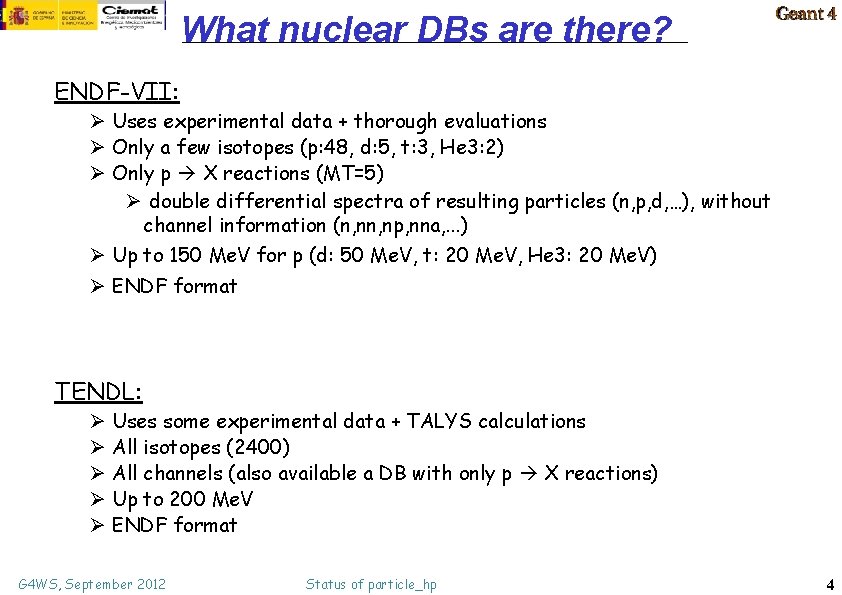
What nuclear DBs are there? ENDF-VII: Uses experimental data + thorough evaluations Only a few isotopes (p: 48, d: 5, t: 3, He 3: 2) Only p X reactions (MT=5) double differential spectra of resulting particles (n, p, d, …), without channel information (n, np, nna, . . . ) Up to 150 Me. V for p (d: 50 Me. V, t: 20 Me. V, He 3: 20 Me. V) ENDF format TENDL: Uses some experimental data + TALYS calculations All isotopes (2400) All channels (also available a DB with only p X reactions) Up to 200 Me. V ENDF format G 4 WS, September 2012 Status of particle_hp 4
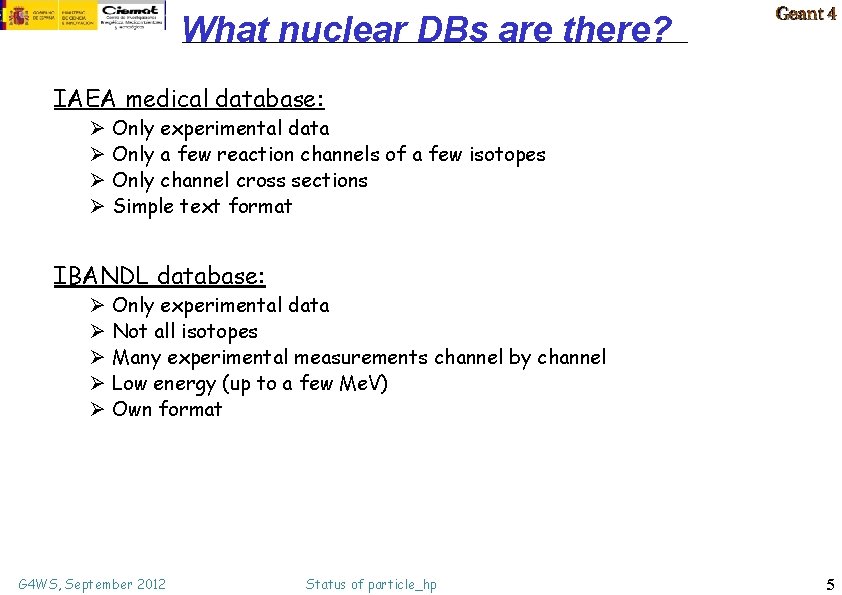
What nuclear DBs are there? IAEA medical database: Only experimental data Only a few reaction channels of a few isotopes Only channel cross sections Simple text format IBANDL database: Only experimental data Not all isotopes Many experimental measurements channel by channel Low energy (up to a few Me. V) Own format G 4 WS, September 2012 Status of particle_hp 5
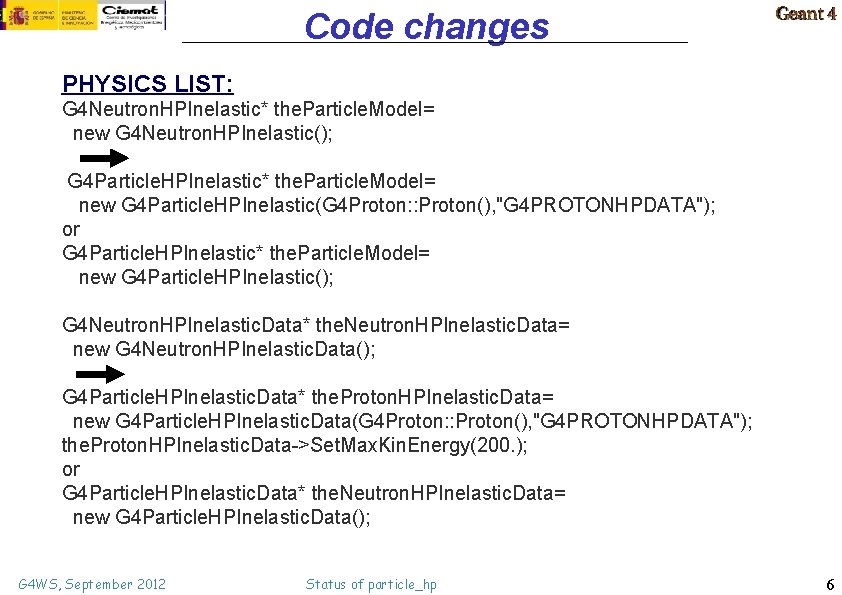
Code changes PHYSICS LIST: G 4 Neutron. HPInelastic* the. Particle. Model= new G 4 Neutron. HPInelastic(); G 4 Particle. HPInelastic* the. Particle. Model= new G 4 Particle. HPInelastic(G 4 Proton: : Proton(), "G 4 PROTONHPDATA"); or G 4 Particle. HPInelastic* the. Particle. Model= new G 4 Particle. HPInelastic(); G 4 Neutron. HPInelastic. Data* the. Neutron. HPInelastic. Data= new G 4 Neutron. HPInelastic. Data(); G 4 Particle. HPInelastic. Data* the. Proton. HPInelastic. Data= new G 4 Particle. HPInelastic. Data(G 4 Proton: : Proton(), "G 4 PROTONHPDATA"); the. Proton. HPInelastic. Data->Set. Max. Kin. Energy(200. ); or G 4 Particle. HPInelastic. Data* the. Neutron. HPInelastic. Data= new G 4 Particle. HPInelastic. Data(); the. Particle. Model = new G 4 Particle. HPInelastic(G 4 Proton: : Proton(), "G 4 PROTONHPDATA"); G 4 WS, September 2012 Status of particle_hp 6
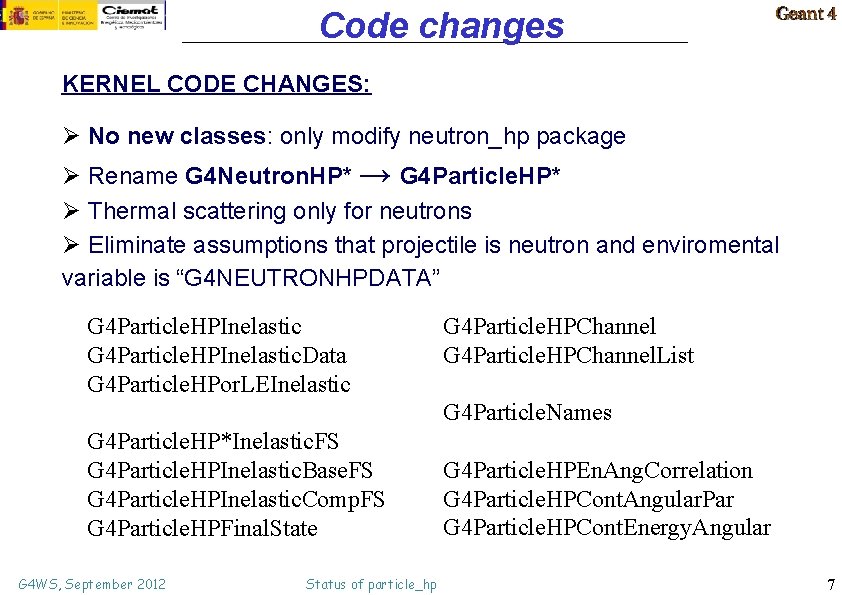
Code changes KERNEL CODE CHANGES: No new classes: only modify neutron_hp package Rename G 4 Neutron. HP* → G 4 Particle. HP* Thermal scattering only for neutrons Eliminate assumptions that projectile is neutron and enviromental variable is “G 4 NEUTRONHPDATA” G 4 Particle. HPInelastic. Data G 4 Particle. HPor. LEInelastic G 4 Particle. HPChannel. List G 4 Particle. Names G 4 Particle. HP*Inelastic. FS G 4 Particle. HPInelastic. Base. FS G 4 Particle. HPInelastic. Comp. FS G 4 Particle. HPFinal. State the. Particle. Model = new G 4 Particle. HPEn. Ang. Correlation G 4 Particle. HPCont. Angular. Par G 4 Particle. HPCont. Energy. Angular G 4 Particle. HPInelastic(G 4 Proton: : Proton(), "G 4 PROTONHPDATA"); G 4 WS, September 2012 Status of particle_hp 7
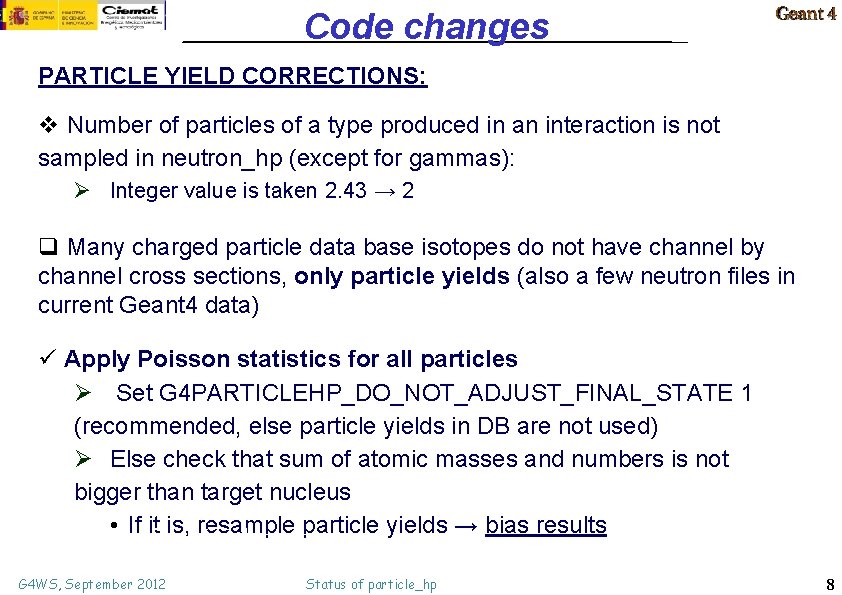
Code changes PARTICLE YIELD CORRECTIONS: Number of particles of a type produced in an interaction is not sampled in neutron_hp (except for gammas): Integer value is taken 2. 43 → 2 Many charged particle data base isotopes do not have channel by channel cross sections, only particle yields (also a few neutron files in current Geant 4 data) Apply Poisson statistics for all particles Set G 4 PARTICLEHP_DO_NOT_ADJUST_FINAL_STATE 1 (recommended, else particle yields in DB are not used) Else check that sum of atomic masses and numbers is not bigger than target nucleus • If it is, resample particle yields → bias results the. Particle. Model = new G 4 Particle. HPInelastic(G 4 Proton: : Proton(), "G 4 PROTONHPDATA"); G 4 WS, September 2012 Status of particle_hp 8
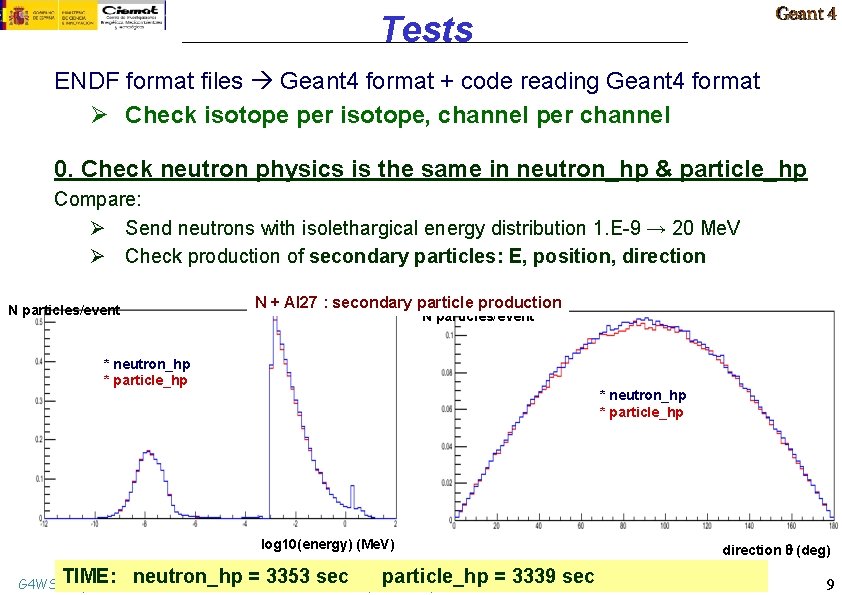
Tests ENDF format files Geant 4 format + code reading Geant 4 format Check isotope per isotope, channel per channel 0. Check neutron physics is the same in neutron_hp & particle_hp Compare: Send neutrons with isolethargical energy distribution 1. E-9 → 20 Me. V Check production of secondary particles: E, position, direction N particles/event N + Al 27 : secondary particle production N particles/event * neutron_hp * particle_hp log 10(energy) (Me. V) G 4 WS, TIME: Septemberneutron_hp 2012 = 3353 Status sec of particle_hp = 3339 sec direction (deg) 9
Tests 1. Check total cross sections Run a Geant 4 job. 1 proton per energy Ask for cross sections as in a real Geant 4 run (G 4 Hadronic. Process: : Get. Microscopic. Cross. Section) Compare to cross sections from TENDL web SORRY. I CANNOT DO FTP OR SSH TO GET THE PLOTS BELIEVE ME THEY ARE OK G 4 WS, September 2012 Status of particle_hp E (Me. V) 10
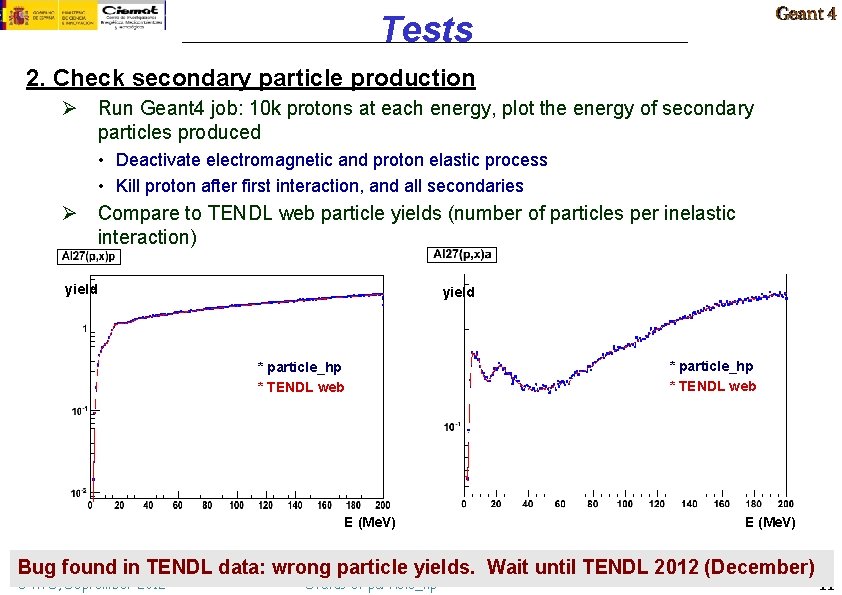
Tests 2. Check secondary particle production Run Geant 4 job: 10 k protons at each energy, plot the energy of secondary particles produced • Deactivate electromagnetic and proton elastic process • Kill proton after first interaction, and all secondaries Compare to TENDL web particle yields (number of particles per inelastic interaction) yield * particle_hp * TENDL web E (Me. V) Bug found in TENDL data: wrong particle yields. Wait until TENDL 2012 (December) G 4 WS, September 2012 Status of particle_hp 11
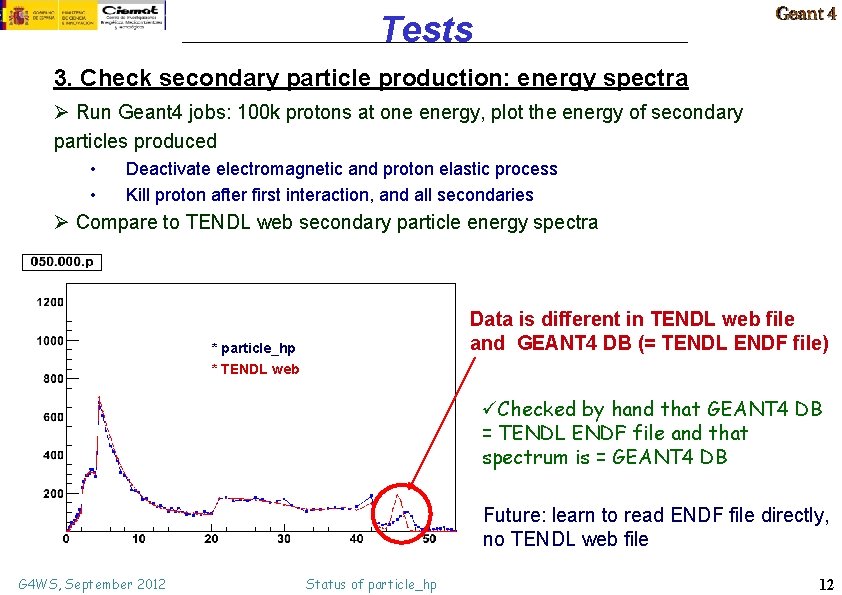
Tests 3. Check secondary particle production: energy spectra Run Geant 4 jobs: 100 k protons at one energy, plot the energy of secondary particles produced • • Deactivate electromagnetic and proton elastic process Kill proton after first interaction, and all secondaries Compare to TENDL web secondary particle energy spectra Data is different in TENDL web file and GEANT 4 DB (= TENDL ENDF file) * particle_hp * TENDL web Checked by hand that GEANT 4 DB = TENDL ENDF file and that spectrum is = GEANT 4 DB Future: learn to read ENDF file directly, no TENDL web file G 4 WS, September 2012 Status of particle_hp 12
Tests 4. Check secondary particle production: emission angle spectra Run Geant 4 jobs: 100 k protons at one energy, plot the emission angle of secondary particles produced • • Deactivate electromagnetic and proton elastic process Kill proton after first interaction, and all secondaries Compare to TENDL web secondary particle energy spectra Postponed until TENDL web files are corrected (ENDF files do not contain emission angle spectra, only Kallback-Mann coefficients) G 4 WS, September 2012 Status of particle_hp 13
Tests 5. Compare with MCNP has the possibility to read evaluated data base for protons Own data with a few isotopes (LAH 150) TENDL data Compare yield of particles, secondary particles energy and emission angle spectra Work started with the help of a MCNP expert G 4 WS, September 2012 Status of particle_hp 14
Tests Automatic testing A set of python and ROOT scripts do the job with one line sh check. Particle. HP. sh Al 27 - Download all files from TENDL web - Prepare and send Geant 4 jobs (may take a few hours, user decides the statistics) - Get total cross sections and particle yields - Get energy spectra with same binning as TENDL web files - Get emission angle spectra with same binning as TENDL web files - Prepare plots comparing Geant 4 particle_hp and TENDL in gif format G 4 WS, September 2012 Status of particle_hp 15
Conclusions Geant 4 (and other MC) theoretical models do not work well for charged particle (p, d, t, He 3, ) inelastic interactions at E < 200 Me. V Alternative implemented: use evaluated data bases Several available (ENDF, TENDL, IAEA medical, IBANDL) Only experimental data for a few isotopes, for others best guess theoretical interpolations Geant 4 code is working First tests done More tests on progress python code + ROOT scripts will be made public to test your favourite isotope by yourself G 4 WS, September 2012 Status of particle_hp 16