
Status of ICRP Committee 1 on Low Dose


- Slides: 18
Status of ICRP Committee 1 on Low Dose and Low Dose Rates for Ionizing Radiation Applicability of Radiation-Response Models to Low Dose Protection Standards American Nuclear Society & Health Physics Society Joint Topical Tri-Cities, Washington, US October 1, 2018 Werner Rühm, Helmholtz Center Munich, Germany
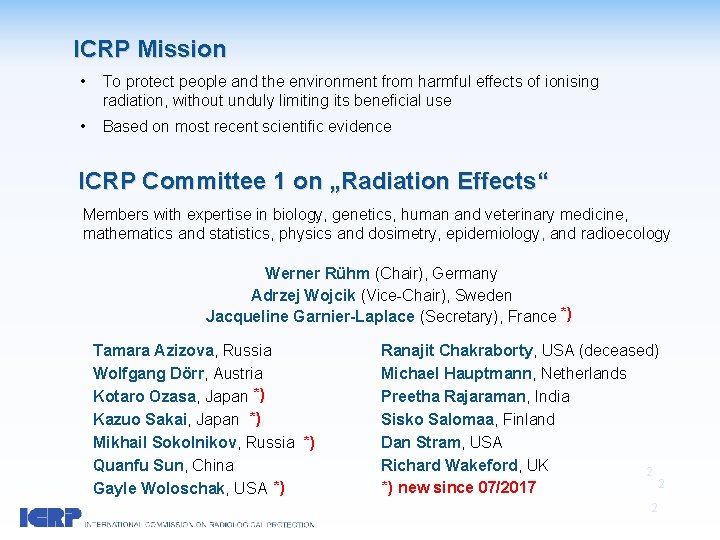
ICRP Mission • To protect people and the environment from harmful effects of ionising radiation, without unduly limiting its beneficial use • Based on most recent scientific evidence ICRP Committee 1 on „Radiation Effects“ Members with expertise in biology, genetics, human and veterinary medicine, mathematics and statistics, physics and dosimetry, epidemiology, and radioecology Werner Rühm (Chair), Germany Adrzej Wojcik (Vice-Chair), Sweden Jacqueline Garnier-Laplace (Secretary), France *) Tamara Azizova, Russia Wolfgang Dörr, Austria Kotaro Ozasa, Japan *) Kazuo Sakai, Japan *) Mikhail Sokolnikov, Russia *) Quanfu Sun, China Gayle Woloschak, USA *) Ranajit Chakraborty, USA (deceased) Michael Hauptmann, Netherlands Preetha Rajaraman, India Sisko Salomaa, Finland Dan Stram, USA Richard Wakeford, UK 2 2 *) new since 07/2017 2
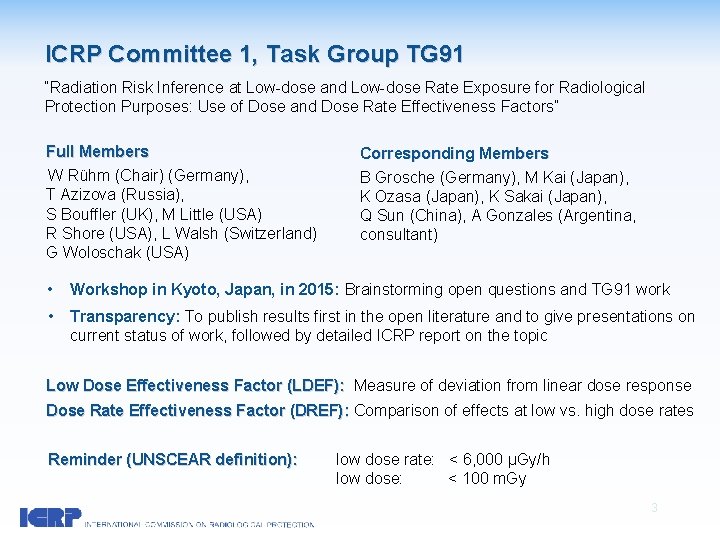
ICRP Committee 1, Task Group TG 91 “Radiation Risk Inference at Low-dose and Low-dose Rate Exposure for Radiological Protection Purposes: Use of Dose and Dose Rate Effectiveness Factors” Full Members W Rühm (Chair) (Germany), T Azizova (Russia), S Bouffler (UK), M Little (USA) R Shore (USA), L Walsh (Switzerland) G Woloschak (USA) Corresponding Members B Grosche (Germany), M Kai (Japan), K Ozasa (Japan), K Sakai (Japan), Q Sun (China), A Gonzales (Argentina, consultant) • Workshop in Kyoto, Japan, in 2015: Brainstorming open questions and TG 91 work • Transparency: To publish results first in the open literature and to give presentations on current status of work, followed by detailed ICRP report on the topic Low Dose Effectiveness Factor (LDEF): Measure of deviation from linear dose response Dose Rate Effectiveness Factor (DREF): Comparison of effects at low vs. high dose rates Reminder (UNSCEAR definition): low dose rate: < 6, 000 μGy/h low dose: < 100 m. Gy 3
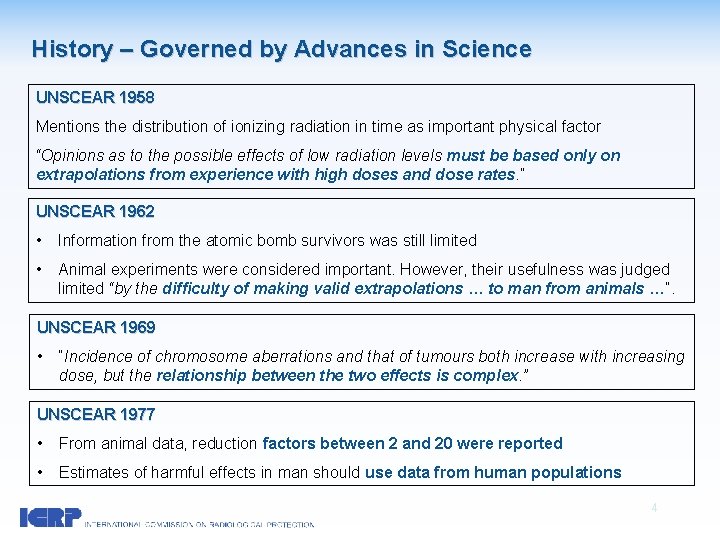
History – Governed by Advances in Science UNSCEAR 1958 Mentions the distribution of ionizing radiation in time as important physical factor “Opinions as to the possible effects of low radiation levels must be based only on extrapolations from experience with high doses and dose rates. ” UNSCEAR 1962 • Information from the atomic bomb survivors was still limited • Animal experiments were considered important. However, their usefulness was judged limited “by the difficulty of making valid extrapolations … to man from animals …”. UNSCEAR 1969 • “Incidence of chromosome aberrations and that of tumours both increase with increasing dose, but the relationship between the two effects is complex. ” UNSCEAR 1977 • From animal data, reduction factors between 2 and 20 were reported • Estimates of harmful effects in man should use data from human populations 4
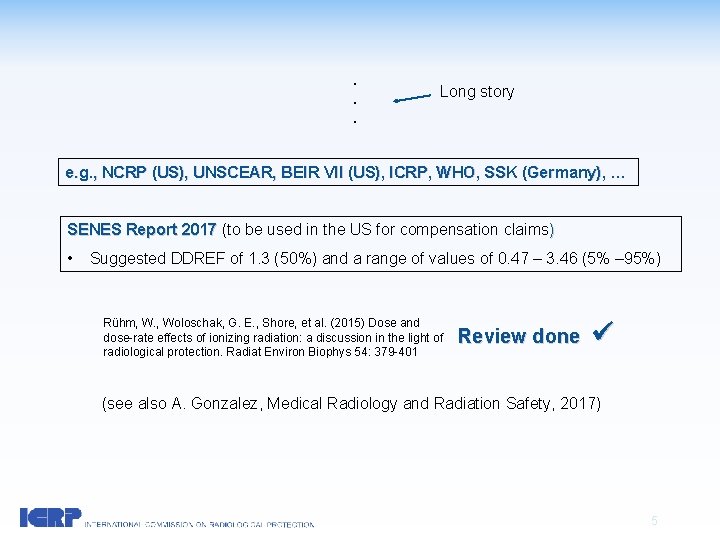
. . . Long story e. g. , NCRP (US), UNSCEAR, BEIR VII (US), ICRP, WHO, SSK (Germany), … SENES Report 2017 (to be used in the US for compensation claims) • Suggested DDREF of 1. 3 (50%) and a range of values of 0. 47 – 3. 46 (5% – 95%) Rühm, W. , Woloschak, G. E. , Shore, et al. (2015) Dose and dose-rate effects of ionizing radiation: a discussion in the light of radiological protection. Radiat Environ Biophys 54: 379 -401 Review done (see also A. Gonzalez, Medical Radiology and Radiation Safety, 2017) 5
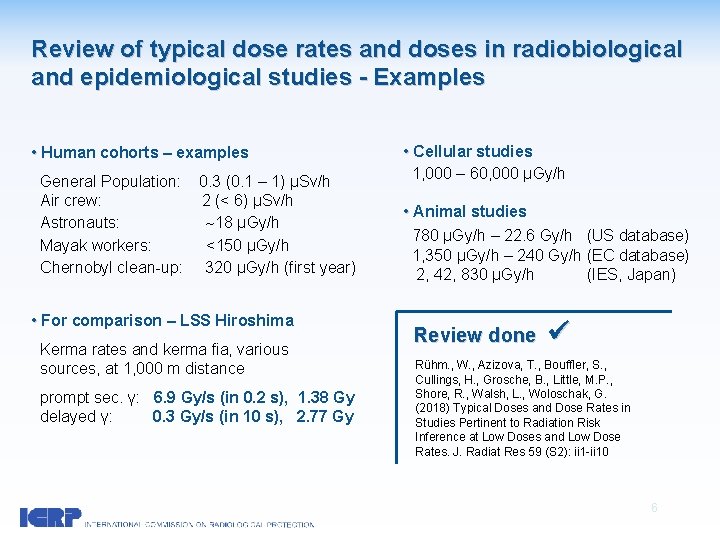
Review of typical dose rates and doses in radiobiological and epidemiological studies - Examples • Human cohorts – examples General Population: 0. 3 (0. 1 – 1) μSv/h Air crew: 2 (< 6) μSv/h Astronauts: 18 μGy/h Mayak workers: <150 μGy/h Chernobyl clean-up: 320 μGy/h (first year) • For comparison – LSS Hiroshima Kerma rates and kerma fia, various sources, at 1, 000 m distance prompt sec. γ: 6. 9 Gy/s (in 0. 2 s), 1. 38 Gy delayed γ: 0. 3 Gy/s (in 10 s), 2. 77 Gy • Cellular studies 1, 000 – 60, 000 μGy/h • Animal studies 780 μGy/h – 22. 6 Gy/h (US database) 1, 350 μGy/h – 240 Gy/h (EC database) 2, 42, 830 μGy/h (IES, Japan) Review done Rühm. , W. , Azizova, T. , Bouffler, S. , Cullings, H. , Grosche, B. , Little, M. P. , Shore, R. , Walsh, L. , Woloschak, G. (2018) Typical Doses and Dose Rates in Studies Pertinent to Radiation Risk Inference at Low Doses and Low Dose Rates. J. Radiat Res 59 (S 2): ii 1 -ii 10 6
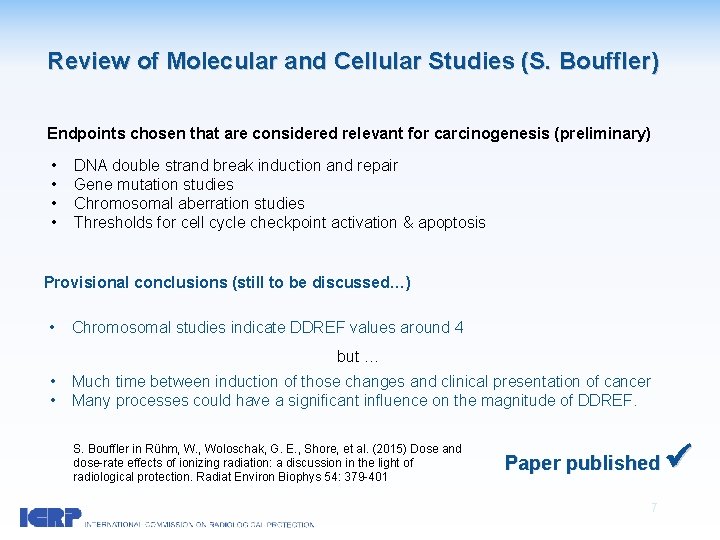
Review of Molecular and Cellular Studies (S. Bouffler) Endpoints chosen that are considered relevant for carcinogenesis (preliminary) • • DNA double strand break induction and repair Gene mutation studies Chromosomal aberration studies Thresholds for cell cycle checkpoint activation & apoptosis Provisional conclusions (still to be discussed…) • Chromosomal studies indicate DDREF values around 4 but … • • Much time between induction of those changes and clinical presentation of cancer Many processes could have a significant influence on the magnitude of DDREF. S. Bouffler in Rühm, W. , Woloschak, G. E. , Shore, et al. (2015) Dose and dose-rate effects of ionizing radiation: a discussion in the light of radiological protection. Radiat Environ Biophys 54: 379 -401 Paper published 7
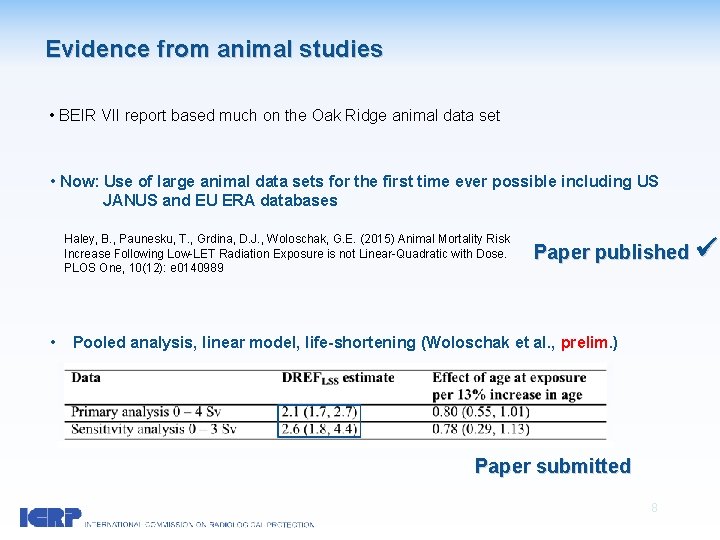
Evidence from animal studies • BEIR VII report based much on the Oak Ridge animal data set • Now: Use of large animal data sets for the first time ever possible including US JANUS and EU ERA databases Haley, B. , Paunesku, T. , Grdina, D. J. , Woloschak, G. E. (2015) Animal Mortality Risk Increase Following Low-LET Radiation Exposure is not Linear-Quadratic with Dose. PLOS One, 10(12): e 0140989 • Paper published Pooled analysis, linear model, life-shortening (Woloschak et al. , prelim. ) Paper submitted 8
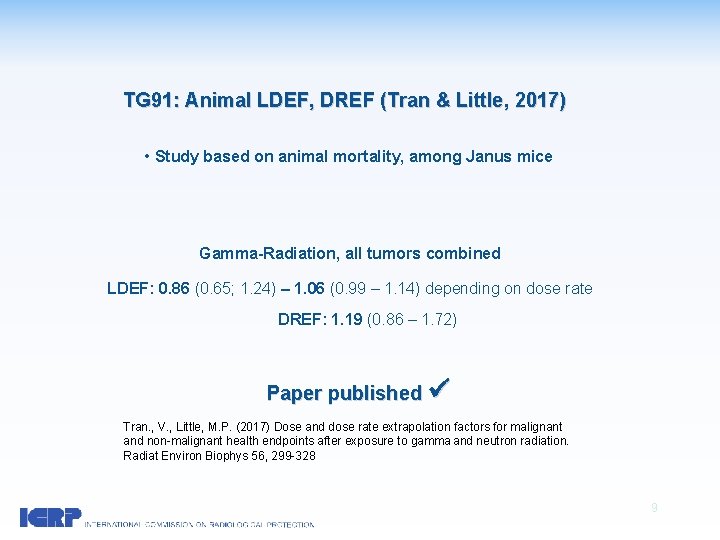
TG 91: Animal LDEF, DREF (Tran & Little, 2017) • Study based on animal mortality, among Janus mice Gamma-Radiation, all tumors combined LDEF: 0. 86 (0. 65; 1. 24) – 1. 06 (0. 99 – 1. 14) depending on dose rate DREF: 1. 19 (0. 86 – 1. 72) Paper published Tran. , V. , Little, M. P. (2017) Dose and dose rate extrapolation factors for malignant and non-malignant health endpoints after exposure to gamma and neutron radiation. Radiat Environ Biophys 56, 299 -328 9
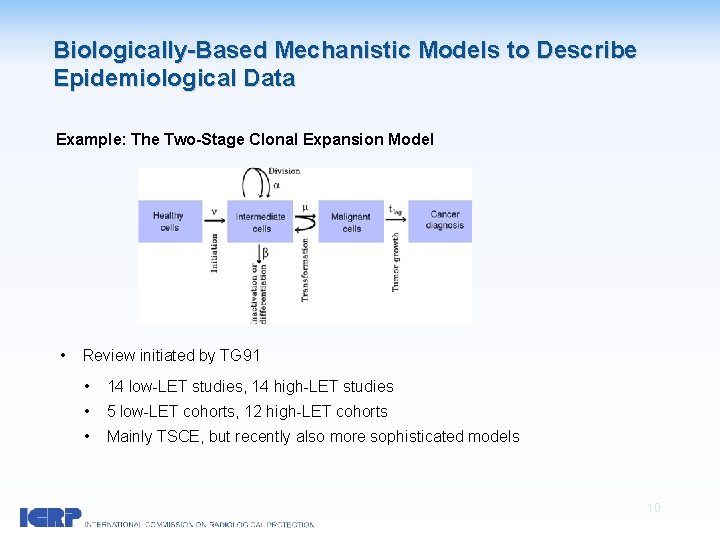
Biologically-Based Mechanistic Models to Describe Epidemiological Data Example: The Two-Stage Clonal Expansion Model • Review initiated by TG 91 • 14 low-LET studies, 14 high-LET studies • 5 low-LET cohorts, 12 high-LET cohorts • Mainly TSCE, but recently also more sophisticated models 10
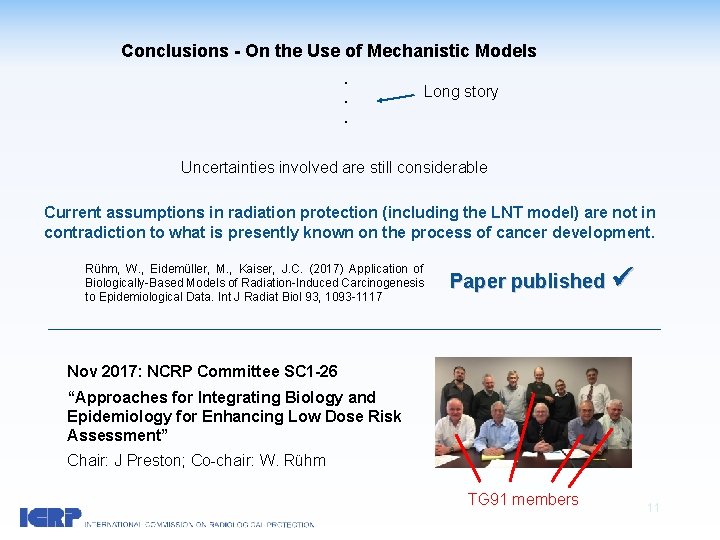
Conclusions - On the Use of Mechanistic Models. . . Long story Uncertainties involved are still considerable Current assumptions in radiation protection (including the LNT model) are not in contradiction to what is presently known on the process of cancer development. Rühm, W. , Eidemüller, M. , Kaiser, J. C. (2017) Application of Biologically-Based Models of Radiation-Induced Carcinogenesis to Epidemiological Data. Int J Radiat Biol 93, 1093 -1117 Paper published Nov 2017: NCRP Committee SC 1 -26 “Approaches for Integrating Biology and Epidemiology for Enhancing Low Dose Risk Assessment” Chair: J Preston; Co-chair: W. Rühm TG 91 members 11
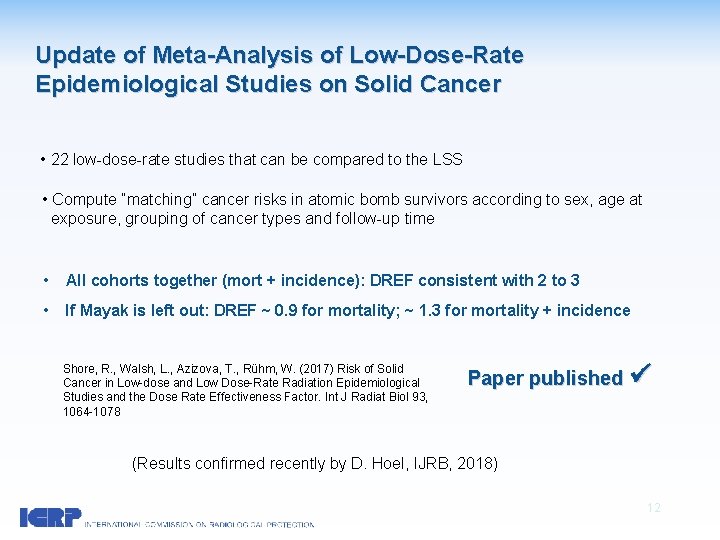
Update of Meta-Analysis of Low-Dose-Rate Epidemiological Studies on Solid Cancer • 22 low-dose-rate studies that can be compared to the LSS • Compute “matching” cancer risks in atomic bomb survivors according to sex, age at exposure, grouping of cancer types and follow-up time • All cohorts together (mort + incidence): DREF consistent with 2 to 3 • If Mayak is left out: DREF ~ 0. 9 for mortality; ~ 1. 3 for mortality + incidence Shore, R. , Walsh, L. , Azizova, T. , Rühm, W. (2017) Risk of Solid Cancer in Low-dose and Low Dose-Rate Radiation Epidemiological Studies and the Dose Rate Effectiveness Factor. Int J Radiat Biol 93, 1064 -1078 Paper published (Results confirmed recently by D. Hoel, IJRB, 2018) 12
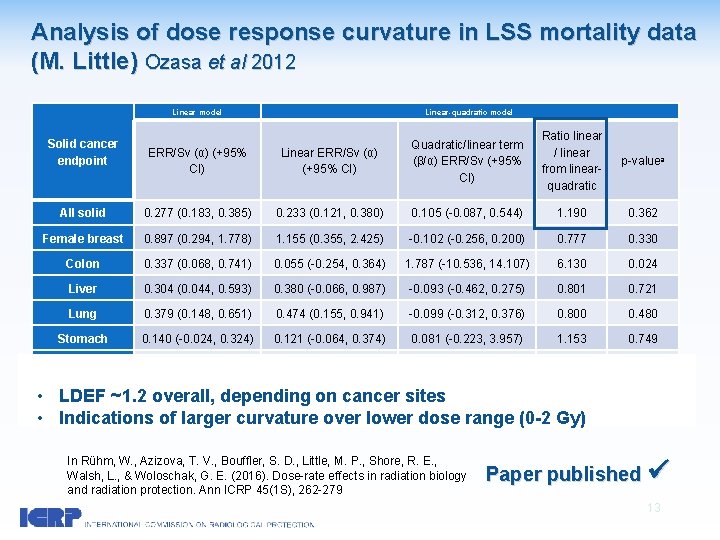
Analysis of dose response curvature in LSS mortality data (M. Little) Ozasa et al 2012 Linear model Linear-quadratic model ERR/Sv (α) (+95% CI) Linear ERR/Sv (α) (+95% CI) Quadratic/linear term (β/α) ERR/Sv (+95% CI) Ratio linear / linear from linearquadratic p-valuea All solid 0. 277 (0. 183, 0. 385) 0. 233 (0. 121, 0. 380) 0. 105 (-0. 087, 0. 544) 1. 190 0. 362 Female breast 0. 897 (0. 294, 1. 778) 1. 155 (0. 355, 2. 425) -0. 102 (-0. 256, 0. 200) 0. 777 0. 330 Colon 0. 337 (0. 068, 0. 741) 0. 055 (-0. 254, 0. 364) 1. 787 (-10. 536, 14. 107) 6. 130 0. 024 Liver 0. 304 (0. 044, 0. 593) 0. 380 (-0. 066, 0. 987) -0. 093 (-0. 462, 0. 275) 0. 801 0. 721 Lung 0. 379 (0. 148, 0. 651) 0. 474 (0. 155, 0. 941) -0. 099 (-0. 312, 0. 376) 0. 800 0. 480 Stomach 0. 140 (-0. 024, 0. 324) 0. 121 (-0. 064, 0. 374) 0. 081 (-0. 223, 3. 957) 1. 153 0. 749 All solid except breast, colon, 0. 257 (0. 093, 0. 480) 0. 194 (0. 026, 0. 508) 0. 163 (-0. 173, 3. 673) lung, ~1. 2 overall, depending on cancer sites • liver, LDEF stomach 1. 320 0. 501 Solid cancer endpoint • Indications of larger curvature over lower dose range (0 -2 Gy) In Rühm, W. , Azizova, T. V. , Bouffler, S. D. , Little, M. P. , Shore, R. E. , Walsh, L. , & Woloschak, G. E. (2016). Dose-rate effects in radiation biology and radiation protection. Ann ICRP 45(1 S), 262 -279 Paper published 13
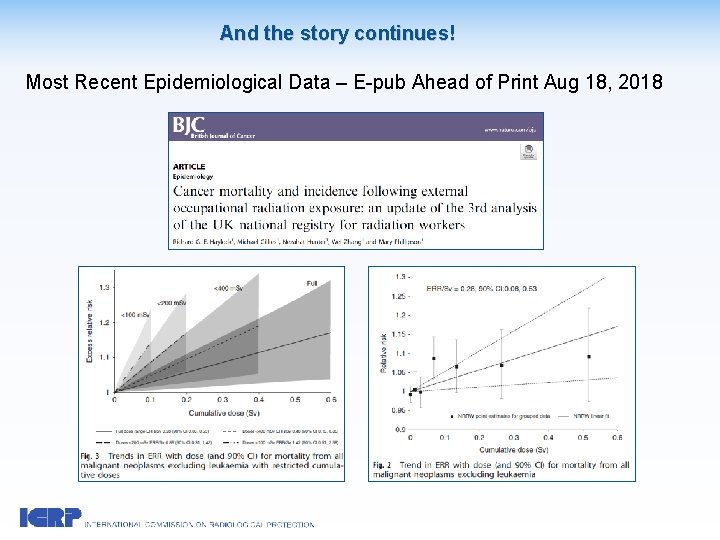
And the story continues! Most Recent Epidemiological Data – E-pub Ahead of Print Aug 18, 2018
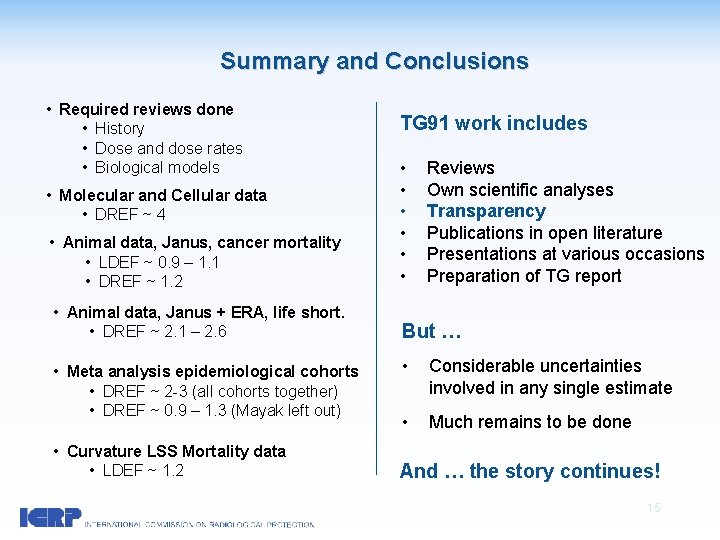
Summary and Conclusions • Required reviews done • History • Dose and dose rates • Biological models TG 91 work includes • Animal data, Janus, cancer mortality • LDEF ~ 0. 9 – 1. 1 • DREF ~ 1. 2 • • Animal data, Janus + ERA, life short. • DREF ~ 2. 1 – 2. 6 But … • Molecular and Cellular data • DREF ~ 4 • Meta analysis epidemiological cohorts • DREF ~ 2 -3 (all cohorts together) • DREF ~ 0. 9 – 1. 3 (Mayak left out) • Curvature LSS Mortality data • LDEF ~ 1. 2 Reviews Own scientific analyses Transparency Publications in open literature Presentations at various occasions Preparation of TG report • Considerable uncertainties involved in any single estimate • Much remains to be done And … the story continues! 15
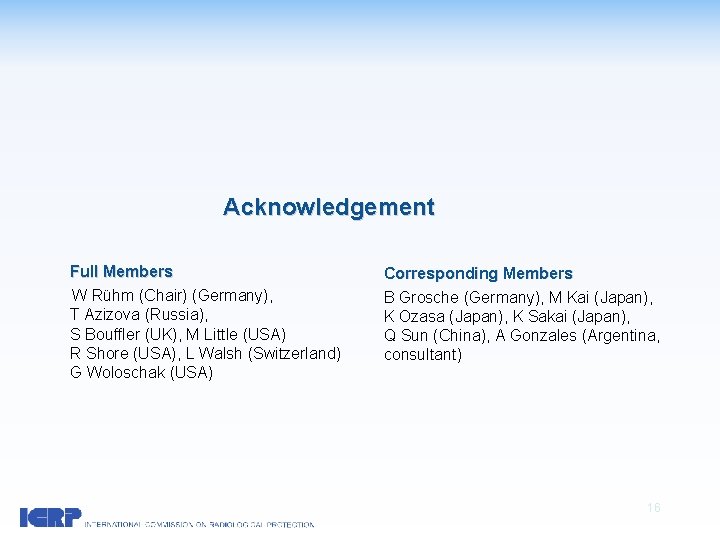
Acknowledgement Full Members W Rühm (Chair) (Germany), T Azizova (Russia), S Bouffler (UK), M Little (USA) R Shore (USA), L Walsh (Switzerland) G Woloschak (USA) Corresponding Members B Grosche (Germany), M Kai (Japan), K Ozasa (Japan), K Sakai (Japan), Q Sun (China), A Gonzales (Argentina, consultant) 16
THANK YOU!
18