
Status of Dynamical Core C Rewrite Oliver Fuhrer

- Slides: 17
Status of Dynamical Core C++ Rewrite Oliver Fuhrer (Meteo. Swiss), Tobias Gysi (SCS), Men Muhheim (SCS), Katharina Riedinger (SCS), David Müller (SCS), Thomas Schulthess (CSCS) …and the rest of the HP 2 C team!
Outline • Motivation • Design choices • CPU and GPU implementation status • Outlook
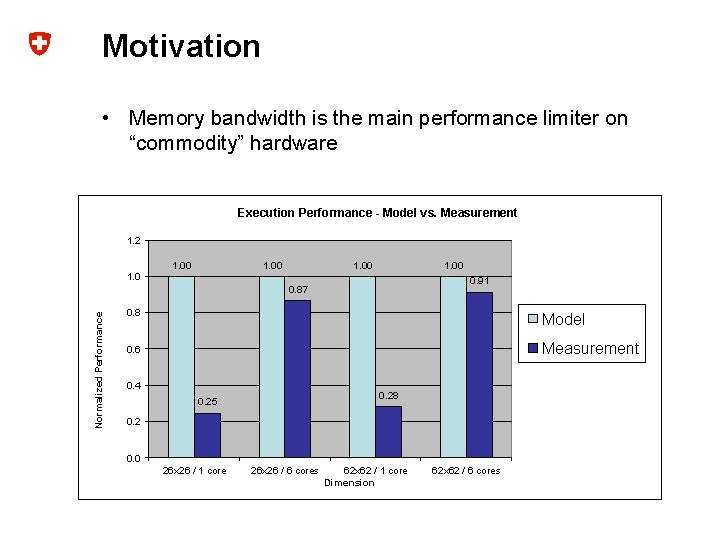
Motivation • Memory bandwidth is the main performance limiter on “commodity” hardware Execution Performance - Model vs. Measurement 1. 2 1. 00 1. 0 0. 91 Normalized Performance 0. 87 0. 8 Model 0. 6 Measurement 0. 4 0. 28 0. 25 0. 2 0. 0 26 x 26 / 1 core 26 x 26 / 6 cores 62 x 62 / 1 core Dimension 62 x 62 / 6 cores
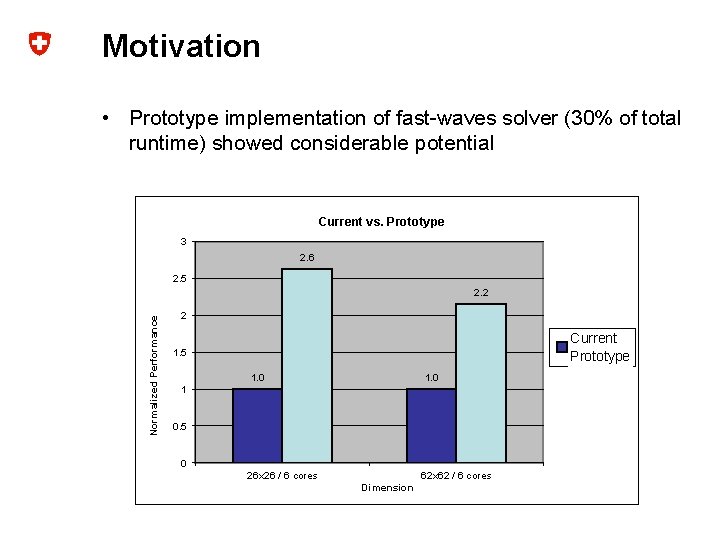
Motivation • Prototype implementation of fast-waves solver (30% of total runtime) showed considerable potential Current vs. Prototype 3 2. 6 2. 5 Normalized Performance 2. 2 2 Current Fortran Prototype 1. 5 1. 0 1 0. 5 0 26 x 26 / 6 cores 62 x 62 / 6 cores Dimension
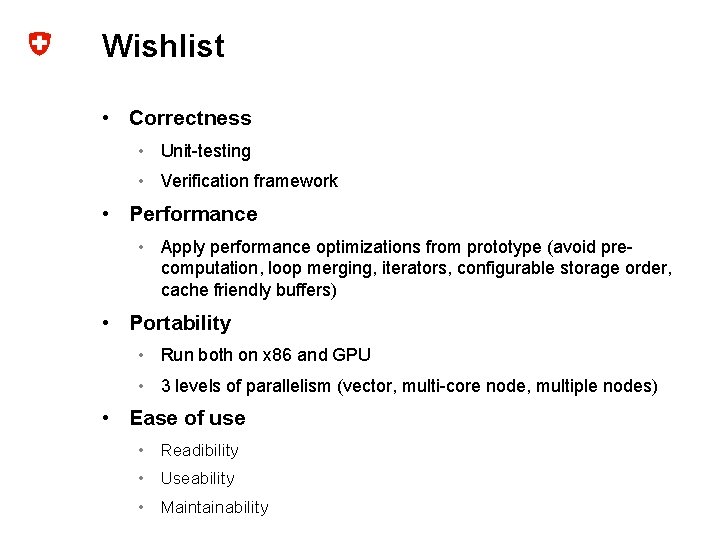
Wishlist • Correctness • Unit-testing • Verification framework • Performance • Apply performance optimizations from prototype (avoid precomputation, loop merging, iterators, configurable storage order, cache friendly buffers) • Portability • Run both on x 86 and GPU • 3 levels of parallelism (vector, multi-core node, multiple nodes) • Ease of use • Readibility • Useability • Maintainability
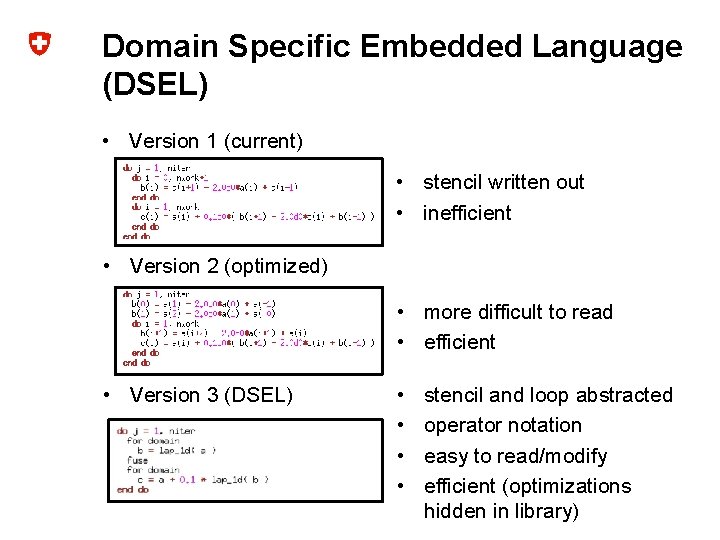
Domain Specific Embedded Language (DSEL) • Version 1 (current) • stencil written out • inefficient • Version 2 (optimized) • more difficult to read • efficient • Version 3 (DSEL) • • stencil and loop abstracted operator notation easy to read/modify efficient (optimizations hidden in library)
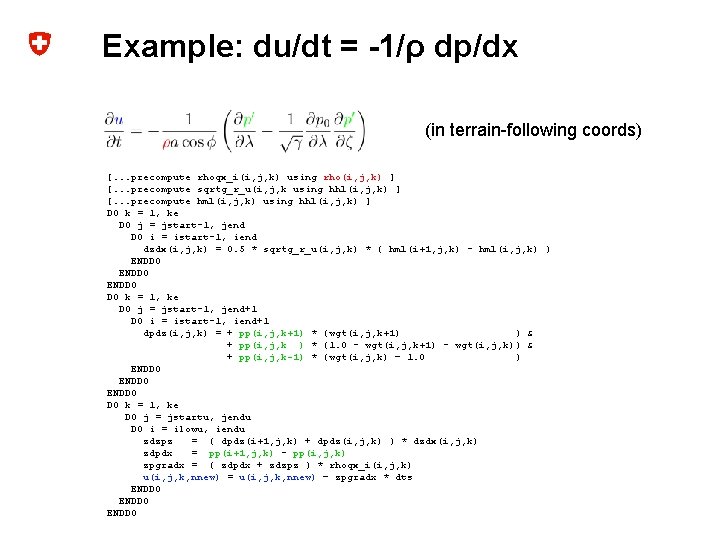
Example: du/dt = -1/ρ dp/dx (in terrain-following coords) [. . . precompute rhoqx_i(i, j, k) using rho(i, j, k) ] [. . . precompute sqrtg_r_u(i, j, k using hhl(i, j, k) ] [. . . precompute hml(i, j, k) using hhl(i, j, k) ] DO k = 1, ke DO j = jstart-1, jend DO i = istart-1, iend dzdx(i, j, k) = 0. 5 * sqrtg_r_u(i, j, k) * ( hml(i+1, j, k) - hml(i, j, k) ) ENDDO DO k = 1, ke DO j = jstart-1, jend+1 DO i = istart-1, iend+1 dpdz(i, j, k) = + pp(i, j, k+1) * (wgt(i, j, k+1) ) & + pp(i, j, k ) * (1. 0 - wgt(i, j, k+1) - wgt(i, j, k)) & + pp(i, j, k-1) * (wgt(i, j, k) – 1. 0 ) ENDDO DO k = 1, ke DO j = jstartu, jendu DO i = ilowu, iendu zdzpz = ( dpdz(i+1, j, k) + dpdz(i, j, k) ) * dzdx(i, j, k) zdpdx = pp(i+1, j, k) - pp(i, j, k) zpgradx = ( zdpdx + zdzpz ) * rhoqx_i(i, j, k) u(i, j, k, nnew) = u(i, j, k, nnew) – zpgradx * dts ENDDO
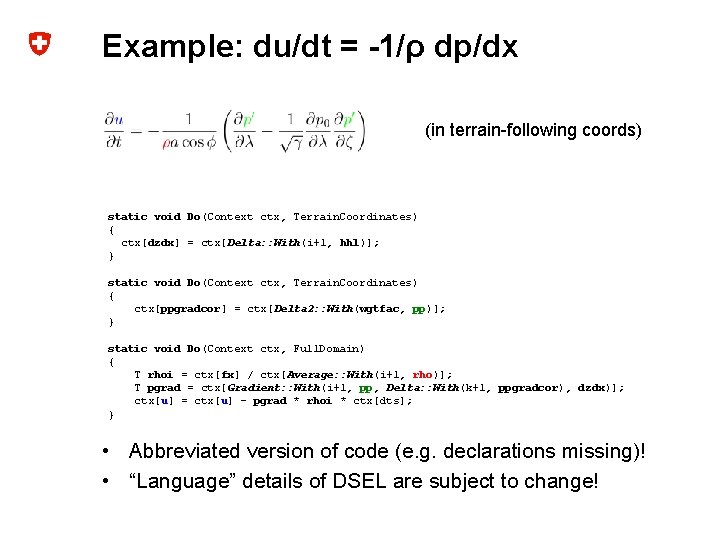
Example: du/dt = -1/ρ dp/dx (in terrain-following coords) static void Do(Context ctx, Terrain. Coordinates) { ctx[dzdx] = ctx[Delta: : With(i+1, hhl)]; } static void Do(Context ctx, Terrain. Coordinates) { ctx[ppgradcor] = ctx[Delta 2: : With(wgtfac, pp)]; } static void Do(Context ctx, Full. Domain) { T rhoi = ctx[fx] / ctx[Average: : With(i+1, rho)]; T pgrad = ctx[Gradient: : With(i+1, pp, Delta: : With(k+1, ppgradcor), dzdx)]; ctx[u] = ctx[u] - pgrad * rhoi * ctx[dts]; } • Abbreviated version of code (e. g. declarations missing)! • “Language” details of DSEL are subject to change!
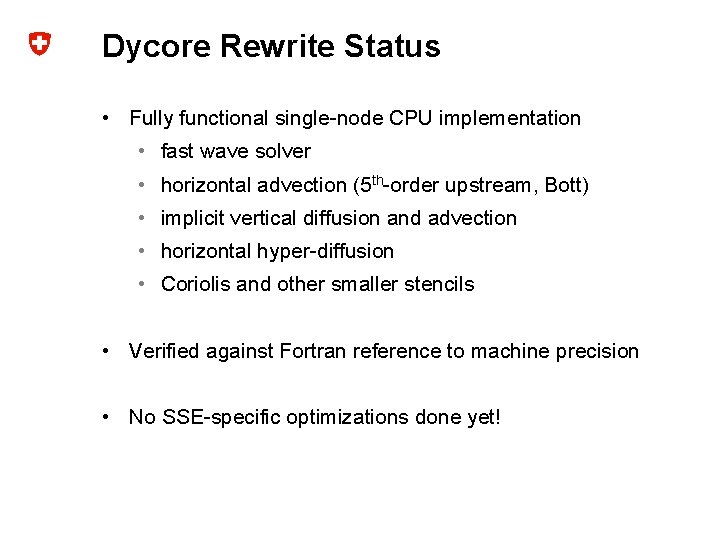
Dycore Rewrite Status • Fully functional single-node CPU implementation • fast wave solver • horizontal advection (5 th-order upstream, Bott) • implicit vertical diffusion and advection • horizontal hyper-diffusion • Coriolis and other smaller stencils • Verified against Fortran reference to machine precision • No SSE-specific optimizations done yet!
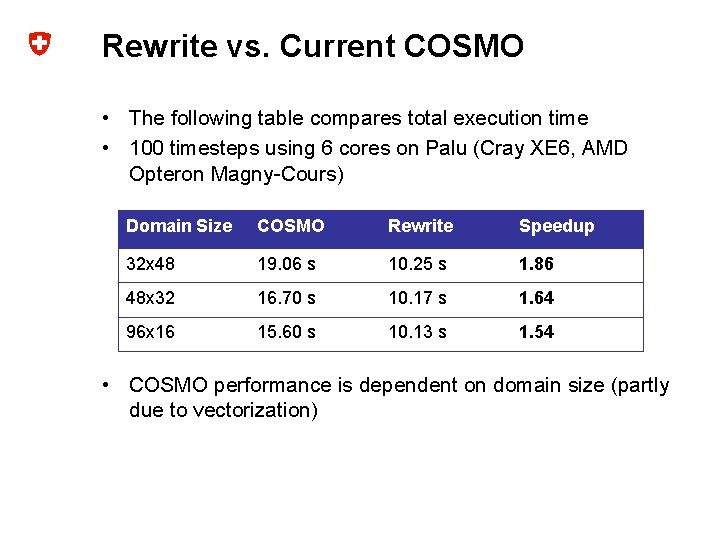
Rewrite vs. Current COSMO • The following table compares total execution time • 100 timesteps using 6 cores on Palu (Cray XE 6, AMD Opteron Magny-Cours) Domain Size COSMO Rewrite Speedup 32 x 48 19. 06 s 10. 25 s 1. 86 48 x 32 16. 70 s 10. 17 s 1. 64 96 x 16 15. 60 s 10. 13 s 1. 54 • COSMO performance is dependent on domain size (partly due to vectorization)
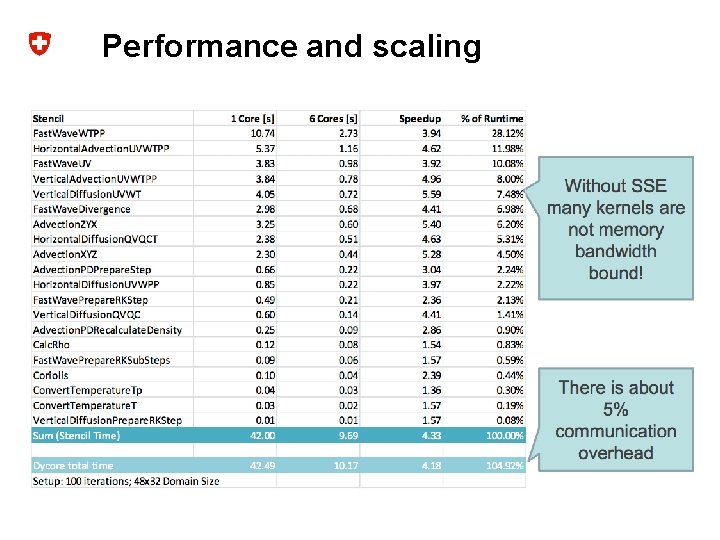
Performance and scaling
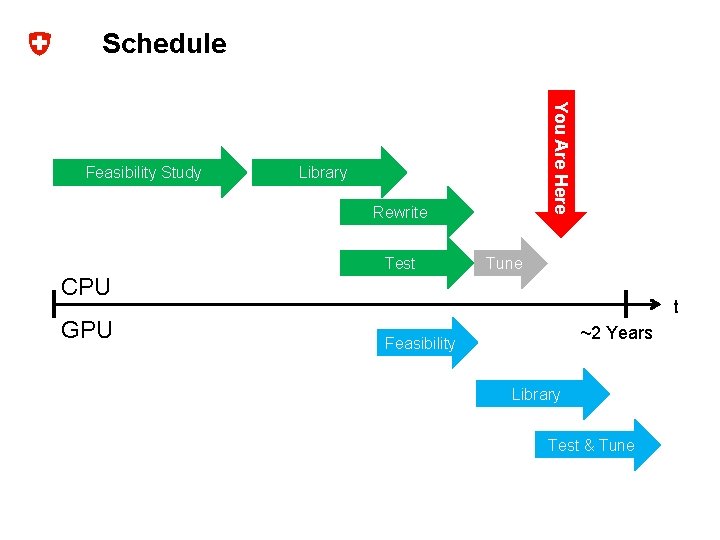
Schedule You Are Here Feasibility Study Library Rewrite Test Tune CPU GPU t ~2 Years Feasibility Library Test & Tune
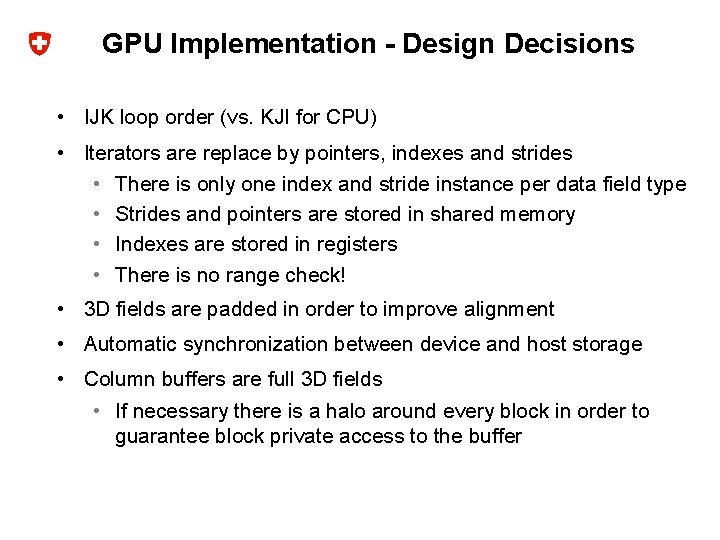
GPU Implementation - Design Decisions • IJK loop order (vs. KJI for CPU) • Iterators are replace by pointers, indexes and strides • There is only one index and stride instance per data field type • Strides and pointers are stored in shared memory • Indexes are stored in registers • There is no range check! • 3 D fields are padded in order to improve alignment • Automatic synchronization between device and host storage • Column buffers are full 3 D fields • If necessary there is a halo around every block in order to guarantee block private access to the buffer
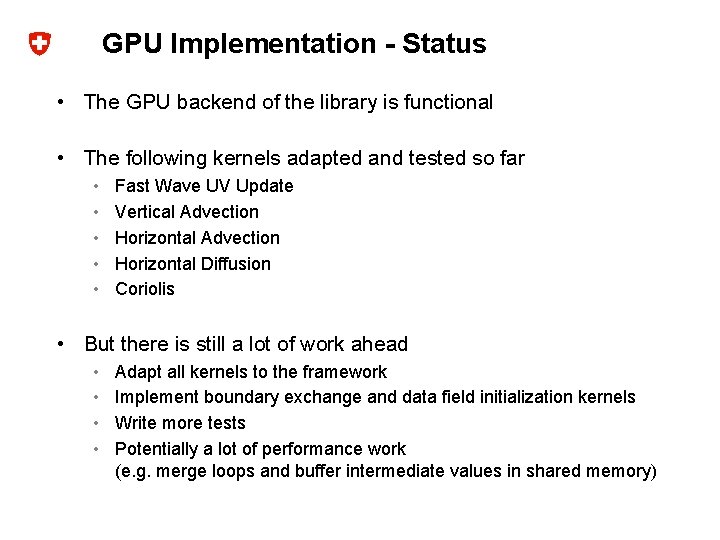
GPU Implementation - Status • The GPU backend of the library is functional • The following kernels adapted and tested so far • • • Fast Wave UV Update Vertical Advection Horizontal Diffusion Coriolis • But there is still a lot of work ahead • • Adapt all kernels to the framework Implement boundary exchange and data field initialization kernels Write more tests Potentially a lot of performance work (e. g. merge loops and buffer intermediate values in shared memory)
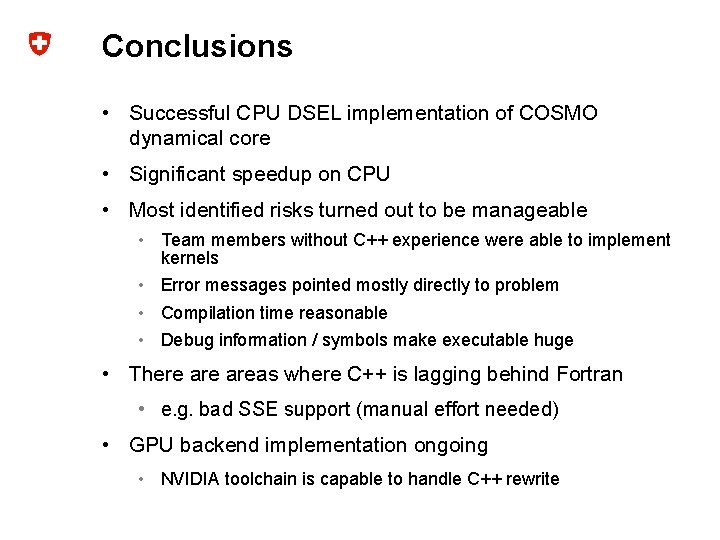
Conclusions • Successful CPU DSEL implementation of COSMO dynamical core • Significant speedup on CPU • Most identified risks turned out to be manageable • Team members without C++ experience were able to implement kernels • Error messages pointed mostly directly to problem • Compilation time reasonable • Debug information / symbols make executable huge • There areas where C++ is lagging behind Fortran • e. g. bad SSE support (manual effort needed) • GPU backend implementation ongoing • NVIDIA toolchain is capable to handle C++ rewrite
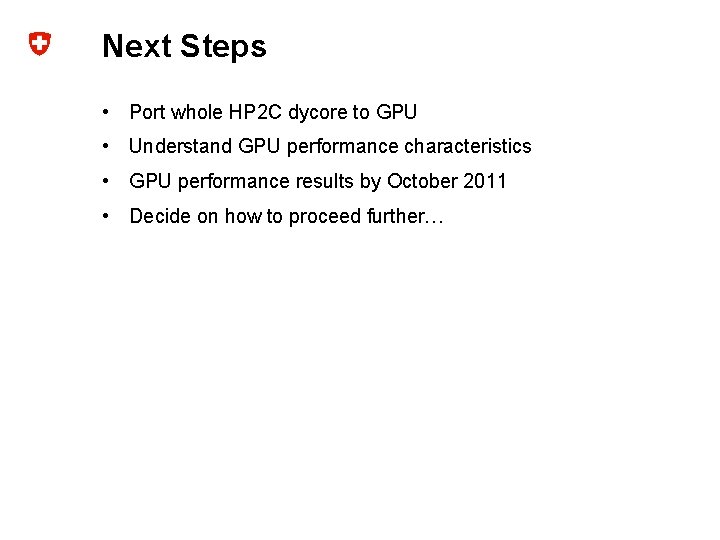
Next Steps • Port whole HP 2 C dycore to GPU • Understand GPU performance characteristics • GPU performance results by October 2011 • Decide on how to proceed further…
For more information… https: //hpcforge. org/plugins/mediawiki/cclm-dev/index. php/HP 2 C_Dy. Core