
Status Of Compton Imaging Projects Carried Out In
- Slides: 30
Status Of Compton Imaging Projects Carried Out In The CIMA Collaboration HPD Brain PET Meeting Bari 16. 01. 2007 P. Weilhammer INFN Perugia/CERN 16. January 2007 Status Report On Compton Imaging Projects 1
OUTLINE of Presentation 1. Photon Detection with Silicon Detectors (A few trivial notions) 2. Two Projects Involving the Compton Camera Concept Using Silicon Radiation Detectors 16. January 2007 Status Report On Compton Imaging Projects 2
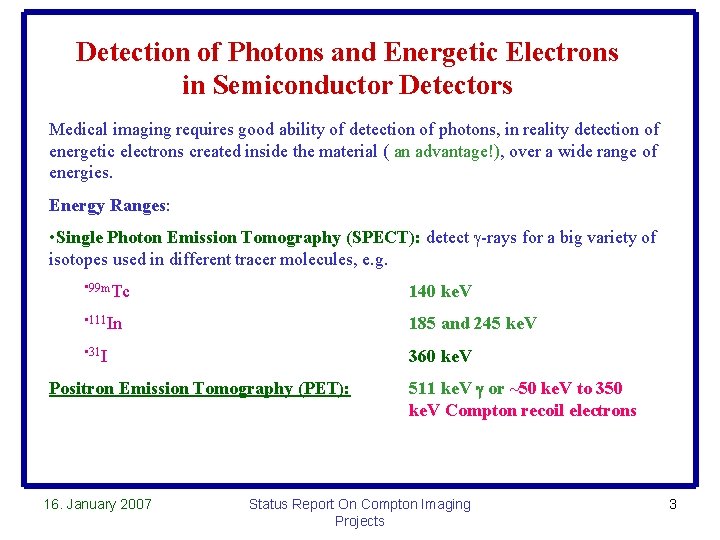
Detection of Photons and Energetic Electrons in Semiconductor Detectors Medical imaging requires good ability of detection of photons, in reality detection of energetic electrons created inside the material ( an advantage!), over a wide range of energies. Energy Ranges: • Single Photon Emission Tomography (SPECT): detect g-rays for a big variety of isotopes used in different tracer molecules, e. g. • 99 m. Tc 140 ke. V • 111 In 185 and 245 ke. V • 31 I 360 ke. V Positron Emission Tomography (PET): 16. January 2007 511 ke. V g or ~50 ke. V to 350 ke. V Compton recoil electrons Status Report On Compton Imaging Projects 3
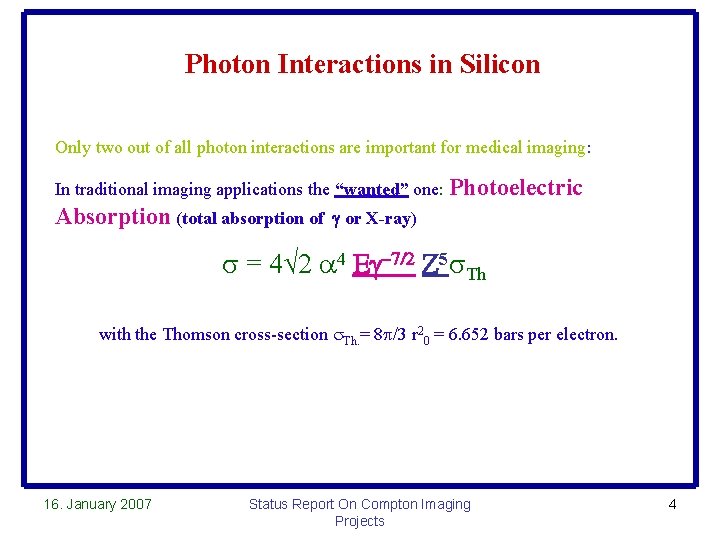
Photon Interactions in Silicon Only two out of all photon interactions are important for medical imaging: In traditional imaging applications the “wanted” one: Photoelectric Absorption (total absorption of g or X-ray) s = 4√ 2 a 4 Eg-7/2 Z 5 s. Th with the Thomson cross-section s. Th. = 8 p/3 r 20 = 6. 652 bars per electron. 16. January 2007 Status Report On Compton Imaging Projects 4
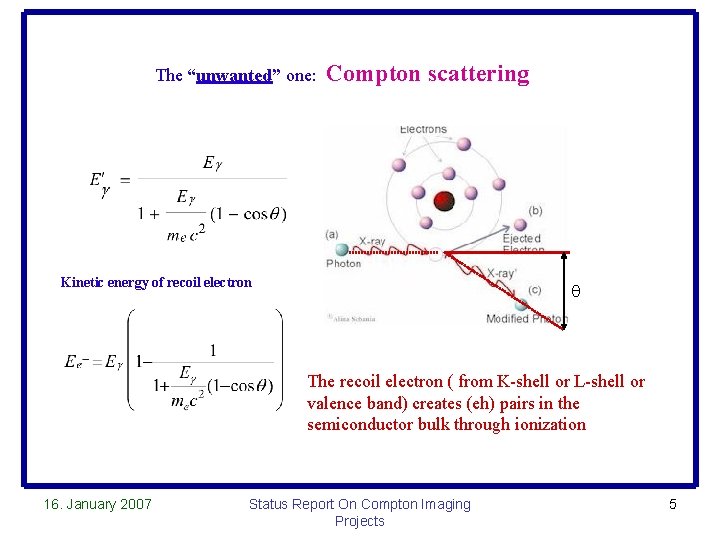
The “unwanted” one: Compton scattering Kinetic energy of recoil electron q The recoil electron ( from K-shell or L-shell or valence band) creates (eh) pairs in the semiconductor bulk through ionization 16. January 2007 Status Report On Compton Imaging Projects 5
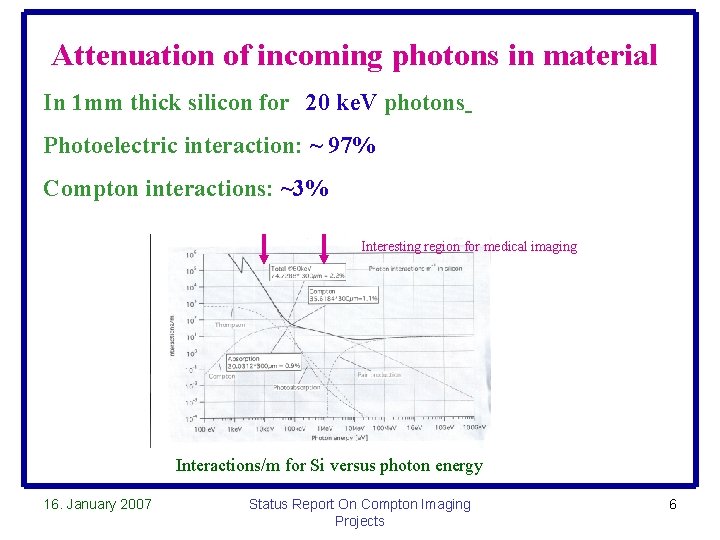
Attenuation of incoming photons in material In 1 mm thick silicon for 20 ke. V photons Photoelectric interaction: ~ 97% Compton interactions: ~3% Interesting region for medical imaging Interactions/m for Si versus photon energy 16. January 2007 Status Report On Compton Imaging Projects 6
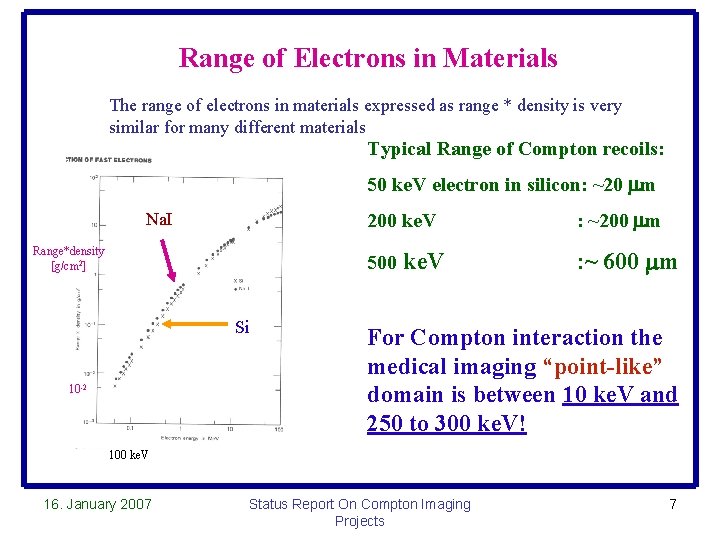
Range of Electrons in Materials The range of electrons in materials expressed as range * density is very similar for many different materials Typical Range of Compton recoils: 50 ke. V electron in silicon: ~20 m Na. I Range*density [g/cm 2] Si 10 -2 200 ke. V : ~200 m 500 ke. V : ~ 600 m For Compton interaction the medical imaging “point-like” domain is between 10 ke. V and 250 to 300 ke. V! 100 ke. V 16. January 2007 Status Report On Compton Imaging Projects 7
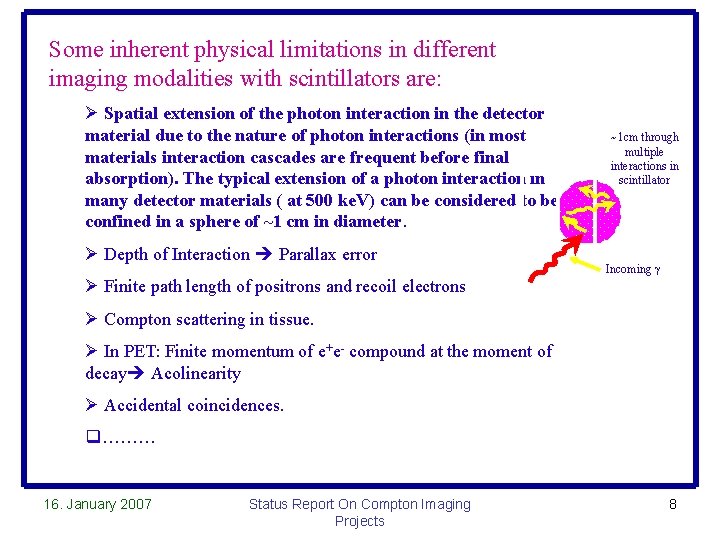
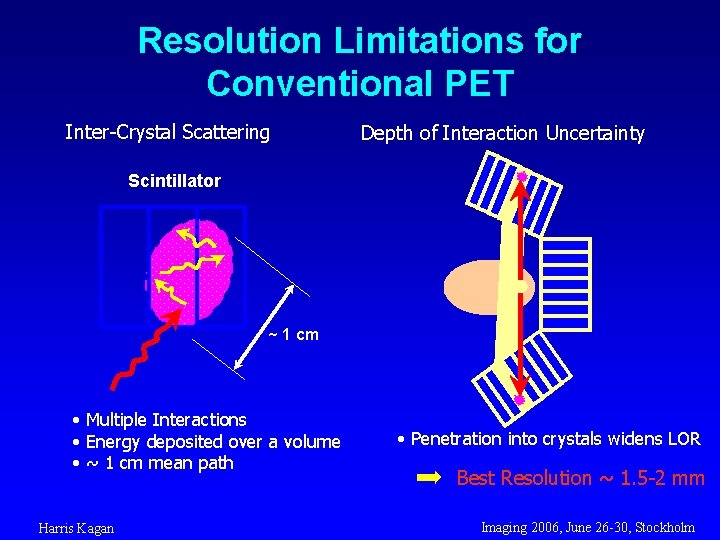
Some inherent physical limitations in different imaging modalities with scintillators are: Ø Spatial extension of the photon interaction in the detector material due to the nature of photon interactions (in most materials interaction cascades are frequent before final absorption). The typical extension of a photon interaction in many detector materials ( at 500 ke. V) can be considered to be confined in a sphere of ~1 cm in diameter. Ø Depth of Interaction Parallax error Ø Finite path length of positrons and recoil electrons ~1 cm through multiple interactions in scintillator Incoming g Ø Compton scattering in tissue. Ø In PET: Finite momentum of e+e- compound at the moment of decay Acolinearity Ø Accidental coincidences. q……… 16. January 2007 Status Report On Compton Imaging Projects 8
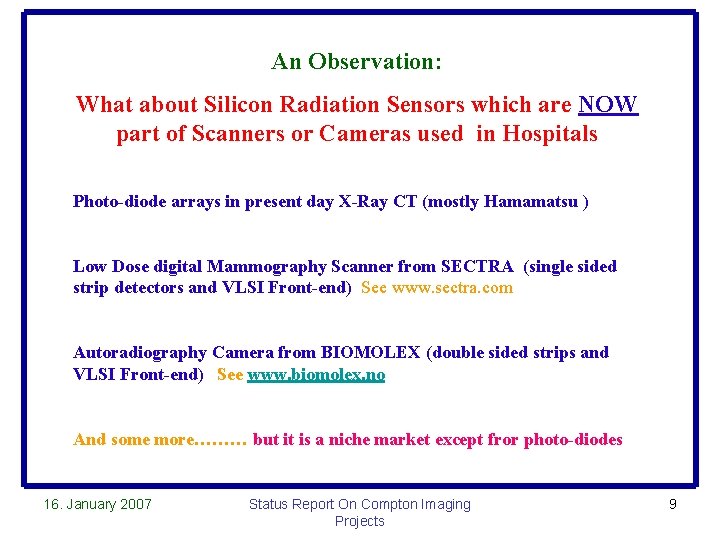
An Observation: What about Silicon Radiation Sensors which are NOW part of Scanners or Cameras used in Hospitals Photo-diode arrays in present day X-Ray CT (mostly Hamamatsu ) Low Dose digital Mammography Scanner from SECTRA (single sided strip detectors and VLSI Front-end) See www. sectra. com Autoradiography Camera from BIOMOLEX (double sided strips and VLSI Front-end) See www. biomolex. no And some more……… but it is a niche market except fror photo-diodes 16. January 2007 Status Report On Compton Imaging Projects 9
R&D Projects using Silicon Detectors in Medical Imaging within the CIMA Collaboration • Novel axial brain PET Scanner • Compton Camera and Probes • High resolution small animal PET scanner based on Compton interactions 16. January 2007 Status Report On Compton Imaging Projects 10
Compton Imaging 16. January 2007 Status Report On Compton Imaging Projects 11
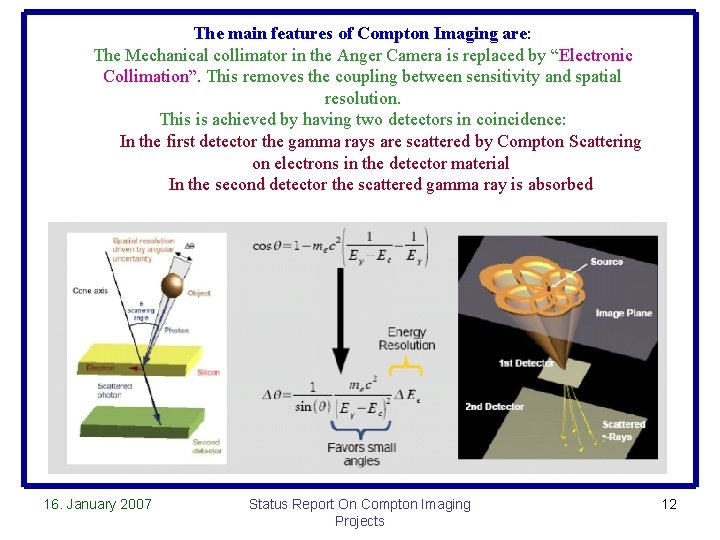
The main features of Compton Imaging are: The Mechanical collimator in the Anger Camera is replaced by “Electronic Collimation”. This removes the coupling between sensitivity and spatial resolution. This is achieved by having two detectors in coincidence: In the first detector the gamma rays are scattered by Compton Scattering on electrons in the detector material In the second detector the scattered gamma ray is absorbed 16. January 2007 Status Report On Compton Imaging Projects 12
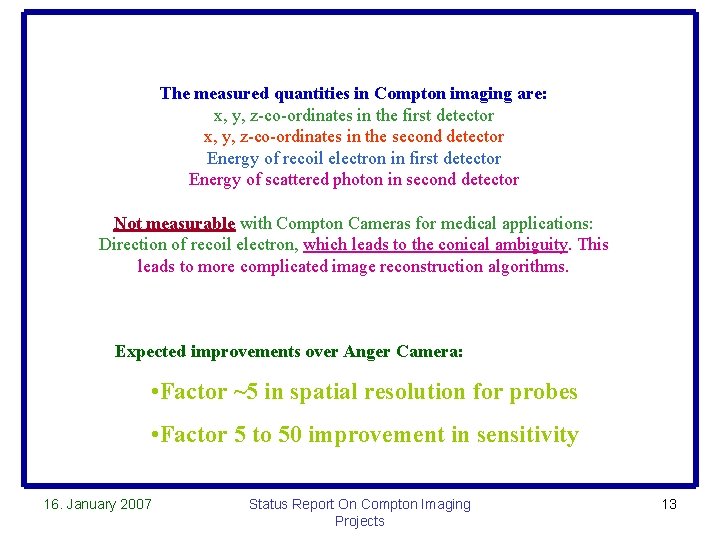
The measured quantities in Compton imaging are: x, y, z-co-ordinates in the first detector x, y, z-co-ordinates in the second detector Energy of recoil electron in first detector Energy of scattered photon in second detector Not measurable with Compton Cameras for medical applications: Direction of recoil electron, which leads to the conical ambiguity. This leads to more complicated image reconstruction algorithms. Expected improvements over Anger Camera: • Factor ~5 in spatial resolution for probes • Factor 5 to 50 improvement in sensitivity 16. January 2007 Status Report On Compton Imaging Projects 13
Results from a Demonstrator Test in 2005 16. January 2007 Status Report On Compton Imaging Projects 14
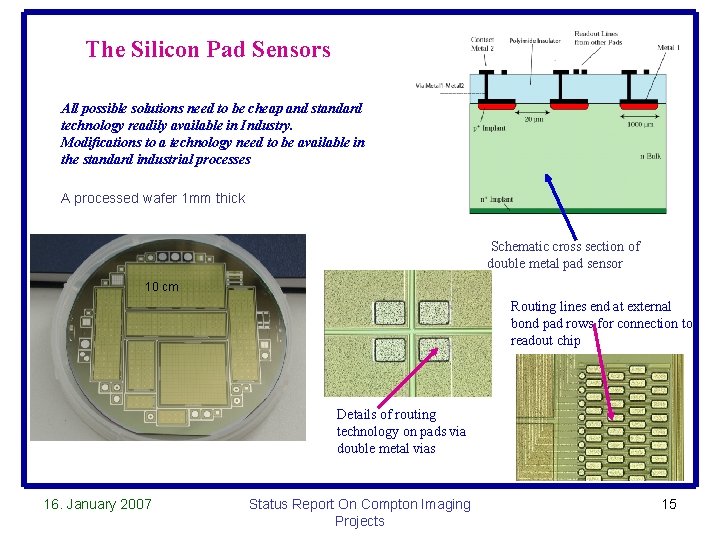
The Silicon Pad Sensors All possible solutions need to be cheap and standard technology readily available in Industry. Modifications to a technology need to be available in the standard industrial processes A processed wafer 1 mm thick Schematic cross section of double metal pad sensor 10 cm Routing lines end at external bond pad rows for connection to readout chip Details of routing technology on pads via double metal vias 16. January 2007 Status Report On Compton Imaging Projects 15
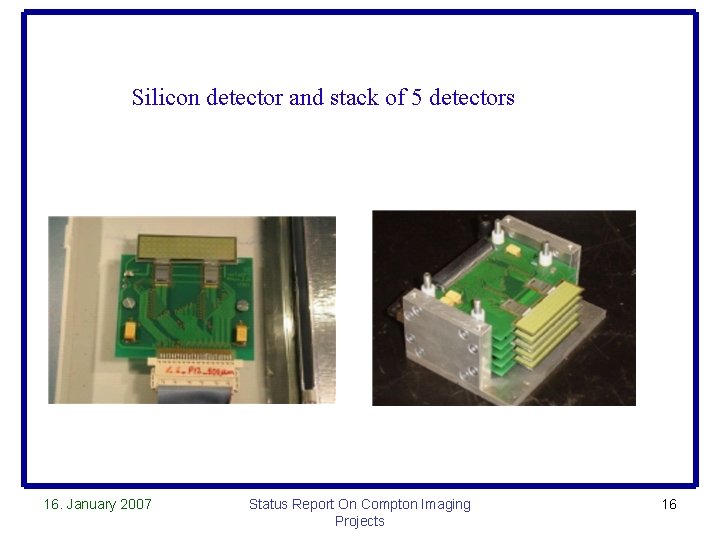
Silicon detector and stack of 5 detectors 16. January 2007 Status Report On Compton Imaging Projects 16
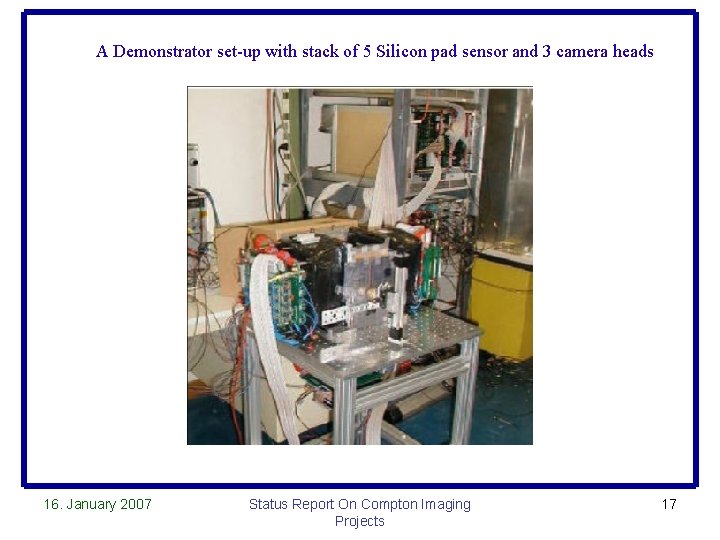
A Demonstrator set-up with stack of 5 Silicon pad sensor and 3 camera heads 16. January 2007 Status Report On Compton Imaging Projects 17
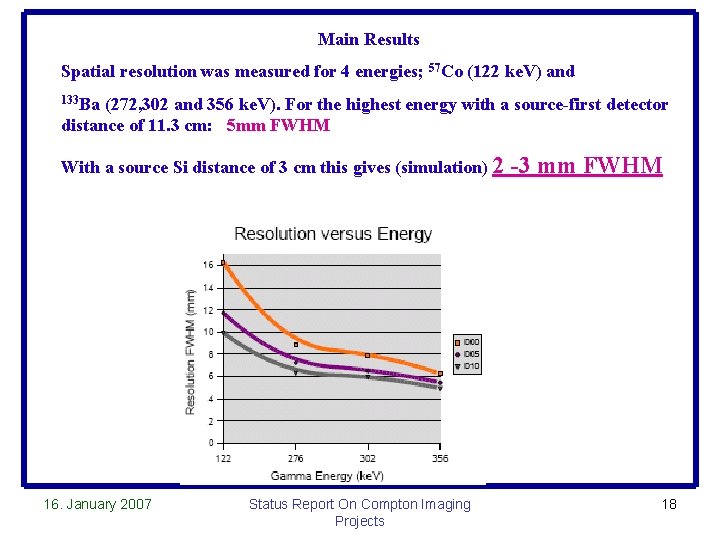
Main Results Spatial resolution was measured for 4 energies; 57 Co (122 ke. V) and 133 Ba (272, 302 and 356 ke. V). For the highest energy with a source-first detector distance of 11. 3 cm: 5 mm FWHM With a source Si distance of 3 cm this gives (simulation) 2 16. January 2007 Status Report On Compton Imaging Projects -3 mm FWHM 18
Status: Spatial resolution in Silicon Demonstrated Next Demonstrator test foreseen before end of 2006 with much improved camera head and improved silicon ( lower thresholds possible) 16. January 2007 Status Report On Compton Imaging Projects 19
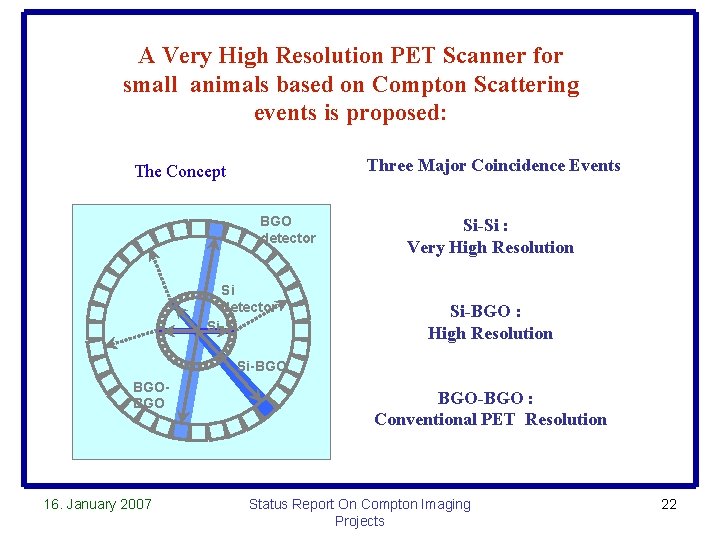
A High Resolution Small Animal PET Scanner based on Compton Scatter Events in Silicon Pad Detectors 16. January 2007 Status Report On Compton Imaging Projects 20
Resolution Limitations for Conventional PET Inter-Crystal Scattering Depth of Interaction Uncertainty Scintillator ~ 1 cm • Multiple Interactions • Energy deposited over a volume • ~ 1 cm mean path Harris Kagan • Penetration into crystals widens LOR Best Resolution ~ 1. 5 -2 mm Imaging 2006, June 26 -30, Stockholm
A Very High Resolution PET Scanner for small animals based on Compton Scattering events is proposed: Three Major Coincidence Events The Concept BGO detector Si-Si : Very High Resolution Si-BGO : High Resolution Si-BGO BGOBGO 16. January 2007 BGO-BGO : Conventional PET Resolution Status Report On Compton Imaging Projects 22
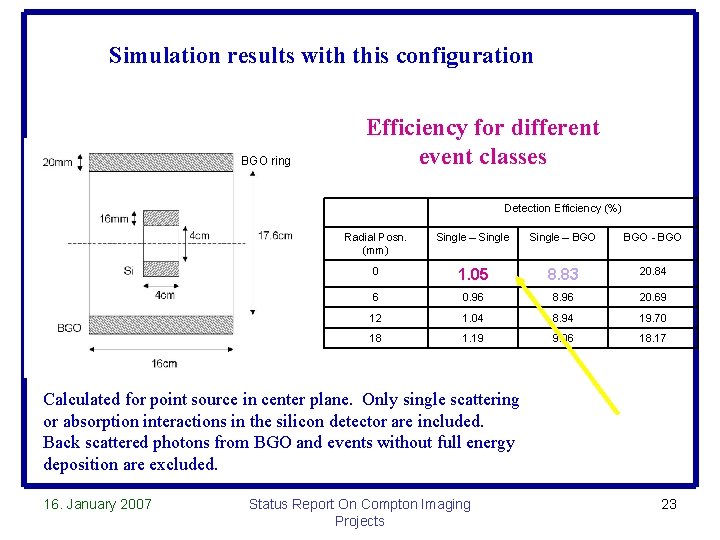
Simulation results with this configuration BGO ring Efficiency for different event classes Detection Efficiency (%) Radial Posn. (mm) Single – BGO - BGO 0 1. 05 8. 83 20. 84 6 0. 96 8. 96 20. 69 12 1. 04 8. 94 19. 70 18 1. 19 9. 06 18. 17 Calculated for point source in center plane. Only single scattering or absorption interactions in the silicon detector are included. Back scattered photons from BGO and events without full energy deposition are excluded. 16. January 2007 Status Report On Compton Imaging Projects 23
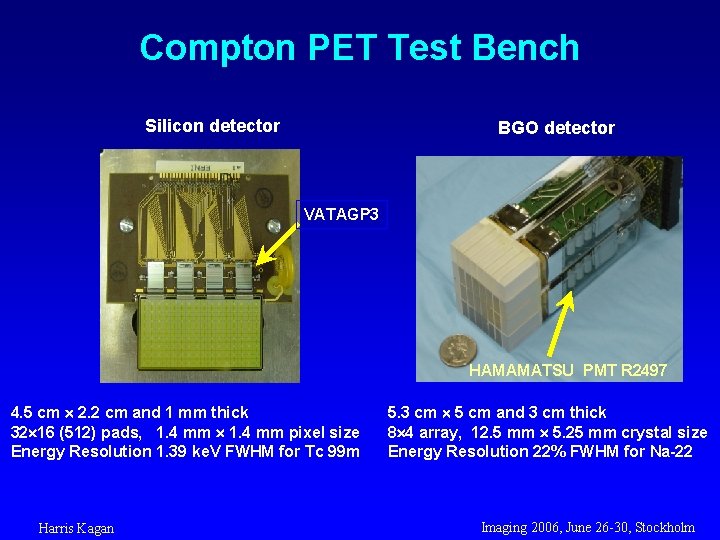
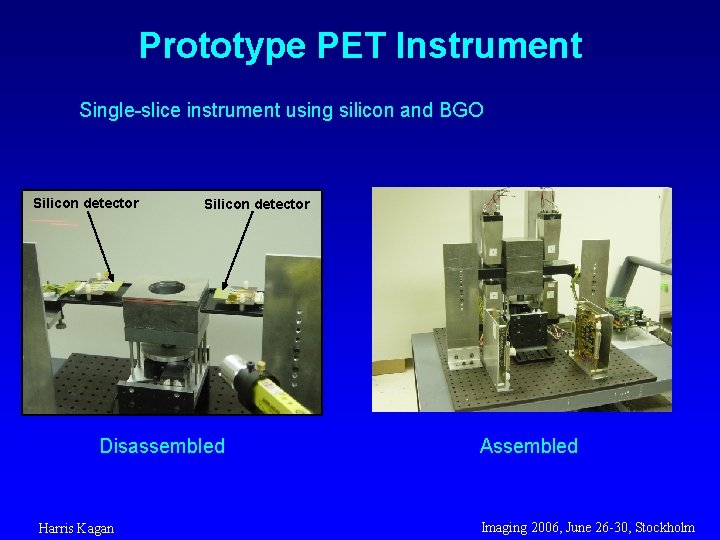
Compton PET Test Bench Silicon detector BGO detector VATAGP 3 HAMAMATSU PMT R 2497 4. 5 cm 2. 2 cm and 1 mm thick 32 16 (512) pads, 1. 4 mm pixel size Energy Resolution 1. 39 ke. V FWHM for Tc 99 m Harris Kagan 5. 3 cm 5 cm and 3 cm thick 8 4 array, 12. 5 mm 5. 25 mm crystal size Energy Resolution 22% FWHM for Na-22 Imaging 2006, June 26 -30, Stockholm
Prototype PET Instrument Single-slice instrument using silicon and BGO Silicon detector Disassembled Harris Kagan Assembled Imaging 2006, June 26 -30, Stockholm
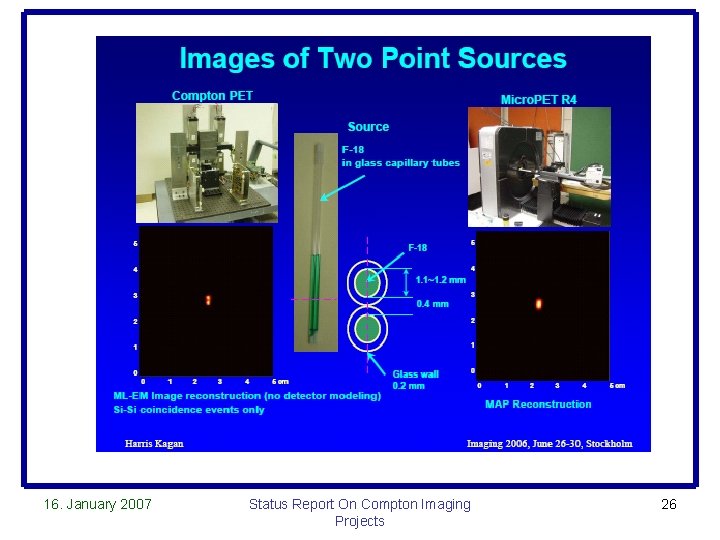
16. January 2007 Status Report On Compton Imaging Projects 26
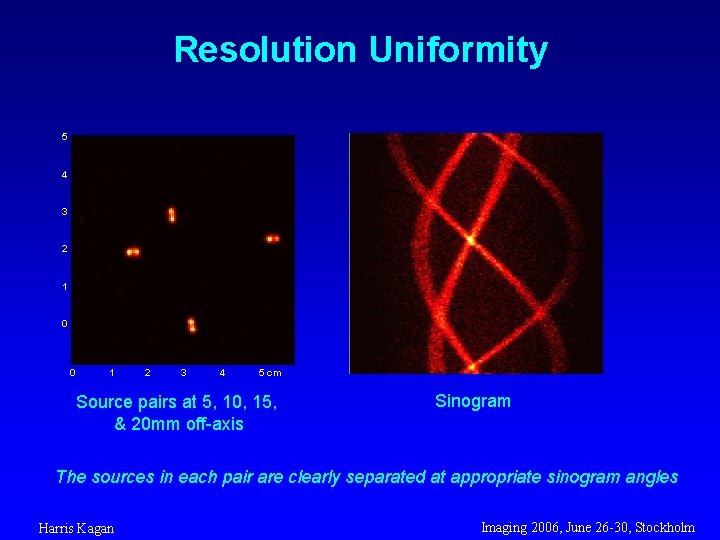
Resolution Uniformity 5 4 3 2 1 0 0 1 2 3 4 5 cm Source pairs at 5, 10, 15, & 20 mm off-axis Sinogram The sources in each pair are clearly separated at appropriate sinogram angles Harris Kagan Imaging 2006, June 26 -30, Stockholm
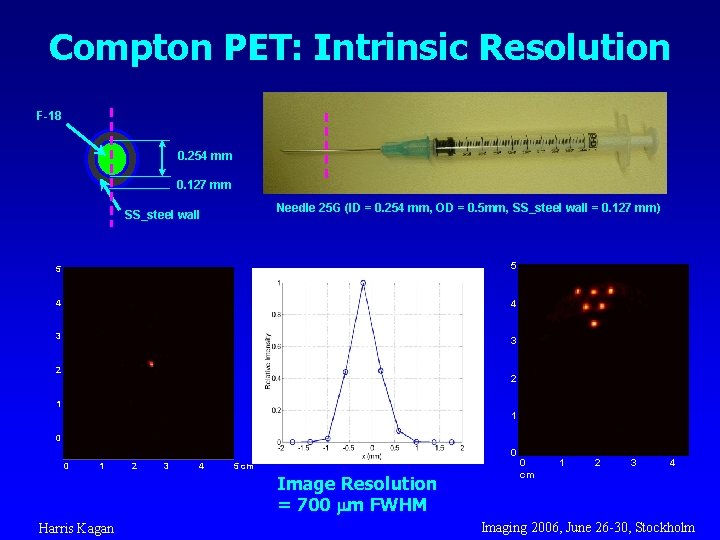
Compton PET: Intrinsic Resolution F-18 0. 254 mm 0. 127 mm Needle 25 G (ID = 0. 254 mm, OD = 0. 5 mm, SS_steel wall = 0. 127 mm) SS_steel wall 5 5 4 4 3 3 2 2 1 1 0 0 0 1 2 3 4 5 cm Image Resolution = 700 m FWHM Harris Kagan 0 cm 1 2 3 4 Imaging 2006, June 26 -30, Stockholm 5
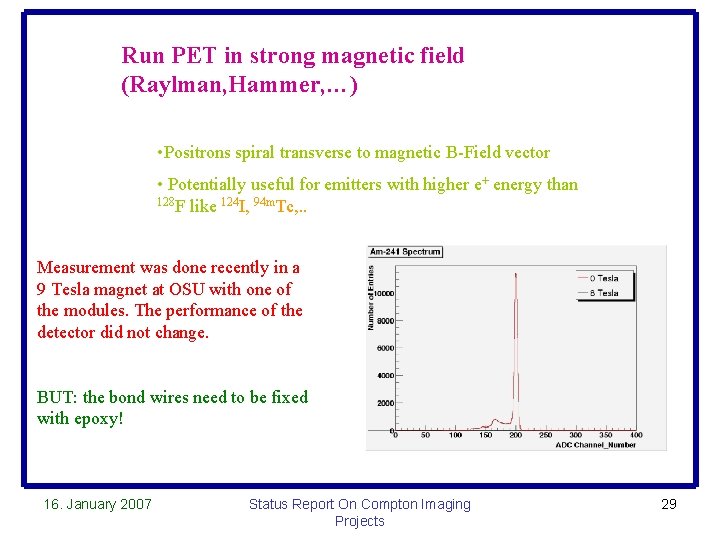
Run PET in strong magnetic field (Raylman, Hammer, …) • Positrons spiral transverse to magnetic B-Field vector • Potentially useful for emitters with higher e+ energy than 128 F like 124 I, 94 m. Tc, . . Measurement was done recently in a 9 Tesla magnet at OSU with one of the modules. The performance of the detector did not change. BUT: the bond wires need to be fixed with epoxy! 16. January 2007 Status Report On Compton Imaging Projects 29
This work goes on For the PET project we got NIH funding and will go for FP 7 European funduing For the ”PET in magnetic field” study a funding proposal has been submitted to NIH. For Compton PET project a funding request is prepared to develop a VATA”Compton” chip together with GM-I 16. January 2007 Status Report On Compton Imaging Projects 30