
Status of biodiversity conservation in Pakistan Pakistan possesses
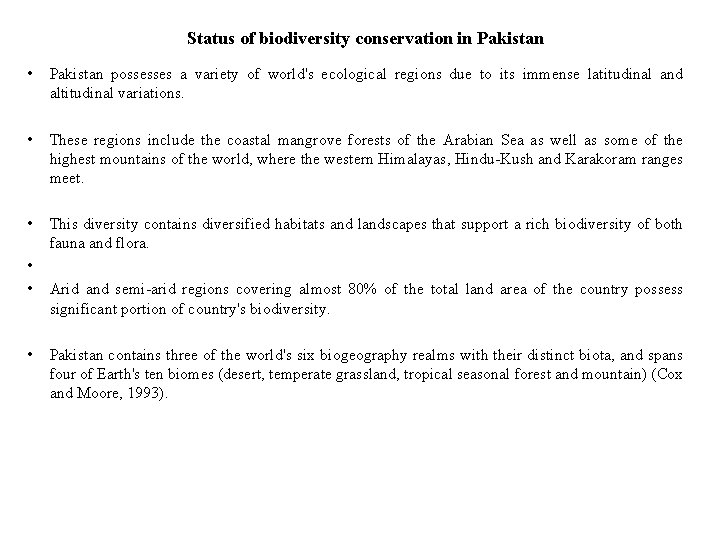
Status of biodiversity conservation in Pakistan • Pakistan possesses a variety of world's ecological regions due to its immense latitudinal and altitudinal variations. • These regions include the coastal mangrove forests of the Arabian Sea as well as some of the highest mountains of the world, where the western Himalayas, Hindu-Kush and Karakoram ranges meet. • This diversity contains diversified habitats and landscapes that support a rich biodiversity of both fauna and flora. • • • Arid and semi-arid regions covering almost 80% of the total land area of the country possess significant portion of country's biodiversity. Pakistan contains three of the world's six biogeography realms with their distinct biota, and spans four of Earth's ten biomes (desert, temperate grassland, tropical seasonal forest and mountain) (Cox and Moore, 1993).
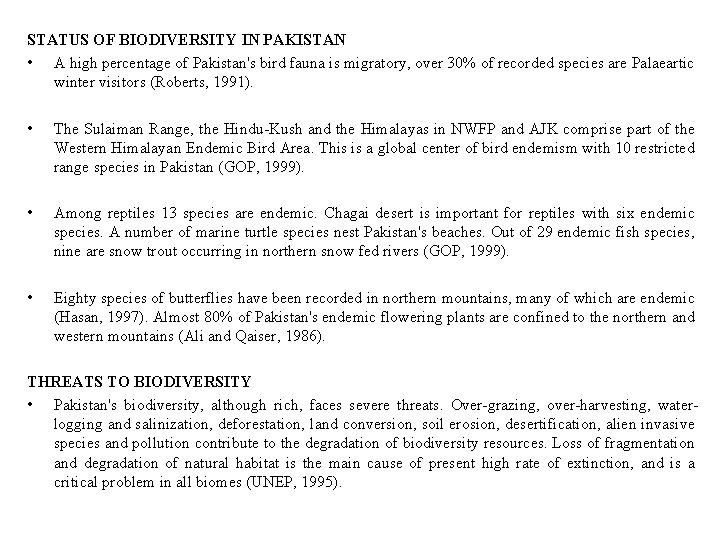
STATUS OF BIODIVERSITY IN PAKISTAN • A high percentage of Pakistan's bird fauna is migratory, over 30% of recorded species are Palaeartic winter visitors (Roberts, 1991). • The Sulaiman Range, the Hindu-Kush and the Himalayas in NWFP and AJK comprise part of the Western Himalayan Endemic Bird Area. This is a global center of bird endemism with 10 restricted range species in Pakistan (GOP, 1999). • Among reptiles 13 species are endemic. Chagai desert is important for reptiles with six endemic species. A number of marine turtle species nest Pakistan's beaches. Out of 29 endemic fish species, nine are snow trout occurring in northern snow fed rivers (GOP, 1999). • Eighty species of butterflies have been recorded in northern mountains, many of which are endemic (Hasan, 1997). Almost 80% of Pakistan's endemic flowering plants are confined to the northern and western mountains (Ali and Qaiser, 1986). THREATS TO BIODIVERSITY • Pakistan's biodiversity, although rich, faces severe threats. Over-grazing, over-harvesting, waterlogging and salinization, deforestation, land conversion, soil erosion, desertification, alien invasive species and pollution contribute to the degradation of biodiversity resources. Loss of fragmentation and degradation of natural habitat is the main cause of present high rate of extinction, and is a critical problem in all biomes (UNEP, 1995).
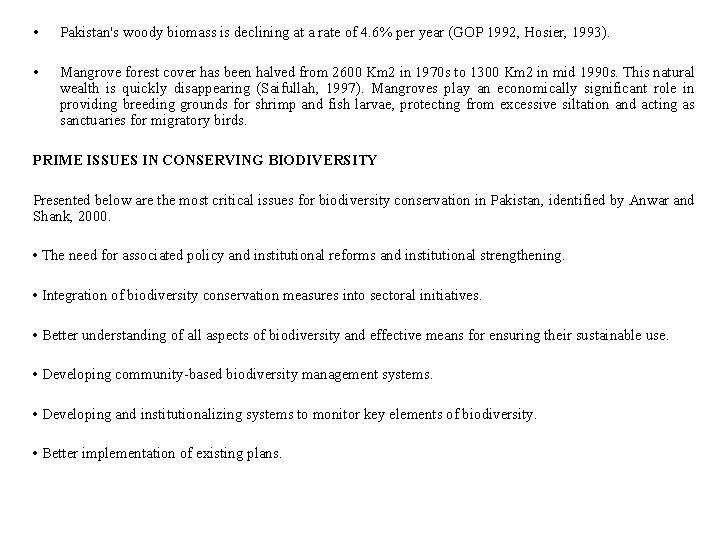
• Pakistan's woody biomass is declining at a rate of 4. 6% per year (GOP 1992, Hosier, 1993). • Mangrove forest cover has been halved from 2600 Km 2 in 1970 s to 1300 Km 2 in mid 1990 s. This natural wealth is quickly disappearing (Saifullah, 1997). Mangroves play an economically significant role in providing breeding grounds for shrimp and fish larvae, protecting from excessive siltation and acting as sanctuaries for migratory birds. PRIME ISSUES IN CONSERVING BIODIVERSITY Presented below are the most critical issues for biodiversity conservation in Pakistan, identified by Anwar and Shank, 2000. • The need for associated policy and institutional reforms and institutional strengthening. • Integration of biodiversity conservation measures into sectoral initiatives. • Better understanding of all aspects of biodiversity and effective means for ensuring their sustainable use. • Developing community-based biodiversity management systems. • Developing and institutionalizing systems to monitor key elements of biodiversity. • Better implementation of existing plans.
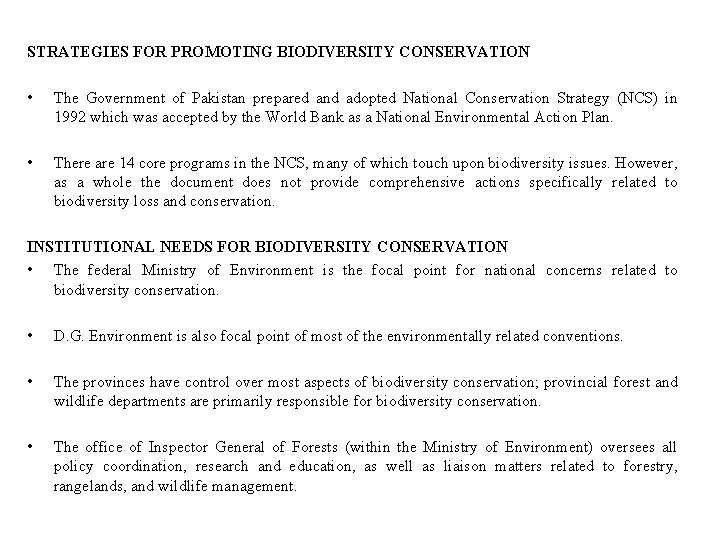
STRATEGIES FOR PROMOTING BIODIVERSITY CONSERVATION • The Government of Pakistan prepared and adopted National Conservation Strategy (NCS) in 1992 which was accepted by the World Bank as a National Environmental Action Plan. • There are 14 core programs in the NCS, many of which touch upon biodiversity issues. However, as a whole the document does not provide comprehensive actions specifically related to biodiversity loss and conservation. INSTITUTIONAL NEEDS FOR BIODIVERSITY CONSERVATION • The federal Ministry of Environment is the focal point for national concerns related to biodiversity conservation. • D. G. Environment is also focal point of most of the environmentally related conventions. • The provinces have control over most aspects of biodiversity conservation; provincial forest and wildlife departments are primarily responsible for biodiversity conservation. • The office of Inspector General of Forests (within the Ministry of Environment) oversees all policy coordination, research and education, as well as liaison matters related to forestry, rangelands, and wildlife management.

• The Pakistan Environmental Protection Agency (PEPA) is an attached agency of Ministry of Environment established under the Pakistan Environmental Protection Act of 1997. PEPA has the responsibility for executing, enforcing and regulating protection of the environment in the country. • PEPA is also the focal point and approving authority for Initial Environmental Examinations (IEEs) and Environmental Impact Assessments (El. As). The agency is supported by provincial EPAs. PROTECTED AREAS • Government of Pakistan has taken a number of steps for the protection and conservation of biodiversity in the country. • The national protected areas system has been established throughout the country. • This includes national parks, wildlife sanctuaries and game reserves, and covers an area of 9. 17 million hectares (10. 4 per cent of total land area) (GOP, 1999). • However, most of these protected areas were designated in the 1960 s and 1970 s through legislation. • Wildlife sanctuaries provide greater protection than national parks, while game reserves afford no protection to habitat but merely regulate hunting.
NATIONAL ACTION PLAN TO COMBAT DESERTIFICATION • Pakistan is also Part to UN Convention to Combat Desertification (CCD) since 1997 and has prepared National Action Plan to Combat Desertification (NAP). Creation of an organization on biodiversity at the national level Keeping in view the importance of the subject and the threatening situation, it seems logical to create an organization on biodiversity at the national level, having an international and national mandate. That will maintain liaison with all international commitments regarding biodiversity conservation focusing on technical, financial, human resource development (HRD) and communication aspects. At the National level, the organization should be able to serve the all aspects of biodiversity like: development of human resources; policy reforms and legislation; Sensitization especially at policy and mid level; and assist all concerned public departments/ agencies in assisting, educating and segregating biodiversity issues.
- Slides: 6