
Status and Prospects of Reactor Neutrino Experiments SooBong
Status and Prospects of Reactor Neutrino Experiments Soo-Bong Kim (KNRC, Seoul National University) “Nu. Phys 2014: Prospects in Neutrino Physics, London, Dec. 15 -17, 2014”
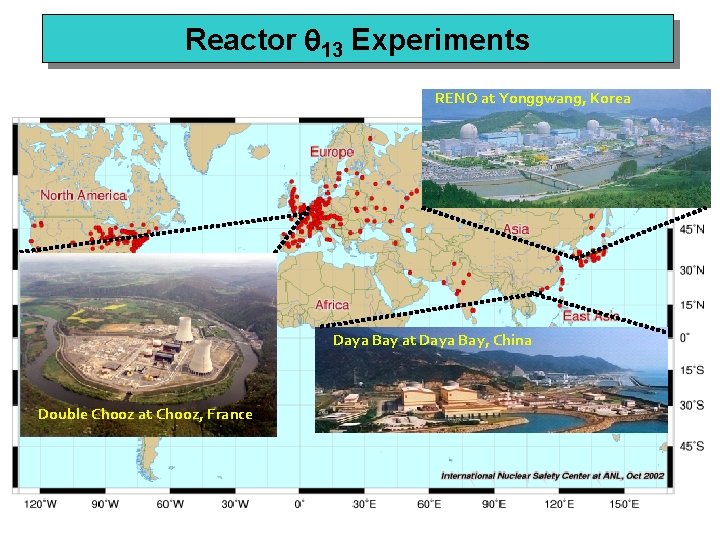
Reactor 13 Experiments RENO at Yonggwang, Korea Daya Bay at Daya Bay, China Double Chooz at Chooz, France
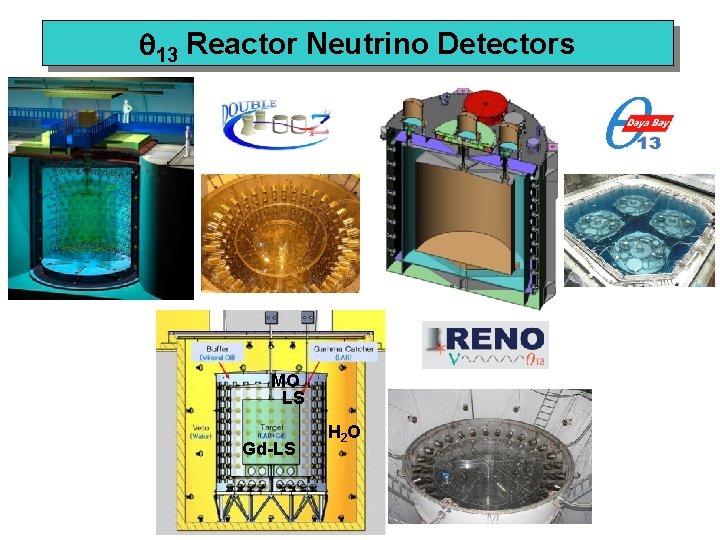
13 Reactor Neutrino Detectors MO LS Gd-LS H 2 O
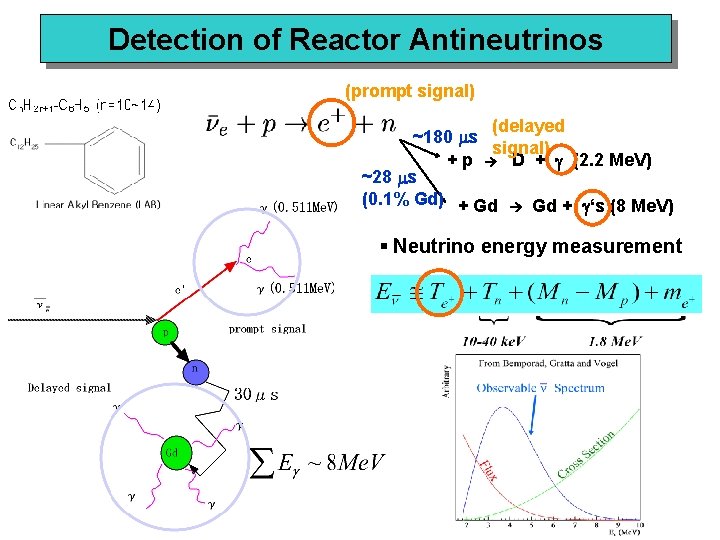
Detection of Reactor Antineutrinos (prompt signal) (delayed ~180 ms signal) + p D + g (2. 2 Me. V) ~28 ms (0. 1% Gd) + Gd + g‘s (8 Me. V) § Neutrino energy measurement
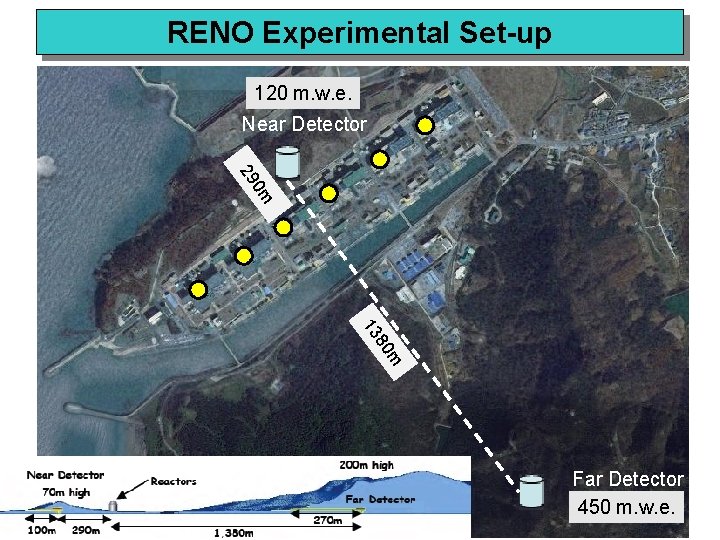
RENO Experimental Set-up 120 m. w. e. Near Detector m 0 29 m 80 13 Far Detector 450 m. w. e.
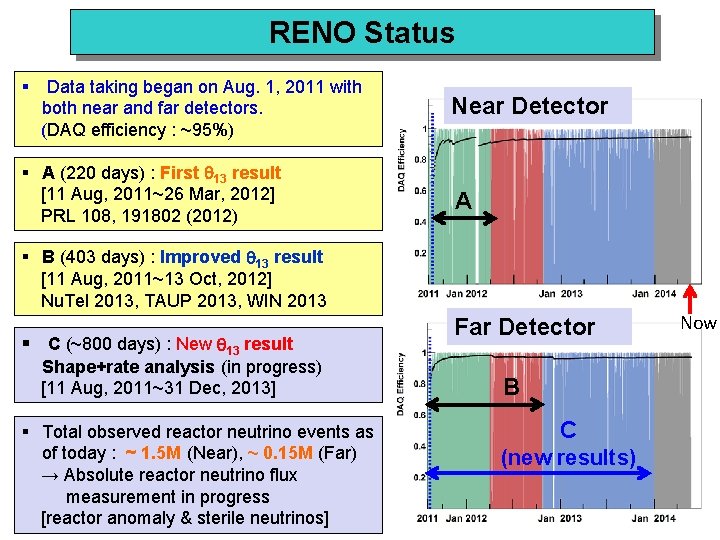
RENO Status § Data taking began on Aug. 1, 2011 with both near and far detectors. (DAQ efficiency : ~95%) Near Detector § A (220 days) : First 13 result [11 Aug, 2011~26 Mar, 2012] PRL 108, 191802 (2012) A § B (403 days) : Improved 13 result [11 Aug, 2011~13 Oct, 2012] Nu. Tel 2013, TAUP 2013, WIN 2013 § C (~800 days) : New 13 result Shape+rate analysis (in progress) [11 Aug, 2011~31 Dec, 2013] § Total observed reactor neutrino events as of today : ~ 1. 5 M (Near), ~ 0. 15 M (Far) → Absolute reactor neutrino flux measurement in progress [reactor anomaly & sterile neutrinos] Far Detector B C (new results) Now
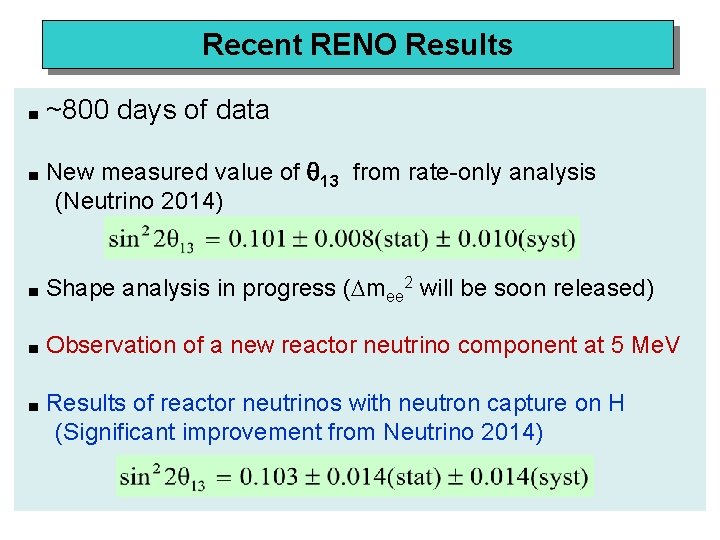
Recent RENO Results ■ ■ ~800 days of data New measured value of 13 from rate-only analysis (Neutrino 2014) ■ Shape analysis in progress (Dmee 2 will be soon released) ■ Observation of a new reactor neutrino component at 5 Me. V ■ Results of reactor neutrinos with neutron capture on H (Significant improvement from Neutrino 2014)
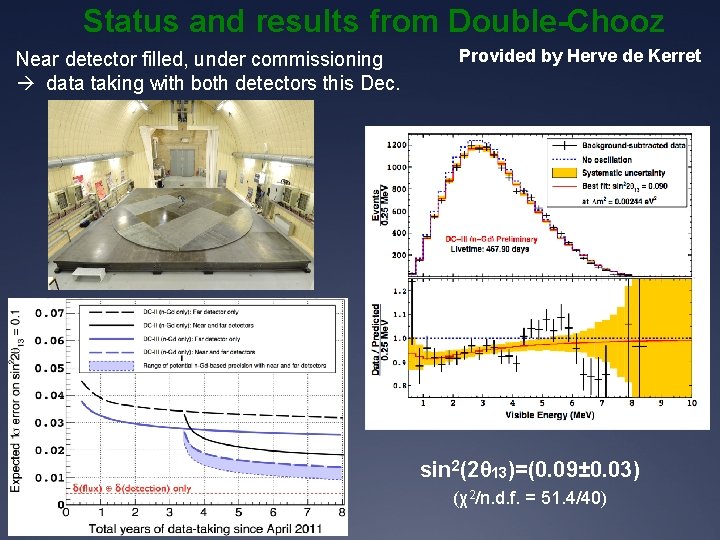
Status and results from Double-Chooz Near detector filled, under commissioning data taking with both detectors this Dec. Provided by Herve de Kerret sin 2(2θ 13)=(0. 09± 0. 03) (χ2/n. d. f. = 51. 4/40)
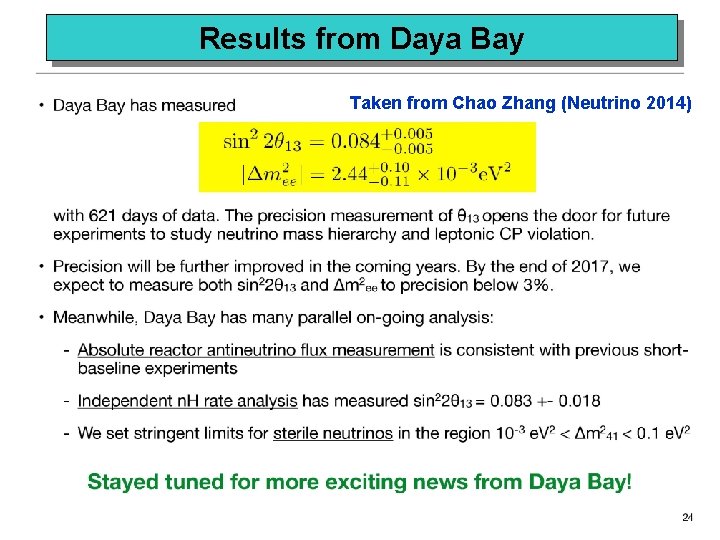
Results from Daya Bay Taken from Chao Zhang (Neutrino 2014)
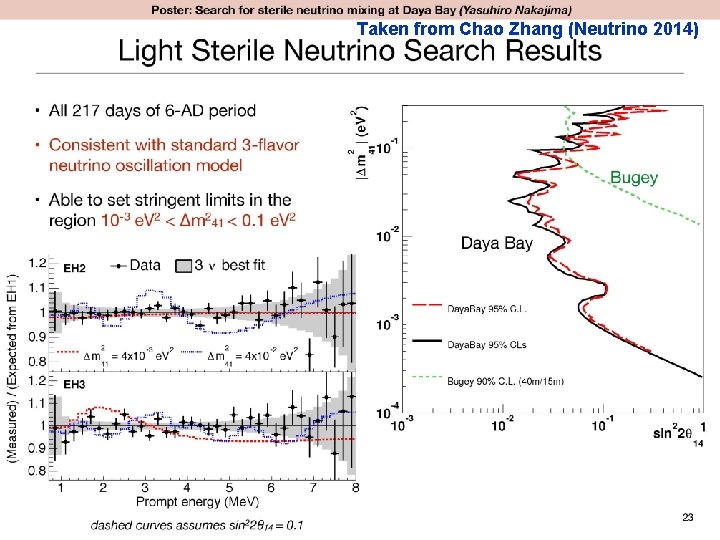
Taken from Chao Zhang (Neutrino 2014)
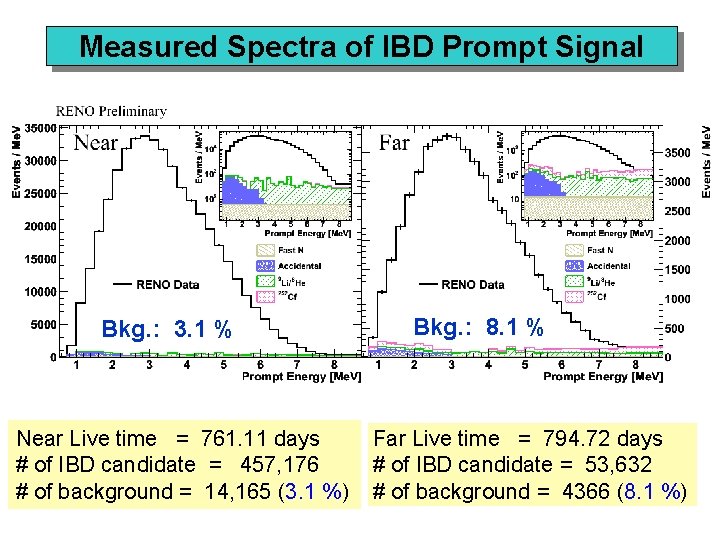
Measured Spectra of IBD Prompt Signal Bkg. : 3. 1 % Near Live time = 761. 11 days # of IBD candidate = 457, 176 # of background = 14, 165 (3. 1 %) Bkg. : 8. 1 % Far Live time = 794. 72 days # of IBD candidate = 53, 632 # of background = 4366 (8. 1 %)
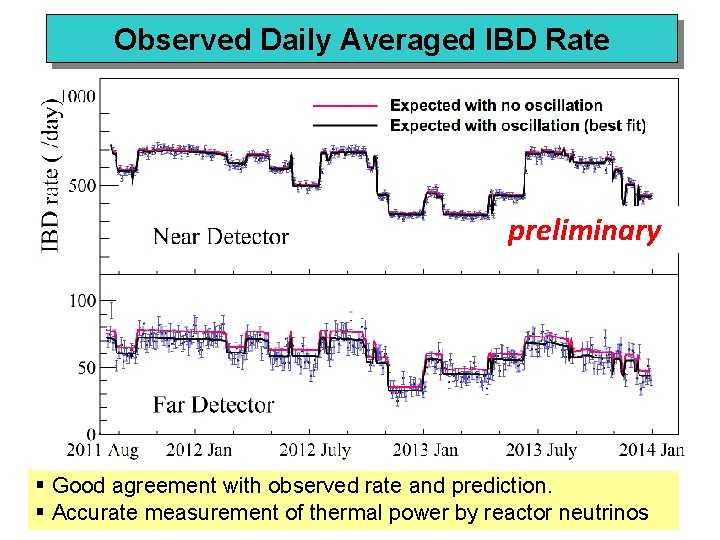
Observed Daily Averaged IBD Rate preliminary § Good agreement with observed rate and prediction. § Accurate measurement of thermal power by reactor neutrinos
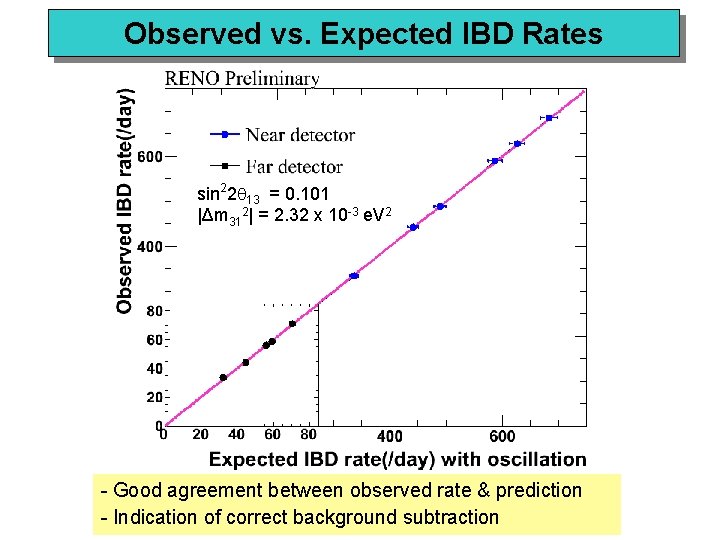
Observed vs. Expected IBD Rates sin 22 q 13 = 0. 101 |Δm 312| = 2. 32 x 10 -3 e. V 2 - Good agreement between observed rate & prediction - Indication of correct background subtraction
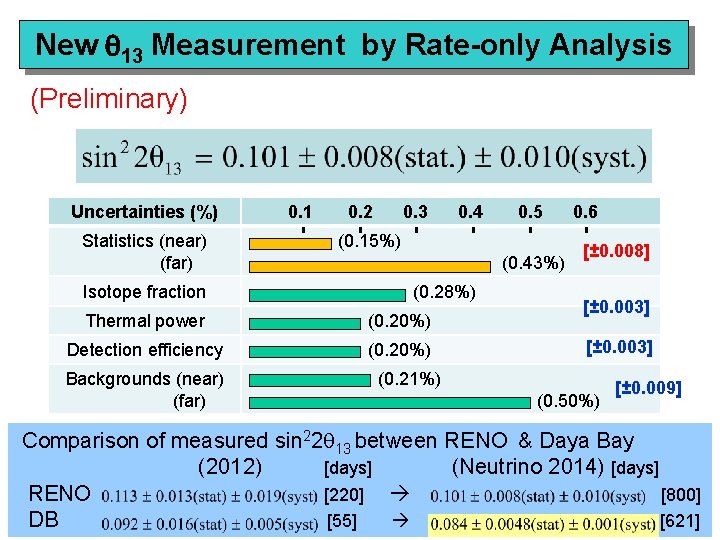
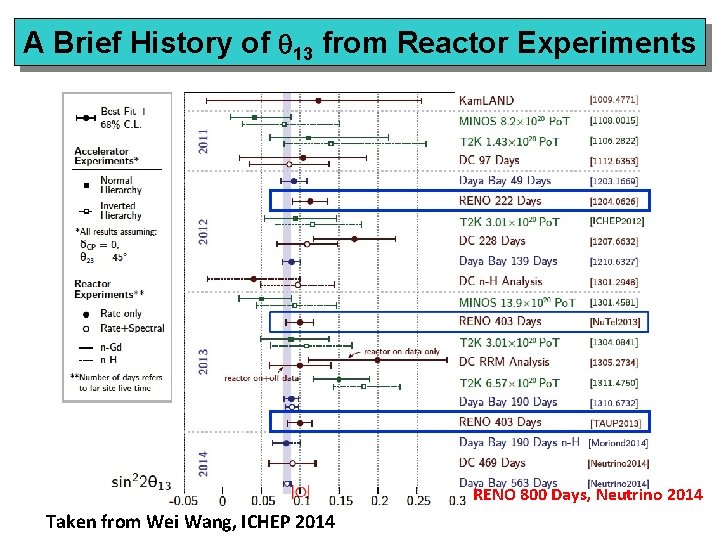
New 13 Measurement by Rate-only Analysis (Preliminary) Uncertainties (%) Statistics (near) (far) Isotope fraction 0. 1 0. 2 0. 3 0. 5 (0. 15%) (0. 43%) (0. 28%) Thermal power (0. 20%) Detection efficiency (0. 20%) Backgrounds (near) (far) 0. 4 0. 6 [± 0. 008] [± 0. 003] (0. 21%) (0. 50%) [± 0. 009] Comparison of measured sin 22 q 13 between RENO & Daya Bay 4. 9 s (Neutrino 2012) (2012) [days] (Neutrino 2014) [days] 6. 3 s (TAUP/WIN 2013) RENO [220] [800] 7. 8 s (Neutrino 2014) DB [55] [621]
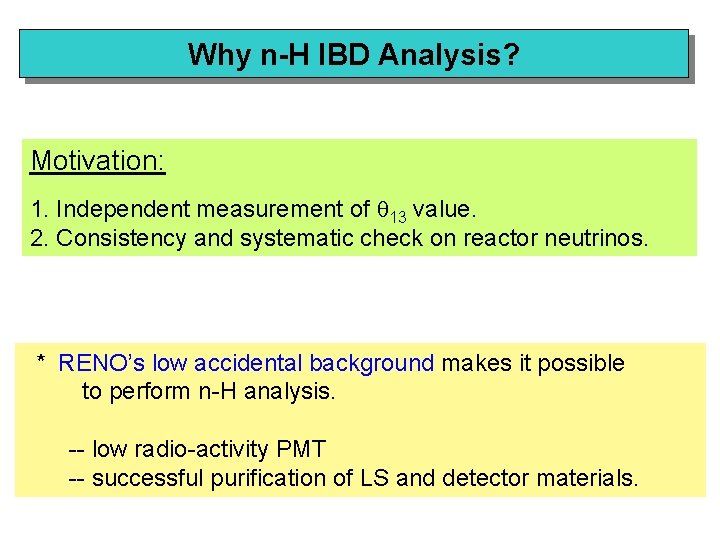
Why n-H IBD Analysis? Motivation: 1. Independent measurement of q 13 value. 2. Consistency and systematic check on reactor neutrinos. * RENO’s low accidental background makes it possible to perform n-H analysis. -- low radio-activity PMT -- successful purification of LS and detector materials.
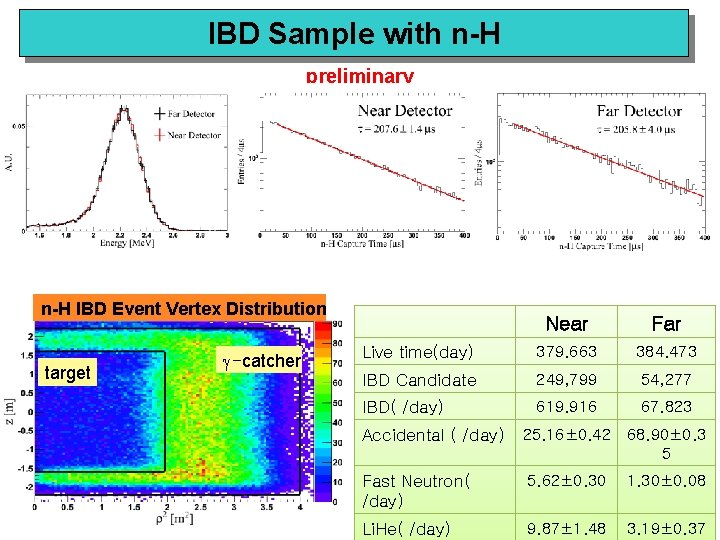
IBD Sample with n-H preliminary n-H IBD Event Vertex Distribution target g-catcher Near Far Live time(day) 379. 663 384. 473 IBD Candidate 249, 799 54, 277 IBD( /day) 619. 916 67. 823 Accidental ( /day) 25. 16± 0. 42 68. 90± 0. 3 5 Fast Neutron( /day) 5. 62± 0. 30 1. 30± 0. 08 Li. He( /day) 9. 87± 1. 48 3. 19± 0. 37
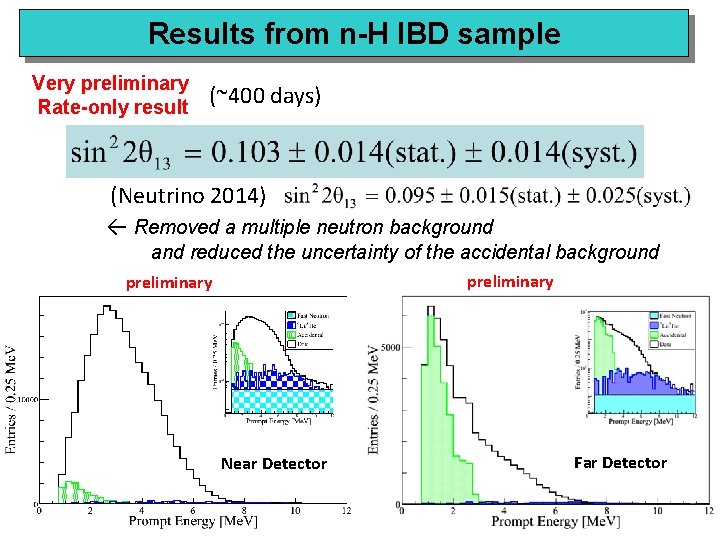
Results from n-H IBD sample Very preliminary Rate-only result (~400 days) (Neutrino 2014) ← Removed a multiple neutron background and reduced the uncertainty of the accidental background preliminary Near Detector Far Detector
Energy Calibration from g-ray Sources
B 12 Energy Spectrum (Near & Far)
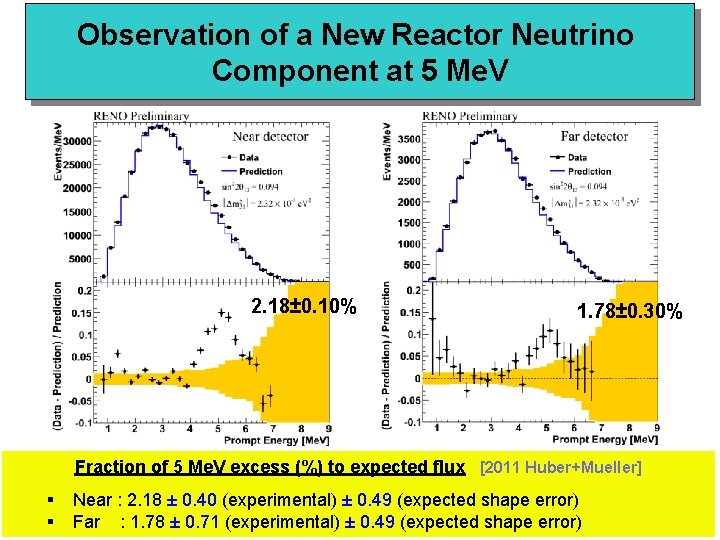
Observation of a New Reactor Neutrino Component at 5 Me. V 2. 18± 0. 10% 1. 78± 0. 30% Fraction of 5 Me. V excess (%) to expected flux [2011 Huber+Mueller] § § Near : 2. 18 ± 0. 40 (experimental) ± 0. 49 (expected shape error) Far : 1. 78 ± 0. 71 (experimental) ± 0. 49 (expected shape error)
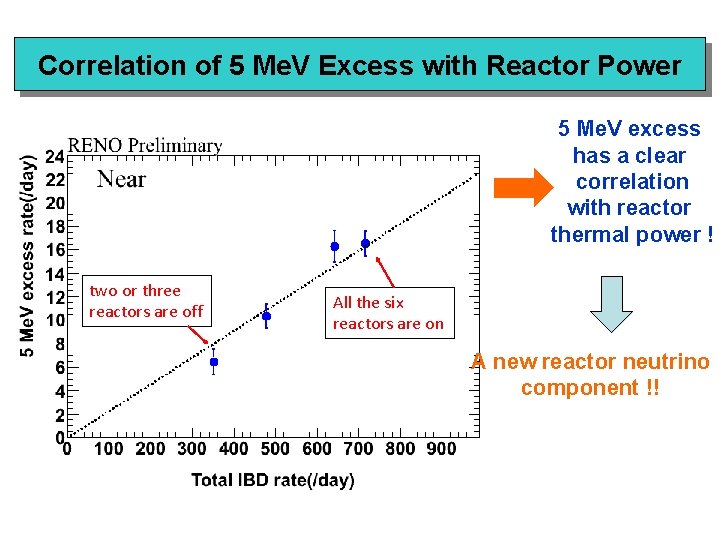
Correlation of 5 Me. V Excess with Reactor Power 5 Me. V excess has a clear correlation with reactor thermal power ! two or three reactors are off All the six reactors are on A new reactor neutrino component !!
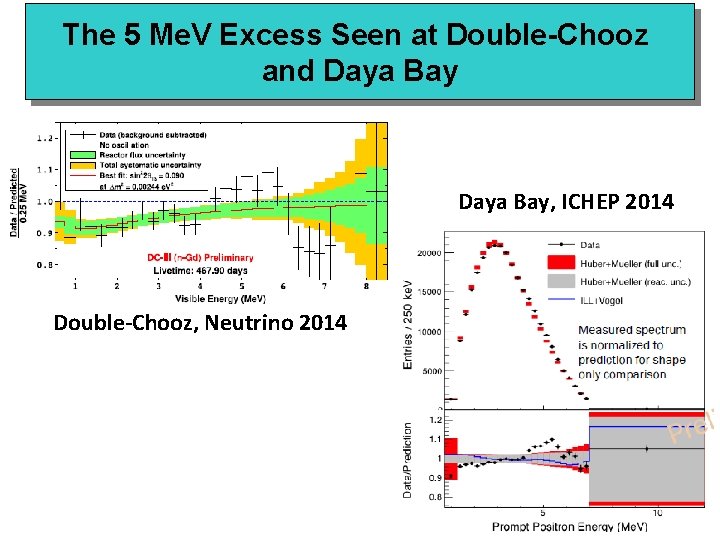
The 5 Me. V Excess Seen at Double-Chooz and Daya Bay, ICHEP 2014 Double-Chooz, Neutrino 2014
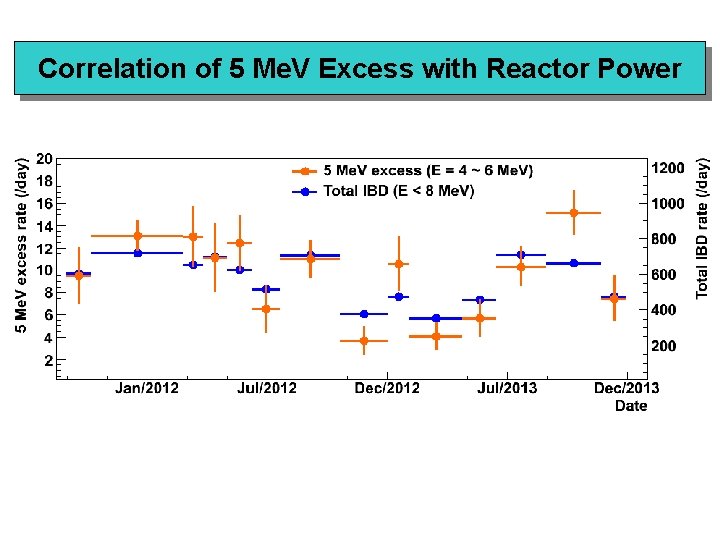
Correlation of 5 Me. V Excess with Reactor Power
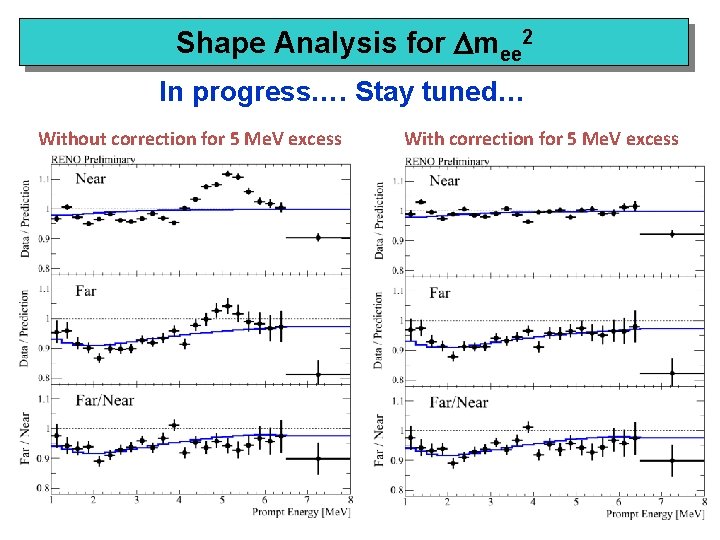
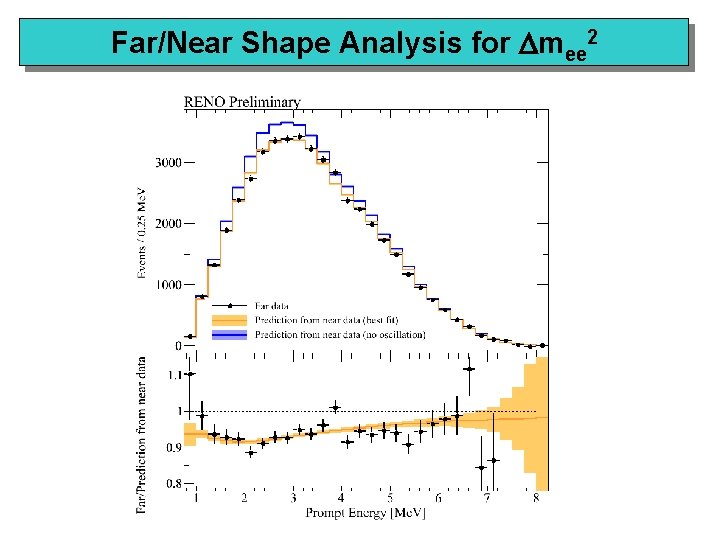
Shape Analysis for Dmee 2 In progress…. Stay tuned… Without correction for 5 Me. V excess With correction for 5 Me. V excess
Far/Near Shape Analysis for Dmee 2
Reactor Neutrino Disappearance on L/E
RENO’s Projected Sensitivity of 13 Neutrino 2014 (~800 days) (7. 8 s) (13 % precision) (14 s) (in 3 years) (7 % precision) 2012. 4 § 5 years of data : ± 7% 2013. 3 2013. 9 2014. 6 - stat. error : ± 0. 008 → ± 0. 005 - syst. error : ± 0. 010 → ± 0. 005 (7 % precision) could be possible !!
A Brief History of 13 from Reactor Experiments RENO 800 Days, Neutrino 2014 Taken from Wei Wang, ICHEP 2014
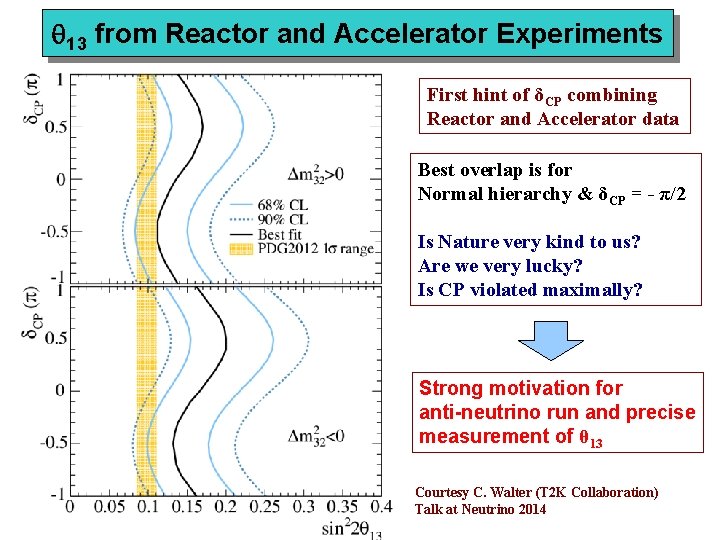
13 from Reactor and Accelerator Experiments First hint of δCP combining Reactor and Accelerator data Best overlap is for Normal hierarchy & δCP = - π/2 Is Nature very kind to us? Are we very lucky? Is CP violated maximally? Strong motivation for anti-neutrino run and precise measurement of θ 13 Courtesy C. Walter (T 2 K Collaboration) Talk at Neutrino 2014
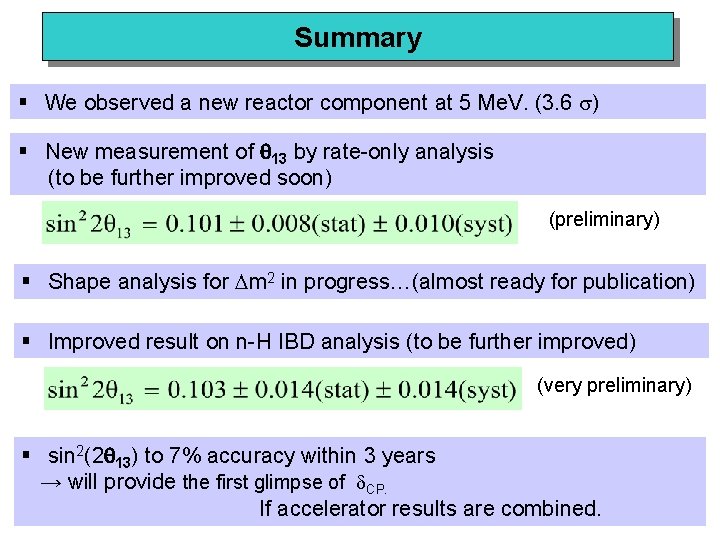
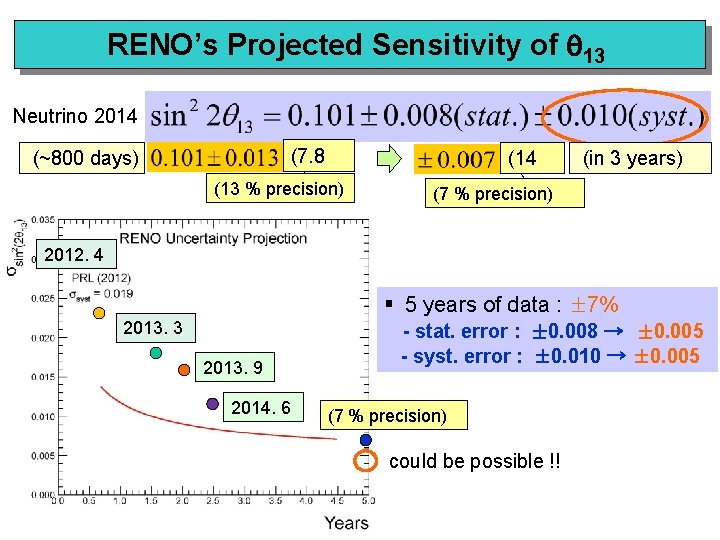
Summary § We observed a new reactor component at 5 Me. V. (3. 6 s) § New measurement of 13 by rate-only analysis (to be further improved soon) (preliminary) § Shape analysis for Dm 2 in progress…(almost ready for publication) § Improved result on n-H IBD analysis (to be further improved) (very preliminary) § sin 2(2 13) to 7% accuracy within 3 years → will provide the first glimpse of CP. If accelerator results are combined.
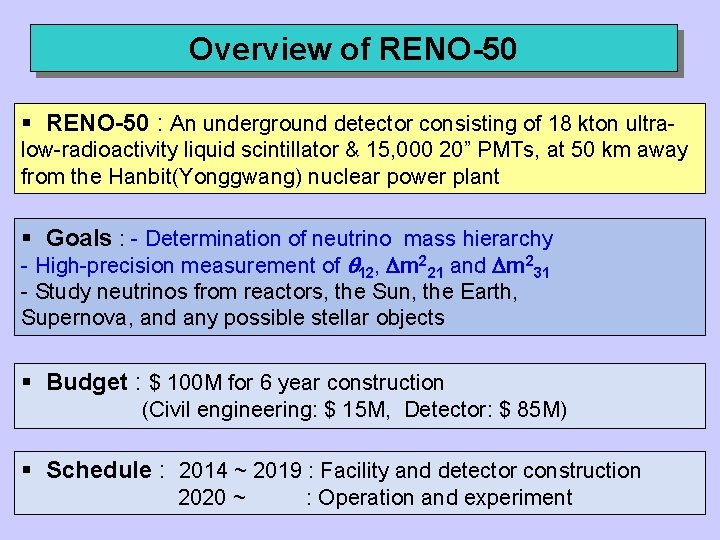
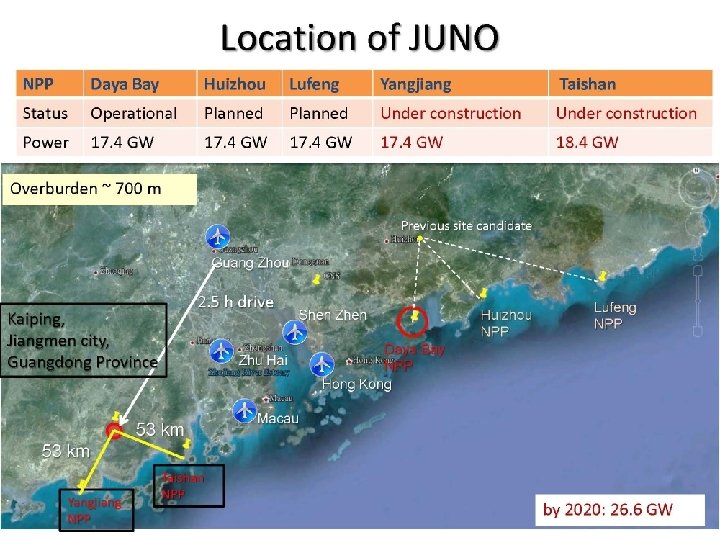
Overview of RENO-50 § RENO-50 : An underground detector consisting of 18 kton ultralow-radioactivity liquid scintillator & 15, 000 20” PMTs, at 50 km away from the Hanbit(Yonggwang) nuclear power plant § Goals : - Determination of neutrino mass hierarchy - High-precision measurement of q 12, Dm 221 and Dm 231 - Study neutrinos from reactors, the Sun, the Earth, Supernova, and any possible stellar objects § Budget : $ 100 M for 6 year construction (Civil engineering: $ 15 M, Detector: $ 85 M) § Schedule : 2014 ~ 2019 : Facility and detector construction 2020 ~ : Operation and experiment
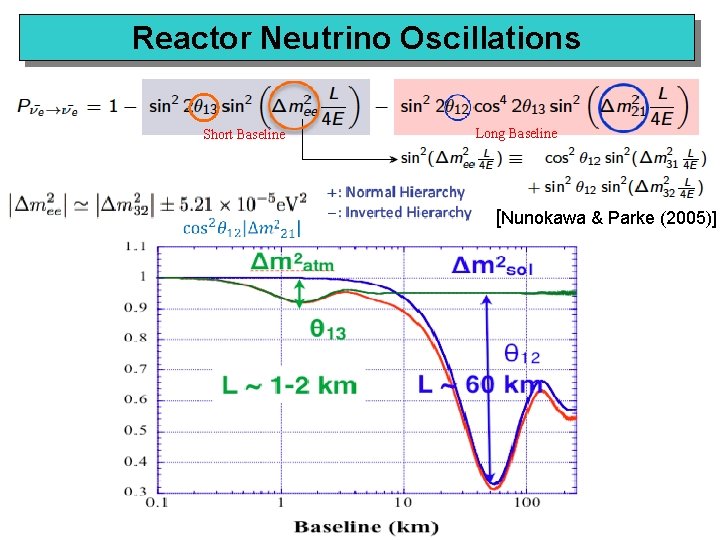
Reactor Neutrino Oscillations Short Baseline Long Baseline [Nunokawa & Parke (2005)]
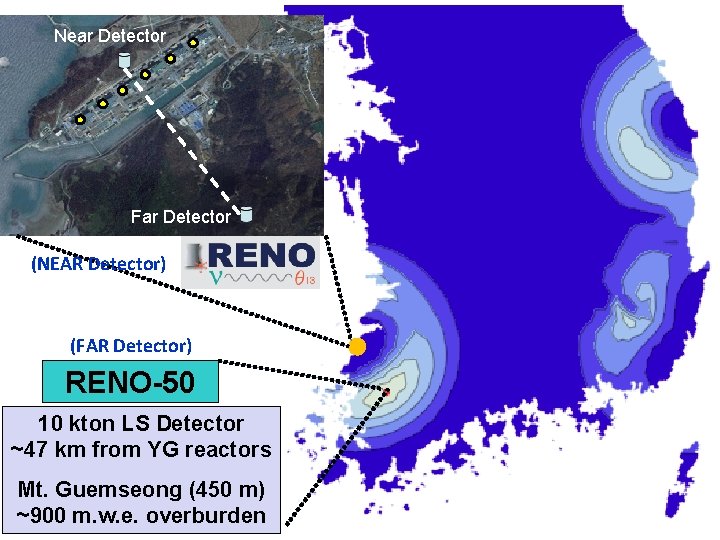
Near Detector Far Detector (NEAR Detector) (FAR Detector) RENO-50 10 kton LS Detector ~47 km from YG reactors Mt. Guemseong (450 m) ~900 m. w. e. overburden
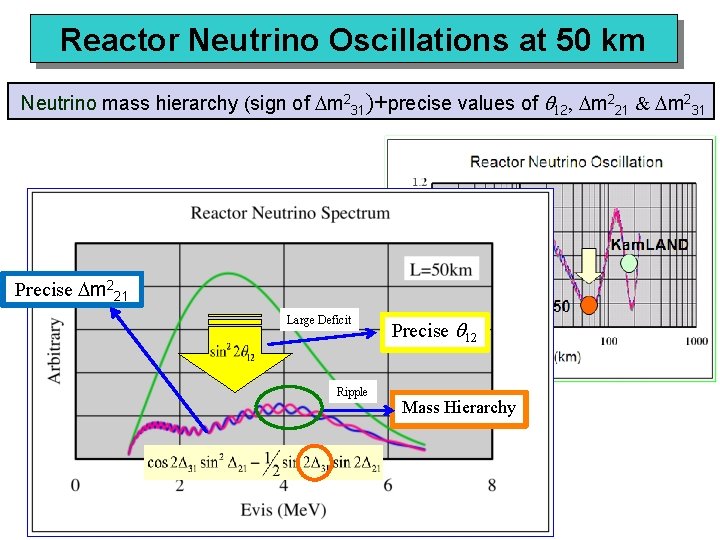
Reactor Neutrino Oscillations at 50 km Neutrino mass hierarchy (sign of Dm 231)+precise values of 12, Dm 221 & Dm 231 Precise Dm 221 Large Deficit Ripple Precise 12 Mass Hierarchy
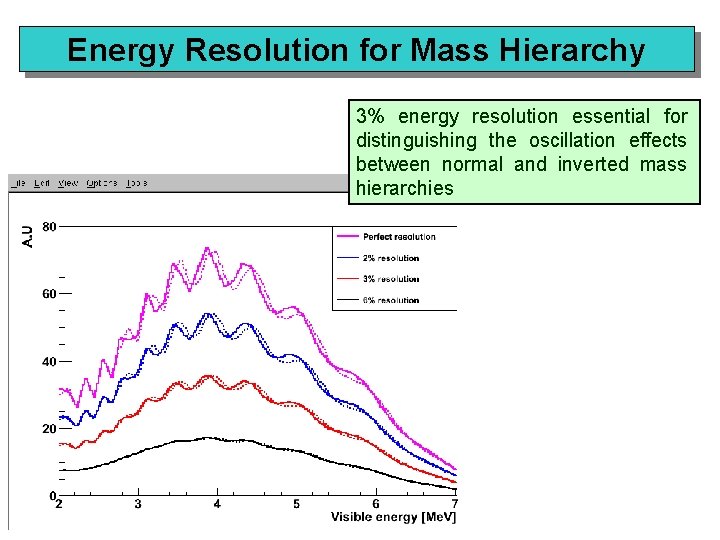
Energy Resolution for Mass Hierarchy 3% energy resolution essential for distinguishing the oscillation effects between normal and inverted mass hierarchies
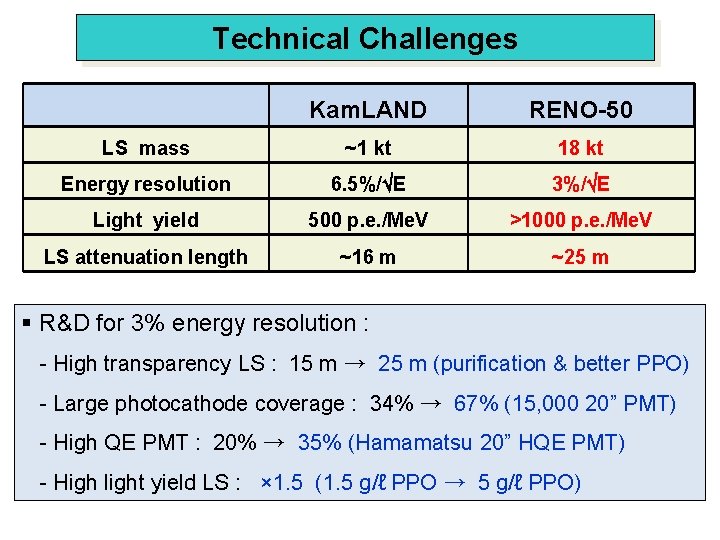
Technical Challenges Kam. LAND RENO-50 LS mass ~1 kt 18 kt Energy resolution 6. 5%/ E 3%/ E Light yield 500 p. e. /Me. V >1000 p. e. /Me. V LS attenuation length ~16 m ~25 m § R&D for 3% energy resolution : - High transparency LS : 15 m → 25 m (purification & better PPO) - Large photocathode coverage : 34% → 67% (15, 000 20” PMT) - High QE PMT : 20% → 35% (Hamamatsu 20” HQE PMT) - High light yield LS : × 1. 5 (1. 5 g/ℓ PPO → 5 g/ℓ PPO)
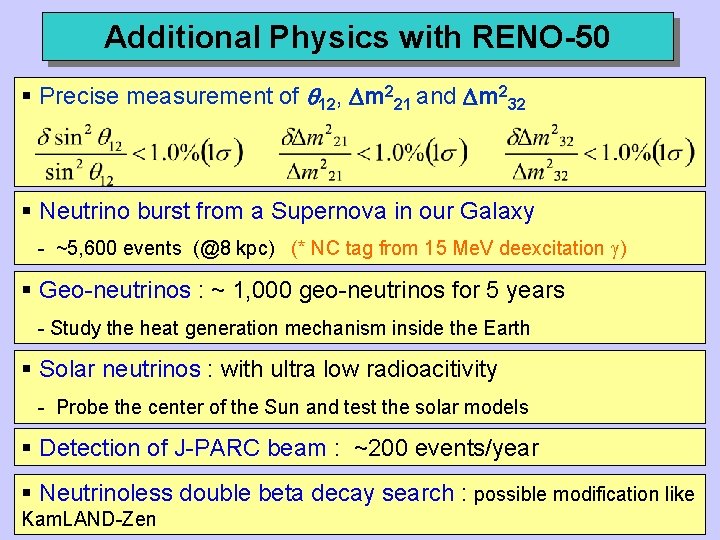
Additional Physics with RENO-50 § Precise measurement of q 12, Dm 221 and Dm 232 § Neutrino burst from a Supernova in our Galaxy - ~5, 600 events (@8 kpc) (* NC tag from 15 Me. V deexcitation g) § Geo-neutrinos : ~ 1, 000 geo-neutrinos for 5 years - Study the heat generation mechanism inside the Earth § Solar neutrinos : with ultra low radioacitivity - Probe the center of the Sun and test the solar models § Detection of J-PARC beam : ~200 events/year § Neutrinoless double beta decay search : possible modification like Kam. LAND-Zen
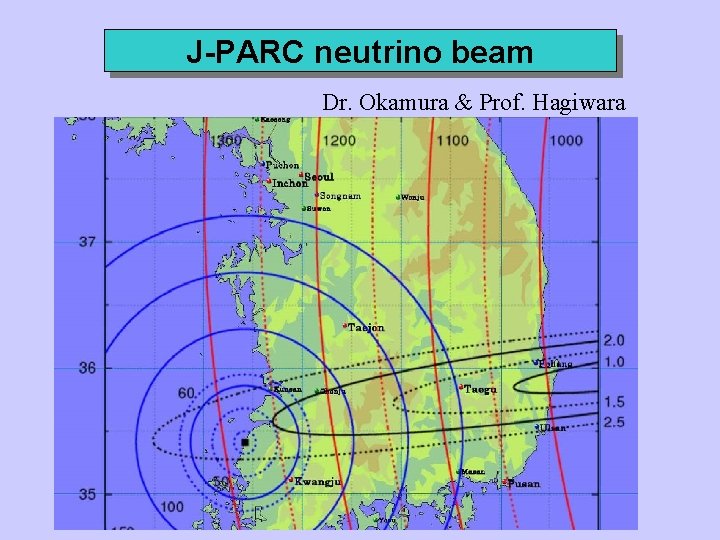
J-PARC neutrino beam Dr. Okamura & Prof. Hagiwara
Summary § Longer baseline (~50 km) reactor experiments is under pursuit to determine the mass hierarchy in 3 s for 5 years of data-taking, and to perform high-precision (<1%) measurements of 12, Dm 221, & Dm 231. § Domestic and international workshops held in 2013 to discuss the feasibility and physics opportunities § An R&D funding (US $ 2 M in next 3 years) will be given by the Samsung Science & Technology Foundation. § A proposal have been submitted to obtain full funding. Thanks for your attention!
- Slides: 40