
Status and Progress of the International Axion Observatory
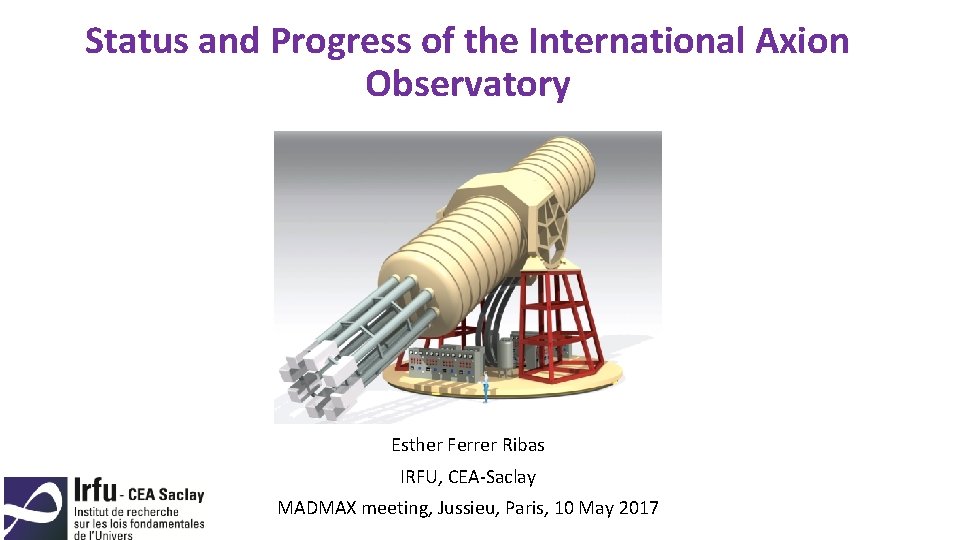
Status and Progress of the International Axion Observatory Esther Ferrer Ribas IRFU, CEA-Saclay MADMAX meeting, Jussieu, Paris, 10 May 2017

IAXO: International AXion Observatory • Baseline search: solar axions • Why are we looking for axions? • Most elegant solution to explain the apparent symmetry between matter and anti-matter in the strong interactions (CP violation); • Predicted by SM extensions, neutral, very light, low interacting cross-section; • Dark matter candidates; • Astrophysical hints for axion/ALPs? • Transparency of the Universe to UHE gammas; • Anomalous cooling of different types of stars; • Relevant axion/ALP parameter space at reach of current and near-future experiments; • Still too little experimental effort devoted to axions when compared to WIMP; 2
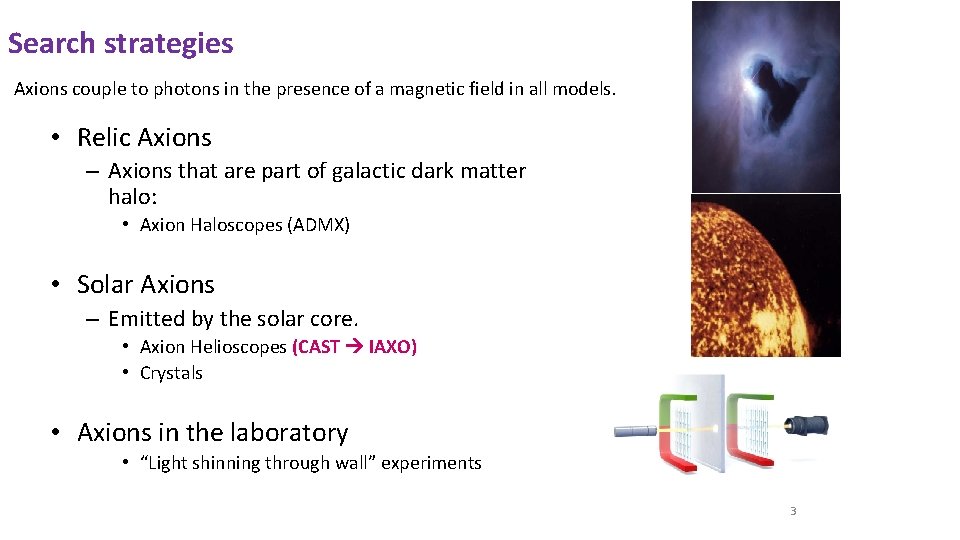
Search strategies Axions couple to photons in the presence of a magnetic field in all models. • Relic Axions – Axions that are part of galactic dark matter halo: • Axion Haloscopes (ADMX) • Solar Axions – Emitted by the solar core. • Axion Helioscopes (CAST IAXO) • Crystals • Axions in the laboratory • “Light shinning through wall” experiments 3
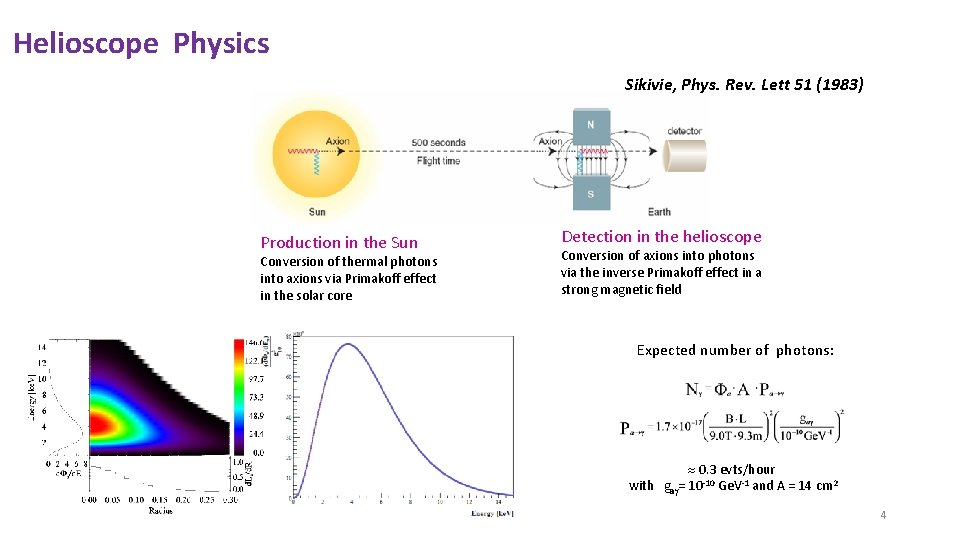
Helioscope Physics Sikivie, Phys. Rev. Lett 51 (1983) Production in the Sun Conversion of thermal photons into axions via Primakoff effect in the solar core Detection in the helioscope Conversion of axions into photons via the inverse Primakoff effect in a strong magnetic field Expected number of photons: 0. 3 evts/hour with ga = 10 -10 Ge. V-1 and A = 14 cm 2 4
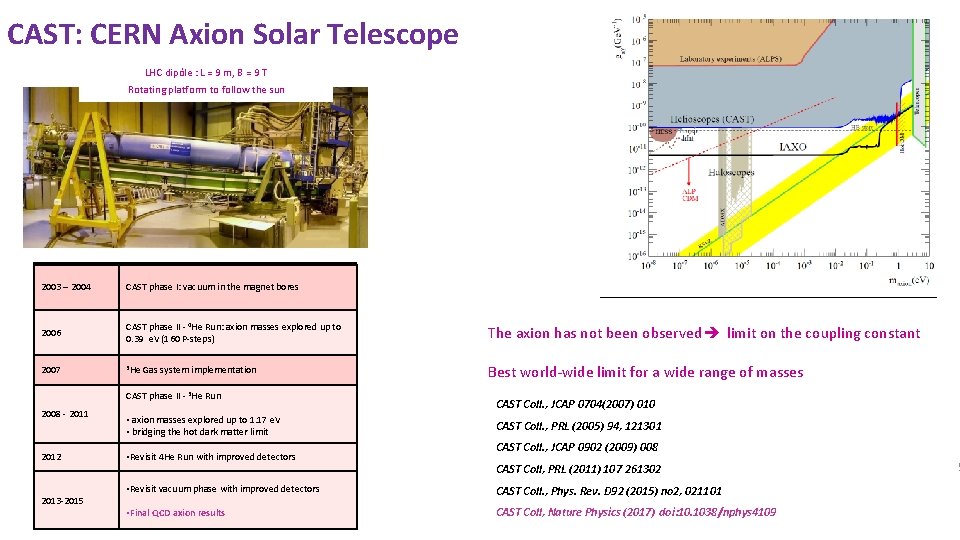
CAST: CERN Axion Solar Telescope LHC dipôle : L = 9 m, B = 9 T Rotating platform to follow the sun 2003 – 2004 CAST phase I: vacuum in the magnet bores 2006 CAST phase II - 4 He Run: axion masses explored up to 0. 39 e. V (160 P-steps) The axion has not been observed limit on the coupling constant 2007 3 He Best world-wide limit for a wide range of masses Gas system implementation CAST phase II - 3 He Run 2008 - 2011 2012 2013 -2015 • axion masses explored up to 1. 17 e. V • bridging the hot dark matter limit • Revisit 4 He Run with improved detectors CAST Coll. , JCAP 0704(2007) 010 CAST Coll. , PRL (2005) 94, 121301 CAST Coll. , JCAP 0902 (2009) 008 CAST Coll, PRL (2011) 107 261302 • Revisit vacuum phase with improved detectors CAST Coll. , Phys. Rev. D 92 (2015) no 2, 021101 • Final QCD axion results CAST Coll, Nature Physics (2017) doi: 10. 1038/nphys 4109 5
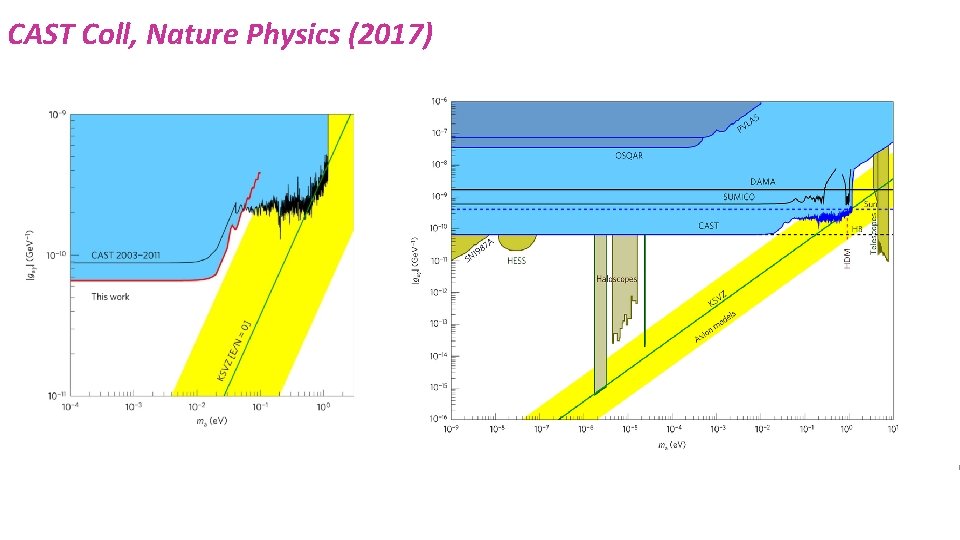
CAST Coll, Nature Physics (2017) 6
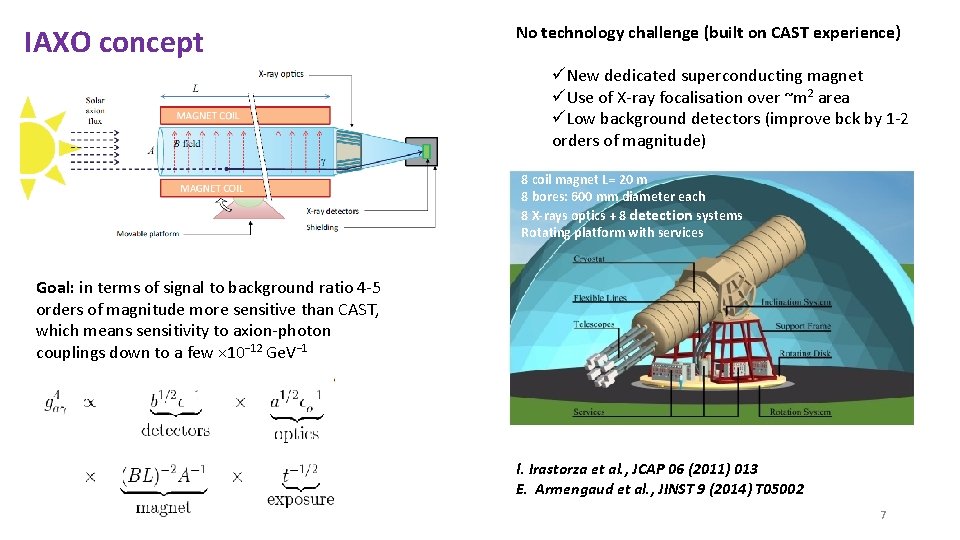
IAXO concept No technology challenge (built on CAST experience) üNew dedicated superconducting magnet üUse of X-ray focalisation over ~m 2 area üLow background detectors (improve bck by 1 -2 orders of magnitude) 8 coil magnet L= 20 m 8 bores: 600 mm diameter each 8 X-rays optics + 8 detection systems Rotating platform with services Goal: in terms of signal to background ratio 4 -5 orders of magnitude more sensitive than CAST, which means sensitivity to axion-photon couplings down to a few × 10− 12 Ge. V− 1 I. Irastorza et al. , JCAP 06 (2011) 013 E. Armengaud et al. , JINST 9 (2014) T 05002 7
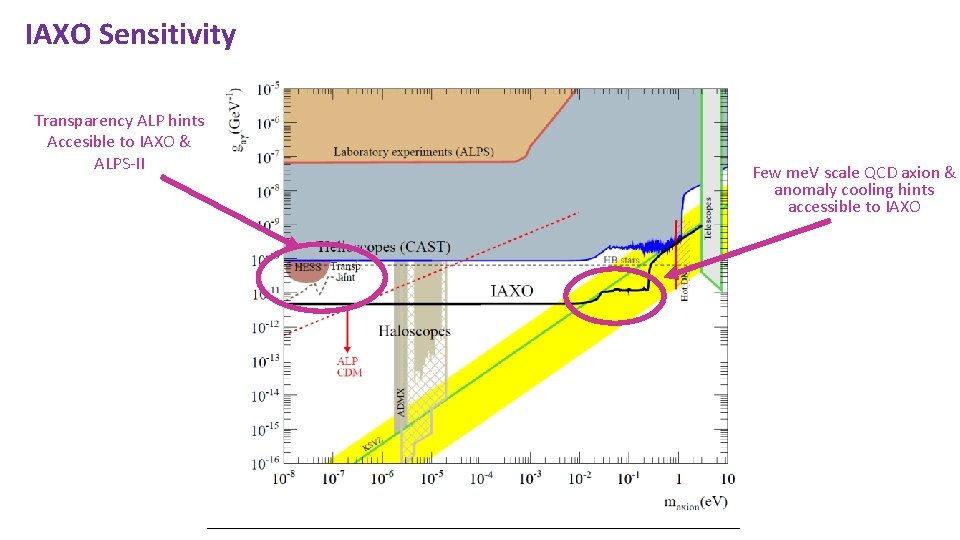
IAXO Sensitivity Transparency ALP hints Accesible to IAXO & ALPS-II Few me. V scale QCD axion & anomaly cooling hints accessible to IAXO
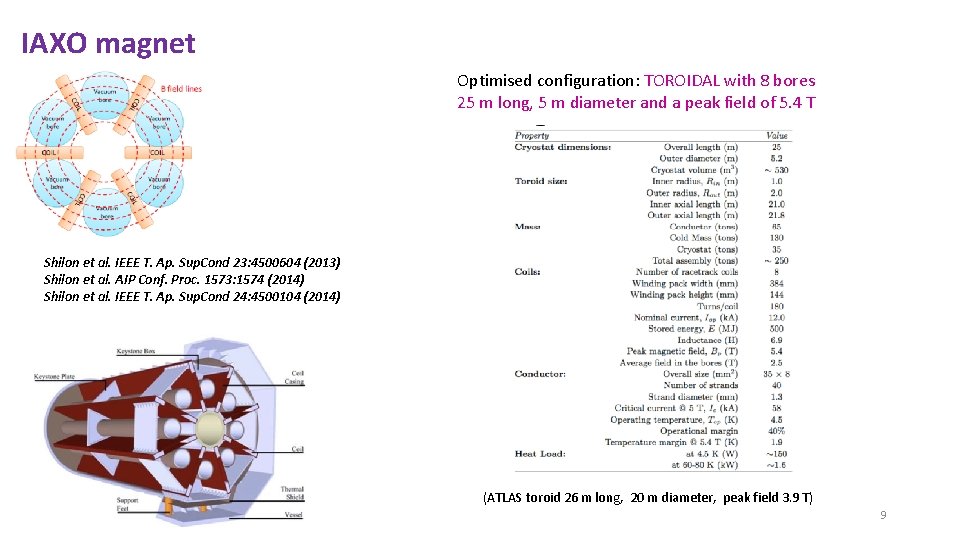
IAXO magnet Optimised configuration: TOROIDAL with 8 bores 25 m long, 5 m diameter and a peak field of 5. 4 T Shilon et al. IEEE T. Ap. Sup. Cond 23: 4500604 (2013) Shilon et al. AIP Conf. Proc. 1573: 1574 (2014) Shilon et al. IEEE T. Ap. Sup. Cond 24: 4500104 (2014) (ATLAS toroid 26 m long, 20 m diameter, peak field 3. 9 T) 9
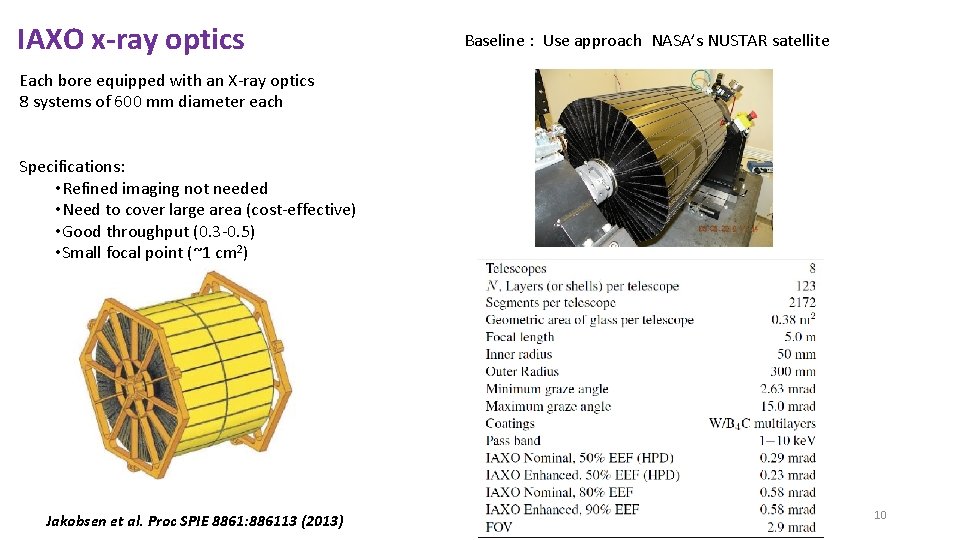
IAXO x-ray optics Baseline : Use approach NASA’s NUSTAR satellite Each bore equipped with an X-ray optics 8 systems of 600 mm diameter each Specifications: • Refined imaging not needed • Need to cover large area (cost-effective) • Good throughput (0. 3 -0. 5) • Small focal point (~1 cm 2) Jakobsen et al. Proc SPIE 8861: 886113 (2013) 10
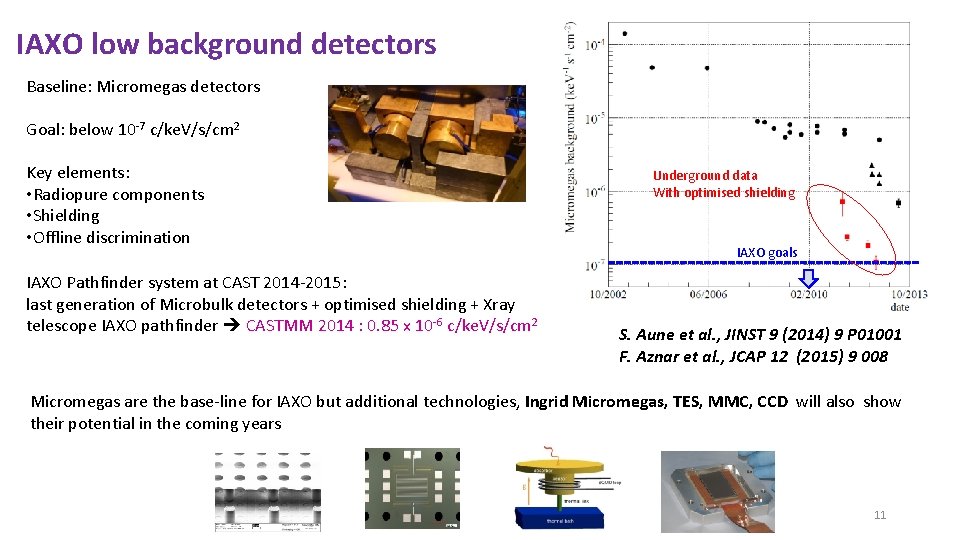
IAXO low background detectors Baseline: Micromegas detectors Goal: below 10 -7 c/ke. V/s/cm 2 Key elements: • Radiopure components • Shielding • Offline discrimination IAXO Pathfinder system at CAST 2014 -2015: last generation of Microbulk detectors + optimised shielding + Xray telescope IAXO pathfinder CASTMM 2014 : 0. 85 x 10 -6 c/ke. V/s/cm 2 Underground data With optimised shielding IAXO goals S. Aune et al. , JINST 9 (2014) 9 P 01001 F. Aznar et al. , JCAP 12 (2015) 9 008 Micromegas are the base-line for IAXO but additional technologies, Ingrid Micromegas, TES, MMC, CCD will also show their potential in the coming years 11
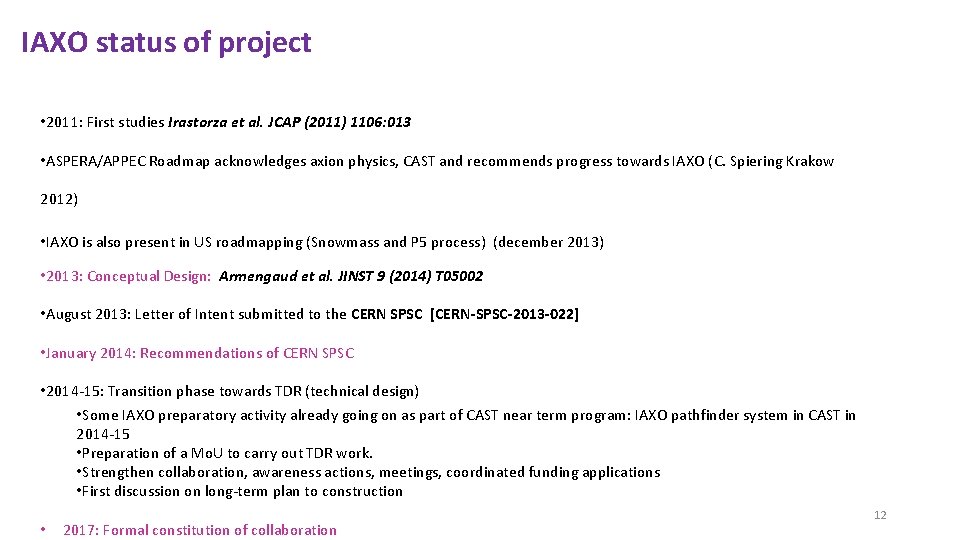
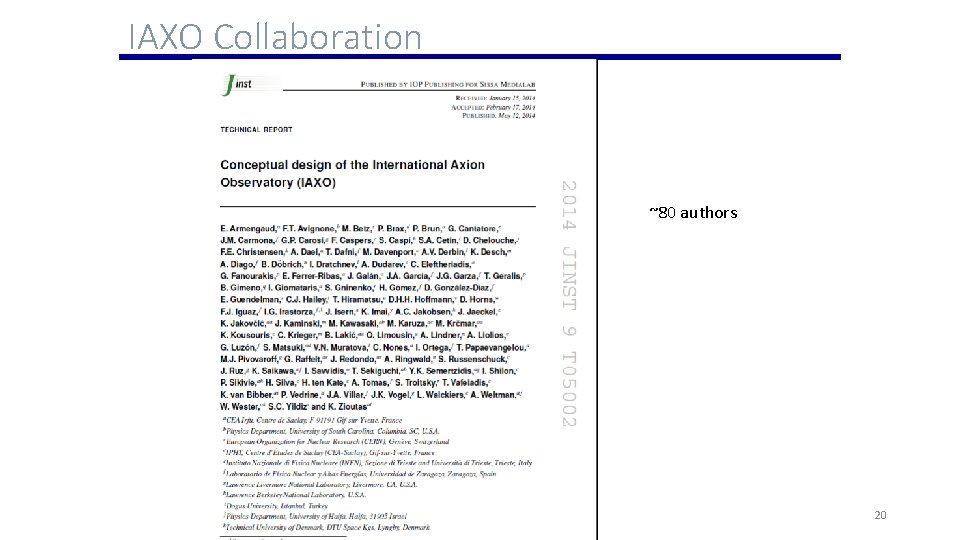
IAXO status of project • 2011: First studies Irastorza et al. JCAP (2011) 1106: 013 • ASPERA/APPEC Roadmap acknowledges axion physics, CAST and recommends progress towards IAXO (C. Spiering Krakow 2012) • IAXO is also present in US roadmapping (Snowmass and P 5 process) (december 2013) • 2013: Conceptual Design: Armengaud et al. JINST 9 (2014) T 05002 • August 2013: Letter of Intent submitted to the CERN SPSC [CERN-SPSC-2013 -022] • January 2014: Recommendations of CERN SPSC • 2014 -15: Transition phase towards TDR (technical design) • Some IAXO preparatory activity already going on as part of CAST near term program: IAXO pathfinder system in CAST in 2014 -15 • Preparation of a Mo. U to carry out TDR work. • Strengthen collaboration, awareness actions, meetings, coordinated funding applications • First discussion on long-term plan to construction • 2017: Formal constitution of collaboration 12
“Founding” IAXO collaboration 3 -4 th July: You are all welcome!!
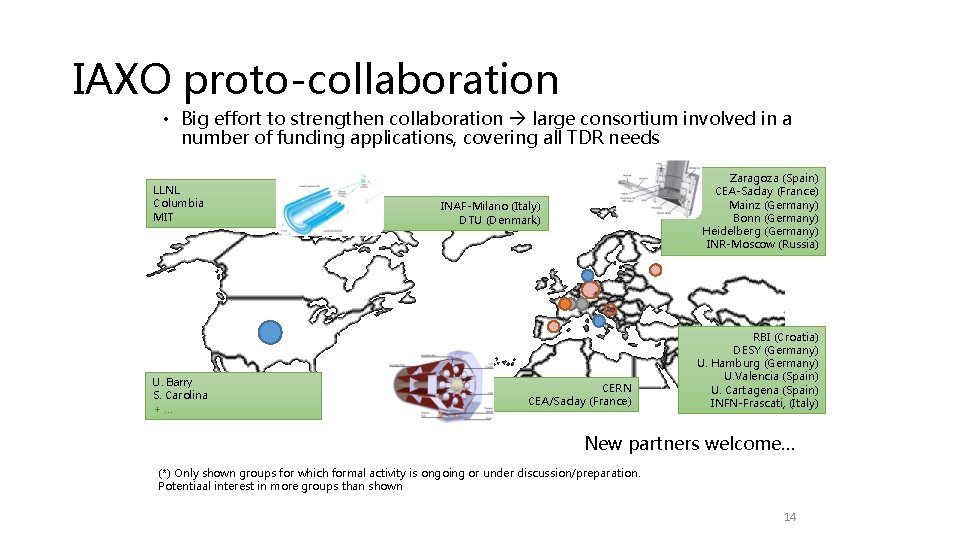
IAXO proto-collaboration • Big effort to strengthen collaboration large consortium involved in a number of funding applications, covering all TDR needs LLNL Columbia MIT U. Barry S. Carolina +… Zaragoza (Spain) CEA-Saclay (France) Mainz (Germany) Bonn (Germany) Heidelberg (Germany) INR-Moscow (Russia) INAF-Milano (Italy) DTU (Denmark) CERN CEA/Saclay (France) RBI (Croatia) DESY (Germany) U. Hamburg (Germany) U. Valencia (Spain) U. Cartagena (Spain) INFN-Frascati, (Italy) New partners welcome… (*) Only shown groups for which formal activity is ongoing or under discussion/preparation. Potentiaal interest in more groups than shown 14
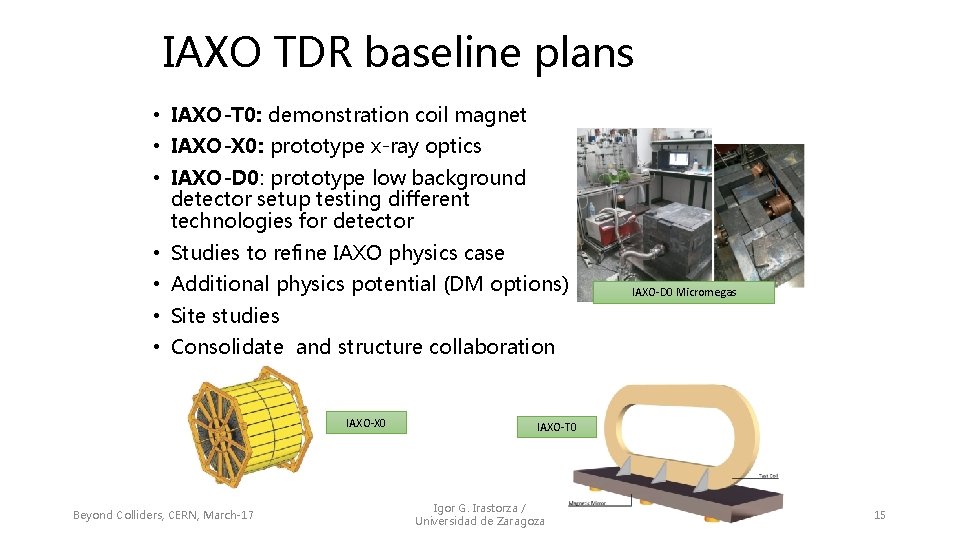
IAXO TDR baseline plans • IAXO-T 0: demonstration coil magnet • IAXO-X 0: prototype x-ray optics • IAXO-D 0: prototype low background detector setup testing different technologies for detector • Studies to refine IAXO physics case • Additional physics potential (DM options) IAXO-D 0 Micromegas • Site studies • Consolidate and structure collaboration IAXO-X 0 Beyond Colliders, CERN, March-17 IAXO-T 0 Igor G. Irastorza / Universidad de Zaragoza 15
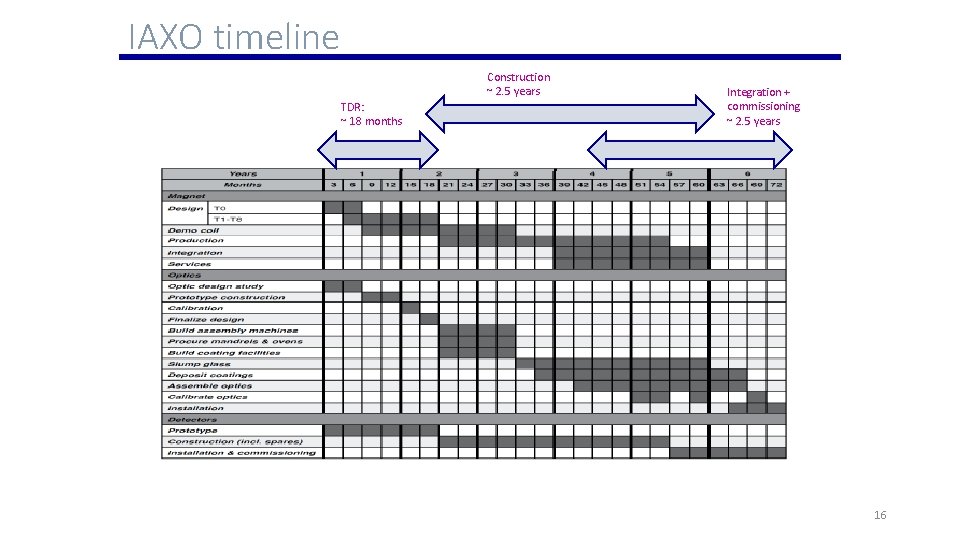
IAXO timeline Construction ~ 2. 5 years TDR: ~ 18 months Integration + commissioning ~ 2. 5 years 16
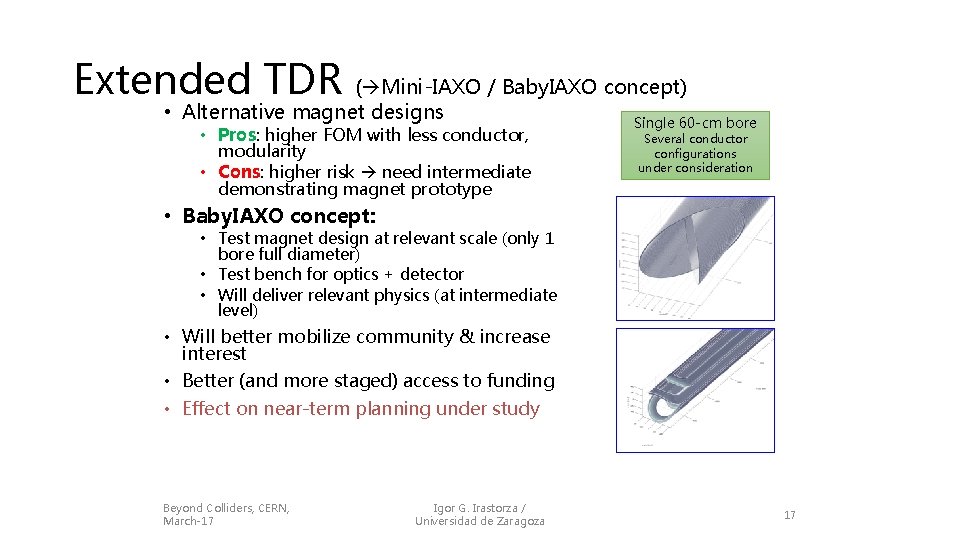
Extended TDR ( Mini-IAXO / Baby. IAXO concept) • Alternative magnet designs Single 60 -cm bore • Pros: higher FOM with less conductor, modularity • Cons: higher risk need intermediate demonstrating magnet prototype Several conductor configurations under consideration • Baby. IAXO concept: • Test magnet design at relevant scale (only 1 bore full diameter) • Test bench for optics + detector • Will deliver relevant physics (at intermediate level) • Will better mobilize community & increase interest • Better (and more staged) access to funding • Effect on near-term planning under study Beyond Colliders, CERN, March-17 Igor G. Irastorza / Universidad de Zaragoza 17

Conclusions and next steps Axion searches strong physics case Increasing experimental effort in the different axion searches strategies: solar axions, relic axions, laboratory axions… CAST has been a very important milestone in axion research during the last decade IAXO can probe deep into unexplored axion-ALP parameter space IAXO could become next large project & a generic axion facility with discovery potential in the next decade Need to continue with TDR & preparatory activities, formal endorsement & resources finding Mini. IAXO / Baby. IAXO new concept that can • Enhance final FOM of experiment • Catalize near-term activities in the collaboration towards an intermediate experiment with relevant physics outcome Exciting work in front us: join us! 18

http: //iaxo. web. cern. ch/iaxo/ 19
IAXO Collaboration ~80 authors 20
IAXO costs 21

Originalities of CAST • Use of X-ray telescope increase S/B noise sensitivity improved by a factor 150 by focusing a ø 43 mm x-ray beam to ø 3 mm • Low background techniques shieldings, low radioactive materials, simulation and modeling of backgrounds…. 22

The WISPs zoo Weakly Interacting Sub-e. V Particles (WISPs) Axion Like particles (ALPs) Axions Stringy axion Arion Majoron Hidden Photons (HPs) Mini Charged Particles Chameleons gag and ma are two independent “phenomenological” parameters 23
- Slides: 23