
Status and Progress of ARGO Jong Uk James
- Slides: 17
Status and Progress of ARGO Jong Uk (James) Park Korea Astronomy & Space Science Institute Hyung-Chul Lim, Yoon-Kyung Seo, Jang-Hyun Park & Young-Su Kim Korea Astronomy and Space Science Institute Young Su Son Korea Institute of Machinary and Materials Yong Ki Kim Kongju National University
Outline 2 /16 1 Backgrounds 2 Overview of ARGO Project 3 Requirements of ARGO System 4 Milestone of ARGO Project 5 Summary 16 th International Workshop on Laser Ranging, 13 -17 October 2008 Poznan, Poland
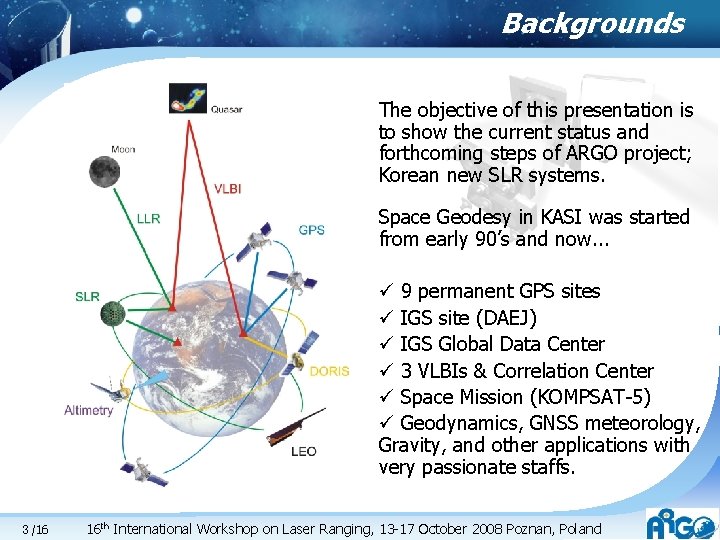
Backgrounds The objective of this presentation is to show the current status and forthcoming steps of ARGO project; Korean new SLR systems. Space Geodesy in KASI was started from early 90’s and now. . . ü 9 permanent GPS sites ü IGS site (DAEJ) ü IGS Global Data Center ü 3 VLBIs & Correlation Center ü Space Mission (KOMPSAT-5) ü Geodynamics, GNSS meteorology, Gravity, and other applications with very passionate staffs. 3 /16 16 th International Workshop on Laser Ranging, 13 -17 October 2008 Poznan, Poland
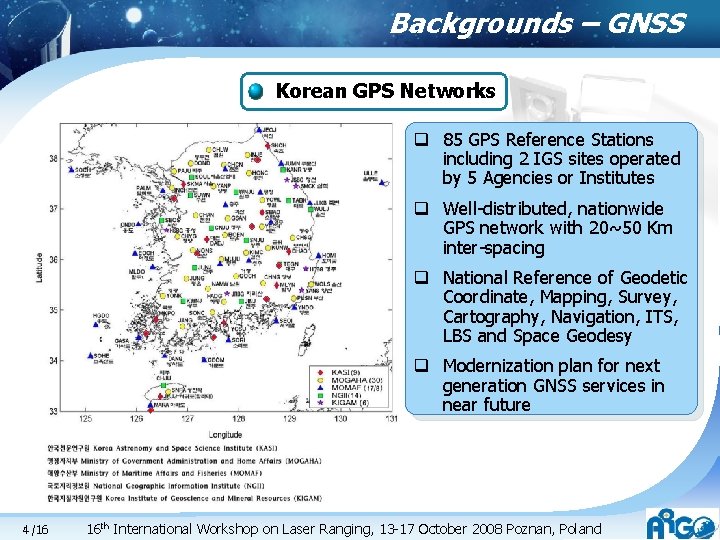
Backgrounds – GNSS Korean GPS Networks q 85 GPS Reference Stations including 2 IGS sites operated by 5 Agencies or Institutes q Well-distributed, nationwide GPS network with 20~50 Km inter-spacing q National Reference of Geodetic Coordinate, Mapping, Survey, Cartography, Navigation, ITS, LBS and Space Geodesy q Modernization plan for next generation GNSS services in near future 4 /16 16 th International Workshop on Laser Ranging, 13 -17 October 2008 Poznan, Poland
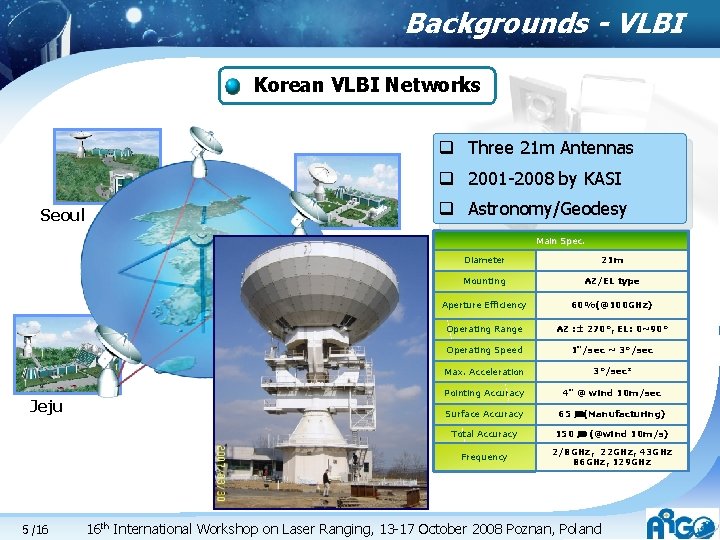
Backgrounds - VLBI Korean VLBI Networks q Three 21 m Antennas q 2001 -2008 by KASI q Astronomy/Geodesy Seoul Ulsan Jeju 5 /16 Main Spec. Diameter 21 m Mounting AZ/EL type Aperture Efficiency 60%(@100 GHz) Operating Range AZ : ± 270°, EL: 0~90° Operating Speed 1"/sec ~ 3°/sec Max. Acceleration 3°/sec² Pointing Accuracy 4" @ wind 10 m/sec Surface Accuracy 65 ㎛(Manufacturing) Total Accuracy 150 ㎛ (@wind 10 m/s) Frequency 2/8 GHz, 22 GHz, 43 GHz 86 GHz, 129 GHz 16 th International Workshop on Laser Ranging, 13 -17 October 2008 Poznan, Poland
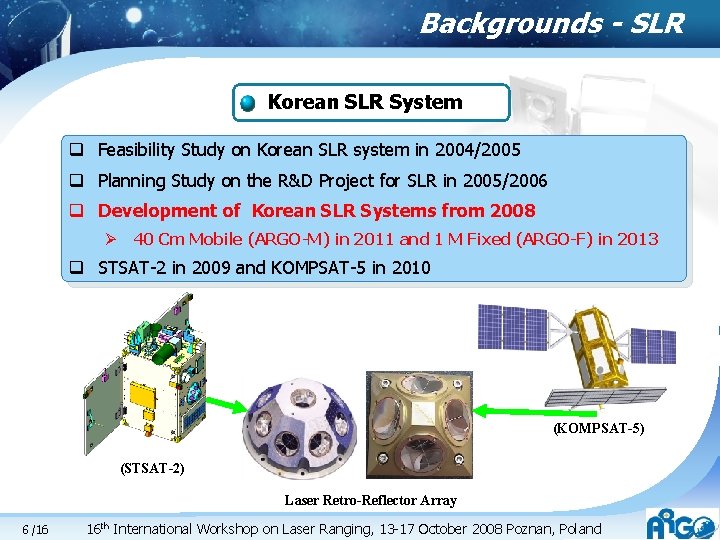
Backgrounds - SLR Korean SLR System q Feasibility Study on Korean SLR system in 2004/2005 No! q Planning Study on the R&D Project for SLR in 2005/2006 q Development of Korean SLR Systems from 2008 Ø 40 Cm Mobile (ARGO-M) in 2011 and 1 M Fixed (ARGO-F) in 2013 q STSAT-2 in 2009 and KOMPSAT-5 in 2010 (KOMPSAT-5) (STSAT-2) Laser Retro-Reflector Array 6 /16 16 th International Workshop on Laser Ranging, 13 -17 October 2008 Poznan, Poland
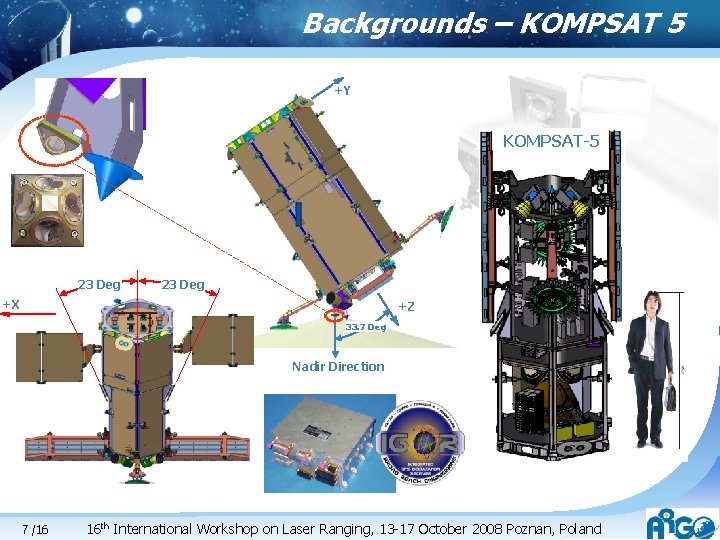
Backgrounds – KOMPSAT 5 +Y KOMPSAT-5 23 Deg +X +Z 33. 7 Deg Nadir Direction 7 /16 16 th International Workshop on Laser Ranging, 13 -17 October 2008 Poznan, Poland
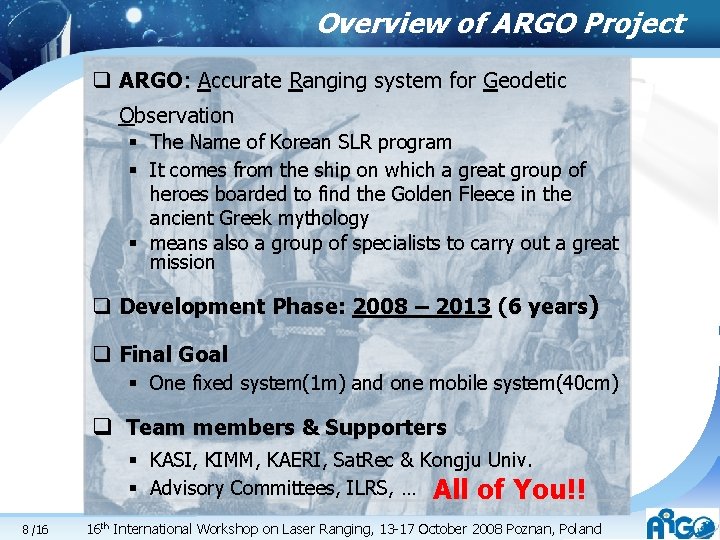
Overview of ARGO Project q ARGO: Accurate Ranging system for Geodetic Observation § The Name of Korean SLR program § It comes from the ship on which a great group of heroes boarded to find the Golden Fleece in the ancient Greek mythology § means also a group of specialists to carry out a great mission q Development Phase: 2008 – 2013 (6 years) q Final Goal § One fixed system(1 m) and one mobile system(40 cm) q Team members & Supporters § KASI, KIMM, KAERI, Sat. Rec & Kongju Univ. § Advisory Committees, ILRS, … All of You!! 8 /16 16 th International Workshop on Laser Ranging, 13 -17 October 2008 Poznan, Poland
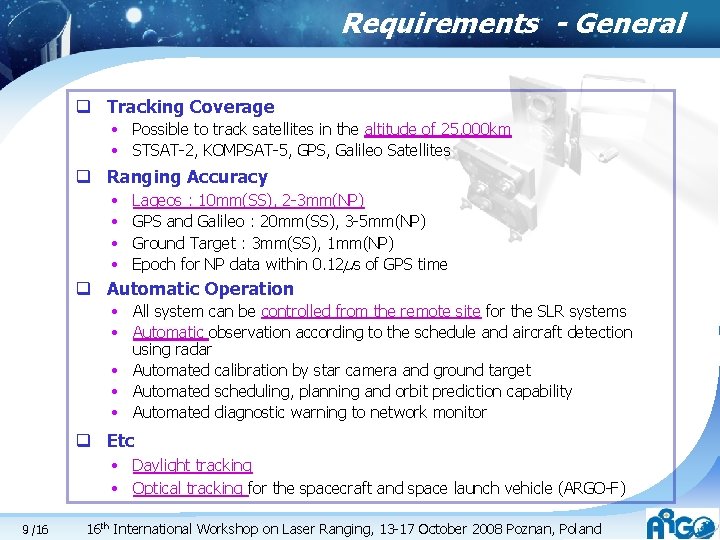
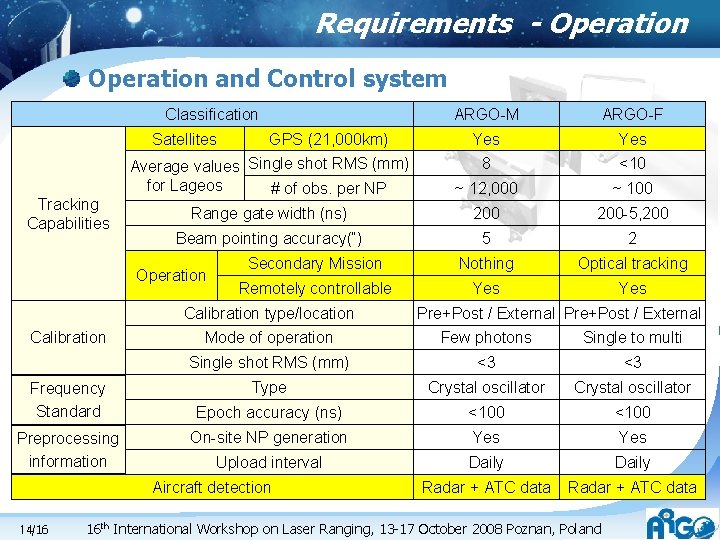
Requirements - General q Tracking Coverage • Possible to track satellites in the altitude of 25, 000 km • STSAT-2, KOMPSAT-5, GPS, Galileo Satellites q Ranging Accuracy • • Lageos : 10 mm(SS), 2 -3 mm(NP) GPS and Galileo : 20 mm(SS), 3 -5 mm(NP) Ground Target : 3 mm(SS), 1 mm(NP) Epoch for NP data within 0. 12μs of GPS time q Automatic Operation • All system can be controlled from the remote site for the SLR systems • Automatic observation according to the schedule and aircraft detection using radar • Automated calibration by star camera and ground target • Automated scheduling, planning and orbit prediction capability • Automated diagnostic warning to network monitor q Etc • Daylight tracking • Optical tracking for the spacecraft and space launch vehicle (ARGO-F) 9 /16 16 th International Workshop on Laser Ranging, 13 -17 October 2008 Poznan, Poland
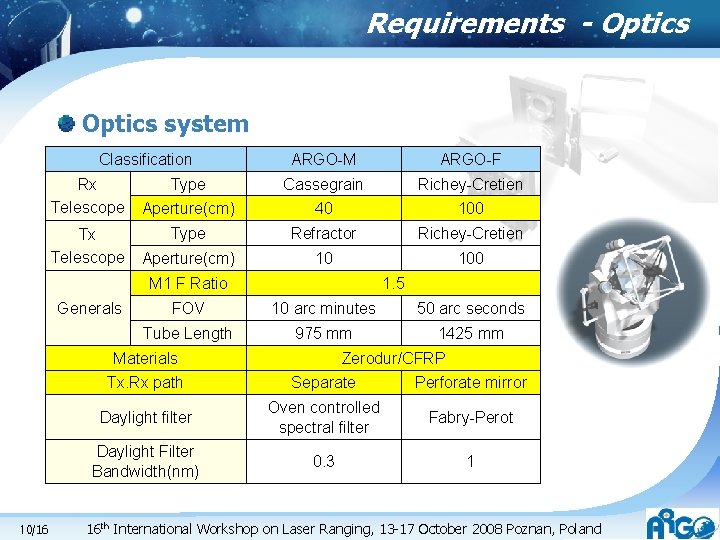
Requirements - Optics system Classification Rx Telescope Tx Telescope ARGO-M ARGO-F Type Cassegrain Richey-Cretien Aperture(cm) 40 100 Type Refractor Richey-Cretien Aperture(cm) 10 100 M 1 F Ratio Generals 1. 5 FOV 10 arc minutes 50 arc seconds Tube Length 975 mm 1425 mm Materials 10/16 Zerodur/CFRP Tx. Rx path Separate Perforate mirror Daylight filter Oven controlled spectral filter Fabry-Perot Daylight Filter Bandwidth(nm) 0. 3 1 16 th International Workshop on Laser Ranging, 13 -17 October 2008 Poznan, Poland
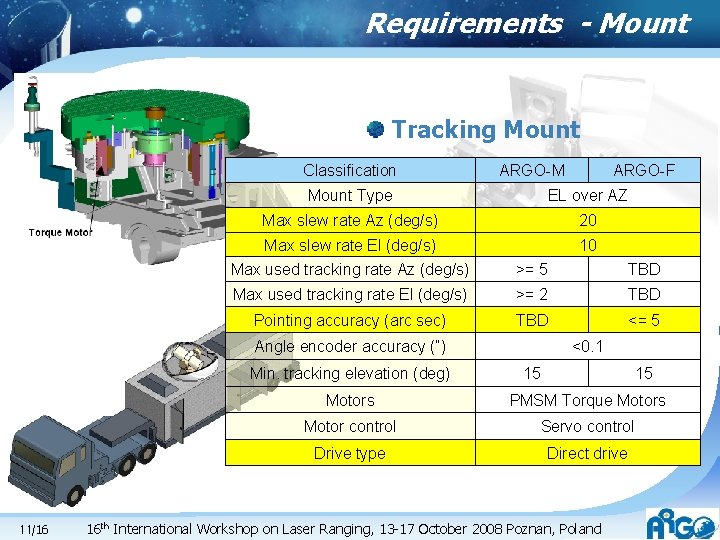
Requirements - Mount Tracking Mount Classification ARGO-M Mount Type EL over AZ Max slew rate Az (deg/s) 20 Max slew rate El (deg/s) 10 Max used tracking rate Az (deg/s) >= 5 TBD Max used tracking rate El (deg/s) >= 2 TBD Pointing accuracy (arc sec) TBD <= 5 Angle encoder accuracy (“) Min. tracking elevation (deg) 11/16 ARGO-F <0. 1 15 15 Motors PMSM Torque Motors Motor control Servo control Drive type Direct drive 16 th International Workshop on Laser Ranging, 13 -17 October 2008 Poznan, Poland
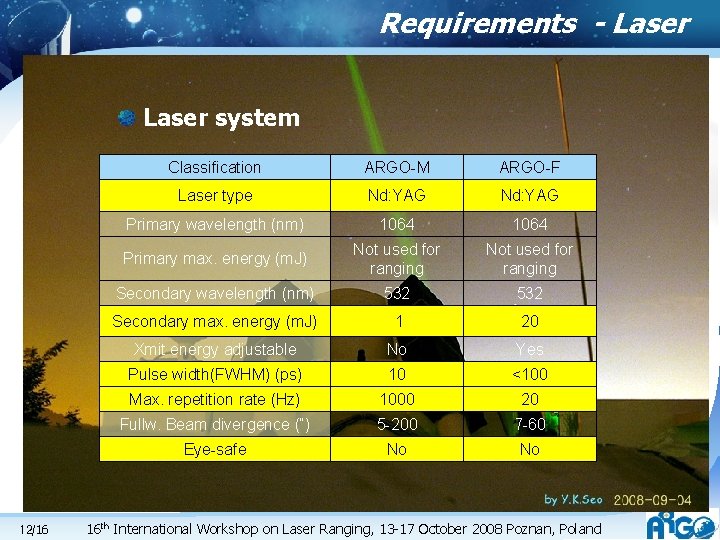
Requirements - Laser system 12/16 Classification ARGO-M ARGO-F Laser type Nd: YAG Primary wavelength (nm) 1064 Primary max. energy (m. J) Not used for ranging Secondary wavelength (nm) 532 Secondary max. energy (m. J) 1 20 Xmit energy adjustable No Yes Pulse width(FWHM) (ps) 10 <100 Max. repetition rate (Hz) 1000 20 Fullw. Beam divergence (“) 5 -200 7 -60 Eye-safe No No 16 th International Workshop on Laser Ranging, 13 -17 October 2008 Poznan, Poland
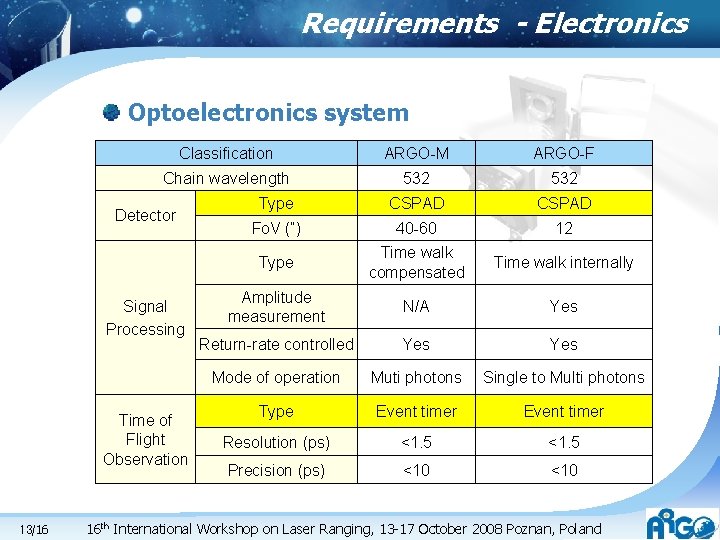
Requirements - Electronics Optoelectronics system Classification ARGO-M ARGO-F Chain wavelength 532 Type CSPAD Fo. V (“) 40 -60 12 Type Time walk compensated Time walk internally Amplitude measurement N/A Yes Return-rate controlled Yes Mode of operation Muti photons Single to Multi photons Type Event timer Resolution (ps) <1. 5 Precision (ps) <10 Detector Signal Processing Time of Flight Observation 13/16 16 th International Workshop on Laser Ranging, 13 -17 October 2008 Poznan, Poland
Requirements - Operation and Control system Classification Satellites Tracking Capabilities GPS (21, 000 km) Preprocessing information Yes <10 ~ 12, 000 ~ 100 Range gate width (ns) 200 -5, 200 Beam pointing accuracy(“) 5 2 Secondary Mission Nothing Optical tracking Remotely controllable Yes Pre+Post / External Mode of operation Few photons Single to multi Single shot RMS (mm) <3 <3 Type Crystal oscillator Epoch accuracy (ns) <100 On-site NP generation Yes Upload interval Daily Radar + ATC data Aircraft detection 14/16 Yes 8 Calibration type/location Frequency Standard ARGO-F Average values Single shot RMS (mm) for Lageos # of obs. per NP Operation Calibration ARGO-M 16 th International Workshop on Laser Ranging, 13 -17 October 2008 Poznan, Poland
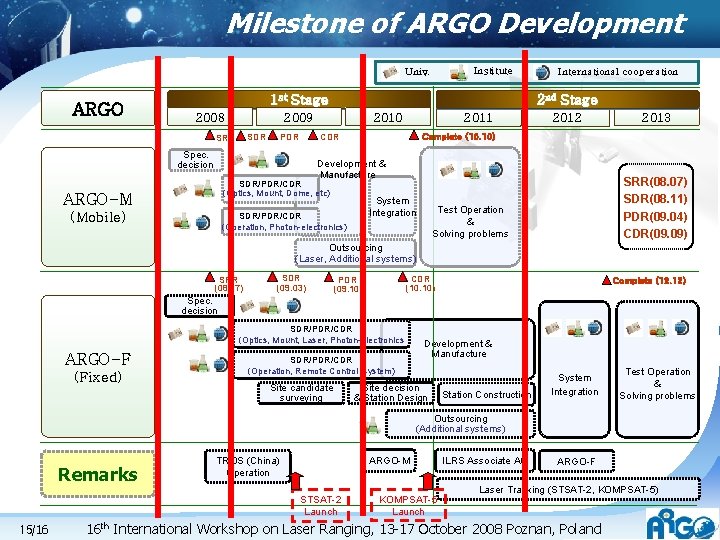
Milestone of ARGO Development Institute Univ. ARGO 1 st Stage 2008 2 nd Stage 2009 SDR SRR 2010 2011 CDR PDR Spec. decision International cooperation 2012 Complete (10. 10) Development & Manufacture SDR/PDR/CDR (Optics, Mount, Dome, etc) ARGO-M (Mobile) 2013 System Integration SDR/PDR/CDR (Operation, Photon-electronics) SRR(08. 07) SDR(08. 11) PDR(09. 04) CDR(09. 09) Test Operation & Solving problems Outsourcing (Laser, Additional systems) SRR (08. 07) SDR (09. 03) CDR (10. 10) PDR (09. 10) Complete (12. 12) Spec. decision SDR/PDR/CDR (Optics, Mount, Laser, Photon-electronics ARGO-F (Fixed) SDR/PDR/CDR (Operation, Remote Control system) Site candidate surveying Development & Manufacture Site decision & Station Design Station Construction System Integration Test Operation & Solving problems Outsourcing (Additional systems) Remarks TROS (China) Operation ARGO-M STSAT-2 Launch 15/16 KOMPSAT-5 Launch ILRS Associate AC ARGO-F Laser Tracking (STSAT-2, KOMPSAT-5) 16 th International Workshop on Laser Ranging, 13 -17 October 2008 Poznan, Poland
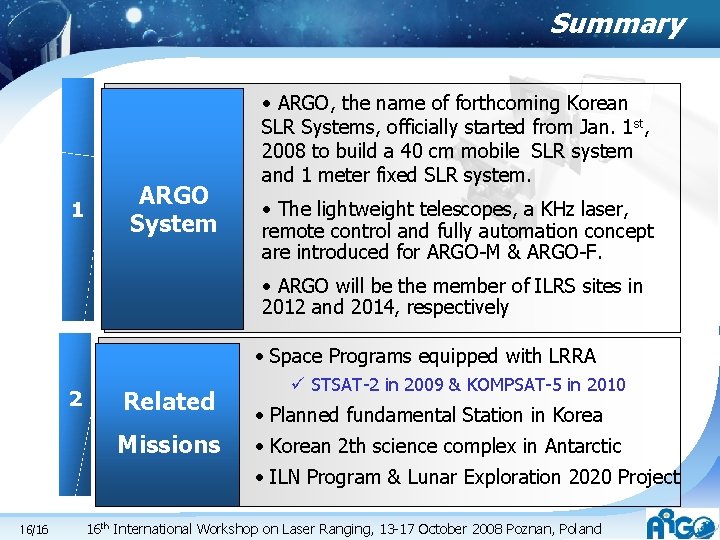
Summary 1 ARGO System • ARGO, the name of forthcoming Korean SLR Systems, officially started from Jan. 1 st, 2008 to build a 40 cm mobile SLR system and 1 meter fixed SLR system. • The lightweight telescopes, a KHz laser, remote control and fully automation concept are introduced for ARGO-M & ARGO-F. • ARGO will be the member of ILRS sites in 2012 and 2014, respectively • Space Programs equipped with LRRA 2 Related Missions ü STSAT-2 in 2009 & KOMPSAT-5 in 2010 • Planned fundamental Station in Korea • Korean 2 th science complex in Antarctic • ILN Program & Lunar Exploration 2020 Project 16/16 16 th International Workshop on Laser Ranging, 13 -17 October 2008 Poznan, Poland
Thank you !!! www. slr. re. kr