
Status and future of x TCA developments not
- Slides: 20
Status and future of x. TCA developments (not necessarily an exhaustive report) Markus Joos CERN EP/ESE • ATLAS • CMS M. Joos, CERN ACES workshop 2016 1
EP/ESE x. TCA evaluation project (2011 -2016+) • Technical evaluations of selected Micro. TCA and ATCA components • Focus on infrastructure components (shelves, power supplies, …) • ATCA shelves • AC/DC rectifiers for ATCA • MTCA shelves and power modules • ATCA rack cooling simulations and measurements • Development of components • MMC software for AMCs • IPMC for ATCA • Equipment recommendations and user consultancy • Establishment of a purchasing and support framework M. Joos, CERN ACES workshop 2016 2
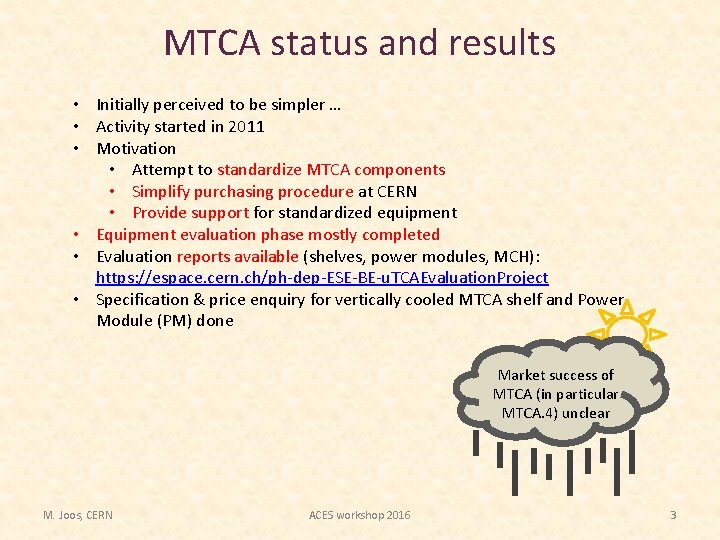
MTCA status and results • Initially perceived to be simpler … • Activity started in 2011 • Motivation • Attempt to standardize MTCA components • Simplify purchasing procedure at CERN • Provide support for standardized equipment • Equipment evaluation phase mostly completed • Evaluation reports available (shelves, power modules, MCH): https: //espace. cern. ch/ph-dep-ESE-BE-u. TCAEvaluation. Project • Specification & price enquiry for vertically cooled MTCA shelf and Power Module (PM) done Market success of MTCA (in particular MTCA. 4) unclear M. Joos, CERN ACES workshop 2016 3
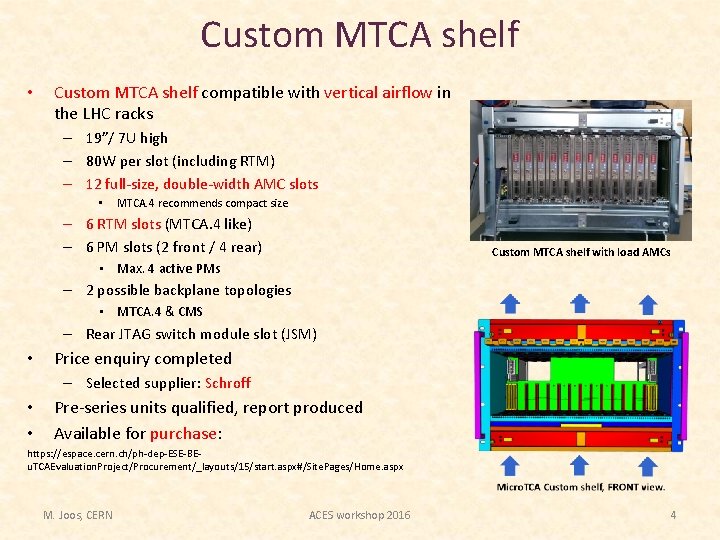
Custom MTCA shelf • Custom MTCA shelf compatible with vertical airflow in the LHC racks – 19”/ 7 U high – 80 W per slot (including RTM) – 12 full-size, double-width AMC slots • MTCA. 4 recommends compact size – 6 RTM slots (MTCA. 4 like) – 6 PM slots (2 front / 4 rear) Custom MTCA shelf with load AMCs • Max. 4 active PMs – 2 possible backplane topologies • MTCA. 4 & CMS – Rear JTAG switch module slot (JSM) • Price enquiry completed – Selected supplier: Schroff • • Pre-series units qualified, report produced Available for purchase: https: //espace. cern. ch/ph-dep-ESE-BEu. TCAEvaluation. Project/Procurement/_layouts/15/start. aspx#/Site. Pages/Home. aspx M. Joos, CERN ACES workshop 2016 4
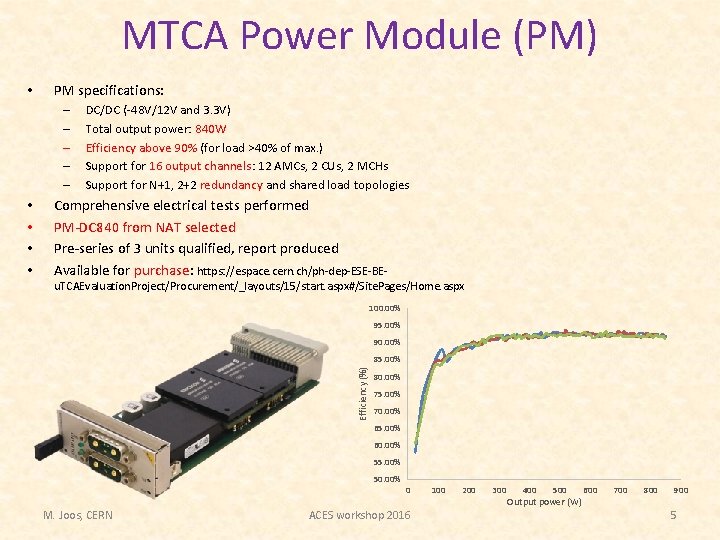
MTCA Power Module (PM) • PM specifications: – – – Comprehensive electrical tests performed PM-DC 840 from NAT selected Pre-series of 3 units qualified, report produced Available for purchase: https: //espace. cern. ch/ph-dep-ESE-BE- u. TCAEvaluation. Project/Procurement/_layouts/15/start. aspx#/Site. Pages/Home. aspx 100. 00% 95. 00% 90. 00% 85. 00% Efficiency (%) • • DC/DC (-48 V/12 V and 3. 3 V) Total output power: 840 W Efficiency above 90% (for load >40% of max. ) Support for 16 output channels: 12 AMCs, 2 CUs, 2 MCHs Support for N+1, 2+2 redundancy and shared load topologies 80. 00% 75. 00% 70. 00% 65. 00% 60. 00% 55. 00% 50. 00% M. Joos, CERN 0 ACES workshop 2016 100 200 300 400 500 Output power (W) 600 700 800 900 5
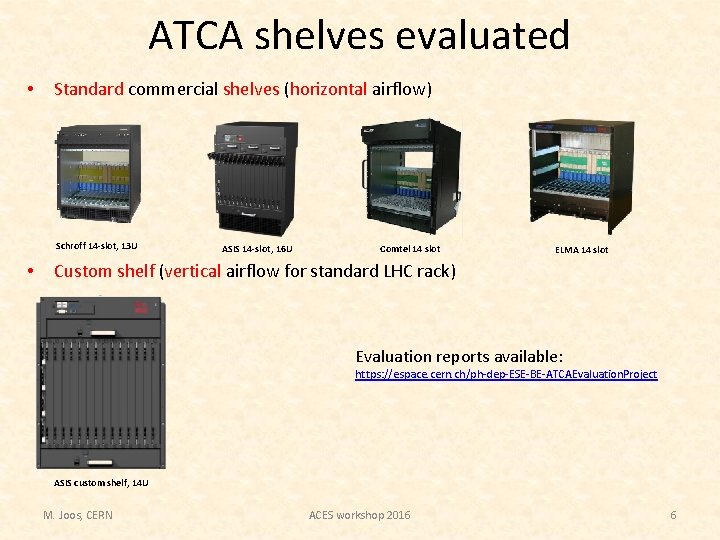
ATCA shelves evaluated • Standard commercial shelves (horizontal airflow) Schroff 14 -slot, 13 U • ASIS 14 -slot, 16 U Comtel 14 slot ELMA 14 slot Custom shelf (vertical airflow for standard LHC rack) Evaluation reports available: https: //espace. cern. ch/ph-dep-ESE-BE-ATCAEvaluation. Project ASIS custom shelf, 14 U M. Joos, CERN ACES workshop 2016 6
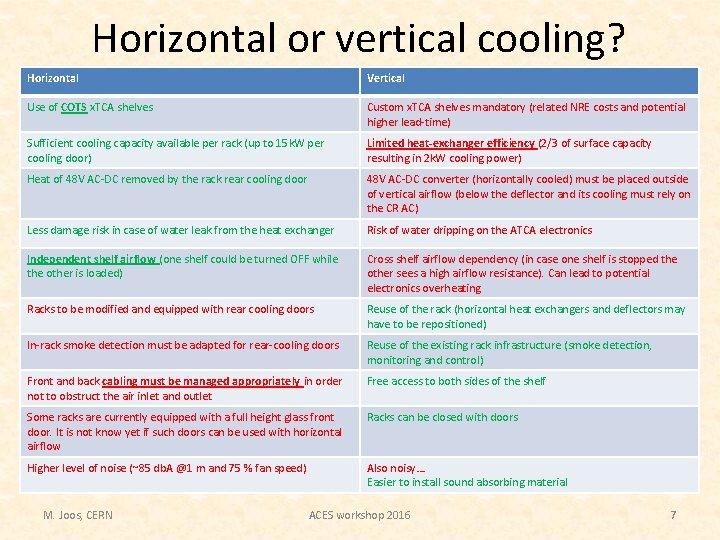
Horizontal or vertical cooling? Horizontal Vertical Use of COTS x. TCA shelves Custom x. TCA shelves mandatory (related NRE costs and potential higher lead-time) Sufficient cooling capacity available per rack (up to 15 k. W per cooling door) Limited heat-exchanger efficiency (2/3 of surface capacity resulting in 2 k. W cooling power) Heat of 48 V AC-DC removed by the rack rear cooling door 48 V AC-DC converter (horizontally cooled) must be placed outside of vertical airflow (below the deflector and its cooling must rely on the CR AC) Less damage risk in case of water leak from the heat exchanger Risk of water dripping on the ATCA electronics Independent shelf airflow (one shelf could be turned OFF while the other is loaded) Cross shelf airflow dependency (in case one shelf is stopped the other sees a high airflow resistance). Can lead to potential electronics overheating Racks to be modified and equipped with rear cooling doors Reuse of the rack (horizontal heat exchangers and deflectors may have to be repositioned) In-rack smoke detection must be adapted for rear-cooling doors Reuse of the existing rack infrastructure (smoke detection, monitoring and control) Front and back cabling must be managed appropriately in order not to obstruct the air inlet and outlet Free access to both sides of the shelf Some racks are currently equipped with a full height glass front door. It is not know yet if such doors can be used with horizontal airflow Racks can be closed with doors Higher level of noise (~85 db. A @1 m and 75 % fan speed) Also noisy…. Easier to install sound absorbing material M. Joos, CERN ACES workshop 2016 7
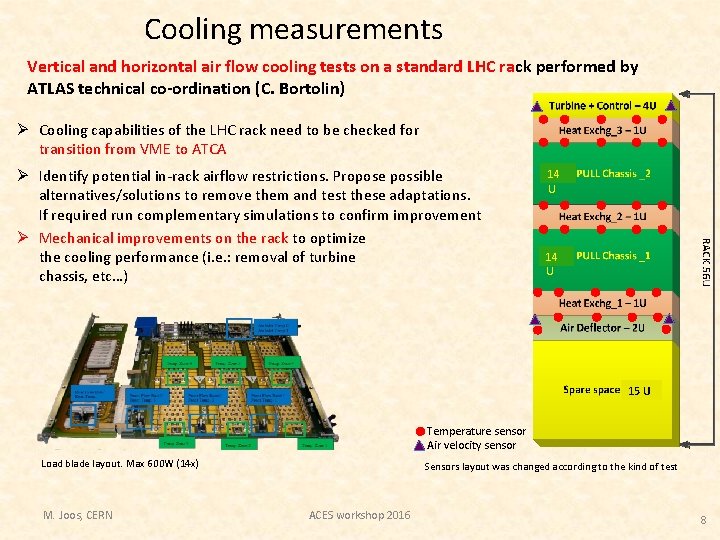
Cooling measurements Vertical and horizontal air flow cooling tests on a standard LHC rack performed by ATLAS technical co-ordination (C. Bortolin) Ø Cooling capabilities of the LHC rack need to be checked for transition from VME to ATCA Ø Identify potential in-rack airflow restrictions. Propose possible alternatives/solutions to remove them and test these adaptations. If required run complementary simulations to confirm improvement Ø Mechanical improvements on the rack to optimize the cooling performance (i. e. : removal of turbine chassis, etc…) 14 U 15 U Temperature sensor Air velocity sensor Load blade layout. Max 600 W (14 x) M. Joos, CERN Sensors layout was changed according to the kind of test ACES workshop 2016 8
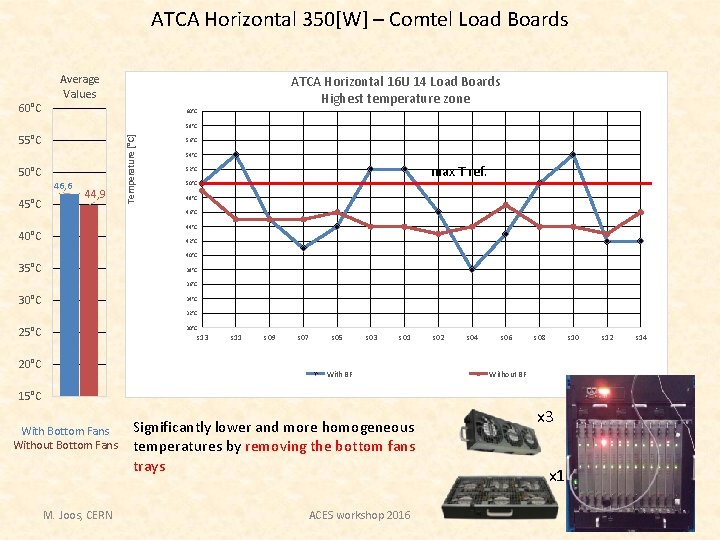
ATCA Horizontal 350[W] – Comtel Load Boards Average Values ATCA Horizontal 16 U 14 Load Boards Highest temperature zone 60°C 55°C 50°C 45°C 46, 6 44, 9 Temperature [°C] 58°C 56°C 54°C max T ref. 52°C 50°C 48°C 46°C 44°C 40°C 42°C 40°C 35°C 38°C 36°C 30°C 34°C 32°C 30°C 25°C s 13 20°C s 11 s 09 s 07 s 05 s 03 s 01 With BF s 02 s 04 s 06 s 08 s 10 s 12 s 14 Without BF 15°C With Bottom Fans Without Bottom Fans M. Joos, CERN Significantly lower and more homogeneous temperatures by removing the bottom fans trays ACES workshop 2016 x 3 x 1 9
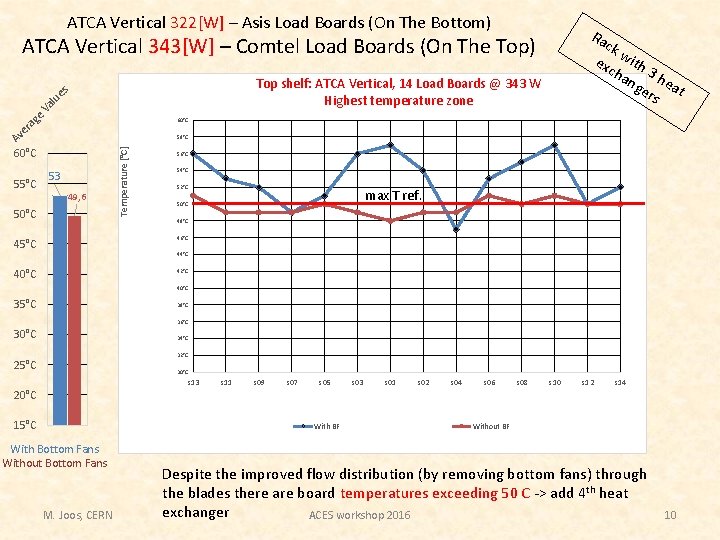
ATCA Vertical 322[W] – Asis Load Boards (On The Bottom) Ra ck ex with ch 3 an he ge at rs ATCA Vertical 343[W] – Comtel Load Boards (On The Top) e Va l ue s Top shelf: ATCA Vertical, 14 Load Boards @ 343 W Highest temperature zone er ag 60°C 55°C 53 49, 6 50°C Temperature [°C] Av 58°C 56°C 54°C 52°C max T ref. 50°C 48°C 45°C 46°C 40°C 42°C 44°C 40°C 35°C 38°C 36°C 30°C 34°C 32°C 25°C 30°C s 13 s 11 s 09 s 07 s 05 s 03 s 01 s 02 s 04 s 06 s 08 s 10 s 12 s 14 20°C 15°C With BF With Bottom Fans Without Bottom Fans M. Joos, CERN Without BF Despite the improved flow distribution (by removing bottom fans) through the blades there are board temperatures exceeding 50 C -> add 4 th heat exchanger ACES workshop 2016 10
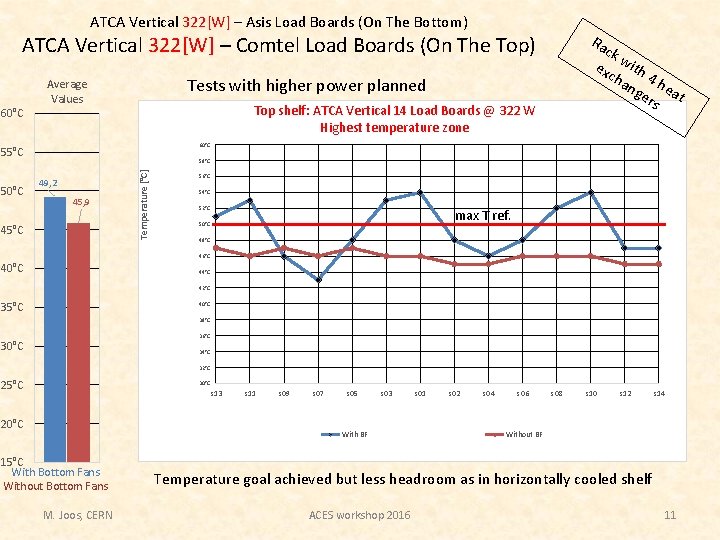
ATCA Vertical 322[W] – Asis Load Boards (On The Bottom) Ra ck ex with ch 4 an he ge at rs ATCA Vertical 322[W] – Comtel Load Boards (On The Top) Tests with higher power planned Average Values Top shelf: ATCA Vertical 14 Load Boards @ 322 W Highest temperature zone 60°C 55°C 49, 2 45, 9 45°C Temperature [°C] 50°C 58°C 56°C 54°C 52°C max T ref. 50°C 48°C 46°C 40°C 44°C 42°C 35°C 40°C 38°C 36°C 30°C 34°C 32°C 25°C 30°C s 13 20°C s 11 s 09 s 07 s 05 s 03 With BF 15°C With Bottom Fans Without Bottom Fans M. Joos, CERN s 01 s 02 s 04 s 06 s 08 s 10 s 12 s 14 Without BF Temperature goal achieved but less headroom as in horizontally cooled shelf ACES workshop 2016 11
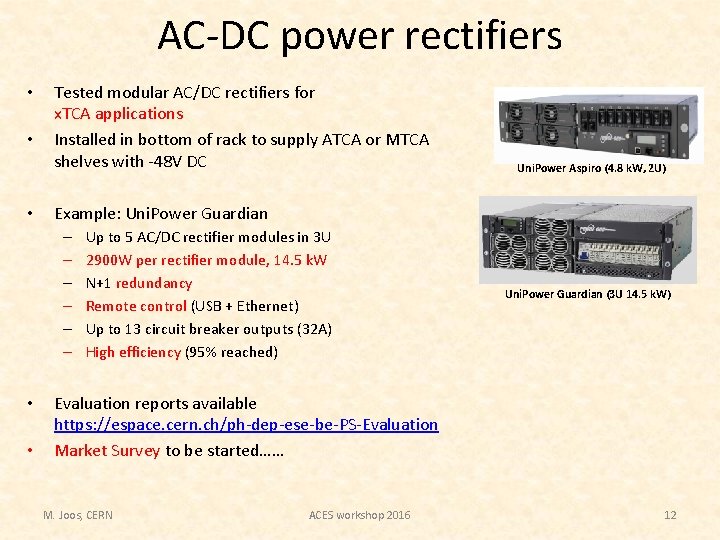
AC-DC power rectifiers • • • Tested modular AC/DC rectifiers for x. TCA applications Installed in bottom of rack to supply ATCA or MTCA shelves with -48 V DC Example: Uni. Power Guardian – – – • • Uni. Power Aspiro (4. 8 k. W, 2 U) Up to 5 AC/DC rectifier modules in 3 U 2900 W per rectifier module, 14. 5 k. W N+1 redundancy Remote control (USB + Ethernet) Up to 13 circuit breaker outputs (32 A) High efficiency (95% reached) Uni. Power Guardian (3 U 14. 5 k. W) Evaluation reports available https: //espace. cern. ch/ph-dep-ese-be-PS-Evaluation Market Survey to be started…… M. Joos, CERN ACES workshop 2016 12
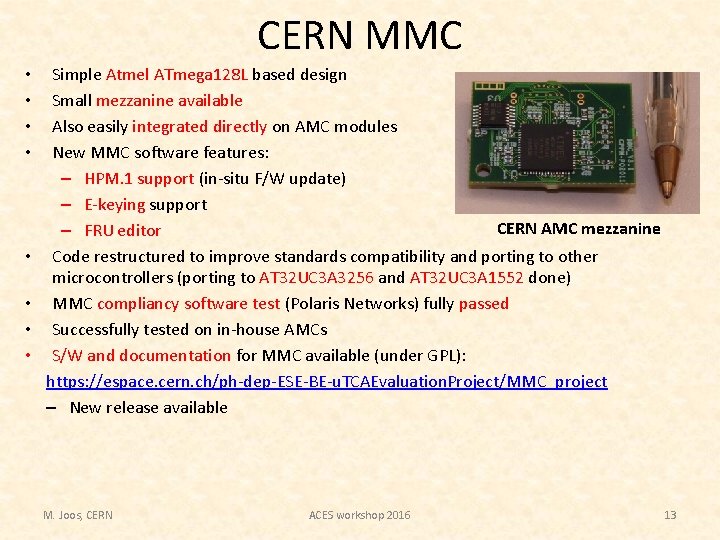
CERN MMC • • Simple Atmel ATmega 128 L based design Small mezzanine available Also easily integrated directly on AMC modules New MMC software features: – HPM. 1 support (in-situ F/W update) – E-keying support CERN AMC mezzanine – FRU editor Code restructured to improve standards compatibility and porting to other microcontrollers (porting to AT 32 UC 3 A 3256 and AT 32 UC 3 A 1552 done) MMC compliancy software test (Polaris Networks) fully passed Successfully tested on in-house AMCs S/W and documentation for MMC available (under GPL): https: //espace. cern. ch/ph-dep-ESE-BE-u. TCAEvaluation. Project/MMC_project – New release available M. Joos, CERN ACES workshop 2016 13
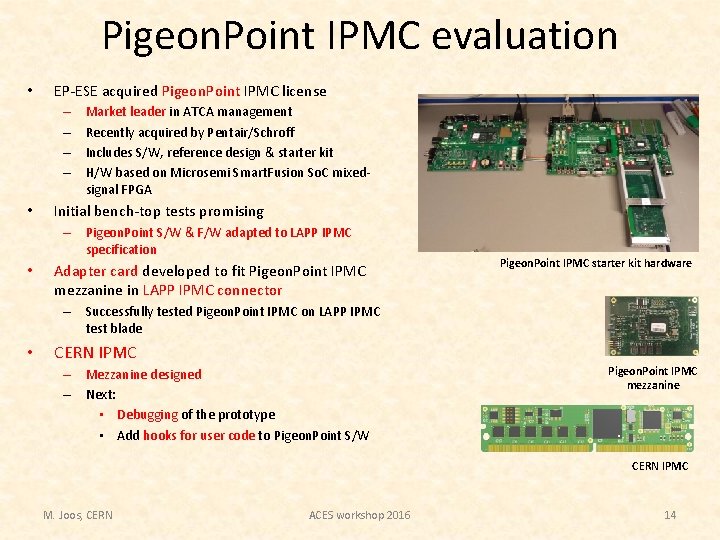
Pigeon. Point IPMC evaluation • EP-ESE acquired Pigeon. Point IPMC license – – • Market leader in ATCA management Recently acquired by Pentair/Schroff Includes S/W, reference design & starter kit H/W based on Microsemi Smart. Fusion So. C mixedsignal FPGA Initial bench-top tests promising – Pigeon. Point S/W & F/W adapted to LAPP IPMC specification • Adapter card developed to fit Pigeon. Point IPMC mezzanine in LAPP IPMC connector Pigeon. Point IPMC starter kit hardware – Successfully tested Pigeon. Point IPMC on LAPP IPMC test blade • CERN IPMC – Mezzanine designed – Next: • Debugging of the prototype • Add hooks for user code to Pigeon. Point S/W Pigeon. Point IPMC mezzanine CERN IPMC M. Joos, CERN ACES workshop 2016 14
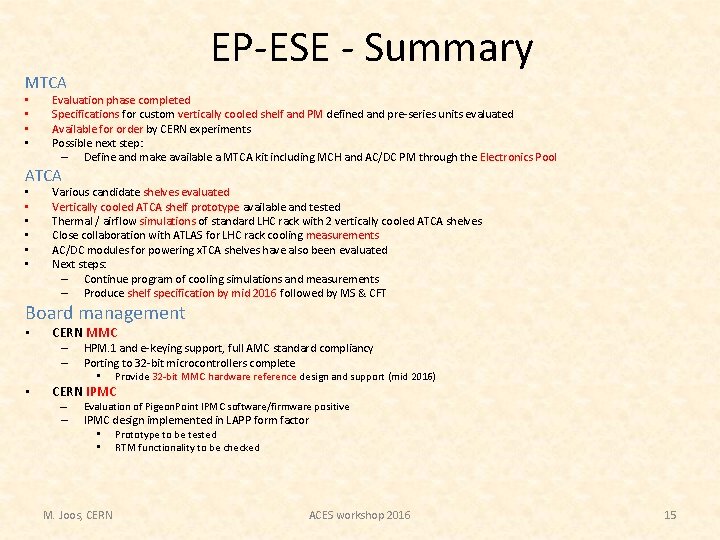
EP-ESE - Summary MTCA • • Evaluation phase completed Specifications for custom vertically cooled shelf and PM defined and pre-series units evaluated Available for order by CERN experiments Possible next step: – Define and make available a MTCA kit including MCH and AC/DC PM through the Electronics Pool ATCA • • • Various candidate shelves evaluated Vertically cooled ATCA shelf prototype available and tested Thermal / airflow simulations of standard LHC rack with 2 vertically cooled ATCA shelves Close collaboration with ATLAS for LHC rack cooling measurements AC/DC modules for powering x. TCA shelves have also been evaluated Next steps: – Continue program of cooling simulations and measurements – Produce shelf specification by mid 2016 followed by MS & CFT Board management • CERN MMC – – • HPM. 1 and e-keying support, full AMC standard compliancy Porting to 32 -bit microcontrollers complete • Provide 32 -bit MMC hardware reference design and support (mid 2016) CERN IPMC – – Evaluation of Pigeon. Point IPMC software/firmware positive IPMC design implemented in LAPP form factor • Prototype to be tested • RTM functionality to be checked M. Joos, CERN ACES workshop 2016 15
ATCA in ATLAS • • • Overview • Upgrades until Phase-I: Trigger, LAr calorimeter, CSC readout, FTK, muon new small wheel, … ATCA chosen for most off-detector electronics upgrades Number of ATCA shelves used in USA 15: • Phase-0: 2 shelves (6 -slot) • L 1 Topo (1), CSC ROD (1) • Phase-I: ~20 shelves (14 -slot) • FTK (5), L 1 Calo e. FEX / j. FEX / g. FEX (3 -4), LAr LDPS (3), NSW (2 -3), MUCTPI (1) • Phase-II: l. Ar, Tile, …. . NSW: • ATCA board developed together with industry (Eicsys Gmbh) within RD 51 framework • full mesh backplane • Clock and Trigger (AXIe compliant) • Proprietary IPMC CSC: • One shelf with 6 cards (COB) in operation since 2015 • ATCA backplane not used for data exchange • Shelf manager connects via Control Network to DCS • 3 important components (G-Link, S-Link, TTC distribution) implemented in firmware instead of using dedicated hardware (G-Link Card, S-Link Hola Card, TIM), resulting in lower footprint and power consumption. L 1 Track / FTK: • Target: Phase - II • 12 processing cards per shelf • 2 (3? ) shelves per rack • Planned ATCA card (development not started): AMTP (Associative Memory Tracking Processor), 400 W • Issue: ATCA allows less dense packing of AM chips than customized crate (due to wider card pitch) M. Joos, CERN ACES workshop 2016 16
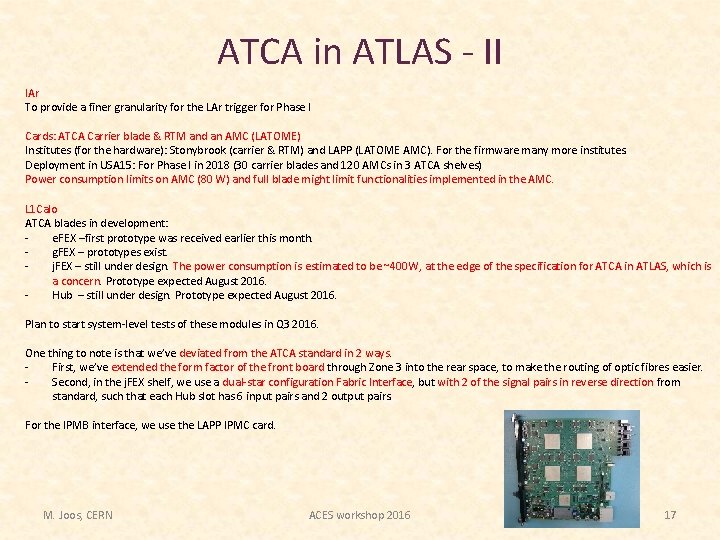
ATCA in ATLAS - II l. Ar To provide a finer granularity for the LAr trigger for Phase I Cards: ATCA Carrier blade & RTM and an AMC (LATOME) Institutes (for the hardware): Stonybrook (carrier & RTM) and LAPP (LATOME AMC). For the firmware many more institutes. Deployment in USA 15: For Phase I in 2018 (30 carrier blades and 120 AMCs in 3 ATCA shelves) Power consumption limits on AMC (80 W) and full blade might limit functionalities implemented in the AMC. L 1 Calo ATCA blades in development: e. FEX –first prototype was received earlier this month. g. FEX – prototypes exist. j. FEX – still under design. The power consumption is estimated to be ~400 W, at the edge of the specification for ATCA in ATLAS, which is a concern. Prototype expected August 2016. Hub – still under design. Prototype expected August 2016. Plan to start system-level tests of these modules in Q 3 2016. One thing to note is that we’ve deviated from the ATCA standard in 2 ways. First, we’ve extended the form factor of the front board through Zone 3 into the rear space, to make the routing of optic fibres easier. Second, in the j. FEX shelf, we use a dual-star configuration Fabric Interface, but with 2 of the signal pairs in reverse direction from standard, such that each Hub slot has 6 input pairs and 2 output pairs. For the IPMB interface, we use the LAPP IPMC card. M. Joos, CERN ACES workshop 2016 17
ATCA in ATLAS - III LAPP – IPMC Status Hardware: • 120 boards produced and 70 distributed: ATLAS FTK, LAr & L 1 Calo (e/j/g/FEX, Topo); CMS, BELLE. • New batch of 120 boards will be produced in 2016 to cover known requests up to end 2017. Firmware: • ICARE-00 -01 -00 available since December 2015 • ATCA blade support OK • AMC support Firmware OK • Upgrade via tcpip 10/100 Mb. E OK • Not yet integrated: JTAG master (under test) and AMC E-Keying • To be done: Polaris test Latest presentation: https: //indico. cern. ch/event/470196/ DCS There is a JCOP framework component (fw. ATCA ) already in operation and used by CSC and FTK. Later L 1 Topo will join. It is based on SNMP communication with the Pigeon Point SM. See also: https: //twiki. cern. ch/twiki/bin/view/Atlas. Dcs. Atca https: //indico. cern. ch/event/355891/session/4/contribution/20/attachments/706827/970388/DCS_Upg rade. Week_04_2015. pptx -> slide 7 Open question: Does that tie ATLAS to companies that sell Pigeon Point based SMs? M. Joos, CERN ACES workshop 2016 18
x. TCA in CMS MTCA: LS 1: HCAL back-end, L 1 rigger, TCDS (trigger control distribution system), pixel backend EYETS 16/17) LS 2: GEM • Experiment-wide backplane signal connectivity scheme • Clocks, TTC, TTS (=TTC feedback to throttle trigger), DAQ • MMC: 2 microcontrollers, 3 different S/W designs (aiming at decreasing to 2 S/W designs) • AMC form factor: dual width, full height, no RTMs • Power budget: 80 W (seen as limitation for next generation boards) • Power density on AMC makes cooling difficult. • Systems installed in the pit: ~40 • Reliability: No failures in operation! • Endpoint protocols: IP-bus (to CMS F/W), TCP/IP (to embedded Linux) ATCA (LS 3): • Applications: Sub-detector read out • Idea: Route physics data from input blade across backplane to switch blade. Then exit on 2*40 or 100 Gbit Ethernet to N/W • Motivation: Power and cooling (board space less of an issue) • ATCA less adapted to TDAQ (lack of clock distribution) • Have to “hijack” backplane signals • Next step: Work on connectivity standard • Volume: 50 – 100 shelves • Cooling: Preference for vertical cooling (VMEbus compatible) • Shelves per rack: 3! • IPMC: Use common design (if available in time) • Milestones: • Preliminary report in June 2016 • Sub-detector TDRs: 2017 M. Joos, CERN ACES workshop 2016 19
For your agenda: 10 th meeting of the x. TCA interest group Thursday, 10 March 2016 from 15: 00 to 17: 30 CERN (13 -2 -005) and Vidyo https: //indico. cern. ch/event/470196/ o n er ft a s i Th M. Joos, CERN ACES workshop 2016 ! n o 20