
Statistics Sweden Results from operations in 2006 146
- Slides: 26
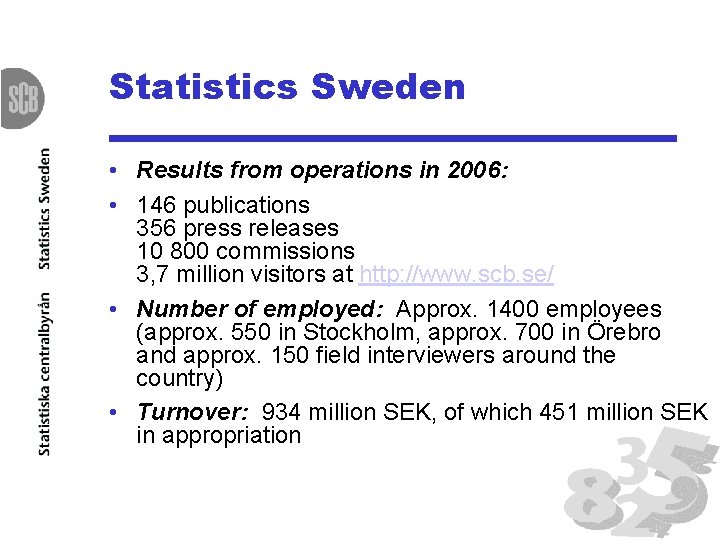
Statistics Sweden • Results from operations in 2006: • 146 publications 356 press releases 10 800 commissions 3, 7 million visitors at http: //www. scb. se/ • Number of employed: Approx. 1400 employees (approx. 550 in Stockholm, approx. 700 in Örebro and approx. 150 field interviewers around the country) • Turnover: 934 million SEK, of which 451 million SEK in appropriation
About Statistics Sweden • Statistics Sweden is a central government authority for official statistics and other government statistics and in this capacity also responsible for coordinating and supporting the Swedish system for official statistics. • Statistics Sweden’s mission – In order to supply customers with good quality statistics to be used as the basis for decision-making, debate and research, Statistics Sweden will: – develop, produce and communicate statistics, actively contribute to statistical cooperation on an international level and coordinate and support the Swedish system for official statistics.
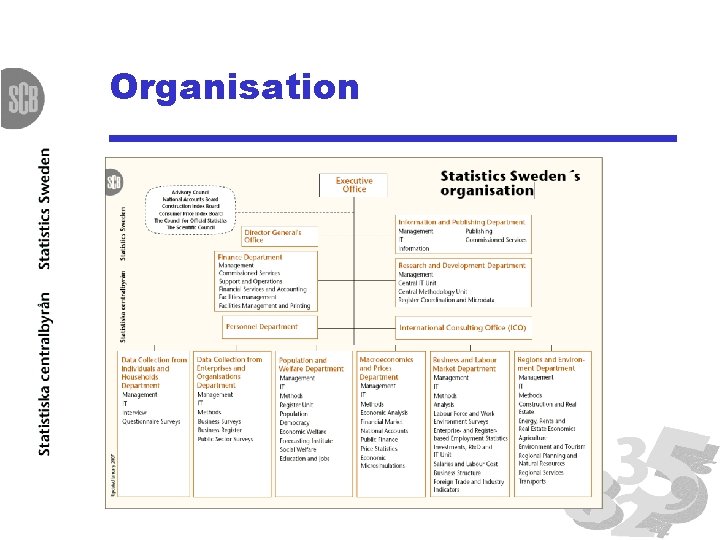
Organisation
The Lotta project • Standardised production and tools – – – Process orientation Customer focus Efficiency Standardisation Quality control • New organisation after summer – Internal review during summer
The Lotta project
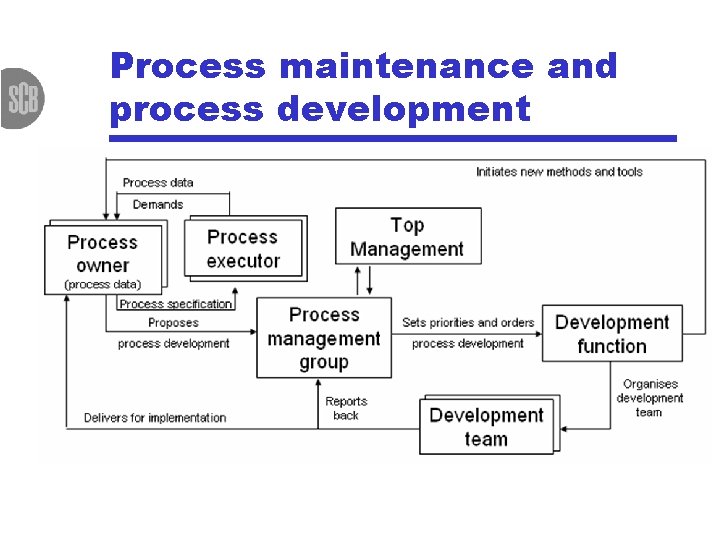
Process maintenance and process development
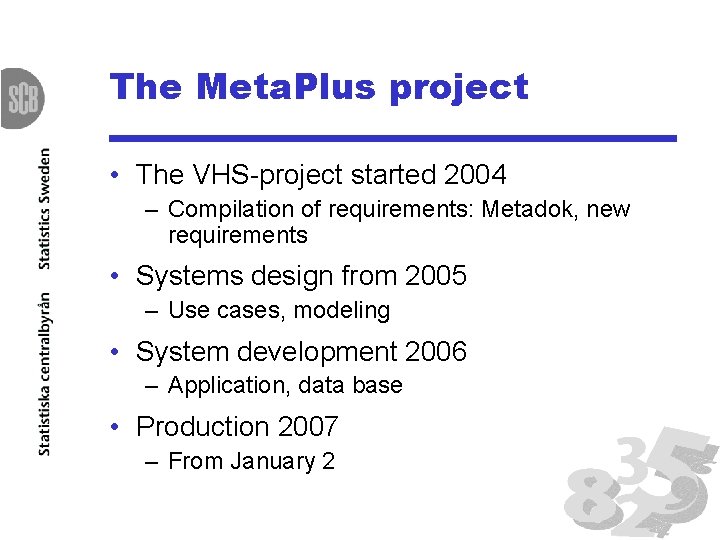
The Meta. Plus project • The VHS-project started 2004 – Compilation of requirements: Metadok, new requirements • Systems design from 2005 – Use cases, modeling • System development 2006 – Application, data base • Production 2007 – From January 2
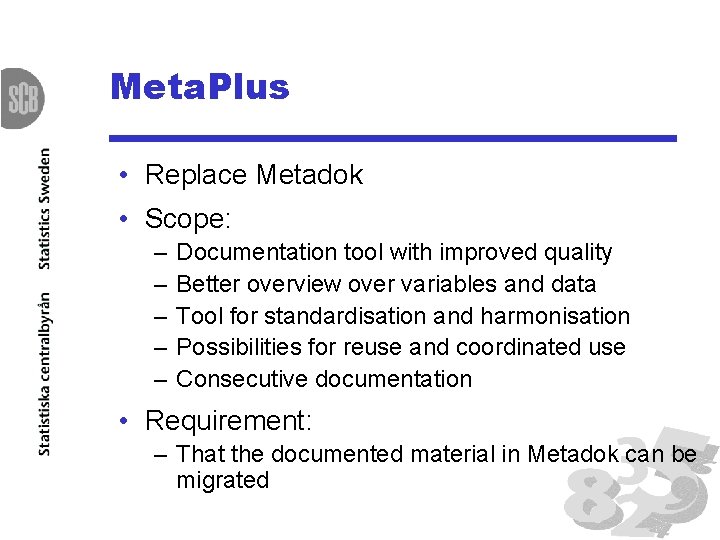
Meta. Plus • Replace Metadok • Scope: – – – Documentation tool with improved quality Better overview over variables and data Tool for standardisation and harmonisation Possibilities for reuse and coordinated use Consecutive documentation • Requirement: – That the documented material in Metadok can be migrated
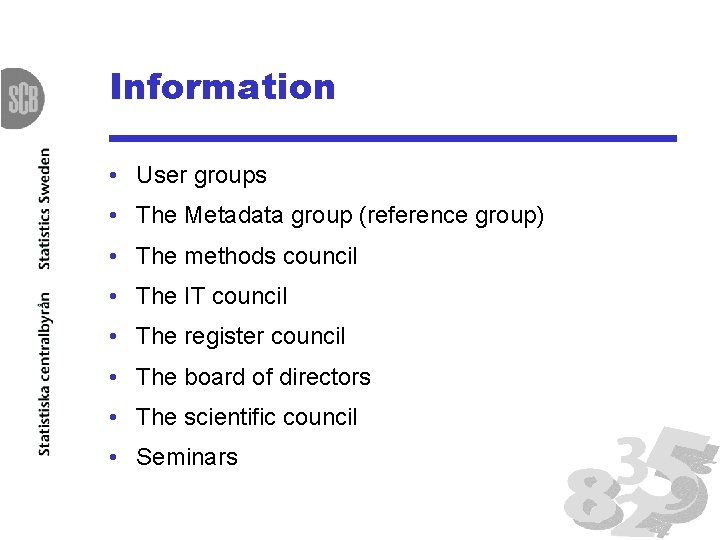
Information • User groups • The Metadata group (reference group) • The methods council • The IT council • The register council • The board of directors • The scientific council • Seminars
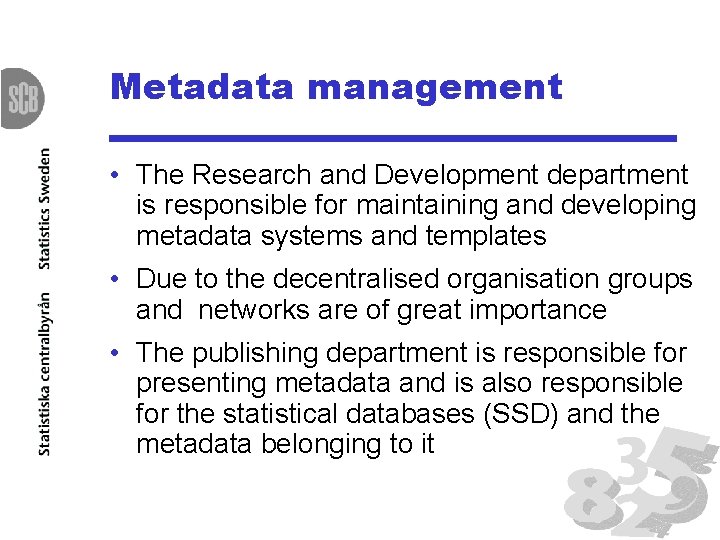
Metadata management • The Research and Development department is responsible for maintaining and developing metadata systems and templates • Due to the decentralised organisation groups and networks are of great importance • The publishing department is responsible for presenting metadata and is also responsible for the statistical databases (SSD) and the metadata belonging to it
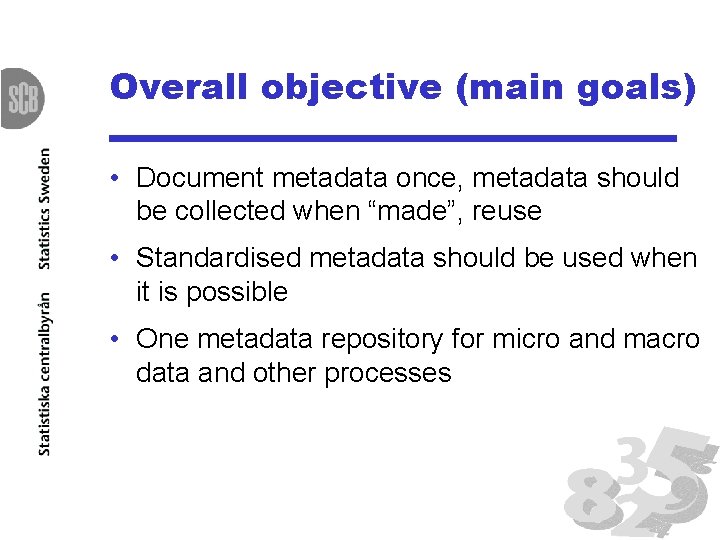
Overall objective (main goals) • Document metadata once, metadata should be collected when “made”, reuse • Standardised metadata should be used when it is possible • One metadata repository for micro and macro data and other processes
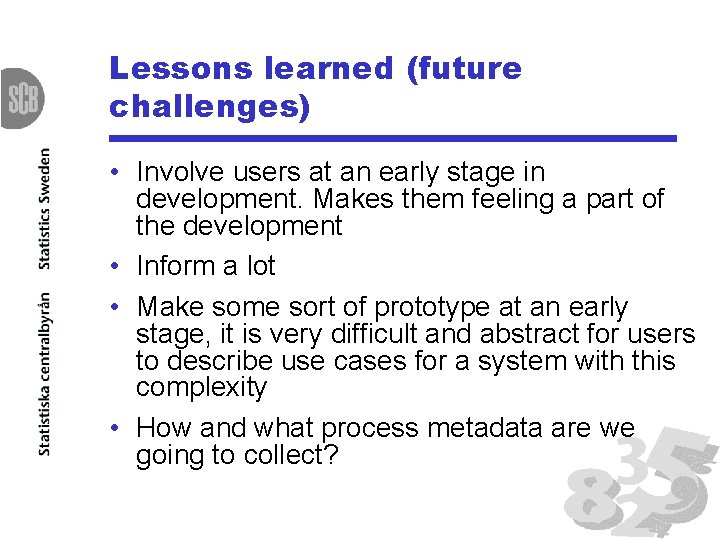
Lessons learned (future challenges) • Involve users at an early stage in development. Makes them feeling a part of the development • Inform a lot • Make some sort of prototype at an early stage, it is very difficult and abstract for users to describe use cases for a system with this complexity • How and what process metadata are we going to collect?
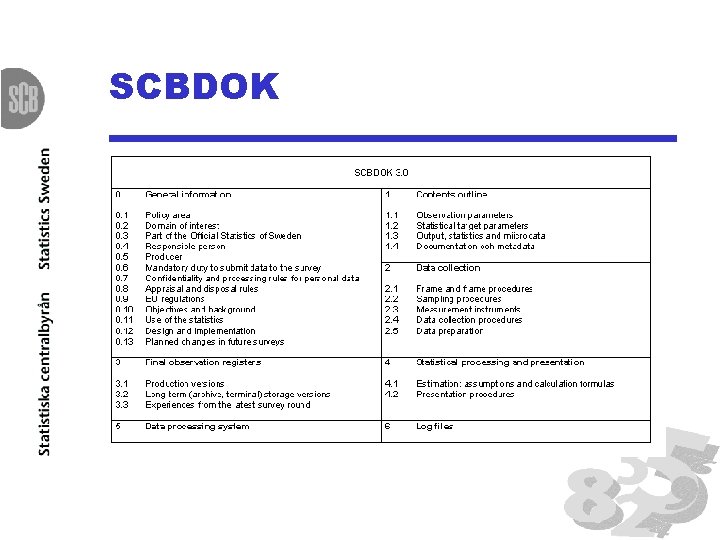
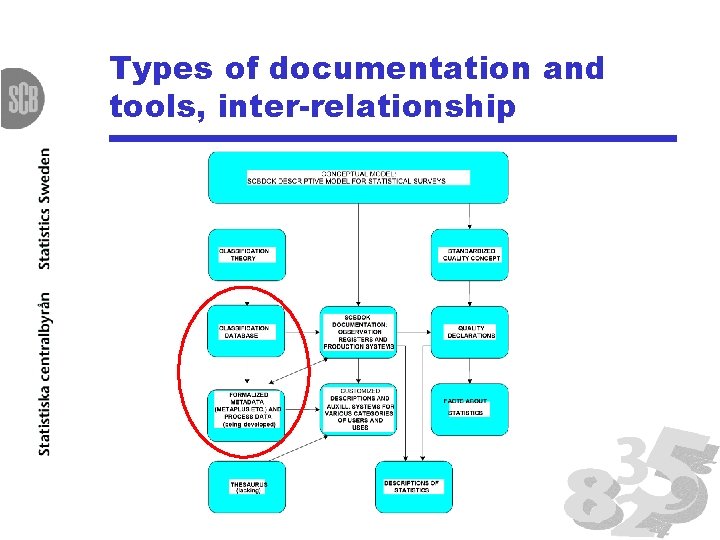
Metadata at Statistics Sweden • SCBDOK – Word template, standardised structure free text description • Meta. Plus (Metadok) – Formalized metadata, coded information • KDB, the classification database – Statistical standards and classifications • Other documentation – Description of the statistics – the quality declaration – Product database – Private production documentation
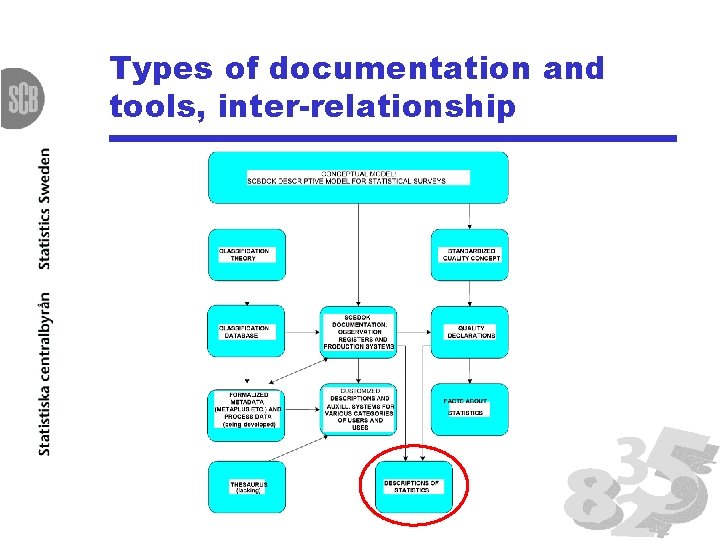
Types of documentation and tools, inter-relationship
Description of the statistics • According to the Swedish Statistics Act they must be produced for all statistics products. – Purpose: provide brief information on the quality of the statistics and other basic facts. The descriptions serve an important function as a quality declaration for the published statistics. • Free text format, main chapter’s: – General information – Quality declaration
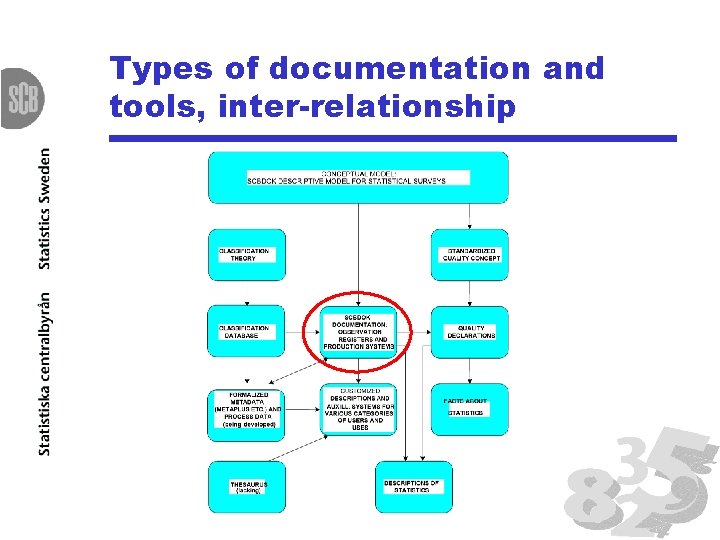
Types of documentation and tools, inter-relationship
SCBDOK
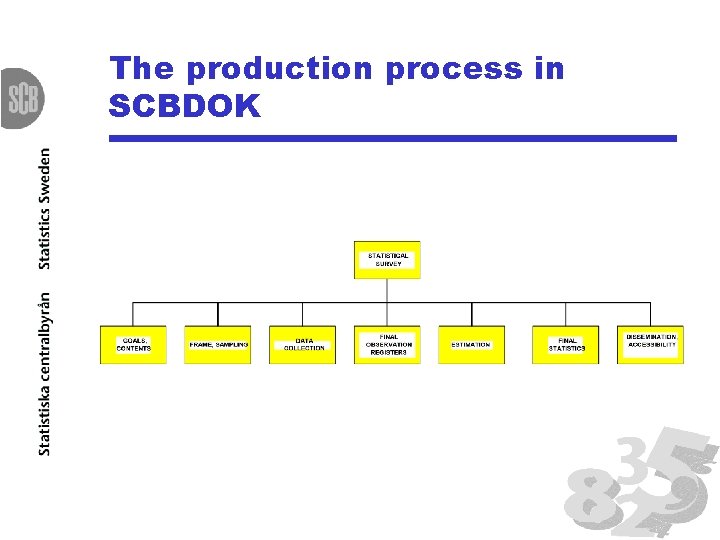
The production process in SCBDOK
Types of documentation and tools, inter-relationship
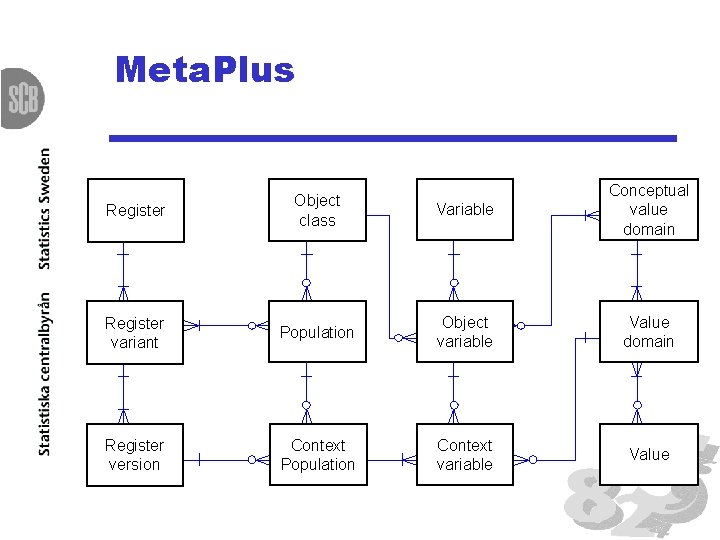
Meta. Plus Register Object class Variable Conceptual value domain Register variant Population Object variable Value domain Register version Context Population Context variable Value
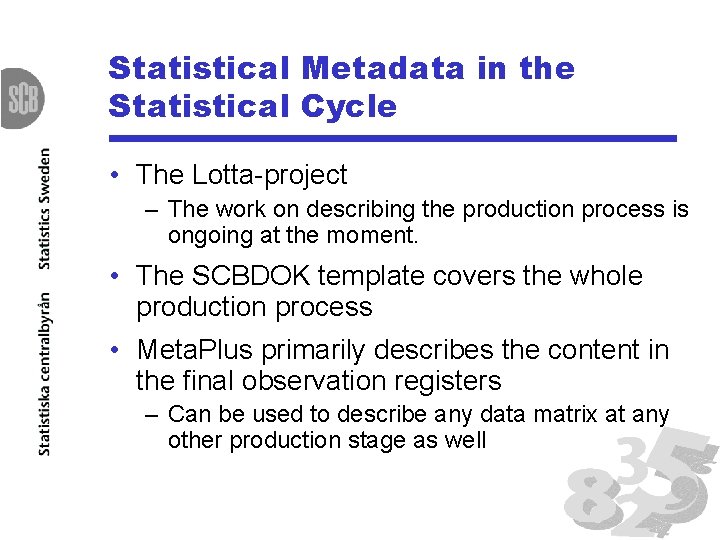
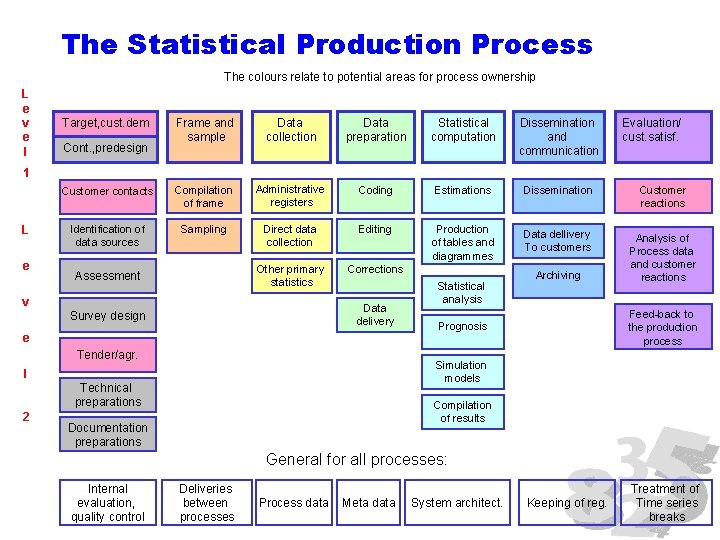
Statistical Metadata in the Statistical Cycle • The Lotta-project – The work on describing the production process is ongoing at the moment. • The SCBDOK template covers the whole production process • Meta. Plus primarily describes the content in the final observation registers – Can be used to describe any data matrix at any other production stage as well
The Statistical Production Process The colours relate to potential areas for process ownership L e v e l Target, cust. dem Frame and sample Data collection Data preparation Statistical computation Dissemination and communication Customer contacts Compilation of frame Administrative registers Coding Estimations Dissemination Customer reactions Identification of data sources Sampling Direct data collection Editing Production of tables and diagrammes Data dellivery To customers Other primary statistics Corrections Analysis of Process data and customer reactions Cont. , predesign Evaluation/ cust. satisf. 1 L e Assessment v Data delivery Survey design e Tender/agr. Archiving Feed-back to the production process Prognosis Simulation models l Technical preparations 2 Statistical analysis Compilation of results Documentation preparations General for all processes: Internal evaluation, quality control Deliveries between processes Process data Meta data System architect. Keeping of reg. Treatment of Time series breaks
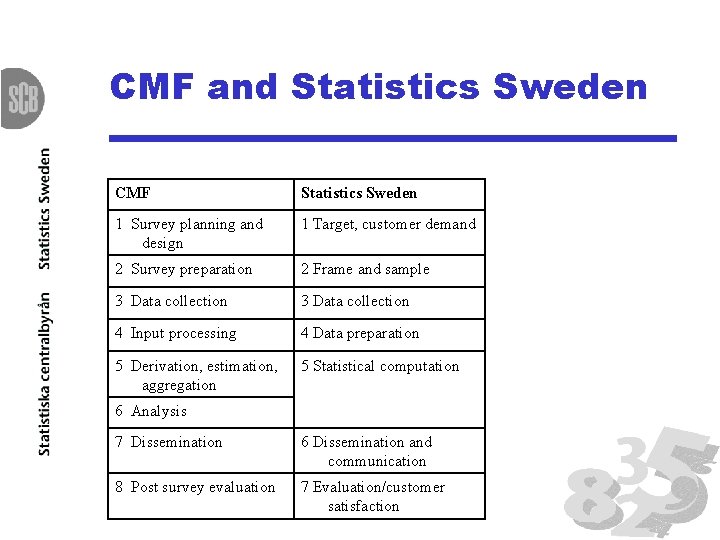
CMF and Statistics Sweden CMF Statistics Sweden 1 Survey planning and design 1 Target, customer demand 2 Survey preparation 2 Frame and sample 3 Data collection 4 Input processing 4 Data preparation 5 Derivation, estimation, aggregation 5 Statistical computation 6 Analysis 7 Dissemination 6 Dissemination and communication 8 Post survey evaluation 7 Evaluation/customer satisfaction
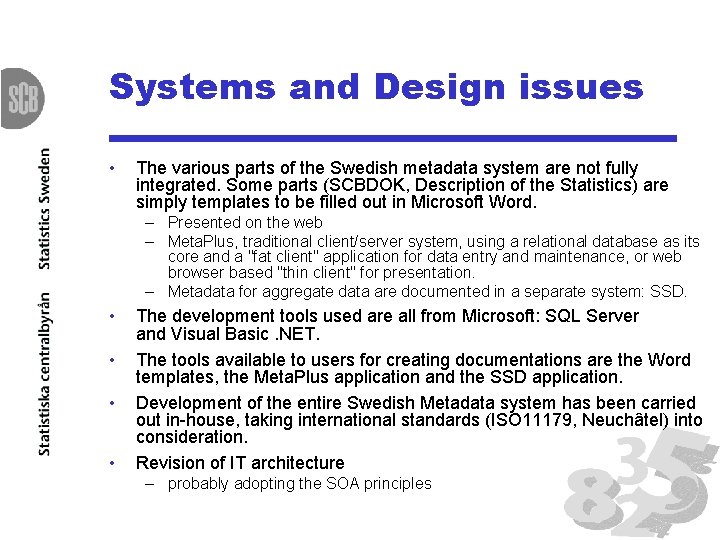
Systems and Design issues • The various parts of the Swedish metadata system are not fully integrated. Some parts (SCBDOK, Description of the Statistics) are simply templates to be filled out in Microsoft Word. – Presented on the web – Meta. Plus, traditional client/server system, using a relational database as its core and a "fat client" application for data entry and maintenance, or web browser based "thin client" for presentation. – Metadata for aggregate data are documented in a separate system: SSD. • • The development tools used are all from Microsoft: SQL Server and Visual Basic. NET. The tools available to users for creating documentations are the Word templates, the Meta. Plus application and the SSD application. Development of the entire Swedish Metadata system has been carried out in-house, taking international standards (ISO 11179, Neuchâtel) into consideration. Revision of IT architecture – probably adopting the SOA principles
Organizational and cultural issues • Subject matter statisticians – Documenting – Responsible for the content • The KMI group • The metadata group • The documentation network – Training issues • The classification network
Summing up • Content org – Standardisation and harmonisation is very time consuming – Se principles for content – Work on harmonisation guidelines as early as possible • Experiences – Migration of content is difficult – Make a simple prototype at an early stage • Future – One repository – one tool – Metadata and process data in the production process