
Statistics Starts Here CHAPTER 1 What is Statistics
- Slides: 11
Statistics Starts Here! CHAPTER 1
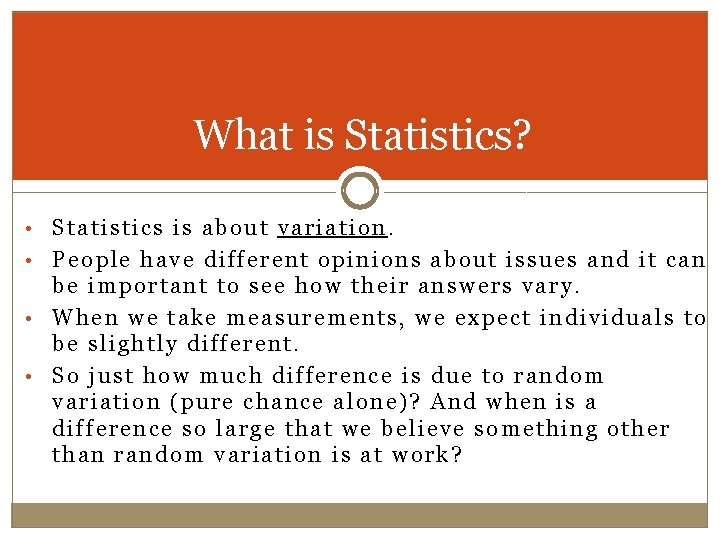
What is Statistics? Statistics is about variation. • People have different opinions about issues and it can be important to see how their answers vary. • When we take measurements, we expect individuals to be slightly different. • So just how much difference is due to random variation (pure chance alone)? And when is a difference so large that we believe something other than random variation is at work? •
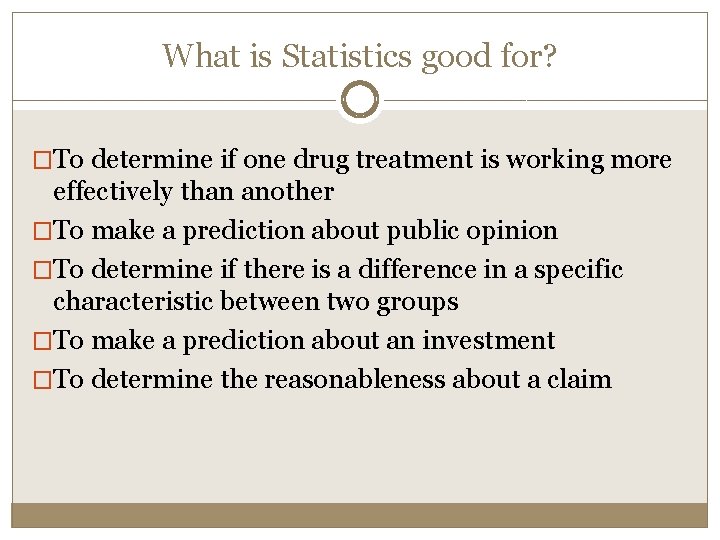
What is Statistics good for? �To determine if one drug treatment is working more effectively than another �To make a prediction about public opinion �To determine if there is a difference in a specific characteristic between two groups �To make a prediction about an investment �To determine the reasonableness about a claim
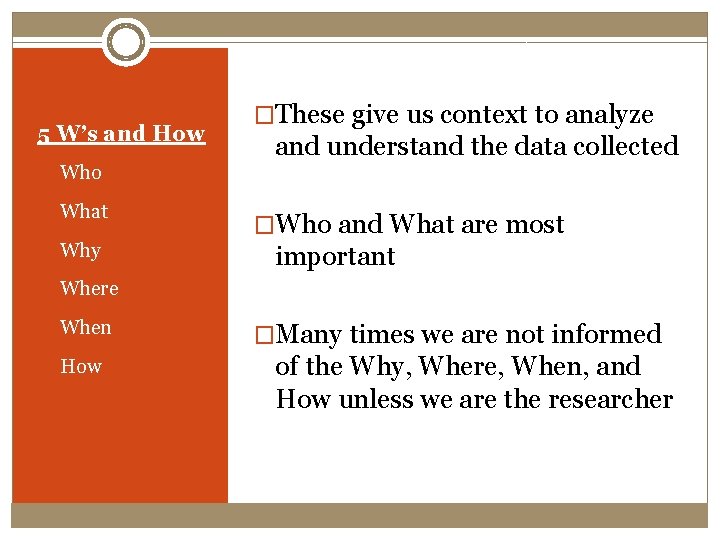
5 W’s and How • Who • What • Why �These give us context to analyze and understand the data collected �Who and What are most important • Where • When • How �Many times we are not informed of the Why, Where, When, and How unless we are the researcher
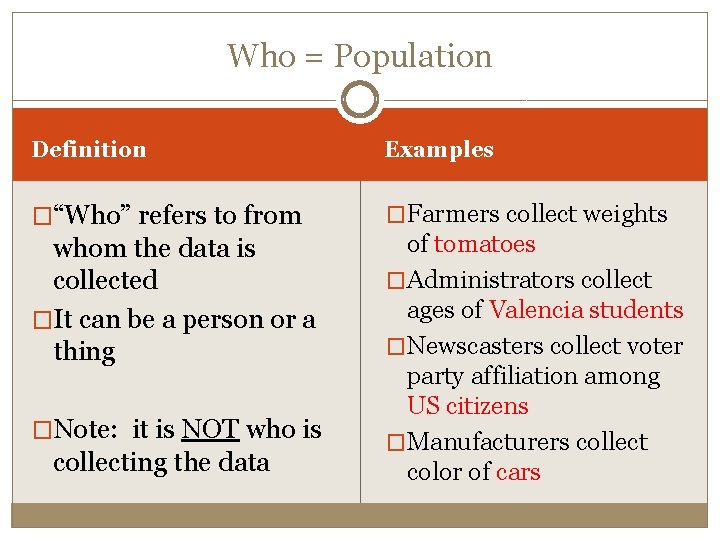
Who = Population Definition Examples �“Who” refers to from �Farmers collect weights whom the data is collected �It can be a person or a thing �Note: it is NOT who is collecting the data of tomatoes �Administrators collect ages of Valencia students �Newscasters collect voter party affiliation among US citizens �Manufacturers collect color of cars
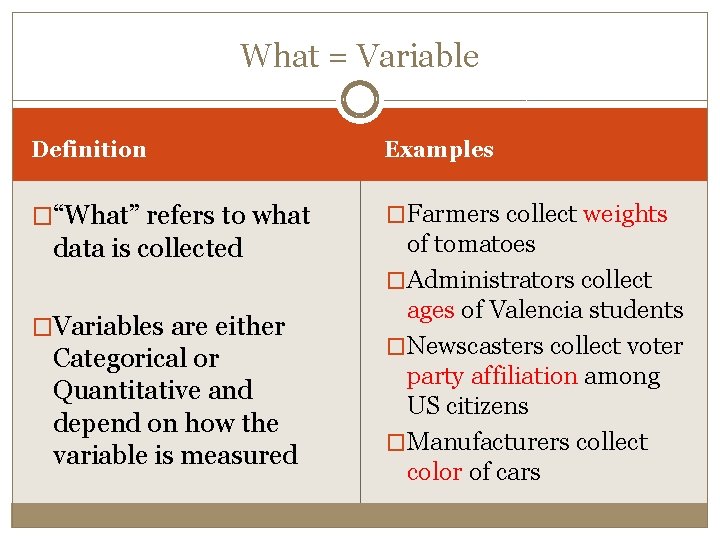
What = Variable Definition Examples �“What” refers to what �Farmers collect weights data is collected �Variables are either Categorical or Quantitative and depend on how the variable is measured of tomatoes �Administrators collect ages of Valencia students �Newscasters collect voter party affiliation among US citizens �Manufacturers collect color of cars
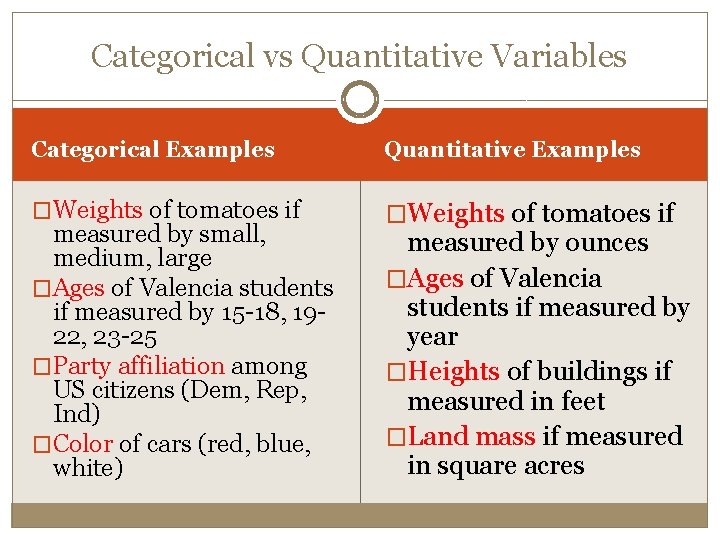
Categorical vs Quantitative Variables Categorical Examples Quantitative Examples �Weights of tomatoes if measured by small, medium, large �Ages of Valencia students if measured by 15 -18, 1922, 23 -25 �Party affiliation among US citizens (Dem, Rep, Ind) �Color of cars (red, blue, white) measured by ounces �Ages of Valencia students if measured by year �Heights of buildings if measured in feet �Land mass if measured in square acres
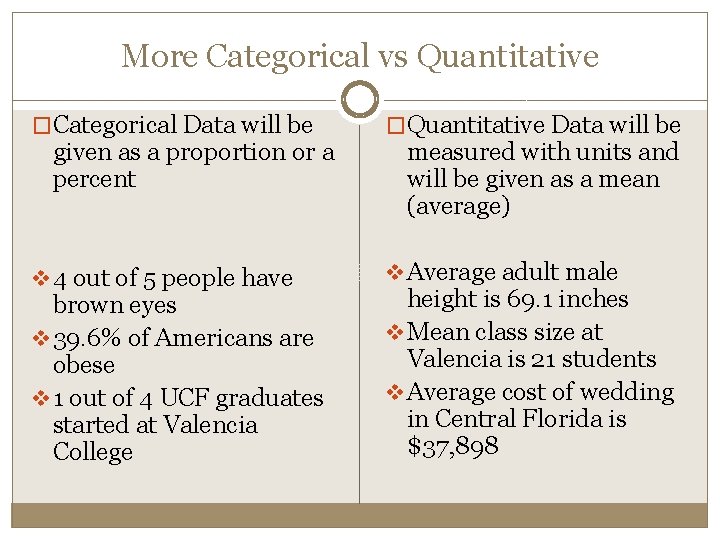
More Categorical vs Quantitative �Categorical Data will be �Quantitative Data will be v 4 out of 5 people have v Average adult male given as a proportion or a percent brown eyes v 39. 6% of Americans are obese v 1 out of 4 UCF graduates started at Valencia College measured with units and will be given as a mean (average) height is 69. 1 inches v Mean class size at Valencia is 21 students v Average cost of wedding in Central Florida is $37, 898
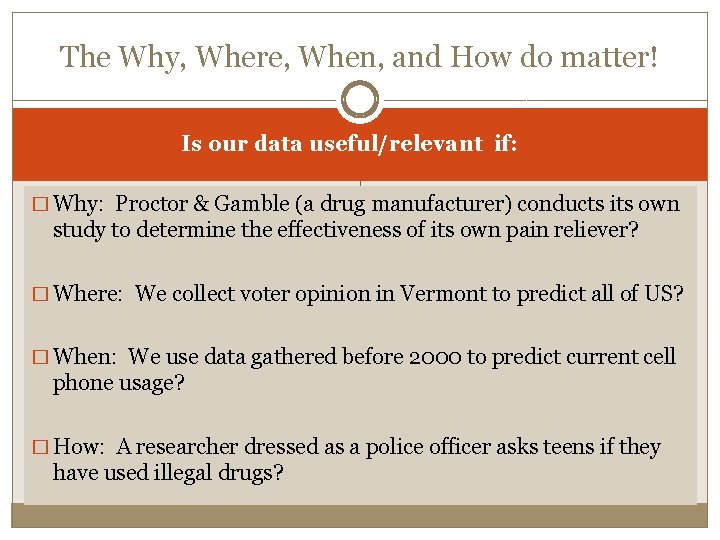
The Why, Where, When, and How do matter! Is our data useful/relevant if: � Why: Proctor & Gamble (a drug manufacturer) conducts its own study to determine the effectiveness of its own pain reliever? � Where: We collect voter opinion in Vermont to predict all of US? � When: We use data gathered before 2000 to predict current cell phone usage? � How: A researcher dressed as a police officer asks teens if they have used illegal drugs?
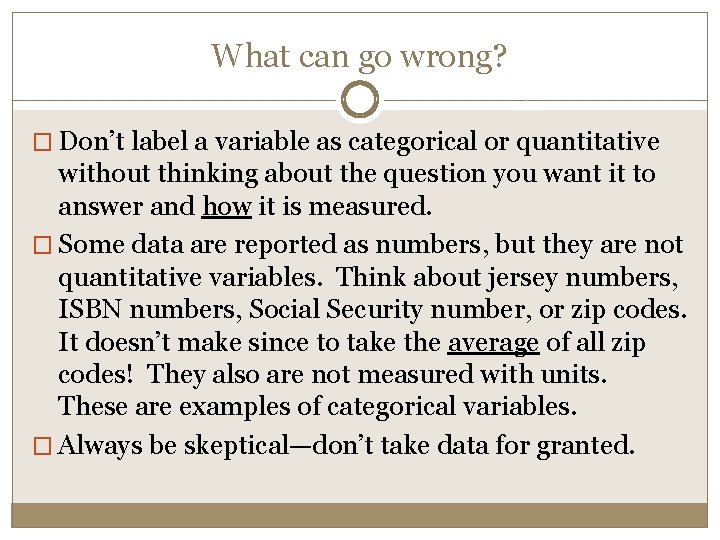
What can go wrong? � Don’t label a variable as categorical or quantitative without thinking about the question you want it to answer and how it is measured. � Some data are reported as numbers, but they are not quantitative variables. Think about jersey numbers, ISBN numbers, Social Security number, or zip codes. It doesn’t make since to take the average of all zip codes! They also are not measured with units. These are examples of categorical variables. � Always be skeptical—don’t take data for granted.
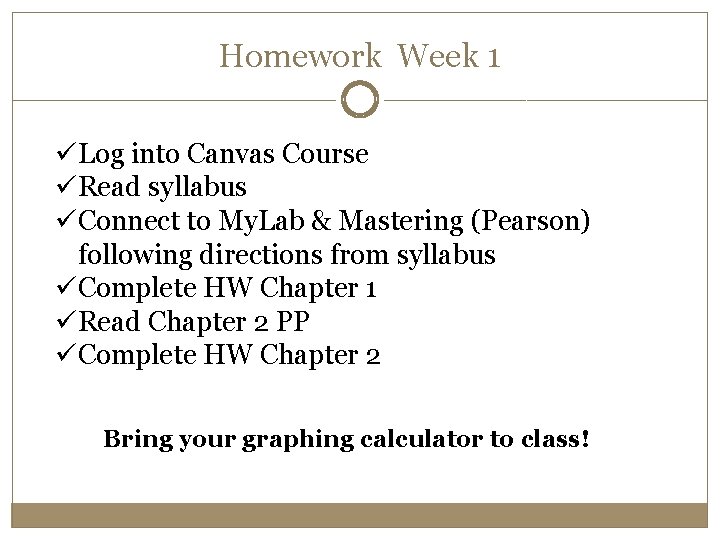
Homework Week 1 üLog into Canvas Course üRead syllabus üConnect to My. Lab & Mastering (Pearson) following directions from syllabus üComplete HW Chapter 1 üRead Chapter 2 PP üComplete HW Chapter 2 Bring your graphing calculator to class!