
Statistics Section 2 5 notes continued Range Rule
- Slides: 10
Statistics Section 2. 5 notes continued
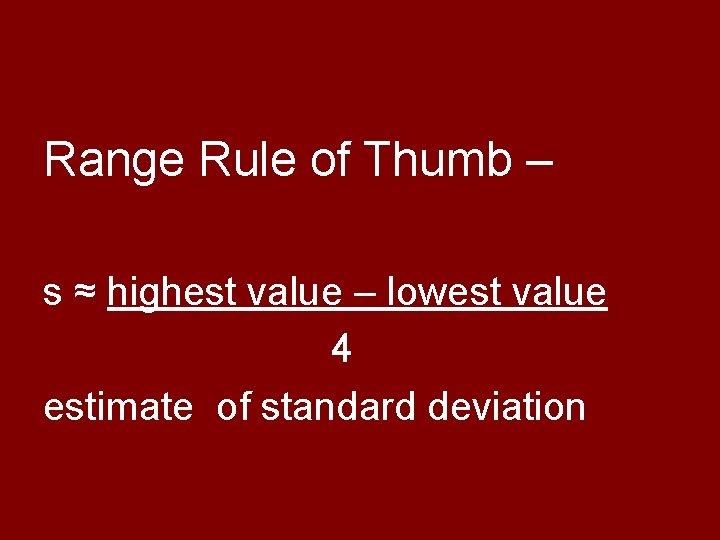
Range Rule of Thumb – s ≈ highest value – lowest value 4 estimate of standard deviation
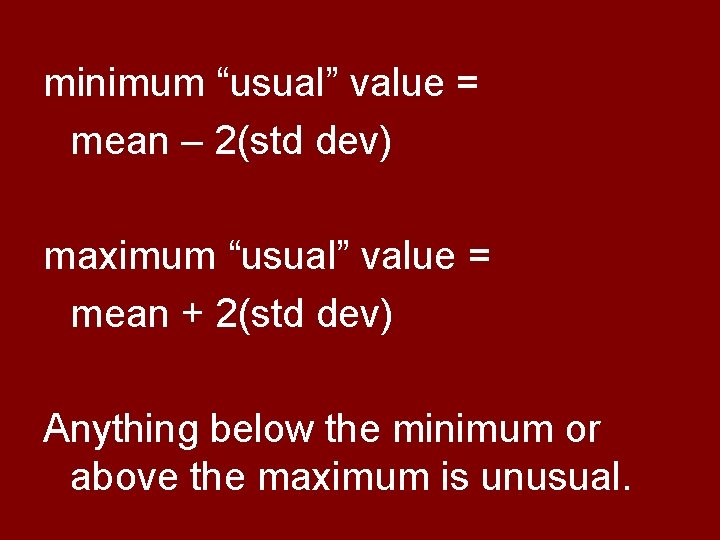
minimum “usual” value = mean – 2(std dev) maximum “usual” value = mean + 2(std dev) Anything below the minimum or above the maximum is unusual.
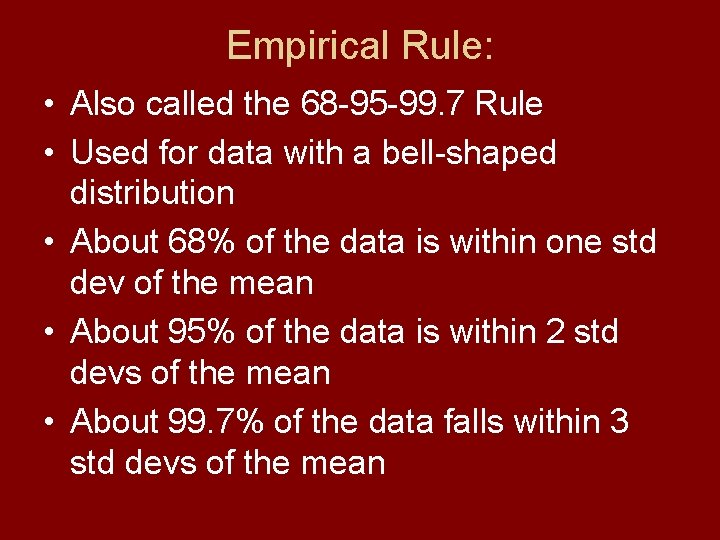
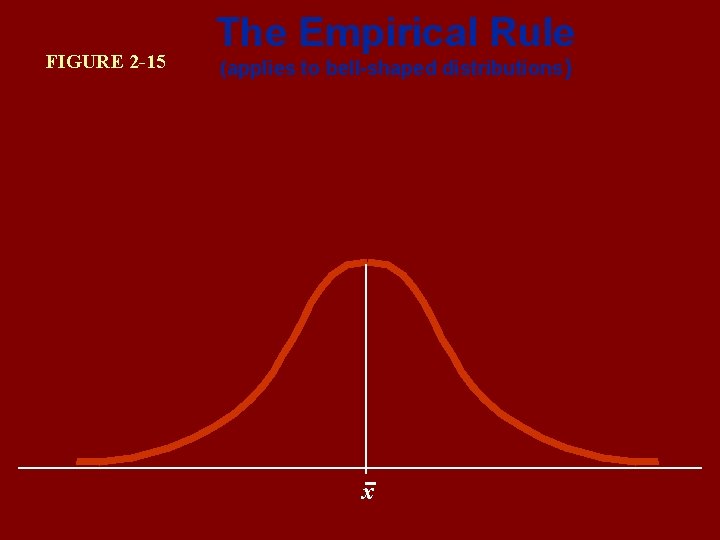
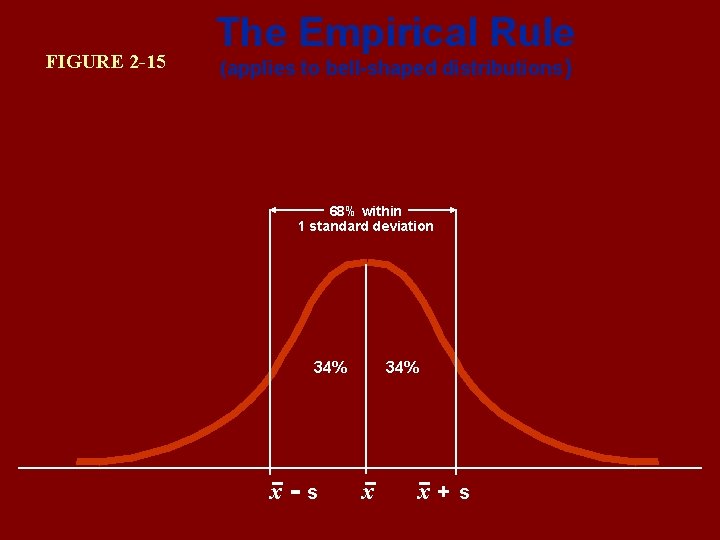
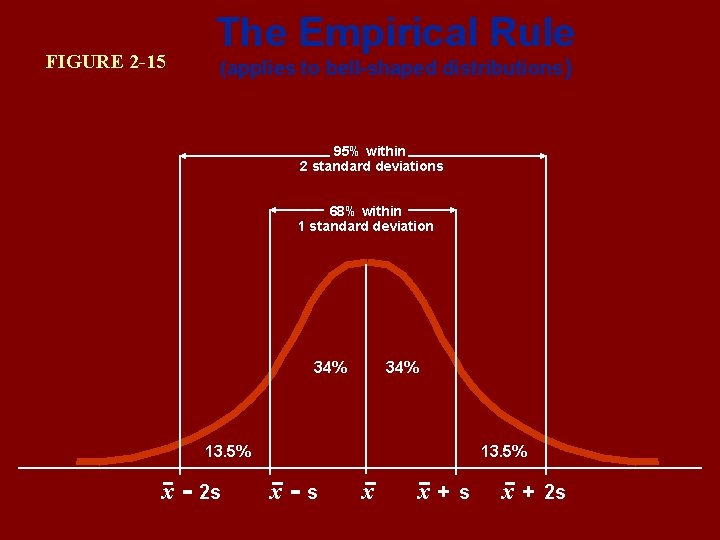
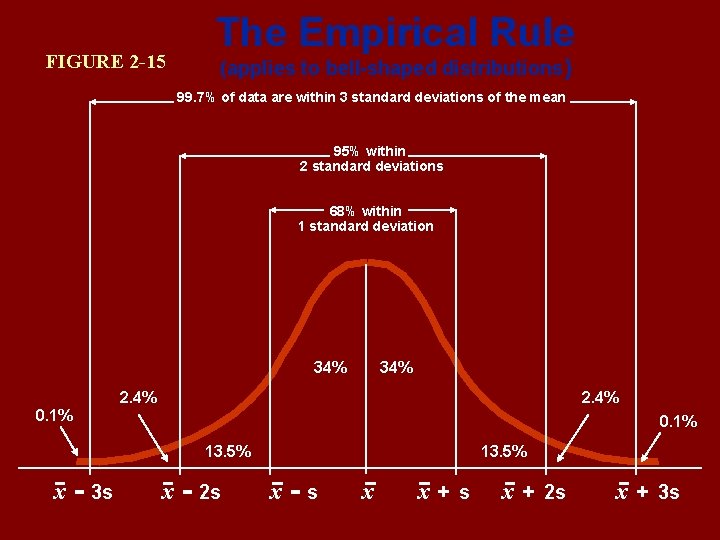
Empirical Rule: • Also called the 68 -95 -99. 7 Rule • Used for data with a bell-shaped distribution • About 68% of the data is within one std dev of the mean • About 95% of the data is within 2 std devs of the mean • About 99. 7% of the data falls within 3 std devs of the mean
FIGURE 2 -15 The Empirical Rule (applies to bell-shaped distributions) x
FIGURE 2 -15 The Empirical Rule (applies to bell-shaped distributions) 68% within 1 standard deviation 34% x-s 34% x x+s
FIGURE 2 -15 The Empirical Rule (applies to bell-shaped distributions) 95% within 2 standard deviations 68% within 1 standard deviation 34% 13. 5% x - 2 s 13. 5% x-s x x+s x + 2 s
FIGURE 2 -15 The Empirical Rule (applies to bell-shaped distributions) 99. 7% of data are within 3 standard deviations of the mean 95% within 2 standard deviations 68% within 1 standard deviation 34% 2. 4% 0. 1% 13. 5% x - 3 s x - 2 s 13. 5% x-s x x+s x + 2 s x + 3 s
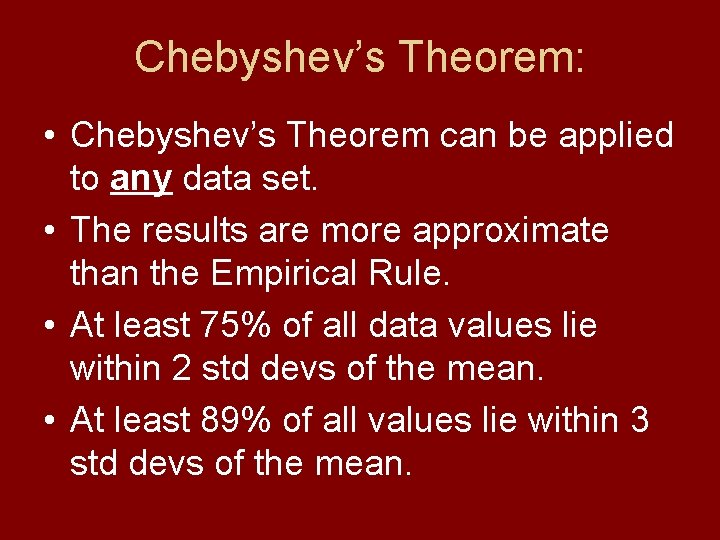
Chebyshev’s Theorem: • Chebyshev’s Theorem can be applied to any data set. • The results are more approximate than the Empirical Rule. • At least 75% of all data values lie within 2 std devs of the mean. • At least 89% of all values lie within 3 std devs of the mean.
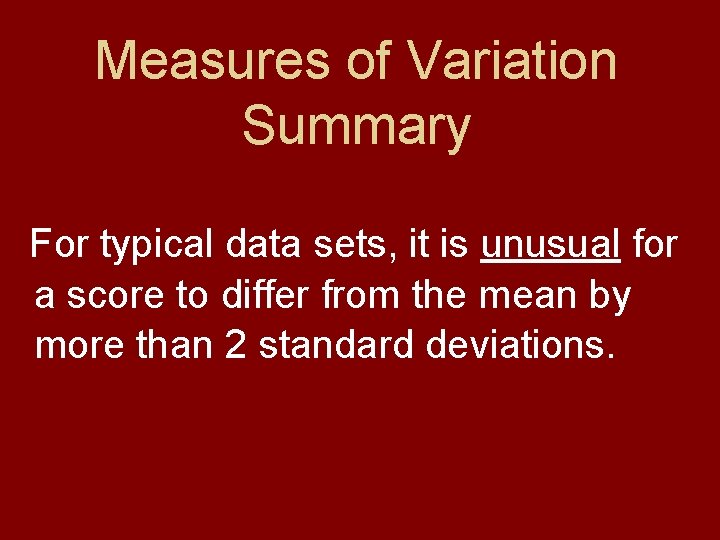
Measures of Variation Summary For typical data sets, it is unusual for a score to differ from the mean by more than 2 standard deviations.