
Statistics of Children Living In Lowincome Neighborhoods Skill
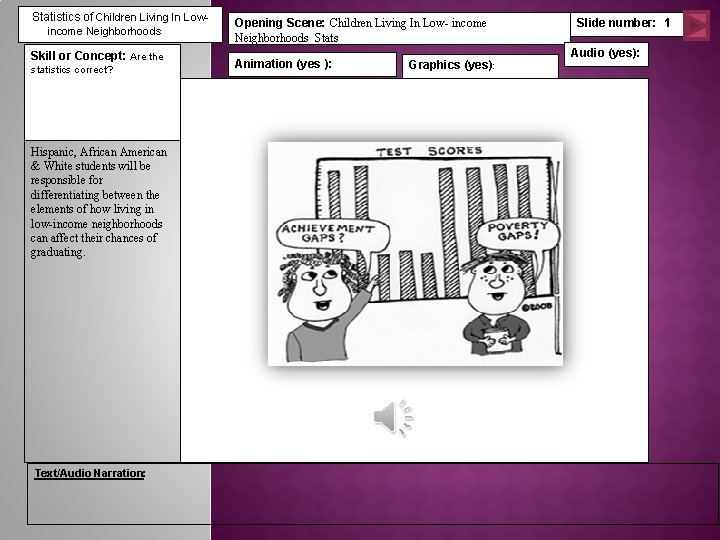
Statistics of Children Living In Lowincome Neighborhoods Skill or Concept: Are the statistics correct? Hispanic, African American & White students will be responsible for differentiating between the elements of how living in low-income neighborhoods can affect their chances of graduating. Text/Audio Narration: Opening Scene: Children Living In Low- income Neighborhoods Stats Animation (yes ): Graphics (yes): Slide number: 1 Audio (yes):
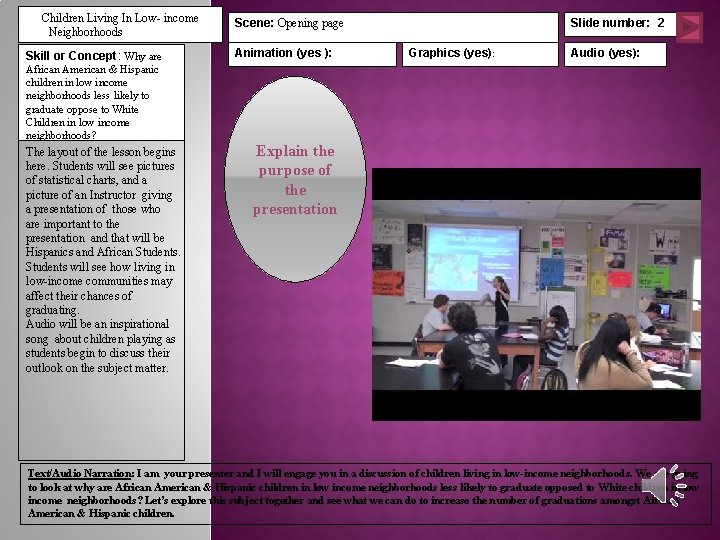
Children Living In Low- income Neighborhoods Skill or Concept: Why are Scene: Opening page Animation (yes ): Slide number: 2 Graphics (yes): Audio (yes): African American & Hispanic children in low income neighborhoods less likely to graduate oppose to White Children in low income neighborhoods? The layout of the lesson begins here. Students will see pictures of statistical charts, and a picture of an Instructor giving a presentation of those who are important to the presentation and that will be Hispanics and African Students will see how living in low-income communities may affect their chances of graduating. Audio will be an inspirational song about children playing as students begin to discuss their outlook on the subject matter. Explain the purpose of the presentation Text/Audio Narration: I am your presenter and I will engage you in a discussion of children living in low-income neighborhoods. We are going to look at why are African American & Hispanic children in low income neighborhoods less likely to graduate opposed to White children in low income neighborhoods? Let’s explore this subject together and see what we can do to increase the number of graduations amongst African American & Hispanic children.
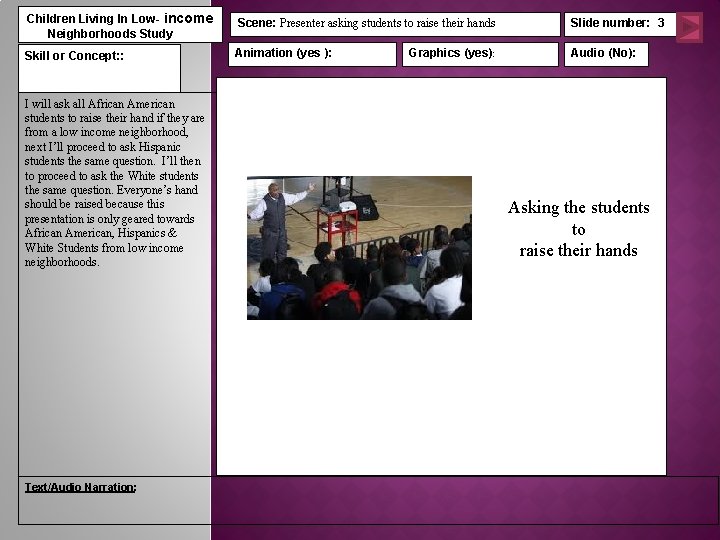
Children Living In Low- income Neighborhoods Study Scene: Presenter asking students to raise their hands Slide number: 3 Skill or Concept: : Animation (yes ): Audio (No): I will ask all African American students to raise their hand if they are from a low income neighborhood, next I’ll proceed to ask Hispanic students the same question. I’ll then to proceed to ask the White students the same question. Everyone’s hand should be raised because this presentation is only geared towards African American, Hispanics & White Students from low income neighborhoods. Text/Audio Narration: Graphics (yes): Asking the students to raise their hands
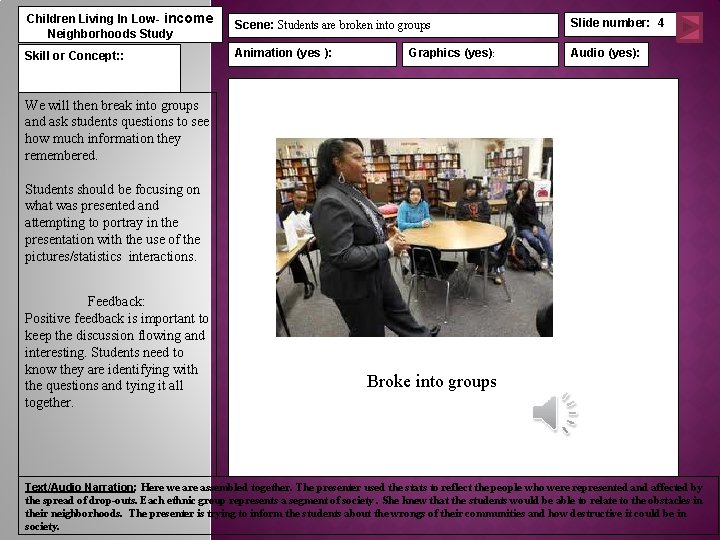
Children Living In Low- income Neighborhoods Study Scene: Students are broken into groups Slide number: 4 Skill or Concept: : Animation (yes ): Audio (yes): Graphics (yes): We will then break into groups and ask students questions to see how much information they remembered. Students should be focusing on what was presented and attempting to portray in the presentation with the use of the pictures/statistics interactions. Feedback: Positive feedback is important to keep the discussion flowing and interesting. Students need to know they are identifying with the questions and tying it all together. Broke into groups Text/Audio Narration: Here we are assembled together. The presenter used the stats to reflect the people who were represented and affected by the spread of drop-outs. Each ethnic group represents a segment of society. She knew that the students would be able to relate to the obstacles in their neighborhoods. The presenter is trying to inform the students about the wrongs of their communities and how destructive it could be in society.
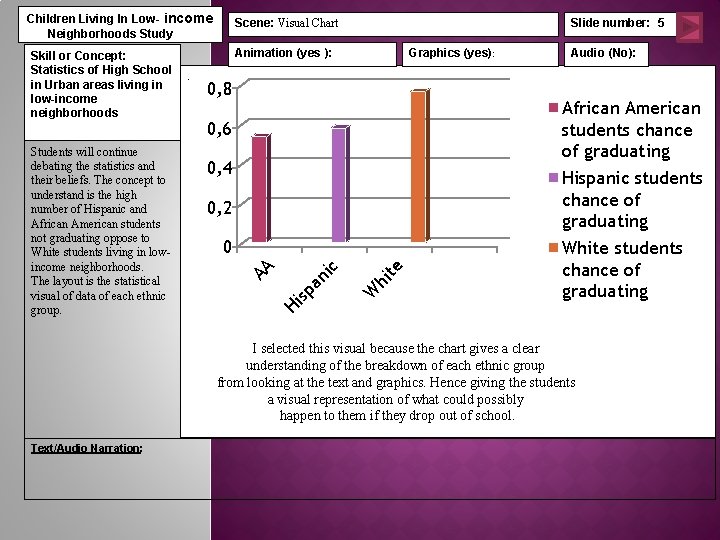
Children Living In Low- income Neighborhoods Study Graphics (yes): 0, 8 0, 6 0, 4 0, 2 W hi te 0 an ic . Hi sp Students will continue debating the statistics and their beliefs. The concept to understand is the high number of Hispanic and African American students not graduating oppose to White students living in lowincome neighborhoods. The layout is the statistical visual of data of each ethnic group. Slide number: 5 Animation (yes ): AA Skill or Concept: Statistics of High School in Urban areas living in low-income neighborhoods Scene: Visual Chart Audio (No): African American students chance of graduating Hispanic students chance of graduating White students chance of graduating I selected this visual because the chart gives a clear understanding of the breakdown of each ethnic group from looking at the text and graphics. Hence giving the students a visual representation of what could possibly happen to them if they drop out of school. Text/Audio Narration:
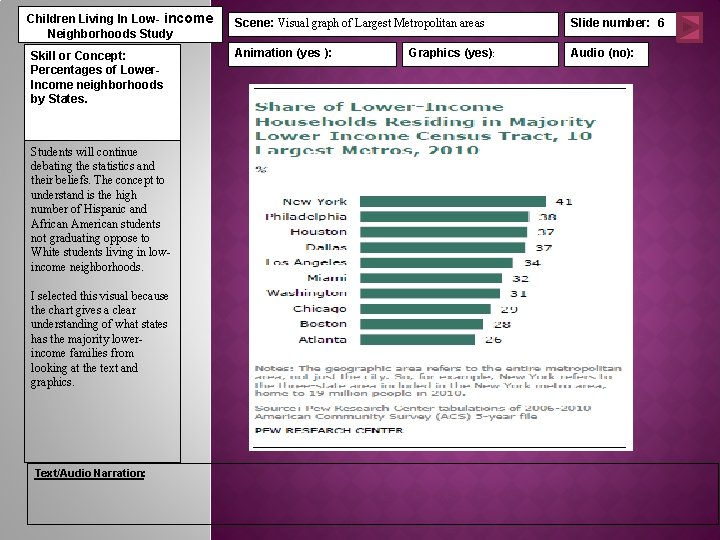
Children Living In Low- income Neighborhoods Study Skill or Concept: Percentages of Lower. Income neighborhoods by States. Students will continue debating the statistics and their beliefs. The concept to understand is the high number of Hispanic and African American students not graduating oppose to White students living in lowincome neighborhoods. I selected this visual because the chart gives a clear understanding of what states has the majority lowerincome families from looking at the text and graphics. Text/Audio Narration: Scene: Visual graph of Largest Metropolitan areas Slide number: 6 Animation (yes ): Audio (no): Graphics (yes):
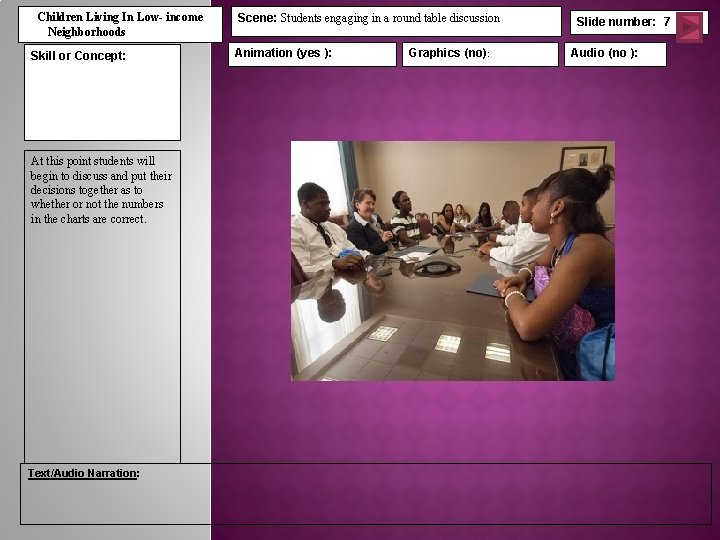
Children Living In Low- income Neighborhoods Skill or Concept: At this point students will begin to discuss and put their decisions together as to whether or not the numbers in the charts are correct. Text/Audio Narration: Scene: Students engaging in a round table discussion Animation (yes ): Graphics (no): Slide number: 7 Audio (no ):
Children Living In Low- income Neighborhoods Skill or Concept: Identifying an audio-sharing technology to use in recording audio for my storyboard An audio-sharing technology tool I can use in recording audio for my storyboard is Voice thread. With Voice. Thread, group conversations are collected and shared in one place from anywhere in the world. All with no software to install. A Voice. Thread is a collaborative, multimedia slide show that holds images, documents, and videos and allows people to navigate slides and leave comments in 5 ways - using voice (with a mic or telephone), text, audio file, or video (via a webcam). Share a Voice. Thread with friends, students, and colleagues for them to record comments too. Users can doodle while commenting, use multiple identities, and pick which comments are shown through moderation. Voice. Threads can even be embedded to show and receive comments on other websites and exported to MP 3 players. Text/Audio Narration: Audio is attached Scene: Audio assignment Week 4 Animation (no ): Slide number: 8 Graphics (no): Audio (yes):
Title: Tying it all together Skill or Concept: Final Decisions Scene: Collaborative Activity Animation (yes ): Slide number: 9 Graphics (no): Audio (yes ): Ø Students identifies one of the neighborhoods we are studying. Ex: A community of which the students resides. This will be the wrap up of the lesson. Students will identify one of the main reason for Hispanics & African Students in low-income neighborhoods not graduating. They will come up with reason(s) why are White children residing in lowincome neighborhoods graduating at a higher rate that are from low-income neighborhoods. This collaborative activity enhances instruction by giving Hispanics & African American students a better perspective on why they are not graduating at the same rate as White Students and what they can do to increase their chances of graduating at the same rate. Ø Students will define low-income and the traits of the a person living in a low-income communities. Ex: A group of people living together in one place, such as clean water, nutrition, health care, education. Ø Students will define poverty and the traits as set by the government. Ex: Poverty is the lack of basic human needs, what Poverty is according to the U. S. Census Bureau. Ø Students will choose one neighborhood that they relate to in personality. They must be ready to share with the rest of the students the neighborhood that was chosen, their attributes, their genetically determined characteristic, and why they think they relate best to this study. Ø Students will vote on whether or not they agree with the other students decisions and/or solutions they came up with. Text/Audio Narration: Students will answer the wrap up questions concerning the study findings. We will use this time as a way for students to answer the questions and also present any questions they may have regarding any lessons demonstrated within the lesson. This will also be a good time for the teacher to encourage students and provide some feedback. Students want to know they are on the right track. At this time also, students will be evaluating themselves and their classmates as to the solutions chosen and how it will be beneficial to the student’s. Students enjoy hearing the feedback from the teacher and from their peers. Keep this time focused but light and interesting.
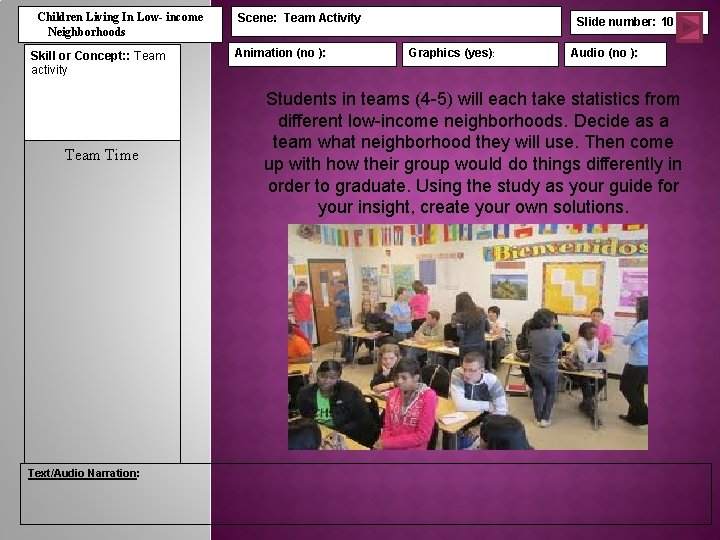
Children Living In Low- income Neighborhoods Skill or Concept: : Team activity Team Time Text/Audio Narration: Scene: Team Activity Animation (no ): Slide number: 10 Graphics (yes): Audio (no ): Students in teams (4 -5) will each take statistics from different low-income neighborhoods. Decide as a team what neighborhood they will use. Then come up with how their group would do things differently in order to graduate. Using the study as your guide for your insight, create your own solutions.
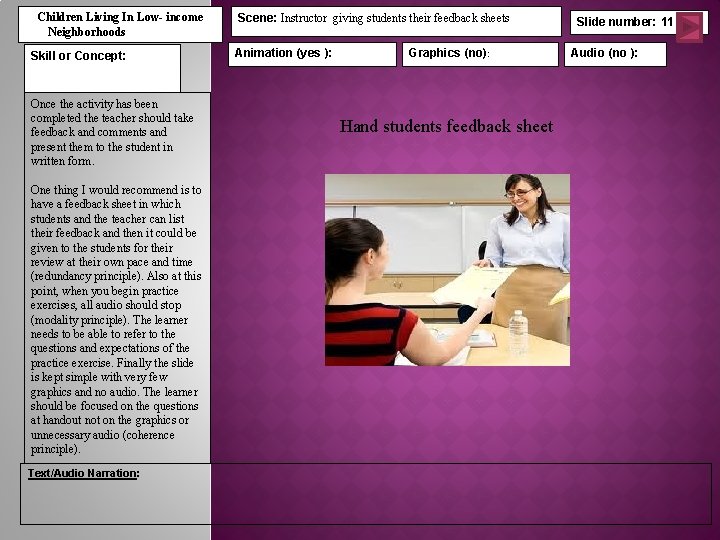
Children Living In Low- income Neighborhoods Skill or Concept: Once the activity has been completed the teacher should take feedback and comments and present them to the student in written form. One thing I would recommend is to have a feedback sheet in which students and the teacher can list their feedback and then it could be given to the students for their review at their own pace and time (redundancy principle). Also at this point, when you begin practice exercises, all audio should stop (modality principle). The learner needs to be able to refer to the questions and expectations of the practice exercise. Finally the slide is kept simple with very few graphics and no audio. The learner should be focused on the questions at handout not on the graphics or unnecessary audio (coherence principle). Text/Audio Narration: Scene: Instructor giving students their feedback sheets Animation (yes ): Graphics (no): Hand students feedback sheet Slide number: 11 Audio (no ):
Children Living In Low- income Neighborhoods Skill or Concept: Scene: Feedback Animation (yes ): Slide number: 12 Graphics (no): Audio (yes): Feedback for user performing the practice exercise: At this point we have covered a lot of ground. You have all done an awesome job of discussing how living in low-income neighborhoods affects Hispanics and African American students graduation status vs the graduation status of White students living in low-income neighborhoods. I am pleased with your individual and team assignments. Overall you have learned how to take a look at statistics, discuss the occurrences in your neighborhoods and come up with ideas/solutions that will increase the number of students graduating in your communities. Wonderful job students! I look forward to our next presentation and evaluation time. Text/Audio Narration:
Children Living In Low- income Neighborhoods Skill or Concept: An appropriate level of learner control. My storyboard provides students with a high level of learner control. They are able to play and replay the narration by pushing on the audio buttons. My storyboard has a practice exercise and the students is given the opportunity to move around the slides to where ever they feel they need to be. My storyboard allows the learner to look at the information and not feel overwhelmed. Everyone has different learning styles, and allowing the learner to choose what works best for him/her this gives them a sense of control over what they are learning. Text/Audio Narration: Scene: Animation (yes ): Slide number: 13 Graphics (no): Audio (yes):
Children Living In Low- income Neighborhoods Skill or Concept: Rationale for my design decisions, are as follows. I had to consider what lessons could be learned by others. A designer risks lacking the knowledge to put forward some truly creative ideas if he or she can’t keep the leaner in mind when designing. I had to introduce my design in appropriate ways so that it would appeal to the target audience. I chose my design decisions because the design imposed structure. I wanted my storyboard design to create a common discussion point and opening the door to external contributions. Text/Audio Narration: Scene: Animation (yes ): . Slide number: 14 Graphics (no): Audio (no):
Children Living In Low- income Neighborhoods Skill or Concept: Text/Audio Narration: Scene: Closing of presentation Animation (yes ): Slide number: 15 Graphics (no): Audio (yes):
- Slides: 15