
Statistics of breakdown and conditioning in pulsed dc
Statistics of breakdown and conditioning in pulsed dc and rf systems Anders Korsback, Jorge Giner Navaro, Robin Rajamaki and Walter Wuensch mini-Me. VArc, 21 March 2016 Walter Wuensch, CERN
Motivation Statistics Physics – The statistical properties of breakdown may give us insight into the evolution of the surface under pulses, the underlying trigger mechanism and what happens to the surface after breakdown. Practical – We try to operate the structures ever closer the gradient limit but we demand reliability and life-time. The statistical properties may give the essential life functions. Conditioning Physics – Determining what exactly gets better as a structure conditions could give us insight into etc. Practical – Conditioning is long, months at 50 Hz, and consequently expensive. How can we shorten this process or replace it with another one? mini-Me. VArc, 21 March 2016 Walter Wuensch, CERN
Breakdown statistics: RF and DC Anders Korsbäck CERN / University of Helsinki Robin Rajamäki CERN / Aalto University Jorge Giner Navarro CERN / University of Valencia Walter Wuensch CERN WW note: The first time I saw a BD interval plot was by W. Farabolini
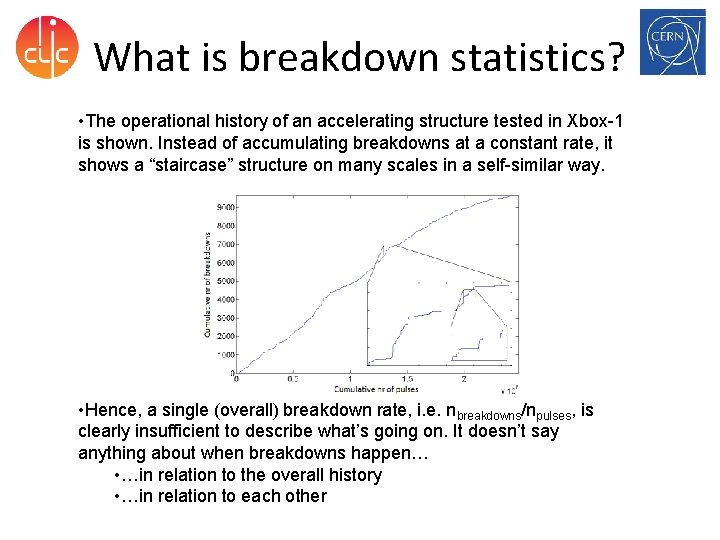
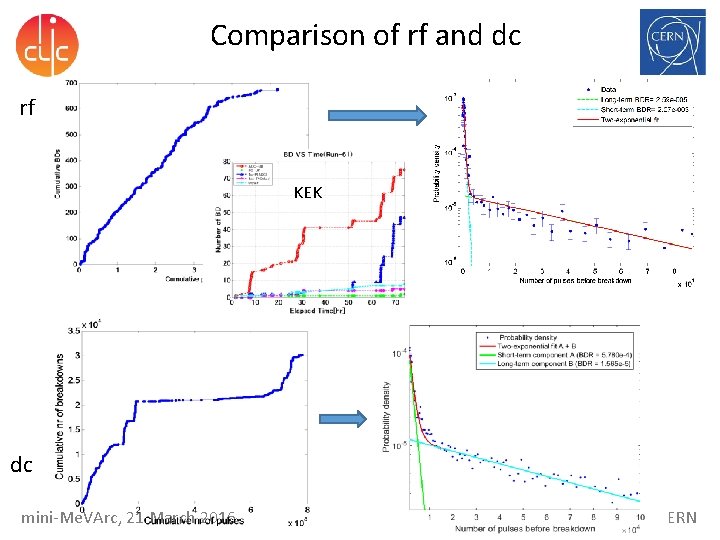
What is breakdown statistics? • The operational history of an accelerating structure tested in Xbox-1 is shown. Instead of accumulating breakdowns at a constant rate, it shows a “staircase” structure on many scales in a self-similar way. • Hence, a single (overall) breakdown rate, i. e. nbreakdowns/npulses, is clearly insufficient to describe what’s going on. It doesn’t say anything about when breakdowns happen… • …in relation to the overall history • …in relation to each other
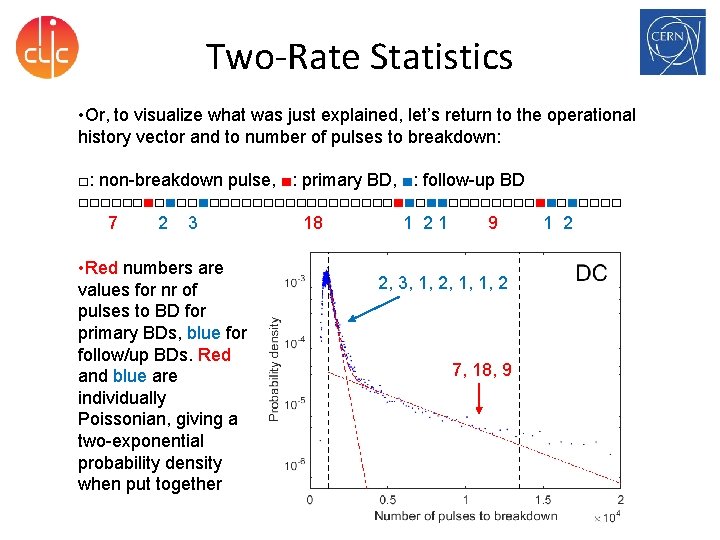
Two-Rate Statistics • Or, to visualize what was just explained, let’s return to the operational history vector and to number of pulses to breakdown: □: non-breakdown pulse, ■: primary BD, ■: follow-up BD □□□□□□■□■□□■□□□□□□□□□■■□■■□□□□■■□■□□□□ 7 2 3 18 1 21 9 1 2 • Red numbers are values for nr of pulses to BD for primary BDs, blue for follow/up BDs. Red and blue are individually Poissonian, giving a two-exponential probability density when put together 2, 3, 1, 2, 1, 1, 2 7, 18, 9
Comparison of rf and dc rf KEK dc mini-Me. VArc, 21 March 2016 Walter Wuensch, CERN
Breakdown positioning in CLIC prototype RF accelerating structures CLIC workshop 2016 R. Rajamäki*, W. Farabolini, J. Giner Navarro, T. Argyropoulos, B. Woolley, W. Wuensch 19. 01. 2016 *Aalto university / CERN
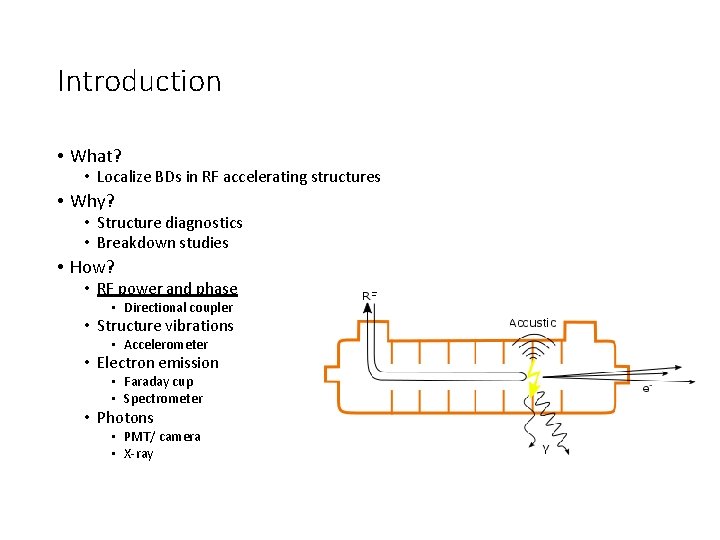
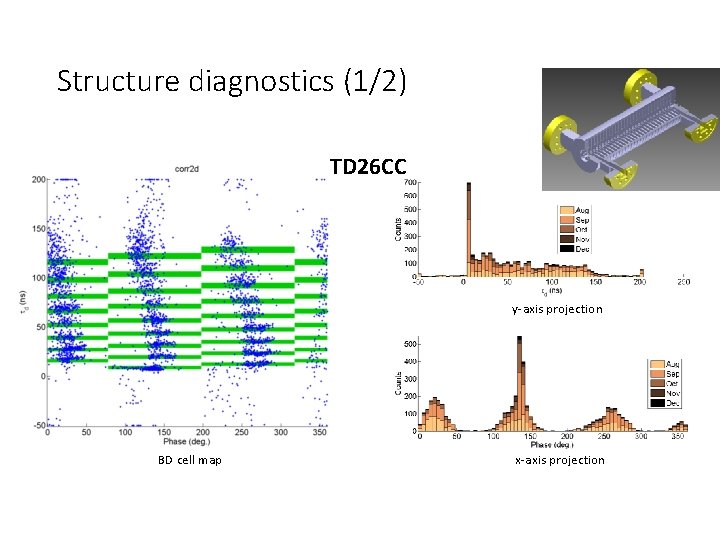
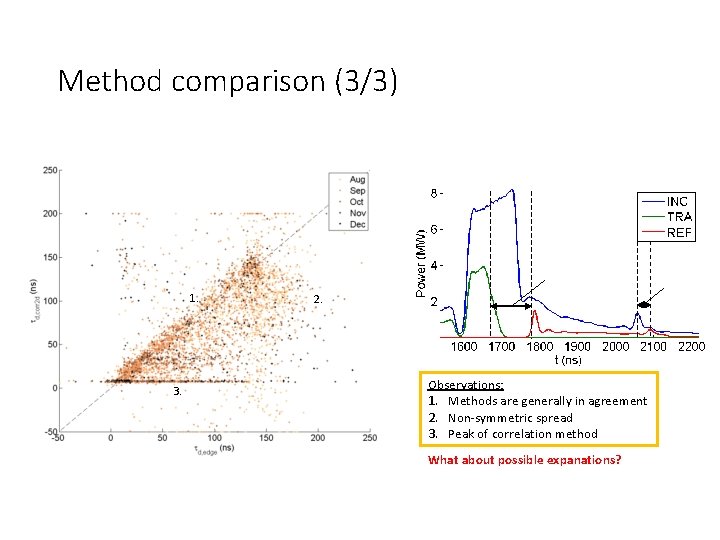
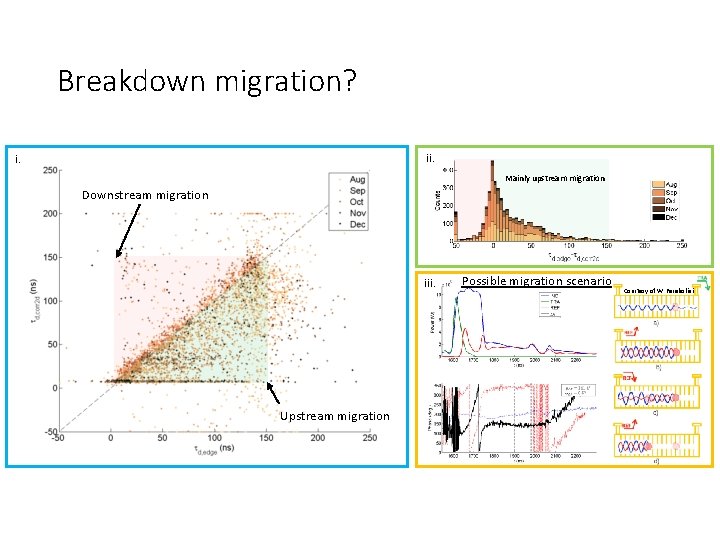
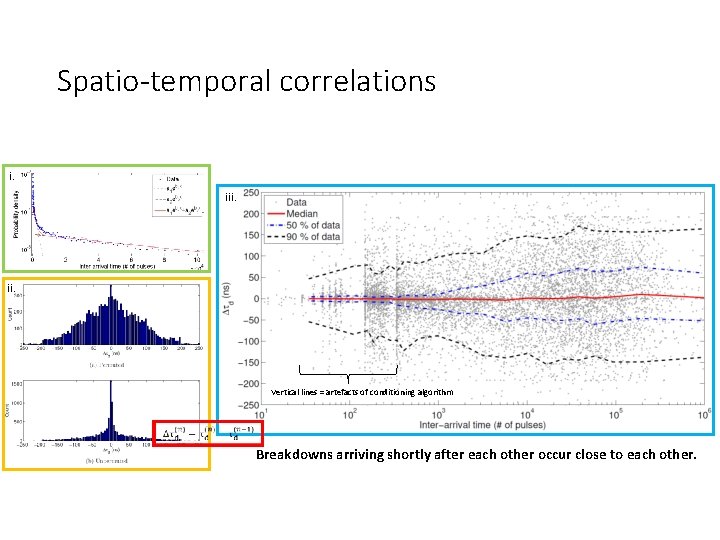
Introduction • What? • Localize BDs in RF accelerating structures • Why? • Structure diagnostics • Breakdown studies • How? • RF power and phase • Directional coupler • Structure vibrations • Accelerometer • Electron emission • Faraday cup • Spectrometer • Photons • PMT/ camera • X-ray
Structure diagnostics (1/2) TD 26 CC y-axis projection BD cell map x-axis projection
Method comparison (3/3) 1. 3. 2. Observations: 1. Methods are generally in agreement 2. Non-symmetric spread 3. Peak of correlation method What about possible expanations?
Breakdown migration? ii. Mainly upstream migration Downstream migration iii. Upstream migration Possible migration scenario Courtesy of W. Farabolini
Spatio-temporal correlations i. iii. Vertical lines = artefacts of conditioning algorithm Breakdowns arriving shortly after each other occur close to each other.
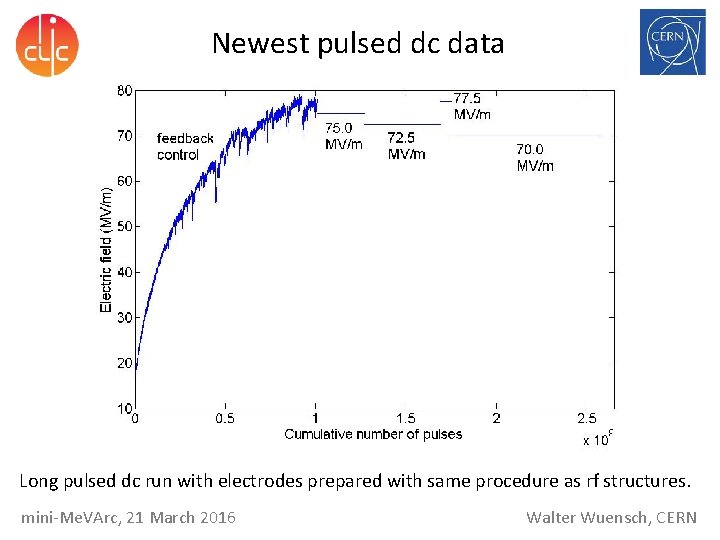
Newest pulsed dc data Long pulsed dc run with electrodes prepared with same procedure as rf structures. mini-Me. VArc, 21 March 2016 Walter Wuensch, CERN
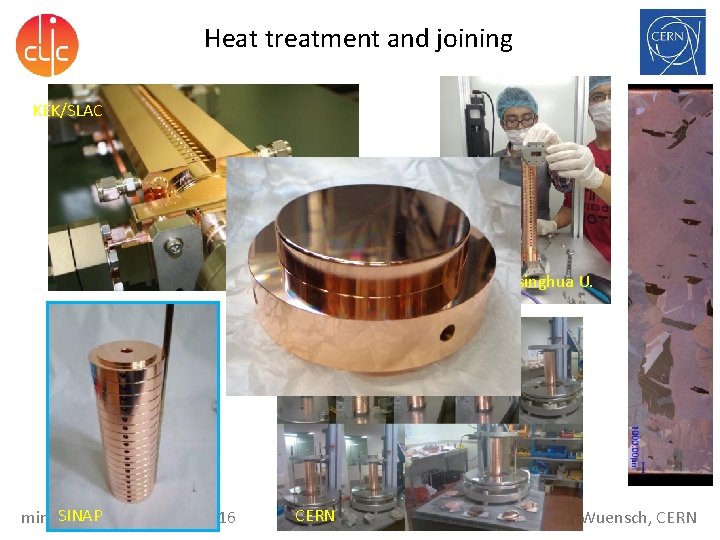
Heat treatment and joining KEK/SLAC Tsinghua U. SINAP mini-Me. VArc, 21 March 2016 CERN Walter Wuensch, CERN
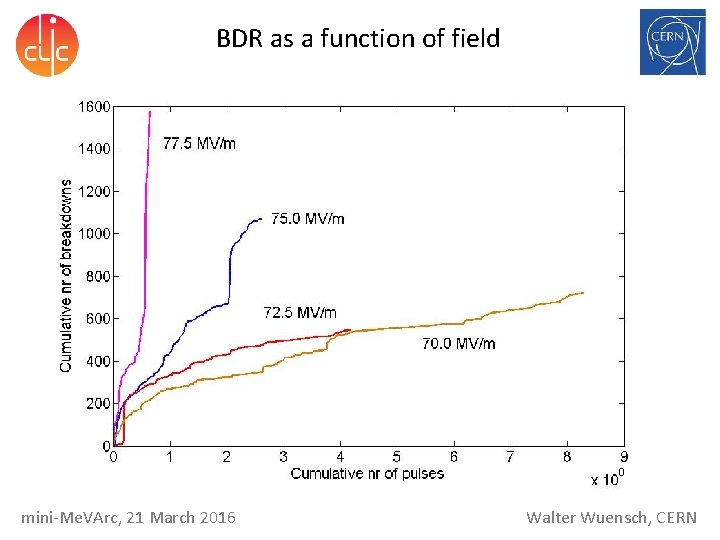
BDR as a function of field mini-Me. VArc, 21 March 2016 Walter Wuensch, CERN
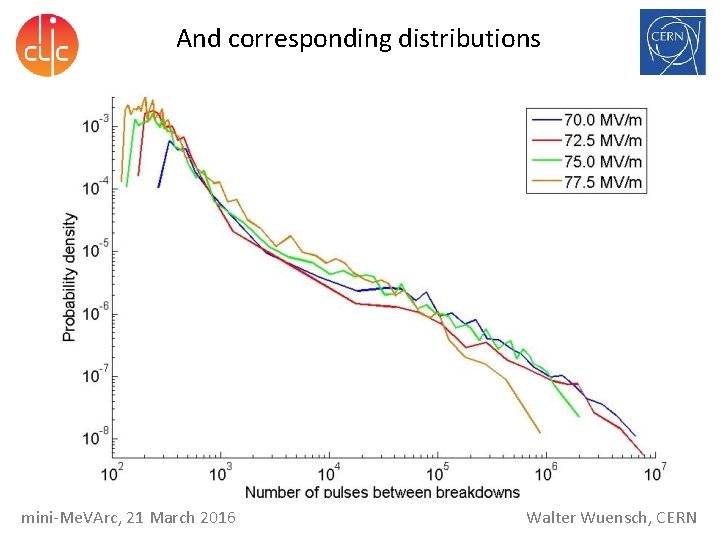
And corresponding distributions mini-Me. VArc, 21 March 2016 Walter Wuensch, CERN
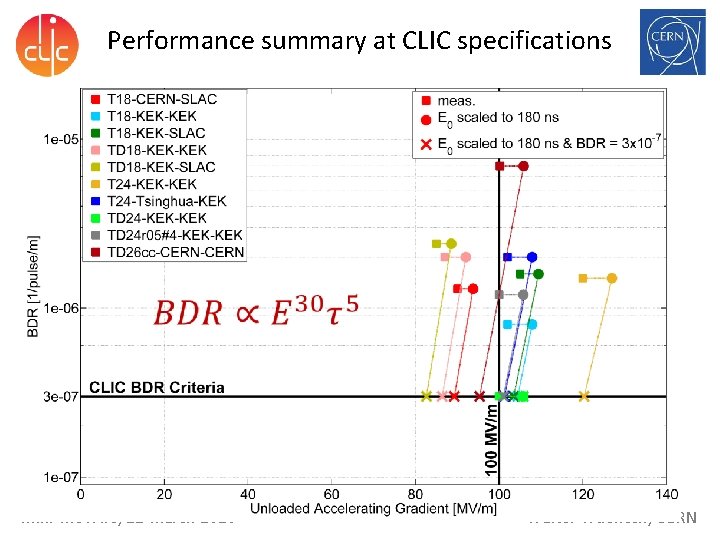
Performance summary at CLIC specifications mini-Me. VArc, 21 March 2016 Walter Wuensch, CERN
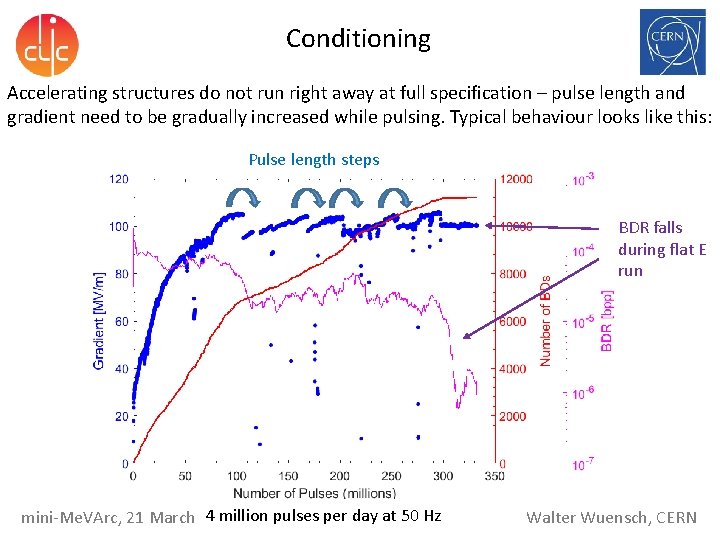
Conditioning Accelerating structures do not run right away at full specification – pulse length and gradient need to be gradually increased while pulsing. Typical behaviour looks like this: Pulse length steps BDR falls during flat E run 4 million pulses per day at 50 Hz mini-Me. VArc, 21 March 2016 Walter Wuensch, CERN
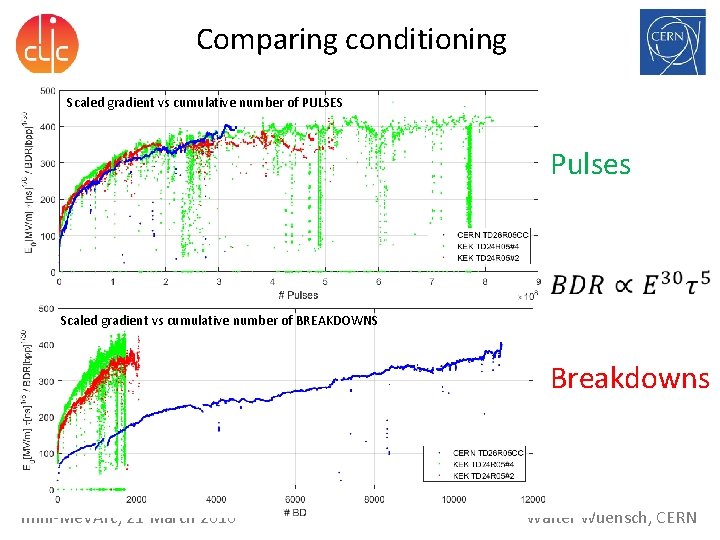
Comparing conditioning Scaled gradient vs cumulative number of PULSES Pulses Scaled gradient vs cumulative number of BREAKDOWNS Breakdowns mini-Me. VArc, 21 March 2016 Walter Wuensch, CERN
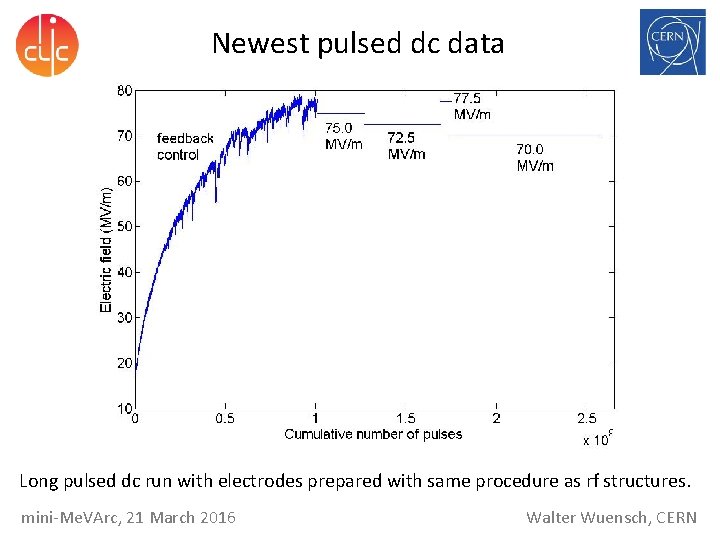
Newest pulsed dc data Long pulsed dc run with electrodes prepared with same procedure as rf structures. mini-Me. VArc, 21 March 2016 Walter Wuensch, CERN
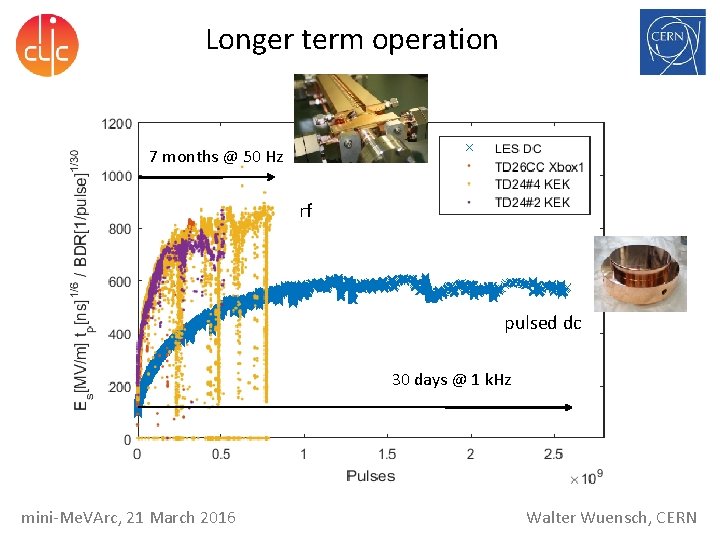
Longer term operation 7 months @ 50 Hz rf pulsed dc 30 days @ 1 k. Hz mini-Me. VArc, 21 March 2016 Walter Wuensch, CERN
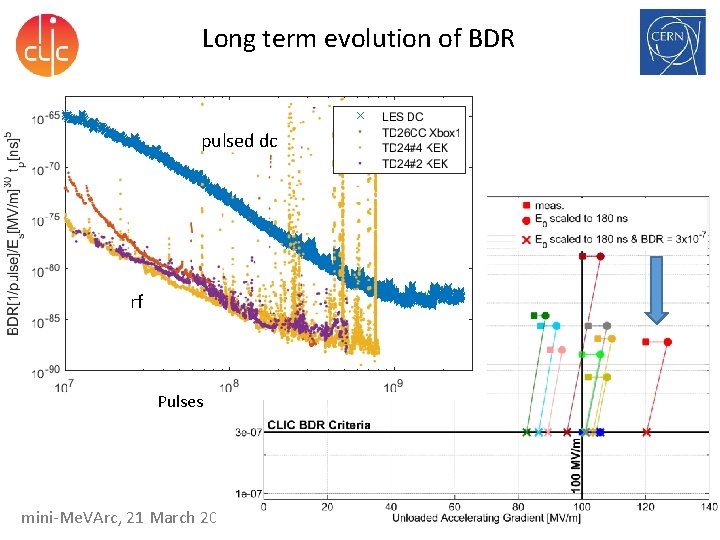
Long term evolution of BDR pulsed dc rf Pulses mini-Me. VArc, 21 March 2016 Walter Wuensch, CERN
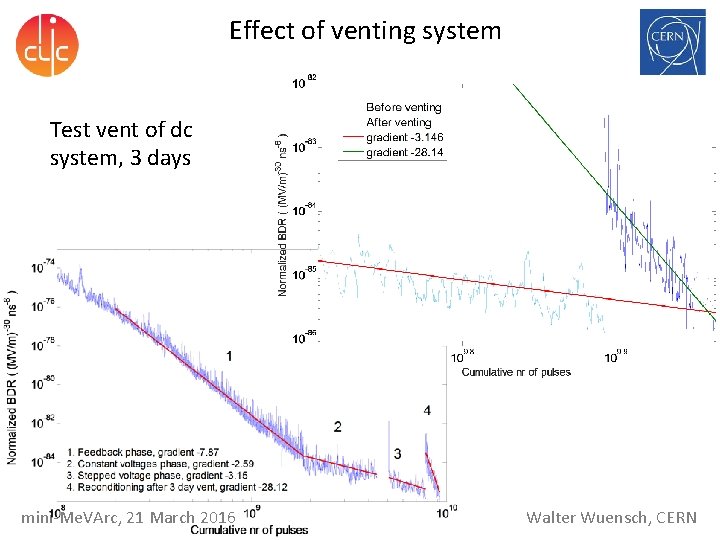
Effect of venting system Test vent of dc system, 3 days mini-Me. VArc, 21 March 2016 Walter Wuensch, CERN
Dynamic Vacuum Meter is at CERN Antti Meriläinen 1, 2, Robin Rajamäki 3, Ivan Kassamakov 1, 2, Walter Wuensch 3, Kenneth Österberg 1, 2 and Edward Hæggström 1 1) Department of Physics, University of Helsinki 2) Helsinki Institute of Physics 3) CERN www. helsinki. fi/yliopisto 19. 1. 2016
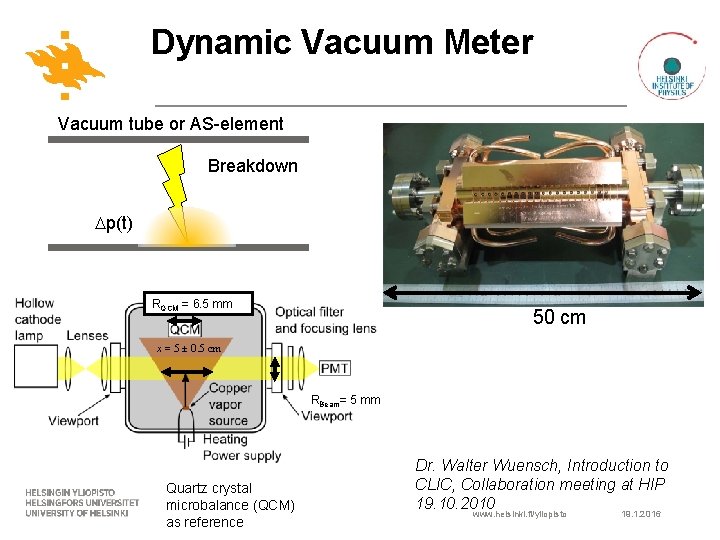
Dynamic Vacuum Meter Vacuum tube or AS-element Breakdown p(t) RQCM = 6. 5 mm 50 cm x = 5 ± 0. 5 cm RBeam= 5 mm Quartz crystal microbalance (QCM) as reference Dr. Walter Wuensch, Introduction to CLIC, Collaboration meeting at HIP 19. 10. 2010 www. helsinki. fi/yliopisto 19. 1. 2016
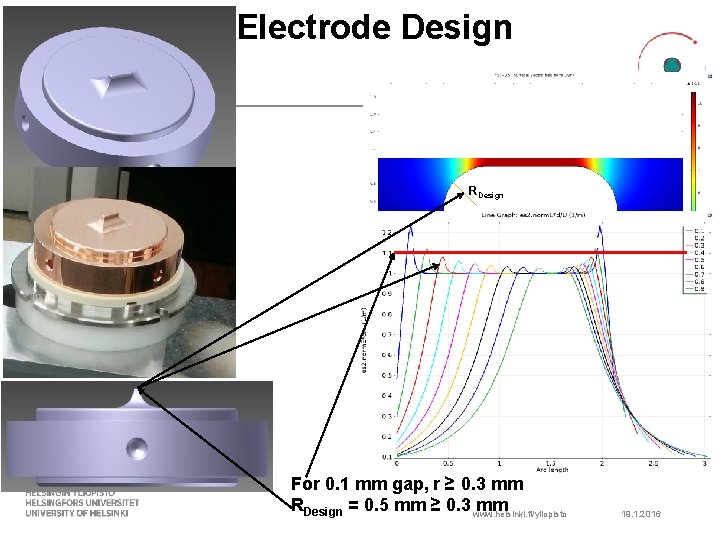
Electrode Design RDesign For 0. 1 mm gap, r ≥ 0. 3 mm RDesign = 0. 5 mm ≥ 0. 3 www. helsinki. fi/yliopisto mm 19. 1. 2016
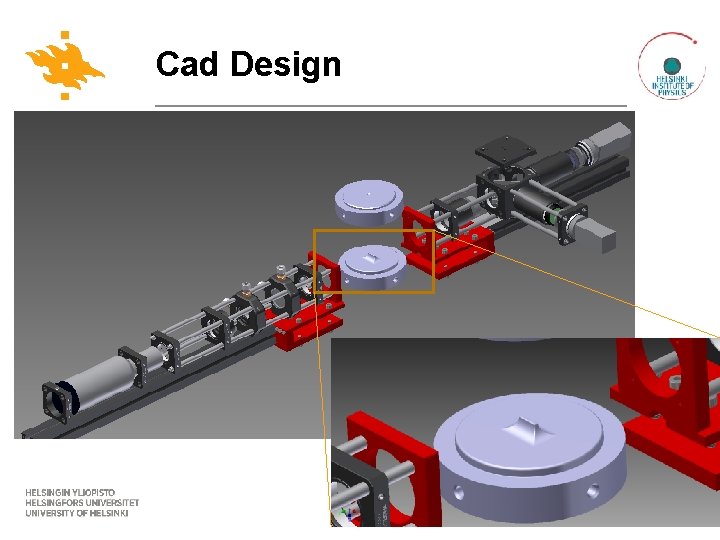
Cad Design www. helsinki. fi/yliopisto 19. 1. 2016
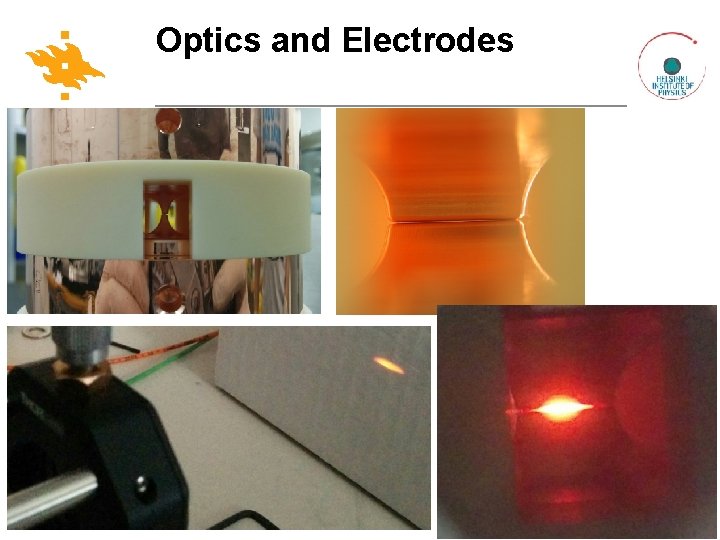
Optics and Electrodes www. helsinki. fi/yliopisto 19. 1. 2016
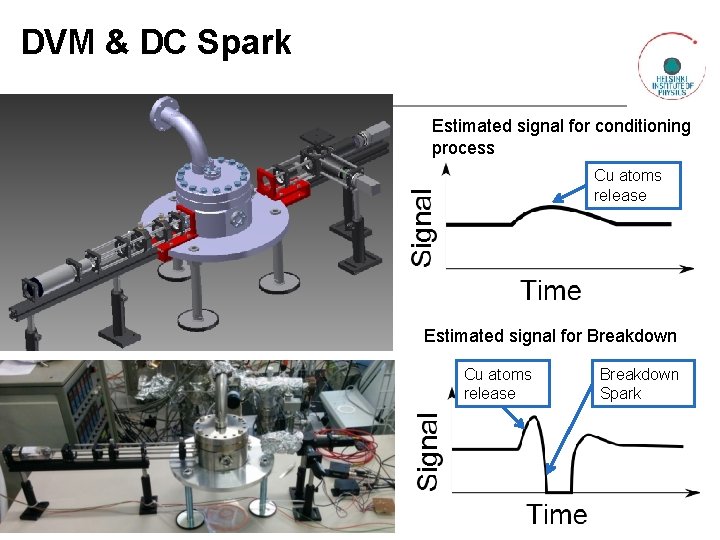
DVM & DC Spark Estimated signal for conditioning process Cu atoms release Estimated signal for Breakdown Cu atoms release www. helsinki. fi/yliopisto Breakdown Spark 19. 1. 2016
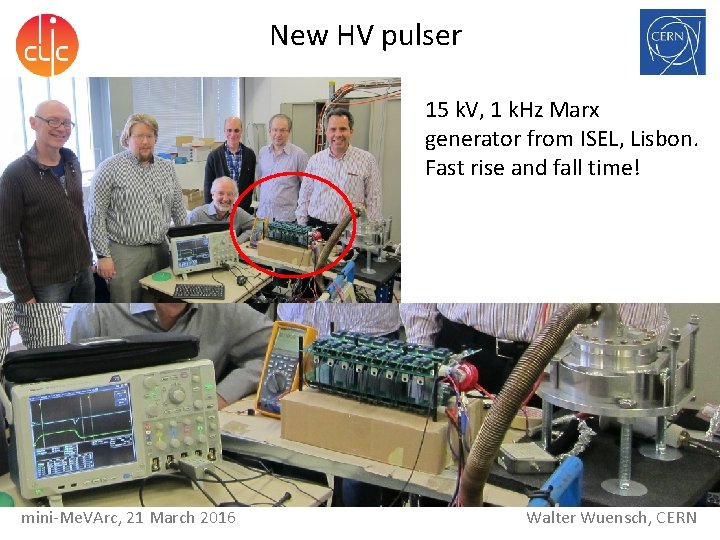
New HV pulser 15 k. V, 1 k. Hz Marx generator from ISEL, Lisbon. Fast rise and fall time! mini-Me. VArc, 21 March 2016 Walter Wuensch, CERN
Electrode pipeline Running • Hard copper, with acoustic sensors - running Available • Cu, Cu. Ag, stainless steel - SLAC • Nb • 3 -D printed Ti • Small ridge for optical access • About 10 pairs of diamond machined Cu • Ceramic spacers Under preparation • Voids - Helsinki • Diamond like coating - PSI mini-Me. VArc, 21 March 2016 Walter Wuensch, CERN

Nb electrode made in central workshop. We propose to build this cool -able to cryogenic temperatures. mini-Me. VArc, 21 March 2016 Walter Wuensch, CERN
- Slides: 32