
Statistics Interpreting Graphs Scattergraphs Codes Stem and Leaf
- Slides: 28
Statistics Interpreting Graphs. Scattergraphs & Codes Stem and Leaf Diagram Drawing Graphs Mean, Median, Mode and Range of a Data Set Line of best fit Constructing Frequency Tables (Tally Tables) Range Mode & Median from Frequency Table Mean from a Frequency Table
Interpreting Graphs Learning Intention 1. To explain how to interpret various graphs. Success Criteria 1. Understand key information on various graphs. 2. Solve problems involving graphs.
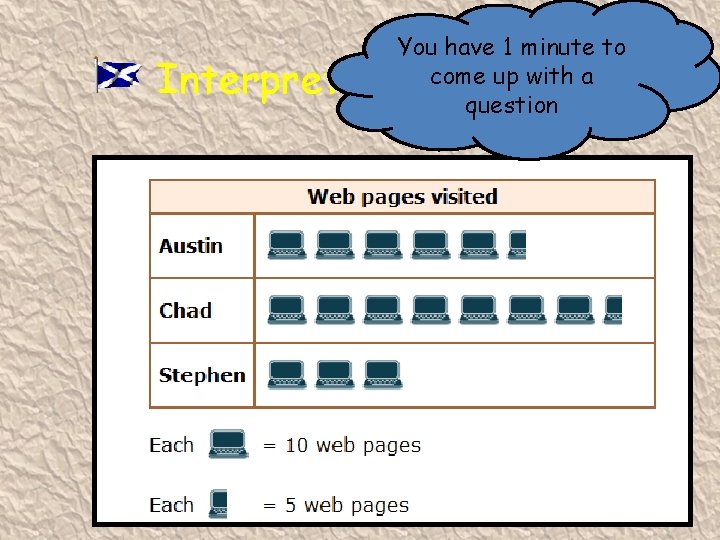
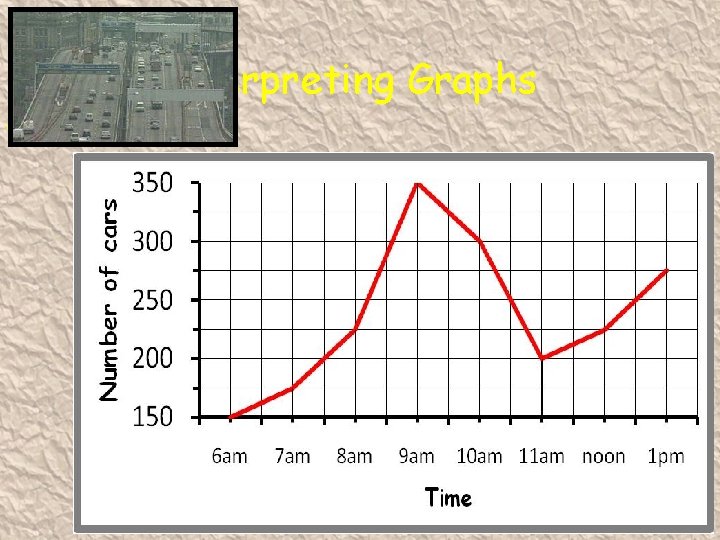
You have 1 minute to What does come up with a 1 computer represent question Interpreting Graphs
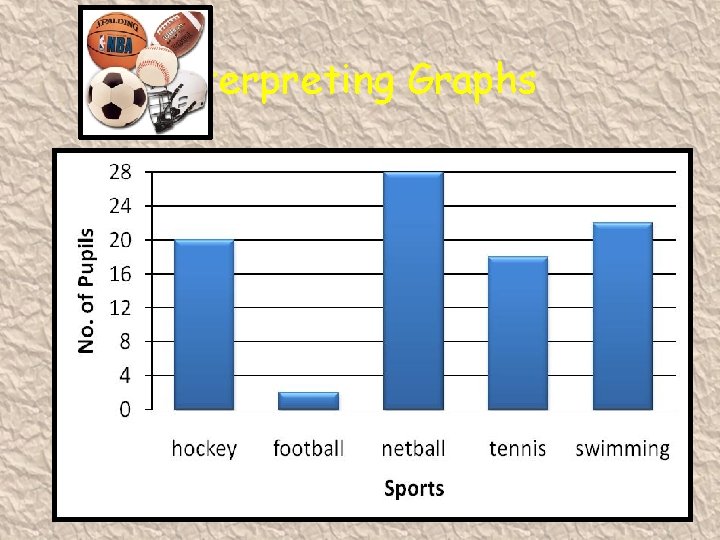
Interpreting Graphs
Interpreting Graphs General Created by Mr. Lafferty Maths Dept
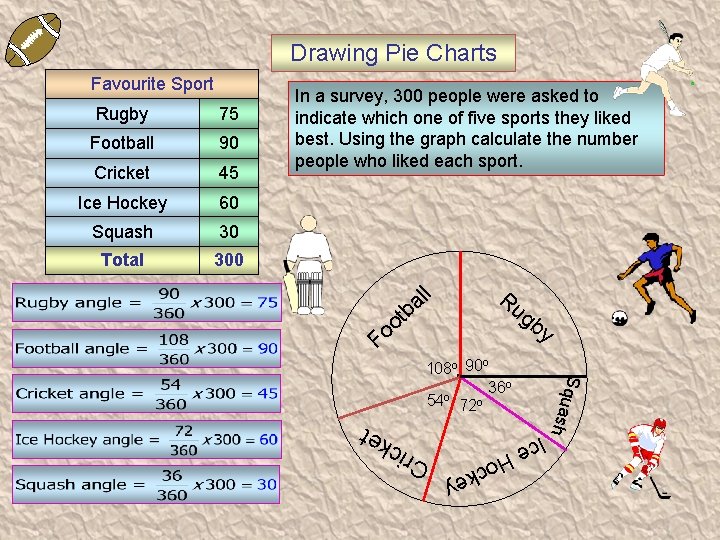
Drawing Pie Charts Cricket 45 Ice Hockey 60 Squash 30 Total 300 l l a b t o o Ru gb F y S q u ash o 108 o 90 36 o 54 o 72 o ey C r 90 ck Ho Football t 75 i c k e Rugby In a survey, 300 people were asked to indicate which one of five sports they liked best. Using the graph calculate the number people who liked each sport. Ice Favourite Sport
Constructing Graphs Learning Intention 1. To construct various graphs accurately. Success Criteria 1. Understand how to construct various graphs from given information.
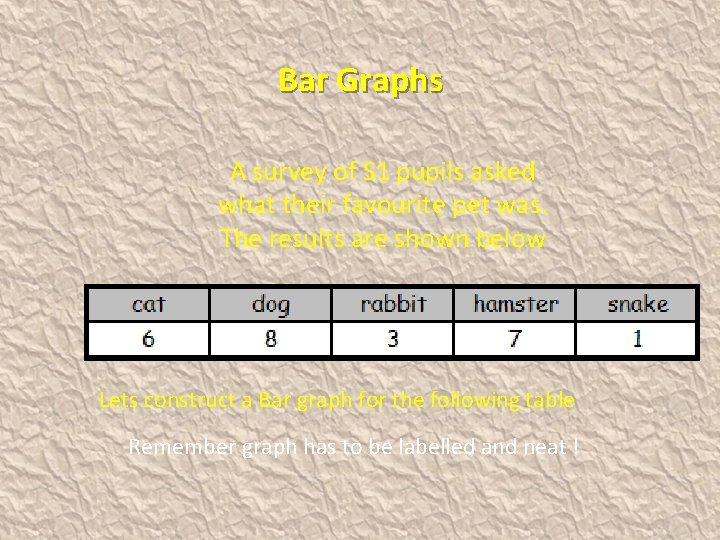
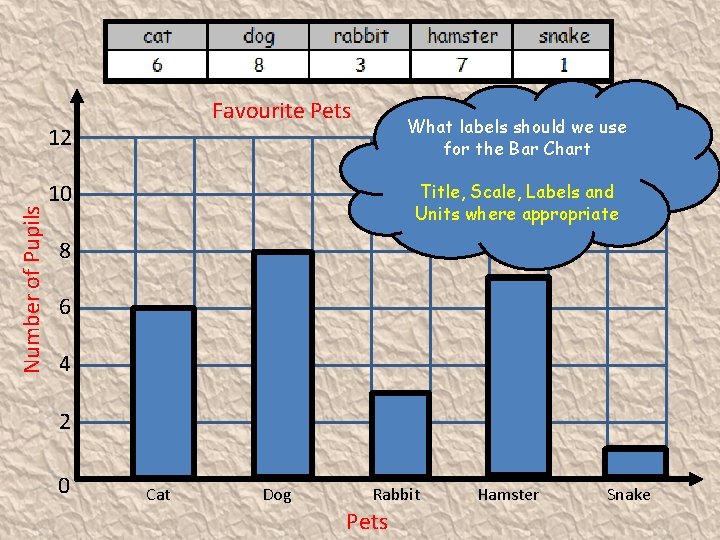
Bar Graphs A survey of S 1 pupils asked what their favourite pet was. The results are shown below Lets construct a Bar graph for the following table Remember graph has to be labelled and neat !
Favourite Pets Number of Pupils 12 What labels should we use for the Bar Chart 10 Title, Scale, Labels and Units where appropriate 8 6 4 2 0 Cat Dog Rabbit Pets Hamster Snake
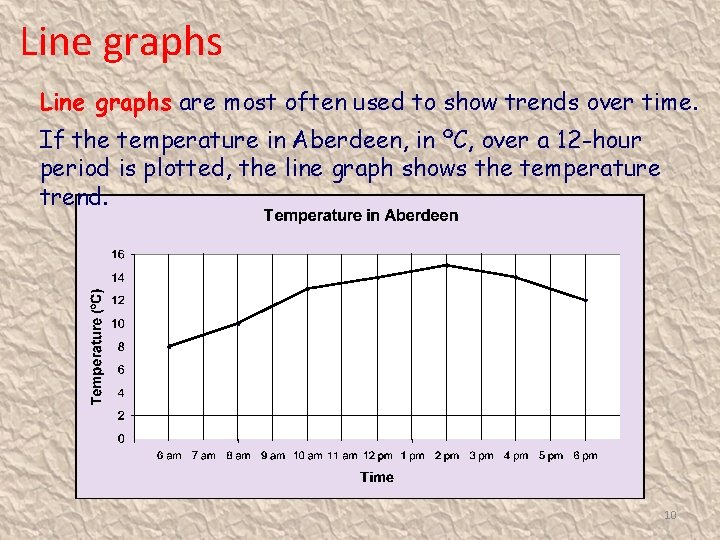
Line graphs are most often used to show trends over time. If the temperature in Aberdeen, in ºC, over a 12 -hour period is plotted, the line graph shows the temperature trend. 10
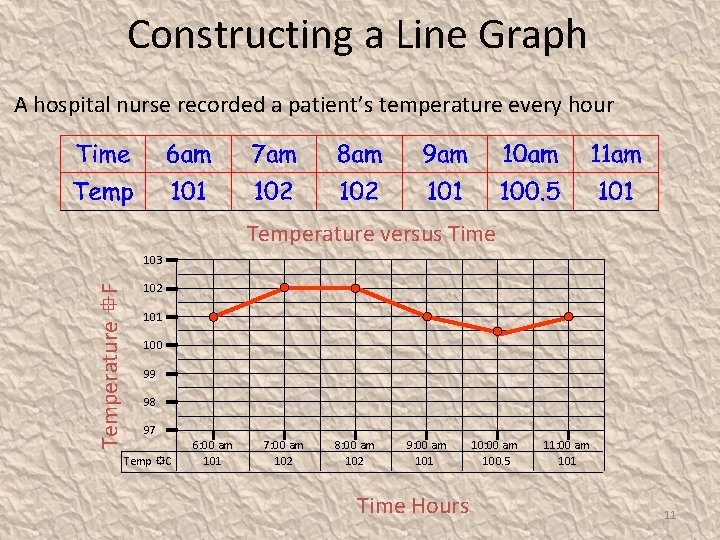
Constructing a Line Graph A hospital nurse recorded a patient’s temperature every hour Temperature versus Time Temperature F 103 102 101 100 99 98 97 Temp C 6: 00 am 101 7: 00 am 102 8: 00 am 102 9: 00 am 101 Time Hours 10: 00 am 100. 5 11: 00 am 101 11
Different Averages Learning Intention 1. To define the terms Mean Median, Mode and Range for a set of data. Success Criteria 1. Know the terms Mean, Median, Mode and Range. 2. Work out values of Mean, Median, Mode and Range.
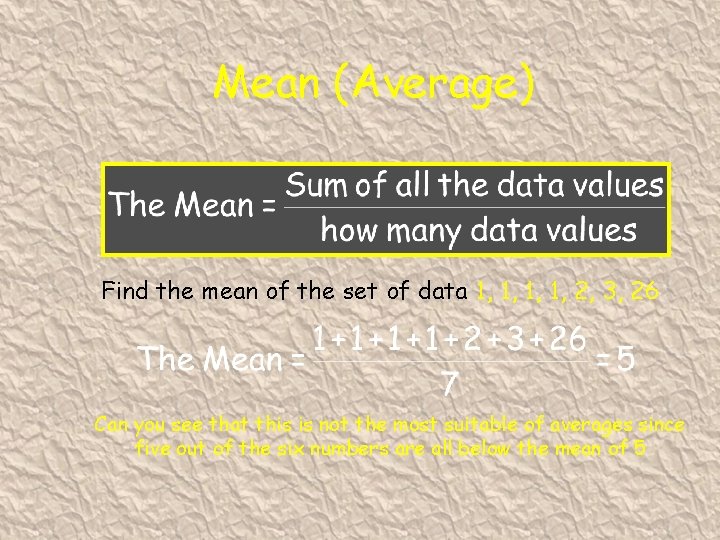
Mean (Average) Find the mean of the set of data 1, 1, 2, 3, 26 Can you see that this is not the most suitable of averages since five out of the six numbers are all below the mean of 5
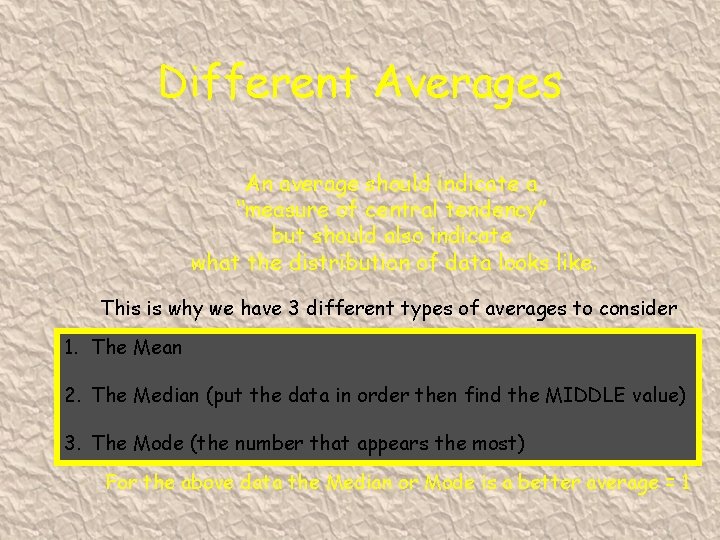
Different Averages An average should indicate a “measure of central tendency” but should also indicate what the distribution of data looks like. This is why we have 3 different types of averages to consider 1. The Mean 2. The Median (put the data in order then find the MIDDLE value) 3. The Mode (the number that appears the most) For the above data the Median or Mode is a better average = 1
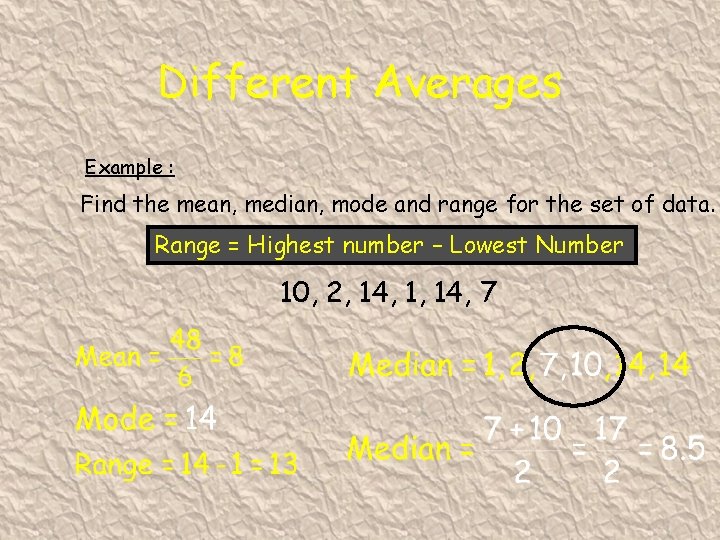
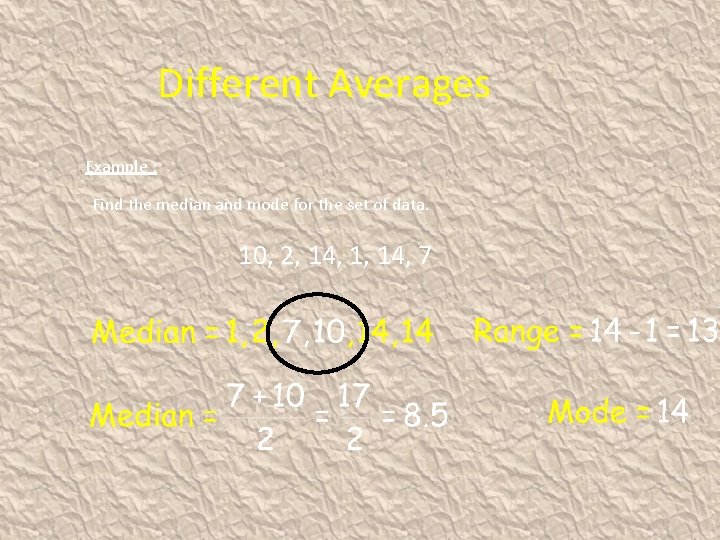
Different Averages Example : Find the mean, median, mode and range for the set of data. Range = Highest number – Lowest Number 10, 2, 14, 1, 14, 7
Aims of the Lesson 1. Understand the term Frequency Table. 2. Construct a Frequency Table. 3. Interpret information from Frequency Tables. 16
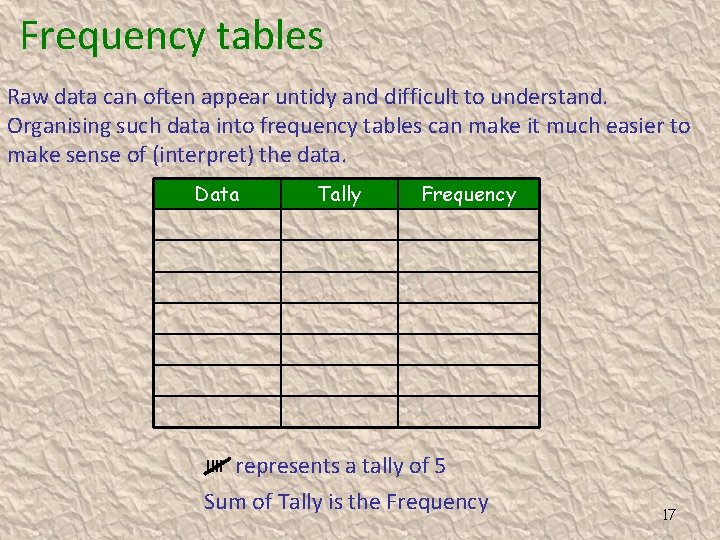
Frequency tables Raw data can often appear untidy and difficult to understand. Organising such data into frequency tables can make it much easier to make sense of (interpret) the data. Data Tally Frequency represents a tally of 5 Sum of Tally is the Frequency llll 17
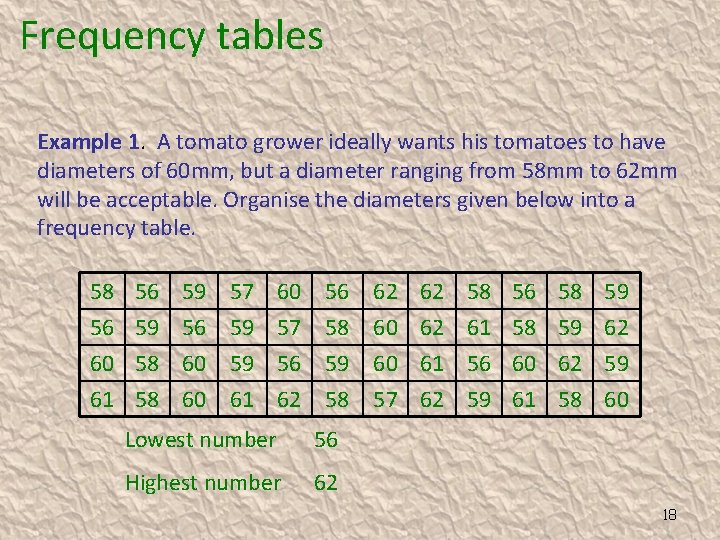
Frequency tables Example 1. A tomato grower ideally wants his tomatoes to have diameters of 60 mm, but a diameter ranging from 58 mm to 62 mm will be acceptable. Organise the diameters given below into a frequency table. 58 56 60 61 56 59 58 58 59 56 60 60 57 59 59 61 60 57 56 62 56 58 59 58 Lowest number 56 Highest number 62 62 60 60 57 62 62 61 62 58 61 56 59 56 58 60 61 58 59 62 59 60 18
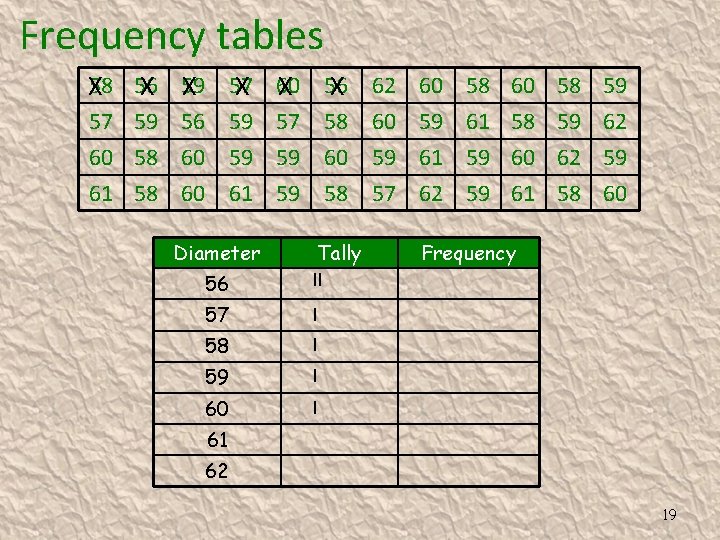
Frequency tables X 58 56 X 57 X 60 X 56 X 62 60 58 59 X 59 57 59 56 59 57 58 60 59 61 58 59 62 60 58 60 59 59 60 59 61 59 60 62 59 61 58 60 61 59 58 57 62 59 61 58 60 Diameter Tally 56 ll 57 l 58 l 59 l 60 l Frequency 61 62 19
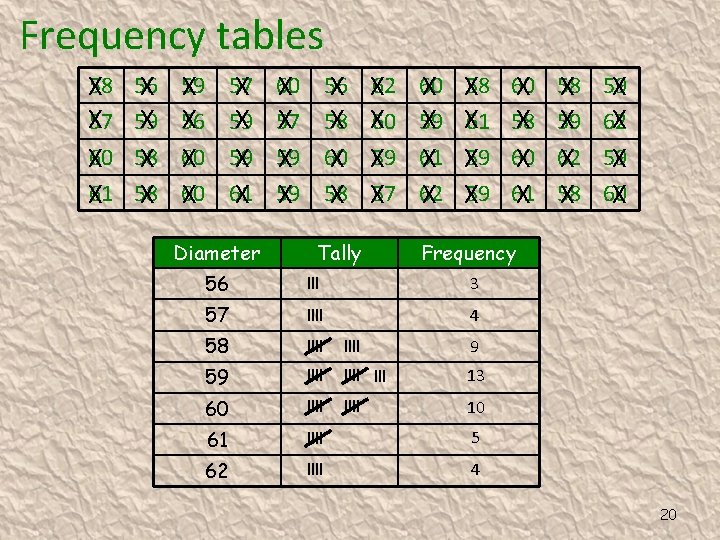
Frequency tables X 58 X 57 X 60 X 61 56 X X 59 58 X 59 X X 56 60 X 57 X X 59 59 X 61 X Diameter 60 X X 57 59 X 56 X X 58 60 X 58 X X 62 X 60 X 59 X 57 Tally 60 X X 59 61 X 62 X X 58 X 61 X 59 60 X X 58 60 X 61 X 58 X X 59 62 X 58 X 59 X X 62 59 X 60 X Frequency 56 lll 3 57 llll 4 58 llll 9 59 llll lll 13 60 llll 10 61 llll 5 62 llll 4 20
Frequency Tables Range, Mode & Median Learning Intention 1. To explain how to work out the range , mode & median from a frequency table. Success Criteria 1. Understand how to work out the range, mode and median from a frequency table. 2. Solve problems using a frequency Table.
Frequency Tables Range, Mode & Median Reminder ! Range : The difference between highest and Lowest values. It is a measure of spread. Median : The middle value of a set of data. When they are two middle values the median is half way between them. Mode : The value that occurs the most in a set of data. Can be more than one value.
Different Averages Example : Find the median and mode for the set of data. 10, 2, 14, 1, 14, 7
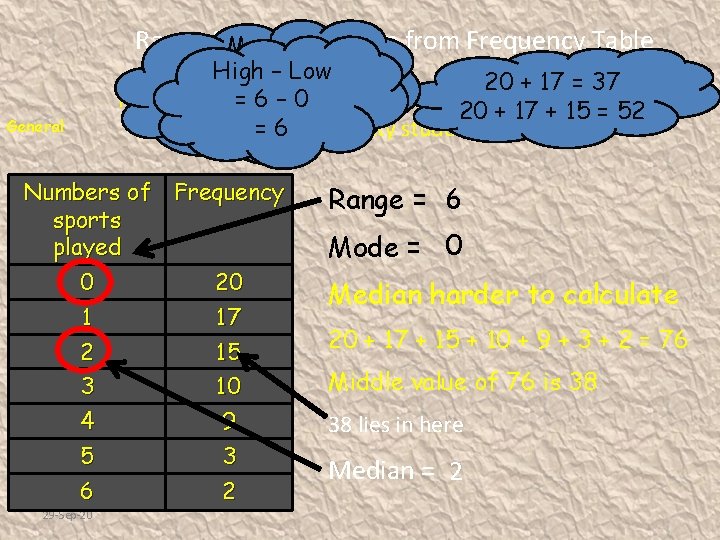
Range Mode& Median from Frequency Table Highthat – Low value 20 + 17 = 37 Here occurs are the=results out= 52 6 – most 0 of a sports survey the 20 carried + 17 + 15 among = =06 university students. General Numbers of Frequency sports played 0 20 1 17 2 3 15 10 4 5 9 3 6 2 29 -Sep-20 Range = 6 Mode = 0 Median harder to calculate 20 + 17 + 15 + 10 + 9 + 3 + 2 = 76 Middle value of 76 is 38 38 lies in here Median = 2
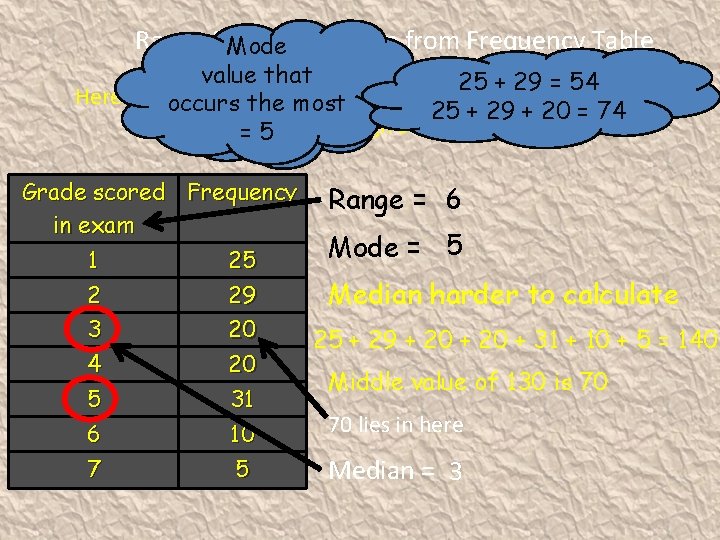
Range Mode& Median from Frequency Table Highthat – Low value 25 + 29 = 54 Here are the results of a S 3 maths exam survey carried out 7 – most 1 occurs=the 25 + 29 + 20 = 74 among St. High School students. 6 = =5 Ninian’s Grade scored Frequency in exam 1 25 2 29 3 4 20 20 5 6 31 10 7 5 Range = 6 Mode = 5 Median harder to calculate 25 + 29 + 20 + 31 + 10 + 5 = 140 Middle value of 130 is 70 70 lies in here Median = 3
Frequency Tables Working Out the Mean Learning Intention 1. To explain how to work out the mean by adding in a third column to a Frequency Table. 29 -Sep-20 Success Criteria 1. Add a third column to a frequency table. 2. Work out the mean from a frequency Table. Created by Mr. Lafferty Maths Dept.
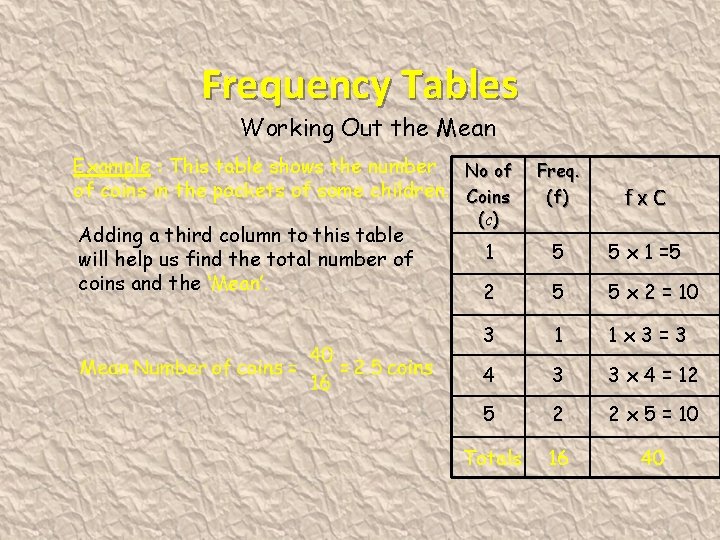
Frequency Tables Working Out the Mean Example : This table shows the number No of of coins in the pockets of some children. Coins Adding a third column to this table will help us find the total number of coins and the ‘Mean’. Freq. (f) fx. C 1 5 5 x 1 =5 2 5 5 x 2 = 10 3 1 1 x 3=3 4 3 3 x 4 = 12 5 2 2 x 5 = 10 Totals 16 40 (c )
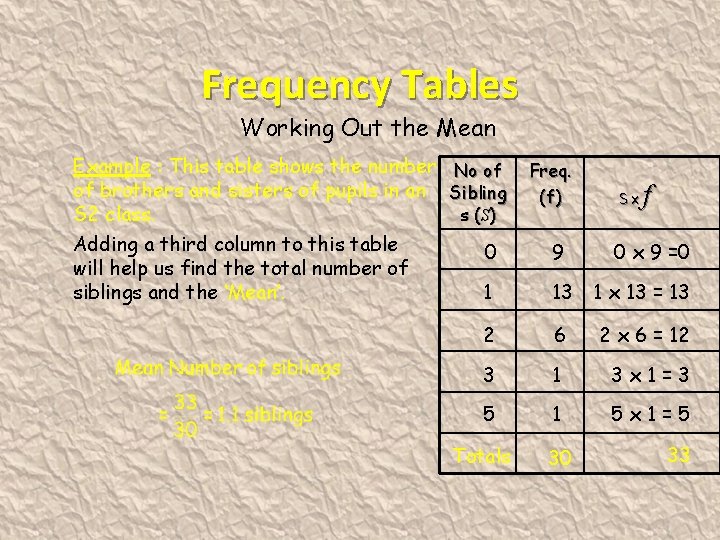
Frequency Tables Working Out the Mean Example : This table shows the number No of of brothers and sisters of pupils in an Sibling s (S) S 2 class. Adding a third column to this table 0 will help us find the total number of siblings and the ‘Mean’. 1 Freq. (f) 9 Sxf 0 x 9 =0 13 1 x 13 = 13 2 6 2 x 6 = 12 3 1 3 x 1=3 5 1 5 x 1=5 Totals 30 33