
Statistics for the Behavioral Sciences Multiple Regression Introduction
Statistics for the Behavioral Sciences Multiple Regression Introduction to Mediation HDFS 7060 - Bubb, R. 1
Mediation Models A mediator accounts for (explains) the relationship between a predictor and outcome - Signified as a cause and effect sequence - Predictor determines the mediator which in turn determines the outcome - Best used with longitudinal-type data HDFS 7060 - Bubb, R.

Mediation Models 4 steps to establish mediation: 1. Predictor should be correlated with outcome 2. Predictor should be correlated with mediator 3. Mediator should be correlated with the outcome when controlling for the predictor 4. Predictor should not be correlated with the outcome when the mediator is controlled - Mediator explains the X-Y relationship HDFS 7060 - Bubb, R.
Mediation Models A mediator accounts for (explains) the relationship between a predictor and outcome - Therefore, a mediator will eliminate the relationship between predictor and outcome - If X-Y relationship significantly reduces to “ 0”, then full mediation - If X-Y relationship is significantly reduced but not to “ 0”, then partial mediation - If X-Y relationship reduces to “ 0”, but the reduction is not significant then no mediation - If X-Y relationship does not reduce to “ 0” and the reduction is not significant then no mediation - d HDFS 7060 - Bubb, R.
Mediation Models RQ: Does heart rate mediate the relationship between those w/wo Down syndrome and recommendation for a grocery store bagger position? - The relationship between applicant characteristics and recommendation is explained by raters physiology HDFS 7060 - Bubb, R.
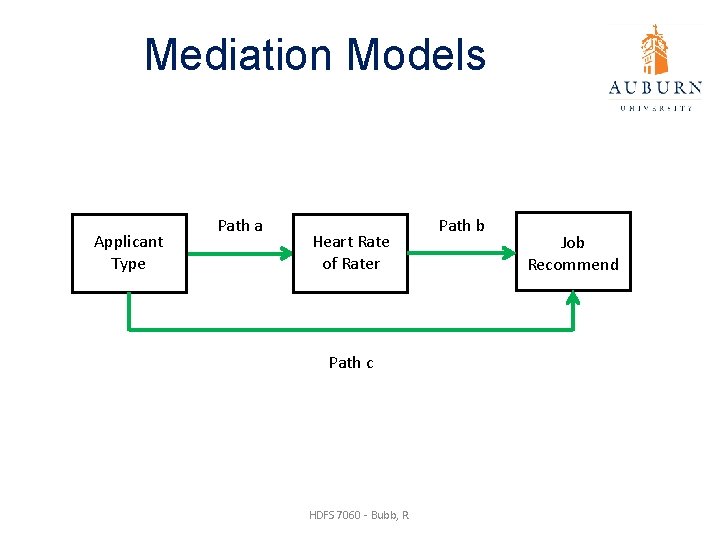
Mediation Models Applicant Type Path a Heart Rate of Rater Path c HDFS 7060 - Bubb, R. Path b Job Recommend
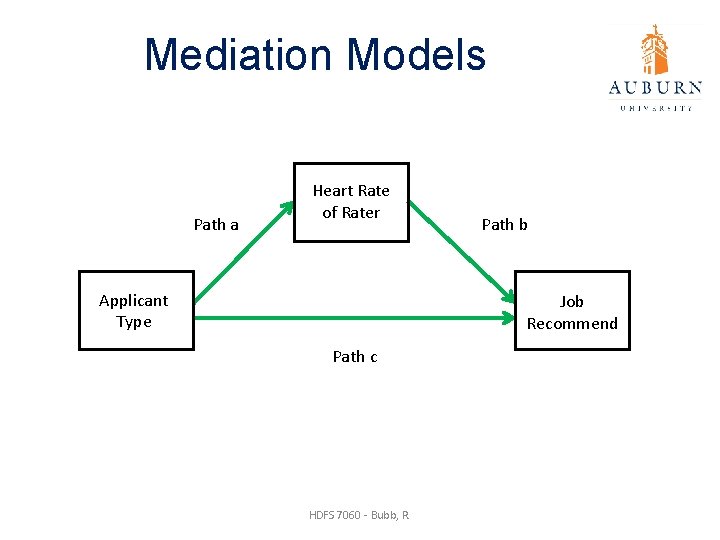
Mediation Models Path a Heart Rate of Rater Applicant Type Path b Job Recommend Path c HDFS 7060 - Bubb, R.
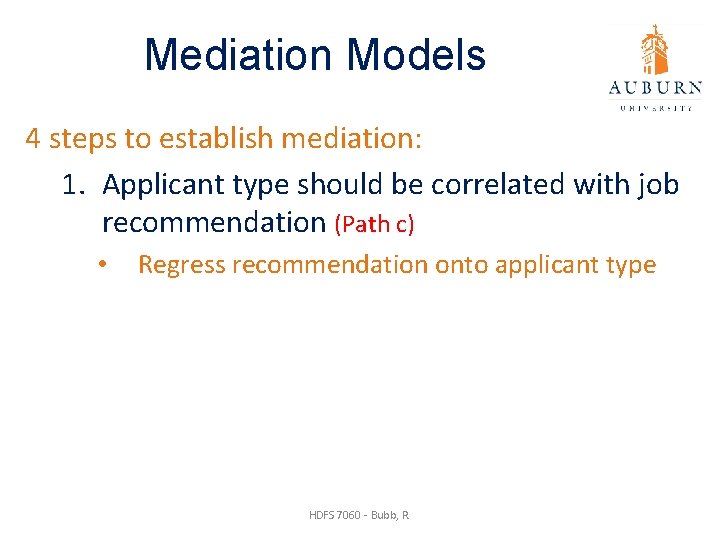
Mediation Models 4 steps to establish mediation: 1. Applicant type should be correlated with job recommendation (Path c) • Regress recommendation onto applicant type HDFS 7060 - Bubb, R.
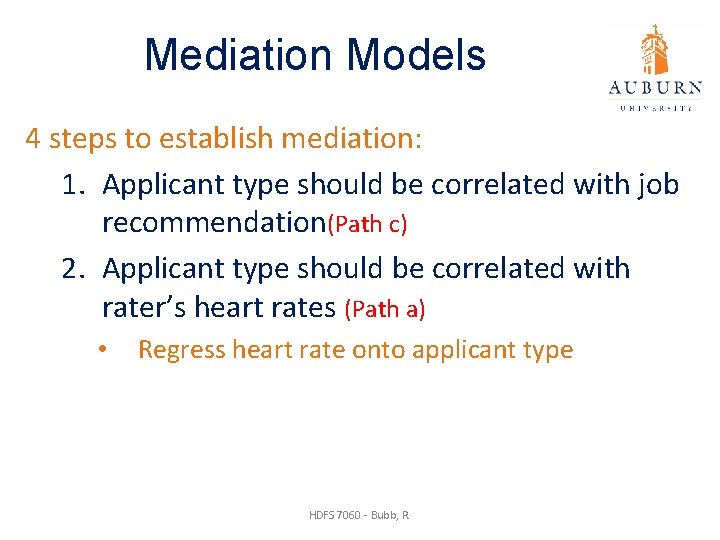
Mediation Models 4 steps to establish mediation: 1. Applicant type should be correlated with job recommendation(Path c) 2. Applicant type should be correlated with rater’s heart rates (Path a) • Regress heart rate onto applicant type HDFS 7060 - Bubb, R.
Mediation Models 4 steps to establish mediation: 1. Applicant type should be correlated with job recommendation (Path c) 2. Applicant type should be correlated with rater’s heart rate (Path a) 3. Heart rate should be correlated with job recommendation when accounting for applicant type (Path b) • Regress recommendation onto both heart rate and applicant type HDFS 7060 - Bubb, R.
Mediation Models 4 steps to establish mediation: 1. Applicant type should be correlated with job recommendation (Path c) 2. Applicant type should be correlated with rater’s heart rate (Path a) 3. Heart rate should be correlated with job recommend when accounting for applicant type (Path b) 4. Applicant type should not be correlated with job recommendation when heart rate is controlled (Path c) • Regress recommendation onto both heart rate and applicant type (same as step 3) HDFS 7060 - Bubb, R.
Mediation Models Use the Sobel test to test the reduction • Sobel’s test should be used to determine significance of the indirect effect • Especially helpful for partial mediation • Compare Sobel test statistic to a t-critical value HDFS 7060 - Bubb, R.
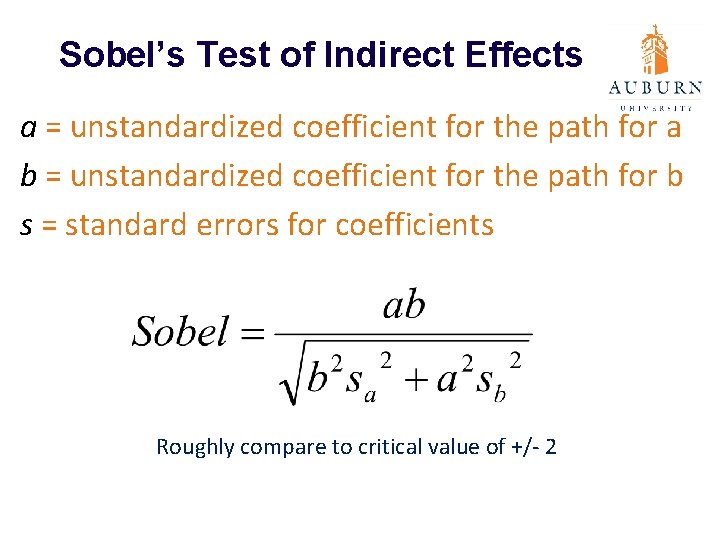
Sobel’s Test of Indirect Effects a = unstandardized coefficient for the path for a b = unstandardized coefficient for the path for b s = standard errors for coefficients Roughly compare to critical value of +/- 2
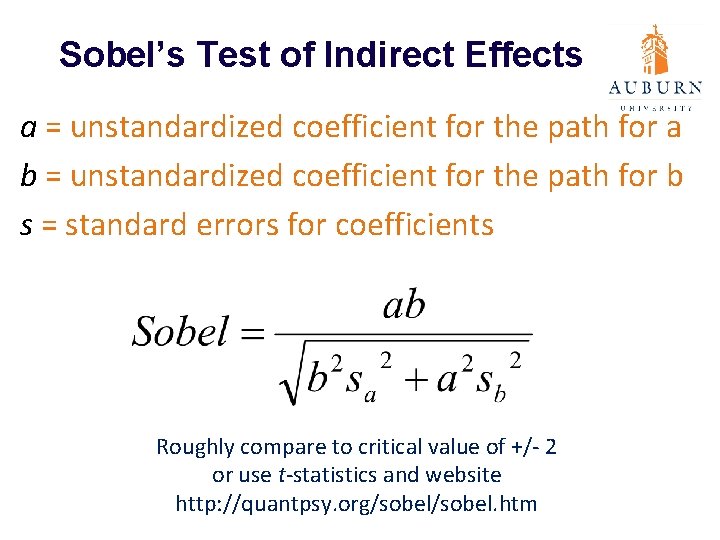
Sobel’s Test of Indirect Effects a = unstandardized coefficient for the path for a b = unstandardized coefficient for the path for b s = standard errors for coefficients Roughly compare to critical value of +/- 2 or use t-statistics and website http: //quantpsy. org/sobel. htm
Mediation with Multi. Reg Mediation with multiple regression assumes: • No measurement error in mediator • If there is measurement error then Type II error will increase • • • Underestimate effect between mediator and outcome Also overestimate effect between predictor and outcome Having multiple measurements of the mediator will help control Type II error rates • The outcome does not cause the mediator HDFS 7060 - Bubb, R.
Reporting When reporting: • If no mediation • Report Path C • If partial mediation • Report Paths A, B, & C’ • If full mediation • Report Paths A & B • Always report the Sobel test, zsobel = , p = • Put all three models in a table • Make a figure with coefficients and p-values HDFS 7060 - Bubb, R.
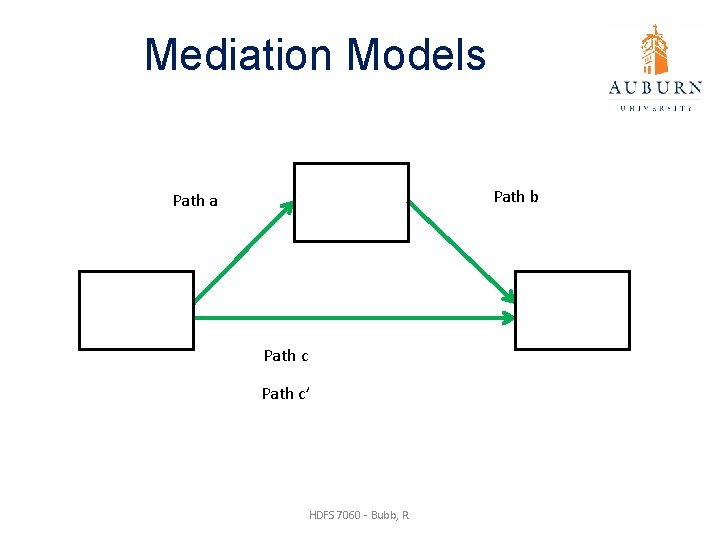
Mediation Models Path b Path a Path c’ HDFS 7060 - Bubb, R.
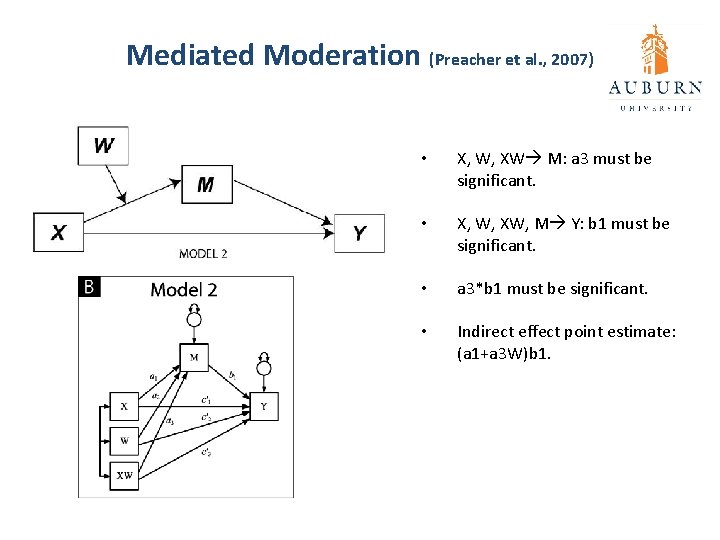
Mediated Moderation (Preacher et al. , 2007) • X, W, XW M: a 3 must be significant. • X, W, XW, M Y: b 1 must be significant. • a 3*b 1 must be significant. • Indirect effect point estimate: (a 1+a 3 W)b 1.
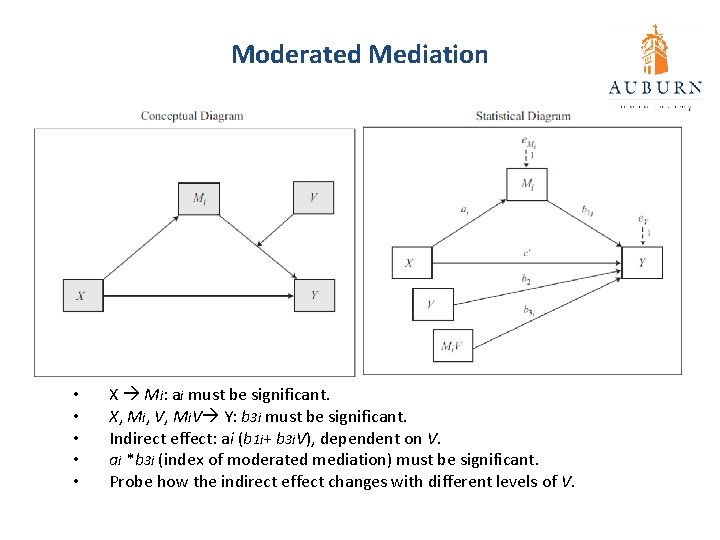
Moderated Mediation • • • X Mi: ai must be significant. X, Mi, V, Mi. V Y: b 3 i must be significant. Indirect effect: ai (b 1 i+ b 3 i. V), dependent on V. ai *b 3 i (index of moderated mediation) must be significant. Probe how the indirect effect changes with different levels of V.
- Slides: 19