
Statistics for Microarrays Multiple Hypothesis Testing Class web

Statistics for Microarrays Multiple Hypothesis Testing Class web site: http: //statwww. epfl. ch/davison/teaching/Microarrays/ETHZ/
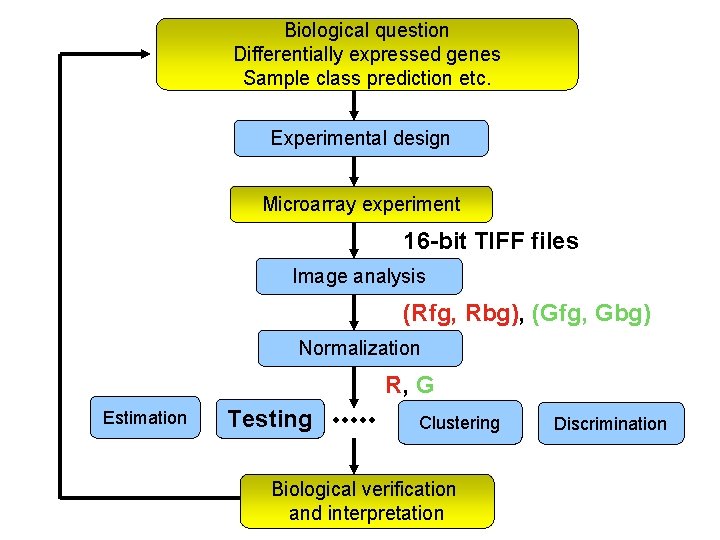
Biological question Differentially expressed genes Sample class prediction etc. Experimental design Microarray experiment 16 -bit TIFF files Image analysis (Rfg, Rbg), (Gfg, Gbg) Normalization R, G Estimation Testing Clustering Biological verification and interpretation Discrimination
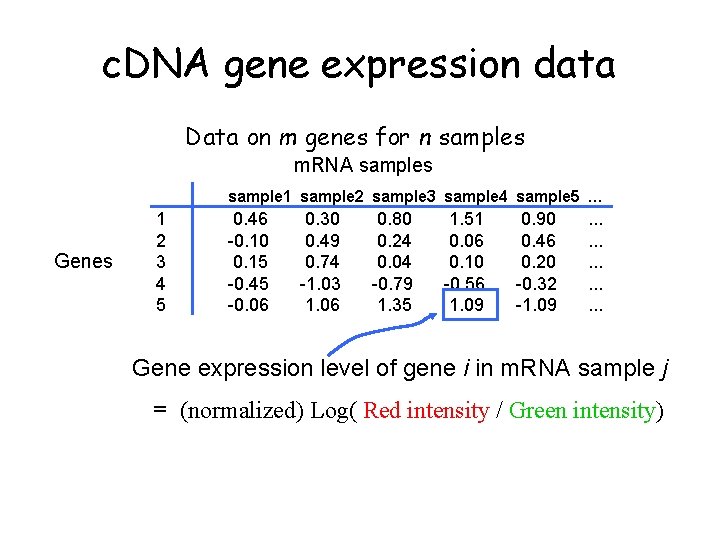
c. DNA gene expression data Data on m genes for n samples m. RNA samples sample 1 sample 2 sample 3 sample 4 sample 5 … Genes 1 2 3 4 5 0. 46 -0. 10 0. 15 -0. 45 -0. 06 0. 30 0. 49 0. 74 -1. 03 1. 06 0. 80 0. 24 0. 04 -0. 79 1. 35 1. 51 0. 06 0. 10 -0. 56 1. 09 0. 90 0. 46 0. 20 -0. 32 -1. 09 . . . . Gene expression level of gene i in m. RNA sample j = (normalized) Log( Red intensity / Green intensity)
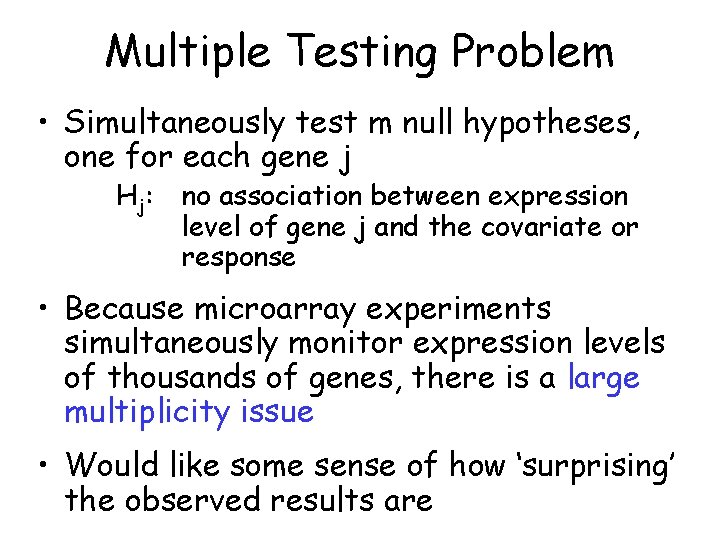
Multiple Testing Problem • Simultaneously test m null hypotheses, one for each gene j Hj: no association between expression level of gene j and the covariate or response • Because microarray experiments simultaneously monitor expression levels of thousands of genes, there is a large multiplicity issue • Would like some sense of how ‘surprising’ the observed results are
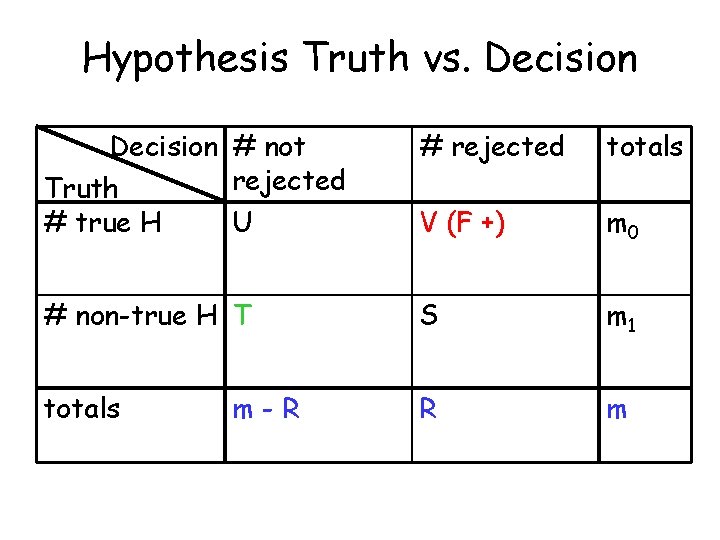
Hypothesis Truth vs. Decision # not rejected Truth # true H U # rejected totals V (F +) m 0 # non-true H T S m 1 totals R m m-R

Type I (False Positive) Error Rates • Per-family Error Rate PFER = E(V) • Per-comparison Error Rate PCER = E(V)/m • Family-wise Error Rate FWER = p(V ≥ 1) • False Discovery Rate FDR = E(Q), where Q = V/R if R > 0; Q = 0 if R = 0
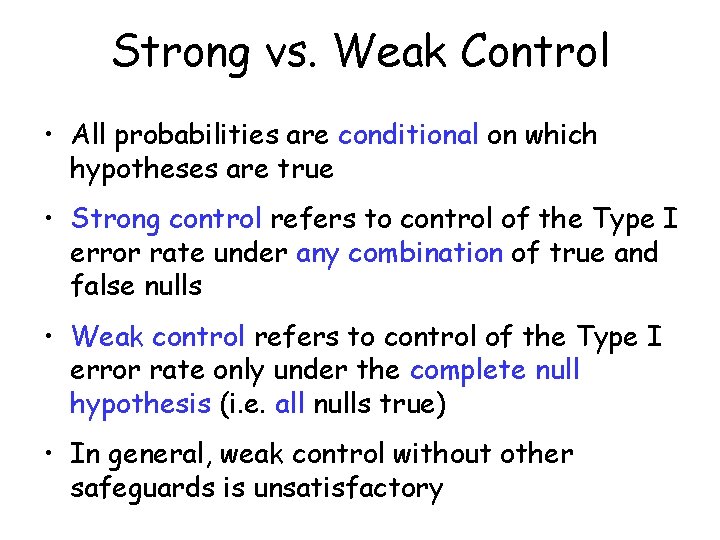
Strong vs. Weak Control • All probabilities are conditional on which hypotheses are true • Strong control refers to control of the Type I error rate under any combination of true and false nulls • Weak control refers to control of the Type I error rate only under the complete null hypothesis (i. e. all nulls true) • In general, weak control without other safeguards is unsatisfactory
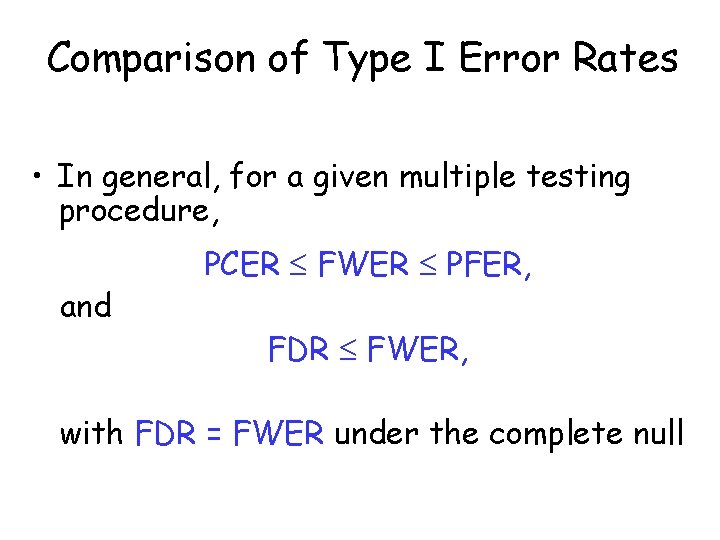
Comparison of Type I Error Rates • In general, for a given multiple testing procedure, and PCER FWER PFER, FDR FWER, with FDR = FWER under the complete null
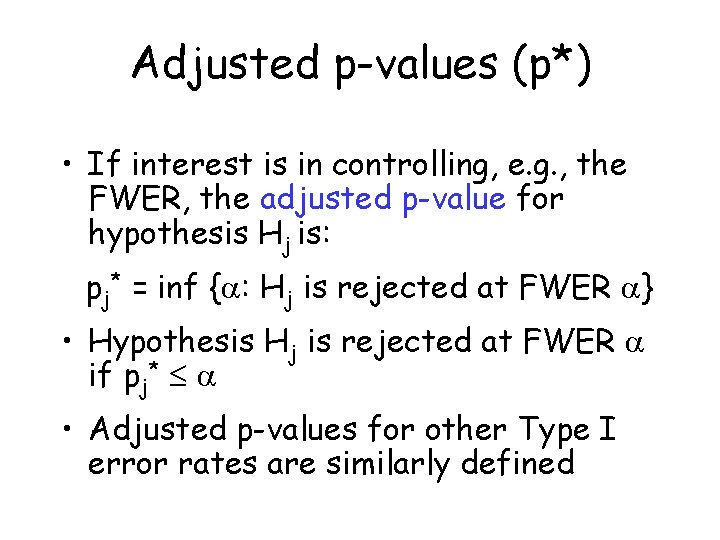
Adjusted p-values (p*) • If interest is in controlling, e. g. , the FWER, the adjusted p-value for hypothesis Hj is: pj* = inf { : Hj is rejected at FWER } • Hypothesis Hj is rejected at FWER if pj* • Adjusted p-values for other Type I error rates are similarly defined
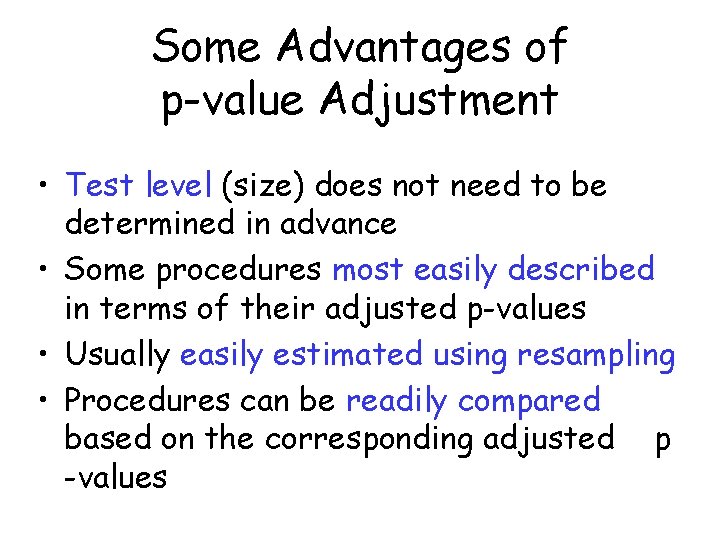
Some Advantages of p-value Adjustment • Test level (size) does not need to be determined in advance • Some procedures most easily described in terms of their adjusted p-values • Usually easily estimated using resampling • Procedures can be readily compared based on the corresponding adjusted p -values
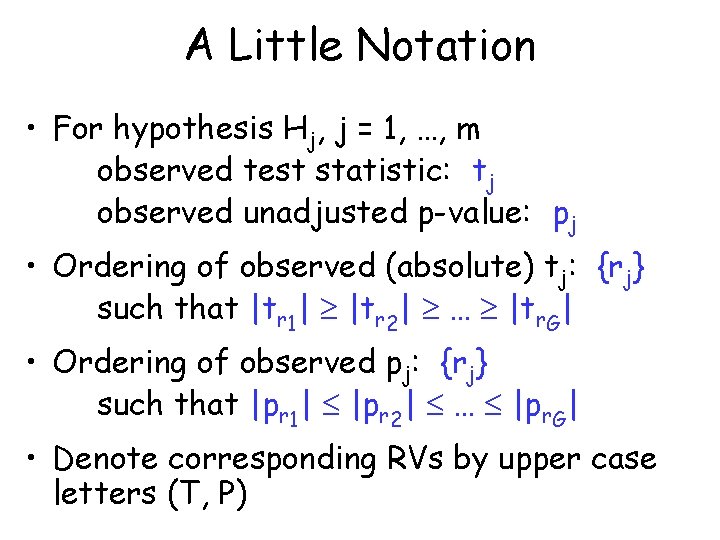
A Little Notation • For hypothesis Hj, j = 1, …, m observed test statistic: tj observed unadjusted p-value: pj • Ordering of observed (absolute) tj: {rj} such that |tr 1| |tr 2| … |tr. G| • Ordering of observed pj: {rj} such that |pr 1| |pr 2| … |pr. G| • Denote corresponding RVs by upper case letters (T, P)
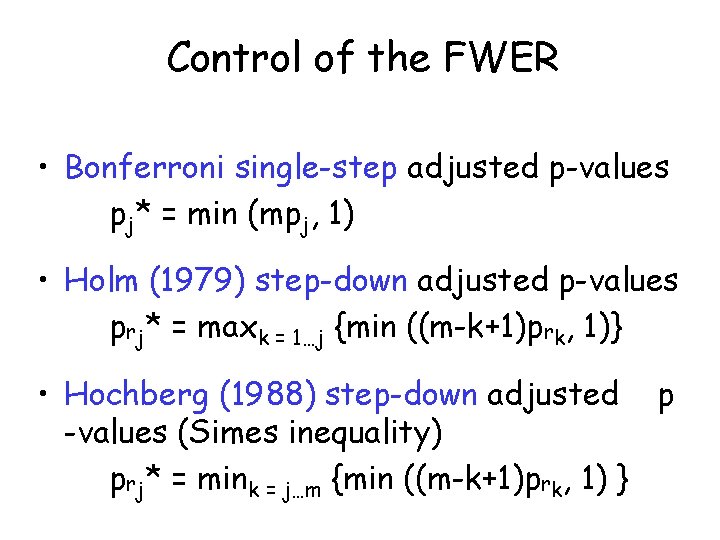
Control of the FWER • Bonferroni single-step adjusted p-values pj* = min (mpj, 1) • Holm (1979) step-down adjusted p-values prj* = maxk = 1…j {min ((m-k+1)prk, 1)} • Hochberg (1988) step-down adjusted p -values (Simes inequality) prj* = mink = j…m {min ((m-k+1)prk, 1) }

Control of the FWER • Westfall & Young (1993) step-down min. P adjusted p-values prj* = maxk = 1…j { p(maxl {rk…rm} Pl prk H 0 C )} • Westfall & Young (1993) step-down max. T adjusted p-values prj* = maxk = 1…j { p(maxl {rk…rm} |Tl| ≥ |trk| H 0 C )}

Westfall & Young (1993) Adjusted p-values • Step-down procedures: successively smaller adjustments at each step • Take into account the joint distribution of the test statistics • Less conservative than Bonferroni, Holm, or Hochberg adjusted p-values • Can be estimated by resampling but computer-intensive (especially for min. P)
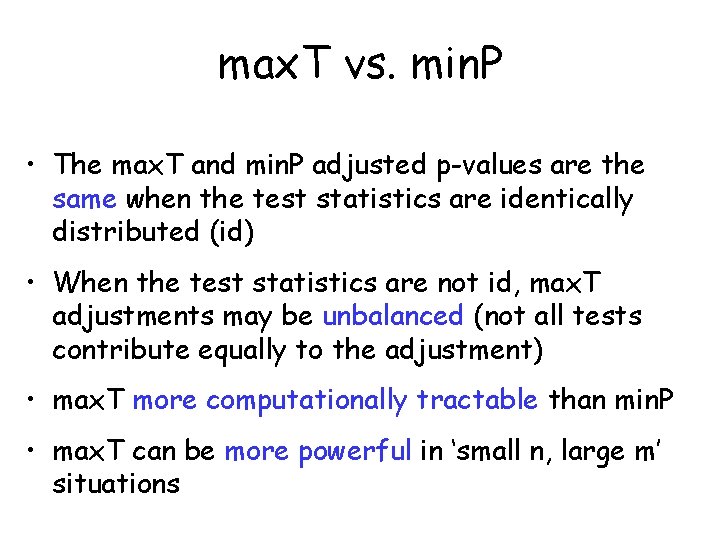
max. T vs. min. P • The max. T and min. P adjusted p-values are the same when the test statistics are identically distributed (id) • When the test statistics are not id, max. T adjustments may be unbalanced (not all tests contribute equally to the adjustment) • max. T more computationally tractable than min. P • max. T can be more powerful in ‘small n, large m’ situations
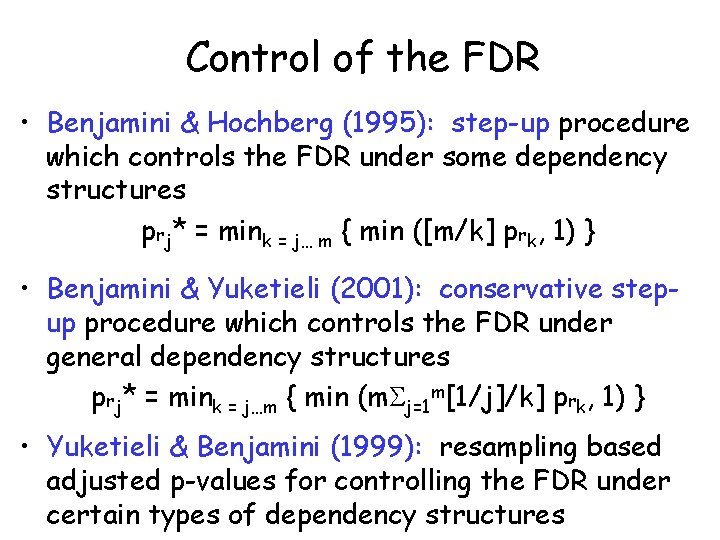
Control of the FDR • Benjamini & Hochberg (1995): step-up procedure which controls the FDR under some dependency structures prj* = mink = j… m { min ([m/k] prk, 1) } • Benjamini & Yuketieli (2001): conservative stepup procedure which controls the FDR under general dependency structures prj* = mink = j…m { min (m j=1 m[1/j]/k] prk, 1) } • Yuketieli & Benjamini (1999): resampling based adjusted p-values for controlling the FDR under certain types of dependency structures

Identification of Genes Associated with Survival • Data: survival yi and gene expression xij for individuals i = 1, …, n and genes j = 1, …, m • Fit Cox model for each gene singly: h(t) = h 0(t) exp( jxij) • For any gene j = 1, …, m, can test Hj: j = 0 • Complete null H 0 C: j = 0 for all j = 1, …, m • The Hj are tested on the basis of the Wald statistics tj and their associated p-values pj
Datasets • Lymphoma (Alizadeh et al. ) 40 individuals, 4026 genes • Melanoma (Bittner et al. ) 15 individuals, 3613 genes • Both available at http: //lpgprot 101. nci. nih. gov: 8080/GEAW
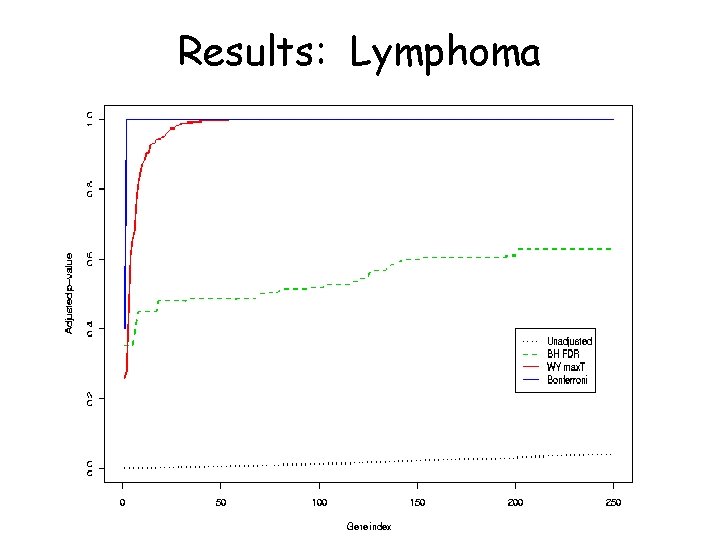
Results: Lymphoma
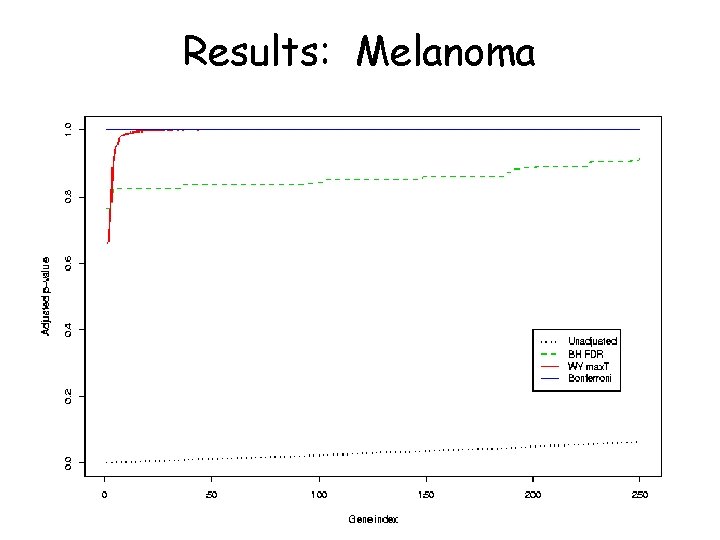
Results: Melanoma
Other Proposals from the Microarray Literature • ‘Neighborhood Analysis’, Golub et al. – In general, gives only weak control of FWER • ‘Significance Analysis of Microarrays (SAM)’ (2 versions) – Efron et al. (2000): weak control of PFER – Tusher et al. (2001): strong control of PFER • SAM also estimates ‘FDR’, but this ‘FDR’ is defined as E(V|H 0 C)/R, not E(V/R)
Controversies • Whether multiple testing methods (adjustments) should be applied at all • Which tests should be included in the family (e. g. all tests performed within a single experiment; define ‘experiment’) • Alternatives – Bayesian approach – Meta-analysis
Situations where inflated error rates are a concern • It is plausible that all nulls may be true • A serious claim will be made whenever any p <. 05 is found • Much data manipulation may be performed to find a ‘significant’ result • The analysis is planned to be exploratory but wish to claim ‘sig’ results are real • Experiment unlikely to be followed up before serious actions are taken
References • Alizadeh et al. (2000) Distinct types of diffuse large B -cell lymphoma identified by gene expression profiling. Nature 403: 503 -511 • Benjamini and Hochberg (1995) Controlling the false discovery rate: a practical and powerful approach to multiple testing. JRSSB 57: 289 -200 • Benjamini and Yuketieli (2001) The control of false discovery rate in multiple hypothesis testing under dependency. Annals of Statistics • Bittner et al. (2000) Molecular classification of cutaneous malignant melanoma by gene expression profiling. Nature 406: 536 -540 • Efron et al. (2000) Microarrays and their use in a comparative experiment. Tech report, Stats, Stanford • Golub et al. (1999) Molecular classification of cancer. Science 286: 531 -537
References • Hochberg (1988) A sharper Bonferroni procedure for multiple tests of significance. Biometrika 75: 800 -802 • Holm (1979) A simple sequentially rejective multiple testing procedure. Scand. J Statistics 6: 65 -70 • Ihaka and Gentleman (1996) R: A language for data analysis and graphics. J Comp Graph Stats 5: 299 -314 • Tusher et al. (2001) Significance analysis of microarrays applied to transcriptional responses to ionizing radiation. PNAS 98: 5116 -5121 • Westfall and Young (1993) Resampling-based multiple testing: Examples and methods for p-value adjustment. New York: Wiley • Yuketieli and Benjamini (1999) Resampling based false discovery rate controlling multiple test procedures for correlated test statistics. J Stat Plan Inf 82: 171 -196

Acknowledgements • Debashis Ghosh • Erin Conlon • Sandrine Dudoit • José Correa
- Slides: 26