
Statistics for Managers using Microsoft Excel 6 th

- Slides: 24
Statistics for Managers using Microsoft Excel 6 th Edition Chapter 18 Data Analysis Overview Copyright © 2011 Pearson Education, Inc. publishing as Prentice Hall 18 -1
Learning Objectives In this chapter, you learn: n. The steps involved in choosing what statistical methods to use to conduct a data analysis Copyright © 2011 Pearson Education, Inc. publishing as Prentice Hall 18 -2
Good Data Analysis Requires Choosing The Proper Technique(s) n Choosing the proper technique(s) to use requires the consideration of: n n The purpose of the analysis The type of variable being analyzed n n n Numerical Categorical The assumptions about the variable you are willing to make Copyright © 2011 Pearson Education, Inc. publishing as Prentice Hall 18 -3
Questions To Ask When Analyzing Numerical Variables n Do you seek to: n n n Describe the characteristics of the variable (possibly broken into several groups) Draw conclusions about the mean and standard deviation of the variable in a population Determine whether the mean and standard deviation of the variable differs depending on the group Determine which factors affect the value of the variable Predict the value of the variable based on the value of other variables Determine whether the values of the variable are stable over time Copyright © 2011 Pearson Education, Inc. publishing as Prentice Hall 18 -4
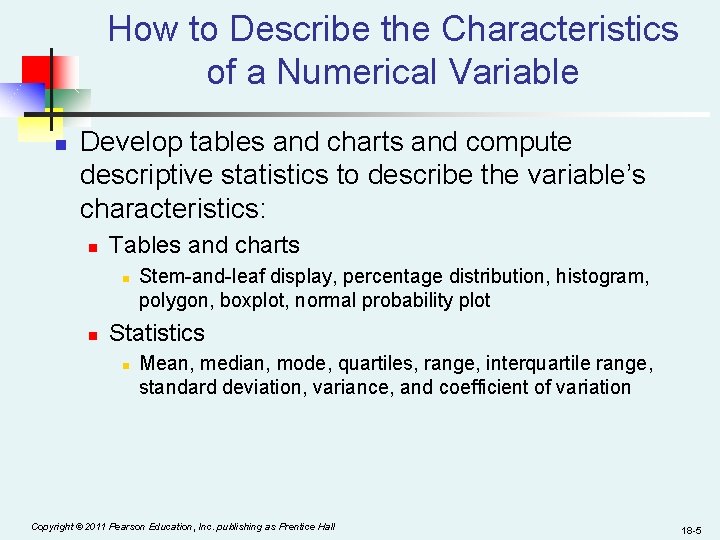
How to Describe the Characteristics of a Numerical Variable n Develop tables and charts and compute descriptive statistics to describe the variable’s characteristics: n Tables and charts n n Stem-and-leaf display, percentage distribution, histogram, polygon, boxplot, normal probability plot Statistics n Mean, median, mode, quartiles, range, interquartile range, standard deviation, variance, and coefficient of variation Copyright © 2011 Pearson Education, Inc. publishing as Prentice Hall 18 -5
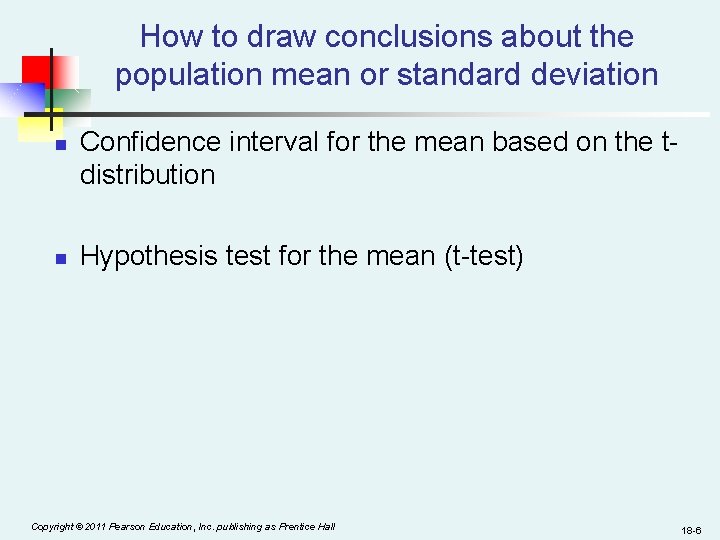
How to draw conclusions about the population mean or standard deviation n n Confidence interval for the mean based on the tdistribution Hypothesis test for the mean (t-test) Copyright © 2011 Pearson Education, Inc. publishing as Prentice Hall 18 -6
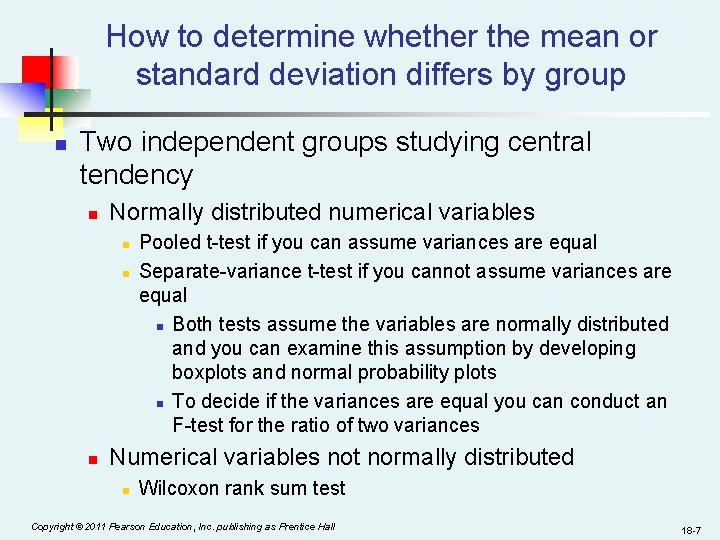
How to determine whether the mean or standard deviation differs by group n Two independent groups studying central tendency n Normally distributed numerical variables n n n Pooled t-test if you can assume variances are equal Separate-variance t-test if you cannot assume variances are equal n Both tests assume the variables are normally distributed and you can examine this assumption by developing boxplots and normal probability plots n To decide if the variances are equal you can conduct an F-test for the ratio of two variances Numerical variables not normally distributed n Wilcoxon rank sum test Copyright © 2011 Pearson Education, Inc. publishing as Prentice Hall 18 -7
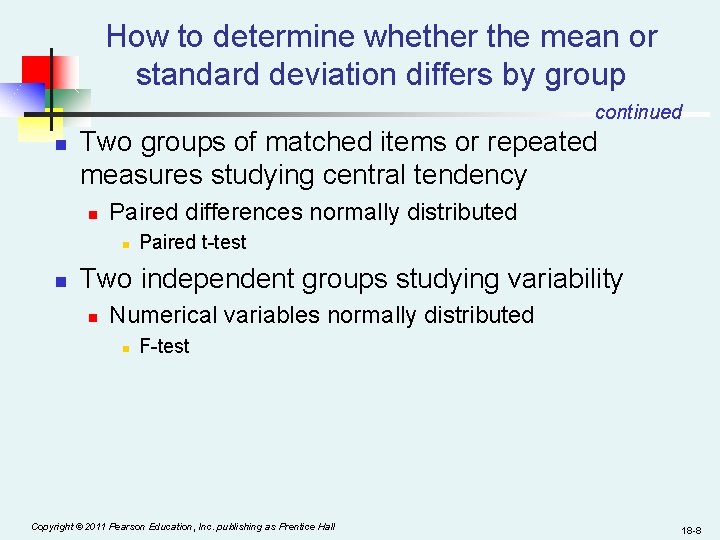
How to determine whether the mean or standard deviation differs by group continued n Two groups of matched items or repeated measures studying central tendency n Paired differences normally distributed n n Paired t-test Two independent groups studying variability n Numerical variables normally distributed n F-test Copyright © 2011 Pearson Education, Inc. publishing as Prentice Hall 18 -8
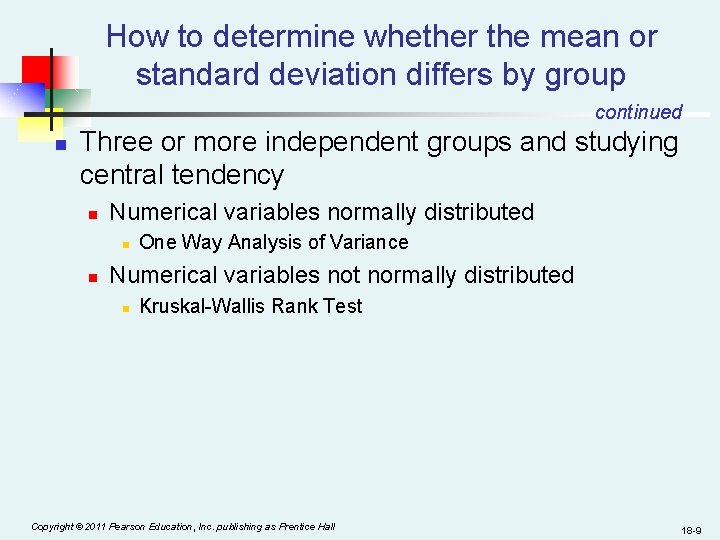
How to determine whether the mean or standard deviation differs by group continued n Three or more independent groups and studying central tendency n Numerical variables normally distributed n n One Way Analysis of Variance Numerical variables not normally distributed n Kruskal-Wallis Rank Test Copyright © 2011 Pearson Education, Inc. publishing as Prentice Hall 18 -9
How to determine which factors affect the value of the variable n Two factors to be examined n Two-factorial design Copyright © 2011 Pearson Education, Inc. publishing as Prentice Hall 18 -10
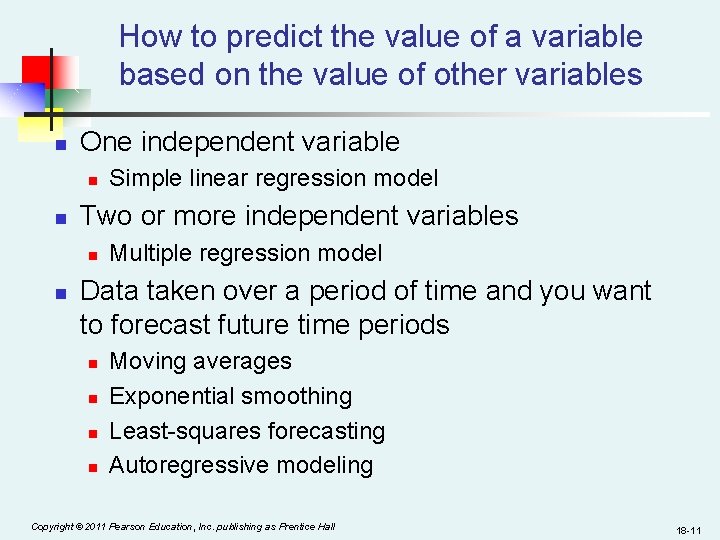
How to predict the value of a variable based on the value of other variables n One independent variable n n Two or more independent variables n n Simple linear regression model Multiple regression model Data taken over a period of time and you want to forecast future time periods n n Moving averages Exponential smoothing Least-squares forecasting Autoregressive modeling Copyright © 2011 Pearson Education, Inc. publishing as Prentice Hall 18 -11
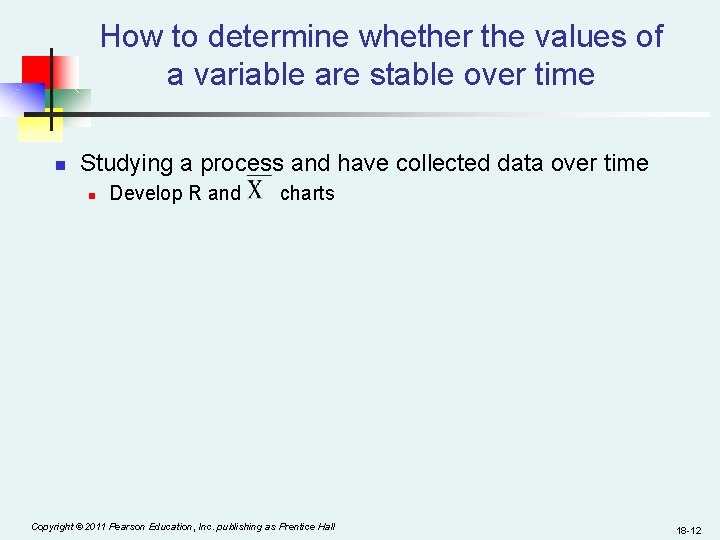
How to determine whether the values of a variable are stable over time n Studying a process and have collected data over time n Develop R and charts Copyright © 2011 Pearson Education, Inc. publishing as Prentice Hall 18 -12
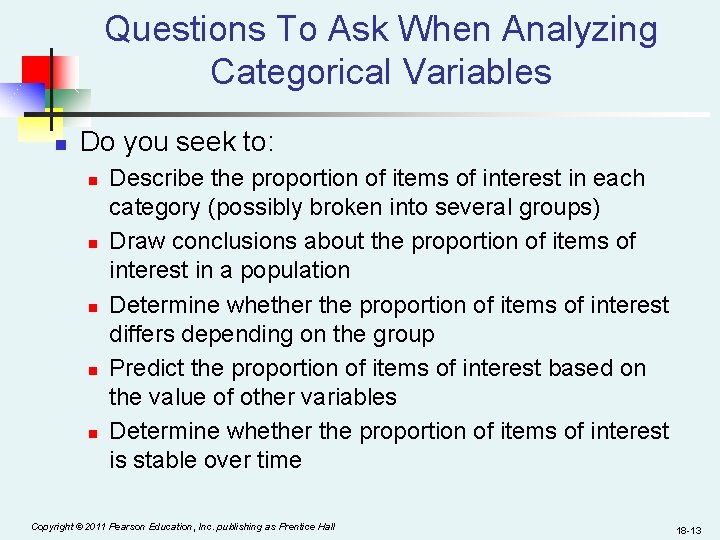
Questions To Ask When Analyzing Categorical Variables n Do you seek to: n n n Describe the proportion of items of interest in each category (possibly broken into several groups) Draw conclusions about the proportion of items of interest in a population Determine whether the proportion of items of interest differs depending on the group Predict the proportion of items of interest based on the value of other variables Determine whether the proportion of items of interest is stable over time Copyright © 2011 Pearson Education, Inc. publishing as Prentice Hall 18 -13
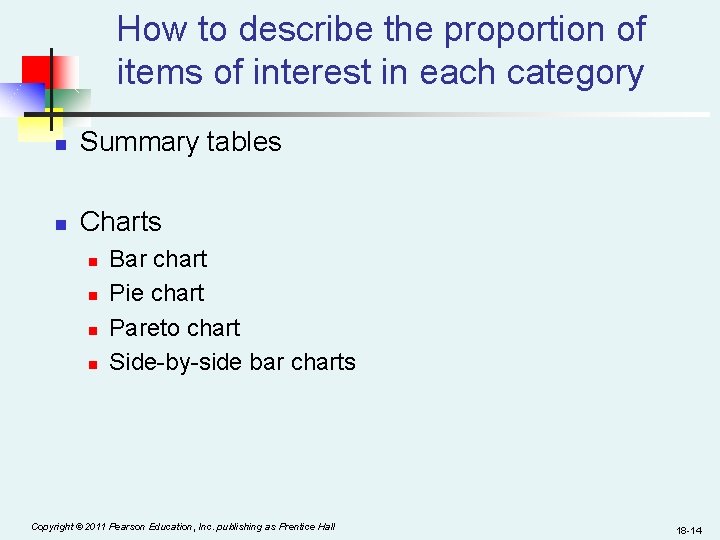
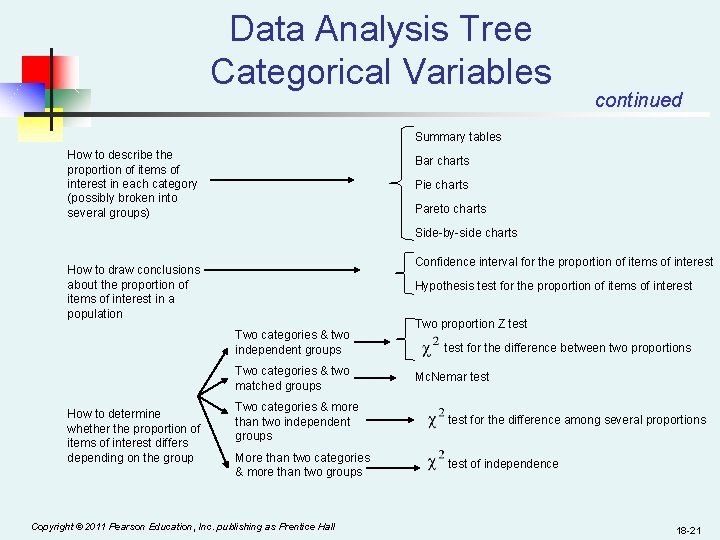
How to describe the proportion of items of interest in each category n Summary tables n Charts n n Bar chart Pie chart Pareto chart Side-by-side bar charts Copyright © 2011 Pearson Education, Inc. publishing as Prentice Hall 18 -14
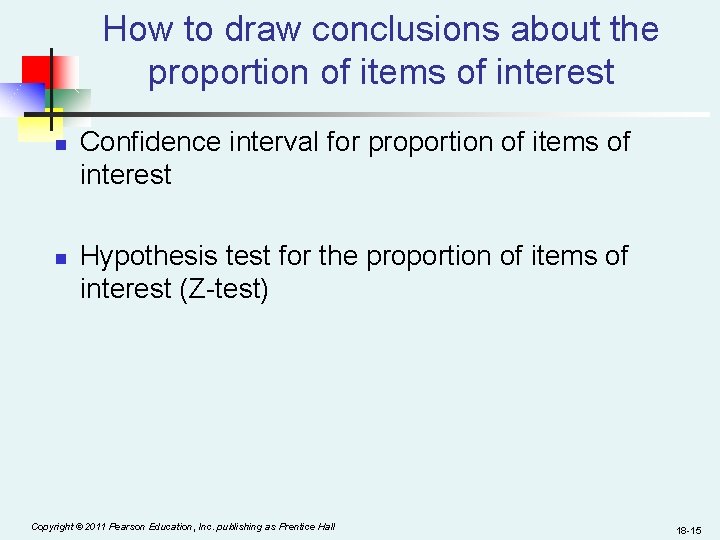
How to draw conclusions about the proportion of items of interest n n Confidence interval for proportion of items of interest Hypothesis test for the proportion of items of interest (Z-test) Copyright © 2011 Pearson Education, Inc. publishing as Prentice Hall 18 -15
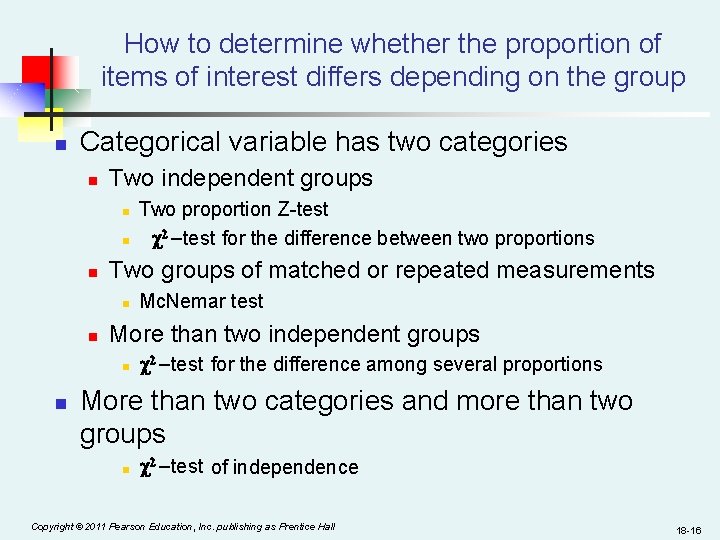
How to determine whether the proportion of items of interest differs depending on the group n Categorical variable has two categories n Two independent groups n n n Two groups of matched or repeated measurements n n Mc. Nemar test More than two independent groups n n Two proportion Z-test 2 -test for the difference between two proportions 2 -test for the difference among several proportions More than two categories and more than two groups n 2 -test of independence Copyright © 2011 Pearson Education, Inc. publishing as Prentice Hall 18 -16
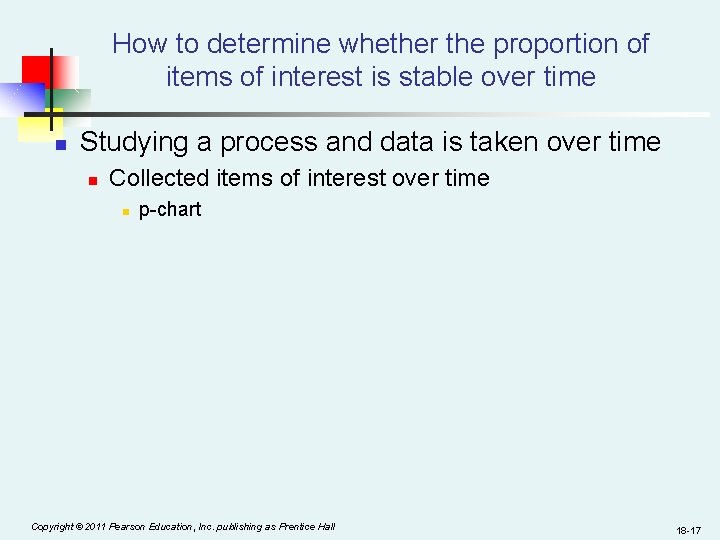
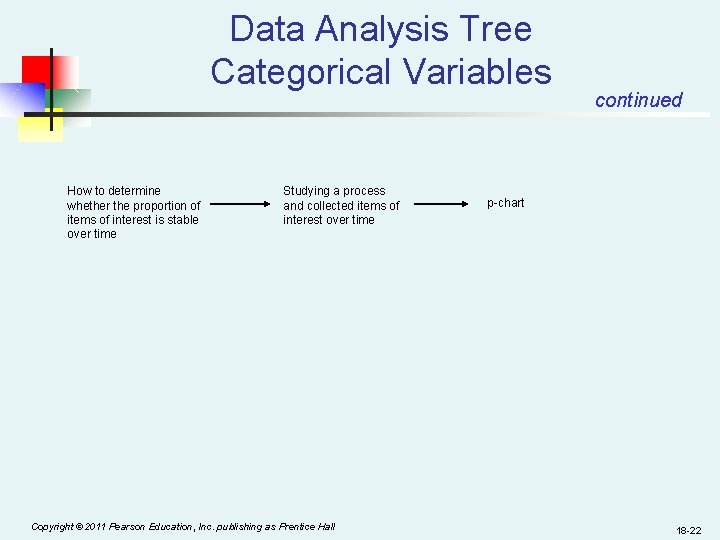
How to determine whether the proportion of items of interest is stable over time n Studying a process and data is taken over time n Collected items of interest over time n p-chart Copyright © 2011 Pearson Education, Inc. publishing as Prentice Hall 18 -17
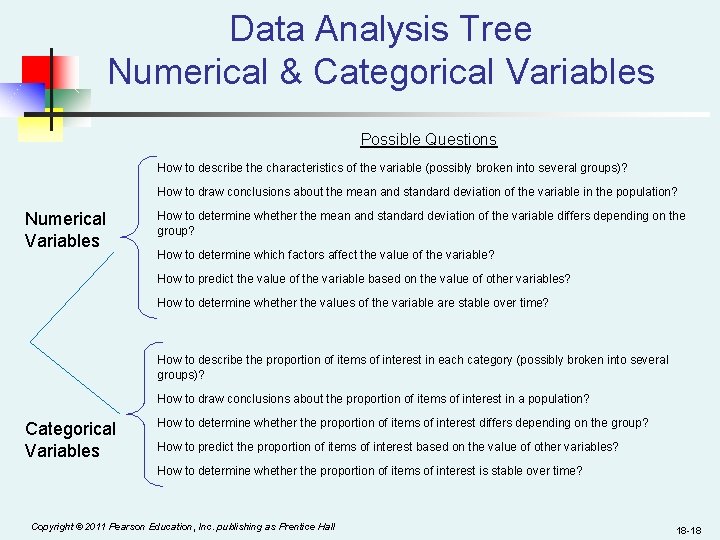
Data Analysis Tree Numerical & Categorical Variables Possible Questions How to describe the characteristics of the variable (possibly broken into several groups)? How to draw conclusions about the mean and standard deviation of the variable in the population? Numerical Variables How to determine whether the mean and standard deviation of the variable differs depending on the group? How to determine which factors affect the value of the variable? How to predict the value of the variable based on the value of other variables? How to determine whether the values of the variable are stable over time? How to describe the proportion of items of interest in each category (possibly broken into several groups)? How to draw conclusions about the proportion of items of interest in a population? Categorical Variables How to determine whether the proportion of items of interest differs depending on the group? How to predict the proportion of items of interest based on the value of other variables? How to determine whether the proportion of items of interest is stable over time? Copyright © 2011 Pearson Education, Inc. publishing as Prentice Hall 18 -18
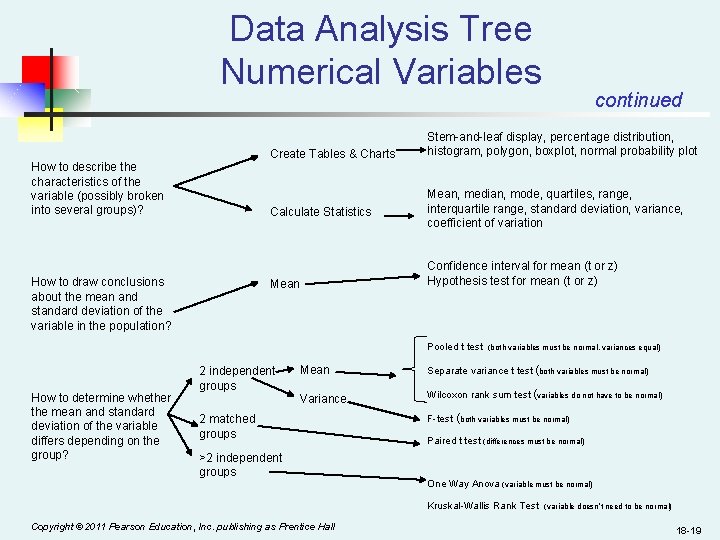
Data Analysis Tree Numerical Variables Create Tables & Charts How to describe the characteristics of the variable (possibly broken into several groups)? Calculate Statistics How to draw conclusions about the mean and standard deviation of the variable in the population? Mean Stem-and-leaf display, percentage distribution, histogram, polygon, boxplot, normal probability plot Mean, median, mode, quartiles, range, interquartile range, standard deviation, variance, coefficient of variation Confidence interval for mean (t or z) Hypothesis test for mean (t or z) Pooled t test How to determine whether the mean and standard deviation of the variable differs depending on the group? 2 independent groups Mean Variance 2 matched groups >2 independent groups (both variables must be normal, variances equal) Separate variance t test (both variables must be normal) Wilcoxon rank sum test (variables do not have to be normal) F-test (both variables must be normal) Paired t test (differences must be normal) One Way Anova (variable must be normal) Kruskal-Wallis Rank Test Copyright © 2011 Pearson Education, Inc. publishing as Prentice Hall continued (variable doesn’t need to be normal) 18 -19
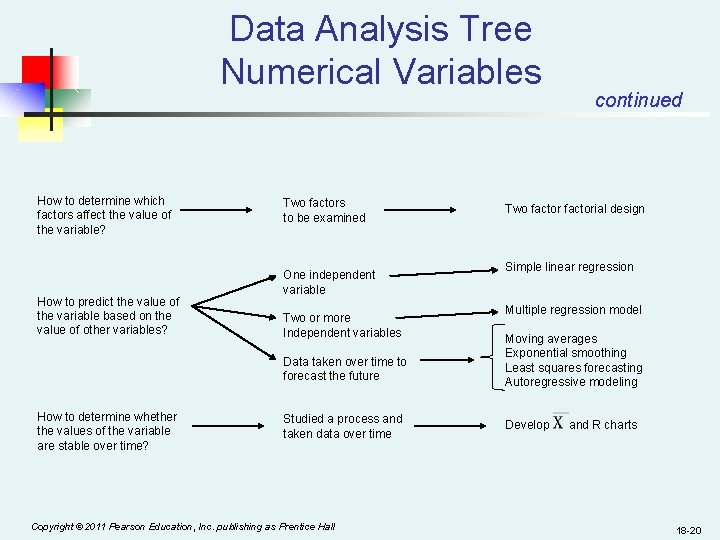
Data Analysis Tree Numerical Variables How to determine which factors affect the value of the variable? How to predict the value of the variable based on the value of other variables? Two factors to be examined One independent variable Two or more Independent variables Data taken over time to forecast the future How to determine whether the values of the variable are stable over time? Studied a process and taken data over time Copyright © 2011 Pearson Education, Inc. publishing as Prentice Hall continued Two factorial design Simple linear regression Multiple regression model Moving averages Exponential smoothing Least squares forecasting Autoregressive modeling Develop and R charts 18 -20
Data Analysis Tree Categorical Variables continued Summary tables How to describe the proportion of items of interest in each category (possibly broken into several groups) Bar charts Pie charts Pareto charts Side-by-side charts Confidence interval for the proportion of items of interest How to draw conclusions about the proportion of items of interest in a population Hypothesis test for the proportion of items of interest Two categories & two independent groups Two categories & two matched groups How to determine whether the proportion of items of interest differs depending on the group Two proportion Z test for the difference between two proportions Mc. Nemar test Two categories & more than two independent groups test for the difference among several proportions More than two categories & more than two groups test of independence Copyright © 2011 Pearson Education, Inc. publishing as Prentice Hall 18 -21
Data Analysis Tree Categorical Variables How to determine whether the proportion of items of interest is stable over time Studying a process and collected items of interest over time Copyright © 2011 Pearson Education, Inc. publishing as Prentice Hall continued p-chart 18 -22
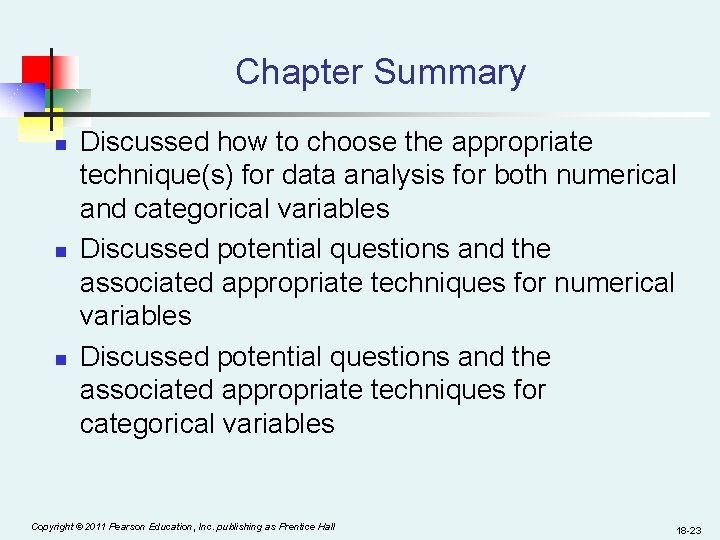
Chapter Summary n n n Discussed how to choose the appropriate technique(s) for data analysis for both numerical and categorical variables Discussed potential questions and the associated appropriate techniques for numerical variables Discussed potential questions and the associated appropriate techniques for categorical variables Copyright © 2011 Pearson Education, Inc. publishing as Prentice Hall 18 -23
All rights reserved. No part of this publication may be reproduced, stored in a retrieval system, or transmitted, in any form or by any means, electronic, mechanical, photocopying, recording, or otherwise, without the prior written permission of the publisher. Printed in the United States of America. Copyright © 2011 Pearson Education, Inc. publishing as Prentice Hall 18 -24