
Statistics for Managers using Microsoft Excel 6 th






- Slides: 52
Statistics for Managers using Microsoft Excel 6 th Edition Chapter 7 Sampling and Sampling Distributions Copyright © 2011 Pearson Education, Inc. publishing as Prentice Hall 7 -1
Learning Objectives In this chapter, you learn: n n To distinguish between different sampling methods The concept of the sampling distribution To compute probabilities related to the sample mean and the sample proportion The importance of the Central Limit Theorem Copyright © 2011 Pearson Education, Inc. publishing as Prentice Hall 7 -2
Why Sample? n n DCOVA Selecting a sample is less time-consuming than selecting every item in the population (census). An analysis of a sample is less cumbersome and more practical than an analysis of the entire population. Copyright © 2011 Pearson Education, Inc. publishing as Prentice Hall 7 -3
A Sampling Process Begins With A Sampling Frame DCOVA n n The sampling frame is a listing of items that make up the population Frames are data sources such as population lists, directories, or maps Inaccurate or biased results can result if a frame excludes certain portions of the population Using different frames to generate data can lead to dissimilar conclusions Copyright © 2011 Pearson Education, Inc. publishing as Prentice Hall 7 -4
Types of Samples DCOVA Samples Non-Probability Samples Judgment Convenience Probability Samples Simple Random Stratified Systematic Copyright © 2011 Pearson Education, Inc. publishing as Prentice Hall Cluster 7 -5
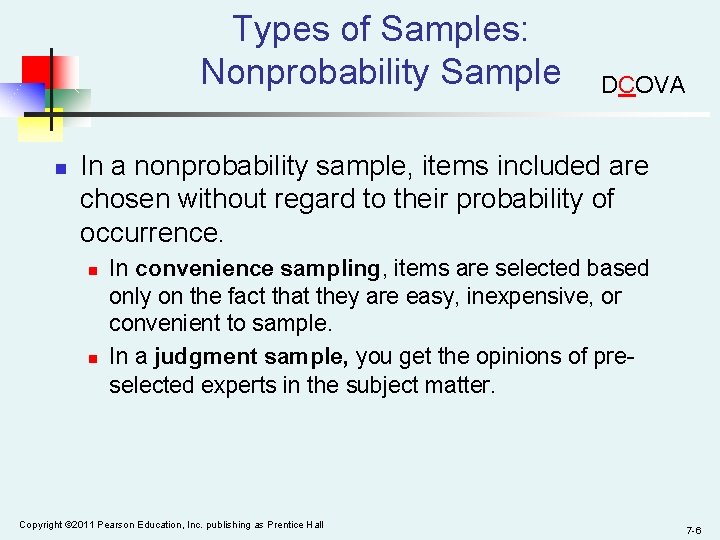
Types of Samples: Nonprobability Sample n DCOVA In a nonprobability sample, items included are chosen without regard to their probability of occurrence. n n In convenience sampling, items are selected based only on the fact that they are easy, inexpensive, or convenient to sample. In a judgment sample, you get the opinions of preselected experts in the subject matter. Copyright © 2011 Pearson Education, Inc. publishing as Prentice Hall 7 -6
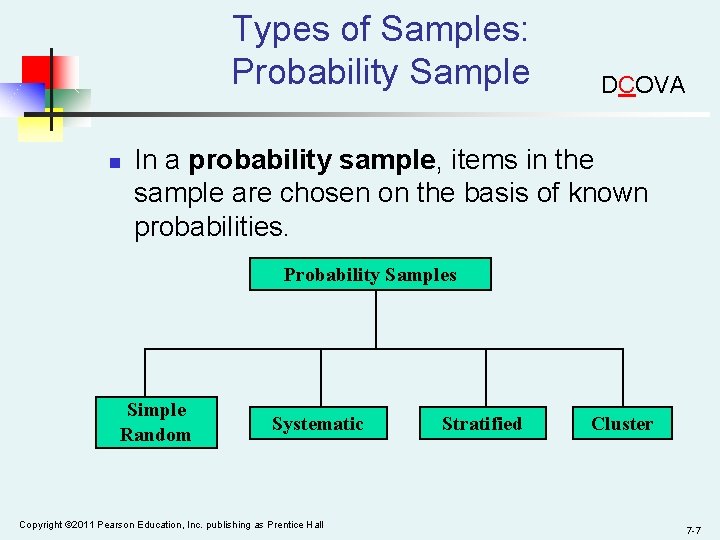
Types of Samples: Probability Sample n DCOVA In a probability sample, items in the sample are chosen on the basis of known probabilities. Probability Samples Simple Random Systematic Copyright © 2011 Pearson Education, Inc. publishing as Prentice Hall Stratified Cluster 7 -7
Probability Sample: Simple Random Sample n n n DCOVA Every individual or item from the frame has an equal chance of being selected Selection may be with replacement (selected individual is returned to frame for possible reselection) or without replacement (selected individual isn’t returned to the frame). Samples obtained from table of random numbers or computer random number generators. Copyright © 2011 Pearson Education, Inc. publishing as Prentice Hall 7 -8
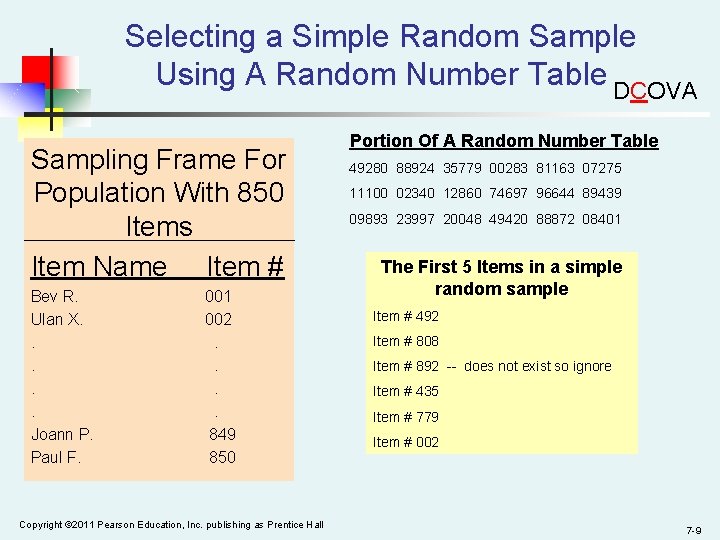
Selecting a Simple Random Sample Using A Random Number Table DCOVA Sampling Frame For Population With 850 Items Item Name Item # Bev R. Ulan X. . . Joann P. Paul F. 001 002. . 849 850 Copyright © 2011 Pearson Education, Inc. publishing as Prentice Hall Portion Of A Random Number Table 49280 88924 35779 00283 81163 07275 11100 02340 12860 74697 96644 89439 09893 23997 20048 49420 88872 08401 The First 5 Items in a simple random sample Item # 492 Item # 808 Item # 892 -- does not exist so ignore Item # 435 Item # 779 Item # 002 7 -9
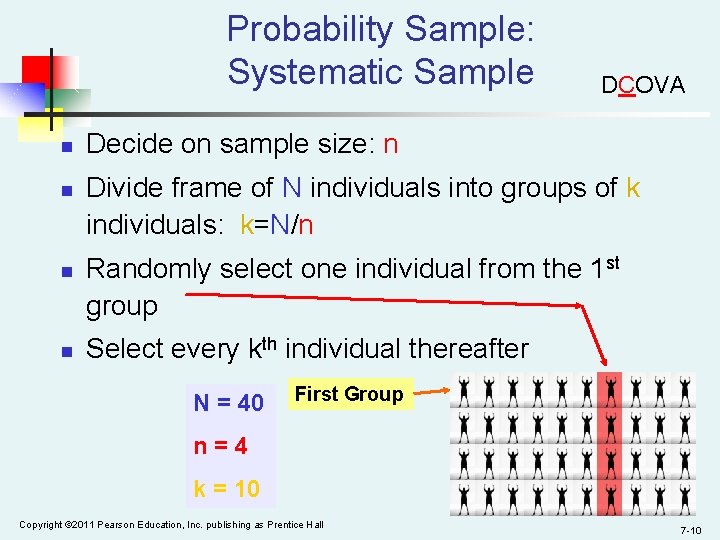
Probability Sample: Systematic Sample n n DCOVA Decide on sample size: n Divide frame of N individuals into groups of k individuals: k=N/n Randomly select one individual from the 1 st group Select every kth individual thereafter N = 40 First Group n=4 k = 10 Copyright © 2011 Pearson Education, Inc. publishing as Prentice Hall 7 -10
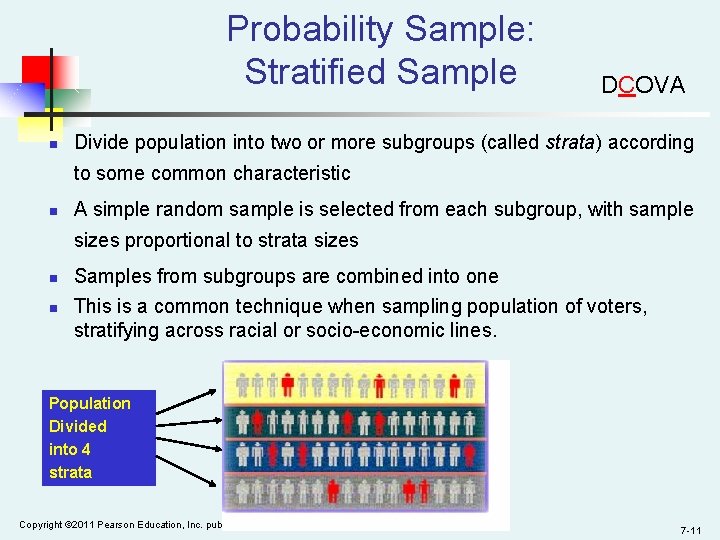
Probability Sample: Stratified Sample n DCOVA Divide population into two or more subgroups (called strata) according to some common characteristic n A simple random sample is selected from each subgroup, with sample sizes proportional to strata sizes n n Samples from subgroups are combined into one This is a common technique when sampling population of voters, stratifying across racial or socio-economic lines. Population Divided into 4 strata Copyright © 2011 Pearson Education, Inc. publishing as Prentice Hall 7 -11
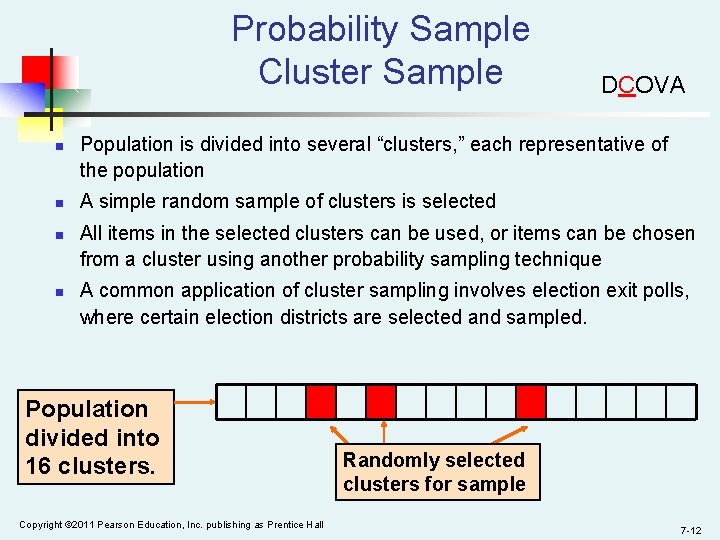
Probability Sample Cluster Sample n n DCOVA Population is divided into several “clusters, ” each representative of the population A simple random sample of clusters is selected All items in the selected clusters can be used, or items can be chosen from a cluster using another probability sampling technique A common application of cluster sampling involves election exit polls, where certain election districts are selected and sampled. Population divided into 16 clusters. Copyright © 2011 Pearson Education, Inc. publishing as Prentice Hall Randomly selected clusters for sample 7 -12
Probability Sample: Comparing Sampling Methods DCOVA n n n Simple random sample and Systematic sample n Simple to use n May not be a good representation of the population’s underlying characteristics Stratified sample n Ensures representation of individuals across the entire population Cluster sample n More cost effective n Less efficient (need larger sample to acquire the same level of precision) Copyright © 2011 Pearson Education, Inc. publishing as Prentice Hall 7 -13
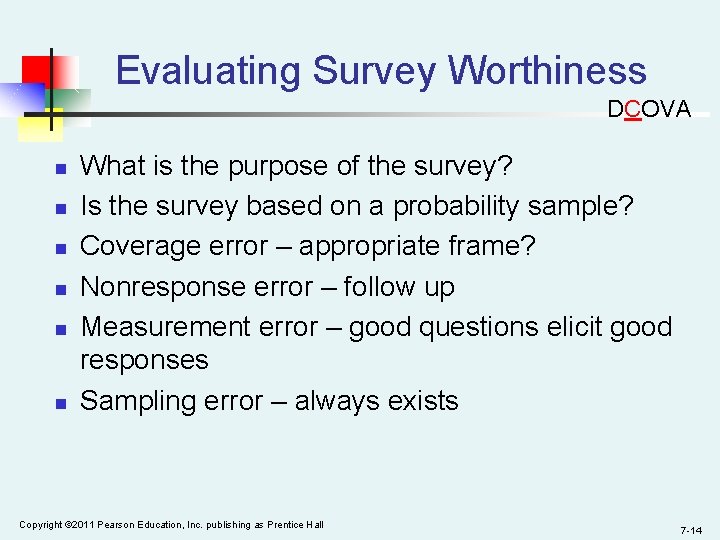
Evaluating Survey Worthiness DCOVA n n n What is the purpose of the survey? Is the survey based on a probability sample? Coverage error – appropriate frame? Nonresponse error – follow up Measurement error – good questions elicit good responses Sampling error – always exists Copyright © 2011 Pearson Education, Inc. publishing as Prentice Hall 7 -14
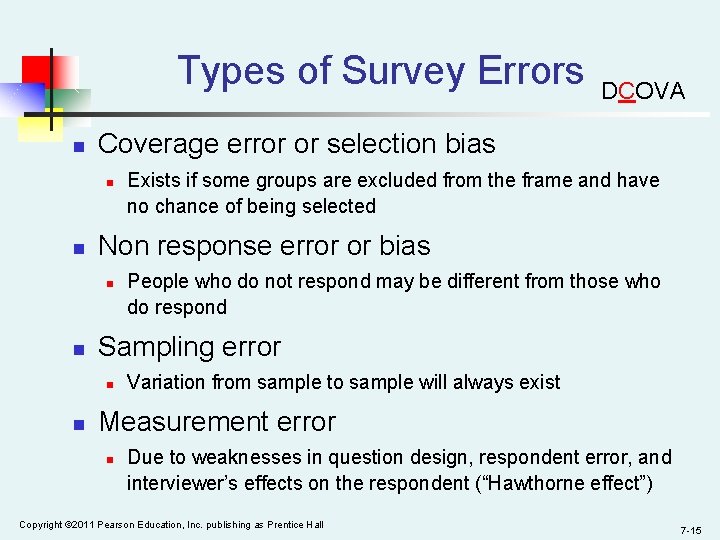
Types of Survey Errors n Coverage error or selection bias n n People who do not respond may be different from those who do respond Sampling error n n Exists if some groups are excluded from the frame and have no chance of being selected Non response error or bias n n DCOVA Variation from sample to sample will always exist Measurement error n Due to weaknesses in question design, respondent error, and interviewer’s effects on the respondent (“Hawthorne effect”) Copyright © 2011 Pearson Education, Inc. publishing as Prentice Hall 7 -15
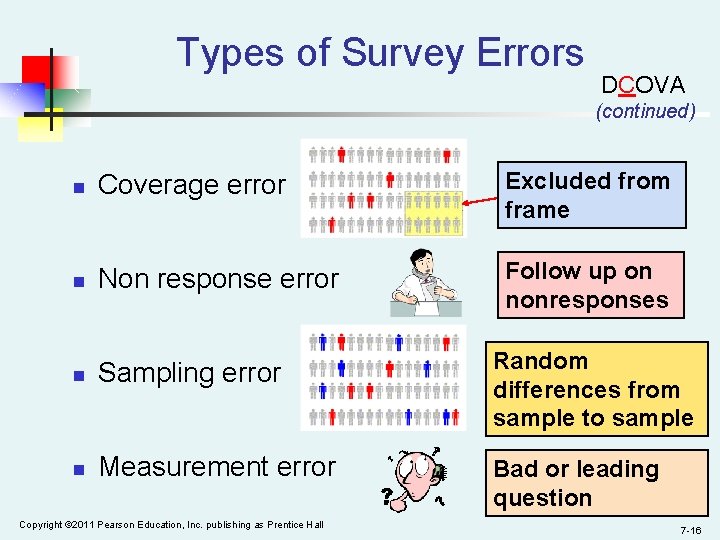
Types of Survey Errors DCOVA (continued) n Coverage error Excluded from frame n Non response error Follow up on nonresponses n Sampling error Random differences from sample to sample n Measurement error Bad or leading question Copyright © 2011 Pearson Education, Inc. publishing as Prentice Hall 7 -16
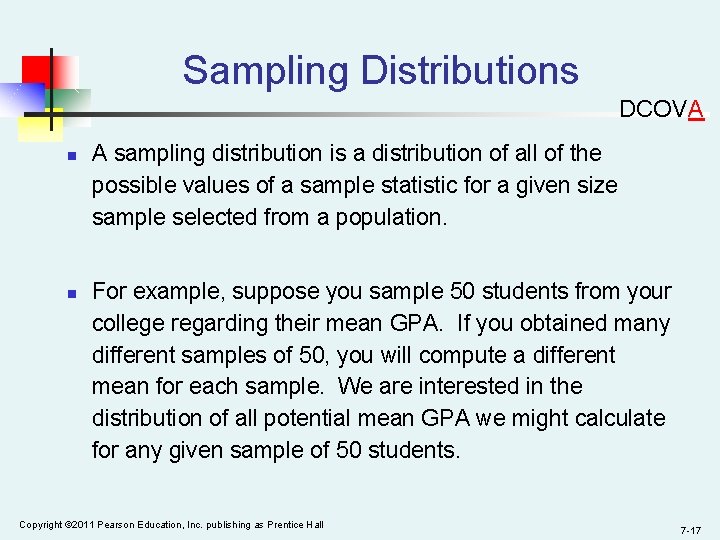
Sampling Distributions DCOVA n n A sampling distribution is a distribution of all of the possible values of a sample statistic for a given size sample selected from a population. For example, suppose you sample 50 students from your college regarding their mean GPA. If you obtained many different samples of 50, you will compute a different mean for each sample. We are interested in the distribution of all potential mean GPA we might calculate for any given sample of 50 students. Copyright © 2011 Pearson Education, Inc. publishing as Prentice Hall 7 -17
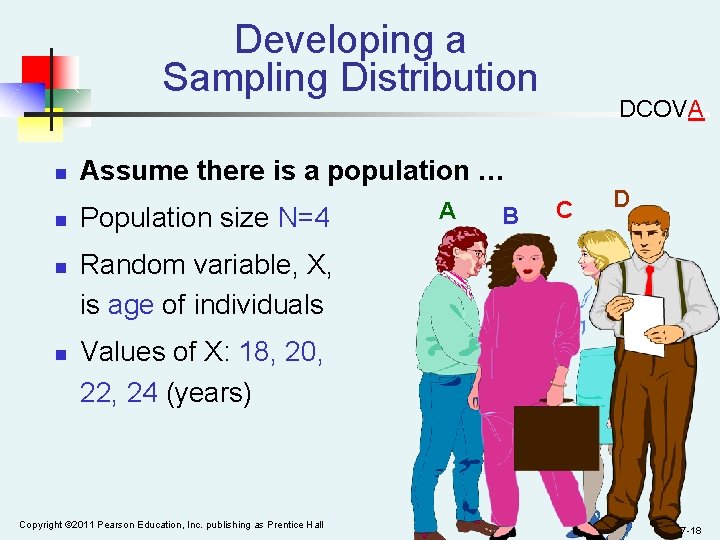
Developing a Sampling Distribution n n DCOVA Assume there is a population … Population size N=4 A B C D Random variable, X, is age of individuals Values of X: 18, 20, 22, 24 (years) Copyright © 2011 Pearson Education, Inc. publishing as Prentice Hall 7 -18
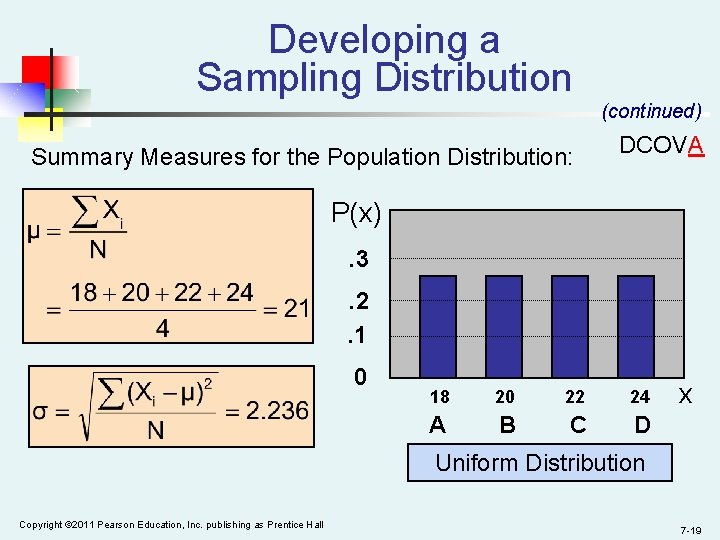
Developing a Sampling Distribution Summary Measures for the Population Distribution: (continued) DCOVA P(x). 3. 2. 1 0 18 20 22 24 A B C D x Uniform Distribution Copyright © 2011 Pearson Education, Inc. publishing as Prentice Hall 7 -19
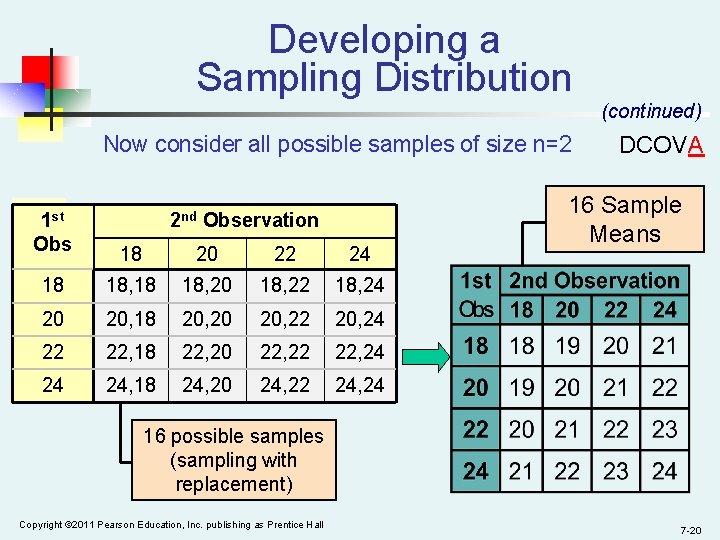
Developing a Sampling Distribution Now consider all possible samples of size n=2 1 st Obs 2 nd Observation 18 20 22 24 18 18, 20 18, 22 18, 24 20 20, 18 20, 20 20, 22 20, 24 22 22, 18 22, 20 22, 22 22, 24 24 24, 18 24, 20 24, 22 24, 24 (continued) DCOVA 16 Sample Means 16 possible samples (sampling with replacement) Copyright © 2011 Pearson Education, Inc. publishing as Prentice Hall 7 -20
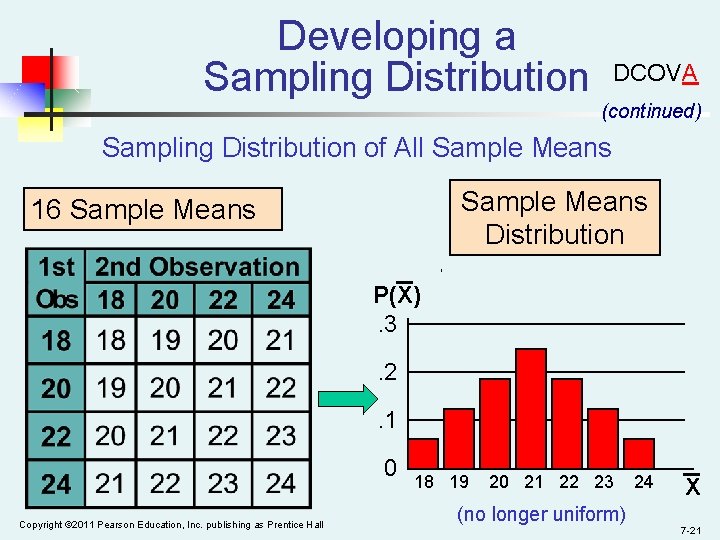
Developing a Sampling Distribution DCOVA (continued) Sampling Distribution of All Sample Means Distribution 16 Sample Means _ P(X). 3. 2. 1 0 Copyright © 2011 Pearson Education, Inc. publishing as Prentice Hall 18 19 20 21 22 23 (no longer uniform) 24 _ X 7 -21
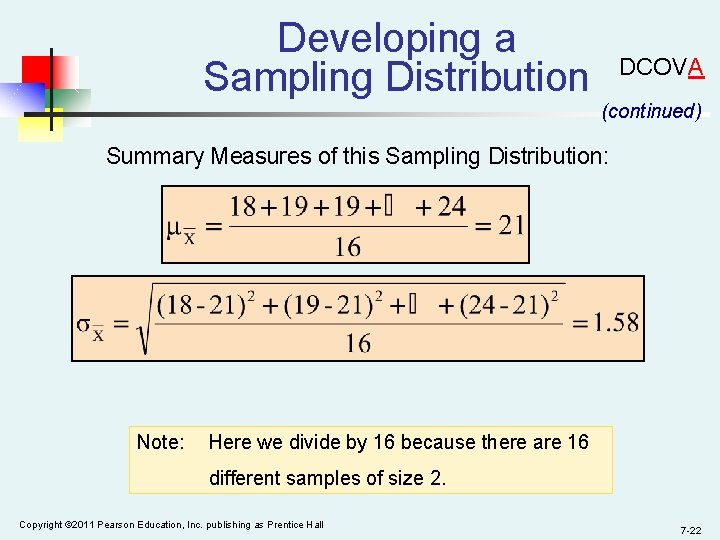
Developing a Sampling Distribution DCOVA (continued) Summary Measures of this Sampling Distribution: Note: Here we divide by 16 because there are 16 different samples of size 2. Copyright © 2011 Pearson Education, Inc. publishing as Prentice Hall 7 -22
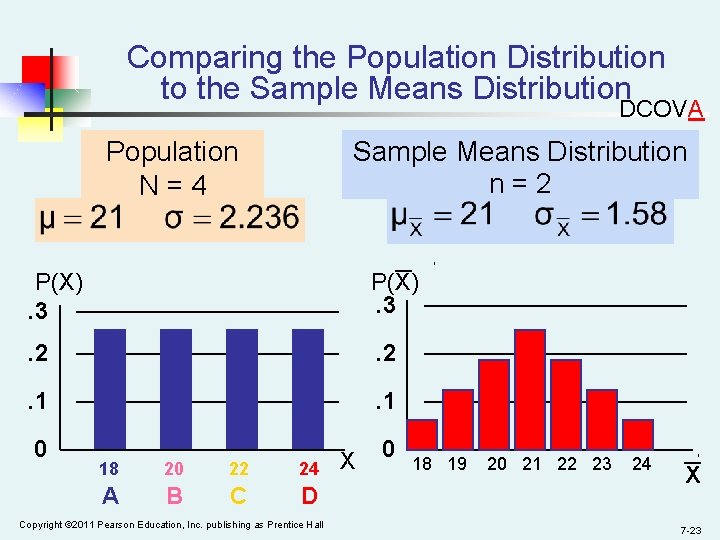
Comparing the Population Distribution to the Sample Means Distribution DCOVA Population N=4 Sample Means Distribution n=2 _ P(X). 3 . 2 . 1 0 18 20 22 24 A B C D Copyright © 2011 Pearson Education, Inc. publishing as Prentice Hall X 0 18 19 20 21 22 23 24 _ X 7 -23
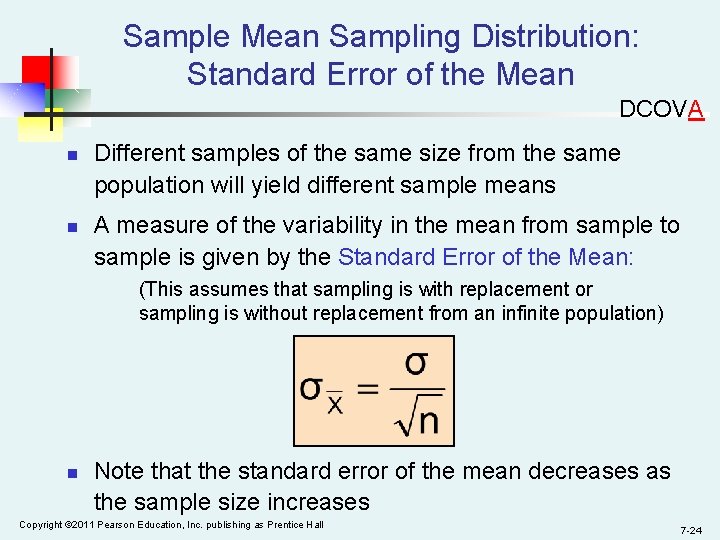
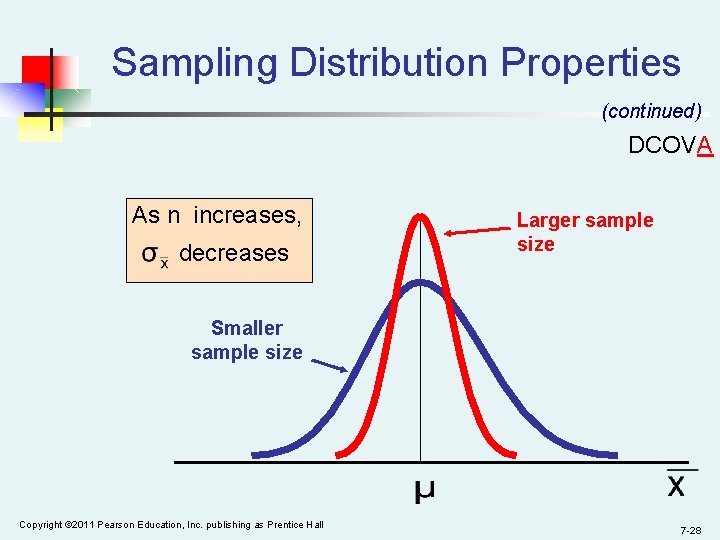
Sample Mean Sampling Distribution: Standard Error of the Mean DCOVA n n Different samples of the same size from the same population will yield different sample means A measure of the variability in the mean from sample to sample is given by the Standard Error of the Mean: (This assumes that sampling is with replacement or sampling is without replacement from an infinite population) n Note that the standard error of the mean decreases as the sample size increases Copyright © 2011 Pearson Education, Inc. publishing as Prentice Hall 7 -24
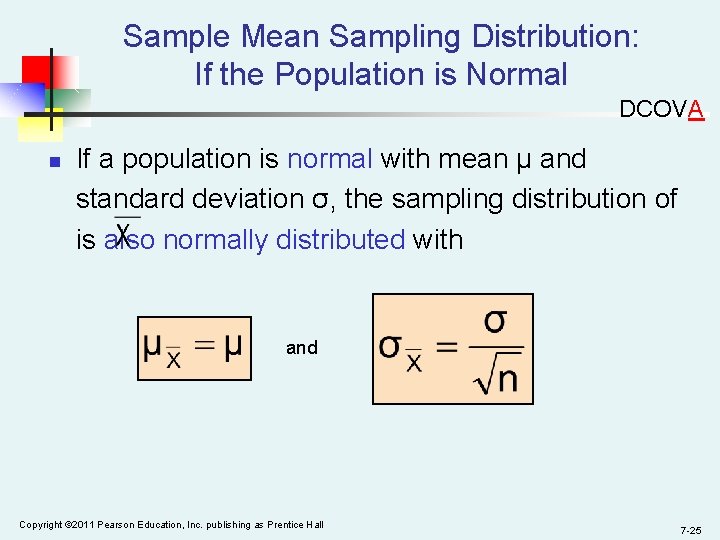
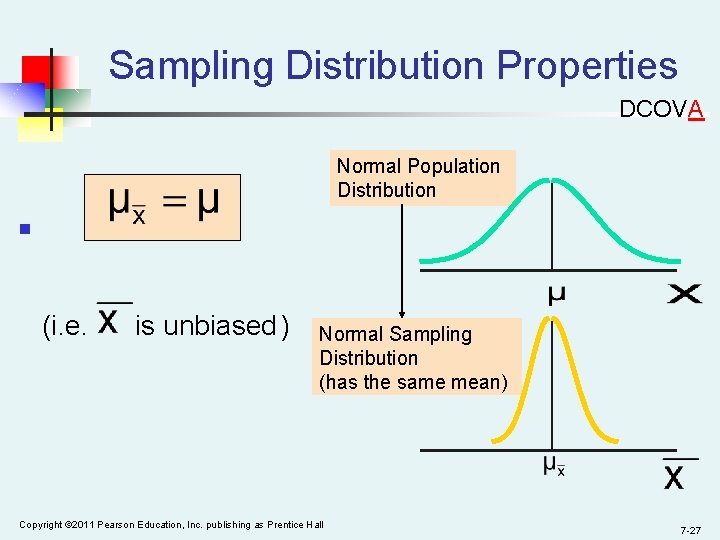
Sample Mean Sampling Distribution: If the Population is Normal DCOVA n If a population is normal with mean μ and standard deviation σ, the sampling distribution of is also normally distributed with and Copyright © 2011 Pearson Education, Inc. publishing as Prentice Hall 7 -25
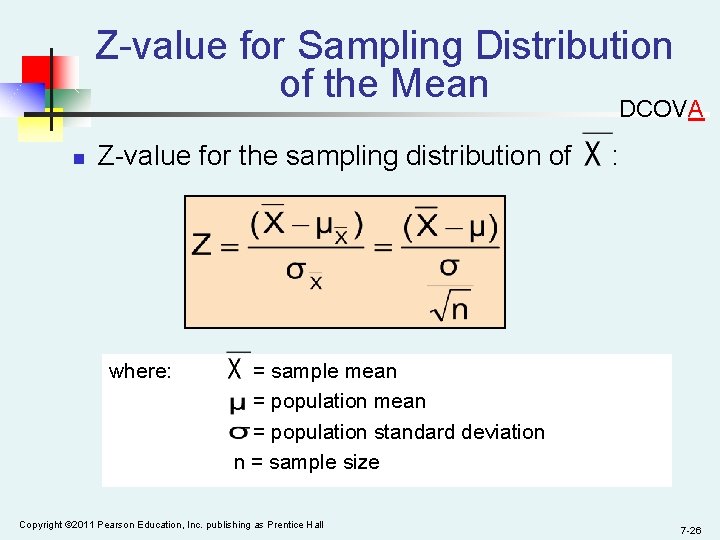
Z-value for Sampling Distribution of the Mean DCOVA n Z-value for the sampling distribution of where: : = sample mean = population standard deviation n = sample size Copyright © 2011 Pearson Education, Inc. publishing as Prentice Hall 7 -26
Sampling Distribution Properties DCOVA Normal Population Distribution n (i. e. is unbiased ) Normal Sampling Distribution (has the same mean) Copyright © 2011 Pearson Education, Inc. publishing as Prentice Hall 7 -27
Sampling Distribution Properties (continued) DCOVA As n increases, decreases Larger sample size Smaller sample size Copyright © 2011 Pearson Education, Inc. publishing as Prentice Hall 7 -28
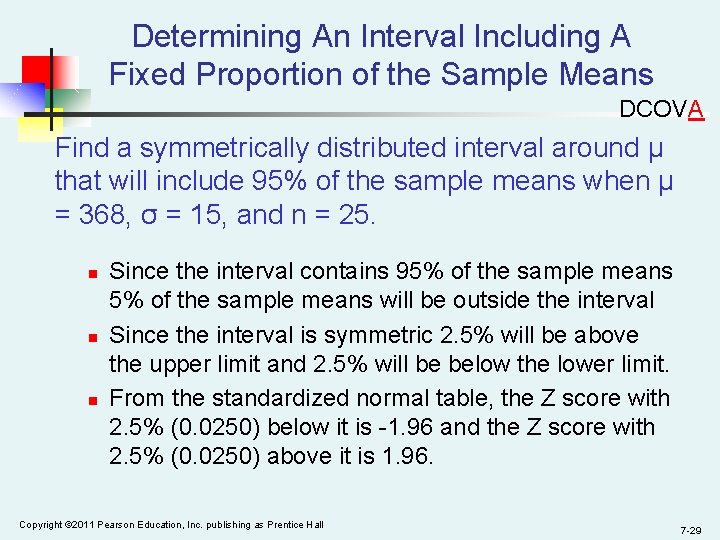
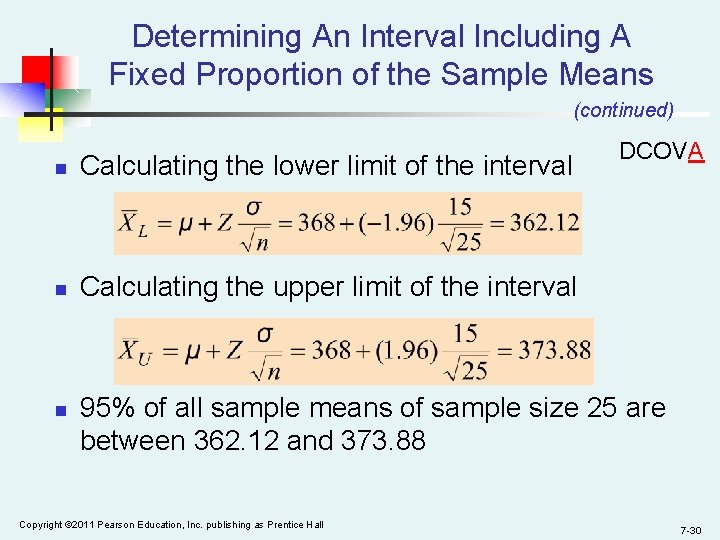
Determining An Interval Including A Fixed Proportion of the Sample Means DCOVA Find a symmetrically distributed interval around µ that will include 95% of the sample means when µ = 368, σ = 15, and n = 25. n n n Since the interval contains 95% of the sample means will be outside the interval Since the interval is symmetric 2. 5% will be above the upper limit and 2. 5% will be below the lower limit. From the standardized normal table, the Z score with 2. 5% (0. 0250) below it is -1. 96 and the Z score with 2. 5% (0. 0250) above it is 1. 96. Copyright © 2011 Pearson Education, Inc. publishing as Prentice Hall 7 -29
Determining An Interval Including A Fixed Proportion of the Sample Means (continued) n Calculating the lower limit of the interval n Calculating the upper limit of the interval n DCOVA 95% of all sample means of sample size 25 are between 362. 12 and 373. 88 Copyright © 2011 Pearson Education, Inc. publishing as Prentice Hall 7 -30
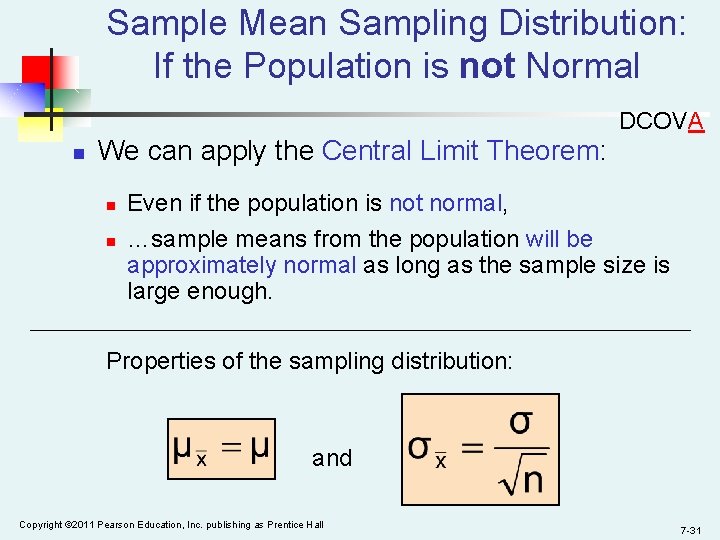
Sample Mean Sampling Distribution: If the Population is not Normal DCOVA n We can apply the Central Limit Theorem: n n Even if the population is not normal, …sample means from the population will be approximately normal as long as the sample size is large enough. Properties of the sampling distribution: and Copyright © 2011 Pearson Education, Inc. publishing as Prentice Hall 7 -31
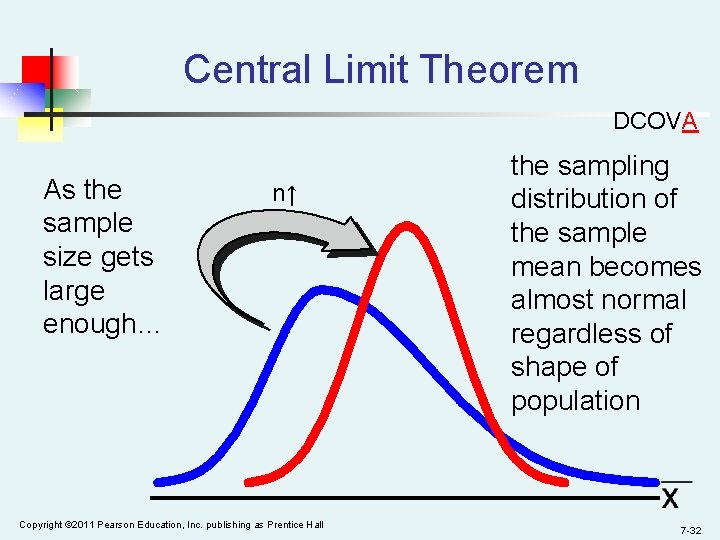
Central Limit Theorem DCOVA As the sample size gets large enough… n↑ Copyright © 2011 Pearson Education, Inc. publishing as Prentice Hall the sampling distribution of the sample mean becomes almost normal regardless of shape of population 7 -32
Sample Mean Sampling Distribution: If the Population is not Normal (continued) Population Distribution Sampling distribution properties: DCOVA Central Tendency Variation Sampling Distribution (becomes normal as n increases) Smaller sample size Copyright © 2011 Pearson Education, Inc. publishing as Prentice Hall Larger sample size 7 -33
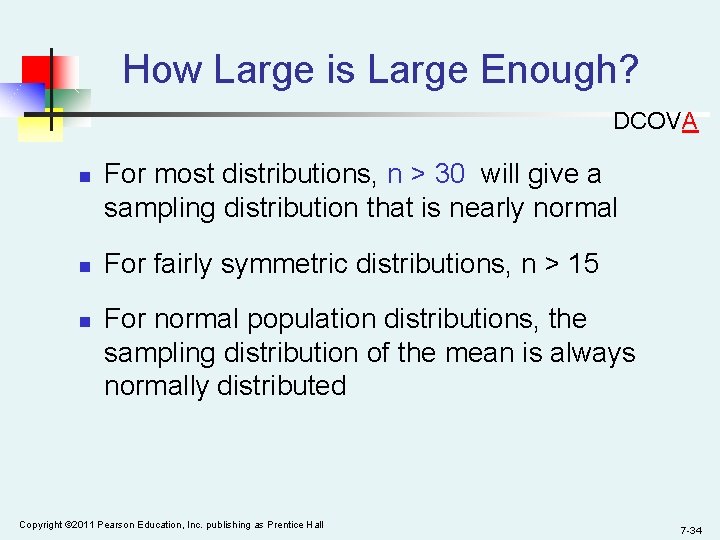
How Large is Large Enough? DCOVA n n n For most distributions, n > 30 will give a sampling distribution that is nearly normal For fairly symmetric distributions, n > 15 For normal population distributions, the sampling distribution of the mean is always normally distributed Copyright © 2011 Pearson Education, Inc. publishing as Prentice Hall 7 -34
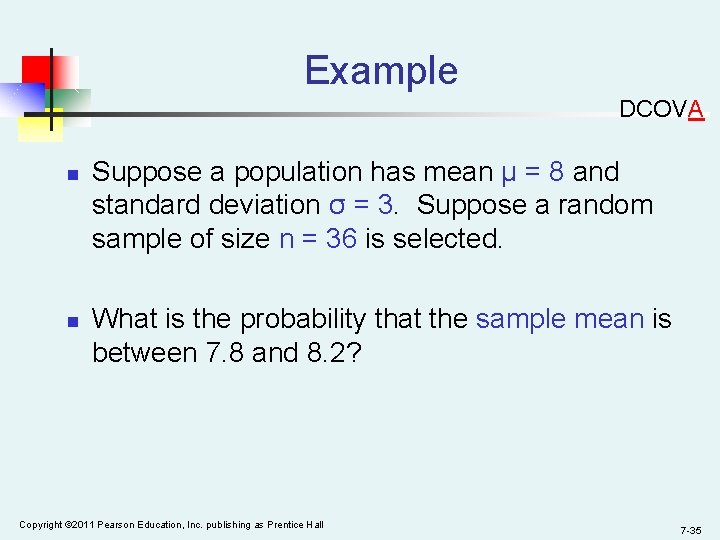
Example DCOVA n n Suppose a population has mean μ = 8 and standard deviation σ = 3. Suppose a random sample of size n = 36 is selected. What is the probability that the sample mean is between 7. 8 and 8. 2? Copyright © 2011 Pearson Education, Inc. publishing as Prentice Hall 7 -35
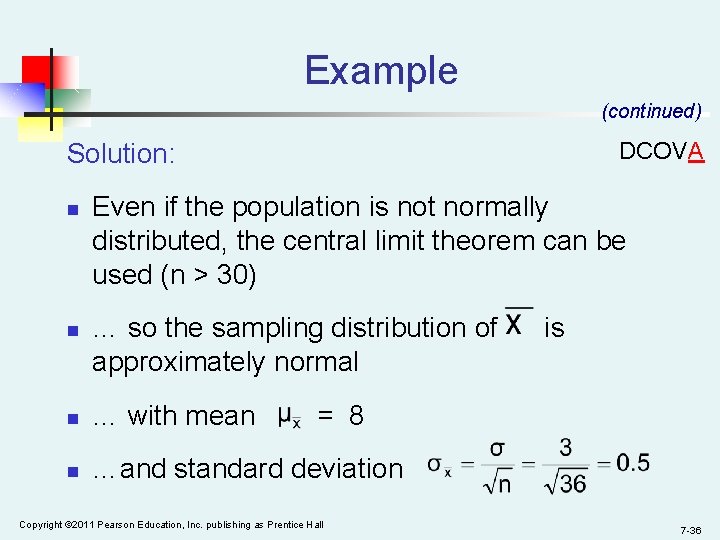
Example (continued) DCOVA Solution: n n Even if the population is not normally distributed, the central limit theorem can be used (n > 30) … so the sampling distribution of approximately normal n … with mean n …and standard deviation is = 8 Copyright © 2011 Pearson Education, Inc. publishing as Prentice Hall 7 -36
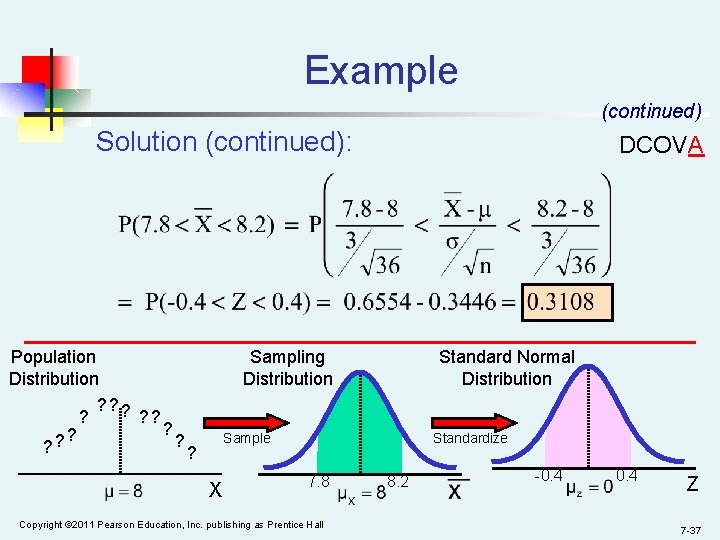
Example (continued) Solution (continued): Population Distribution ? ? ? DCOVA Sampling Distribution Standard Normal Distribution Sample ? X Standardize 7. 8 Copyright © 2011 Pearson Education, Inc. publishing as Prentice Hall 8. 2 -0. 4 Z 7 -37
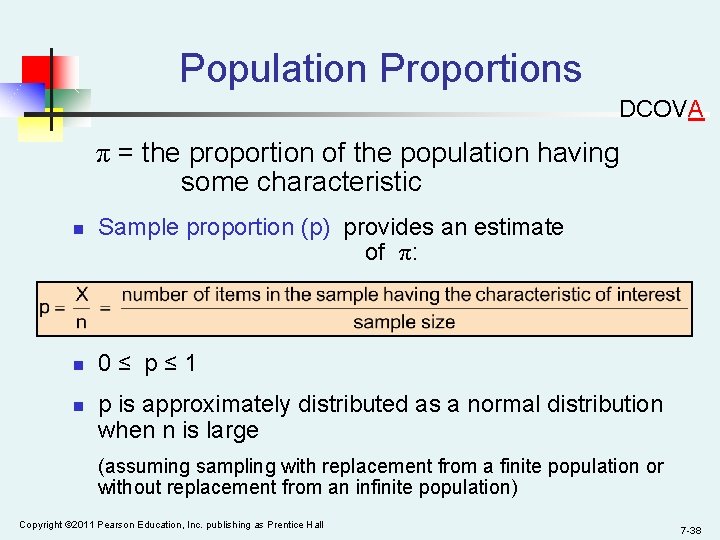
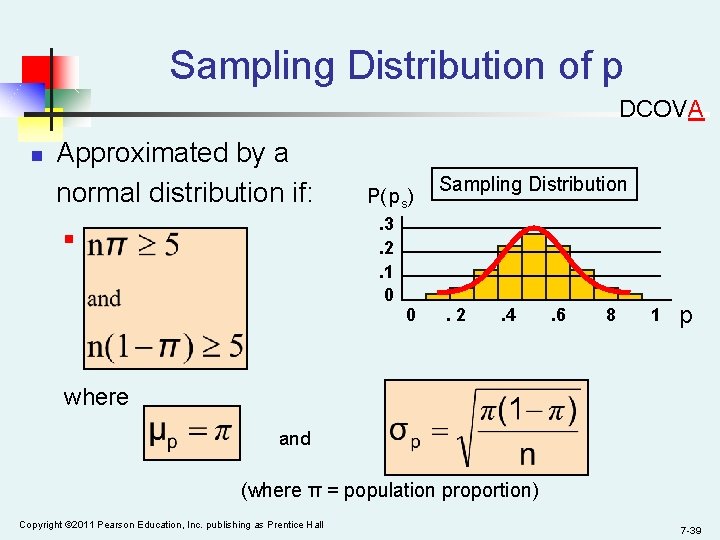
Population Proportions DCOVA π = the proportion of the population having some characteristic n n n Sample proportion (p) provides an estimate of π: 0≤ p≤ 1 p is approximately distributed as a normal distribution when n is large (assuming sampling with replacement from a finite population or without replacement from an infinite population) Copyright © 2011 Pearson Education, Inc. publishing as Prentice Hall 7 -38
Sampling Distribution of p DCOVA n Approximated by a normal distribution if: P( ps). 3. 2. 1 0 n 0 Sampling Distribution . 2 . 4 . 6 8 1 p where and (where π = population proportion) Copyright © 2011 Pearson Education, Inc. publishing as Prentice Hall 7 -39
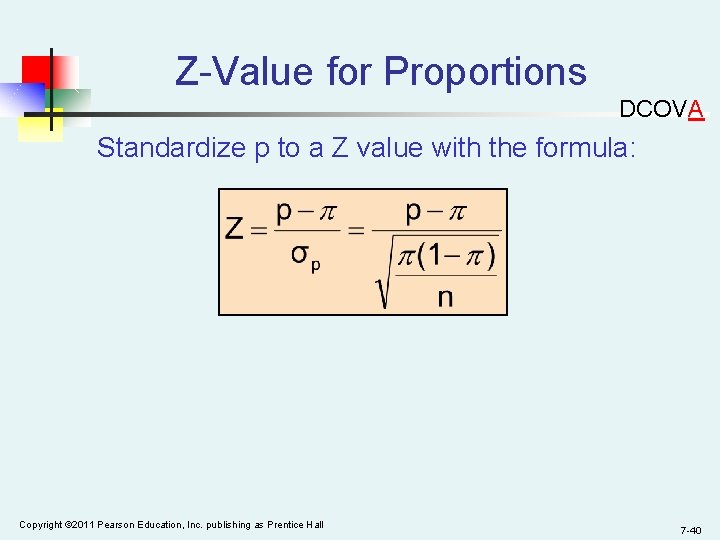
Z-Value for Proportions DCOVA Standardize p to a Z value with the formula: Copyright © 2011 Pearson Education, Inc. publishing as Prentice Hall 7 -40
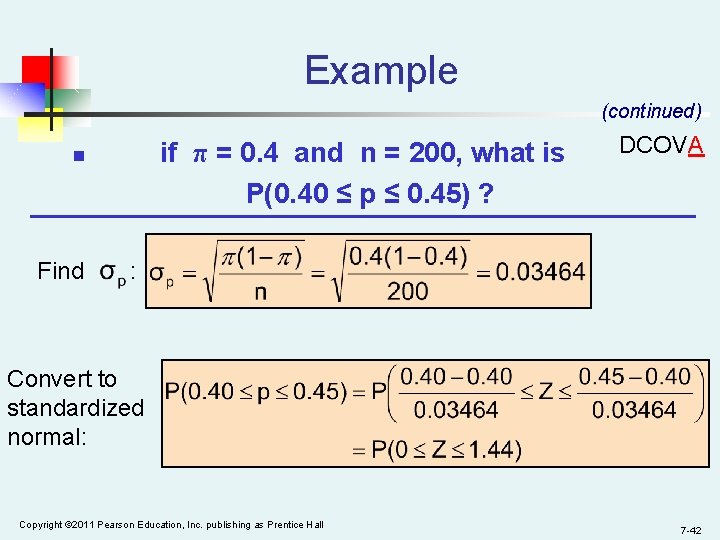
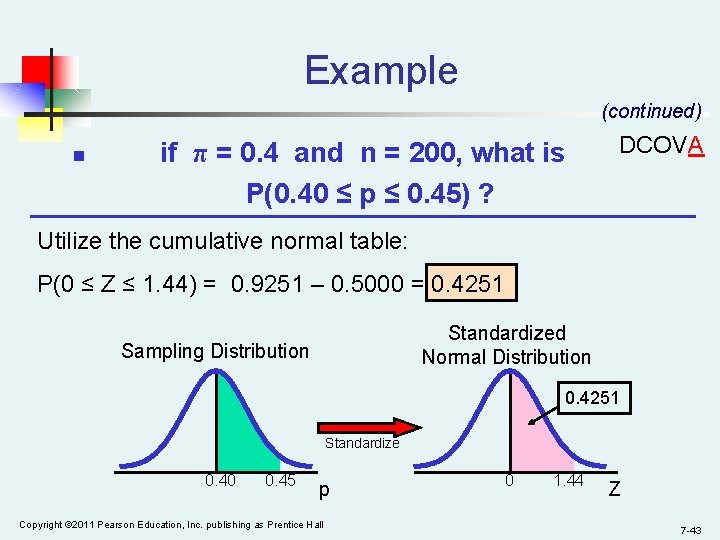
Example DCOVA n n If the true proportion of voters who support Proposition A is π = 0. 4, what is the probability that a sample of size 200 yields a sample proportion between 0. 40 and 0. 45? i. e. : if π = 0. 4 and n = 200, what is P(0. 40 ≤ p ≤ 0. 45) ? Copyright © 2011 Pearson Education, Inc. publishing as Prentice Hall 7 -41
Example (continued) if π = 0. 4 and n = 200, what is P(0. 40 ≤ p ≤ 0. 45) ? n Find DCOVA : Convert to standardized normal: Copyright © 2011 Pearson Education, Inc. publishing as Prentice Hall 7 -42
Example (continued) n if π = 0. 4 and n = 200, what is P(0. 40 ≤ p ≤ 0. 45) ? DCOVA Utilize the cumulative normal table: P(0 ≤ Z ≤ 1. 44) = 0. 9251 – 0. 5000 = 0. 4251 Standardized Normal Distribution Sampling Distribution 0. 4251 Standardize 0. 40 0. 45 p Copyright © 2011 Pearson Education, Inc. publishing as Prentice Hall 0 1. 44 Z 7 -43
Chapter Summary n n n n Discussed probability and nonprobability samples Described four common probability samples Examined survey worthiness and types of survey errors Introduced sampling distributions Described the sampling distribution of the mean n For normal populations n Using the Central Limit Theorem Described the sampling distribution of a proportion Calculated probabilities using sampling distributions Copyright © 2011 Pearson Education, Inc. publishing as Prentice Hall 7 -44
Statistics for Managers using Microsoft Excel 6 th Edition Online Topic Sampling From Finite Populations Copyright © 2011 Pearson Education, Inc. publishing as Prentice Hall 7 -45
Learning Objectives In this chapter, you learn: n n To know when finite population corrections are needed To know how to utilize finite population corrections factors in calculating standard errors Copyright © 2011 Pearson Education, Inc. publishing as Prentice Hall 7 -46
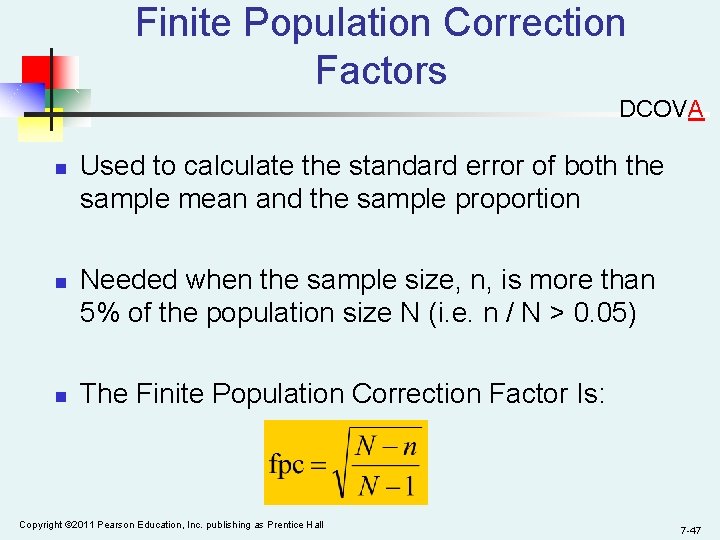
Finite Population Correction Factors DCOVA n n n Used to calculate the standard error of both the sample mean and the sample proportion Needed when the sample size, n, is more than 5% of the population size N (i. e. n / N > 0. 05) The Finite Population Correction Factor Is: Copyright © 2011 Pearson Education, Inc. publishing as Prentice Hall 7 -47
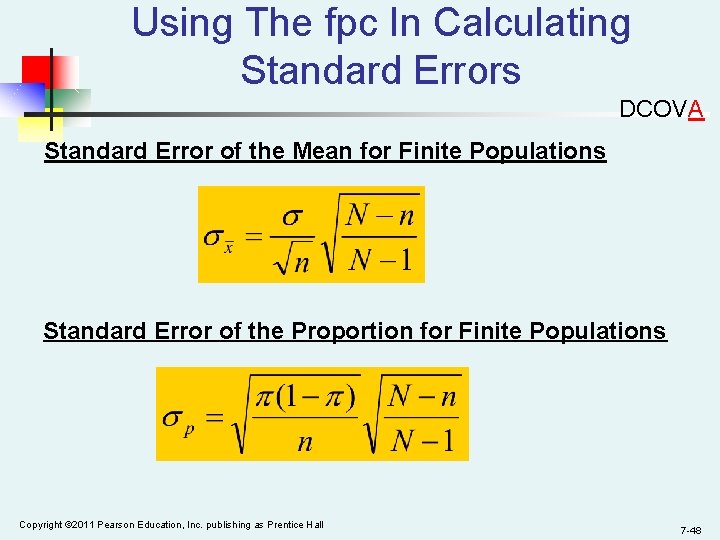
Using The fpc In Calculating Standard Errors DCOVA Standard Error of the Mean for Finite Populations Standard Error of the Proportion for Finite Populations Copyright © 2011 Pearson Education, Inc. publishing as Prentice Hall 7 -48
Using The fpc Reduces The Standard Error DCOVA n The fpc is always less than 1 n So when it is used it reduces the standard error n Resulting in more precise estimates of population parameters Copyright © 2011 Pearson Education, Inc. publishing as Prentice Hall 7 -49
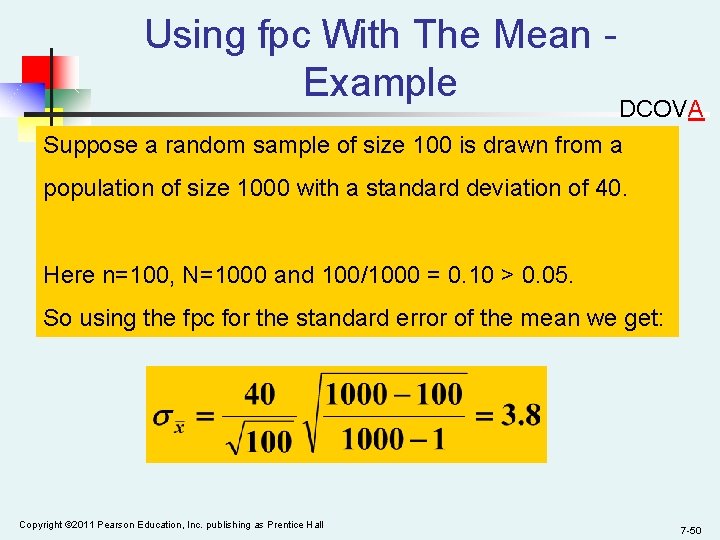
Using fpc With The Mean Example DCOVA Suppose a random sample of size 100 is drawn from a population of size 1000 with a standard deviation of 40. Here n=100, N=1000 and 100/1000 = 0. 10 > 0. 05. So using the fpc for the standard error of the mean we get: Copyright © 2011 Pearson Education, Inc. publishing as Prentice Hall 7 -50
Section Summary n n Identified when a finite population correction should be used. Identified how to utilize a finite population correction factor in calculating the standard error of both a sample mean and a sample proportion Copyright © 2011 Pearson Education, Inc. publishing as Prentice Hall 7 -51
All rights reserved. No part of this publication may be reproduced, stored in a retrieval system, or transmitted, in any form or by any means, electronic, mechanical, photocopying, recording, or otherwise, without the prior written permission of the publisher. Printed in the United States of America. Copyright © 2011 Pearson Education, Inc. publishing as Prentice Hall 7 -52