
STATISTICS Chapter 5 b Probability Addition Rule C
STATISTICS Chapter 5 b Probability Addition Rule C. M. Pascual 1

Definition v Compound Event Any event combining 2 or more simple events C. M. Pascual 2

Definition v Compound Event Any event combining 2 or more simple events v Notation P(A or B) = P (event A occurs or event B occurs or they both occur) C. M. Pascual 3
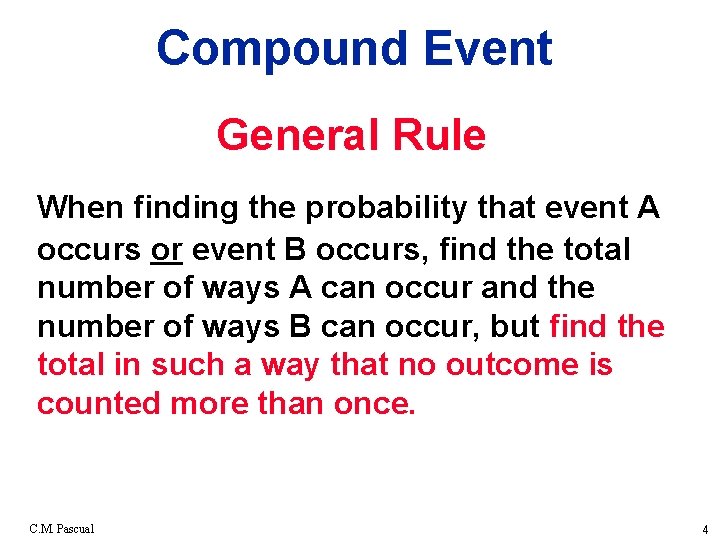
Compound Event General Rule When finding the probability that event A occurs or event B occurs, find the total number of ways A can occur and the number of ways B can occur, but find the total in such a way that no outcome is counted more than once. C. M. Pascual 4
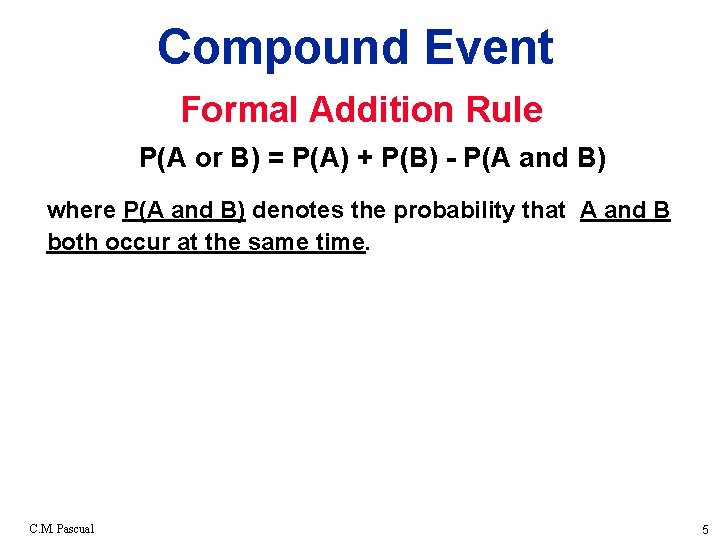
Compound Event Formal Addition Rule P(A or B) = P(A) + P(B) - P(A and B) where P(A and B) denotes the probability that A and B both occur at the same time. C. M. Pascual 5

Compound Event Formal Addition Rule P(A or B) = P(A) + P(B) - P(A and B) where P(A and B) denotes the probability that A and B both occur at the same time. Intuitive Addition Rule To find P(A or B), find the sum of the number of ways event A can occur and the number of ways event B can occur, adding in such a way that every outcome is counted only once. P(A or B) is equal to that sum, divided by the total number of outcomes. C. M. Pascual 6
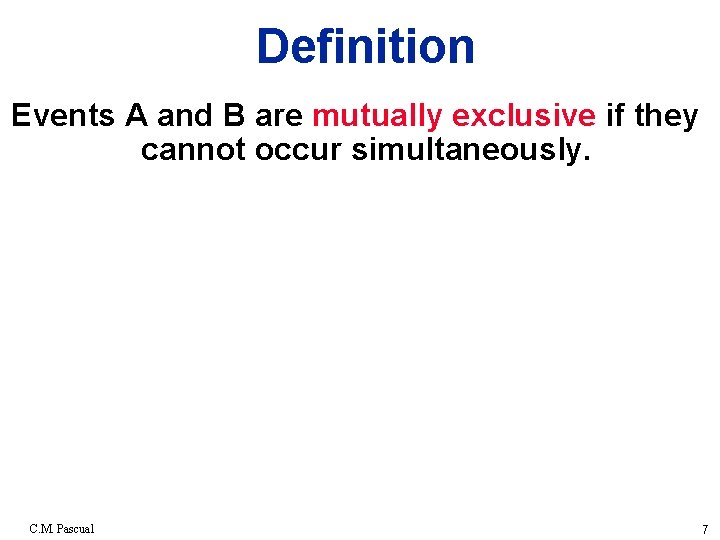
Definition Events A and B are mutually exclusive if they cannot occur simultaneously. C. M. Pascual 7
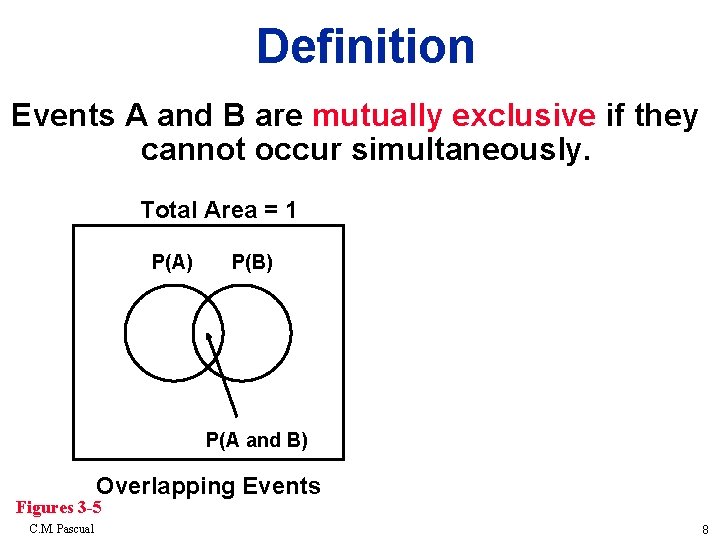
Definition Events A and B are mutually exclusive if they cannot occur simultaneously. Total Area = 1 P(A) P(B) P(A and B) Overlapping Events Figures 3 -5 C. M. Pascual 8
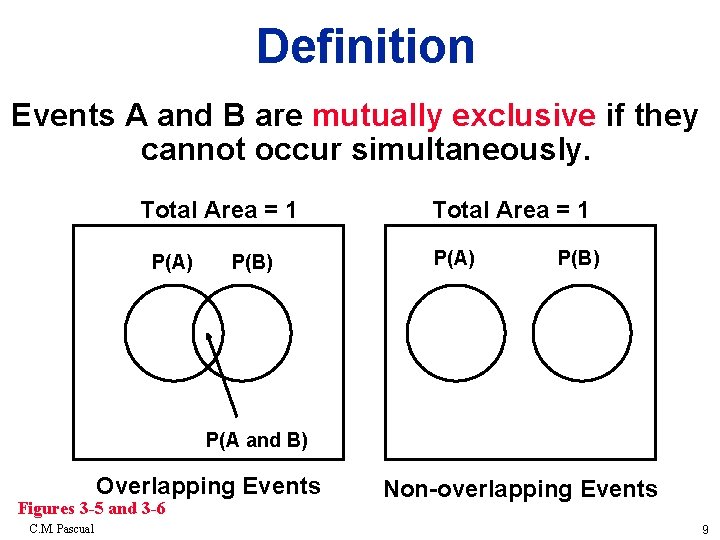
Definition Events A and B are mutually exclusive if they cannot occur simultaneously. Total Area = 1 P(A) P(B) P(A and B) Overlapping Events Figures 3 -5 and 3 -6 C. M. Pascual Non-overlapping Events 9
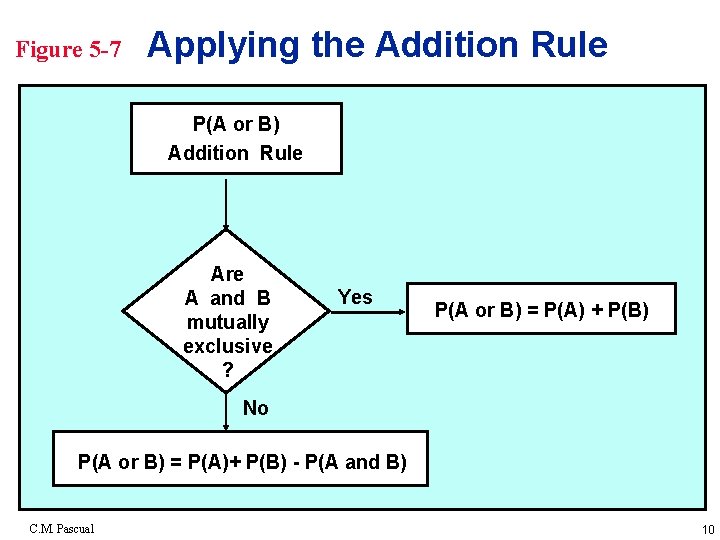
Figure 5 -7 Applying the Addition Rule P(A or B) Addition Rule Are A and B mutually exclusive ? Yes P(A or B) = P(A) + P(B) No P(A or B) = P(A)+ P(B) - P(A and B) C. M. Pascual 10
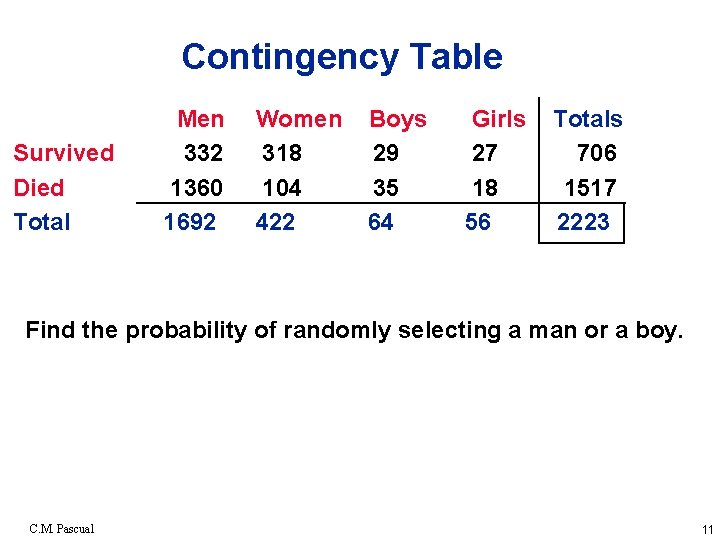
Contingency Table Survived Died Total Men 332 1360 1692 Women 318 104 422 Boys 29 35 64 Girls 27 18 56 Totals 706 1517 2223 Find the probability of randomly selecting a man or a boy. C. M. Pascual 11
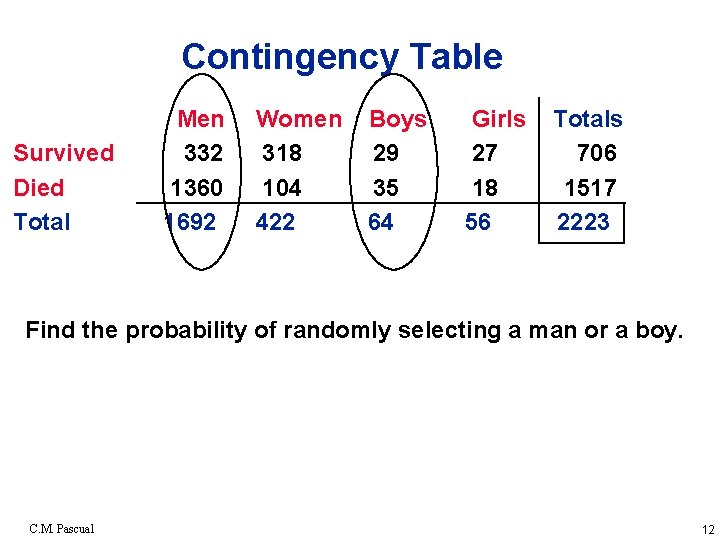
Contingency Table Survived Died Total Men 332 1360 1692 Women 318 104 422 Boys 29 35 64 Girls 27 18 56 Totals 706 1517 2223 Find the probability of randomly selecting a man or a boy. C. M. Pascual 12
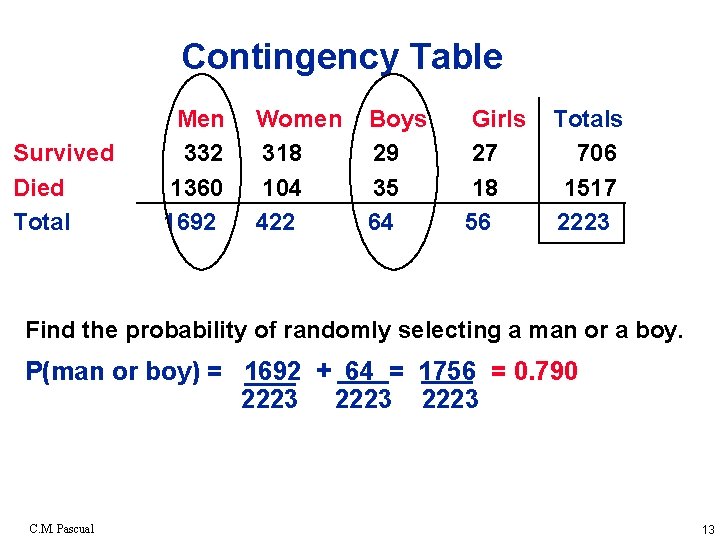
Contingency Table Survived Died Total Men 332 1360 1692 Women 318 104 422 Boys 29 35 64 Girls 27 18 56 Totals 706 1517 2223 Find the probability of randomly selecting a man or a boy. P(man or boy) = 1692 + 64 = 1756 = 0. 790 2223 C. M. Pascual 13
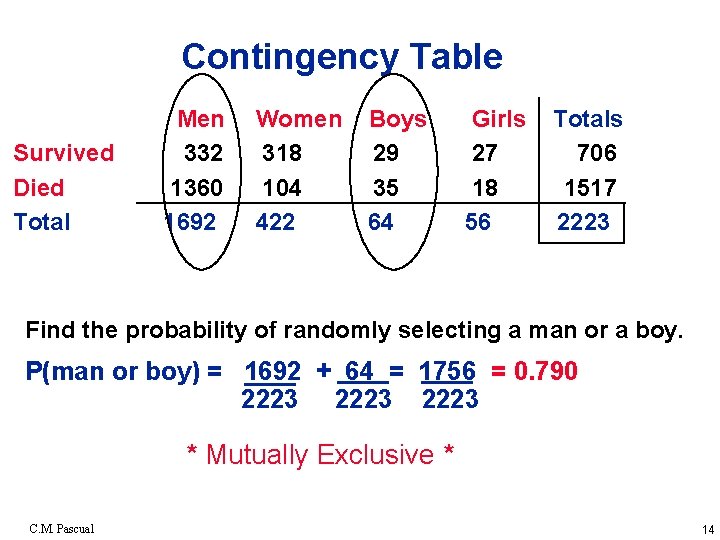
Contingency Table Survived Died Total Men 332 1360 1692 Women 318 104 422 Boys 29 35 64 Girls 27 18 56 Totals 706 1517 2223 Find the probability of randomly selecting a man or a boy. P(man or boy) = 1692 + 64 = 1756 = 0. 790 2223 * Mutually Exclusive * C. M. Pascual 14
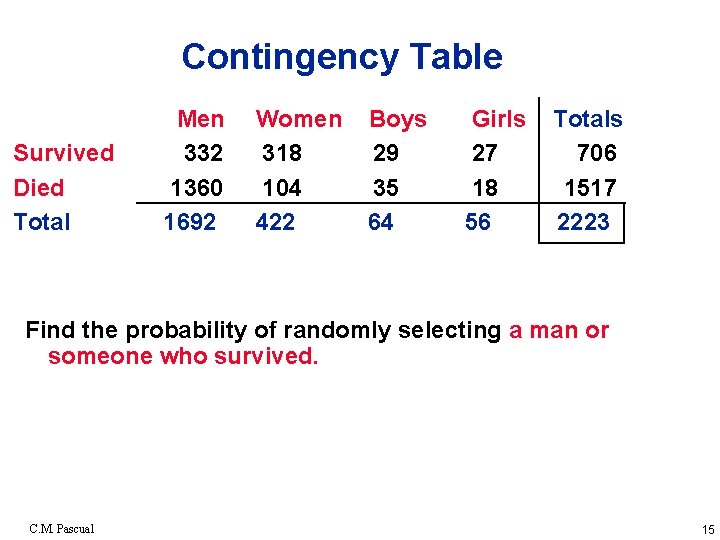
Contingency Table Survived Died Total Men 332 1360 1692 Women 318 104 422 Boys 29 35 64 Girls 27 18 56 Totals 706 1517 2223 Find the probability of randomly selecting a man or someone who survived. C. M. Pascual 15
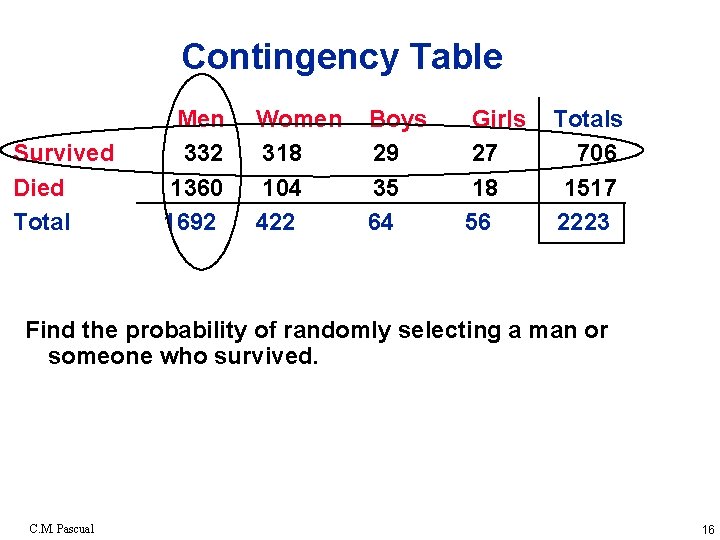
Contingency Table Survived Died Total Men 332 1360 1692 Women 318 104 422 Boys 29 35 64 Girls 27 18 56 Totals 706 1517 2223 Find the probability of randomly selecting a man or someone who survived. C. M. Pascual 16
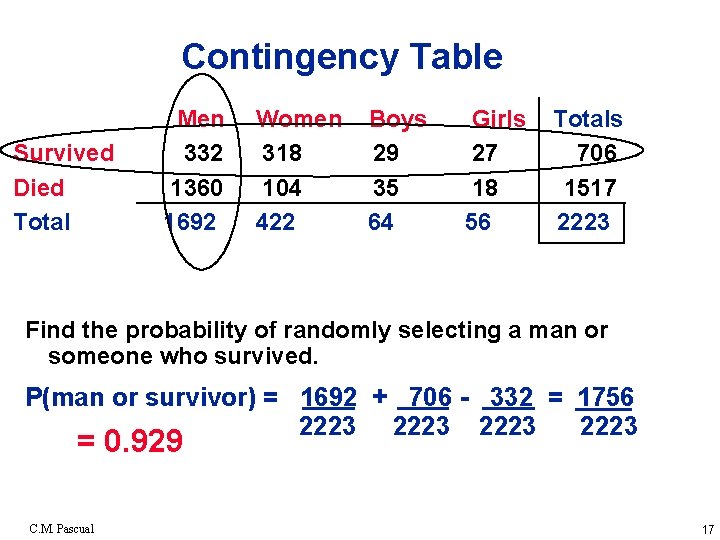
Contingency Table Survived Died Total Men 332 1360 1692 Women 318 104 422 Boys 29 35 64 Girls 27 18 56 Totals 706 1517 2223 Find the probability of randomly selecting a man or someone who survived. P(man or survivor) = 1692 + 706 - 332 = 1756 2223 = 0. 929 C. M. Pascual 17
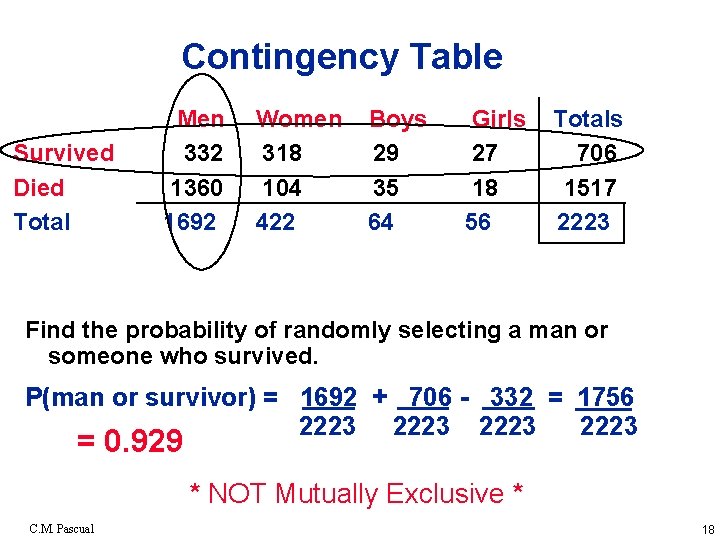
Contingency Table Survived Died Total Men 332 1360 1692 Women 318 104 422 Boys 29 35 64 Girls 27 18 56 Totals 706 1517 2223 Find the probability of randomly selecting a man or someone who survived. P(man or survivor) = 1692 + 706 - 332 = 1756 2223 = 0. 929 * NOT Mutually Exclusive * C. M. Pascual 18
Complementary Events C. M. Pascual 19
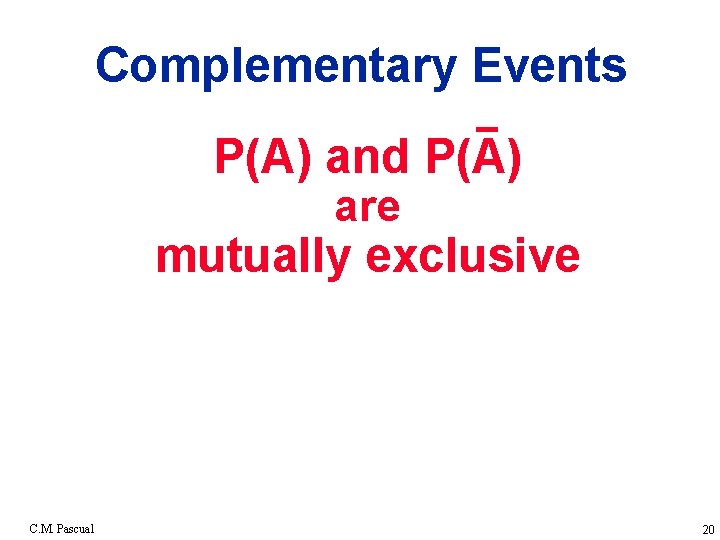
Complementary Events P(A) and P(A) are mutually exclusive C. M. Pascual 20
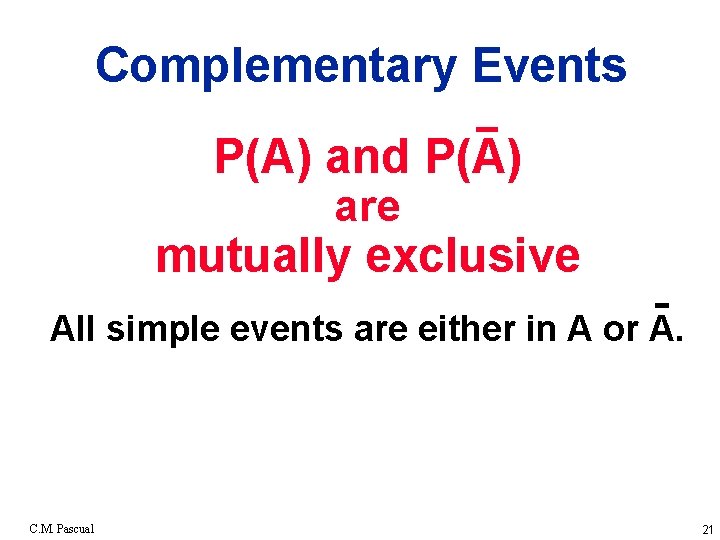
Complementary Events P(A) and P(A) are mutually exclusive All simple events are either in A or A. C. M. Pascual 21
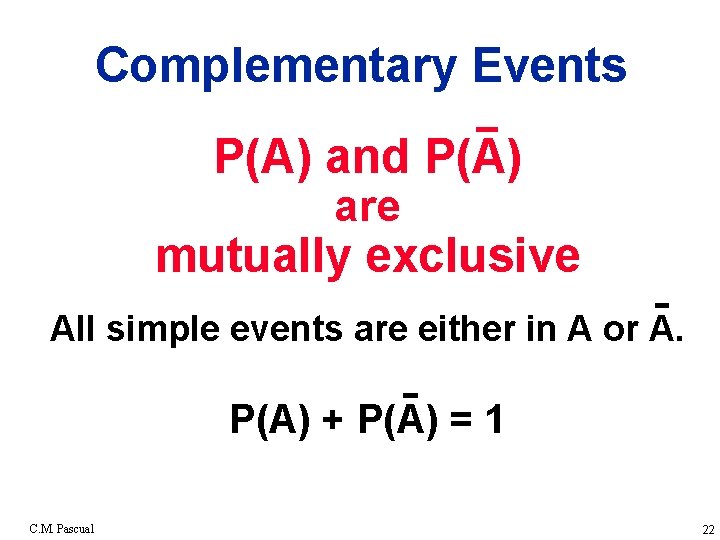
Complementary Events P(A) and P(A) are mutually exclusive All simple events are either in A or A. P(A) + P(A) = 1 C. M. Pascual 22
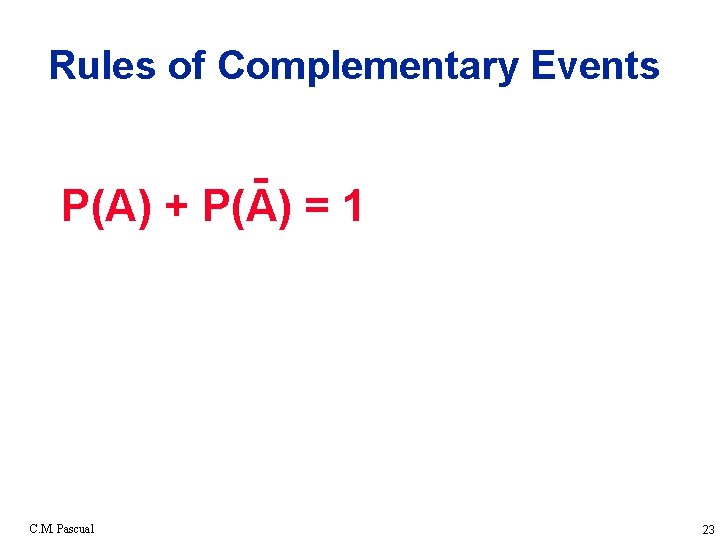
Rules of Complementary Events P(A) + P(A) = 1 C. M. Pascual 23
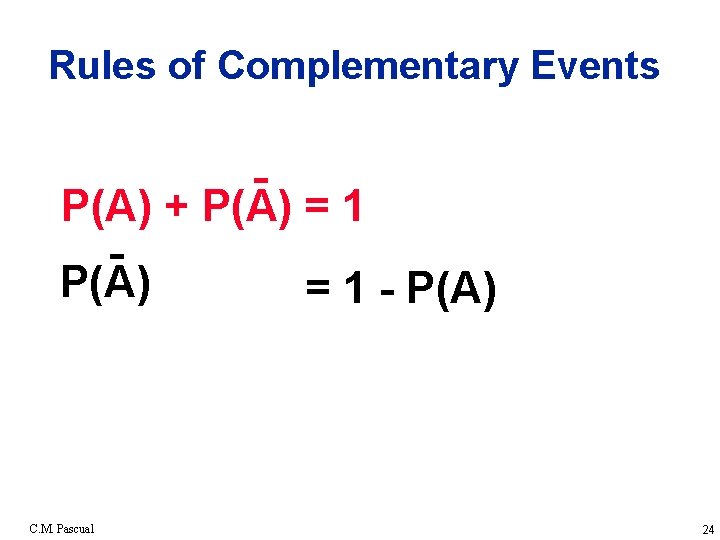
Rules of Complementary Events P(A) + P(A) = 1 P(A) C. M. Pascual = 1 - P(A) 24
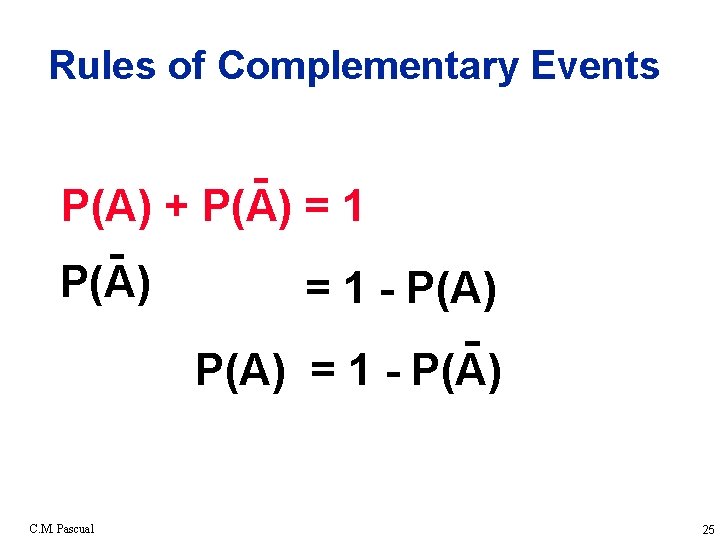
Rules of Complementary Events P(A) + P(A) = 1 - P(A) C. M. Pascual 25
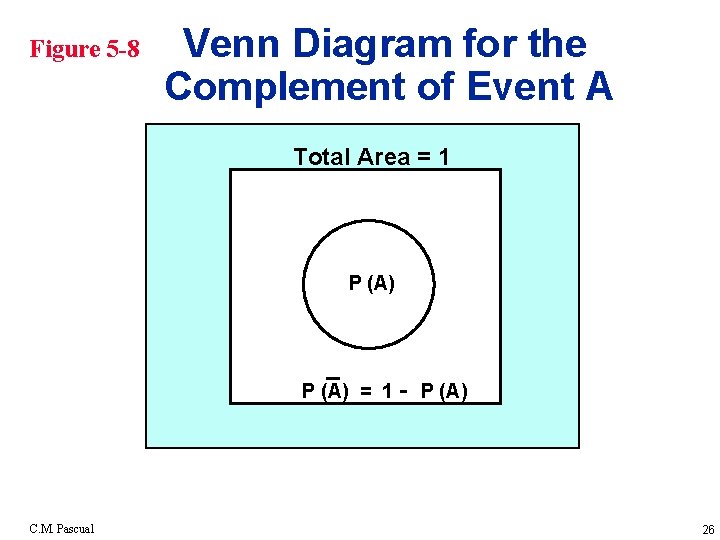
Figure 5 -8 Venn Diagram for the Complement of Event A Total Area = 1 P (A) = 1 - P (A) C. M. Pascual 26
- Slides: 26