
STATISTICS Chapter 5 a Probability C M Pascual
STATISTICS Chapter 5 a Probability C. M. Pascual 1
Chapter 5 Probability 5 -1 Overview 5 -2 Fundamentals 5 -3 Addition Rule 5 -4 Multiplication Rule: Basics 5 -5 Multiplication Rule: Complements and Conditional Probability 5 -6 Probabilities Through Simulations 5 -7 Counting C. M. Pascual 2
5 -1 Overview Objectives v develop sound understanding of probability values used in subsequent chapters v develop basic skills necessary to solve simple probability problems Rare Event Rule for Inferential Statistics: If, under a given assumption, the probability of a particular observed event is extremely small, we conclude that the assumption is probably not correct. C. M. Pascual 3
5 -2 Fundamentals Definitions v. Event - any collection of results or outcomes from some procedure v Simple event - any outcome or event that cannot be broken down into simpler components v Sample space - all possible simple events C. M. Pascual 4
Notation P - denotes a probability A, B, . . . - denote specific events P (A) C. M. Pascual denotes the probability of event A occurring 5
Basic Rules for Computing Probability Rule 1: Relative Frequency Approximation Conduct (or observe) an experiment a large number of times, and count the number of times event A actually occurs, then an estimate of P(A) is C. M. Pascual 6
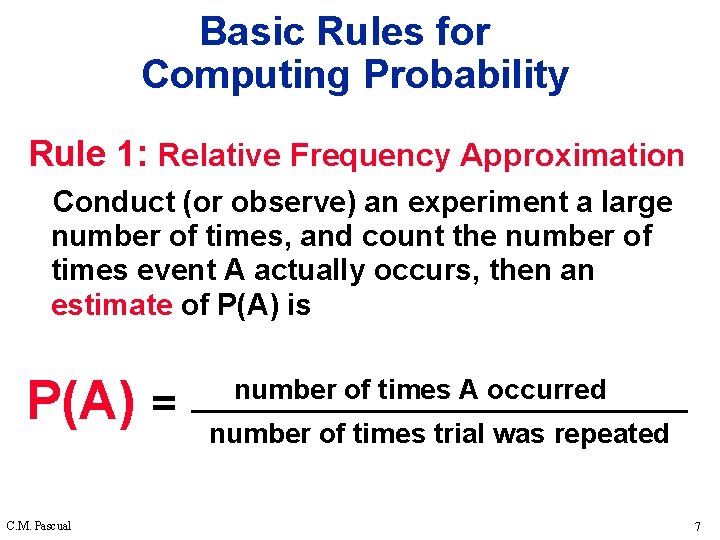
Basic Rules for Computing Probability Rule 1: Relative Frequency Approximation Conduct (or observe) an experiment a large number of times, and count the number of times event A actually occurs, then an estimate of P(A) is P(A) = C. M. Pascual number of times A occurred number of times trial was repeated 7
Basic Rules for Computing Probability Rule 2: Classical approach (requires equally likely outcomes) If a procedure has n different simple events, each with an equal chance of occurring, and s is the number of ways event A can occur, then C. M. Pascual 8
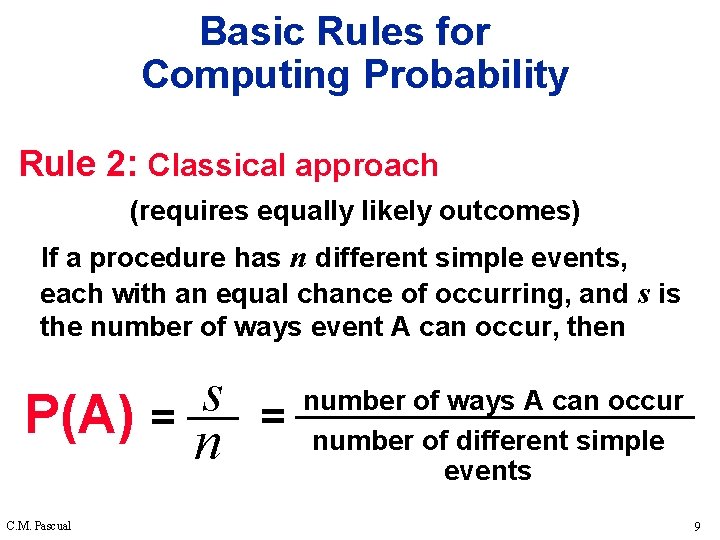
Basic Rules for Computing Probability Rule 2: Classical approach (requires equally likely outcomes) If a procedure has n different simple events, each with an equal chance of occurring, and s is the number of ways event A can occur, then s P(A) = n = C. M. Pascual number of ways A can occur number of different simple events 9

Basic Rules for Computing Probability Rule 3: Subjective Probabilities P(A), the probability of A, is found by simply guessing or estimating its value based on knowledge of the relevant circumstances. C. M. Pascual 10
Rule 1 The relative frequency approach is an approximation. C. M. Pascual 11
Rule 1 The relative frequency approach is an approximation. Rule 2 The classical approach is the actual probability. C. M. Pascual 12
Law of Large Numbers As a procedure is repeated again and again, the relative frequency probability (from Rule 1) of an event tends to approach the actual probability. C. M. Pascual 13
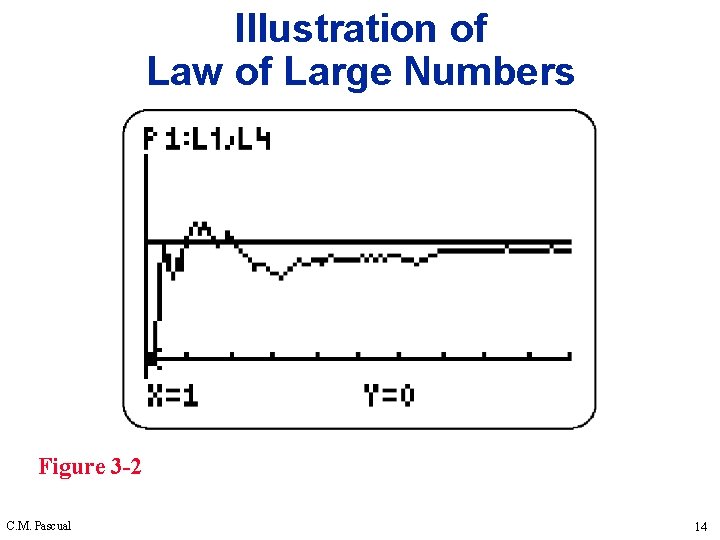
Illustration of Law of Large Numbers Figure 3 -2 C. M. Pascual 14
Example: Find the probability that a randomly selected person will be struck by lightning this year. The sample space consists of two simple events: the person is struck by lightning or is not. Because these simple events are not equally likely, we can use the relative frequency approximation (Rule 1) or subjectively estimate the probability (Rule 3). Using Rule 1, we can research past events to determine that in a recent year 377 people were struck by lightning in the US, which has a population of about 274, 037, 295. Therefore, P(struck by lightning in a year) 377 / 274, 037, 295 1/727, 000 C. M. Pascual 15
Example: On an ACT or SAT test, a typical multiplechoice question has 5 possible answers. If you make a random guess on one such question, what is the probability that your response is wrong? There are 5 possible outcomes or answers, and there are 4 ways to answer incorrectly. Random guessing implies that the outcomes in the sample space are equally likely, so we apply the classical approach (Rule 2) to get: P(wrong answer) = 4 / 5 = 0. 8 C. M. Pascual 16
Probability Limits v The probability of an impossible event is 0. v The probability of an event that is certain to occur is 1. C. M. Pascual 17
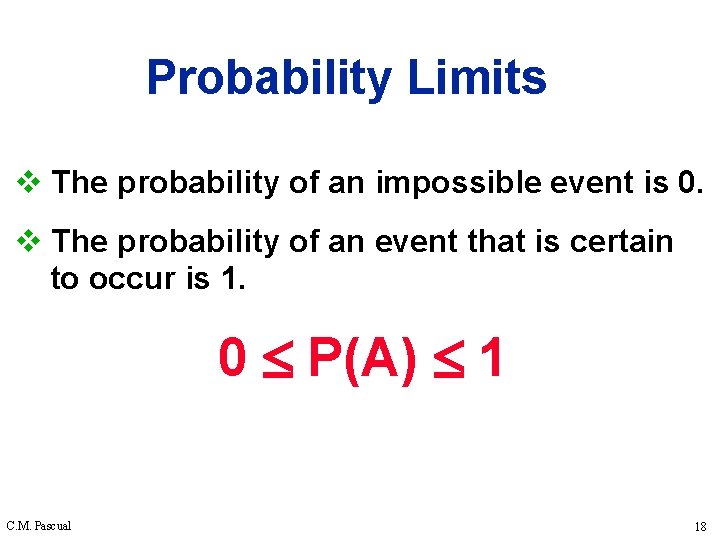
Probability Limits v The probability of an impossible event is 0. v The probability of an event that is certain to occur is 1. 0 P(A) 1 C. M. Pascual 18
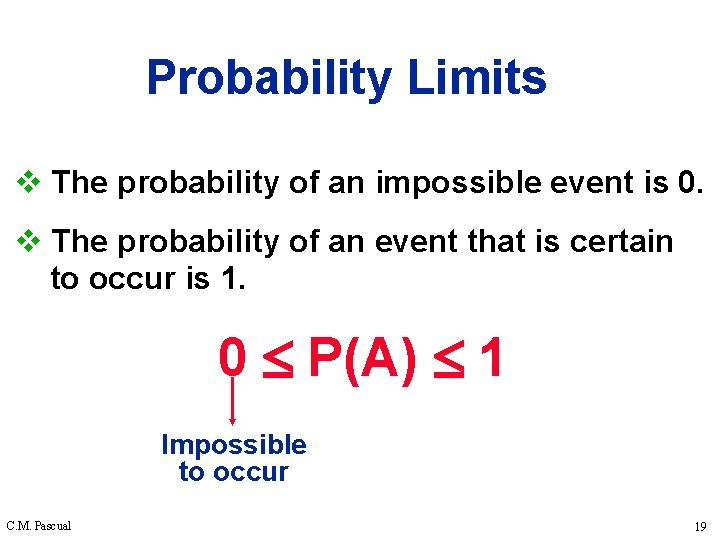
Probability Limits v The probability of an impossible event is 0. v The probability of an event that is certain to occur is 1. 0 P(A) 1 Impossible to occur C. M. Pascual 19
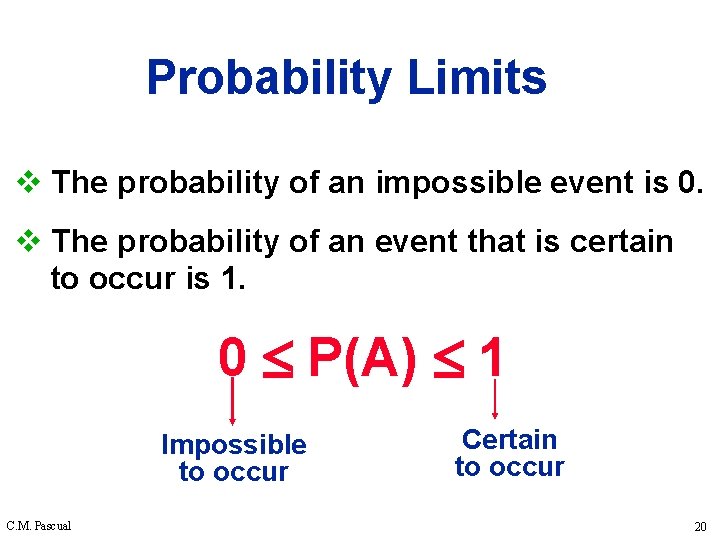
Probability Limits v The probability of an impossible event is 0. v The probability of an event that is certain to occur is 1. 0 P(A) 1 Impossible to occur C. M. Pascual Certain to occur 20
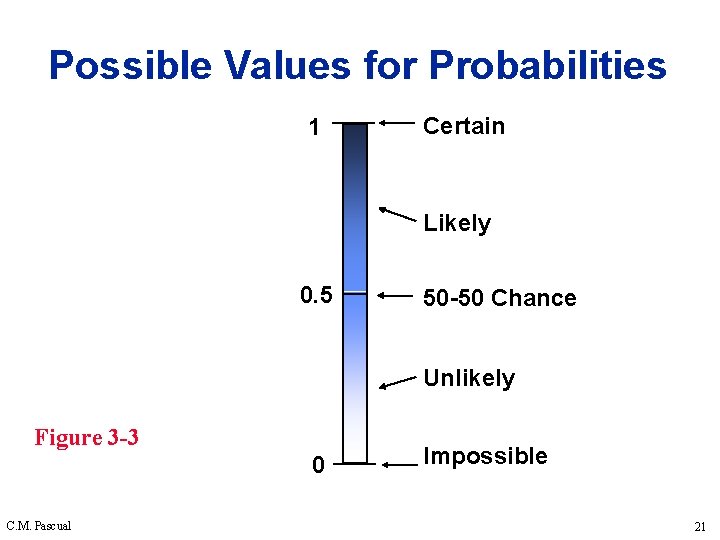
Possible Values for Probabilities 1 Certain Likely 0. 5 50 -50 Chance Unlikely Figure 3 -3 0 C. M. Pascual Impossible 21
Complementary Events C. M. Pascual 22
Complementary Events The complement of event A, denoted by A, consists of all outcomes in which event A does not occur. C. M. Pascual 23
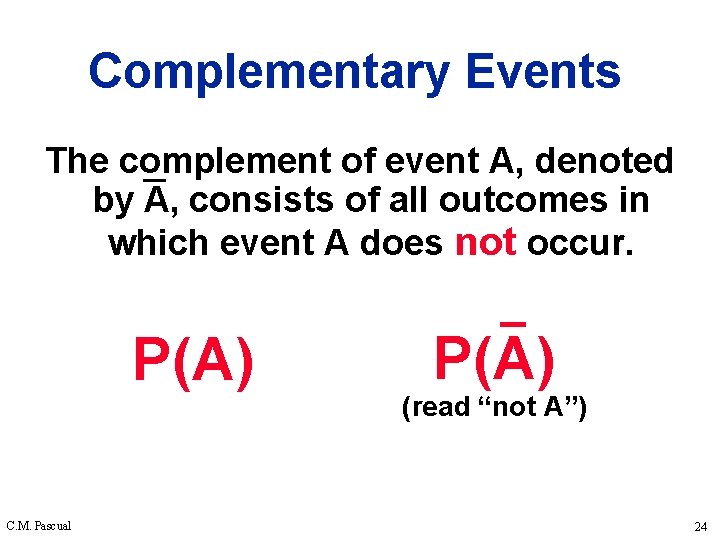
Complementary Events The complement of event A, denoted by A, consists of all outcomes in which event A does not occur. P(A) C. M. Pascual P(A) (read “not A”) 24
Example: Testing Corvettes The General Motors Corporation wants to conduct a test of a new model of Corvette. A pool of 50 drivers has been recruited, 20 or whom are men. When the first person is selected from this pool, what is the probability of not getting a male driver? C. M. Pascual 25
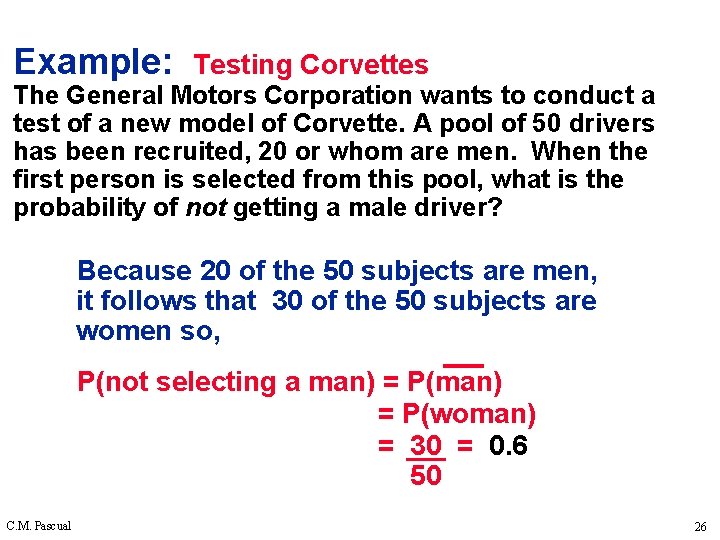
Example: Testing Corvettes The General Motors Corporation wants to conduct a test of a new model of Corvette. A pool of 50 drivers has been recruited, 20 or whom are men. When the first person is selected from this pool, what is the probability of not getting a male driver? Because 20 of the 50 subjects are men, it follows that 30 of the 50 subjects are women so, P(not selecting a man) = P(woman) = 30 = 0. 6 50 C. M. Pascual 26
Rounding Off Probabilities vgive the exact fraction or decimal or C. M. Pascual 27
Rounding Off Probabilities vgive the exact fraction or decimal or vround off the final result to three significant digits C. M. Pascual 28
Odds C. M. Pascual 29
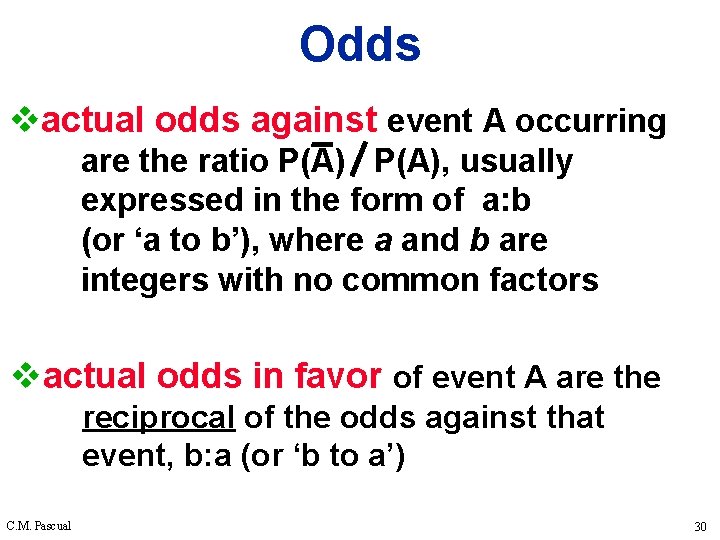
Odds vactual odds against event A occurring are the ratio P(A), usually expressed in the form of a: b (or ‘a to b’), where a and b are integers with no common factors vactual odds in favor of event A are the reciprocal of the odds against that event, b: a (or ‘b to a’) C. M. Pascual 30
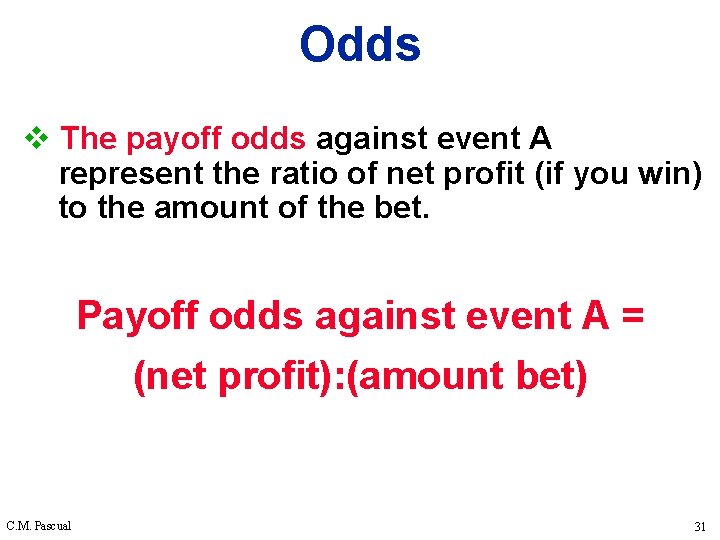
Odds v The payoff odds against event A represent the ratio of net profit (if you win) to the amount of the bet. Payoff odds against event A = (net profit): (amount bet) C. M. Pascual 31
- Slides: 31