
Statistics Chapter 1 Sections 1 1 1 2

- Slides: 13
Statistics Chapter 1 Sections 1. 1 -1. 2
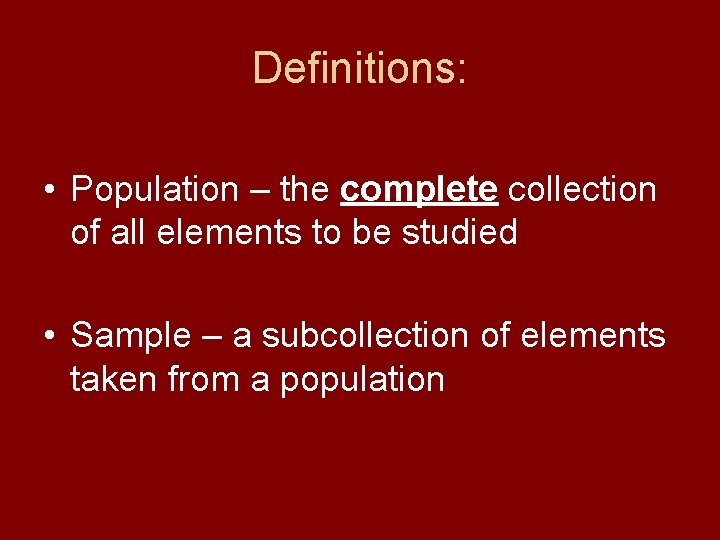
Definitions: • Population – the complete collection of all elements to be studied • Sample – a subcollection of elements taken from a population
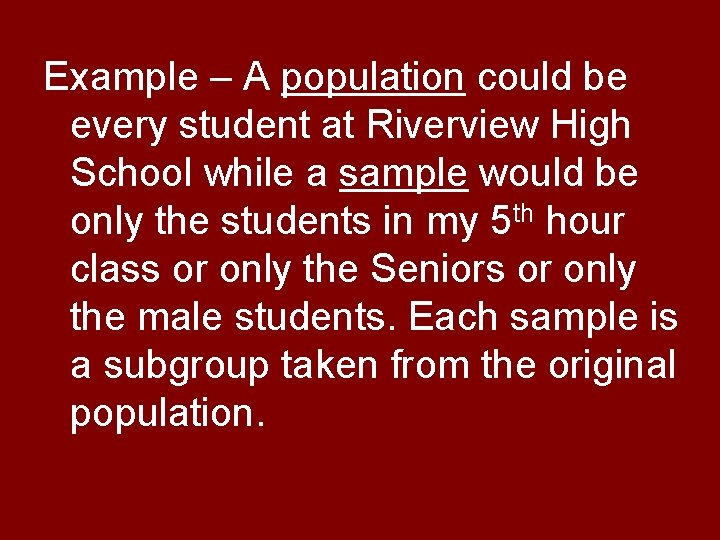
Example – A population could be every student at Riverview High School while a sample would be only the students in my 5 th hour class or only the Seniors or only the male students. Each sample is a subgroup taken from the original population.
• Parameter – a numerical measurement describing some characteristic of a population. • Example – 32% of the students at RCHS plan to attend the sock hop after the football game. • Hint – Population and parameter both start with “p”.
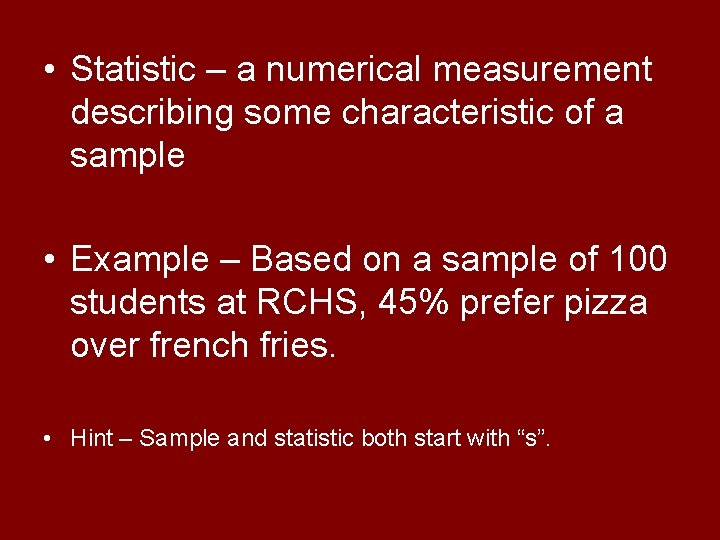
• Statistic – a numerical measurement describing some characteristic of a sample • Example – Based on a sample of 100 students at RCHS, 45% prefer pizza over french fries. • Hint – Sample and statistic both start with “s”.
• Quantitative data – numbers that represent counts or measurements. • Examples – incomes of college graduates, scores on Chapter 1 test, amount of time spent studying each evening, GPAs
• Qualitative data – nonnumeric data • Examples – favorite color, favorite food, gender
• Discrete data – the number must be a finite number (has an ending), typically this is data that must be a whole number • Examples – number of students, number of desks, number of books, number of puppies
• Continuous data – the data value corresponds to a continuous scale that covers a range of values (i. e. the number can be taken out to many decimal places and recorded more and more accurately…basically a decimal number) • Examples – any type of measurement, height, weight, amounts of liquid, etc.
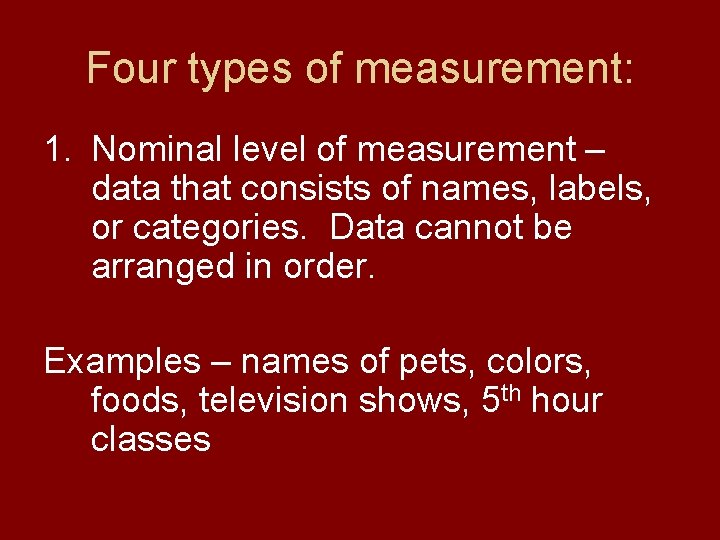
Four types of measurement: 1. Nominal level of measurement – data that consists of names, labels, or categories. Data cannot be arranged in order. Examples – names of pets, colors, foods, television shows, 5 th hour classes
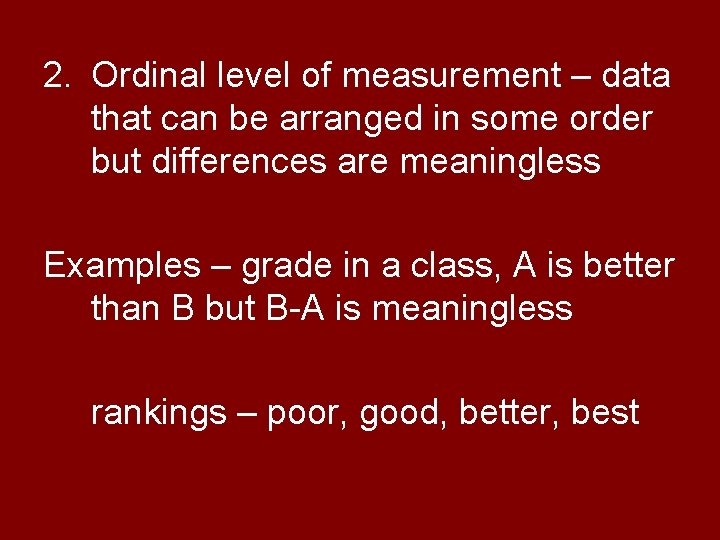
2. Ordinal level of measurement – data that can be arranged in some order but differences are meaningless Examples – grade in a class, A is better than B but B-A is meaningless rankings – poor, good, better, best
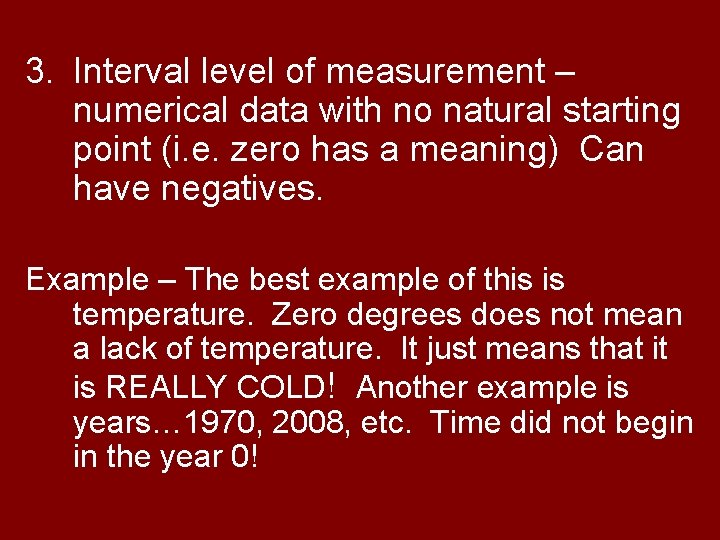
3. Interval level of measurement – numerical data with no natural starting point (i. e. zero has a meaning) Can have negatives. Example – The best example of this is temperature. Zero degrees does not mean a lack of temperature. It just means that it is REALLY COLD! Another example is years… 1970, 2008, etc. Time did not begin in the year 0!
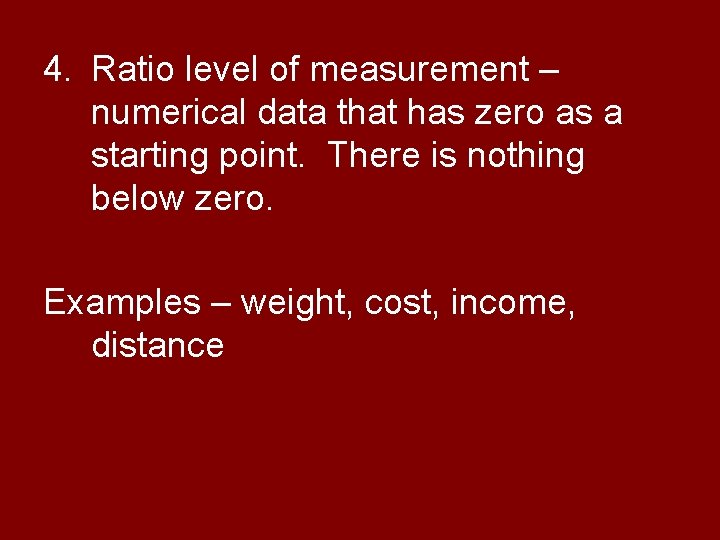
4. Ratio level of measurement – numerical data that has zero as a starting point. There is nothing below zero. Examples – weight, cost, income, distance