
Statistics Canadas Survey Methodology for the New Services


- Slides: 25
Statistics Canada’s Survey Methodology for the New Services Producer Price Index Surveys By: Saad Rais, Statistics Canada Zdenek Patak, Statistics Canada Statistique Canada Statistics Canada 1
Outline of Presentation n n Introduction Sampling Design Estimation Outlier Detection Conclusion 2
Introduction What is a Price Index? n Proportionate change in the price of goods or services over time What is its purpose? n n Deflator Indicator 3
Introduction Users: n n n Government departments Private companies Economists, analysts, researchers etc. Examples: n n n Consumer Price Index Import and Export Price Index Producer Price Index 4
Introduction Price Indices in Canada n n Price indices were mostly limited to the goods sector 2003 - Service industry accounted for 75% of employment and 68% of the GDP in Canada Five year plan to produce a set of Services Producer Price Indices (SPPI) Focus on a survey methodology that is based on sound statistical principles 5
Sampling Design Two Stage Design: n n Sampling of businesses Sampling of items within each business 6
Sampling Scheme Common method: Judgmental sampling n n Straightforward sampling and estimation Absence of a complete reliable frame Limited resources Statistical quality measures cannot be calculated 7
Sampling Scheme Cut-off sampling n n n Yields a sample with the optimal coverage of some size measure variable – revenue in our surveys Susceptible to biased estimates No sample rotation 8
Sampling Scheme Stratified Simple Random Sampling Without Replacement (Stratified SRSWOR) n n n Common Sampling scheme for business surveys A probability sample Abundance of literature Size stratification Each unit has equal probability of selection 9
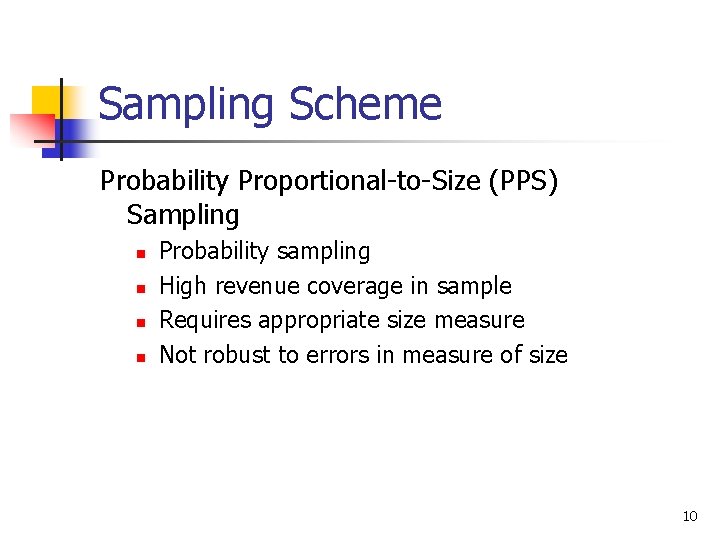
Sampling Scheme Probability Proportional-to-Size (PPS) Sampling n n Probability sampling High revenue coverage in sample Requires appropriate size measure Not robust to errors in measure of size 10
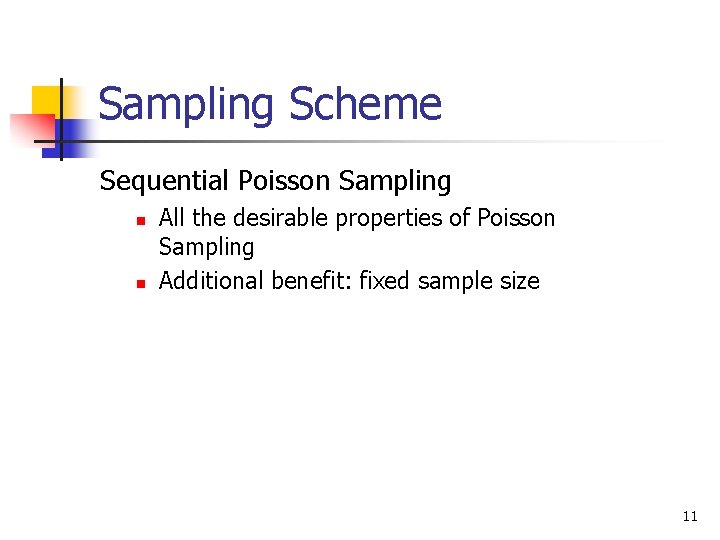
Sampling Scheme Sequential Poisson Sampling n n All the desirable properties of Poisson Sampling Additional benefit: fixed sample size 11
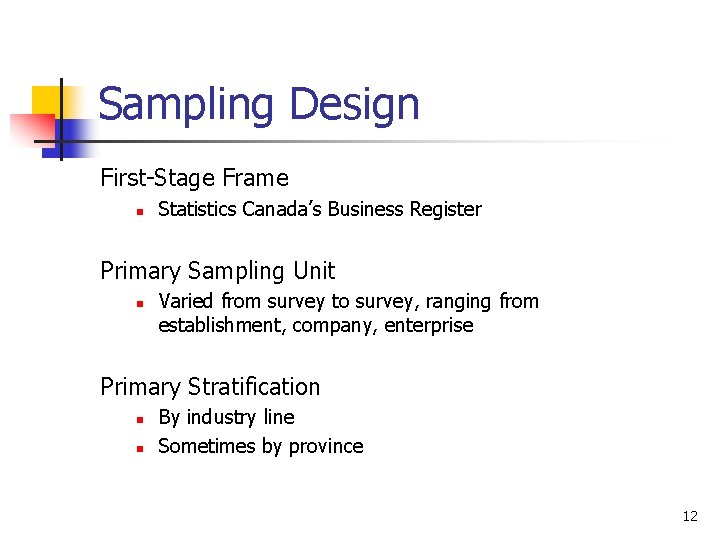
Sampling Design First-Stage Frame n Statistics Canada’s Business Register Primary Sampling Unit n Varied from survey to survey, ranging from establishment, company, enterprise Primary Stratification n n By industry line Sometimes by province 12
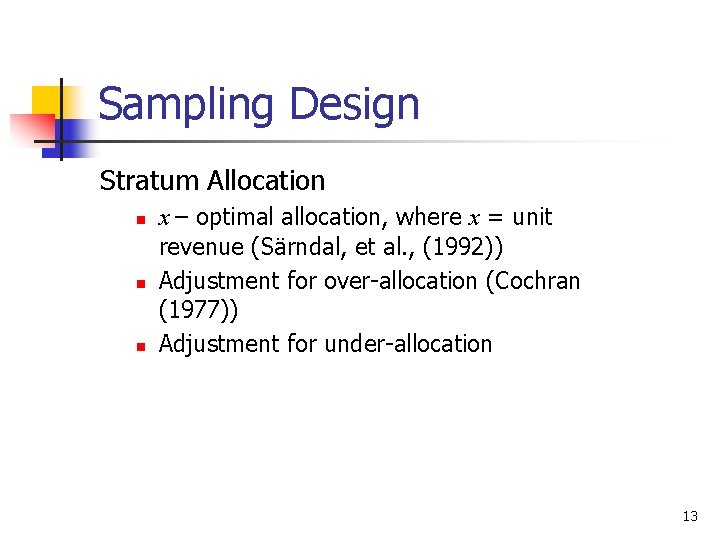
Sampling Design Stratum Allocation n x – optimal allocation, where x = unit revenue (Särndal, et al. , (1992)) Adjustment for over-allocation (Cochran (1977)) Adjustment for under-allocation 13
Sampling Design Sample Size n n n Based on availability of resources and expert knowledge and experience No previous or related data available to anticipate response rate or target a CV to estimate a sample size Improvements to sample size will be made after obtaining sufficient data 14
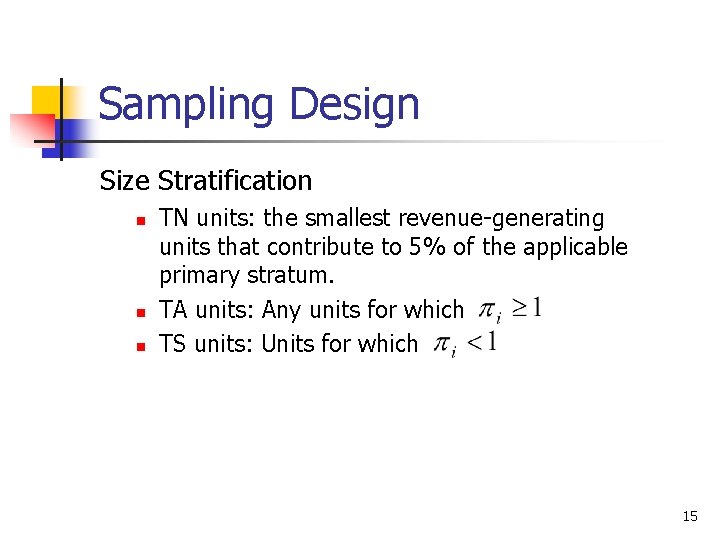
Sampling Design Size Stratification n TN units: the smallest revenue-generating units that contribute to 5% of the applicable primary stratum. TA units: Any units for which TS units: Units for which 15
Sampling Design Second Stage Sampling: Selection of Items n n PPS sampling scheme n Requires a list of items for each business unit n Resource intensive, high response burden Therefore a judgmental sample is selected n Concerns: n No variance estimation n Sampling bias could result from not pricing representative items 16
Estimation in 2 stages: n n Elemental Indices Aggregate Indices 17
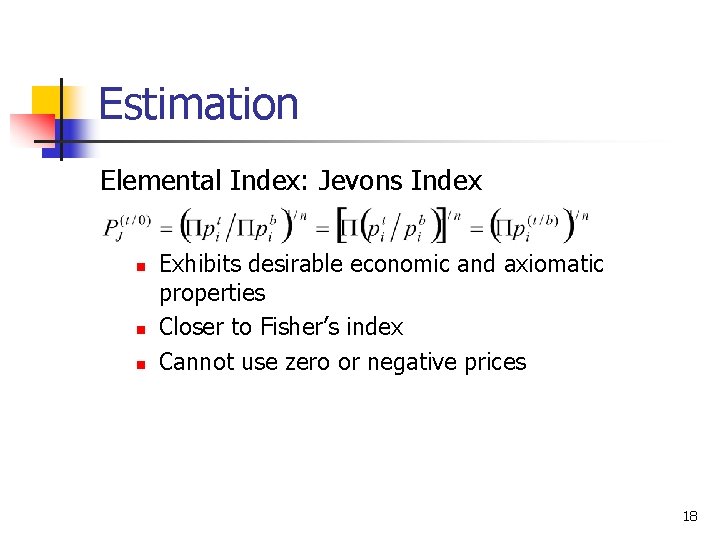
Estimation Elemental Index: Jevons Index n n n Exhibits desirable economic and axiomatic properties Closer to Fisher’s index Cannot use zero or negative prices 18
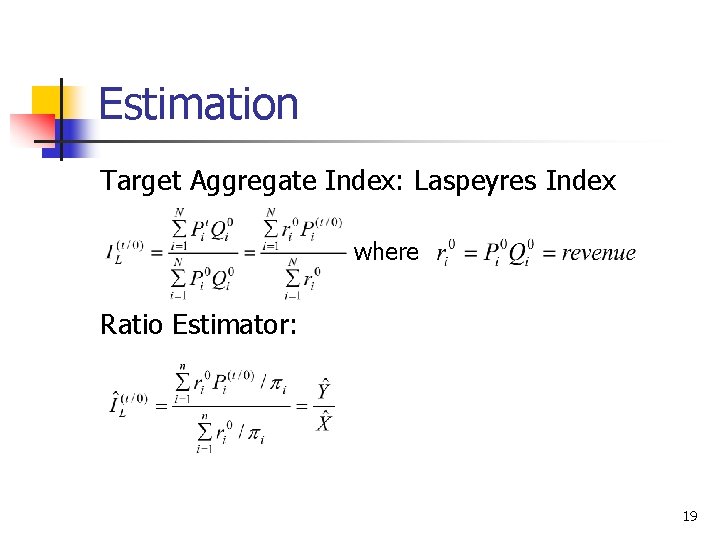
Estimation Target Aggregate Index: Laspeyres Index where Ratio Estimator: 19
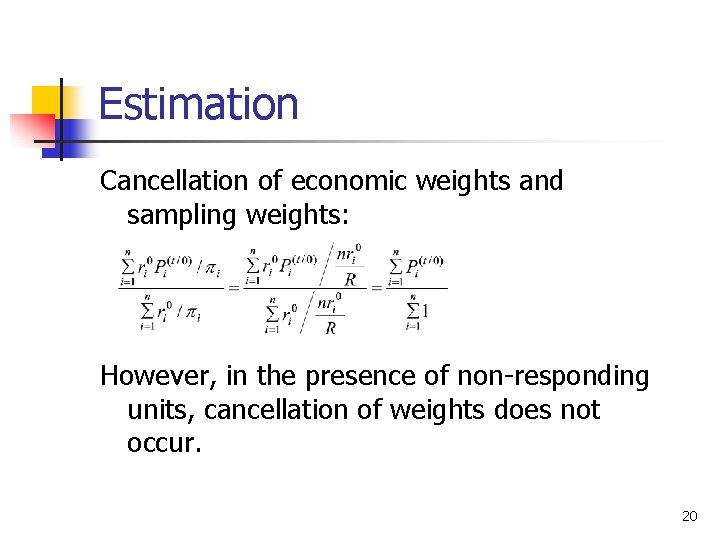
Estimation Cancellation of economic weights and sampling weights: However, in the presence of non-responding units, cancellation of weights does not occur. 20
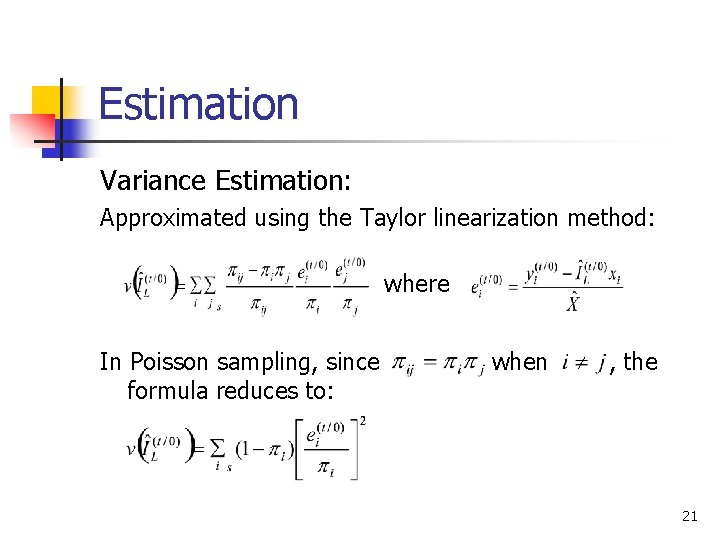
Estimation Variance Estimation: Approximated using the Taylor linearization method: where In Poisson sampling, since formula reduces to: when , the 21
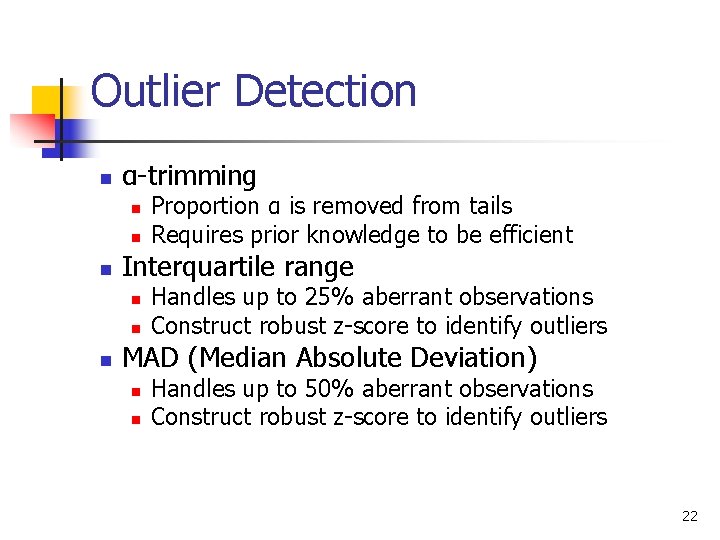
Outlier Detection n α-trimming n n n Interquartile range n n n Proportion α is removed from tails Requires prior knowledge to be efficient Handles up to 25% aberrant observations Construct robust z-score to identify outliers MAD (Median Absolute Deviation) n n Handles up to 50% aberrant observations Construct robust z-score to identify outliers 22
Conclusion Current and future projects n n Research on the efficiency of PPS sampling versus SRSWOR sampling Outlier detection methods Imputation methods Bootstrap variance estimation 23
Conclusion n Services industry is an integral component of our economy We are currently in the pilot/developmental stage of index production With the collection of data, efficiencies in the sample size, and further research will help improve our methodology 24
Thank You Pour de plus amples informations ou pour obtenir une copie en français du document veuillez contacter: For more information, or to obtain a French copy of the presentation, please contact: Saad Rais E-Mail: saad. rais@statcan. ca Statistique Canada Statistics Canada 25