
Statistics And Classification UNIT 1 Business Statistics BBA

Statistics And Classification UNIT – 1 Business Statistics BBA 206 By Kiran kalia
Statistics • The word 'Statistics' of english language originated from latin word 'Status' or Italian word 'statista' or german word 'Statistik. The meaning of all these word is 'Political State'. The word Statistics was first used by German Philospher Gottfried Ackenwall in 1749. He is called father of statistics. • • In Pural sense; “Statistics are numerical statements of facts in any department of enquiry to each other”. In Singular sense; Statistics is the science of esimating and probabilities.
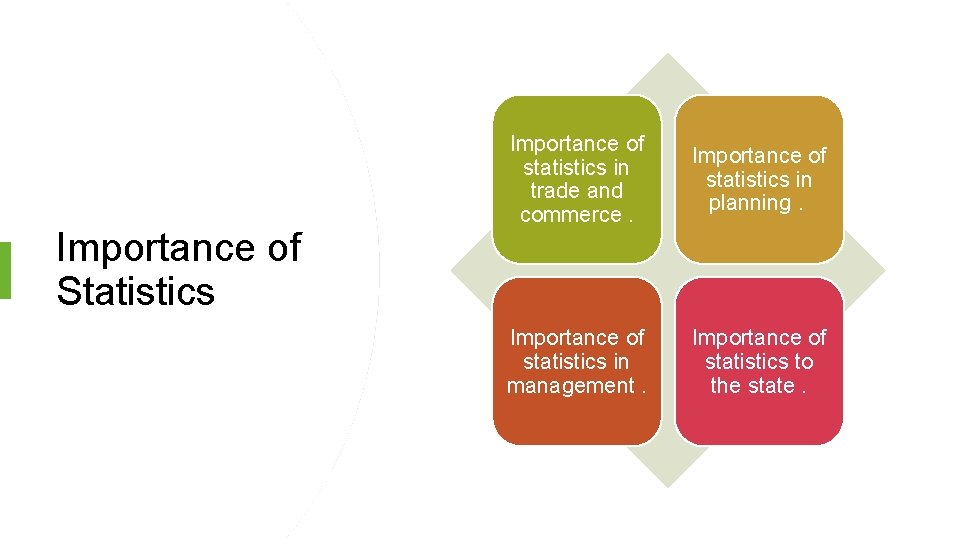
Importance of Statistics Importance of statistics in trade and commerce. Importance of statistics in planning. Importance of statistics in management. Importance of statistics to the state.
Scope of Statistics • Statistical Methods : Statistical methods are the devices used in statistics. Collection of data , Summarization of data , Presentation of data , Analysis of data , Interpretation of data • Applied Statistics : It is of two categories. • . Descriptive Applied Statistics • Scientific Applied statistics
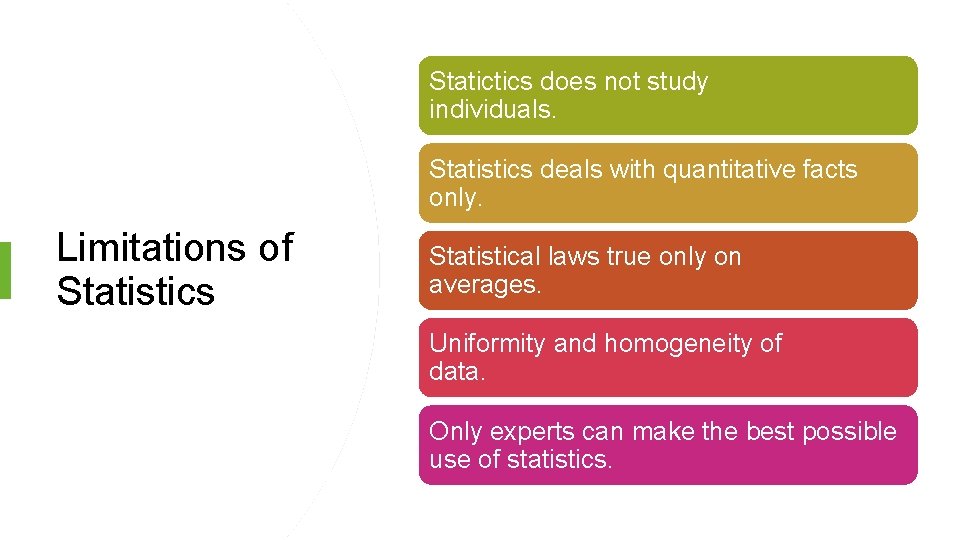
Statictics does not study individuals. Statistics deals with quantitative facts only. Limitations of Statistics Statistical laws true only on averages. Uniformity and homogeneity of data. Only experts can make the best possible use of statistics.
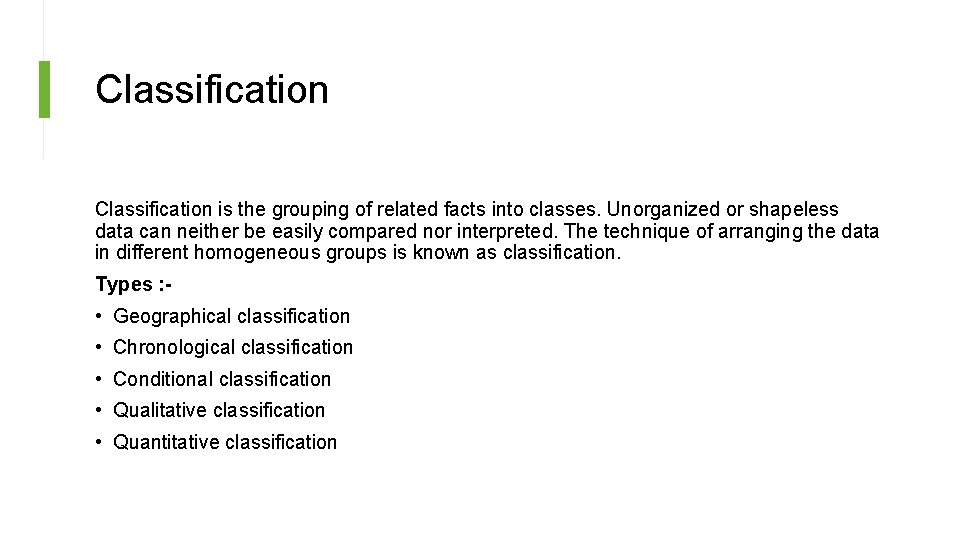
Classification is the grouping of related facts into classes. Unorganized or shapeless data can neither be easily compared nor interpreted. The technique of arranging the data in different homogeneous groups is known as classification. Types : - • Geographical classification • Chronological classification • Conditional classification • Qualitative classification • Quantitative classification
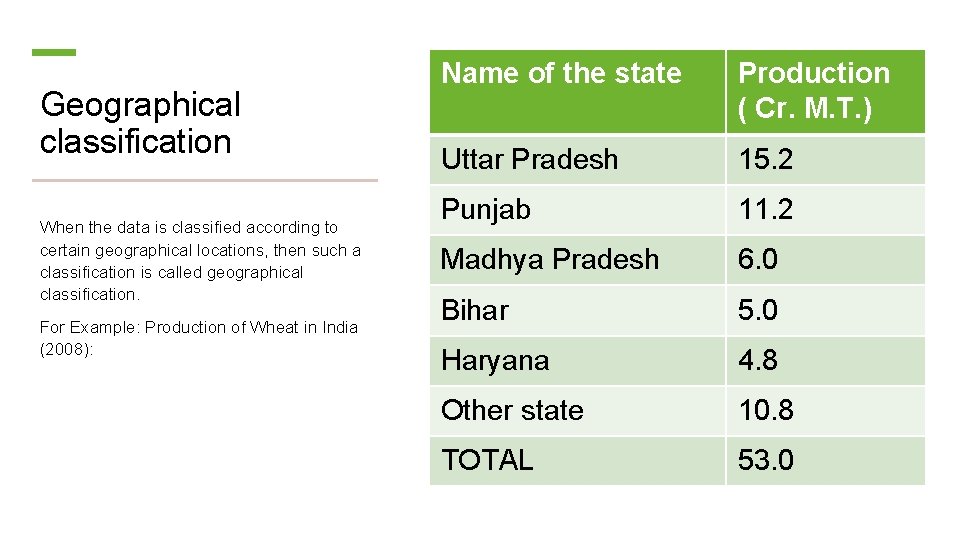
Geographical classification When the data is classified according to certain geographical locations, then such a classification is called geographical classification. For Example: Production of Wheat in India (2008): Name of the state Production ( Cr. M. T. ) Uttar Pradesh 15. 2 Punjab 11. 2 Madhya Pradesh 6. 0 Bihar 5. 0 Haryana 4. 8 Other state 10. 8 TOTAL 53. 0
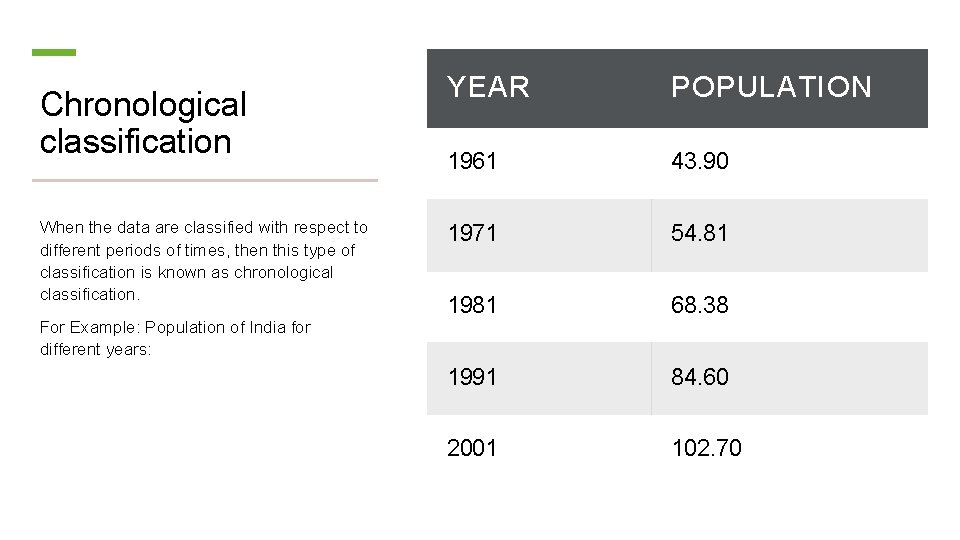
Chronological classification When the data are classified with respect to different periods of times, then this type of classification is known as chronological classification. For Example: Population of India for different years: YEAR POPULATION 1961 43. 90 1971 54. 81 1981 68. 38 1991 84. 60 2001 102. 70
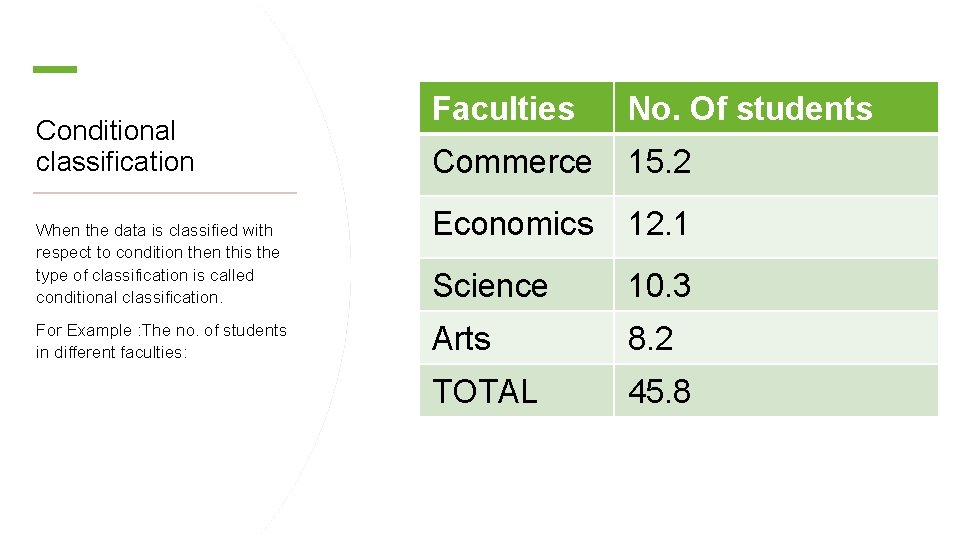
Conditional classification When the data is classified with respect to condition then this the type of classification is called conditional classification. For Example : The no. of students in different faculties: Faculties No. Of students Commerce 15. 2 Economics 12. 1 Science 10. 3 Arts 8. 2 TOTAL 45. 8
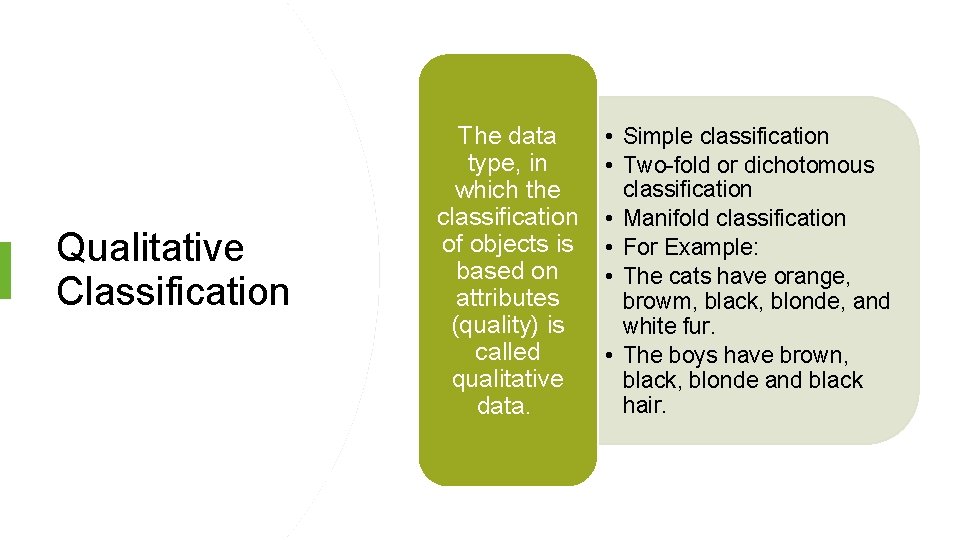
Qualitative Classification The data type, in which the classification of objects is based on attributes (quality) is called qualitative data. • Simple classification • Two-fold or dichotomous classification • Manifold classification • For Example: • The cats have orange, browm, black, blonde, and white fur. • The boys have brown, black, blonde and black hair.
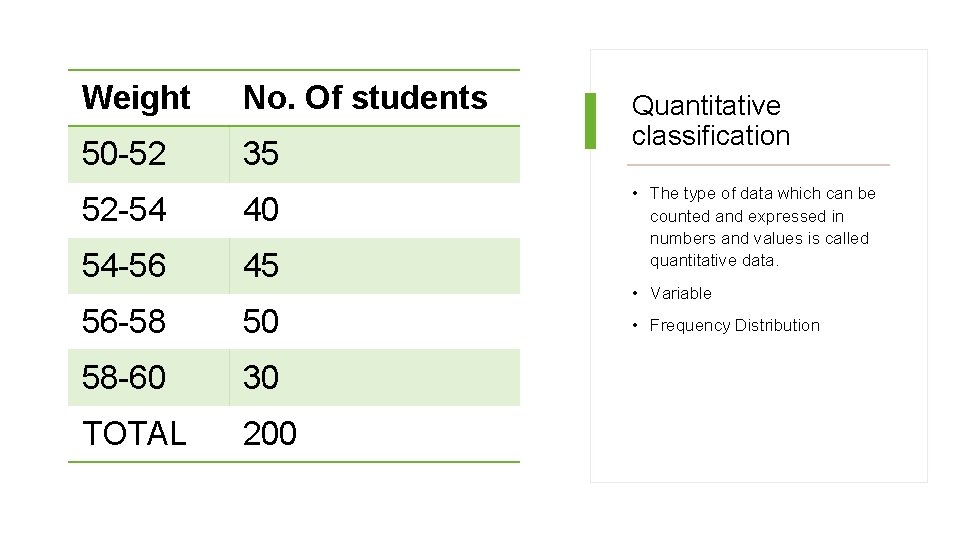
Weight No. Of students 50 -52 35 52 -54 40 54 -56 45 56 -58 50 58 -60 30 TOTAL 200 Quantitative classification • The type of data which can be counted and expressed in numbers and values is called quantitative data. • Variable • Frequency Distribution

THE END THANK YOU FOR WATCHING
- Slides: 12