
Statistics 201 Lecture 24 Back to Significance Testing
Statistics 201 – Lecture 24
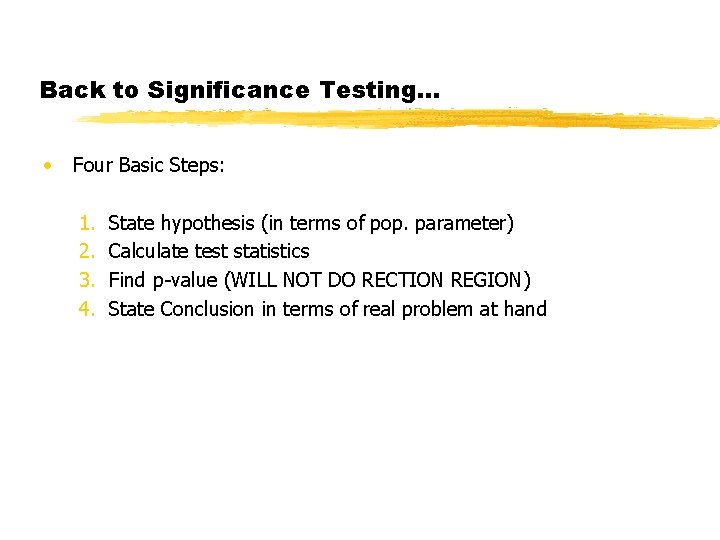
Back to Significance Testing… • Four Basic Steps: 1. 2. 3. 4. State hypothesis (in terms of pop. parameter) Calculate test statistics Find p-value (WILL NOT DO RECTION REGION) State Conclusion in terms of real problem at hand
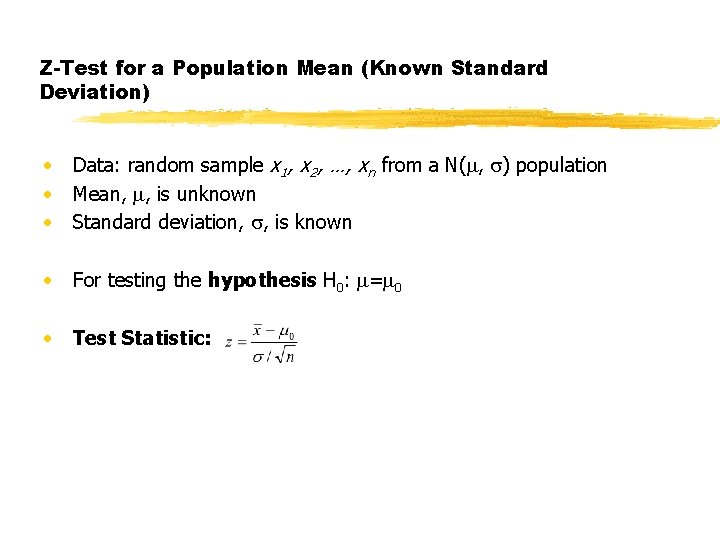
Z-Test for a Population Mean (Known Standard Deviation) • • • Data: random sample x 1, x 2, …, xn from a N(m, s) population Mean, m, is unknown Standard deviation, s, is known • For testing the hypothesis H 0: m=m 0 • Test Statistic:
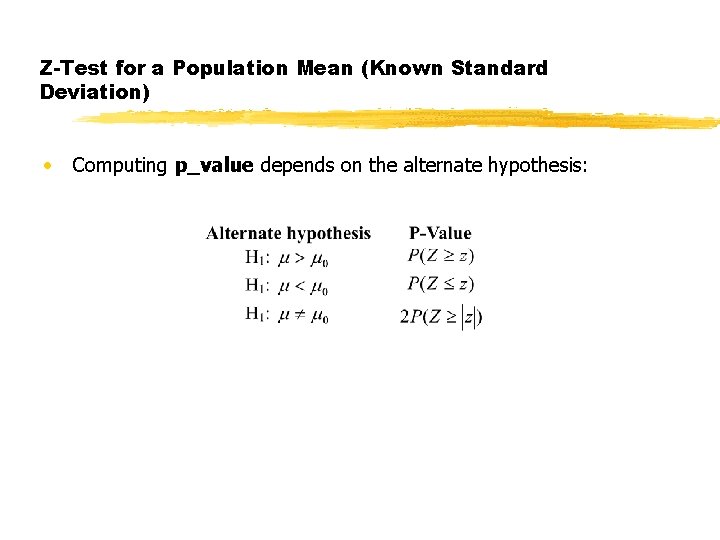
Z-Test for a Population Mean (Known Standard Deviation) • Computing p_value depends on the alternate hypothesis:
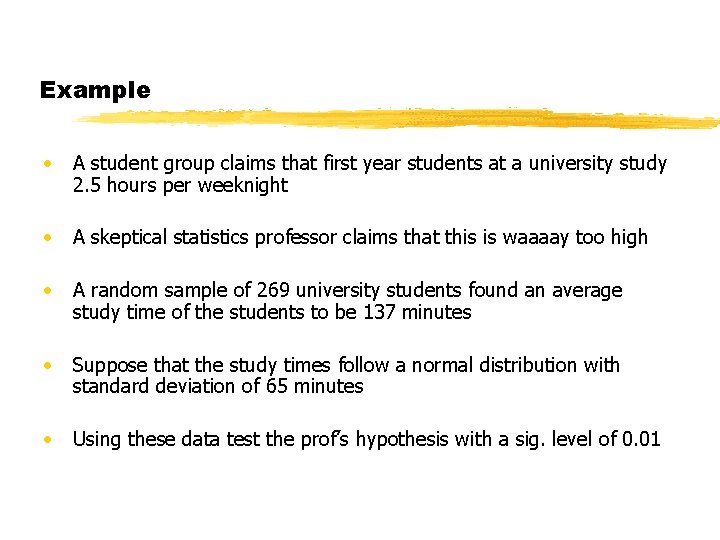
Example • A student group claims that first year students at a university study 2. 5 hours per weeknight • A skeptical statistics professor claims that this is waaaay too high • A random sample of 269 university students found an average study time of the students to be 137 minutes • Suppose that the study times follow a normal distribution with standard deviation of 65 minutes • Using these data test the prof’s hypothesis with a sig. level of 0. 01

Example • Hypotheses: • Test Statistic • P-value • Conclusion
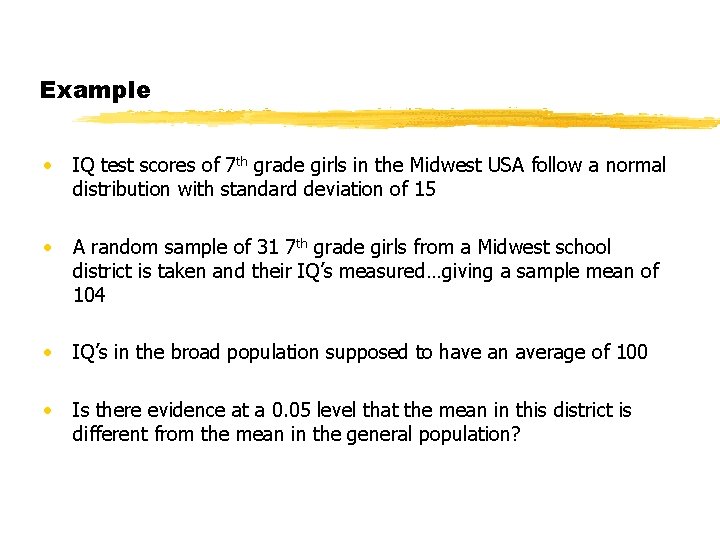
Example • IQ test scores of 7 th grade girls in the Midwest USA follow a normal distribution with standard deviation of 15 • A random sample of 31 7 th grade girls from a Midwest school district is taken and their IQ’s measured…giving a sample mean of 104 • IQ’s in the broad population supposed to have an average of 100 • Is there evidence at a 0. 05 level that the mean in this district is different from the mean in the general population?
Example • Hypotheses: • Test Statistic • P-value • Conclusion
- Slides: 8