
Statistically Recognize Faces Based on Hidden Markov Models
Statistically Recognize Faces Based on Hidden Markov Models Presented by Timothy Hsiao-Yi Chin Rahul Mody Timothy and Rahul E 6886 Project 1
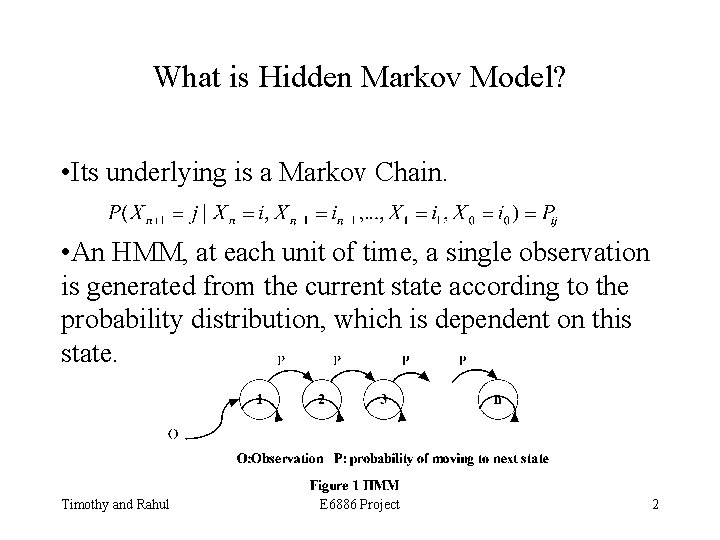
What is Hidden Markov Model? • Its underlying is a Markov Chain. • An HMM, at each unit of time, a single observation is generated from the current state according to the probability distribution, which is dependent on this state. Timothy and Rahul E 6886 Project 2
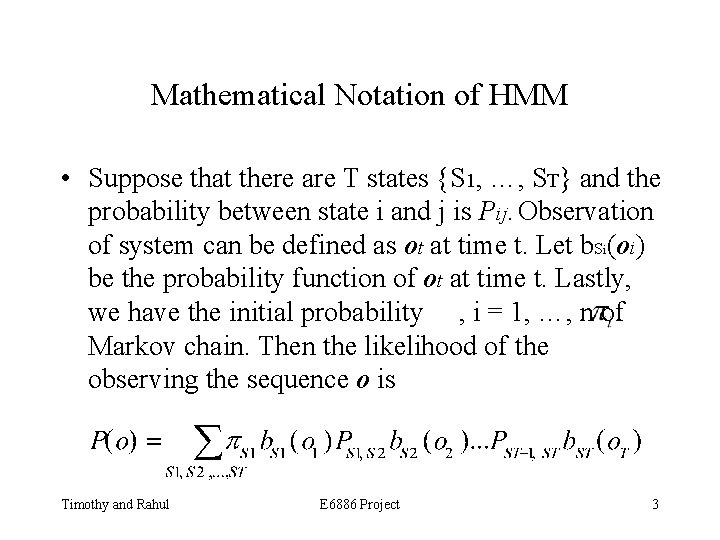
Mathematical Notation of HMM • Suppose that there are T states {S 1, …, ST} and the probability between state i and j is Pij. Observation of system can be defined as ot at time t. Let b. Si(oi) be the probability function of ot at time t. Lastly, we have the initial probability , i = 1, …, n of Markov chain. Then the likelihood of the observing the sequence o is Timothy and Rahul E 6886 Project 3
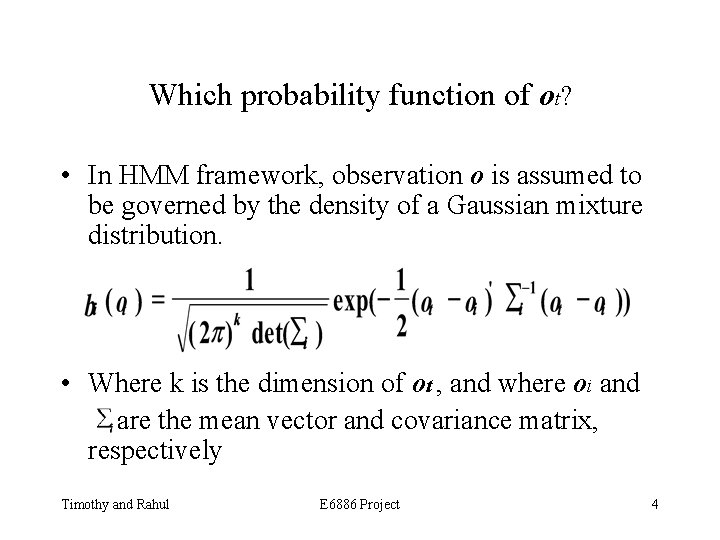
Which probability function of ot? • In HMM framework, observation o is assumed to be governed by the density of a Gaussian mixture distribution. • Where k is the dimension of ot , and where oi and are the mean vector and covariance matrix, respectively Timothy and Rahul E 6886 Project 4
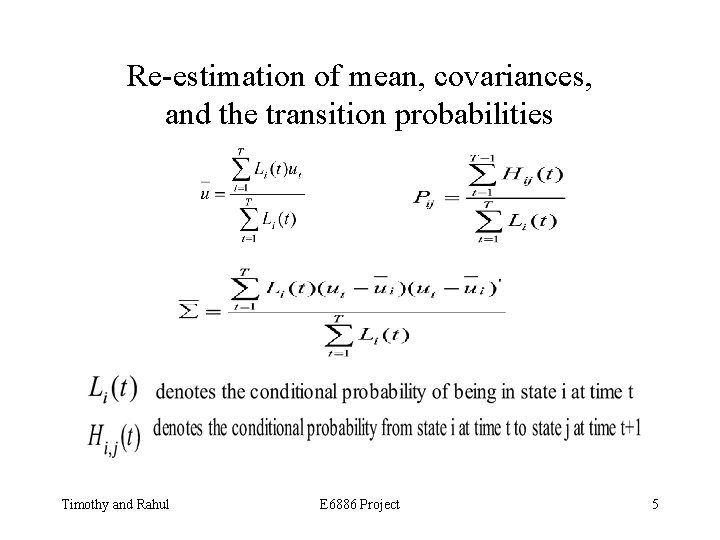
Re-estimation of mean, covariances, and the transition probabilities Timothy and Rahul E 6886 Project 5
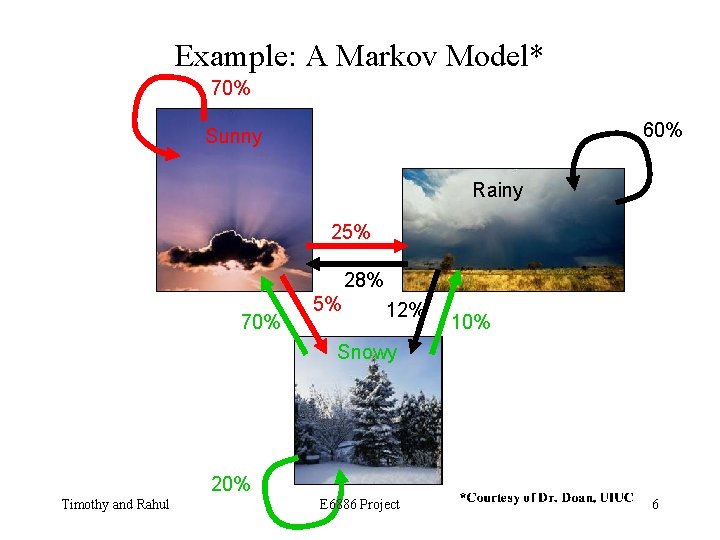
Example: A Markov Model* 70% 60% Sunny Rainy 25% 28% 70% 5% 12% 10% Snowy 20% Timothy and Rahul E 6886 Project 6
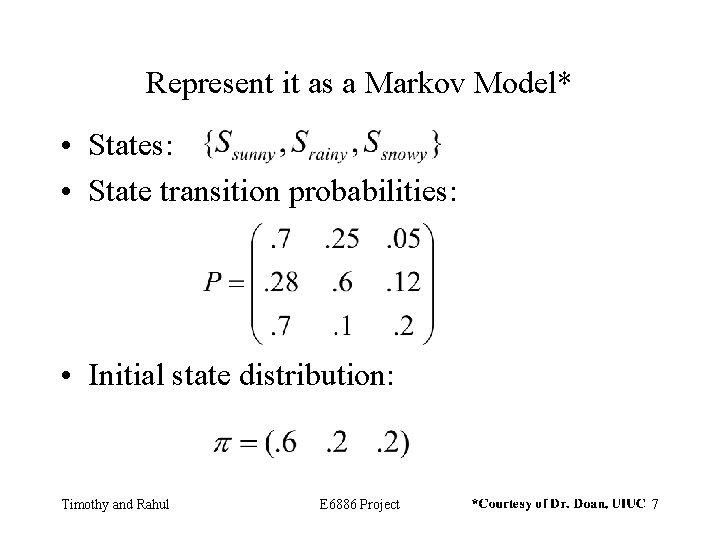
Represent it as a Markov Model* • States: • State transition probabilities: • Initial state distribution: Timothy and Rahul E 6886 Project 7
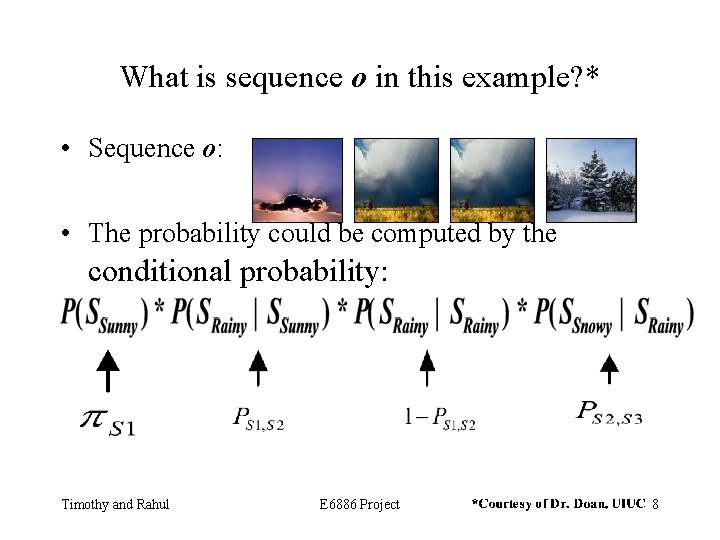
What is sequence o in this example? * • Sequence o: • The probability could be computed by the conditional probability: Timothy and Rahul E 6886 Project 8
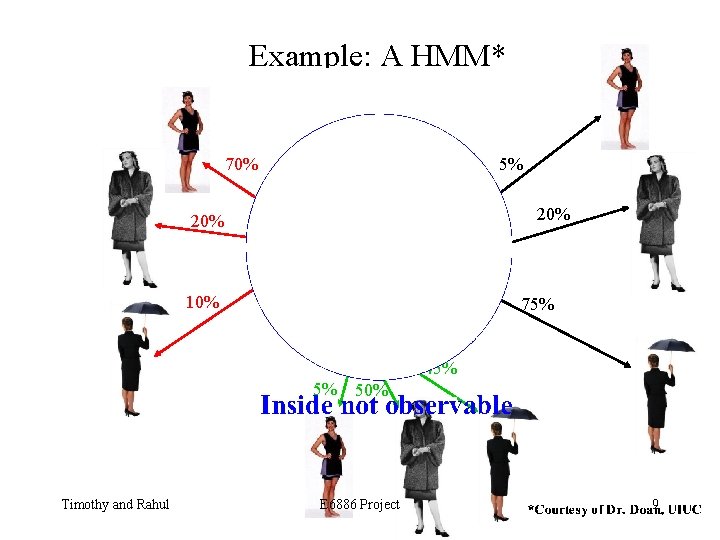
Example: A HMM* 5% 70% 80% 20% Sunny 60% Rainy 15% 38% 10% 75% 5% 20% 5% Timothy and Rahul 75% Snowy 45% 50% E 6886 Project 9
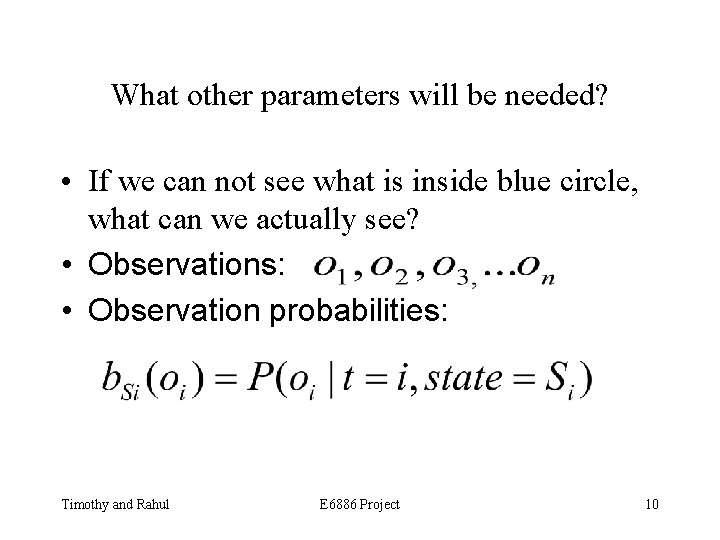
What other parameters will be needed? • If we can not see what is inside blue circle, what can we actually see? • Observations: • Observation probabilities: Timothy and Rahul E 6886 Project 10
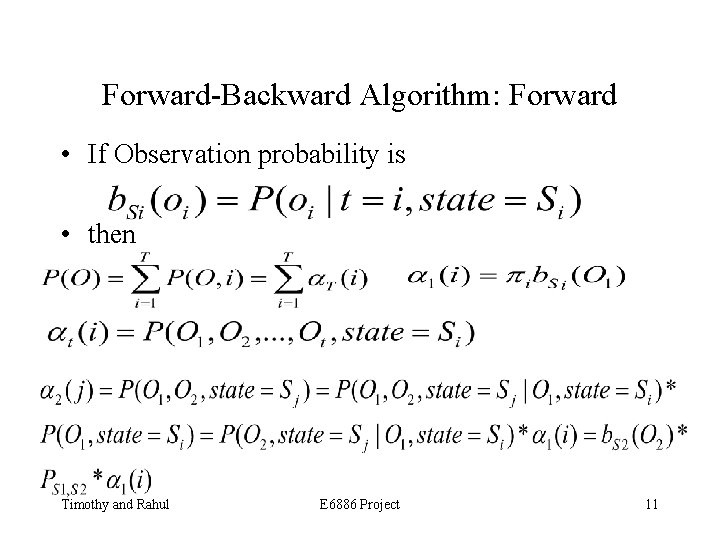
Forward-Backward Algorithm: Forward • If Observation probability is • then Timothy and Rahul E 6886 Project 11
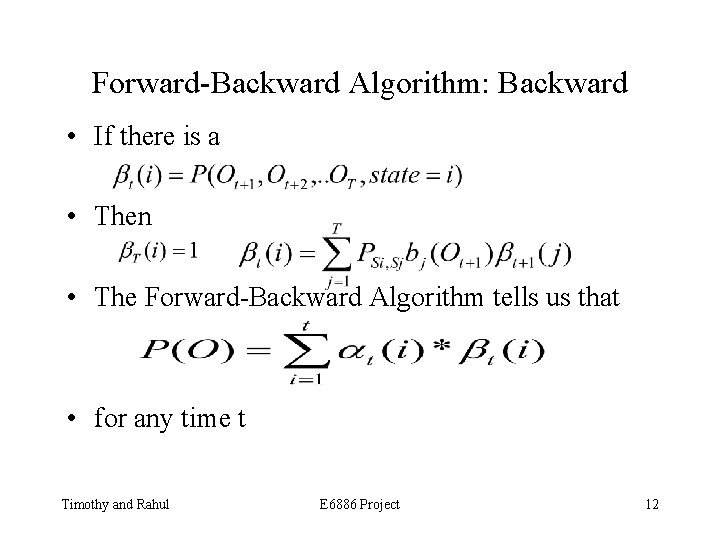
Forward-Backward Algorithm: Backward • If there is a • Then • The Forward-Backward Algorithm tells us that • for any time t Timothy and Rahul E 6886 Project 12
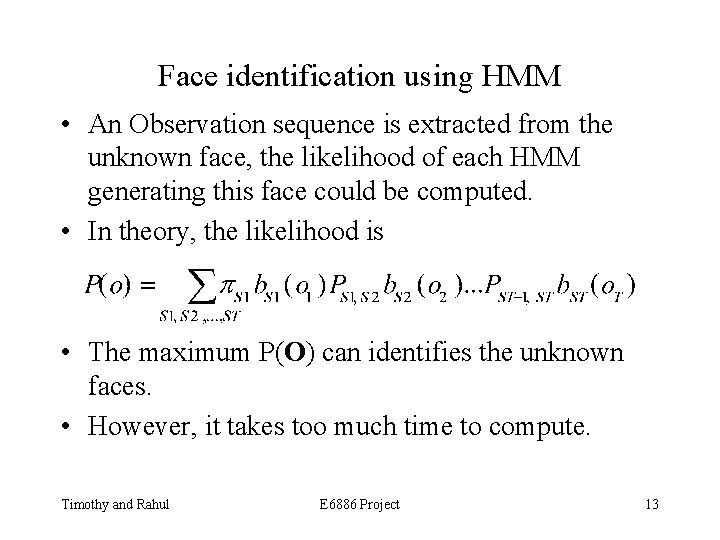
Face identification using HMM • An Observation sequence is extracted from the unknown face, the likelihood of each HMM generating this face could be computed. • In theory, the likelihood is • The maximum P(O) can identifies the unknown faces. • However, it takes too much time to compute. Timothy and Rahul E 6886 Project 13
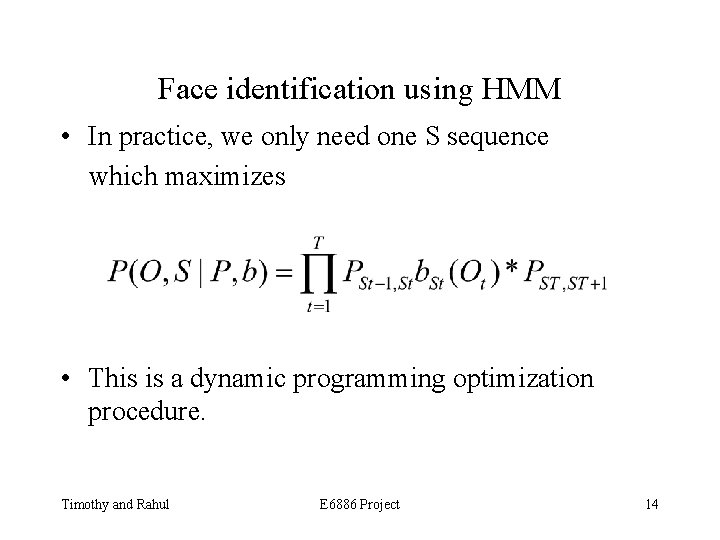
Face identification using HMM • In practice, we only need one S sequence which maximizes • This is a dynamic programming optimization procedure. Timothy and Rahul E 6886 Project 14
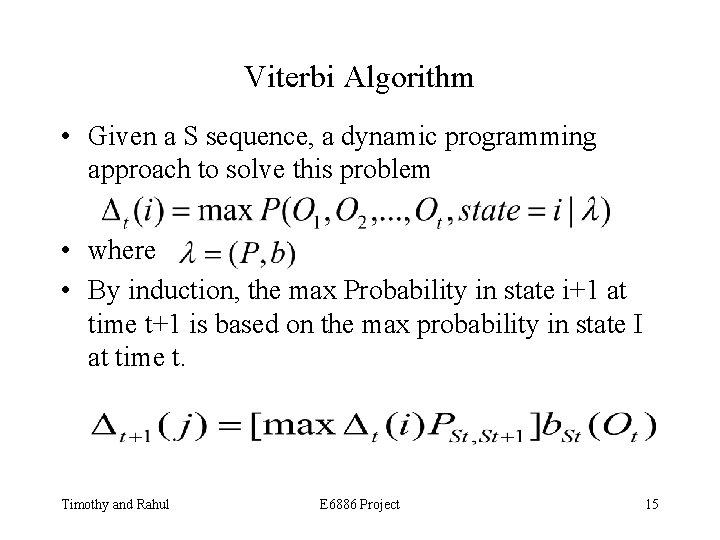
Viterbi Algorithm • Given a S sequence, a dynamic programming approach to solve this problem • where • By induction, the max Probability in state i+1 at time t+1 is based on the max probability in state I at time t. Timothy and Rahul E 6886 Project 15
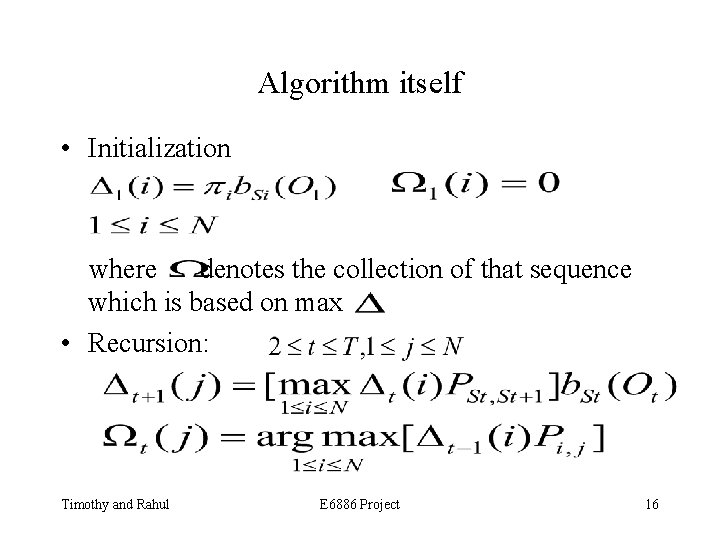
Algorithm itself • Initialization where denotes the collection of that sequence which is based on max • Recursion: Timothy and Rahul E 6886 Project 16
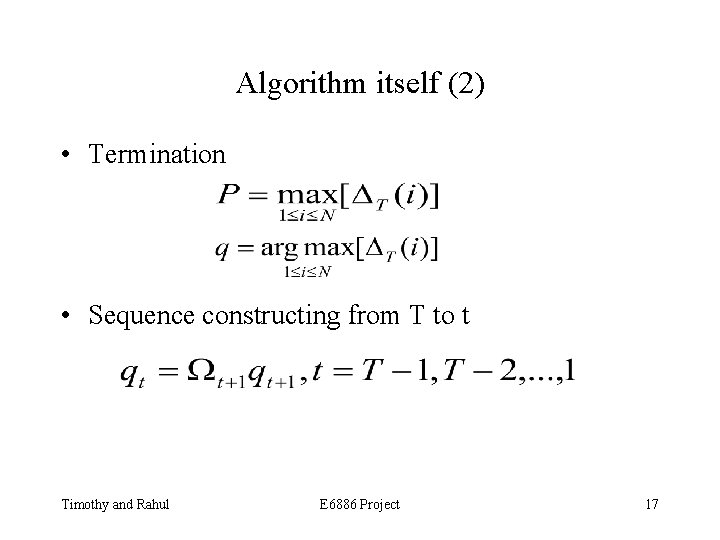
Algorithm itself (2) • Termination • Sequence constructing from T to t Timothy and Rahul E 6886 Project 17
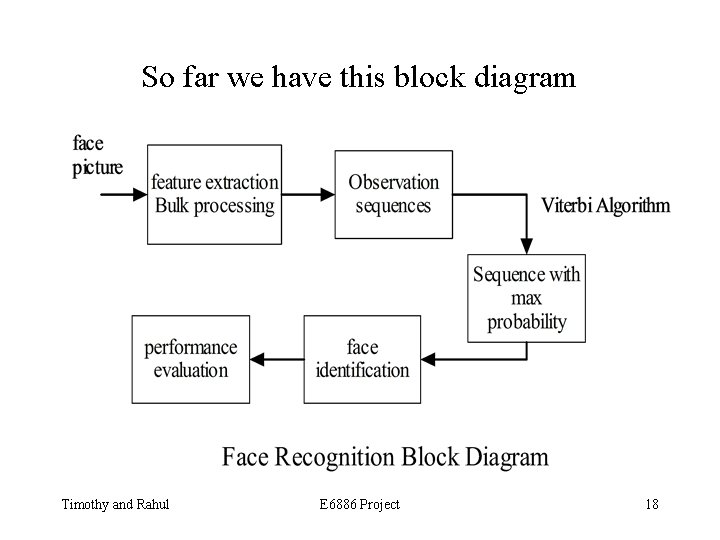
So far we have this block diagram Timothy and Rahul E 6886 Project 18
Face Detection • In simple face recognition framework, the picture is assumed to be a frontal view of a single person and the background is monochrome. • This project assumes that with the techniques of face detection, the performance of face recognition may be better than the approach presented above. Timothy and Rahul E 6886 Project 19

Acknowledgement • The authors of this presentation slides would like to give thanks to Dr. Doan, UIUC. Timothy and Rahul E 6886 Project 20
Reference • [1] Ferdinando Samaria, and Steve Young, HMM-based architecture for face identification. • [2] Jia, Li, Amir Najmi, and Robert M. Gray, Image Classification by a Two-Dimensional Hidden Markov Model • [3] Ming-Hsuan Yang, David J. Kriegman, Narendra Ahuja, Detecting Faces In Images: A survey • [4] T. K. Leung, M. C. Burl, and P. Perona, Finding Faces in Cluttered Scenes using Random Labeled Graph Matching • [5] James Wayman, Anil Jain, Davide Maltoni, and Dario Maio, Biometric Systems, Springer, 2005 Timothy and Rahul E 6886 Project 21
- Slides: 21